REVIEW 3 major objections 6 minor 9 references
A Condition Monitoring Concept Studied at the MST Prototype for the Cherenkov Telescope Array
T0 review · 3 major / 6 minor · reviewed 2026-08-14 · deepseek-v4-flash
Pith's one-line read A vibration-monitoring concept could let CTA telescopes predict their own failures.
desk verdict A modest, honest engineering progress report: the CMS concept for CTA MSTs is sensible, the first single-sensor OMA check is real, but the load-bearing damage-detection claim rests on an unverified ambient-excitation assumption and no baseline data. read the letter →
The pith
A machine-rendered reading of the paper's core claim, the machinery that carries it, and where it could break.
The reading
What carries the argument
The central object is Operational Modal Analysis (OMA), the output-only modal identification technique that assumes a parked structure is excited by broad-band, spatially distributed noise. The analysis pipeline computes cross-spectral density matrices between accelerometer channels, decimates to the 0-10 Hz band of interest, applies singular value decomposition, and picks peaks in the first singular value curve as candidate modal frequencies. The Modal Assurance Criterion (MAC) then checks linear independence of mode shapes to discard duplicates and, together with inverse transforms of the resonance bells, yields damping ratios. The drive monitoring side uses the same accelerometer data stream at kHz rates, identifying motor and gear excitation frequencies and the noise floor as damage indicators.
What would settle it
Park the MST in its defined zero-pose, record a 30-minute accelerometer dataset on a calm morning and again during strong wind, and compare the first singular-value peaks; if the identified modal frequencies or MAC-validated mode shapes change with wind speed, the OMA baseline is excitation-dependent. Conversely, loosen a known camera-frame bolt or add a small mass to the camera support and see whether the modal frequency shift exceeds the run-to-run scatter; if it does not, the system cannot resolve the small structural changes it is meant to warn about.
Extended reading notes
Core claim
A centrally acquired network of accelerometers can characterize a Medium-Sized Telescope's health on a daily basis. When the telescope is parked in a fixed pose, low-frequency force-balance sensors record ambient vibration and Operational Modal Analysis recovers the modal frequencies, mode shapes, and damping ratios; changes in any of these signal structural degradation. When the telescope is moving, high-rate piezoelectric accelerometers on the azimuth and elevation drives expose the excitation frequencies of motors and gearboxes, and rises in the noise tail reveal impact damage such as wear, free play, or broken teeth. The paper presents the first performance results from the prototype showing that modal peaks can be extracted from a single sensor and validated against commercial software, and describes the automated acquisition and analysis pipeline intended to run without manual data analysis.
Load-bearing premise
The OMA part of the system assumes that while the telescope stands still, the wind and ground noise hitting it is broad-band and spread over the whole structure, so the extracted modal frequencies and mode shapes are true properties of the telescope rather than artifacts of the excitation.
Editorial extensions
If this is right
- Daily automated status reports for every MST would let the local crew act on warnings instead of performing scheduled inspections.
- Trends in modal frequencies and damping ratios could reveal fatigue or loosening in the camera support structure before visible damage.
- Drive vibration monitoring would catch wear, free play, and broken teeth before a motor failure leaves a telescope unable to park.
- A warning system that runs without human analysis makes predictive maintenance practical for the 40 MSTs and potentially for the whole CTA array.
Reading between the lines
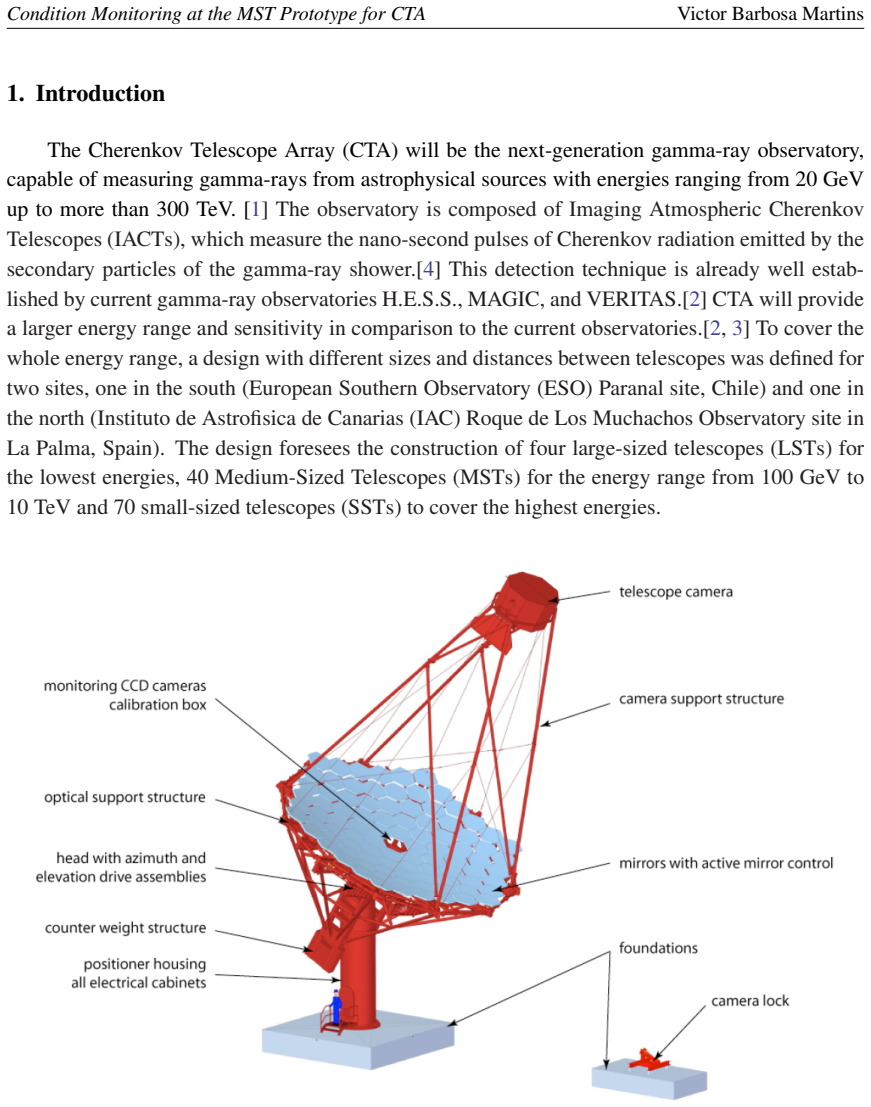
- The same OMA-plus-drive-vibration concept could transfer directly to the larger and smaller CTA telescope types, whose structures have different modal bands but the same maintenance bottleneck.
- If deployed across the array, the collected modal baselines could double as a site-characterization dataset, since changes may correlate with wind, temperature, and seismic conditions rather than damage; separating environmental from structural drift would require a regression model.
- The white-noise assumption is testable in situ: a windless night and a gusty night should yield the same modal frequencies if the excitation is sufficiently broad; if they do not, the monitoring baseline must be conditioned on weather.
Signed reviews
Editorial analysis
A structured set of objections, weighed in public.
Referee Report
Summary. This paper presents a concept for a Condition Monitoring System (CMS) for the Medium-Sized Telescopes (MSTs) of the Cherenkov Telescope Array, developed and studied at the Berlin MST prototype. The CMS is split into Structure Health Monitoring (SHM), based on Operational Modal Analysis (OMA) of accelerometer data acquired while the telescope is parked, and Drive Monitoring System (DMS), based on high-frequency vibration monitoring of the drive motors and gearboxes while the telescope moves. The paper describes the sensor types, the joint data acquisition system, the OMA analysis pipeline (detrending, cross-spectral density, decimation, SVD, peak picking, MAC validation, damping estimation), and the DMS methodology. It reports one preliminary SHM result using a single accelerometer, compares that result with the commercial software Artemis Modal, and notes that automatic data taking and offline analysis are running at the prototype. The authors conclude that the CMS will enable automatic warning and reduce maintenance manpower, while also acknowledging that the setup is still experimental and that damage tests are planned for late 2019.
Significance. If the proposed CMS works as intended, it would enable predictive maintenance for a fleet of more than 100 telescopes at remote, high-altitude sites, potentially reducing manual inspection and preventing critical failures such as camera damage from an unparked telescope. The paper is appropriately cautious in describing the work as a concept with preliminary results, and it builds on established OMA methodology (Brincker et al., frequency domain decomposition) rather than introducing unvalidated ad-hoc procedures. The comparison of the in-house Python analysis with the commercial Artemis Modal software is a positive step for code verification. However, the paper does not yet provide quantitative validation of the central feasibility claim: there are no error bars, no baseline measurements over time, no multi-sensor modal identification, no demonstration of damage detection or trend identification, and no evidence that the OMA assumptions hold at the actual CTA sites. The significance of the concept is real, but the evidence presented is at an early, proof-of-concept stage.
major comments (3)
- [Section 2 (SHM)] The OMA-based SHM rests on three stated assumptions: broad-spectrum (white-noise) input, force applied over the whole structure, and distributed sensors. The paper provides no measurement or physical argument that the ambient excitation at the CTA sites (Paranal, La Palma) satisfies these conditions. Wind loading on a 12-m dish and camera support is typically colored, low-frequency turbulence concentrated on the dish and camera rather than broadband and uniformly distributed. Under the Frequency Domain Decomposition used in Eq. (2.2), colored and spatially concentrated excitation can bias the estimated modal frequencies and, particularly, the damping ratios. Since the paper explicitly proposes monitoring damping-ratio trends as a damage indicator, weather-dependent changes in the excitation spectrum could mimic or mask structural degradation. The single-sensor test in Figure 2 cannot validate the assumption because one channel provides no spatial-distribution or mode-shape information. The authors should either measure the input excitation and its spatial coherence at the prototype or a representative site, or discuss the expected deviations and how the monitoring strategy would remain robust to them.
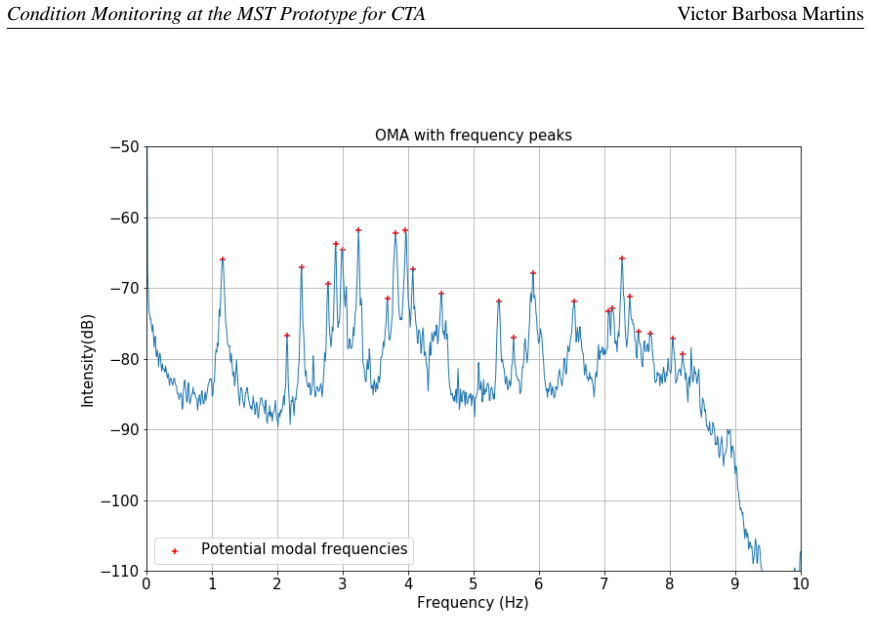
- [Figure 2 and Section 2 (SHM)] The only quantitative SHM result is a one-sensor OMA test. With a single channel, the CSD matrix is 1x1, the SVD yields a single singular value, and the MAC criterion cannot be used to compare mode shapes because there is only one spatial point. The plot in Figure 2 shows peaks in the singular value, but the paper does not identify which structural mode each peak corresponds to (for example, by comparison with FEM predictions), does not provide uncertainties or repeatability over multiple datasets, and does not demonstrate that the peak frequencies or damping ratios change under induced damage. This result is therefore insufficient to support the claim that the system can detect small changes in telescope behavior or identify trends. A multi-channel measurement, preferably validated against FEM or an Experimental Modal Analysis, is needed to establish a credible baseline before damage-detection claims can be assessed.
- [Section 5 (Conclusions)] The conclusions state that with the SHM and DMS 'a complete picture of the status of every MST can be obtained on a daily basis' and that the automatic analysis and warning system 'will spare the need of manpower for the data analysis.' These statements are stronger than the evidence presented: the DMS section contains no measured spectra or trend results, the SHM section shows only a single-sensor peak detection, and the paper itself acknowledges that the setup is still experimental and that damage tests are planned. The conclusions should be framed as a proposal or as the intended capability, not as an achieved outcome, or the paper should present sufficient data to support the stronger claims.
minor comments (6)
- [Section 2 (SHM), Eq. (2.1)] The term 'sampling ratio' should be 'sampling frequency' or 'sampling rate'; 'ratio' is misleading.
- [Figure 2] The axes of Figure 2 are not labeled. Please indicate the units of the x-axis (Hz, presumably) and the meaning and units of the y-axis (singular value).
- [Section 2 (SHM)] The sentence 'Every three channels correspond to the three cartesian coordinates of one sensor' is confusing because the described test uses a single 1-axis sensor. It should be clarified that a 3-axis sensor would occupy three channels; the single-channel test is a special case.
- [Section 2 (SHM)] The phrase 'the input force is assumed to be a white noise i.e. a broad spectrum excitation' should be punctuated as 'white noise, i.e., a broad-spectrum excitation'.
- [References] Reference [7] has a typo: 'Y . TamuraDamping' should be 'Y. Tamura, Damping estimation by Frequency Domain Decomposition'; please also ensure consistent formatting for conference proceedings.
- [Section 4 (Data acquisition)] The sentence 'The measuring range of such sensors are of hundreds of g' should read 'The measuring range of such sensors is of the order of hundreds of g' or similar, and '1g = 10m/s2' is an approximation that should be given as 9.81 m/s² if exact values are intended.
Circularity Check
No significant circularity: the OMA methodology is taken from external literature and benchmarked against a commercial tool, and no fitted parameter is renamed as a prediction.
full rationale
The paper is a concept and feasibility report rather than a derivation of predictions from fitted inputs. The SHM analysis follows Frequency Domain Decomposition as defined by Brincker, Zhang and Andersen [6], with damping estimation from Zhang and Tamura [7], and the in-house Python code was successfully compared with the commercial software Artemis Modal [8]. These are external methodological anchors, not self-citations carrying the argument. The claimed capability to detect structural changes via modal frequencies, mode shapes, and damping is presented as the standard industry approach applied to the MST, not as a result derived from parameters fitted to the same telescope data. The acknowledged OMA assumption that the input force is broad-spectrum white noise is an explicit stated prerequisite for applying the external method, and the paper addresses one violation by parking the telescope; this is an assumption and a limitation, not a circular step. No equation in the paper is equivalent to its own input, and no fitted quantity is subsequently reported as a prediction. Accordingly, the circularity score is 0.
Assumptions & free parameters
assumptions (4)
- domain assumption The excitation while the telescope is parked is broad-spectrum white noise distributed over the structure (OMA assumption).
- domain assumption Modal frequencies, mode shapes, and damping of the MST are stable and repeatable at the fixed azimuth and elevation zero configuration, so changes in time indicate damage.
- domain assumption Damage to the structure or drive components produces measurable changes in vibration spectra before failure.
- standard math The sampling criteria fs >= 2.5 fmax and ttotal = 1000/fmin from Eqs. 2.1 are sufficient for the 0 to 10 Hz range of interest.
Cite this review
Pith. "Pith review of A Condition Monitoring Concept Studied at the MST Prototype for the Cherenkov Telescope Array." pith.science (2026). https://pith.science/paper/MIZZ5PBI
@misc{pith2026190802180,
  author       = {Pith},
  title        = {Pith review of: A Condition Monitoring Concept Studied at the MST Prototype for the Cherenkov Telescope Array},
  year         = {2026},
  howpublished = {\url{https://pith.science/paper/MIZZ5PBI}},
  note         = {Machine review of arXiv:1908.02180}
}
read the original abstract
The Cherenkov Telescope Array (CTA) is a future ground-based gamma-ray observatory that will provide unprecedented sensitivity and angular resolution for the detection of gamma rays with energies above a few tens of GeV. In comparison to existing instruments (like H.E.S.S., MAGIC, and VERITAS) the sensitivity will be improved by installing two extended arrays of telescopes in the northern and southern hemisphere, respectively. A large number of planned telescopes (>100 in total) motivates the application of predictive maintenance techniques to the individual telescopes. A constant and automatic condition monitoring of the mechanical telescope structure and of the drive system (motors, gears) is considered for this purpose. The condition monitoring system aims at detecting degradations well before critical errors occur; it should help to ensure long-term operation and to reduce the maintenance efforts of the observatory. We present approaches for the condition monitoring of the structure and the drive system of Medium-Sized Telescopes (MSTs), respectively. The overall concept has been developed and tested at the MST prototype for CTA in Berlin. The sensors used, the joint data acquisition system, possible analysis methods (like Operational Modal Analysis, OMA, and Experimental Modal Analysis, EMA) and first performance results are discussed.
Figures

Figures from the paper (1 more)

Reference graph
Works this paper leans on
-
[1]
The CTA Consortium, represented by Rene A. Ong, Cherenkov Telescope Array: The Next Generation Gamma-ray Observatory, in proceedings of 35th International Cosmic Ray Conference â ˘A¸ S ICRC2017, PoS(ICRC2017)1071
-
[2]
J. Holder TeV gamma-ray astronomy: A summary, Astroparticle Physics 39-40(2012 61-75) [DOI 10.1016/j.astropartphys.2012.02.014]
-
[3]
The CTA Consortium Design concepts for the Cherenkov Telescope Array CTA: an advanced facility for ground-based high-energy gamma-ray astronomy, Exp Astron 32(2011 32:193-316) [DOI 10.1007/s10686-011-9247-0]
-
[4]
A.M. Hillas Evolution of ground-based gamma-ray astronomy from the early days to the Cherenkov Telescope Arrays, Astroparticle Physics 43(2013 19-43) [DOI 10.1016/j.astropartphys.2012.06.002]
-
[5]
M. Garczarczyk et al. the CTA Consortium Status of the Medium-Sized Telescope for the Cherenkov Telescope Array, in proceedings of 34th International Cosmic Ray Conference â ˘A¸ S ICRC2015, PoS(ICRC2015)959
-
[6]
R. Brincker, L. Zhang and P. Andersen Modal identification of output-only systems usingfrequency domain decomposition, Smart Mater. Struct. 10(2001 441-445) [DOI 10.1088/0964-1726/10/3/303]
- [7]
-
[8]
http://www.svibs.com/
Show all 9 references
-
[9]
https://www.gantner-instruments.com 7
Reviewed August 14, 2026 · model on record in the stance chip above.
Discussion (0). Continue with ORCID to comment.