REVIEW 2 major objections 4 minor 23 references
Comments on "Scattering Cancellation-Based Cloaking for the Maxwell--Cattaneo Heat Waves"
T0 review · 2 major / 4 minor · reviewed 2026-08-14 · deepseek-v4-flash
Pith's one-line read A claimed heat-wave cloak may instead model diffusion, not Maxwell-Cattaneo waves.
desk verdict A sharp Comment whose core claim—Farhat et al.'s 'Maxwell–Cattaneo' model is actually Guyer–Krumhansl and diffusive—holds up; two small typos in Christov's own equations should be cleaned up before the piece becomes a citation. read the letter →
The pith
A machine-rendered reading of the paper's core claim, the machinery that carries it, and where it could break.
The reading
What carries the argument
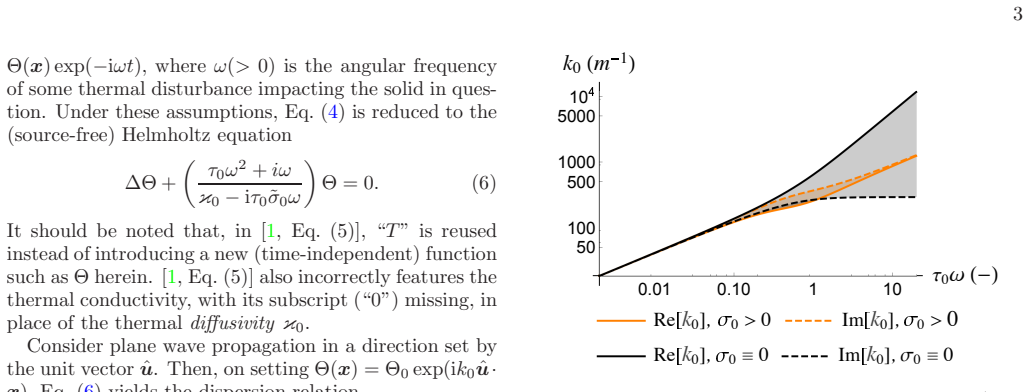
The load-bearing object is the corrected flux-law operator $K:=1+\tau_0\partial_t-\tau_0\sigma_0(\Delta+2\nabla\nabla\cdot)$, which the comment identifies as the Guyer-Krumhansl law. Eliminating the flux between the energy balance and this operator produces a Jeffreys-type transport equation for temperature, whose $\tilde\sigma_0=0$ reduction is the damped wave equation of Maxwell-Cattaneo theory. The argument is carried by exact solutions of the 1D semi-infinite initial-boundary value problem and by the dispersion relation $k_0^2(\omega)=a+ib$ for harmonic disturbances, which separate finite-speed wave propagation from diffusive instantaneous penetration.
What would settle it
Compute the signal-front speed of the corrected transport equation for $\tilde\sigma_0>0$ from the exact Tanner solution: if the solution gives nonzero temperature at every point for arbitrarily small $t$, the model is diffusive, whereas a sharp finite-speed front would contradict the critique. Equivalently, evaluate $\operatorname{Re}(k_0)$ and $\operatorname{Im}(k_0)$ from Eq. (8): the critique predicts $\operatorname{Re}(k_0)<\operatorname{Im}(k_0)$ for realistic parameters under the Guyer-Krumhansl-type model, while the Maxwell-Cattaneo reduction gives $\operatorname{Re}(k_0)>\operatorname{Im}(k_0)$.
Extended reading notes
Core claim
The paper claims that the energy balance equation in the commented article omits the $\rho c_p$ factor and a source term, and that the additional flux term intended to stabilize discretization is a truncated Guyer-Krumhansl operator. Restoring the missing $\rho c_p$ and the missing $2\nabla\nabla\cdot$ term turns the flux law into the Guyer-Krumhansl law, and eliminating the flux yields $\partial T/\partial t+\tau_0\partial^2 T/\partial t^2=\tau_0\tilde\sigma_0\,\partial(\Delta T)/\partial t+\kappa_0\Delta T$ plus a source term. For $\tilde\sigma_0>0$ this is a multidimensional Jeffreys-type diffusive equation with infinite signal speed; only the $\tilde\sigma_0\to0$ limit is the damped hyperbolic wave equation of Maxwell-Cattaneo heat transfer. Therefore the original article's cloaking calculation applies to a diffusive model, not to Maxwell-Cattaneo heat waves, and its series-expansion boundary conditions, which incorrectly identify the flux with $-\kappa_0\nabla T$, undermine the computed cloaking coefficients.
Load-bearing premise
The conclusion depends on identifying the extra flux term in the commented article with the full Guyer-Krumhansl operator, including the missed $2\nabla\nabla\cdot$ term, so that the corrected transport equation becomes diffusive; if the intended regularization were a different operator that preserves hyperbolicity, the claim that the model is not Maxwell-Cattaneo would not follow.
Editorial extensions
If this is right
- The original cloaking design must be reworked with the Maxwell-Cattaneo flux law $\sigma_0\equiv0$, the correct boundary conditions, and correct material parameters before claiming cloaking of heat waves.
- Under the Maxwell-Cattaneo law the heat flux at a boundary is obtained by solving the flux law for $\Phi$, not by taking $\mathbf{\Phi}=-\kappa_0\nabla T$, so the matching of series-expansion coefficients in the commented article is called into question.
- For the true Maxwell-Cattaneo law the wavenumber satisfies $\operatorname{Re}(k_0)>\operatorname{Im}(k_0)$, while $\operatorname{Im}(k_0)$ tends to a constant as $\tau_0\omega\to\infty$; hence scattering and absorption are not balanced.
- The corrected model predicts that a temperature signal is felt instantly at every point of a half-space, so no thermal wave front exists; the distinction between Maxwell-Cattaneo wave theory and the Guyer-Krumhansl-type diffusive model is qualitative, not a small correction.
Reading between the lines
- A direct testable consequence: repeating the original cloaking simulation with the unmodified Maxwell-Cattaneo law and corrected boundary conditions should produce different scattering data; if no scattering cancellation appears, the original result was an artifact of the diffusive model.
- The classification argument suggests a practical experimental discriminator: a heat-pulse experiment in the proposed cloak geometry would show either a sharp finite-speed front (Maxwell-Cattaneo) or an immediate temperature rise everywhere (Guyer-Krumhansl-type diffusion).
- If the critique is correct, earlier numerical schemes that introduced the flux-diffusion term for stability were effectively changing the physical model from hyperbolic to parabolic heat transport, which has broader implications for thermal cloaking and thermal-metamaterial simulations.
Signed reviews
Editorial analysis
A structured set of objections, weighed in public.
Referee Report
Summary. This Comment critiques Farhat et al. (Phys. Rev. Appl. 11, 044089) on scattering-cancellation cloaking for Maxwell–Cattaneo heat waves. The author argues that the target paper made several mathematical and conceptual errors: the energy balance omits a source term and the factor rho c_p; the added 'flux diffusion' term actually converts the Maxwell–Cattaneo law into a Guyer–Krumhansl-type law; the units of sigma_0 are misreported; and the boundary conditions are imposed using the Fourier flux instead of the correct flux expression. The Comment derives corrected governing equations (Eqs. (2)-(4)), shows that the resulting transport equation is a Jeffreys-type diffusive equation rather than a hyperbolic wave equation, illustrates the difference with an exact solution of Tanner's IBVP (Fig. 1), and derives the corrected dispersion relation (Eqs. (6)-(8)). It concludes that the target paper does not provide the claimed first demonstration of cloaking for Maxwell–Cattaneo heat waves.
Significance. If the critique stands, it is significant: it directly challenges the physical interpretation of a published cloaking result and clarifies a substantive modeling distinction between hyperbolic Maxwell–Cattaneo heat conduction and Guyer–Krumhansl-type diffusion. The Comment's strengths include a clean derivation from established phonon-transport literature (Joseph–Preziosi, Guyer–Krumhansl, Tanner) and a numerical demonstration using experimentally motivated limestone parameters. The classification argument is robust: even if the disputed 2 grad-grad operator in the Guyer–Krumhansl law were omitted, the remaining flux-diffusion term would still produce a Jeffreys-type diffusive equation rather than a wave equation. However, as printed, two central equations contain sign/index errors that need correction before the harmonic-analysis portion of the critique can be accepted.
major comments (2)
- [Harmonic disturbances, Eq. (7)] The real part of k_0^2 is written as tau_0 omega^2 (kappa_0 - sigma_0) / (kappa_0^2 + tau_0^2 tilde_sigma_0^2 omega^2), but the derivation from Eq. (6) yields kappa_0 - tilde_sigma_0 in the numerator, with tilde_sigma_0 = 3 sigma_0. This is not a purely notational slip: for the parameter values used in Fig. 1, kappa_0 - sigma_0 is positive whereas kappa_0 - tilde_sigma_0 is negative, so Eq. (8) would give Re(k_0) > Im(k_0) at large omega instead of the claimed Re(k_0) < Im(k_0). The sentence comparing the real and imaginary parts below Eq. (8) is therefore unsupported as printed. Please correct Eq. (7) and verify that Fig. 2 and the surrounding discussion are consistent with the corrected expression.
- [Other issues, item (iii), Eq. (9)] The flux boundary condition under the Maxwell–Cattaneo law is misstated. Solving (1 + tau_0 partial/partial t) Phi = -kappa_0 grad T for harmonic time dependence Phi = F exp(-i omega t) gives F = -(1 + i omega tau_0)/(1 + omega^2 tau_0^2) kappa_0 grad Theta, not the expression with (1 - i omega tau_0) in the numerator. The sign of the imaginary part matters for the boundary condition used in the series-expansion matching that the Comment criticizes, so this equation should be corrected and the surrounding text adjusted accordingly.
minor comments (4)
- [Eq. (2b) and text below] The symbol V in the expression sigma_0 = (1/5) tau_N V^2 is not defined in the manuscript; please define it explicitly (e.g., as a characteristic phonon speed) for readers not familiar with Guyer–Krumhansl theory.
- [Other issues, item (i)] The statement that there is 'no difficulty whatsoever' in discretizing hyperbolic heat transport would be more persuasive with a concrete reference to a modern finite-volume or discontinuous-Galerkin scheme for hyperbolic heat conduction, rather than only to older work.
- [Fig. 2 caption] The caption distinguishes 'dark colors' and 'light colors' for the two laws, but the text then refers to 'dark contours' in a way that may confuse readers, especially if the printed figure is not in color; consider using line styles or other unambiguous labels.
- [Other issues, item (iv)] The argument that Fourier's heat equation is frame-invariant is terse; a one-sentence statement of the transformation used (e.g., invariance under Galilean changes of frame with material derivative D T/D t) would make the point more accessible.
Circularity Check
No significant circularity: the corrected model derivation is self-contained and externally anchored.
full rationale
This Comment does not fit any circularity pattern. Its derivation chain begins from the Maxwell–Cattaneo law (Eq. 1), incorporates the target paper's flux-diffusion term corrected into the Guyer–Krumhansl-type operator (Eq. 2b), and then eliminates the flux to obtain the transport equation (Eq. 4). The classification of Eq. (4) as a Jeffreys-type diffusive equation follows from the mathematical structure of that equation, specifically the presence of the τ₀σ̃₀∂(ΔT)/∂t term; it is not obtained by fitting any quantity and then renaming it a prediction. The identification of the target term with the Guyer–Krumhansl model is supported by an external source (Ref. [6], Guyer and Krumhansl's derivation from the linearized phonon Boltzmann equation), and the central criticism is robust even if the disputed ∇∇· part were absent, because the remaining Δ term alone still generates the Jeffreys-type ∂ΔT/∂t contribution. The numerical demonstration uses externally reported limestone parameters (Ref. [11]) and Tanner's exact solution (Ref. [10]). The author's self-citations, Refs. [9], [13], and [8], are used only for standard solution representations and references to wave-solution literature; they do not supply the load-bearing claim that the target model is diffusive rather than hyperbolic. There is no fitted input disguised as a prediction, no uniqueness theorem imported from the author's own prior work, no ansatz smuggled in via self-citation, and no renaming of a known empirical pattern presented as derivation. Accordingly, the appropriate finding is no significant circularity, with a score of 0.
Assumptions & free parameters
assumptions (3)
- domain assumption The target paper's extra flux term, once corrected, is the Guyer-Krumhansl operator (Delta + 2 grad grad dot).
- standard math Tanner's exact solution of the Jeffreys-type IBVP is valid and its numerical evaluation with Mathematica is reliable.
- domain assumption The material parameters for limestone from Ref. [11] are appropriate for the illustrative comparison.
Cite this review
Pith. "Pith review of Comments on "Scattering Cancellation-Based Cloaking for the Maxwell--Cattaneo Heat Waves"." pith.science (2026). https://pith.science/paper/5W26XG42
@misc{pith2026190802188,
  author       = {Pith},
  title        = {Pith review of: Comments on "Scattering Cancellation-Based Cloaking for the Maxwell--Cattaneo Heat Waves"},
  year         = {2026},
  howpublished = {\url{https://pith.science/paper/5W26XG42}},
  note         = {Machine review of arXiv:1908.02188}
}
read the original abstract
A number of errors, both mathematical and conceptual, are identified, in a recent article by Farhat \textit{et al.}\ [Phys.\ Rev.\ Appl.\ \textbf{11}, 044089 (2019)] on cloaking of thermal waves in solids, and corrected. The differences between the two thermal flux laws considered in the latter article are also critically discussed, specifically showing that the chosen model does not, in fact, correspond to the Maxwell--Cattaneo hyperbolic (wave) theory of heat transfer.
Figures

Reference graph
Works this paper leans on
- [1]
-
[2]
are dimensionally inconsistent and, therefore, devoid of physical meaning. For example, consider [ 1, Eq. (4)]. 2 The first and second terms on the left-hand side (LHS) have units K s − 1, while the third and fourth terms on the LHS have units W m − 3. The thermal transport equation. As in [ 1], regard all coefficients as constant and proceed to eliminate Φ ...
-
[3]
Straughan, Heat Waves , Applied Mathematical Sci- ences, Vol
B. Straughan, Heat Waves , Applied Mathematical Sci- ences, Vol. 117 (Springer, New York, 2011)
work page 2011
-
[4]
is reduced to the (source-free) Helmholtz equation ∆Θ + ( τ0ω2 + iω κ 0 − iτ0 ˜σ0ω ) Θ = 0 . (6) It should be noted that, in [ 1, Eq. (5)], “ T ” is reused instead of introducing a new (time-independent) function such as Θ herein. [ 1, Eq. (5)] also incorrectly features the thermal conductivity, with its subscript (“0”) missing, in place of the thermal di...
-
[5]
On hyperbolic heat-mass transfer equa- tion,
S. L. Sobolev, “On hyperbolic heat-mass transfer equa- tion,” Int. J. Heat Mass Transfer 122, 629–630 (2018) ; O. G. Bakunin, “Mysteries of diffusion and labyrinths of destiny,” Phys.-Usp. 46, 309–313 (2003)
work page 2018
-
[6]
make the discretizing process asymptotically stable
yields the dispersion relation k2 0(ω) = τ0ω2(κ 0 − σ0) κ 2 0 + τ 2 0 ˜σ2 0ω2 /bracehtipupleft /bracehtipdownright/bracehtipdownleft /bracehtipupright =:a +i ω(κ 0 + τ 2 0 ˜σ0ω2) κ 2 0 + τ 2 0 ˜σ2 0ω2 /bracehtipupleft /bracehtipdownright/bracehtipdownleft /bracehtipupright =:b , (7) where, i = √−1, Θ 0 > 0 and k0 ∈ C. Enforcing Θ < ∞ as |x| → ∞ (and, also...
-
[7]
the Fourier heat equation is not frame invariant
for Φ . In the case of harmonic time-dependence, for which Φ (x, t) = F (x) exp(−iωt), specifying the flux at the boundary of some spatial domain D ⊂ R3, un- der the MC law, would correspond to specifying F = − ( 1 − iωτ0 1 + ω2τ 2 0 ) κ0∇Θ on x ∈ ∂D. (9) The corresponding expression under the GK flux law ( 2b) is lengthier. This error in imposing the BCs o...
-
[8]
the temperature field T , as well as its flux κ∇T
for the same parameter values used to generate Fig. 1. (iii) The unknown coefficients in the expansions in [ 1, Eqs. (8) and (9)] are found by applying a bound- ary condition involving “the temperature field T , as well as its flux κ∇T .” Under the MC law, the heat flux is not (with misprints corrected) −κ0∇T , as it would be under Fourier’s law; rather, it is...
Show all 23 references
-
[9]
Scattering cancellation-based cloaking for the Maxwell-Cattaneo heat waves,
M. Farhat, S. Guenneau, P.-Y. Chen, A. Al` u, and K. N. Salama, “Scattering cancellation-based cloaking for the Maxwell-Cattaneo heat waves,” Phys. Rev. Applied 11, 044089 (2019)
2019
-
[10]
Heat waves,
D. D. Joseph and L. Preziosi, “Heat waves,” Rev. Mod. Phys 61, 41–73 (1989) ; “Addendum to the paper “Heat Waves” [Rev. Mod. Phys. 61, 41 (1989)],” Rev. Mod. Phys 62, 375–391 (1990)
1989
-
[11]
On the dynamical theory of gases,
J. C. Maxwell, “On the dynamical theory of gases,” Phil. Trans. R. Soc. Lond. 157, 49–88 (1867) ; C. Cattaneo, “Sulla conduzione del calore,” Atti Sem. Mat. Fis. Univ. Modena 3, 83–101 (1948)
1948
-
[12]
Solution of the lin- earized phonon Boltzmann equation,
R. A. Guyer and J. A. Krumhansl, “Solution of the lin- earized phonon Boltzmann equation,” Phys. Rev. 148, 766–778 (1966)
1966
-
[13]
H. S. Carslaw and J. C. Jaeger, Conduction of Heat in Solids, 2nd ed. (Oxford University Press, Oxford, 1959)
1959
-
[14]
Hyperbolic Heat- Conduction Equation—A Solution for the Semi-Infinite Body Problem,
K. J. Baumeister and T. D. Hamill, “Hyperbolic Heat- Conduction Equation—A Solution for the Semi-Infinite Body Problem,” ASME J. Heat Transfer 91, 543–548 (1969); “Discussion: “Hyperbolic Heat-Conduction Equation—A Solution for the Semi-Infinite Body Prob- lem (Baumeister, K. J....
1969
-
[15]
Wave solutions,
I. C. Christov, “Wave solutions,” in Encyclopedia of Thermal Stresses , edited by R. B. Hetnarski (Springer, Netherlands, 2014) pp. 6495–6506
2014
-
[16]
Note on the Rayleigh problem for a visco-elastic fluid,
R. I. Tanner, “Note on the Rayleigh problem for a visco-elastic fluid,” Z. angew. Math. Phys. (ZAMP) 13, 573–580 (1962)
1962
-
[17]
Guyer-Krumhansl–type heat conduction at room temperature,
P. V´ an, A. Berezovski, T. F¨ ul¨ op, Gy. Gr´ of, R. Kov´ acs, ´A. Lovas, and J. Verh´ as, “Guyer-Krumhansl–type heat conduction at room temperature,” EPL (Europhys. Lett.) 118, 50005 (2017)
2017
-
[18]
Berezovski and P
A. Berezovski and P. V´ an, Internal Variables in Ther- moelasticity, Solid Mechanics and Its Applications, Vol. 243 (Springer International Publishing, Cham, Switzer- land, 2017)
2017
-
[19]
Stokes’ first problem for some non- Newtonian fluids: Results and mistakes,
I. C. Christov, “Stokes’ first problem for some non- Newtonian fluids: Results and mistakes,” Mech. Res. Commun. 37, 717–723 (2010)
2010
-
[20]
Hyperbolic heat transfer with reflection,
G. F. Carey and M. Tsai, “Hyperbolic heat transfer with reflection,” Numer. Heat Transfer 5, 309–327 (1982) ; D. E. Glass, M. N. ¨Ozi¸ sik, D. S. McRae, and B. Vick, “On the numerical solution of hyperbolic heat conduc- tion,” Numer. Heat Transfer 8, 497–504 (1985)
1982
-
[21]
R. J. LeVeque, Finite Volume Methods for Hyperbolic Problems (Cambridge University Press, New York, 2002)
2002
-
[22]
C. S. Jog, Continuum Mechanics: Foundations and Ap- plications of Mechanics , 3rd ed., Vol. 1 (Cambridge Uni- versity Press, Delhi, India, 2015)
2015
-
[23]
Comment on the paper “On Cattaneo–Christov heat flux model for Carreau fluid flow over a slendering sheet, Hashim, Masood Khan, Results in Physics 7 (2017) 310–319
A. Pantokratoras, “Comment on the paper “On Cattaneo–Christov heat flux model for Carreau fluid flow over a slendering sheet, Hashim, Masood Khan, Results in Physics 7 (2017) 310–319”,” Res. Phys. 7, 1504–1505 (2017); “Comment on the paper “Three-dimensional flow of Prandtl fluid w...
2017
Reviewed August 14, 2026 · model on record in the stance chip above.
Discussion (0). Continue with ORCID to comment.