REVIEW 3 major objections 5 minor 57 references
Neural Blind Deconvolution Using Deep Priors
T0 review · 3 major / 5 minor · reviewed 2026-08-14 · deepseek-v4-flash
Pith's one-line read This paper claims that blind deconvolution can be reduced to fitting two randomly initialized neural networks to a single blurry image, with the network architectures themselves acting as priors that outperform handcrafted MAP-based…
desk verdict Useful empirical paper on DIP-based blind deconvolution, but the objective provably favors the delta kernel; the reported gains rest on early stopping, not a demonstrated deep prior. read the letter →
The pith
A machine-rendered reading of the paper's core claim, the machinery that carries it, and where it could break.
The reading
What carries the argument
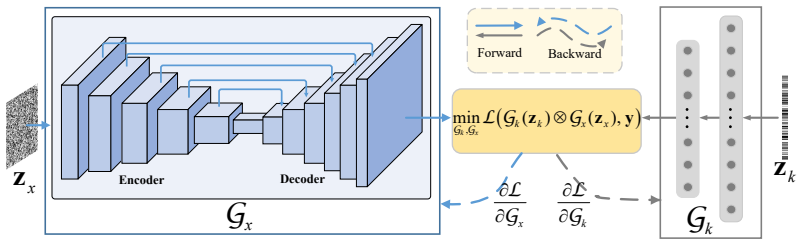
The central object is the pair of generative networks Gx and Gk inserted into the forward model y = k ⊗ x + n. Instead of regularizing x and k directly, the objective regularizes the network parameters through the architectures: Gx is a deep image prior, an untrained skip-connected encoder–decoder that preferentially produces natural-image-like structures, while Gk is a deliberately simple fully-connected network whose output layer uses Softmax, making the non-negativity and sum-to-one kernel constraints automatic. The fixed random input vectors zx and zk turn blind deconvolution into an unconstrained optimization over network parameters only, solved by joint ADAM updates with an added TV term whose weight is set by the estimated noise level.
What would settle it
Take a synthetic blurry image with a known kernel, run the method from many different random seeds, and compare the estimated kernels to the ground truth; the architectural-prior claim predicts consistently accurate kernels, while the weakest-assumption failure would show delta-kernel or high-variance collapses on some seeds. A simpler check is whether the reported error ratio on the small benchmark degrades sharply when the image generator alone is replaced by a plain autoencoder without skip connections.
Extended reading notes
Core claim
The paper's central claim is that both unknowns in blind deconvolution—the latent clean image and the blur kernel—can be represented as outputs of generative networks with fixed random inputs, and that fitting those networks to the blurry observation, plus a small total-variation term, estimates both unknowns without paired training data. The image network is an asymmetric autoencoder with skip connections and a sigmoid output; the kernel network is a fully-connected network whose final Softmax layer guarantees the kernel is non-negative and sums to one. The paper argues that this unconstrained neural optimization avoids the trivial delta-kernel solution that can trap conventional MAP methods, and that jointly updating both networks with ADAM performs better than alternating their updates. The reported results include average PSNR 33.07 and error ratio 1.1968 on the smaller benchmark, and average PSNR 20.97 on the larger benchmark, which the paper presents as improvements over the compared state of the art.
Load-bearing premise
The load-bearing premise is that a randomly initialized, untrained network architecture supplies a prior strong enough that minimizing the reconstruction loss on one blurry image drives the solution to the true kernel and sharp image rather than to a trivial delta kernel or to noise fitting.
Editorial extensions
If this is right
- A single blurry image suffices: no paired training data or learned deblurring network is needed, so the method can in principle be applied to cameras or image types for which no training set exists.
- Because the kernel network's Softmax output enforces non-negativity and sum-to-one at every iteration, the projection and delayed-normalization steps that MAP methods rely on are unnecessary.
- The latent image produced by Gx already has visually favorable texture, making the second non-blind deconvolution stage optional rather than compulsory.
- The TV weight is tied to the estimated noise level through $\lambda = 0.1\sigma$, so the method explicitly adapts its prior strength when the blurry image is also noisy.
Reading between the lines
- Beyond the paper: this two-network factorization is a template for other blind inverse problems with a convolutional forward model, such as joint demosaicking with unknown blur or super-resolution with an unknown downsampling kernel; the same architecture-as-prior logic should be testable there without changing the method's structure.
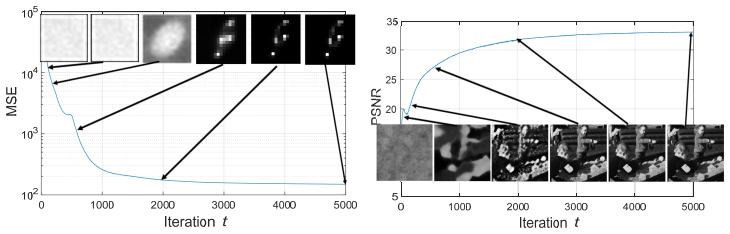
- Beyond the paper: since the paper fixes one random seed and one iteration budget, the relative roles of architecture prior versus early stopping are unresolved; a seed-averaging or early-stopping experiment would separate these and could make the method's behavior more predictable.
- Beyond the paper: the comparison against learned deep deblurring is limited to one retrained network on one benchmark; a broader comparison on larger, non-uniform, or saturated kernels would clarify whether the zero-shot prior generalizes beyond the tested distributions.
Signed reviews
Editorial analysis
A structured set of objections, weighed in public.
Referee Report
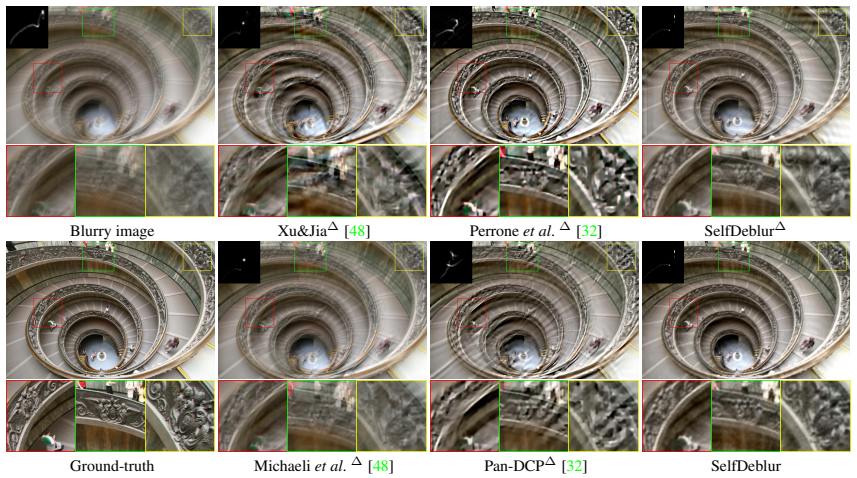
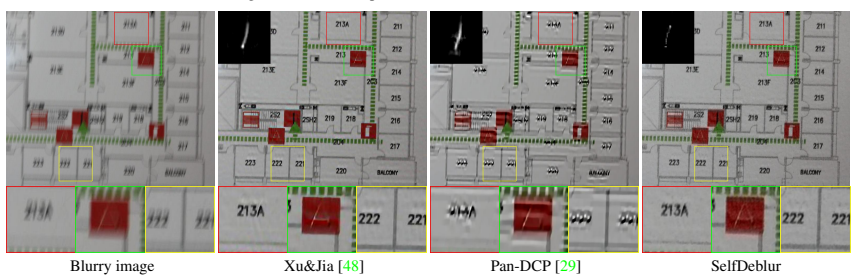
Summary. The paper proposes SelfDeblur, a zero-shot blind deconvolution method that replaces handcrafted MAP priors with two untrained generative networks: a DIP-style asymmetric autoencoder Gx for the latent clean image and a fully-connected network Gk with a Softmax output layer for the blur kernel. The method optimizes the unconstrained objective in Eq. (6) by ADAM, with joint optimization as the default, and reports state-of-the-art average PSNR/SSIM/error-ratio results on the Levin and Lai benchmarks as well as favorable qualitative results on real blurry images. The authors argue that the generative-network priors and joint optimization avoid the trivial delta-kernel solution, making non-blind deconvolution optional.
Significance. If the empirical results hold, the paper makes a useful conceptual contribution: it extends the deep-image-prior idea to blind deconvolution and shows that untrained generators can serve as image and kernel priors without any training data. The paper's strengths include public code, a clear architecture ablation, and quantitative comparisons on standard benchmarks. However, the theoretical explanation for avoiding the trivial delta-kernel solution is not supported by the objective in Eq. (6), and the empirical robustness claims are weakened by the absence of seed sensitivity and hyperparameter sensitivity analyses. The contribution is therefore significant but conditional on additional analysis and on a corrected or carefully qualified claim about the optimization mechanism.
major comments (3)
- [Sec. 3.3, Eq. (6)] The objective in Eq. (6) is mathematically biased toward the trivial delta-kernel solution, so the claim that 'the powerful modeling capacity of Gk and Gx is beneficial to avoid trivial delta kernel solution' is unsupported. For any nonnegative unit-mass kernel k, convolution is a convex combination of shifted copies of x, and hence TV(k*x) <= TV(x). For the trivial solution k=delta, x=y, the loss is lambda*TV(y). For the true solution, the loss is lambda*TV(x) + ||k*x - y||^2 >= lambda*TV(x) >= lambda*TV(y). Since the Softmax FCN can approximate a delta kernel arbitrarily closely and the overparameterized DIP can fit y, the global infimum of Eq. (6) is no larger than the value at the true solution. The reported results at T=5,000 therefore depend on early stopping and on the optimization trajectory, not on a demonstrated property of the generative priors. The authors should either add a mechanism that actually excludes the delta solution, provide an analysis of the optimization bias that explains why early stopping selects the true solution, or empirically isolate the role of initialization and stopping time across many seeds.
- [Sec. 4.1, Tables 1-2] All ablations are conducted on a single dataset (Levin et al.) and no seed or initialization sensitivity is reported, even though the method randomly samples zx and zk with a fixed seed and also perturbs zx randomly at each iteration. The central empirical claim of robustness would be considerably strengthened by reporting means and standard deviations over at least several random seeds on both the Levin and Lai benchmarks, including error ratios and failure cases. Without this, the average PSNR of 33.07 on Levin could reflect a favorable initialization or an early-stopping artifact.
- [Sec. 3.2 and Sec. 4.2] The TV regularization weight is hand-chosen as lambda = 0.1*sigma, with sigma estimated by [54], and no sensitivity analysis is provided. Since the TV term is explicitly introduced to handle noise and to prevent overfitting, the benchmark results depend on this choice. The paper should report how PSNR, SSIM, and kernel error vary with lambda on the Levin and Lai datasets, and justify the linear schedule rather than treating it as a fixed default.
minor comments (5)
- [Algorithm 2] Line 8 of Algorithm 2 states 'x = G^T_x(z_k)' but should presumably read 'k = G^T_k(z_k)'.
- [Figure 2 caption] The caption says the generative networks capture 'the deep priors of blur kernel and latent clean image', but Gx models the image and Gk models the kernel; the order appears reversed.
- [Sec. 4.1] The text says zx is sampled with fixed random seed 0 but then states that zx is perturbed randomly at each iteration following [45]; the relationship between the fixed seed and the per-iteration perturbation should be clarified.
- [General] There are several typographical errors, including 'equalitly', 'emperically', 'Quantitavie', 'Machaeli', and 'Perroe'; these should be corrected in a revision.
- [Sec. 1] The claim that SelfDeblur 'makes the first attempt' at state-of-the-art blind deconvolution with deep networks is stronger than the evidence in the paper supports and should be softened.
Circularity Check
No circularity: the optimization objective, architecture prior, and benchmark evaluations are external to the claimed predictions.
full rationale
The paper's derivation chain is not circular. The central model in Eq. (6) minimizes a reconstruction fidelity term plus a TV regularizer over the parameters of two generative networks, with the network architectures and random inputs fixed before seeing the test image. The claimed outputs — estimated blur kernel and latent clean image — are evaluated against external ground-truth kernels and images on the Levin et al. and Lai et al. benchmarks. No fitted parameter is renamed as a prediction: the regularization weight is set as lambda = 0.1*sigma with sigma estimated by [54], not tuned to the benchmark ground truths. Self-citations that appear, such as [56] and [33], are not load-bearing premises for the method; the DIP prior [45], Double-DIP [6], and benchmark protocols are external sources. The skeptic's delta-kernel objection is an optimization and early-stopping concern about whether the global minimizer of Eq. (6) is the true solution, not a case where the prediction is equivalent to an input by construction. The method's success is an empirical claim supported by external benchmarks, and the deep-prior assumption is an assumption rather than a self-referential definition. Thus no significant circularity is present.
Assumptions & free parameters
free parameters (3)
- TV regularization weight lambda =
0.1 * sigma (e.g., 1e-6 on Levin dataset)
- Network architecture and optimization schedule =
T=5000, initial learning rate 0.01 decayed at 2000/3000/4000, Gx and Gk architectures in supplementary
- Random seed and input noise perturbation =
Seed 0, zx perturbed randomly each iteration
assumptions (5)
- domain assumption Convolutional observation model y = k times x plus noise with a single spatially invariant kernel and additive white Gaussian noise.
- domain assumption The untrained DIP architecture Gx acts as a natural-image prior.
- ad hoc to paper The FCN with Softmax output Gk serves as an effective blur kernel prior.
- ad hoc to paper Joint ADAM optimization of the non-convex objective converges to a useful solution and avoids the trivial delta-kernel solution.
- ad hoc to paper Noise level sigma estimated via [54] and lambda = 0.1*sigma is an adequate regularization schedule.
Cite this review
Pith. "Pith review of Neural Blind Deconvolution Using Deep Priors." pith.science (2026). https://pith.science/paper/YXXS7MED
@misc{pith2026190802197,
  author       = {Pith},
  title        = {Pith review of: Neural Blind Deconvolution Using Deep Priors},
  year         = {2026},
  howpublished = {\url{https://pith.science/paper/YXXS7MED}},
  note         = {Machine review of arXiv:1908.02197}
}
read the original abstract
Blind deconvolution is a classical yet challenging low-level vision problem with many real-world applications. Traditional maximum a posterior (MAP) based methods rely heavily on fixed and handcrafted priors that certainly are insufficient in characterizing clean images and blur kernels, and usually adopt specially designed alternating minimization to avoid trivial solution. In contrast, existing deep motion deblurring networks learn from massive training images the mapping to clean image or blur kernel, but are limited in handling various complex and large size blur kernels. To connect MAP and deep models, we in this paper present two generative networks for respectively modeling the deep priors of clean image and blur kernel, and propose an unconstrained neural optimization solution to blind deconvolution. In particular, we adopt an asymmetric Autoencoder with skip connections for generating latent clean image, and a fully-connected network (FCN) for generating blur kernel. Moreover, the SoftMax nonlinearity is applied to the output layer of FCN to meet the non-negative and equality constraints. The process of neural optimization can be explained as a kind of "zero-shot" self-supervised learning of the generative networks, and thus our proposed method is dubbed SelfDeblur. Experimental results show that our SelfDeblur can achieve notable quantitative gains as well as more visually plausible deblurring results in comparison to state-of-the-art blind deconvolution methods on benchmark datasets and real-world blurry images. The source code is available at https://github.com/csdwren/SelfDeblur
Figures

Figures from the paper (4 more)


Reference graph
Works this paper leans on
-
[54]
D. Zoran and Y . Weiss. Scale invariance and noise in natural images. In Proceedings of the IEEE International Confer- ence on Computer Vision, pages 2209–2216, 2009. 5, 7
work page 2009
-
[1]
A. Chakrabarti. A neural approach to blind motion deblur- ring. In European Conference on Computer Vision , pages 221–235, 2016. 2, 3
work page 2016
-
[2]
T. F. Chan and C.-K. Wong. Total variation blind deconvo- lution. IEEE Transactions on Image Processing, 7(3):370– 375, 1998. 1, 2, 5
work page 1998
-
[3]
L. Chen, F. Fang, T. Wang, and G. Zhang. Blind image deblurring with local maximum gradient prior. In Proceed- ings of the IEEE Conference on Computer Vision and Pattern Recognition, pages 1742–1750, 2019. 1
work page 2019
- [4]
-
[5]
W. Dong, L. Zhang, G. Shi, and X. Li. Nonlocally central- ized sparse representation for image restoration.IEEE Trans- actions on Image Processing, 22(4):1620–1630, 2013. 3
work page 2013
-
[6]
Y . Gandelsman, A. Shocher, and M. Irani. ” double- dip”: Unsupervised image decomposition via coupled deep- image-priors. In Proceedings of the IEEE Conference on Computer Vision and Pattern Recognition , 2019. 2, 3, 4, 6
work page 2019
-
[7]
H. Gao, X. Tao, X. Shen, and J. Jia. Dynamic scene deblur- ring with parameter selective sharing and nested skip con- nections. In Proceedings of the IEEE Conference on Com- puter Vision and Pattern Recognition , pages 3848–3856,
Show all 57 references
-
[8]
Goodfellow, J
I. Goodfellow, J. Pouget-Abadie, M. Mirza, B. Xu, D. Warde-Farley, S. Ozair, A. Courville, and Y . Bengio. Gen- erative adversarial nets. In Advances in Neural Information Processing Systems, pages 2672–2680, 2014. 4
2014
-
[9]
Hyun Kim, K
T. Hyun Kim, K. Mu Lee, B. Scholkopf, and M. Hirsch. Online video deblurring via dynamic temporal blending net- work. In Proceedings of the IEEE International Conference on Computer Vision, pages 4038–4047, 2017. 3
2017
-
[10]
M. Jin, S. Roth, and P. Favaro. Normalized blind deconvo- lution. In European Conference on Computer Vision, 2018. 1
2018
-
[11]
J. Kim, J. Kwon Lee, and K. Mu Lee. Accurate image super- resolution using very deep convolutional networks. In Pro- ceedings of the IEEE Conference on Computer Vision and Pattern Recognition, pages 1646–1654, 2016. 2
2016
-
[12]
J. Kim, J. Kwon Lee, and K. Mu Lee. Deeply-recursive con- volutional network for image super-resolution. In Proceed- ings of the IEEE Conference on Computer Vision and Pattern Recognition, pages 1637–1645, 2016. 2
2016
-
[13]
D. P. Kingma and J. Ba. Adam: A method for stochastic optimization. In International Conference on Learning Rep- resentation, 2015. 5
2015
-
[14]
Krishnan and R
D. Krishnan and R. Fergus. Fast image deconvolution using hyper-Laplacian priors. In Advances in Neural Information Processing Systems, pages 1033–1041, 2009. 3, 7
2009
-
[15]
Krishnan, T
D. Krishnan, T. Tay, and R. Fergus. Blind deconvolution using a normalized sparsity measure. In Proceedings of the IEEE Conference on Computer Vision and Pattern Recogni- tion, pages 233–240, 2011. 2, 3, 4, 6
2011
-
[16]
Kruse, C
J. Kruse, C. Rother, and U. Schmidt. Learning to push the limits of efficient fft-based image deconvolution. InProceed- ings of the IEEE International Conference on Computer Vi- sion, pages 4586–4594, 2017. 3
2017
-
[17]
Kupyn, V
O. Kupyn, V . Budzan, M. Mykhailych, D. Mishkin, and J. Matas. Deblurgan: Blind motion deblurring using condi- tional adversarial networks. InProceedings of the IEEE Con- ference on Computer Vision and Pattern Recognition, pages 8183–8192, 2018. 3
2018
-
[18]
Lai, J.-B
W.-S. Lai, J.-B. Huang, Z. Hu, N. Ahuja, and M.-H. Yang. A comparative study for single image blind deblurring. In Pro- ceedings of the IEEE Conference on Computer Vision and Pattern Recognition, pages 1701–1709, 2016. 2, 7, 8
2016
-
[19]
Levin, Y
A. Levin, Y . Weiss, F. Durand, and W. T. Freeman. Un- derstanding and evaluating blind deconvolution algorithms. In Proceedings of the IEEE Conference on Computer Vision and Pattern Recognition, pages 1964–1971, 2009. 1, 2, 3, 5, 6, 7
1964
-
[20]
Levin, Y
A. Levin, Y . Weiss, F. Durand, and W. T. Freeman. Effi- cient marginal likelihood optimization in blind deconvolu- tion. In Proceedings of the IEEE Conference on Computer Vision and Pattern Recognition, pages 2657–2664, 2011. 2, 6, 7
2011
-
[21]
L. Li, J. Pan, W.-S. Lai, C. Gao, N. Sang, and M.-H. Yang. Learning a discriminative prior for blind image deblurring. In Proceedings of the IEEE Conference on Computer Vision and Pattern Recognition, pages 6616–6625, 2018. 3
2018
-
[22]
G. Liu, S. Chang, and Y . Ma. Blind image deblurring using spectral properties of convolution operators. IEEE Transac- tions on Image Processing , 23(12):5047–5056, 2014. 2, 3, 4
2014
-
[23]
R. Liu, S. Cheng, Y . He, X. Fan, Z. Lin, and Z. Luo. On the convergence of learning-based iterative methods for noncon- vex inverse problems. IEEE Transactions on Pattern Analy- sis and Machine Intelligence, 2019. 2
2019
-
[24]
Michaeli and M
T. Michaeli and M. Irani. Blind deblurring using internal patch recurrence. In European Conference on Computer Vi- sion, pages 783–798, 2014. 2, 3, 4, 7
2014
-
[25]
S. Nah, T. Hyun Kim, and K. Mu Lee. Deep multi-scale convolutional neural network for dynamic scene deblurring. In Proceedings of the IEEE Conference on Computer Vision and Pattern Recognition, pages 3883–3891, 2017. 2, 3
2017
-
[26]
S. Nah, S. Son, and K. M. Lee. Recurrent neural networks with intra-frame iterations for video deblurring. In Proceed- ings of the IEEE Conference on Computer Vision and Pattern Recognition, pages 8102–8111, 2019. 3
2019
-
[27]
J. Pan, Z. Hu, Z. Su, and M.-H. Yang. l 0-regularized in- tensity and gradient prior for deblurring text images and be- yond. IEEE Transactions on Pattern Analysis and Machine Intelligence, 39(2):342–355, 2017. 1, 2, 3, 5, 7
2017
-
[28]
J. Pan, W. Ren, Z. Hu, and M.-H. Yang. Learning to de- blur images with exemplars. IEEE Transactions on Pattern Analysis and Machine Intelligence, 2018. 1
2018
-
[29]
J. Pan, D. Sun, H. Pfister, and M.-H. Yang. Deblurring images via dark channel prior. IEEE Transactions on Pat- tern Analysis and Machine Intelligence , 40(10):2315–2328,
-
[30]
L. Pan, Y . Dai, M. Liu, and F. Porikli. Simultaneous stereo video deblurring and scene flow estimation. In Proceed- ings of the IEEE Conference on Computer Vision and Pattern Recognition, pages 4382–4391, 2017. 3
2017
-
[31]
Paszke, S
A. Paszke, S. Gross, S. Chintala, G. Chanan, E. Yang, Z. De- Vito, Z. Lin, A. Desmaison, L. Antiga, and A. Lerer. Auto- matic differentiation in pytorch. In NIPS Autodiff Workshop: The Future of Gradient-based Machine Learning Software and Techniques, 2017. 5
2017
-
[32]
Perrone and P
D. Perrone and P. Favaro. Total variation blind deconvo- lution: The devil is in the details. In Proceedings of the IEEE Conference on Computer Vision and Pattern Recog- nition, pages 2909–2916, 2014. 1, 2, 3, 4, 7, 8
2014
-
[33]
D. Ren, W. Zuo, D. Zhang, L. Zhang, and M.-H. Yang. Simultaneous fidelity and regularization learning for image restoration. IEEE Transactions on Pattern Analysis and Ma- chine Intelligence, 2019. 6
2019
-
[34]
W. Ren, X. Cao, J. Pan, X. Guo, W. Zuo, and M.-H. Yang. Image deblurring via enhanced low-rank prior. IEEE Trans- actions on Image Processing, 25(7):3426–3437, 2016. 2, 3, 4
2016
-
[35]
Ronneberger, P
O. Ronneberger, P. Fischer, and T. Brox. U-net: Convolu- tional networks for biomedical image segmentation. In In- ternational Conference on Medical Image Computing and Computer-assisted Intervention, pages 234–241, 2015. 4
2015
-
[36]
Schmidt and S
U. Schmidt and S. Roth. Shrinkage fields for effective im- age restoration. In Proceedings of the IEEE Conference on Computer Vision and Pattern Recognition , pages 2774– 2781, 2014. 3
2014
-
[37]
Schmidt, C
U. Schmidt, C. Rother, S. Nowozin, J. Jancsary, and S. Roth. Discriminative non-blind deblurring. In Proceedings of the IEEE Conference on Computer Vision and Pattern Recogni- tion, pages 604–611, 2013. 3
2013
-
[38]
C. J. Schuler, M. Hirsch, S. Harmeling, and B. Sch ¨olkopf. Learning to deblur. IEEE Transactions on Pattern Analysis and Machine Intelligence, 38(7):1439–1451, 2016. 2, 3
2016
-
[39]
Shocher, N
A. Shocher, N. Cohen, and M. Irani. zero-shot super- resolution using deep internal learning. InProceedings of the IEEE Conference on Computer Vision and Pattern Recogni- tion, pages 3118–3126, 2018. 2, 5
2018
-
[40]
J. Sun, W. Cao, Z. Xu, and J. Ponce. Learning a convolu- tional neural network for non-uniform motion blur removal. In Proceedings of the IEEE Conference on Computer Vision and Pattern Recognition, pages 769–777, 2015. 3
2015
-
[41]
L. Sun, S. Cho, J. Wang, and J. Hays. Edge-based blur kernel estimation using patch priors. In IEEE International Confer- ence on Computational Photography, pages 1–8, 2013. 1, 2, 3, 4, 5, 6, 7
2013
-
[42]
Y . Tai, J. Yang, and X. Liu. Image super-resolution via deep recursive residual network. In Proceedings of the IEEE Con- ference on Computer Vision and Pattern Recognition , vol- ume 1, page 5, 2017. 2
2017
-
[43]
X. Tao, H. Gao, X. Shen, J. Wang, and J. Jia. Scale-recurrent network for deep image deblurring. In Proceedings of the IEEE Conference on Computer Vision and Pattern Recogni- tion, pages 8174–8182, 2018. 2, 3, 6
2018
-
[44]
P. Tseng. Convergence of a block coordinate descent method for nondifferentiable minimization. Journal of optimization theory and applications, 109(3):475–494, 2001. 5
2001
-
[45]
Ulyanov, A
D. Ulyanov, A. Vedaldi, and V . Lempitsky. Deep image prior. In Proceedings of the IEEE Conference on Computer Vision and Pattern Recognition, pages 9446–9454, 2018. 2, 3, 4, 5
2018
-
[46]
Z. Wang, A. C. Bovik, H. R. Sheikh, and E. P. Simoncelli. Image quality assessment: from error visibility to struc- tural similarity. IEEE Transactions on Image Processing , 13(4):600–612, 2004. 6
2004
-
[47]
Whyte, J
O. Whyte, J. Sivic, and A. Zisserman. Deblurring shaken and partially saturated images. International Journal of Com- puter Vision, 110(2):185–201, 2014. 7, 8
2014
-
[48]
Xu and J
L. Xu and J. Jia. Two-phase kernel estimation for robust motion deblurring. In European Conference on Computer Vision, pages 157–170, 2010. 1, 6, 7, 8
2010
-
[49]
L. Xu, S. Zheng, and J. Jia. Unnatural l0 sparse represen- tation for natural image deblurring. In Proceedings of the IEEE Conference on Computer Vision and Pattern Recogni- tion, pages 1107–1114, 2013. 3, 6, 7
2013
-
[50]
Y . Yan, W. Ren, Y . Guo, R. Wang, and X. Cao. Image de- blurring via extreme channels prior. In Proceedings of the IEEE Conference on Computer Vision and Pattern Recogni- tion, pages 4003–4011, 2017. 2, 3, 4
2017
-
[51]
Zhang, J
J. Zhang, J. Pan, J. Ren, Y . Song, L. Bao, R. W. Lau, and M.- H. Yang. Dynamic scene deblurring using spatially variant recurrent neural networks. In Proceedings of the IEEE Con- ference on Computer Vision and Pattern Recognition, pages 2521–2529, 2018. 2, 3
2018
-
[52]
Zhang, W
K. Zhang, W. Zuo, Y . Chen, D. Meng, and L. Zhang. Be- yond a gaussian denoiser: Residual learning of deep cnn for image denoising. IEEE Transactions on Image Processing, 26(7):3142–3155, 2017. 2
2017
-
[53]
Zhang, W
K. Zhang, W. Zuo, S. Gu, and L. Zhang. Learning deep cnn denoiser prior for image restoration. In Proceedings of the IEEE Conference on Computer Vision and Pattern Recogni- tion, pages 3929–3938, 2017. 3
2017
-
[55]
Zoran and Y
D. Zoran and Y . Weiss. From learning models of natural image patches to whole image restoration. In Proceedings of the IEEE International Conference on Computer Vision , pages 479–486, 2011. 3
2011
-
[56]
W. Zuo, D. Ren, D. Zhang, S. Gu, and L. Zhang. Learning iteration-wise generalized shrinkage–thresholding operators for blind deconvolution. IEEE Transactions on Image Pro- cessing, 25(4):1751–1764, 2016. 1, 2, 3, 4, 5, 6, 7
2016
-
[2018]
1, 2, 3, 4, 5, 6, 7, 8
Reviewed August 14, 2026 · model on record in the stance chip above.
Discussion (0). Continue with ORCID to comment.