REVIEW 4 major objections 6 minor 81 references
Designing an All-Carbon Membrane for Water Desalination
T0 review · 4 major / 6 minor · reviewed 2026-08-14 · deepseek-v4-flash
Pith's one-line read Hydrogen-terminated pores near 7 Å in graphite oxide let water through while blocking hydrated sodium ions, according to an all-carbon membrane design.
desk verdict Useful barrier maps for water and Na+ in carbon pores, but the headline 7 Å 'best permeability ratio' claim is asserted, not computed. read the letter →
The pith
A machine-rendered reading of the paper's core claim, the machinery that carries it, and where it could break.
The reading
What carries the argument
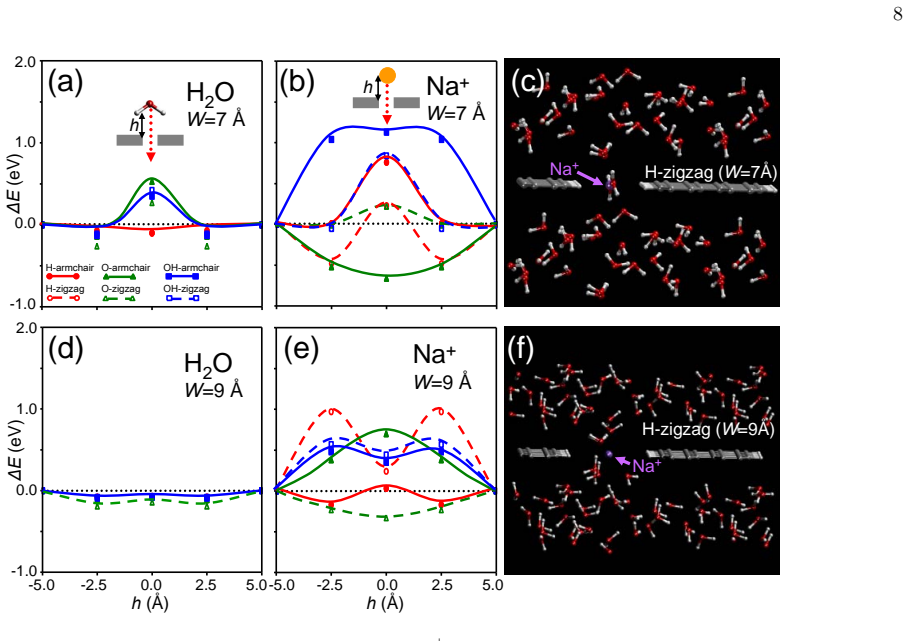
The central object is the in-layer pore of graphite oxide, modeled as an infinite array of graphene nanoribbons with either armchair or zigzag edges terminated by hydrogen, epoxy oxygen, or hydroxyl groups; the pore width $W$ is the separation between closest carbon atoms at opposing edges. For each pore, the paper computes the total-energy change $\Delta E(h)$ as a water molecule or hydrated $\mathrm{Na}^+$ ion moves along the height $h$ through the pore, with carbon atoms fixed, and uses the ratio $\Delta E(\mathrm{H_2O})/\Delta E(\mathrm{Na}^+)$ as the measure of selectivity. The other working part is the hydration shell: with a hydrated $\mathrm{Na}^+$ diameter near 6 Å, the pore opening after hydrogen termination (about 4.6 Å for a 7 Å pore) can geometrically admit a 2.8 Å water molecule but not the intact ion. Concerted motion of several water molecules through narrow pores, which roughly halves the single-molecule barrier, is the mechanism that keeps narrow pores permeable.
What would settle it
Build a graphite-oxide membrane whose in-layer pores are hydrogen-terminated and narrowly distributed near 7 Å, and measure NaCl rejection and water flux under reverse-osmosis conditions; the paper's claim predicts high sodium rejection with usable water flux, while observed flux that is negligible or salt passage comparable to wider-pore membranes would show the computed barrier ratio does not survive real operating conditions. A computational check with flexible pore edges and a spread of pore widths would serve the same purpose.
Extended reading notes
Core claim
On the paper's own terms, the discovery is that selective desalination does not require exotic pore chemistry: hydrogen-terminated armchair pores of width about 7 Å in graphite oxide let a water molecule through with essentially no activation energy, while a hydrated $\mathrm{Na}^+$ ion must shed most of its hydration shell and pay a large energy cost to cross. The same calculations show that narrowing the pore to 5 Å still permits water by concerted, hydrogen-bonded motion at a reduced barrier of about 0.6 eV, and widening it to 9 Å removes the barrier for water but leaves a substantial barrier for $\mathrm{Na}^+$ except at oxygen-terminated zigzag edges; the best computed water-to-$\mathrm{Na}^+$ permeability ratio sits at 7 Å. The authors embed this pore in a layered all-carbon membrane so that the brittle graphite oxide is carried by buckypaper and protected by carbon fabric, which addresses the mechanical and chemical weaknesses of polymer membranes.
Load-bearing premise
The load-bearing premise is that a static, zero-temperature energy barrier computed for one water molecule or one hydrated $\mathrm{Na}^+$ ion crossing a perfectly rigid, fixed-width pore decides which species a real membrane will let through.
Editorial extensions
If this is right
- A fabricator should aim for hydrogen-terminated armchair in-layer pores near 7 Å rather than wider ones, since 9 Å pores trade away selectivity.
- Even 5 Å pores can pass water by concerted hydrogen-bonded motion, so narrow-pore membranes remain permeable while rejecting salt.
- Because the interlayer region of graphite oxide is hydrophilic and slows adjacent water layers, the slit pores add a second ion-rejection mechanism beyond the in-layer pore.
- The all-carbon sandwich is expected to survive chlorine cleaning and can be cleaned by resistive heating in an inert atmosphere, removing the fouling failure mode of polymer membranes.
- Tuning operating pressure should open or close the flexible carbon pores, letting the same membrane adjust salt rejection and water flux in real time.
Reading between the lines
- The paper does not discuss pore-size distributions, but a population centered at 7 Å will include some 9 Å pores that lower selectivity, so fabrication tolerance matters as much as nominal pore width.
- The paper's observation that oxygen- and hydroxyl-terminated pores coordinate $\mathrm{Na}^+$ like a selectivity filter has an untested consequence: cation binding may dominate rejection or cause clogging, making the elimination of strong binding sites a design variable.
- A next step the paper does not take is to convert the barrier heights into room-temperature permeation rates; whether 7 Å stays optimal depends on whether entropy and thermal prefactors differ between water and $\mathrm{Na}^+$.
- The paper's pressure-tuning idea implies a testable control strategy: monitor feed salinity and adjust pressure to keep the effective pore size near the selectivity optimum.
Signed reviews
Editorial analysis
A structured set of objections, weighed in public.
Referee Report
Summary. The paper proposes an all-carbon multilayer membrane for reverse-osmosis water desalination, combining an outer carbon fabric, a buckypaper layer, and a graphite oxide (GO) core. Using DFT (PBE and LDA) and short ab initio MD simulations, the authors study water permeation between GO layers and through idealized in-layer pores represented by periodically repeated graphene nanoribbons with armchair or zigzag edges terminated by H, O, or OH groups. They report static energy profiles for H2O and hydrated Na+ crossing pores of width W = 5, 7, and 9 Å, and they conclude that H-terminated armchair pores near W = 7 Å offer the best water/sodium selectivity. The paper also discusses membrane cleaning, hydrophilicity, swelling, and the use of electrically conductive layers to reduce fouling.
Significance. If the central claim were quantitatively established, the paper would provide a concrete, falsifiable design target: hydrogen-terminated armchair in-layer pores in GO near 7 Å width should separate water from Na+ while wider 9 Å pores should be less selective. The study is valuable in that it uses first-principles methods rather than fitted force fields, compares several edge terminations and pore widths, and is unusually candid about its limitations, explicitly stating that the MD results are illustrative and require ensemble averaging. The proposed barrier-based selectivity proxy is a reasonable starting point, but the manuscript currently overstates the strength of the evidence by referring to a computed 'permeability ratio' that is never actually computed.
major comments (4)
- [Section V; Section IV.F; Fig. 7] The central design claim that 7 Å pores provide the best permeability ratio between H2O and Na+ is not supported by a computed permeability ratio anywhere in the manuscript. The evidence in Fig. 7 consists of static 0 K energy profiles ΔE(h) obtained from constrained optimizations in which the carbon atoms are fixed and only the height h is relaxed. No free-energy barriers, transition-state-theory prefactors, or flux/rejection quantities are reported. For the H-terminated armchair W = 7 Å pore the water barrier is zero, so a finite H2O/Na+ ratio cannot be defined without a separate transport model. The phrase 'permeability ratio' should either be replaced by an explicit 'barrier-based selectivity proxy' or the claim must be supported by actual permeability calculations.
- [Section IV.F; Fig. 8] The barrier heights in Fig. 7 are computed with all carbon atoms held fixed, yet the paper itself invokes pore-edge deformation for W = 5 Å pores and concerted water motion through the pore as mechanisms that substantially reduce barriers. Because the ranking that leads to the 7 Å recommendation depends on these rigid-pore energy profiles, the sensitivity of the ΔE(h) curves to edge relaxation, thermal fluctuations, and collective water motion should be assessed before the ranking is presented as a design conclusion.
- [Section III; Section IV.H; Fig. 9] The MD simulations of ion permeation are single-trajectory runs, and the paper explicitly states that 'ensemble averages over many trajectories would be required for any quantitative conclusions.' These simulations therefore cannot provide quantitative support for the selectivity claim. If the manuscript retains a quantitative selectivity statement, it must be based on statistically converged averages or on a clearly separated analysis of the static barriers, not on these illustrative trajectories.
- [Section III; Section IV.C] The calculations use the PBE functional without van der Waals corrections. For water interacting with graphitic carbon, dispersion interactions are known to be important, and PBE typically underestimates physisorption energies. Since the selectivity argument rests on small differences between water and ion barrier heights, a vdW-corrected functional or an explicit benchmark showing that the ranking is insensitive to this approximation is needed to establish the robustness of the central conclusion.
minor comments (6)
- [Section III] The statement that DFT calculations are 'free of adjustable parameters' is too strong: the choice of exchange-correlation functional and the selection of the surface tension γ are methodological choices, even if not fitted to the desalination problem.
- [Section IV.C] The value γ = 14.0 × 10^-2 J/m^2 is selected from a range spanning 6.6 to 65.9 × 10^-2 J/m^2; the choice should be justified more explicitly, even though the resulting shift in the water permeation energy is small.
- [Fig. 7] The curves in Fig. 7 are distinguished only by colors that are not identified in the caption; a legend or labeled line styles would make the comparison of terminations and pore widths much easier for the reader.
- [Fig. 1 caption] The phrase 'red doted line' should read 'red dotted line.'
- [Section IV.H] There is a duplicated word in 'the postulated reason reason for this behavior'; one 'reason' should be removed.
- [Section V] The statement that the highest ΔE(H2O)/ΔE(Na+) ratio 'maximizes the permeability difference' conflates an energy-barrier ratio with a permeation flux ratio; this should be clarified or softened.
Circularity Check
No circularity: the DFT barrier calculations are self-contained and not equivalent to their inputs.
full rationale
The paper's central permeation results are produced by ab initio DFT calculations with no adjustable parameters fitted to the selectivity conclusion. In Section IV.F, energy profiles ΔE(h) for H2O and hydrated Na+ crossing idealized in-layer pores are obtained from constrained global optimizations, and the ordering of barriers for different pore widths and terminations emerges from the electronic-structure calculations rather than from the input assumptions. The only numerically selected quantity, the surface tension γ=14.0×10^-2 J/m^2 used in the Section IV.C permeation-energy estimate, is taken from within a published theoretical range and has a small effect (~0.05 eV or less) on the energy balance; it is not fitted to reproduce hydrophilicity or any downstream prediction. The single self-citation to the author's own textbook (Ref. [9]) supports only generic background statements about carbon materials' strength, thermal stability, and chemical resilience, and it is not load-bearing for the desalination design. The Section V statement that 7 Å pores give the 'best permeability ratio between H2O and Na+' is an interpretive summary of the computed barrier trends rather than a separately fitted or cited quantity; calling it a permeability ratio may be an overstatement, but that is a precision/validity caveat, not circularity, because the conclusion is not equivalent to the inputs by construction. No uniqueness theorem, ansatz, or prior-work result by the same authors is imported to force the central choice. The derivation chain is therefore self-contained against external benchmarks and shows no significant circularity.
Assumptions & free parameters
free parameters (2)
- Surface tension gamma for water permeation energy =
14.0 x 10^-2 J/m^2
- MD driving force F0 =
6.25 x 10^-3 eV/Å
assumptions (4)
- domain assumption DFT-PBE and LDA without explicit van der Waals corrections give reliable energy barriers for water and ions in carbon nanopores.
- domain assumption The Lerf-Klinowski model represents the chemistry of real GO layers.
- ad hoc to paper In-layer vacancy pores in GO are equivalent to rigid, periodically repeated H/O/OH-terminated armchair or zigzag graphene nanoribbons of uniform width.
- ad hoc to paper Static 0 K energy differences determine the operating permeability ratio.
Cite this review
Pith. "Pith review of Designing an All-Carbon Membrane for Water Desalination." pith.science (2026). https://pith.science/paper/AJV3O2HD
@misc{pith2026190802225,
  author       = {Pith},
  title        = {Pith review of: Designing an All-Carbon Membrane for Water Desalination},
  year         = {2026},
  howpublished = {\url{https://pith.science/paper/AJV3O2HD}},
  note         = {Machine review of arXiv:1908.02225}
}
abstract
We design an all-carbon membrane for the filtration and desalination of water. A unique layered assembly of carbon nanostructures including graphite oxide (GO), buckypaper consisting of carbon nanotubes, and a strong carbon fabric provides high mechanical strength and thermal stability, resilience to harsh chemical cleaning agents and electrical conductivity, thus addressing major shortcomings of commercial reverse osmosis membranes. We use ab initio density functional theory calculations to obtain atomic-level insight into the permeation of water molecules in-between GO layers and across in-layer vacancy defects. Our calculations elucidate the reason for selective rejection of solvated Na$^+$ ions in an optimized GO membrane that is structurally stabilized in a sandwich arrangement in-between layers of buckypaper, which are protected on both sides by strong carbon fabric layers.
Figures


Figures from the paper (4 more)



Reference graph
Works this paper leans on
-
[1]
The future of seawater desalination: Energy, technology, and the en- vironment,
Menachem Elimelech and William A Phillip, “The future of seawater desalination: Energy, technology, and the en- vironment,” Science 333, 712–717 (2011)
2011
-
[2]
Materials for next-generation desalination and water purification membranes,
Jay R. Werber, Chinedum O. Osuji, and Menachem Elimelech, “Materials for next-generation desalination and water purification membranes,” Nat. Rev. Mater. 1, 16018 (2016)
work page 2016
-
[3]
Outlook for graphene-based desali- nation membranes,
Albert Boretti, Sarim Al-Zubaidy, Miroslava Vac- lavikova, Mohammed Al-Abri, Stefania Castelletto, and Sergey Mikhalovsky, “Outlook for graphene-based desali- nation membranes,” npj Clean Water 1, 5 (2018)
work page 2018
-
[4]
Gongping Liu, Wanqin Jin, and Nanping Xu, “Graphene-based membranes,” Chem. Soc. Rev. 44, 5016–5030 (2015)
work page 2015
-
[5]
A perspective on reverse osmosis water de- salination: Quest for sustainability,
Yoram Cohen, Raphael Semiat, and Anditya Ra- hardianto, “A perspective on reverse osmosis water de- salination: Quest for sustainability,” AIChE J. 63, 1771– 1784 (2017)
work page 2017
-
[6]
A review of polymeric membranes and processes for potable water reuse,
David M. Warsinger, Sudip Chakraborty, Emily W. Tow, Megan H. Plumlee, Christopher Bellona, Savvina Loutatidou, Leila Karimi, Anne M. Mikelonis, Andrea Achilli, Abbas Ghassemi, Lokesh P. Padhye, Shane A. Snyder, Stefano Curcio, Chad D. Vecitis, Hassan A. Arafat, and John H. Lienhard, “A review of polymeric membranes and processes for potable water reuse,”...
work page 2018
-
[7]
Pengzhan Sun, Kunlin Wang, and Hongwei Zhu, “Recent developments in graphene-based membranes: Structure, mass-transport mechanism and potential applications,” Adv. Mater. 28, 2287–2310 (2016)
work page 2016
-
[8]
Desalina- tion processes’ efficiency and future roadmap,
Muhammad Wakil Shahzad, Muhammad Burhan, Doskhan Ybyraiymkul, and Kim Choon Ng, “Desalina- tion processes’ efficiency and future roadmap,” Entropy 21, 84 (2019)
work page 2019
Show all 81 references
-
[9]
David Tom´ anek,Guide Through the Nanocarbon Jungle , 2053-2571 (IOP Publishing, Bristol, UK, 2014)
2014
-
[10]
Large-scale purifica- tion of single-wall carbon nanotubes: process, product, and characterization,
A.G. Rinzler, J. Liu, H. Dai, P. Nikolaev, C.B. Huff- man, F.J. Rodr´ ıguez-Mac´ ıas, P.J. Boul, A.H. Lu, D. Hey- mann, D.T. Colbert, R.S. Lee, J.E. Fischer, A.M. Rao, P.C. Eklund, and R.E. Smalley, “Large-scale purifica- tion of single-wall carbon nanotubes: process, product, a...
1998
-
[11]
Synthesis, properties and water permeability of SWNT buckypapers,
L. J. Sweetman, L. Nghiem, I. Chironi, G. Triani, M. In Het Panhuis, and S. F. Ralph, “Synthesis, properties and water permeability of SWNT buckypapers,” J. Mater. Chem. 22, 13800–13810 (2012)
2012
-
[12]
Synthesis, properties, water and solute perme- ability of MWNT buckypapers,
Md Harun Or Rashid, Son Q T Pham, Luke J. Sweetman, Leighton J. Alcock, Anthony Wise, Long D. Nghiem, Gerry Triani, Marc in het Panhuis, and Stephen F. Ralph, “Synthesis, properties, water and solute perme- ability of MWNT buckypapers,” J. Memb. Sci.456, 175– 184 (2014)
2014
-
[13]
Multifunctional carbon nanotube yarns by downsizing an ancient technology,
Mei Zhang, Ken R. Atkinson, and Ray H. Baughman, “Multifunctional carbon nanotube yarns by downsizing an ancient technology,” Science 306, 1358–1361 (2004). 13
2004
-
[14]
Multifunctional fabrics of carbon nanotube fibers,
Xiaogang Luo, Wei Weng, Yunxia Liang, Zexu Hu, Yang Zhang, Junjie Yang, Lijun Yang, Shengyuan Yang, Meifang Zhu, and Hui-Ming Cheng, “Multifunctional fabrics of carbon nanotube fibers,” J. Mater. Chem. A 7, 8790–8797 (2019)
2019
-
[15]
Carbon nanotube membranes: Synthesis, properties, and future filtration applications,
Md. Harun-Or Rashid and Stephen F. Ralph, “Carbon nanotube membranes: Synthesis, properties, and future filtration applications,” Nanomaterials 7, 99 (2017)
2017
-
[16]
Development of graphene oxide (GO)/multi- walled carbon nanotubes (MWCNTs) nanocomposite conductive membranes for electrically enhanced fouling mitigation,
K.C. Ho, Y.H. Teow, A.W. Mohammad, W.L. Ang, and P.H. Lee, “Development of graphene oxide (GO)/multi- walled carbon nanotubes (MWCNTs) nanocomposite conductive membranes for electrically enhanced fouling mitigation,” J. Memb. Sci. 552, 189–201 (2018)
2018
-
[17]
Involve- ment of reactive oxygen species in the electrochemical inhibition of barnacle ( Amphibalanus amphitrite) settle- ment,
Rodolfo E. P´ erez-Roa, Marc A. Anderson, Dan Rittschof, Christopher G. Hunt, and Daniel R. Noguera, “Involve- ment of reactive oxygen species in the electrochemical inhibition of barnacle ( Amphibalanus amphitrite) settle- ment,” Biofouling 25, 563–571 (2009)
2009
-
[18]
Ion separation using a Y-junction carbon nanotube,
Jae Hyun Park, Susan B. Sinnott, and N. R. Aluru, “Ion separation using a Y-junction carbon nanotube,” Nanotechnology 17, 895–900 (2006)
2006
-
[19]
Graphite oxide and its membrane properties,
H.P. Boehm, A Clauss, and U Hofmann, “Graphite oxide and its membrane properties,” J. Chim. Phys. 58, 141– 147 (1961)
1961
-
[20]
Organic fouling of graphene oxide membranes and its implications for membrane fouling control in engineered osmosis,
Meng Hu, Sunxiang Zheng, and Baoxia Mi, “Organic fouling of graphene oxide membranes and its implications for membrane fouling control in engineered osmosis,” En- vironmental Science & Technology 50, 685–693 (2016)
2016
-
[21]
Prepa- ration of graphitic oxide,
William S. Hummers and Richard E. Offeman, “Prepa- ration of graphitic oxide,” J. Am. Chem. Soc. 80, 1339– 1339 (1958)
1958
-
[22]
XIII. On the atomic weight of graphite,
Benjamin Collins Brodie, “XIII. On the atomic weight of graphite,” Phil. Trans. Roy. Soc. (London) 149, 249–259 (1859)
-
[23]
Toxicity of graphene and graphene oxide nanowalls against bacte- ria,
Omid Akhavan and Elham Ghaderi, “Toxicity of graphene and graphene oxide nanowalls against bacte- ria,” ACS Nano 4, 5731–5736 (2010)
2010
-
[24]
Reduction kinetics of graphene oxide determined by electrical transport mea- surements and temperature programmed desorption,
Inhwa Jung, Daniel A. Field, Nicholas J. Clark, Yanwu Zhu, Dongxing Yang, Richard D. Piner, Sasha Stankovich, Dmitriy A. Dikin, Heike Geisler, Carl A. Ventrice, and Rodney S. Ruoff, “Reduction kinetics of graphene oxide determined by electrical transport mea- surements and temp...
2009
-
[25]
Large-area graphene-based nanofil- tration membranes by shear alignment of discotic ne- matic liquid crystals of graphene oxide,
Abozar Akbari, Phillip Sheath, Samuel T Martin, Dhan- raj B Shinde, Mahdokht Shaibani, Parama Chakraborty Banerjee, Rachel Tkacz, Dibakar Bhattacharyya, and Mainak Majumder, “Large-area graphene-based nanofil- tration membranes by shear alignment of discotic ne- matic liquid cr...
2016
-
[26]
Water confined in nan- otubes and between graphene sheets: a first principle study
Giancarlo Cicero, Jeffrey C. Grossman, Eric Schwegler, Francois Gygi, and Giulia Galli, “Water confined in nan- otubes and between graphene sheets: a first principle study.” J. Am. Chem. Soc. 130, 1871–1878 (2008)
2008
-
[27]
Sorption of polar organic solvents and water by graphite oxide: Thermodynamic approach,
Mikhail V. Korobov, Aleksandr V. Talyzin, Anas- tasiya T. Rebrikova, Elizaveta A. Shilayeva, Natalya V. Avramenko, Alexander N. Gagarin, and Nikolay B. Fer- apontov, “Sorption of polar organic solvents and water by graphite oxide: Thermodynamic approach,” Carbon 102, 297–303 (2016)
2016
-
[28]
Water and salt dynamics in mul- tilayer graphene oxide (GO) membrane: Role of lat- eral sheet dimensions,
Abhijit Gogoi, Tukhar Jyoti Konch, Kalyan Raidongia, and K. Anki Reddy, “Water and salt dynamics in mul- tilayer graphene oxide (GO) membrane: Role of lat- eral sheet dimensions,” J. Membrane Sci. 563, 785–793 (2018)
2018
-
[29]
Hydration behavior and dynamics of water molecules in graphite oxide,
A. Lerf, A. Buchsteiner, J. Pieper, S. Sch¨ ottl, I. Dekany, T. Szabo, and H.P. Boehm, “Hydration behavior and dynamics of water molecules in graphite oxide,” J. Phys. Chem. Solids 67, 1106–1110 (2006)
2006
-
[30]
Water permeation and ion rejection in layer-by-layer stacked graphene oxide nanochannels: A molecular dynamics simulation,
Haiwei Dai, Zhijun Xu, and Xiaoning Yang, “Water permeation and ion rejection in layer-by-layer stacked graphene oxide nanochannels: A molecular dynamics simulation,” J. Phys. Chem. C 120, 22585–22596 (2016)
2016
-
[31]
Water dynamics in graphite oxide investigated with neu- tron scattering,
Alexandra Buchsteiner, Anton Lerf, and J¨ org Pieper, “Water dynamics in graphite oxide investigated with neu- tron scattering,” J. Phys. Chem. B 110, 22328–22338 (2006)
2006
-
[32]
Comparison of simple potential functions for simulating liquid water,
William L. Jorgensen, Jayaraman Chandrasekhar, Jef- fry D. Madura, Roger W. Impey, and Michael L. Klein, “Comparison of simple potential functions for simulating liquid water,” J. Chem. Phys. 79, 926–935 (1983)
1983
-
[33]
Two mechanisms of permeation of small neutral molecules and hydrated ions across phospholipid bilayers,
A. G. Volkov, S. Paula, and D. W. Deamer, “Two mechanisms of permeation of small neutral molecules and hydrated ions across phospholipid bilayers,” Bioelec- trochem. Bioenerg. 42, 153–160 (1997)
1997
-
[34]
Hydration of sodium, potassium, and chloride ions in solution and the concept of structure maker/breaker,
R. Mancinelli, A. Botti, F. Bruni, M. A. Ricci, and A. K. Soper, “Hydration of sodium, potassium, and chloride ions in solution and the concept of structure maker/breaker,” J. Phys. Chem. B 111, 13570–13577 (2007)
2007
-
[35]
Hydration structure of salt solutions from ab ini- tio molecular dynamics,
Arindam Bankura, Vincenzo Carnevale, and Michael L. Klein, “Hydration structure of salt solutions from ab ini- tio molecular dynamics,” J. Chem. Phys. 138 (2013), 10.1063/1.4772761
2013 doi
-
[36]
Meot-Ner (Mautner) and S
M. Meot-Ner (Mautner) and S. G. Lias, Chemistry Web- Book: Thermochemistry of cluster ion data , NIST Stan- dard Reference Database (SRD) 69 (National Institute of Standards and Technology, Gaithersburg, MD, USA, 2018)
2018
-
[37]
Xiao Feng Pang, Water: Molecular Structure and Prop- erties (World Scientific, Singapore, 2014)
2014
-
[38]
Ion selectivity of graphene nanopores,
Ryan C. Rollings, Aaron T. Kuan, and Jene A. Golovchenko, “Ion selectivity of graphene nanopores,” Nat. Commun. 7, 11408 (2016)
2016
-
[39]
A study of the hy- dration of the alkali metal ions in aqueous solution,
Johan M¨ ahler and Ingmar Persson, “A study of the hy- dration of the alkali metal ions in aqueous solution,” In- org. Chem. 51, 425–438 (2012)
2012
-
[40]
Assessment of silt density index (SDI) as fouling propen- sity parameter in reverse osmosis (RO) desalination sys- tems,
R. M. Rachman, N. Ghaffour, F. Wali, and G. L. Amy, “Assessment of silt density index (SDI) as fouling propen- sity parameter in reverse osmosis (RO) desalination sys- tems,” Desal. Water Treat. 51, 1091–1103 (2013)
2013
-
[41]
Synergetic effects of oxidized carbon nan- otubes and graphene oxide on fouling control and anti- fouling mechanism of polyvinylidene fluoride ultrafiltra- tion membranes,
Jiguo Zhang, Zhiwei Xu, Mingjing Shan, Baoming Zhou, Yinglin Li, Baodong Li, Jiarong Niu, and Xiaom- ing Qian, “Synergetic effects of oxidized carbon nan- otubes and graphene oxide on fouling control and anti- fouling mechanism of polyvinylidene fluoride ultrafiltra- tion membran...
2013
-
[42]
The siesta method; developments and applicability,
Emilio Artacho, E. Anglada, O. Dieguez, J. D. Gale, A. Garcia, J. Junquera, R. M. Martin, P. Ordejon, J. M. Pruneda, D. Sanchez-Portal, and J. M. Soler, “The siesta method; developments and applicability,” J. Phys. Cond. Mat. 20, 064208 (2008)
2008
-
[43]
Efficient iterative schemes for ab initio total-energy calculations using a plane-wave basis set,
G. Kresse and J. Furthm¨ uller, “Efficient iterative schemes for ab initio total-energy calculations using a plane-wave basis set,” Phys. Rev. B 54, 11169–11186 (1996)
1996
-
[44]
From ultrasoft pseudopoten- tials to the projector augmented-wave method,
G. Kresse and D. Joubert, “From ultrasoft pseudopoten- tials to the projector augmented-wave method,” Phys. 14 Rev. B 59, 1758–1775 (1999)
1999
-
[45]
Generalized gradient approximation made simple,
John P. Perdew, Kieron Burke, and Matthias Ernzer- hof, “Generalized gradient approximation made simple,” Phys. Rev. Lett. 77, 3865–3868 (1996)
1996
-
[46]
Ground state of the electron gas by a stochastic method,
D. M. Ceperley and B. J. Alder, “Ground state of the electron gas by a stochastic method,” Phys. Rev. Lett. 45, 566–569 (1980)
1980
-
[47]
Self-interaction correction to density-functional approximations for many-electron systems,
J. P. Perdew and A. Zunger, “Self-interaction correction to density-functional approximations for many-electron systems,” Phys. Rev. B 23, 5048–5079 (1981)
1981
-
[48]
Adsorption of rare- gas atoms and water on graphite and graphene by van der waals-corrected density functional theory,
A. Ambrosetti and P. L. Silvestrelli, “Adsorption of rare- gas atoms and water on graphite and graphene by van der waals-corrected density functional theory,” J. Phys. Chem. C 115, 3695–3702 (2011)
2011
-
[49]
Efficient pseudopo- tentials for plane-wave calculations,
N. Troullier and Jos´ e Lu´ ıs Martins, “Efficient pseudopo- tentials for plane-wave calculations,” Phys. Rev. B 43, 1993–2006 (1991)
1991
-
[50]
Special points for brillouin-zone integrations,
Hendrik J. Monkhorst and James D. Pack, “Special points for brillouin-zone integrations,” Phys. Rev. B 13, 5188–5192 (1976)
1976
-
[51]
Methods of conjugate gradients for solving linear systems,
M.R. Hestenes and E. Stiefel, “Methods of conjugate gradients for solving linear systems,” J. Res. Natl. Bur. Stand. (U. S.) 49, 409 (1952)
1952
-
[52]
Ab initio theory and modeling of water,
Mohan Chen, Hsin-Yu Ko, Richard C. Remsing, Mar- cos F. Calegari Andrade, Biswajit Santra, Zhaoru Sun, Annabella Selloni, Roberto Car, Michael L. Klein, John P. Perdew, and Xifan Wu, “ Ab initio theory and modeling of water,” Proc. Natl. Acad. Sci. 114, 10846– 10851 (2017)
2017
-
[53]
Isobaric first-principles molecular dynam- ics of liquid water with nonlocal van der waals interac- tions,
Giacomo Miceli, Stefano de Gironcoli, and Alfredo Pasquarello, “Isobaric first-principles molecular dynam- ics of liquid water with nonlocal van der waals interac- tions,” J. Chem. Phys. 142, 034501 (2015)
2015
-
[54]
Den- sity and compressibility of liquid water and ice from first- principles simulations with hybrid functionals,
Alex P. Gaiduk, Fran¸ cois Gygi, and Giulia Galli, “Den- sity and compressibility of liquid water and ice from first- principles simulations with hybrid functionals,” J. Phys. Chem. Lett. 6, 2902–2908 (2015)
2015
-
[55]
Felix Franks, Water: A Matrix of Life: Edition 2 (Royal Society of Chemistry, Cambridge, 2000)
2000
-
[56]
Temperature- dependent self-diffusion coefficients of water and six se- lected molecular liquids for calibration in accurate 1H NMR PFG measurements,
M. Holz, S. R. Heil, and A. Sacco, “Temperature- dependent self-diffusion coefficients of water and six se- lected molecular liquids for calibration in accurate 1H NMR PFG measurements,” Phys. Chem. Chem. Phys. 2, 4740–4742 (2000)
2000
-
[57]
Perspective: How good is DFT for water?
Michael J. Gillan, Dario Alf` e, and Angelos Michaelides, “Perspective: How good is DFT for water?” J. Chem. Phys. 144, 130901 (2016)
2016
-
[58]
Glassy nature of water in an ultraconfining disordered material: The case of calcium-silicate-hydrate,
Mostafa Youssef, Roland J.M. Pellenq, and Bilge Yildiz, “Glassy nature of water in an ultraconfining disordered material: The case of calcium-silicate-hydrate,” J. Am. Chem. Soc. 133, 2499–2510 (2011)
2011
-
[59]
Structure of graphite oxide revisited,
Anton Lerf, Heyong He, Michael Forster, and Jacek Kli- nowski, “Structure of graphite oxide revisited,” J. Phys. Chem. B 102, 4477–4482 (1998)
1998
-
[60]
Interferenz an regellos ori- entierten Teilchen im R¨ ontgenlicht I,
Peter Debye and P. Scherrer, “Interferenz an regellos ori- entierten Teilchen im R¨ ontgenlicht I,” Physikal. Zeitschr. 17, 277 (1916)
1916
-
[61]
Determination of the local chemical structure of graphene oxide and reduced graphene oxide,
Kris Erickson, Rolf Erni, Zonghoon Lee, Nasim Alem, Will Gannett, and Alex Zettl, “Determination of the local chemical structure of graphene oxide and reduced graphene oxide,” Adv. Mater. 22, 4467–4472 (2010)
2010
-
[62]
N. N. Avgul and A. V. Kiselev, in Chemistry and Physics of Carbon , Vol. 6, edited by Jr. Walker, P. L. (Marcel Dekker, New York, 1970) pp. 105–113
1970
-
[63]
Square ice in graphene nanocapillaries,
G. Algara-Siller, O. Lehtinen, F. C. Wang, R. R. Nair, U. Kaiser, H. A. Wu, A. K. Geim, and I. V. Grigorieva, “Square ice in graphene nanocapillaries,” Nature 519, 443–445 (2015)
2015
-
[64]
The observation of square ice in graphene questioned,
Wu Zhou, Kuibo Yin, Canhui Wang, Yuyang Zhang, Tao Xu, Albina Borisevich, Litao Sun, Juan Carlos Idrobo, Matthew F. Chisholm, Sokrates T. Pantelides, Robert F. Klie, and Andrew R. Lupini, “The observation of square ice in graphene questioned,” Nature 528, E1 (2015)
2015
-
[65]
Origin of anomalous water perme- ation through graphene oxide membrane,
Danil W. Boukhvalov, Mikhail I. Katsnelson, and Young Woo Son, “Origin of anomalous water perme- ation through graphene oxide membrane,” Nano Lett. 13, 3930–3935 (2013)
2013
-
[66]
Structure and dynamics of water at the water- air interface using first-principles molecular dynamics simulations within generalized gradient approximation,
Tatsuhiko Ohto, Mayank Dodia, Sho Imoto, and Yuki Nagata, “Structure and dynamics of water at the water- air interface using first-principles molecular dynamics simulations within generalized gradient approximation,” J. Chem. Theory Comput. 15, 595–602 (2019)
2019
-
[67]
(CRC Press, Boca Raton, FL, USA, 1986)
CRC Handbook of Chemistry and Physics, 67th ed. (CRC Press, Boca Raton, FL, USA, 1986)
1986
-
[68]
Fluidity of water confined to subnanometre films,
Uri Raviv, Pierre Laurat, and Jacob Klein, “Fluidity of water confined to subnanometre films,” Nature 413, 51–54 (2001)
2001
-
[69]
Viscous water meniscus under nanoconfinement,
R. C. Major, J. E. Houston, M. J. McGrath, J. I. Siep- mann, and X.-Y. Zhu, “Viscous water meniscus under nanoconfinement,” Phys. Rev. Lett. 96, 177803 (2006)
2006
-
[70]
880 (Springer International Pub- lishing, Cham, ZG, Switzerland, 2014)
Allen Hunt, Robert Ewing, and Behzad Ghanbarian, Percolation Theory for Flow in Porous Media , Lecture Notes in Physics, Vol. 880 (Springer International Pub- lishing, Cham, ZG, Switzerland, 2014)
2014
-
[71]
Supporting Information containing movies of molecular dynamics simulations of water molecules and hydrated ions permeating through an all-carbon membrane is pro- vided free of charge at this URL
-
[72]
A new structural model for graphite oxide,
Heyong He, Jacek Klinowski, Michael Forster, and An- ton Lerf, “A new structural model for graphite oxide,” Chem. Phys. Lett. 287, 53–56 (1998)
1998
-
[73]
Van der Waals volumes and radii,
A. Bondi, “Van der Waals volumes and radii,” J. Phys. Chem. 68, 441–451 (1964)
1964
-
[74]
Silverstein, Francis X
Robert M. Silverstein, Francis X. Webster, David J. Kiemle, and David L. Bryce, Spectrometric identification of organic compounds (John Wiley & Sons, Inc., 2014)
2014
-
[75]
The structure of the potassium channel: Molecular basis of K+ conduction and selectivity,
Declan A Doyle, Declan A Doyle, Morais Cabral, Richard A Pfuetzner, Anling Kuo, Jacqueline M Gulbis, Steven L Cohen, Brian T Chait, and Roderick Mackin- non, “The structure of the potassium channel: Molecular basis of K+ conduction and selectivity,” Science280, 69– 77 (1998)
1998
-
[76]
Chemistry of ion coordina- tion and hydration revealed by a K + channel–fab com- plex at 2.0 ˚A resolution,
Yufeng Zhou, Jo˜ ao H. Morais-Cabral, Amelia Kaufman, and Roderick MacKinnon, “Chemistry of ion coordina- tion and hydration revealed by a K + channel–fab com- plex at 2.0 ˚A resolution,” Nature 414, 43–48 (2001)
2001
-
[77]
Selectivity of a singly permeating ion in nonselective nak channel: Combined QM and MD based investigations,
Biswajit Sadhu, Mahesh Sundararajan, and Tusar Bandyopadhyay, “Selectivity of a singly permeating ion in nonselective nak channel: Combined QM and MD based investigations,” J. Phys. Chem. B 119, 12783– 12797 (2015)
2015
-
[78]
The critical need for increased selectivity, not increased water permeability, for desalination mem- branes,
Jay R. Werber, Akshay Deshmukh, and Menachem Elimelech, “The critical need for increased selectivity, not increased water permeability, for desalination mem- branes,” Environ. Sci. Tech. Let. 3, 112–120 (2016)
2016
-
[79]
Topography-driven surface renewal,
Luka Pocivavsek, Joseph Pugar, Robert O’Dea, Sang-Ho Ye, William Wagner, Edith Tzeng, Sachin Velankar, and Enrique Cerda, “Topography-driven surface renewal,” 15 Nature Phys. 14, 948–953 (2018)
2018
-
[80]
Advanced instrumentation, measurement, control, and automation (IMCA) in multistage flash (MSF) and reverse-osmosis (RO) water desalination,
Noam Lior, Ali El-Nashar, and Corrado Sommariva, “Advanced instrumentation, measurement, control, and automation (IMCA) in multistage flash (MSF) and reverse-osmosis (RO) water desalination,” inAdvances in Water Desalination (John Wiley & Sons, Ltd, Hoboken, NJ, USA, 2012) Chap...
2012
-
[81]
Large-area graphene- nanomesh/carbon-nanotube hybrid membranes for ionic and molecular nanofiltration,
Yanbing Yang, Xiangdong Yang, Ling Liang, Yuyan Gao, Huanyu Cheng, Xinming Li, Mingchu Zou, Renzhi Ma, Quan Yuan, and Xiangfeng Duan, “Large-area graphene- nanomesh/carbon-nanotube hybrid membranes for ionic and molecular nanofiltration,” Science 364, 1057–1062 (2019)
2019
Reviewed August 14, 2026 · model on record in the stance chip above.
Discussion (0). Continue with ORCID to comment.