REVIEW 2 major objections 5 minor 33 references
Goldstone modes in the emergent gauge fields of a frustrated magnet
T0 review · 2 major / 5 minor · reviewed 2026-08-14 · deepseek-v4-flash
Pith's one-line read The paper predicts that spin-glass Goldstone modes in a pyrochlore antiferromagnet travel at speed $c \sim a\Delta$, set by exchange disorder alone, not by the mean exchange $J$.
desk verdict A scaling-level argument with supporting numerics that plausibly corrects the Halperin-Saslow mode speed for weakly disordered pyrochlore magnets; the load-bearing estimate is heuristic, not a fatal flaw. read the letter →
The pith
A machine-rendered reading of the paper's core claim, the machinery that carries it, and where it could break.
The reading
What carries the argument
The central object is the emergent divergenceless tensor field $B^{ai}_r = S^a_r e^i_r$, with spin index $a$ and spatial index $i$, whose flux through each tetrahedron is the cluster magnetization; in the frozen state it supplies three copies of a U(1) gauge field related by global spin rotations. The argument runs on a mode decomposition of fluctuations into a soft subspace with Hessian eigenvalues $O(\Delta)$ (gauge-field twists) and a hard subspace with eigenvalues $O(J)$ (cluster-magnetization fluctuations). The load-bearing identities are the two coarse-grained equations of motion, $\dot{\theta}_\Delta\sim J m_J$ and $\dot{m}_J\sim a^2(\Delta^2/J)\nabla^2\theta_\Delta$, which combine a smooth rotation $\theta_\Delta$ with the surviving smooth component $m_J$ of the hard magnetization, whose magnitude is suppressed by $\Delta/J$.
What would settle it
In a numerical simulation of the model, compute the lowest dynamical-mode frequency $\omega$ at the smallest wavevector for several system sizes $L$ and disorder strengths $\Delta/J$: the claim requires $\omega/q\to c\propto\Delta$, while a scaling $\propto\sqrt{J\Delta}$ at the smallest $\Delta/J$ would refute it. A thermodynamic measurement of the magnetic heat capacity below $T_F$, giving an exponent $2$ rather than $3$ on a three-dimensional pyrochlore, would also contradict the predicted density of states $D(\omega)\propto\omega^3$.
Extended reading notes
Core claim
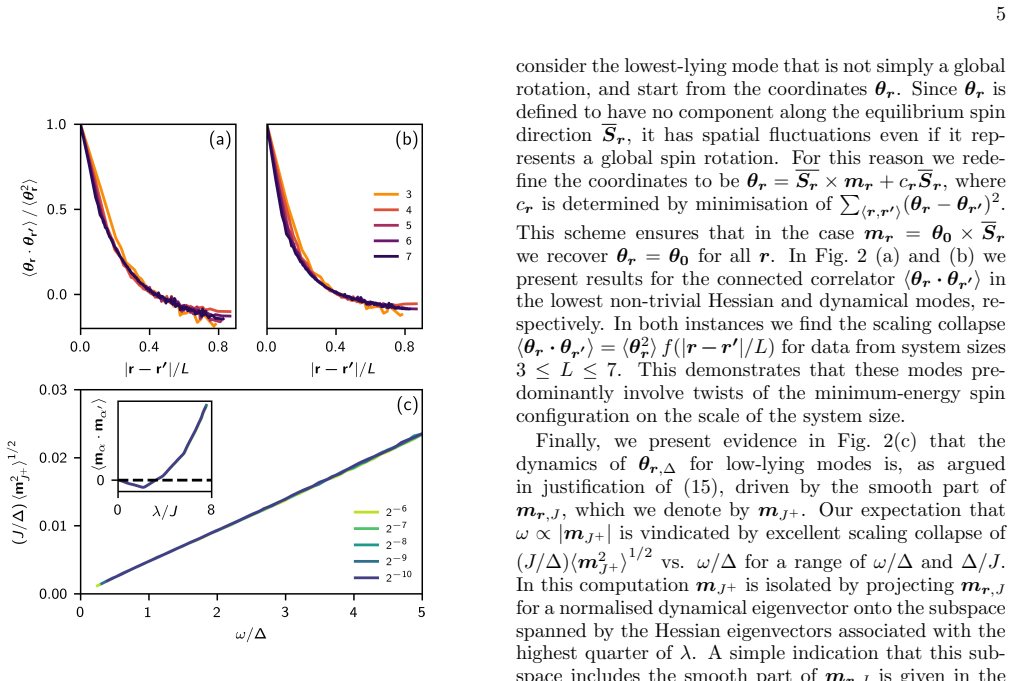
The central claim is that in the regime $0<\Delta\ll J$, the lowest-energy magnons are smooth twists of the spin-glass state and are simultaneously excitations of the emergent gauge fields. The equations of motion are $\dot{\theta}_\Delta \sim J m_J$ and $\dot{m}_J \sim a^2 (\Delta^2/J)\nabla^2\theta_\Delta$, so their combination yields linearly dispersing Goldstone excitations with speed $c \sim a\Delta$, independent of $J$. Because the stiffness of the gauge field is of order $\Delta$ and the smooth magnetization that couples to it is suppressed by $\Delta/J$, the conventional hydrodynamic speed $\sqrt{\rho/\chi_0}\sim a\sqrt{J\Delta}$ is not realized; the paper argues that a naive extension mixes in high-energy degrees of freedom. Numerical data on Hessian eigenvalues, eigenvector correlators, and magnetization scaling support the description.
Load-bearing premise
The prediction $c\sim a\Delta$ rests on the estimate that the smooth part of the magnetization in a dynamical mode is of order $\Delta/J$ rather than order one; if that amplitude were order one instead, the conventional $a\sqrt{J\Delta}$ speed would return.
Editorial extensions
If this is right
- The magnon speed vanishes linearly with disorder strength, so weakly disordered frustrated magnets should show very soft, gapless low-temperature excitations even when the exchange scale $J$ is large.
- The magnetic heat capacity from these modes scales as $(T/\Delta)^3$ below the freezing temperature, explaining large $C_M$ and predicting the exponent in clean samples.
- Inelastic neutron scattering should show pinch-point correlations and, below $T_F$, a triple-peaked energy spectrum; above $T_F$ the same wavevector dependence persists with a Lorentzian lineshape.
- The standard Halperin-Saslow formula $c=\sqrt{\rho/\chi_0}$ does not apply here; the gauge-field stiffness is $\rho\sim\Delta$ and the conjugate magnetization amplitude is what suppresses the speed.
- The low-frequency sector is purely gauge-field-like as $\Delta/J\to0$, so the Goldstone modes coincide with the emergent gauge degrees of freedom.
Reading between the lines
- If the mechanism is generic, similar disorder-selected gauge-field states on other frustrated lattices should show the same $c\sim a\Delta$ scaling whenever the Hessian splits into $O(\Delta)$ and $O(J)$ subspaces; the paper's own footnote indicates the two-dimensional case may acquire logarithmic corrections to the stiffness.
- The predicted $C_M\propto T^3$ could be tested in pyrochlore materials such as NaCaNi2F7, Y2Mo2O7, and Lu2Mo2O7 at temperatures well below their freezing transitions, where reported exponents are closer to 2; a crossover or sample-dependent exponent would clarify the role of disorder.
- A direct test is to measure the dispersion slope $c$ as $\Delta/J$ is tuned, for example by chemical pressure or strain: the paper's claim requires $c/\Delta$ to be constant, while the conventional theory requires $c/\sqrt{J\Delta}$ to be constant.
Signed reviews
Editorial analysis
A structured set of objections, weighed in public.
Referee Report
Summary. This paper studies magnon excitations in the classical Heisenberg antiferromagnet on the pyrochlore lattice with weak Gaussian exchange disorder, in the regime 0 < Δ ≪ J. Using the mapping of the clean ground-state manifold to divergenceless emergent U(1) gauge fields, and a decomposition of fluctuations into O(Δ) soft gauge-field modes and O(J) cluster-magnetization modes, the authors argue that the low-frequency Goldstone modes are smooth rotations of the frozen gauge-field configuration. Their central claim is that the mode speed is c ∼ aΔ, independent of J, in contrast to the conventional Halperin–Saslow result c ∼ a√(JΔ). The paper derives the scaling laws N(λ) ∼ (λ/Δ)^{3/2} and D(ω) ∼ (ω/Δ)^3, and supports them by numerical diagonalization on clusters with L = 3 to 7, including scaling collapses of eigenvector correlators and of the smooth magnetisation amplitude in Fig. 2(c).
Significance. If correct, the result identifies a genuinely new regime in which the emergent gauge-field stiffness is controlled by disorder alone, and it yields a concrete experimental fingerprint: a large magnetic heat capacity C ∼ T^3/Δ^3 at T ≪ T_F. The paper's strengths are that the central scaling laws are parameter-free predictions, that the numerical analysis tests eigenvector structure rather than only spectra, and that the prediction c ∼ aΔ is explicitly falsifiable. The contrast with the naïve extension of Halperin–Saslow theory, which gives c ∼ a√(JΔ), makes the claim physically significant for the frustrated-magnet community.
major comments (2)
- [Section IV, paragraph following Eq. (13), and Eq. (15)] The coefficient a²Δ²/J in Eq. (15), and therefore the central prediction c ∼ aΔ, rests entirely on the estimate |m_{r,J}| ∼ (Δ/J)|m_{r,Δ}| for the amplitudes of the hard- and soft-subspace components of the magnetisation fluctuation. This estimate is asserted without derivation. The earlier result |M_α| ∼ Δ/J quoted in Section II concerns ground-state tetrahedron magnetisations, not the eigenvector decomposition used here, so it does not by itself justify Eq. (15). The numerical collapse in Fig. 2(c) is consistent with the estimate, but it plots (J/Δ)⟨m_{J+}²⟩^{1/2} against ω/Δ; it does not directly measure the ratio |m_J|/|m_Δ| for individual low-lying eigenvectors. If the true ratio were O(1) rather than O(Δ/J), Eq. (15) would have coefficient a²Δ and the mode speed would revert to a√(JΔ), invalidating the paper's headline claim. I ask the authors to derive this ratio from a controlled expansion in Δ/J, or to present a direct numerical measurement of |m_J|/|m_Δ| for fixed low-lying modes over the same range of Δ/J used in Fig. 2(c).
- [Section IV, Eqs. (9) and (15)] There is an apparent tension between the stiffness O(Δ) obtained for smooth rotations in Eq. (9) and the coefficient a²Δ²/J used in the equation of motion (15). A reader who combines the kinetic term θ̇_Δ ∼ J m_J from Eq. (14) with the natural canonical equation ṁ_J = −τ θ_Δ and τ ∼ −Δ a²∇² would obtain c ∼ a√(JΔ), which is precisely the conventional result the paper sets out to disprove. The paper should explain more explicitly how the elimination of m_Δ through the relation |m_J| ∼ (Δ/J)|m_Δ| renormalises the effective stiffness in the coarse-grained dynamics; as written, this is the single point where the J-dependence cancels and the argument is not fully transparent.
minor comments (5)
- [Section V, caption of Fig. 1(d)] The dashed line in Fig. 1(d) is labelled N(ω) ∝ (ω/Δ)^3, but the integrated dynamical density was defined as D(ω) in Section III; please make the notation uniform.
- [Section IV, Eq. (11)] The factor 2 and the proportionality constant in Eq. (11) are not defined; please state the disorder average and normalization explicitly, and comment briefly on the validity of replacing the pyrochlore ground-state average by a Gaussian ensemble of divergenceless fields.
- [Sections II and V] The ranges '2 −10 ≤ Δ/J ≤ 2−6' appear with missing superscripts in the text; please ensure the exponents are typeset consistently as 2^{-10} and 2^{-6}.
- [Section VI, discussion of heat capacity] The statement that D(ω) is convex and hence the measured exponent α decreases with increasing T toward T_F would benefit from one additional sentence, since the heat capacity involves an integral of D(ω) weighted by the Bose factor and the connection is not immediate.
- [Section III, Eq. (6)] The notation O(Δ) after the first term of Eq. (6) should be clarified: it would help to state explicitly that this term collects corrections from the randomness to the Hessian in the basis of clean-system ground-state coordinates.
Circularity Check
No circularity: the c ∼ aΔ prediction is derived from the microscopic equations of motion together with a stated physical estimate, and the numerics test, rather than fit, the predicted scaling.
full rationale
The central claim, a Goldstone speed c ∼ aΔ set only by exchange disorder, is not an input or a fitted parameter. It follows from the continuum equations (14) and (15), which are obtained from the microscopic equation of motion (5)/(13) together with the explicit amplitude estimate |m_{r,J}| ∼ (Δ/J)|m_{r,Δ}| stated in Section IV after Eq. (13). That estimate is a separate physical input; it is not derived by assuming the target dispersion, and it is not adjusted to reproduce the speed. The numerical results are used as genuine tests: the density-of-states collapses in Fig. 1(c,d) use horizontal scaling by Δ without fitting a velocity, and the correlator/magnetization data in Fig. 2(c) measure independently defined quantities rather than tuning a constant. The self-citations (e.g., Moessner–Chalker for the emergent gauge-field description and ground-state degeneracy, Saunders–Chalker for the spin-freezing transition) provide background results that are published, independently checkable, and not the sole load-bearing justification for the mode speed. The weakest step is the unproven O(Δ/J) estimate for the smooth part of the magnetization, which controls the coefficient in Eq. (15); if that estimate failed, the speed would change. This is a rigor or correctness concern, not circularity: the paper does not define the prediction in terms of the data it uses to test it, and no equation in the paper reduces the predicted speed to a fitted or assumed value of that speed. Hence no significant circularity is present.
Assumptions & free parameters
assumptions (3)
- domain assumption The ground-state flux correlator in Eq. (11) approximates the true flux statistics of the pyrochlore ground state as a Gaussian divergenceless field.
- standard math Soft Hessian eigenvalues of the disordered system are O(Δ) by degenerate perturbation theory from the zero modes of the clean model.
- domain assumption The dynamics is governed by the classical precessional equation of motion (4) in the large-S limit.
Cite this review
Pith. "Pith review of Goldstone modes in the emergent gauge fields of a frustrated magnet." pith.science (2026). https://pith.science/paper/M63TIAKF
@misc{pith2026190802271,
  author       = {Pith},
  title        = {Pith review of: Goldstone modes in the emergent gauge fields of a frustrated magnet},
  year         = {2026},
  howpublished = {\url{https://pith.science/paper/M63TIAKF}},
  note         = {Machine review of arXiv:1908.02271}
}
read the original abstract
We consider magnon excitations in the spin-glass phase of geometrically frustrated antiferromagnets with weak exchange disorder, focussing on the nearest-neighbour pyrochlore-lattice Heisenberg model at large spin. The low-energy degrees of freedom in this system are represented by three copies of a U(1) emergent gauge field, related by global spin-rotation symmetry. We show that the Goldstone modes associated with spin-glass order are excitations of these gauge fields, and that the standard theory of Goldstone modes in Heisenberg spin glasses (due to Halperin and Saslow) must be modified in this setting.
Figures

Reference graph
Works this paper leans on
-
[1]
author author N. Read \ and\ author S. Sachdev ,\ 10.1103/PhysRevLett.66.1773 journal journal Phys. Rev. Lett. \ volume 66 ,\ pages 1773 ( year 1991 ) NoStop
-
[2]
author author S. V. \ Isakov , author K. Gregor , author R. Moessner , \ and\ author S. L. \ Sondhi ,\ 10.1103/PhysRevLett.93.167204 journal journal Phys. Rev. Lett. \ volume 93 ,\ pages 167204 ( year 2004 ) NoStop
-
[3]
author author A. Kitaev ,\ https://doi.org/10.1016/j.aop.2005.10.005 journal journal Annals of Physics \ volume 321 ,\ pages 2 ( year 2006 ) NoStop
-
[4]
author author L. Balents ,\ DOI: 10.1038/nature08917 journal journal Nature \ volume 464 ,\ pages 199 ( year 2010 ) NoStop
-
[5]
author author M. J. \ Harris , author S. T. \ Bramwell , author D. F. \ McMorrow , author T. Zeiske , \ and\ author K. W. \ Godfrey ,\ 10.1103/PhysRevLett.79.2554 journal journal Phys. Rev. Lett. \ volume 79 ,\ pages 2554 ( year 1997 ) NoStop
-
[6]
author author S. T. \ Bramwell \ and\ author M. J. P. \ Gingras ,\ 10.1126/science.1064761 journal journal Science \ volume 294 ,\ pages 1495 ( year 2001 ) NoStop
-
[7]
author author C. Castelnovo , author R. Moessner , \ and\ author S. L. \ Sondhi ,\ 10.1038/nature06433 journal journal \ volume 451 ,\ pages 42 ( year 2008 ) NoStop
-
[8]
author author R. Moessner , author S. L. \ Sondhi , \ and\ author P. Chandra ,\ 10.1103/PhysRevLett.84.4457 journal journal Phys. Rev. Lett. \ volume 84 ,\ pages 4457 ( year 2000 ) NoStop
Show all 33 references
-
[9]
Balents , author M
author author L. Balents , author M. P. A. \ Fisher , \ and\ author S. M. \ Girvin ,\ 10.1103/PhysRevB.65.224412 journal journal Phys. Rev. B \ volume 65 ,\ pages 224412 ( year 2002 ) NoStop
2002 doi
-
[10]
Moessner \ and\ author S
author author R. Moessner \ and\ author S. L. \ Sondhi ,\ 10.1103/PhysRevB.68.184512 journal journal Phys. Rev. B \ volume 68 ,\ pages 184512 ( year 2003 ) NoStop
2003 doi
-
[11]
Hermele , author M
author author M. Hermele , author M. P. A. \ Fisher , \ and\ author L. Balents ,\ 10.1103/PhysRevB.69.064404 journal journal Phys. Rev. B \ volume 69 ,\ pages 064404 ( year 2004 ) NoStop
2004 doi
-
[12]
author author C. L. \ Henley ,\ 10.1103/PhysRevLett.96.047201 journal journal Phys. Rev. Lett. \ volume 96 ,\ pages 047201 ( year 2006 ) NoStop
2006 doi
-
[13]
Hizi \ and\ author C
author author U. Hizi \ and\ author C. L. \ Henley ,\ 10.1103/PhysRevB.80.014407 journal journal Phys. Rev. B \ volume 80 ,\ pages 014407 ( year 2009 ) NoStop
2009 doi
-
[14]
Moessner \ and\ author J
author author R. Moessner \ and\ author J. T. \ Chalker ,\ 10.1103/PhysRevLett.80.2929 journal journal Phys. Rev. Lett. \ volume 80 ,\ pages 2929 ( year 1998 a ) NoStop
1998 doi
-
[15]
Moessner \ and\ author J
author author R. Moessner \ and\ author J. T. \ Chalker ,\ 10.1103/PhysRevB.58.12049 journal journal Phys. Rev. B \ volume 58 ,\ pages 12049 ( year 1998 b ) NoStop
1998 doi
-
[16]
author author P. H. \ Conlon \ and\ author J. T. \ Chalker ,\ 10.1103/PhysRevLett.102.237206 journal journal Phys. Rev. Lett. \ volume 102 ,\ pages 237206 ( year 2009 ) NoStop
2009 doi
-
[17]
van Duijn , author N
author author J. van Duijn , author N. Hur , author J. W. \ Taylor , author Y. Qiu , author Q. Z. \ Huang , author S.-W. \ Cheong , author C. Broholm , \ and\ author T. G. \ Perring ,\ 10.1103/PhysRevB.77.020405 journal journal Phys. Rev. B \ volume 77 ,\ pages 020405(R) ( yea...
-
[18]
Bellier-Castella , author M
author author L. Bellier-Castella , author M. J. P. \ Gingras , author P. C. W. \ Holdsworth , \ and\ author R. Moessner ,\ 10.1139/cjp-79-11-12-1365 journal journal Can. J. Phys. \ volume 79 ,\ pages 1365 ( year 2000 ) NoStop
-
[19]
author author T. E. \ Saunders \ and\ author J. T. \ Chalker ,\ 10.1103/PhysRevLett.98.157201 journal journal Phys. Rev. Lett. \ volume 98 ,\ pages 157201 ( year 2007 ) NoStop
2007 doi
-
[20]
Andreanov , author J
author author A. Andreanov , author J. T. \ Chalker , author T. E. \ Saunders , \ and\ author D. Sherrington ,\ 10.1103/PhysRevB.81.014406 journal journal Phys. Rev. B \ volume 81 ,\ pages 014406 ( year 2010 ) NoStop
2010 doi
-
[21]
author author B. I. \ Halperin \ and\ author W. M. \ Saslow ,\ @noop journal journal Phys. Rev. B \ volume 16 ,\ pages 2154 ( year 1977 ) NoStop
1977
-
[22]
author author S. L. \ Ginzburg ,\ @noop journal journal Sov. Phys. JETP \ volume 48 ,\ pages 756 ( year 1978 ) NoStop
1978
-
[23]
author author A. P. \ Ramirez , author G. P. \ Espinosa , \ and\ author A. S. \ Cooper ,\ 10.1103/PhysRevLett.64.2070 journal journal Phys. Rev. Lett. \ volume 64 ,\ pages 2070 ( year 1990 ) NoStop
1990 doi
-
[24]
author author H. J. \ Silverstein , author K. Fritsch , author F. Flicker , author A. M. \ Hallas , author J. S. \ Gardner , author Y. Qiu , author G. Ehlers , author A. T. \ Savici , author Z. Yamani , author K. A. \ Ross , author B. D. \ Gaulin , author M. J. P. \ Gingras , ...
-
[25]
Clark , author G
author author L. Clark , author G. J. \ Nilsen , author E. Kermarrec , author G. Ehlers , author K. S. \ Knight , author A. Harrison , author J. P. \ Attfield , \ and\ author B. D. \ Gaulin ,\ 10.1103/PhysRevLett.113.117201 journal journal Phys. Rev. Lett. \ volume 113 ,\ page...
-
[26]
author author K. W. \ Plumb , author H. J. \ Changlani , author A. Scheie , author S. Zhang , author J. W. \ Kriza , author J. A. \ Rodriguez-Rivera , author Y. Qiu , author B. Winn , author R. J. \ Cava , \ and\ author C. L. \ Broholm ,\ 10.1038/s41567-018-0317-3 journal jour...
-
[27]
note In two dimensions a similar approach gives |b^ ai ( r )|^2 ^ -2 o ln ( /a) , and so in this case the constraint that B^ ai ( r ) is divergenceless implies a stiffness that is logarithmically divergent at large NoStop
-
[28]
author author L. R. \ Walker \ and\ author R. E. \ Walstedt ,\ @noop journal journal Phys. Rev. B \ volume 22 ,\ pages 3816 ( year 1980 ) NoStop
1980
-
[29]
author author C. H. \ Booth , author J. S. \ Gardner , author G. H. \ Kwei , author R. H. \ Heffner , author F. Bridges , \ and\ author M. A. \ Subramanian ,\ 10.1103/PhysRevB.62.R755 journal journal Phys. Rev. B \ volume 62 ,\ pages R755 ( year 2000 ) NoStop
-
[30]
Bilitewski , author M
author author T. Bilitewski , author M. E. \ Zhitomirsky , \ and\ author R. Moessner ,\ 10.1103/PhysRevLett.119.247201 journal journal Phys. Rev. Lett. \ volume 119 ,\ pages 247201 ( year 2017 ) NoStop
2017 doi
-
[31]
Bilitewski , author M
author author T. Bilitewski , author M. E. \ Zhitomirsky , \ and\ author R. Moessner ,\ 10.1103/PhysRevB.99.054416 journal journal Phys. Rev. B \ volume 99 ,\ pages 054416 ( year 2019 ) NoStop
2019 doi
-
[32]
Podolsky \ and\ author Y
author author D. Podolsky \ and\ author Y. B. \ Kim ,\ 10.1103/PhysRevB.79.140402 journal journal Phys. Rev. B \ volume 79 ,\ pages 140402(R) ( year 2009 ) NoStop
2009 doi
-
[33]
Nakatsuji , author Y
author author S. Nakatsuji , author Y. Nambu , author H. Tonomura , author O. Sakai , author S. Jonas , author C. Broholm , author H. Tsunetsugu , author Y. Qiu , \ and\ author Y. Maeno ,\ 10.1126/science.1114727 journal journal Science \ volume 309 ,\ pages 1697 ( year 2005 ) NoStop
Reviewed August 14, 2026 · model on record in the stance chip above.
Discussion (0). Continue with ORCID to comment.