REVIEW 3 major objections 6 minor 14 references
Site-substitution in GdMnO3 : effects on structural, electronic and magnetic properties
T0 review · 3 major / 6 minor · reviewed 2026-08-14 · deepseek-v4-flash
Pith's one-line read Substituting chromium for manganese in GdMnO3 preserves the Jahn-Teller distortion only up to roughly x=0.35, and the onset of magnetization reversal sits at the same crossover.
desk verdict A solid multi-probe study of GdMn1-xCrxO3 whose broad JT-suppression picture likely holds, but the claimed crossover at x≈0.35 is undermeasured and the magnetization linkage has a composition gap. read the letter →
The pith
A machine-rendered reading of the paper's core claim, the machinery that carries it, and where it could break.
The reading
What carries the argument
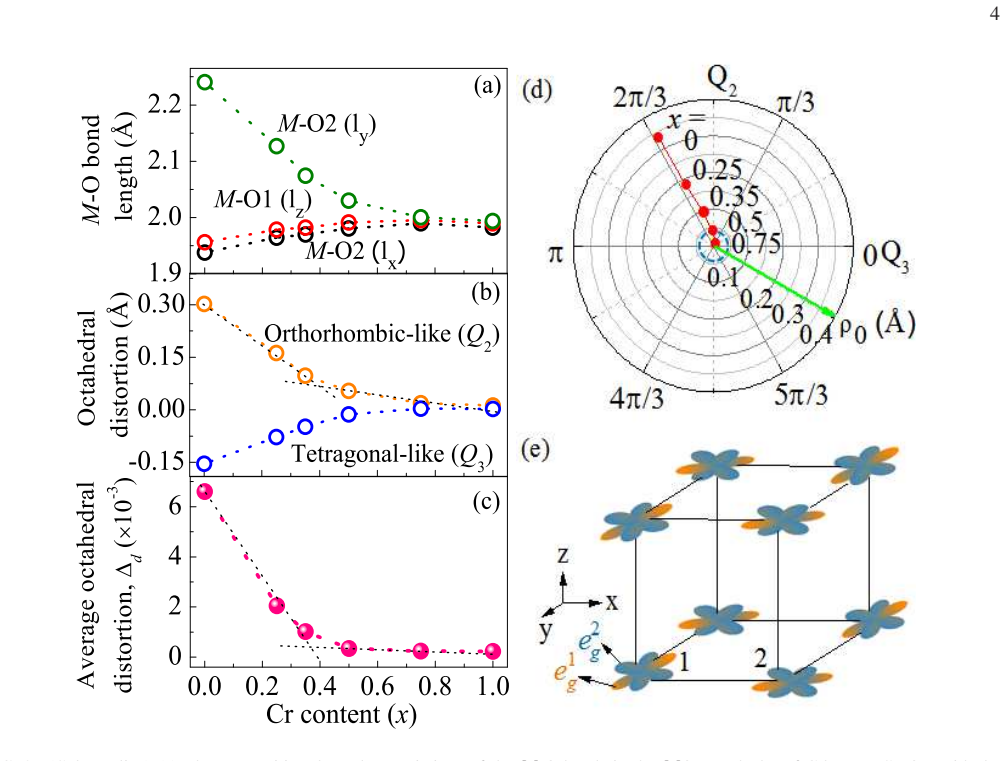
The argument is carried by the local Jahn-Teller distortion coordinates $Q_2 = l_y - l_x$ and $Q_3 = (2l_z - l_x - l_y)/\sqrt{3}$, defined from the three M-O bond lengths in the $M$O$_6$ octahedron, together with the derived quantities $\Delta d$, $\delta d$, $\rho_0 = \sqrt{Q_2^2 + Q_3^2}$ and the angle $\phi = \tan^{-1}(Q_3/Q_2)$. These coordinates quantify how the bond anisotropy shrinks as chromium replaces manganese, and a slope crossover in them near $x \approx 0.35$ is the paper's marker for the transition from a Jahn-Teller-active to a Jahn-Teller-inactive regime. Because the same coordinates determine the occupied $e_g$ orbital wavefunction, the structural crossover doubles as an orbital-ordering crossover. Magnetization reversal, Raman mode shifts, O $K$-edge XAS peak evolution, and DFT magnetic energies are then all compared against this structural coordinate.
What would settle it
Collect high-resolution diffraction data on a dense doping ladder spanning $x = 0.25$ to $0.5$ (for example, steps of 0.05), refine $Q_2$, $Q_3$, $\Delta d$, and $\delta d$ with full uncertainties, and fit a piecewise-linear or sigmoidal crossover: if no statistically significant break appears near $x \approx 0.35$, or if magnetization reversal on the same samples begins at a different composition, the central claim is falsified.
Extended reading notes
Core claim
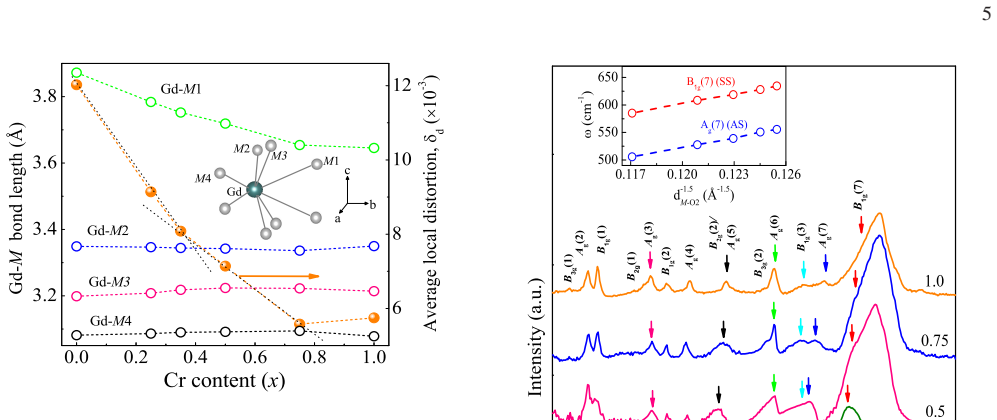
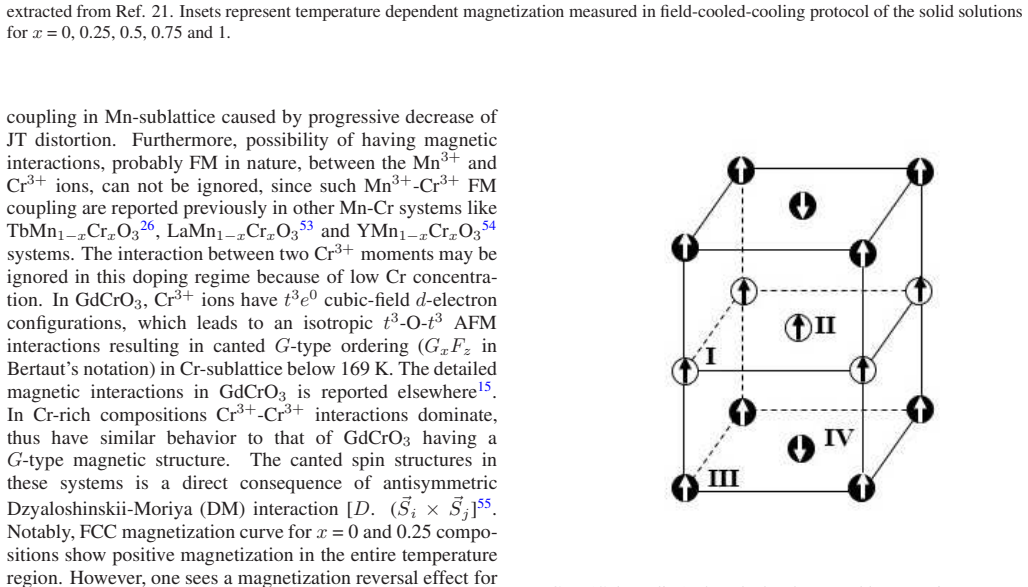
The paper's central discovery is that GdMn$_{1-x}$Cr$_x$O$_3$ has a Jahn-Teller-active region for $x \lesssim 0.35$ and a Jahn-Teller-inactive region beyond it, marked by a slope crossover in the octahedral distortion parameters $Q_2$, $Q_3$, $\Delta d$ and in the local Gd-environment distortion $\delta d$, all extracted from Rietveld refinement of powder x-ray diffraction. In the same series, magnetization measured in field-cooled-cooling mode stays positive for $x = 0$ and $0.25$ but reverses sign for $x = 0.5, 0.75$ and $1.0$, so the onset of reversal coincides with the structural crossover. The paper interprets this as evidence that the exchange couplings respond directly to the loss of cooperative Jahn-Teller order, and it uses GGA+$U$ density functional theory at $x = 0.5$ to identify the magnetic ground state as a layer-by-layer arrangement with ferromagnetic Mn-Mn coupling, antiferromagnetic Cr-Cr coupling, and a small ferromagnetic Mn-Cr coupling, distinct from either parent compound.
Load-bearing premise
The crossover at $x \approx 0.35$ is read by eye from slope changes in refined distortion parameters measured at only five compositions (0, 0.25, 0.5, 0.75, 1.0), with no reported error bars or fitted crossover function, so the claimed coincidence with magnetization reversal rests on the reality of that slope break.
Editorial extensions
If this is right
- For $x \lesssim 0.35$ the Mn sublattice retains its Jahn-Teller-distorted, orbitally ordered state, so the balance of nearest-neighbor ferromagnetic and next-nearest-neighbor antiferromagnetic interactions stays manganite-like; above the crossover the lattice becomes more regular and Cr-like.
- Magnetization reversal in FCC mode appears only for $x \ge 0.35$, making the sign of the low-temperature net moment a marker of the same structural boundary.
- The nonmonotonic remnant magnetization, peaking near $x \sim 0.3$, follows from a competition among FM Mn-Mn, NNN-AFM Mn-Mn, FM Mn-Cr, and AFM Cr-Cr couplings as the Jahn-Teller distortion weakens.
- At $x = 0.5$ the predicted ground state consists of ferromagnetic Mn layers and antiferromagnetic Cr layers stacked along $c$, with a weak ferromagnetic Mn-Cr exchange, a configuration unlike either parent compound.
- The $bc$-plane anisotropy of the eight nearest Gd-M bonds tracks the same crossover, so the local rare-earth environment is also tied to the Jahn-Teller order.
Reading between the lines
- The five-point composition grid (0, 0.25, 0.5, 0.75, 1.0) leaves the location of the crossover underdetermined; a denser series between $x=0.25$ and $0.5$ with stated uncertainties could confirm or refute the $x\approx0.35$ boundary.
- If the coincidence is causal, then external tuning that changes the cooperative Jahn-Teller distortion—such as hydrostatic pressure or strain—should shift the magnetization-reversal onset along with the structural crossover; measuring both on the same crystals would test this.
- The same $Q_2/Q_3$-based analysis could be applied to other $R$Mn$_{1-x}$Cr$_x$O$_3$ series to see whether a universal critical Cr fraction emerges or whether the crossover depends on the rare-earth site.
- The small ferromagnetic Mn-Cr exchange at $x=0.5$ could hide a near cancellation of AFM superexchange and FM double exchange; transport or susceptibility measurements across a wider doping window might expose the double-exchange contribution.
Signed reviews
Editorial analysis
A structured set of objections, weighed in public.
Referee Report
Summary. The manuscript reports a combined experimental and DFT study of the solid solution GdMn1-xCrxO3 for x = 0, 0.25, 0.5, 0.75, and 1.0. Room-temperature XRD with Rietveld refinement is used to track the evolution of Mn-O bond lengths, the Jahn-Teller modes Q2 and Q3, and the octahedral and local Gd-environment distortions; Raman and O K-edge XAS are used to probe lattice and electronic changes, and magnetization measurements are used to characterize the magnetic response. The central claim is that the cooperative Jahn-Teller distortion and associated orbital ordering persist only up to x ≈ 0.35, and that the appearance of magnetization reversal in field-cooled-cooling mode for x ≥ 0.35 coincides with this structural crossover, implying a strong coupling between structural distortion and magnetic interactions. Density functional theory calculations for x = 0.5 are presented, finding a layer-by-layer Mn/Cr arrangement with ferromagnetic Mn-Mn coupling, antiferromagnetic Cr-Cr coupling, and weak ferromagnetic Mn-Cr coupling; a four-parameter spin Hamiltonian fitted to four DFT energies predicts the fifth DFT energy reasonably well.
Significance. If the central claim is quantitatively established, the paper would provide a clear example of doping-tuned entanglement of lattice, orbital, and spin degrees of freedom in an orthorhombic perovskite: the suppression of the Jahn-Teller distortion is argued to coincide with the onset of magnetization reversal. The experimental work has genuine strengths: the conclusions are supported by several independent techniques (XRD, Raman, XAS, magnetization), the XAS data are interpreted with DFT density-of-states calculations for both end members, and the DFT spin-Hamiltonian analysis includes a nontrivial internal check by predicting a fifth energy from four fitted parameters. The nonmonotonic remnant magnetization is an interesting observation. The main weakness is that the crossover concentration x ≈ 0.35 is inferred from a visually identified slope change in Rietveld-derived quantities at only five compositions, without error bars or a fitted crossover function, and the claimed coincidence with magnetization reversal rests on the gap between x = 0.25 and x = 0.5.
major comments (3)
- [Section III (XRD/Rietveld analysis); Figs. 2(b), 2(c), and 3] The central claim that the Jahn-Teller distortion and orbital ordering persist up to x ≈ 0.35 is based on visually identified slope changes in Q2, Q3, Δd, and δd from Rietveld refinement at only five compositions (x = 0, 0.25, 0.5, 0.75, 1.0). No error bars or confidence intervals are reported for the refined bond lengths, no crossover function is fitted, and the two apparent regimes are separated by a gap between x = 0.25 and 0.5. As presented, this apparent slope break cannot be distinguished from coarse sampling or from refinement artifacts such as the single-phase Pbnm average over potentially inhomogeneous local environments. Please add more compositions around the proposed crossover, report Rietveld uncertainties, and fit a quantitative crossover (e.g., a broken-line or smooth threshold model) or, if that is not possible, explicitly soften the claims that depend on the specific value 0.35.
- [Section III (Magnetization); Fig. 6 and insets] The claimed coincidence between the Jahn-Teller crossover and the onset of magnetization reversal is inferred from only two data points: x = 0.25 shows no reversal, while x = 0.5, 0.75, and 1.0 show reversal. The threshold for reversal could therefore lie anywhere in the interval (0.25, 0.5), and the statement that reversal begins at x ≥ 0.35 is not quantitatively established. Please define an explicit operational criterion for magnetization reversal (e.g., the temperature at which the FCC magnetization changes sign) and determine its composition dependence with intermediate compositions, or restate this point as a plausible conjecture rather than a demonstrated coincidence.
- [Section III (DFT); Table I and Eqs. (2)-(6)] The spin-Hamiltonian parameters J1, J2, J3, and Δ are obtained by solving four equations using GGA+U energies with a single set of Hubbard parameters (U = 3 eV for Mn/Cr and U = 4 eV for Gd, with Gd 4f treated as core for the x = 0.5 cell). The fifth-energy check is a useful internal consistency test, but it does not establish that the ordering of magnetic states in Table I is robust to the choice of U or to the treatment of the Gd 4f electrons. Since the DFT conclusion that Mn-Mn is ferromagnetic while Cr-Cr is antiferromagnetic at x = 0.5 is one of the paper's stated findings, please show the U-dependence of the relevant energy differences or otherwise justify that the qualitative ordering in Table I is not an artifact of the chosen U values.
minor comments (6)
- [Abstract and Section I] The end members are referred to as 'GMnO3' in the abstract and introduction; this should be 'GdMnO3'.
- [Section III and Fig. 2 caption] The name 'Reitveld' is misspelled in several places; it should be 'Rietveld'.
- [Section III (Raman); Fig. 4 inset] The text refers to the symmetric stretching Jahn-Teller mode as B1g(7), while the Fig. 4 inset labels it B2g(7); please reconcile the mode labeling.
- [Section III (Δd discussion)] There is a duplicated word in 'shows shows a slope changeover'; please correct this typo.
- [Section III (Spin Hamiltonian); Eq. (1)] The summation notation in Eq. (1), in particular ∑_{<ll'>l}, is confusing because the layer index l appears both as a summation variable and as part of the bond labeling; please rewrite this notation more clearly.
- [Section III (DFT); Eqs. (2)-(6)] The phrase 'In the mean-field approximation, energy/unit-cell' before Eqs. (2)-(6) is misleading, because the equations are DFT total energies of specific spin configurations rather than mean-field expectation values of the spin Hamiltonian.
Circularity Check
No significant circularity: the structural crossover and magnetization reversal are empirical correlations, and the DFT spin-Hamiltonian fifth-energy comparison is a genuine internal consistency check, not a constructionally forced result.
full rationale
The paper's central claim is an empirical correlation between two independently measured observables: structural parameters from Rietveld refinement of XRD (Q2, Q3, Δd, δd) and magnetization reversal from FCC curves. The JT crossover at x≈0.35 is inferred from visual slope changes in those refined parameters; this is a quantitative-precision weakness, not a circularity, because the crossover is not defined in terms of the magnetization reversal and vice versa. The spin-Hamiltonian analysis in Section III is a legitimate internal check: J1, J2, J3, and Δ are solved from four DFT energies (Eqs. 2–5), and the fifth energy is then computed from those parameters and compared with the DFT value (predicted 117.78 meV vs. calculated 125.33 meV). That is not fitting the target; it is a hold-out consistency test within a model. The DFT calculations use U values stated to explain experimental results, but the paper does not present the DFT agreement as a first-principles prediction of the crossover, and the central structural/magnetic correlation does not depend on the tuned U. Self-citations (Refs. 14, 15, 18) are used for background magnetic structures of the parent compounds and are not load-bearing for the new claim. No equation reduces to its input by construction, no fitted parameter is renamed as a prediction, and no uniqueness theorem from the authors' prior work is invoked to force the interpretation. The limitations of the coarse composition grid and absent error bars are robustness concerns, not circularity.
Assumptions & free parameters
free parameters (6)
- Hubbard U for Mn/Cr =
3 eV
- Hubbard U for Gd =
4 eV
- J1 (Mn-Mn nearest-neighbor exchange) =
4.39 meV (ferromagnetic)
- J2 (Cr-Cr nearest-neighbor exchange) =
-1.26 meV (antiferromagnetic)
- J3 (Mn-Cr nearest-neighbor exchange) =
0.55 meV (ferromagnetic)
- Delta (spin Hamiltonian constant) =
65.48 meV
assumptions (5)
- domain assumption GGA+U with PBEsol accurately captures the relative total energies of the magnetic configurations.
- ad hoc to paper The x=0.5 sample has the ordered layer-by-layer cation arrangement used in the 20-atom DFT cell.
- domain assumption Treating Gd 4f electrons as core in GdMn0.5Cr0.5O3 does not change the Mn/Cr magnetic couplings.
- domain assumption The Rietveld refinements in Pbnm (and Pna21 for x=1) correctly assign the bond lengths used to compute Q2 and Q3.
- domain assumption The DM interaction contribution to canting is approximately constant across the series.
Cite this review
Pith. "Pith review of Site-substitution in GdMnO3 : effects on structural, electronic and magnetic properties." pith.science (2026). https://pith.science/paper/3U3N3Q6J
@misc{pith2026190802307,
  author       = {Pith},
  title        = {Pith review of: Site-substitution in GdMnO3 : effects on structural, electronic and magnetic properties},
  year         = {2026},
  howpublished = {\url{https://pith.science/paper/3U3N3Q6J}},
  note         = {Machine review of arXiv:1908.02307}
}
abstract
We report on detailed structural, electronic and magnetic studies of GdMn$_{1-x}$Cr$_x$O$_3$ for Cr doping levels 0 $\le$ $x$ $\le$ 1. In the solid solutions, the Jahn-Teller distortion associated with Mn$^{3+}$ ions gives rise to major changes in the ${bc}$-plane sub-lattice and also the effective orbital ordering in the ${ab}$-plane, which persist up to the compositions $x$ $\sim$ 0.35. These distinct features in the lattice and orbital degrees of freedom are also correlated with $bc$-plane anisotropy of the local Gd environment. A gradual evolution of electronic states with doping is also clearly seen in O $K$-edge x-ray absorption spectra. Evidence of magnetization reversal in field-cooled-cooling mode for $x$ $\ge$ 0.35 coinciding the Jahn-Teller crossover, suggests a close correlation between magnetic interaction and structural distortion. These observations indicate a strong entanglement between lattice, spin, electronic and orbital degrees of freedom. The nonmonotonic variation of remnant magnetization can be explained by doping induced modification of magnetic interactions. Density functional theory calculations are consistent with a layer-by-layer type doping with ferromagnetic (antiferomagnetic) coupling between Mn (Cr) ions for intermediate compound ($x$ = 0.5), which is distinct from that observed for the end members GMnO$_3$ and GdCrO$_3$.
Figures

Figures from the paper (5 more)



Reference graph
Works this paper leans on
-
[3]
2 (d), where φ opens from the Q2 axis in anticlockwise direction35
versus the angle φ (= tan − 1( Q3 Q2 ) was mapped for the compositions as shown in Fig. 2 (d), where φ opens from the Q2 axis in anticlockwise direction35. The description of the eg orbital associated with the M atom in an M O6 octahedron can be made by the wave function ψ with a linear combination of orbitals |x2 −y2⟩ and |3z2 −r2⟩ in the (Q2,Q3) space a...
-
[4]
A complex interplay among the spin, orbital and lattice degrees of freedom has led to a large number of intriguing physical properties in RMnO3 such as colossal magnetoresistance 5, charge and orbital ordering 6– 8, metal- insulator transition9,10, complex spin structures11, multiferroic properties with significant magnetoelectric coupling 12. In contrast ...
-
[7]
(e) Schematic diagram of eg orbitals of Mn 3+ due to the JT orbital ordering
and φ (= tan− 1( Q3 Q2 ), which are used to describe the orbital mixing in GdMn 1− xCrxO3. (e) Schematic diagram of eg orbitals of Mn 3+ due to the JT orbital ordering. that the other predicted modes are either too low in intensit y or beyond our experimental range to be observed. The details about the observed modes are described elsewhere 14,26,37,38. T...
-
[8]
Previously parameters extracted from the XRD patterns, depicted in Fig
Ag(7) and B1g (7) modes show a clear shift up to x ∼ 0.5 composition. Previously parameters extracted from the XRD patterns, depicted in Fig. 2, shows a rapid decrease of M -O2 bond length with Cr doping up to x ∼ 0.5, suggesting that the clear shift in modes are arising from the rapid decrease o f M -O2 bond length. Beyond x ∼ 0.5 composition, both the 5...
-
[15]
It has non-centrosymmetric pna21 structure, associated with the ferroelectric transition concurrent to Cr magnetic ordering temperature with sig- nificant magnetoelectric coupling 13,14. Although the parent compounds without doping are well investigated, the doped solid solution GdMn 1− xCrxO3 is largely unexplored
-
[18]
Remarkably, magnetization at low temperature (10 K) increases gradually upon Cr-doping up to x ∼ 0.25 in TABLE I. Calculated relative energies ( E, in meV/unit cell) of vari- ous magnetic structures of GdMn 0.5Cr0.5O3. The unit cell contains two Mn and two Cr spins. The energies of the FM phase with layer - by-layer arrangements is used as the reference e...
-
[21]
This has motivated us to investigate the GdMn1− xCrxO3 series
V ari- ous interesting properties have been reported in similar ty pe of mixed cation compositions such as DyMn 1− xFexO322, LaMn1− xFexO323, TbMn 1− xFexO324, YbMn 1− xFexO325, TbMn1− xCrxO326 and others. This has motivated us to investigate the GdMn1− xCrxO3 series. In this paper we present systematic structural, elec- tronic and magnetic investigations...
-
[29]
The interaction between ions and electrons was approximated with P AW potentials, treating 3p, 3d and 4s for Cr/Mn and 2s and 2p for O as valence electrons. For Bril- louin zone sampling, we chose 12 ×12×8 Monkhorst-Packk- point mesh 30 and the wave-function was expanded in a basis set consisting of plane waves with kinetic energies less tha n or equal to...
Show all 14 references
-
[31]
To visualize the orbital ordering in GdMnO 3, in ad- dition to the globalX,Y ,Z orthorhombic frame a local frame specific to each Jahn-Teller-type distorted MnO 6 octahedron was defined choosing x,y,z along the middle, short, and long Mn-O axes, respectively31. III. RESULTS AND ...
-
[48]
The second peak of XAS spectrum /s50/s48/s48 /s52/s48/s48 /s54/s48/s48 /s56/s48/s48 /s48/s46/s49/s49/s55 /s48/s46/s49/s50/s48 /s48/s46/s49/s50/s51 /s48/s46/s49/s50/s54 /s53/s48/s48 /s53/s53/s48 /s54/s48/s48 /s54/s53/s48 /s66 /s49 /s103 /s40 /s55 /s41 /s32 /s65 /s103 /s40 /s55/...
-
[56]
It is found that structure with the layer-by-layer doping type with a FM interaction between Mn 3+ spins and AFM interaction between Cr 3+ spins is the most stable configuration similar to that of LaMn 0. 5Cr0. 5O3 58. In constructing an effective Spin Hamiltonian (SH) to under...
-
[58]
On the contrary, YMn 0
All the compounds discussed above possess Pbnm symmetry. On the contrary, YMn 0. 5Cr0. 5O3 has monoclinic structure with layer-by-layer arrangements of Mn and Cr along the c-axis and exhibits ferrimagnetic behavior59,60. In the present system GdMn0. 5Cr0. 5O3, Reitveld refineme...
-
[61]
It is possible that the small magnitude of J M n− Cr results from a near cancellation between two competing contributions, one the usual AFM super-exchange and the other FM double exchange. Figure 8 (a) and (b) shows the variation of the remnant mag- netization (Mr) at 10 K fo...
2002
-
[2017]
p. 130046. 16 Y . Cao, S. Cao, W. Ren, Z. Feng, S. Y uan, B. Kang, B. Lu, and J. Zhang, Applied Physics Letters 104, 232405 (2014) . 17 M. El Amrani, M. Zaghrioui, V . T. Phuoc, F. Gervais, and N. E. Massa, Journal of Magnetism and Magnetic Materials 361, 1 (2014) . 18 S. Maha...
2014
Reviewed August 14, 2026 · model on record in the stance chip above.
Discussion (0). Continue with ORCID to comment.