REVIEW 4 major objections 5 minor 4 references
Excess H, Suppressed He, and the Abundances of Elements in Solar Energetic Particles
T0 review · 4 major / 5 minor · reviewed 2026-08-14 · deepseek-v4-flash
Pith's one-line read The paper argues that hydrogen and helium abundances, measured against the same mass-to-charge power law fitted to heavier elements, sort solar energetic particle events into four acceleration regimes, with proton excess marking shocks…
desk verdict A useful four-category synthesis of SEP abundance behavior; the H energy mismatch is a real caveat, but the classification deserves a serious referee. read the letter →
The pith
A machine-rendered reading of the paper's core claim, the machinery that carries it, and where it could break.
The reading
What carries the argument
The load-bearing object is the enhancement-versus-$A/Q$ power law. For each element, the observed abundance relative to oxygen is divided by a reference SEP-coronal abundance, plotted against the ion's mass-to-charge ratio $A/Q$ at a trial source temperature, and fitted as a power law for elements with $Z \geq 6$; the best temperature is selected by minimum $\chi^2$. Extrapolating that fitted line down to $A/Q = 1$ yields the predicted proton enhancement, so the proton excess is measured as the vertical distance of H above the line. The companion mechanism is a two-component seed-population picture for shocks, in which weak or quasi-perpendicular shocks preferentially accelerate pre-existing impulsive suprathermals at high $Z$ but draw their protons from ambient coronal plasma.
What would settle it
A direct test: measure H abundances in multiple energy channels within one gradual event that shows the excess, from 2–2.5 MeV up to 10–20 MeV per nucleon, and check whether the proton deviation above the $Z \geq 6$ $A/Q$ power law stays constant as a function of energy; if it vanishes at matched energies per nucleon, the excess is an instrument or transport artifact rather than a seed-population effect. A complementary check is to estimate the shock obliquity $\theta_{Bn}$ for each gradual event and test whether the proton-excess subset coincides with quasi-perpendicular geometry.
Extended reading notes
Core claim
The central claim is that H and He are not anomalies but informative endpoints of the $A/Q$ power law. Taking the measured element/O abundances from the Low-Energy Matrix Telescope, dividing by reference SEP-coronal abundances, and fitting the resulting enhancements against $A/Q$ for elements with $Z \geq 6$ gives a power law; extrapolating it to $A/Q = 1$ predicts where protons should be. The author finds that protons either lie on that line or exceed it by roughly an order of magnitude, and the pattern—combined with occasional order-of-magnitude helium suppressions—defines four categories: pure shock-free impulsive events (H fits, He may be suppressed); impulsive events with a CME-driven shock (He fits, H is in excess because the shock preferentially reaccelerates impulsive ions at high Z while sampling ambient protons at $Z=1$); gradual events with fast, strong shocks that sample ambient coronal plasma deeply (H fits); and gradual events with weak or quasi-perpendicular shocks that recycle impulsive suprathermal residue (H is in excess). The mechanism proposed is a two-component seed population: pre-accelerated impulsive ions dominate $Z > 2$, while ordinary coronal protons dominate $Z = 1$ whenever a shock is too weak to draw deeply on the thermal plasma.
Load-bearing premise
The classification assumes that protons measured only in the 2–2.5 MeV channel can be placed on the same $A/Q$ power law fitted to heavier ions measured at 2–20 MeV per nucleon; if energy-dependent acceleration, transport, or wave growth breaks that scaling, the apparent H fit or excess would be an artifact of comparing different energies rather than different elements.
Editorial extensions
If this is right
- A proton excess can be used as a diagnostic: whenever H lies well above the $A/Q$ power-law line, a shock is recycling impulsive suprathermals, regardless of whether the event is labeled impulsive or gradual.
- The four categories imply that pure impulsive events should be shock-free and small, with Fe/O at least four times the coronal reference and no fast CME; such events may also show strong He suppression without any proton excess.
- Gradual events with source temperatures near 3 MK and positive $A/Q$ slopes should be the smaller, recycled-impulsive events with proton excesses, while the most intense gradual events with cooler ($<2$ MK) plasma should show H on the fitted line.
- The 3 MK impulsive source plasma has He/O near 90, whereas the overall gradual-event average is about 57, so He/O itself is a temperature and seed-population tracer across event classes.
- Helium suppression is the only clear event-to-event FIP-related variation among the elements studied, which constrains models of chromospheric fractionation to explain how rapid jet rise can amplify a predicted factor-of-two suppression to an order of magnitude.
Reading between the lines
- If the two-component seed picture is right, the size of the proton excess should track shock obliquity and speed continuously rather than only as a binary category; comparing H/He with independently modeled $\theta_{Bn}$ for a sample of gradual events would be a quantitative check.
- The He-suppression mechanism should in principle affect other slow-ionizing high-FIP species; a dedicated search for suppressed Ne or Ar in the same strongly He-poor jets could separate the FIP-related effect from the $A/Q$ enhancement that usually masks it.
- Because the paper's proton data are confined to 2–2.5 MeV while heavier ions span 2–20 MeV per nucleon, the cleanest extension is to measure protons across matched energies in the same events; if the excess survives at equal energy per nucleon, the seed-population interpretation is on much firmer ground.
- The same 'proton excess equals ambient protons plus recycled impulsive seeds' logic could be exported to corotating-interaction-region shocks, where a similarly mixed seed population has been reported; a proton-excess survey there would test whether the mechanism is generic to weak heliospheric shocks.
Signed reviews
Editorial analysis
A structured set of objections, weighed in public.
Referee Report
Summary. The paper uses Wind/LEMT observations of elemental abundances in solar energetic particle (SEP) events to argue that the behavior of hydrogen, specifically whether its abundance enhancement at A/Q=1 falls on the power-law trend defined by heavier ions (Z >= 6) or lies above it, distinguishes four physical acceleration scenarios: (i) pure, shock-free impulsive events where H fits the extrapolated power law and He may be suppressed by an order of magnitude; (ii) impulsive events with CME-driven shocks that reaccelerate impulsive ions while adding ambient protons, producing a proton excess; (iii) large, strong gradual events where shocks sample ambient coronal plasma and H again fits the power law; and (iv) weaker or quasi-perpendicular gradual shocks that preferentially reaccelerate impulsive suprathermal residue and produce proton excesses. Source-plasma temperatures are derived from chi-square fits to the A/Q power law, and comparisons are made with CME speeds and widths from the SOHO/LASCO catalog.
Significance. If the central dichotomy (H on/off the extrapolated power law) is robust, this paper offers a new, observationally inexpensive diagnostic for classifying SEP acceleration physics and would sharpen the distinction between reconnection-dominated and shock-dominated events. The author draws on a large event sample and on previously published, well-established fitting methods (chi-square minimization over ionization temperature, power-law fits in A/Q), and the four-category taxonomy makes explicit, falsifiable predictions about H and He abundances in future events. The use of publicly available CME catalogs and the quantitative comparisons with CME speed and width strengthen the empirical basis. However, the paper's central claim rests on comparing H measured in a narrow low-energy channel with a power law fitted to heavier ions over a much wider energy range, and this systematic is not controlled; in addition, the 'pure' impulsive subset is defined using the very H-fit criterion that is then reported as a finding.
major comments (4)
- [Sections 1, 2, 5 (energy-matching)] The central classification depends on placing protons measured at 2-2.5 MeV on a power law fitted to heavier elements (Z >= 6) measured over 2-20 MeV/nuc. The paper states in the Introduction that 'energies of H are limited to 2-2.5 MeV' but does not restrict the heavy-ion fits to a matching energy interval or demonstrate that the A/Q enhancements are energy-independent. Section 5 itself describes strong energy-dependent resonance effects (e.g., 2.5 MeV protons resonate with waves generated by 10 MeV protons), so the apparent H fit or excess could be an energy artifact rather than an abundance property. The authors should either refit the Z >= 6 enhancements in a narrow energy band centered near 2.5 MeV/nuc, or explicitly test how many event classifications change when the heavy-ion fit is restricted to the H energy range.
- [Section 2 (selection circularity)] The 'pure' impulsive subset is operationally defined by the H-fit criterion: the paper reports that 17 of 70 events with measurable proton intensities (24%) have H within 1 sigma of the Z >= 6 power-law extrapolation, and these 17 events then form the subset in which 'H fits' the power law. This is circular and also weak in a statistical sense, since 24% is far below the ~68% expected if H were truly consistent with the power law. The authors should select the 'pure' subset using an independent criterion (e.g., small event size, absence of a CME, or low proton intensity) and then report the H-fit fraction, or at minimum quantify how the reported conclusions change when the H-fit preselection is removed.
- [Section 5 (He suppression explanation)] The paper explicitly acknowledges that Laming (2009) predicts at most a factor of about two He suppression, while the events studied show order-of-magnitude suppressions, and the proposed 'rapid chromospheric rise' explanation is presented without a quantitative model. Since suppressed He is one of the four defining categories in the Summary, the explanation is currently unsupported; the authors should either provide a quantitative estimate of the dynamic FIP-processing effect, or clearly label this as a hypothesis to be tested by future modeling and state what observational signature (for example, a correlation with jet speed or type III burst properties) would confirm or refute it.
- [Section 3 (temperature selection bias)] The paper states that temperatures could be assigned to only about 70% of gradual SEP events and that the failures arose when the A/Q dependence was too flat, which may bias the sample toward events containing reaccelerated impulsive ions. Because the gradual-event categorization (ambient T < 2 MK vs. recycled-impulsive T ~ 3 MK) relies on these assigned temperatures, the bias could affect the reported fractions of gradual events in each category. The authors should quantify how the inclusion or exclusion of the unassigned-temperature events affects the claimed dichotomy, for example by using a proxy such as the Fe/O enhancement or the H-excess criterion for those events.
minor comments (5)
- [Throughout (notation)] The paper uses 'He' to mean 4He after stating this, but the 3He/4He discussion in Section 5 would be clearer if the mass number were retained consistently in that paragraph.
- [Figure 2 caption] The caption says intensities, abundance ratios, and enhancements are compared for the two events, but it would help to state explicitly which energy intervals are used for each quantity and to include the 1-sigma error band on the power-law extrapolation to A/Q = 1.
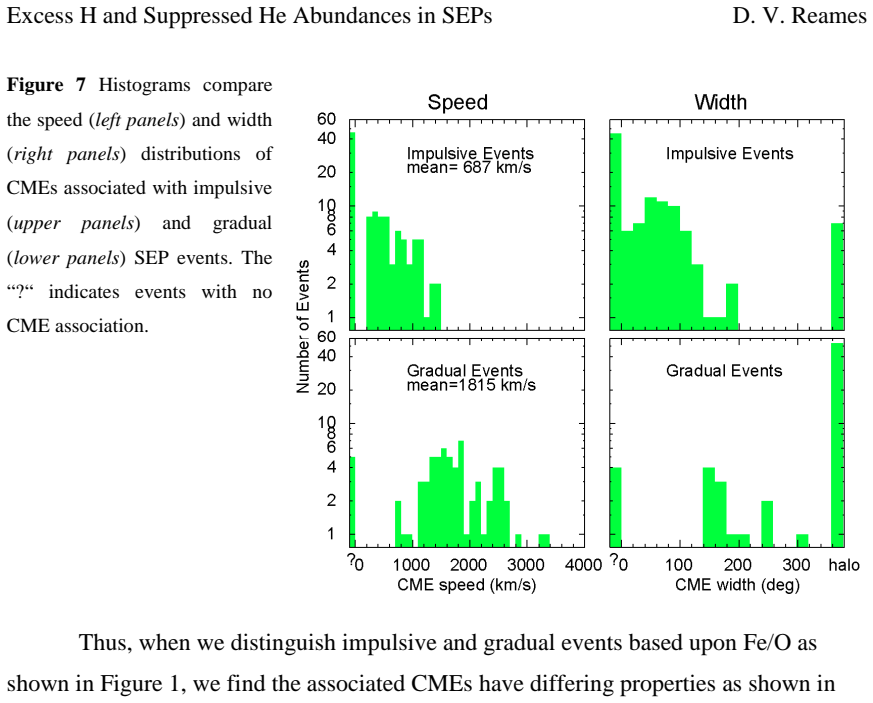
- [Section 4, Figure 7] The histogram bins in Figure 7 are not described; adding bin widths and the number of events per bin would help the reader assess the separation between the CME speed distributions.
- [Appendix, Table 1] The reference abundances are taken from previous Reames papers; a sentence noting that the table values are consistent with those sources and that the enhancement definition uses O as the normalizing element would improve reproducibility.
- [Section 6, items (iii) and (iv)] The distinction between quasi-parallel and quasi-perpendicular shocks in the Summary is presented as established, but the observables used to classify shock geometry in the present sample (if any) are not described earlier; either state the assumed geometry from event characteristics or cite the specific measurements used.
Circularity Check
Two construction circularities: the 'pure' impulsive class is selected by the H-fit criterion it is then said to exhibit, and the gradual-event H 'prediction' is anchored by reference abundances averaged from gradual events.
-
self definitional
[Section 2, paragraph after Figure 2; Section 6 Summary category (i)]
"Of the 111 impulsive SEP events studied (Reames, Cliver, and Kahler, 2014a), 70 have proton intensities above background and 17 (24%) of these have proton intensities within one standard deviation of the value predicted by the best-fit line of the ions with Z ≥ 6 (Reames, 2019a)."
The 'pure, shock-free' impulsive class is selected by the criterion that protons lie within 1σ of the power-law extrapolation from Z ≥ 6 ions. The abstract and Summary then report that in this class 'protons with A/Q = 1 fit the power-law dependence ... extrapolated from the heavier elements.' That statement is a restatement of the sample-selection rule, not an independent finding: the subset was constructed so that H fits, and the remaining events are, by construction, the 'proton excess' class. H is not used in the fit itself, so the extrapolation test is not circular; the circularity is in defining the physical category by the outcome it is then said to exhibit.
-
fitted input called prediction
[Appendix (reference abundances), Section 1, and Abstract claim for gradual events]
"The average element abundances in gradual SEP events are a measure of the coronal abundances sampled by SEP events (Reference SEPs in Table 1). ... Ion 'enhancements' are defined as the observed abundance of a species, relative to O, divided by the reference abundance of that species, relative to O."
The H reference abundance (H/O = 1.6×10^6) and the heavy-element references are themselves averages of gradual SEP events. An event that 'samples the ambient coronal plasma more deeply' should therefore have enhancements near unity for all species by construction, so the claim that H 'again fit[s] the same power-law distribution as all other elements' in the largest gradual events is substantially anchored by the normalization: the average gradual event defines the reference against which 'fitting' is measured. The power-law slope is fitted to Z ≥ 6 deviations, so the test is not purely identity, but the 'prediction' for H in gradual events is partly the input average renamed as an outcome.
full rationale
The central H-versus-extrapolation test itself is not circular, because H is excluded from the Z ≥ 6 power-law fit; protons at A/Q = 1 are genuinely compared with an extrapolated line. However, two construction circularities are present. First, the 'pure' impulsive subset is defined by protons lying within 1σ of that extrapolation, and the paper then presents H fitting in that subset as a physical discovery; the category is defined by the very property it is said to predict. Second, the reference abundances used to define 'enhancements' are averages of gradual SEP events, so the claim that large gradual events show H fitting the same power law is partly a reflection of the normalization: the average gradual event has unit enhancements by definition. The acknowledged energy mismatch (H measured at 2–2.5 MeV versus heavy ions at 2–20 MeV/nuc) is a legitimate correctness risk that could break the A/Q scaling, but it is not a circularity because it concerns the validity of the comparison, not its logical structure. No uniqueness theorem or load-bearing self-citation chain is invoked; the paper is an empirical taxonomy. On balance, the classification scheme has partial circularity but retains independent content in the CME-speed, He-suppression, and temperature correlations.
Assumptions & free parameters
free parameters (4)
- Per-event source plasma temperature T =
0.8-4 MK across events
- Power-law slope for Z >= 6 enhancements =
e.g., 1.9 +/- 0.2 down to 0.44 +/- 0.35 for the 18 April 2014 event
- Fe/O impulsive-event threshold =
4x reference abundance
- Proton-excess criterion =
within 1 sigma versus order-of-magnitude
assumptions (4)
- domain assumption Element abundance enhancements follow a power law in mass-to-charge ratio A/Q
- domain assumption Ion charge states Q are set by equilibrium ionization at the fitted source temperature T
- domain assumption Reference SEP abundances in Table 1 represent true coronal abundances
- ad hoc to paper The FIP-effect theory (Laming 2009) applies to rapid chromospheric rise
Cite this review
Pith. "Pith review of Excess H, Suppressed He, and the Abundances of Elements in Solar Energetic Particles." pith.science (2026). https://pith.science/paper/ANIWMLQX
@misc{pith2026190802321,
  author       = {Pith},
  title        = {Pith review of: Excess H, Suppressed He, and the Abundances of Elements in Solar Energetic Particles},
  year         = {2026},
  howpublished = {\url{https://pith.science/paper/ANIWMLQX}},
  note         = {Machine review of arXiv:1908.02321}
}
read the original abstract
Recent studies of the abundances of H and He relative to those of heavier ions in solar energetic particle (SEP) events suggest new features in the underlying physics. Impulsive SEP events, defined by uniquely large enhancements of Fe/O, emerge from magnetic reconnection in solar jets. In small, "pure," shock-free, impulsive SEP events, protons with mass-to-charge ratio A/Q = 1 fit the power-law dependence of element abundance enhancements versus A/Q extrapolated from the heavier elements 2 < Z < 57. Sometimes these events have order-of-magnitude suppressions of He, even though H fits with heavier elements, perhaps because of the slower ionization of He during a rapid rise of plasma from the chromosphere. In larger impulsive SEP events, He fits, but there are large proton excesses relative to the power-law fit of Z > 2 ions, probably because associated coronal mass ejections (CMEs) drive shock waves fast enough to reaccelerate the impulsive SEPs but also to sample protons from the ambient solar plasma. In contrast, gradual SEP events are accelerated by wide, fast CME-driven shock waves, but those with smaller, weaker shocks, perhaps quasi-perpendicular, favor impulsive suprathermal residue left by many previous jets, again supplemented with excess protons from ambient coronal plasma. In the larger, more common gradual SEP events, faster, stronger shock waves sample the ambient coronal plasma more deeply, overwhelming any impulsive-ion component, so that proton abundances again fit the same power-law distribution as all other elements. Thus, studies of the power-law behavior in A/Q of SEP element abundances give compelling new information on the varying physics of SEP acceleration and properties of the underlying corona.
Figures
Reference graph
Works this paper leans on
-
[1]
Asplund, M., Grevesse, N., Sauval, A.J., Scott, P.: 2009, The chemical composition of the sun, Ann. Rev. Astron. As- trophys . 47 , 481 doi: 10.1146/annurev.astro.46.060407.145222 Bell, A.R.: 1978, The acceleration of cosmic rays in shock fronts. I , Mon. Not. Roy.Astron. Soc., 182 , 147 doi: 10.1093/mnras/182.2.147 Breneman, H.H., Stone, E.C.: 1985, Sola...
arXiv 2009
-
[255]
2015, Case studies of multi-day 3He-rich solar energetic particle peri- ods, Astron
doi:10.1007/s11207-010-9541-4 Chen, N.H., Bu čík R., Innes D.E., Mason G.M. 2015, Case studies of multi-day 3He-rich solar energetic particle peri- ods, Astron. Astrophys . 580 , 16 doi: 10.1051/0004-6361/201525618 Cliver, E.W., Kahler, S.W., Reames, D.V.:2004, Coronal shocks and solar energetic proton events, Astrophys. J. 605 902 doi: 10.1086/382651 Des...
-
[560]
M.: 2007 3He-rich solar energetic particle events, Space Sci
Mason, G. M.: 2007 3He-rich solar energetic particle events, Space Sci. Rev . 130 , 231 doi: 10.1007/s11214-007-9156-8 Mason, G.M., Mazur, J.E., Dwyer, J.R.: 2002, A new heavy ion abundance enrichment pattern in 3He-rich solar particle events. Astrophys. J. Lett . 565, L51 doi: 10.1086/339135 Mason, G.M., Mazur, J.E., Dwyer, J.R., Jokippi, J.R., Gold, R.E...
-
[585]
The Abundance of Helium in the Source Plasma of Solar Energetic Particles
doi: 10.1029/95RG00188 Reames, D.V.: 1999, Particle acceleration at the sun and in the heliosphere, Space Sci. Rev . 90 , 413 doi: 10.1023/A:1005105831781 Reames, D.V.: 2000, Abundances of trans-iron elements in solar energetic particle events, Astrophys. J. Lett . 540 , L111 doi: 10.1086/312886 Reames, D.V.:2009a, Solar release times of energetic particl...
work page Pith review arXiv 1999
Reviewed August 14, 2026 · model on record in the stance chip above.
Discussion (0). Continue with ORCID to comment.