REVIEW 1 major objections 3 minor 18 references
The Poincare lemma, antiexact forms, and fermionic quantum harmonic oscillator
T0 review · 1 major / 3 minor · reviewed 2026-08-14 · deepseek-v4-flash
Pith's one-line read The homotopy operator of the Poincaré lemma works as an abstract integral and, on complex manifolds, creates a mirror of the Dolbeault complex.
desk verdict Clean, modest homotopy-operator paper with a genuine new complex split; watch for a small but real error in the k=0 eigenvalue spectrum. read the letter →
The pith
A machine-rendered reading of the paper's core claim, the machinery that carries it, and where it could break.
The reading
What carries the argument
The load-bearing object is the integral homotopy operator $H\omega=\int_0^1 K\lrcorner\omega_{F(t,x)}t^{k-1}dt$, where $K=(x-x_0)^i\partial_i$ is the radial vector field and $F(t,x)=x_0+t(x-x_0)$ is the line homotopy to $x_0$. It is nilpotent, $H^2=0$, and it satisfies $dH+Hd=I-s^*_{x_0}$, i.e., it inverts $d$ up to evaluation at $x_0$. Those two relations are the whole engine: they produce the exact/antiexact decomposition, the abstract calculus, the oscillator eigenvalues, and, after splitting $K=K_++K_-$ on a complex manifold, the dual Dolbeault double complex with its two holomorphic/antiholomorphic boundary subcomplexes.
What would settle it
On the unit ball in $\mathbb{R}^3$, evaluate $H^2$ on the smooth 2-form $\omega=x\,dy\wedge dz$ using the integral definition of $H$; the paper's algebra predicts exactly zero, so any nonzero value refutes the algebraic core. Similarly, for any exact 1-form $\omega=d\mu$ with $\mu$ vanishing at $x_0$, the predicted eigenvalue relation $Hd\omega=-\omega$ can be checked directly by quadrature.
Extended reading notes
Core claim
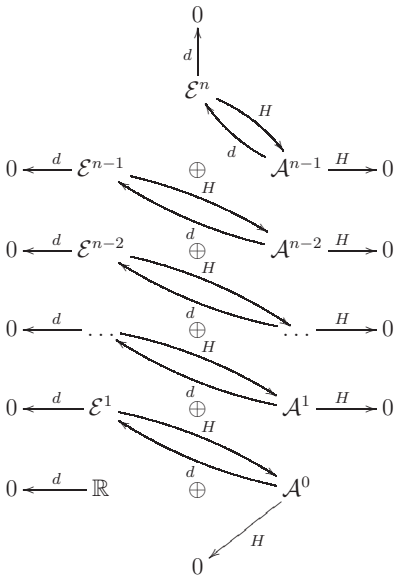
The paper's central claim is that the homotopy operator $H$ from the Poincaré lemma is not an isolated proof device: on a star-shaped region it satisfies $dH+Hd=I-s^*_{x_0}$ and $H^2=0$, which makes $d$ and $H$ an abstract derivative and integral pair in the operator-calculus sense. From those two equations the paper derives a fermionic structure: the operator $Hd-dH$ has eigenvalue $+1$ on antiexact forms and $-1$ on exact forms in intermediate degrees, with $H$ raising and $d$ lowering the degree like creation and annihilation operators. On a complex manifold the same operator splits as $H=H_++H_-$, where $H_+$ lowers the holomorphic degree and $H_-$ lowers the antiholomorphic degree; because $H_+H_+=H_-H_-=0$ and $H_+H_-+H_-H_+=0$, the pair $(H_+,H_-)$ forms a double complex dual to the Dolbeault complex. In the holomorphic and antiholomorphic boundary cases the mixed terms vanish and the identity reduces to $H_+\partial+\partial H_+=I-s^*_{z_0}$ and $H_-\bar\partial+\bar\partial H_-=I-s^*_{\bar z_0}$, giving two subcomplexes.
Load-bearing premise
Everything rests on the assumption that the region is star-shaped and that the homotopy operator $H$ satisfies $H^2=0$ and $dH+Hd=I-s^*_{x_0}$; if either equation fails on the chosen region, the exact/antiexact decomposition, the $\pm1$ spectrum, and the dual Dolbeault complex all collapse.
Editorial extensions
If this is right
- The pair $(d,H)$ is an abstract derivative/integral calculus on the exact/antiexact subcomplexes, so abstract differential equations written with $d$ and $H$ are meaningful on star-shaped regions.
- The operator $Hd-dH$ has eigenvalue $-1$ on exact forms and $+1$ on antiexact forms in middle degrees, and $d$ and $H$ move between the two eigenspaces.
- On a complex manifold, $H_+$ and $H_-$ form a double complex dual to the Dolbeault complex, with $H_+H_-+H_-H_+=0$.
- For holomorphic forms the identity reduces to $H_+\partial+\partial H_+=I-s^*_{z_0}$, and for antiholomorphic forms to the conjugate identity, giving two boundary subcomplexes.
- Because $H$ needs no metric or duality star, it provides a local stand-in for the codifferential on star-shaped regions.
Reading between the lines
- Not stated in the paper: the dual double complex construction is local, so a partition-of-unity argument could glue these local primitives on complex manifolds covered by star-shaped charts, yielding explicit primitives for $\partial$- and $\bar\partial$-closed forms over such manifolds.
- Not stated in the paper: because $H$ is built from a radial vector field alone, the $\pm1$ spectrum of $Hd-dH$ could be turned into a numerical detector for exact versus antiexact parts of a form on a triangulated star-shaped chart, using sparse-matrix eigenvalue computations.
- Not stated in the paper: the fermionic analogy suggests a supersymmetric reading in which $d$ and $H$ act as supercharges and $Hd-dH$ is a supersymmetric index; on a star-shaped region that index should equal 1, matching trivial cohomology.
Signed reviews
Editorial analysis
A structured set of objections, weighed in public.
Referee Report
Summary. The paper studies the homotopy operator H of the Poincaré lemma on star-shaped regions, as developed by Edelen, in combination with Bittner's abstract operator calculus. Part one constructs an operator calculus in which the exterior derivative d plays the role of an abstract derivative and H that of an abstract integral, and analyzes the eigenvalue problem for the operator \bar H = Hd - dH, which is presented as a fermionic quantum harmonic oscillator. Part two extends H to complex manifolds by splitting it into H^+ and H^- according to the decomposition of the tangent vector K into holomorphic and antiholomorphic parts, and shows that these operators define a double complex dual to the Dolbeault complex, with two boundary subcomplexes corresponding to holomorphic and antiholomorphic forms. The paper also contains an explicit verification of the identity (31) on a test form.
Significance. If the results are correct, the paper provides a clean organizing framework for the local homotopy operator: it makes precise the sense in which d and H satisfy Bittner's abstract calculus, provides an explicit spectral interpretation in the spirit of a fermionic harmonic oscillator, and constructs a genuinely new dual bicomplex on the Dolbeault complex. The complex-manifold part is the most novel contribution and is essentially sound; the explicit computations in Section 4 are internally consistent and check out term by term. The main weakness is a mathematical error in the k=0 case of the eigenvalue problem, which affects the stated spectrum of the homotopical harmonic oscillator but does not undermine the operator-calculus or complex-dual constructions.
major comments (1)
- [§3.2, Eq. (20) and following conclusion] The solution of the eigenvalue problem for k = 0 is incomplete and the stated conclusion is wrong. For a constant function f = c, we have Hd f = 0 and dH f = 0, so \bar H f = 0 = λ f, which gives the nonzero eigenvector f = c with eigenvalue λ = 0. The paper instead states that a constant f gives only the trivial solution f = 0 and concludes that for k = 0 there is only the antiexact λ = 1 family. The complete k = 0 spectrum is therefore λ = 1 on A^0 (functions vanishing at x0) together with λ = 0 on the constant functions. This invalidates the summary sentence 'For k = 0 and k = n there is only antiexact or exact solution respectively' and should be corrected in the text and abstract. The rest of the paper, in particular Corollary 2 and the complex dual construction, is not affected by this correction.
minor comments (3)
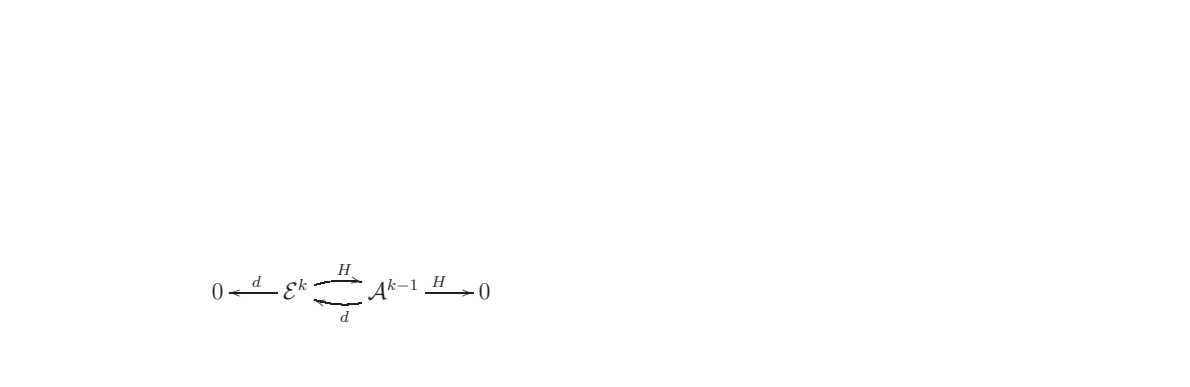
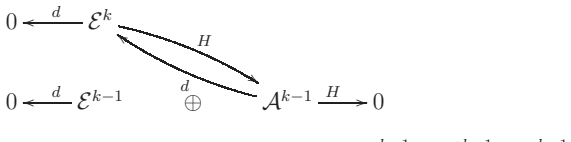
- [§3.1, Lemma 4] Lemma 4 states that for k > 0 the Bittner calculus is realized 'on the spaces of Fig. 3' with Hd = I and dH = I, but this is only true when restricted to the pair (A^{k-1}, E^k). On E^{k-1}, Hd is zero, not the identity. The lemma should specify the exact subspaces on which the abstract derivative/integral pair is realized in order to avoid confusion.
- [§4, after Corollary 2] The sentence 'As a conclusion from the above Theorem and Corollary 1' refers to a theorem that is not explicitly numbered; it would be clearer to refer to Proposition 1 and Corollary 1 by name.
- [§2, Lemma 2 and surrounding text] The remark that E^0(U) is empty is correct, but it is worth adding a parenthetical that the constants are precisely the closed-but-not-exact 0-forms, since this distinction is central to the eigenvalue problem in §3.2.
Circularity Check
No circularity: the derivation is self-contained from the Poincaré lemma, Edelen's homotopy operator identities, and Bittner's operator calculus.
full rationale
The paper's central claims are derived from standard, externally cited results rather than from the conclusions being asserted. The homotopy operator identities (Theorem 4, Lemmas 1–3) are quoted from Edelen's monograph, which is an independent external source and not the target of the paper. The decomposition Ω = E ⊕ A and the properties d² = 0, H² = 0, dH + Hd = I − s*_x0 are used as inputs, not as conclusions. The 'fermionic quantum harmonic oscillator' eigenvalue problem is not a fitted prediction: it is an algebraic consequence of the definition H̄ = Hd − dH together with the previously stated d/H algebra, and the spectral cases are computed directly from those identities. No parameter is fit to any data subset, and no self-citation is load-bearing; in fact, the paper contains no self-citations at all. The complex-manifold part likewise follows by defining H± through the decomposition K = K+ + K− and deriving H+H+ = 0, H−H− = 0, and H+H− + H−H+ = 0 from H² = 0. Corollaries 2 and 3 are direct structural consequences, not renamings of the paper's inputs. A possible correctness concern exists in the k = 0 eigenvalue computation, which appears to omit the λ = 0 eigenspace of constant functions, but that is an accuracy issue, not circularity: the derivation does not rely on the disputed conclusion. Overall, the paper is self-contained against external mathematical benchmarks and exhibits no circular derivation chain.
Assumptions & free parameters
assumptions (4)
- standard math The Poincaré lemma: on a star-shaped open subset of R^n, every closed form is exact.
- domain assumption Edelen's homotopy operator identities: dH + Hd = I - s*_x0, H^2 = 0, and the decomposition Ω = E ⊕ A.
- standard math Bittner's operator calculus axioms: ST_q = I and T_q S = I - s_q for an abstract derivative S and abstract integral T_q.
- standard math Dolbeault bicomplex structure on complex manifolds: d = ∂ + ∂̄, with ∂^2 = ∂̄^2 = 0 and ∂∂̄ + ∂̄∂ = 0.
Cite this review
Pith. "Pith review of The Poincare lemma, antiexact forms, and fermionic quantum harmonic oscillator." pith.science (2026). https://pith.science/paper/OHSJGGVG
@misc{pith2026190802349,
  author       = {Pith},
  title        = {Pith review of: The Poincare lemma, antiexact forms, and fermionic quantum harmonic oscillator},
  year         = {2026},
  howpublished = {\url{https://pith.science/paper/OHSJGGVG}},
  note         = {Machine review of arXiv:1908.02349}
}
read the original abstract
The paper focuses on various properties and applications of the homotopy operator, which occurs in the Poincar\'{e} lemma. In the first part, an abstract operator calculus is constructed, where the exterior derivative is an abstract derivative and the homotopy operator plays the role of an abstract integral. This operator calculus can be used to formulate abstract differential equations. An example of the eigenvalue problem that resembles the fermionic quantum harmonic oscillator is presented. The second part presents the dual complex to the Dolbeault bicomplex generated by the homotopy operator on complex manifolds.
Figures
Figures from the paper (1 more)

Reference graph
Works this paper leans on
-
[1]
Beilinson, p-adic periods and derived de Rham cohomology , J
A. Beilinson, p-adic periods and derived de Rham cohomology , J. Am. Math. Soc., 25, 715–738, (2012); DOI: 10.1090/S0894-0347-2012-00729-2
-
[2]
R. Bittner, Operational calculus in linear spaces , Studia Mathematica, 20, 1–18, (1961); DOI: 10.4064/sm-20-1-1-18
- [3]
-
[4]
Das, Field Theory, a Path Integral Approach , World Scientific, 1993
A. Das, Field Theory, a Path Integral Approach , World Scientific, 1993
work page 1993
-
[5]
M. Desbrun, M. Leok, J.E. Marsden, Discrete Poincar´ e lemma , Applied Numerical Mathematics, 53, 2-4, 231–248, (2005); D OI: 10.1016/j.apnum.2004.09.035
-
[6]
M. Desbrun, A.N. Hirani, M. Leok, J.E. Marsden, Discrete Exterior Calculus , arXiv:math/0508341 [math.DG]
- [7]
-
[8]
Edelen, Applied Exterior Calculus , Dover Publications, Revised edi- tion, 2011
D.G.B. Edelen, Applied Exterior Calculus , Dover Publications, Revised edi- tion, 2011
2011
Show all 18 references
-
[9]
Edelen, Isovector Methods for Equations of Balance , Springer, 1980
D.G.B. Edelen, Isovector Methods for Equations of Balance , Springer, 1980
1980
-
[10]
Harrison, Operator Calculus of Differential Chains and Differential Form s, J
J. Harrison, Operator Calculus of Differential Chains and Differential Form s, J. Geom. Anal., 25, 1, 357–420, (2015); DOI: 10.1007/s12220-013-9433-6
2015 doi
-
[11]
Harrison, Geometric Poincar´ e Lemma, arXiv:1101.0313 [math.AT]
J. Harrison, Geometric Poincar´ e Lemma, arXiv:1101.0313 [math.AT]
-
[12]
Iwaniec, A
T. Iwaniec, A. Lutoborski, Integral estimates for null Lagrangians , Arch. Ra- tional Mech. Anal., 125, 25–79, (1993). DOI: 10.1007/BF00411477
1993 doi
-
[13]
Jell, A Poincar´ e lemma for real-valued differential forms on Berk ovich spaces, Math
P. Jell, A Poincar´ e lemma for real-valued differential forms on Berk ovich spaces, Math. Z., 282, 1149–1167, (2016); DOI: 10.1007/s00209-015-1583-8
2016 doi
-
[14]
Lee, Introduction to Smooth Manifolds , Springer, 2nd edition, 2012
J. Lee, Introduction to Smooth Manifolds , Springer, 2nd edition, 2012
2012
-
[15]
Lesfari, On Poincar´ e lemma or Volterra theorem about differential fo rms and cohomology groups , arXiv:1905.13347 [math.GM] 13
A. Lesfari, On Poincar´ e lemma or Volterra theorem about differential fo rms and cohomology groups , arXiv:1905.13347 [math.GM] 13
1905 arXiv
-
[16]
Nakahara, Geometry, Topology and Physics, CRC Press, 2nd edition, 2003
M. Nakahara, Geometry, Topology and Physics, CRC Press, 2nd edition, 2003
2003
-
[17]
Voronov, On a non-Abelian Poincar´ e lemma, Proc
T. Voronov, On a non-Abelian Poincar´ e lemma, Proc. Amer. Math. Soc., 140, 2855–2872, (2012); DOI: 10.1090/S0002-9939-2011-11116-X
2012 doi
-
[18]
Tu, An Introduction to Manifolds , Springer, 2nd edition, 2010 14
L.W. Tu, An Introduction to Manifolds , Springer, 2nd edition, 2010 14
2010
Reviewed August 14, 2026 · model on record in the stance chip above.
Discussion (0). Continue with ORCID to comment.