REVIEW 4 major objections 5 minor 46 references
Transport phenomena in a free-standing two-dimensional sodium sheet
T0 review · 4 major / 5 minor · reviewed 2026-08-14 · deepseek-v4-flash
Pith's one-line read This paper predicts that a free-standing single layer of sodium is a thermodynamically stable 2D metal whose electrical resistivity is tunable by doping and drops below graphene above 450 K.
desk verdict Competent first-principles transport study of a predicted 2D sodium sheet, but the headline 'doping-independent Θ_BG ≈ 50 K' contradicts the paper's own Θ_BG ∝ k_F definition and is likely a fitting artifact. read the letter →
The pith
A machine-rendered reading of the paper's core claim, the machinery that carries it, and where it could break.
The reading
What carries the argument
The load-bearing objects are a clean circular Fermi surface and the Bloch-Grüneisen temperature $\Theta_{BG} = 2\hbar k_F v_s / \kappa_B$, which marks where resistivity changes from $T^4$ to linear-$T$ behavior. The calculation chain uses density-functional theory to obtain bands, phonons, and electron-phonon matrix elements on a coarse grid, Wannier interpolation to reach a fine grid, and an accurate Boltzmann transport equation to compute resistivity and thermal conductivity. Doping is treated by rigidly shifting the Fermi energy of the pristine band structure, with carrier densities read from the density of states, which is nearly constant in this 2DEG. This clean-parabolic-band description is what produces the doping-independent $\Theta_{BG}$ and the resistivity scalings $\rho \propto 1/E_F$ and $1/E_F^2$ in different doping regimes.
What would settle it
A gate-tuned resistivity measurement on a free-standing monolayer sodium sheet would settle the claims: if the crossover below graphene's resistivity near 450 K does not appear, or if the Bloch-Grüneisen temperature shifts by more than a few kelvin with carrier density, the rigid-band clean-Fermi-surface picture fails. A first-principles calculation that re-optimizes the doped band structure self-consistently, instead of rigidly shifting $E_F$, would test the same assumption without experimental access.
Extended reading notes
Core claim
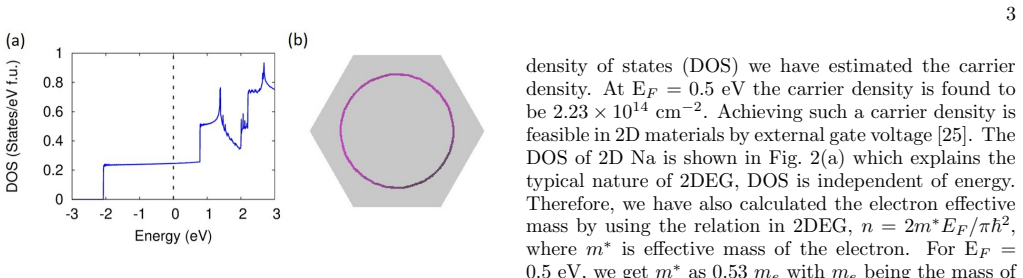
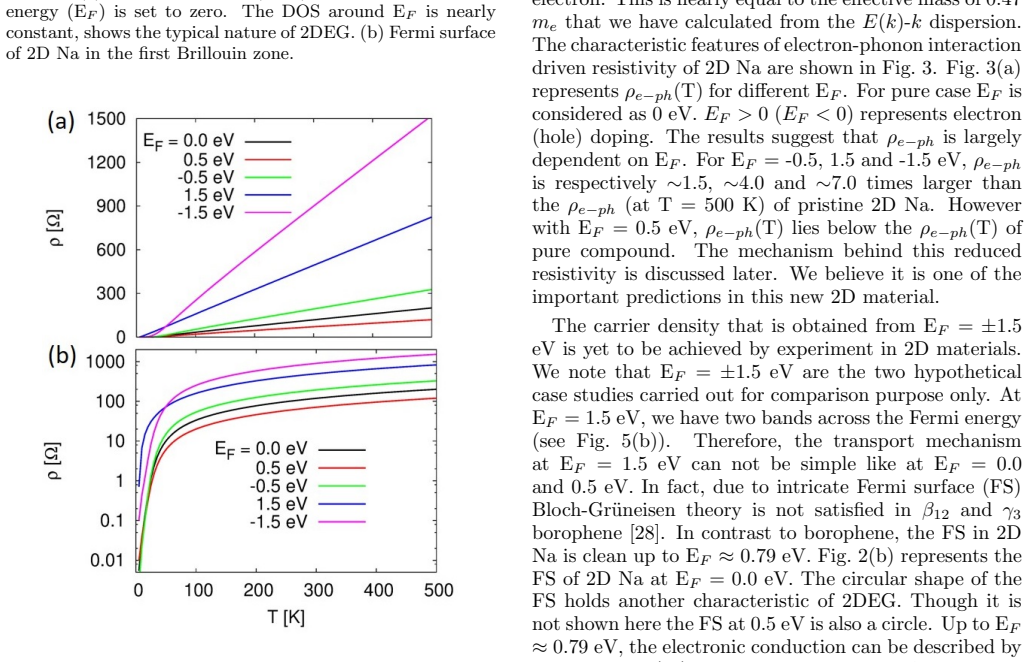
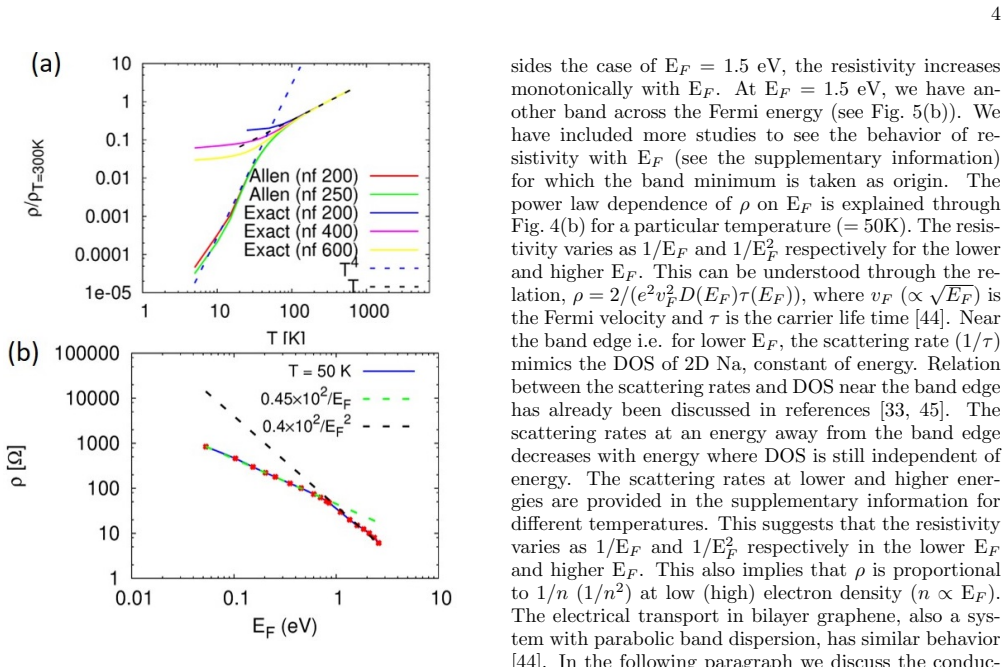
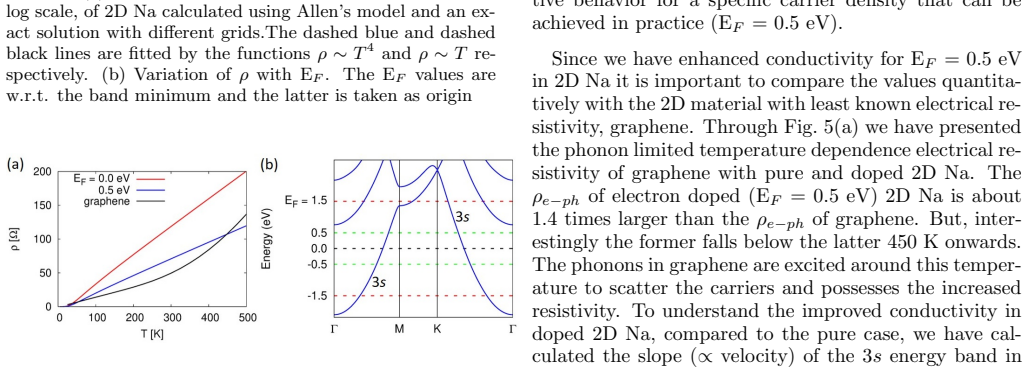
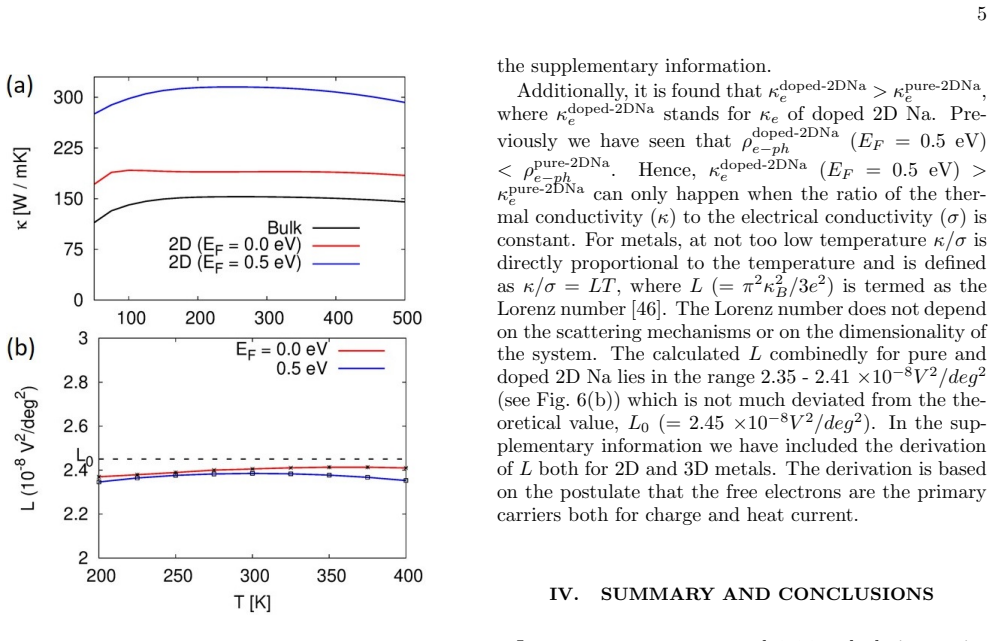
The central claim is that 2D Na is a new thermodynamically stable elemental 2D metal whose transport is governed by a clean 2DEG Fermi surface originating from the half-filled $3s$ orbital. First-principles DFT/DFPT calculations combined with an accurate Boltzmann-transport solution show that the electron-phonon limited resistivity $\rho_{e-ph}(T)$ obeys the Bloch-Grüneisen picture, with two regimes crossing at $\Theta_{BG} \approx 50$ K that is independent of the carrier type or density. At experimentally accessible electron doping ($E_F = 0.5$ eV, carrier density $2.23 \times 10^{14}$ cm$^{-2}$), $\rho_{e-ph}$ is about 1.4 times that of graphene at low temperature but becomes smaller than graphene's above 450 K. The electronic thermal conductivity of pure 2D Na is about 1.24 times that of bulk Na at 300 K, and the calculated Lorenz number is $2.41 \times 10^{-8}\ \mathrm{V}^2/\mathrm{deg}^2$, so the Wiedemann-Franz law is satisfied. The paper concludes that the same transport mechanism should appear in all Na-like systems with a clean Fermi surface, including bulk compounds with planes of Na atoms.
Load-bearing premise
The predictions depend on the rigid-band approximation for doping, where shifting the Fermi energy leaves the bands, phonons, and electron-phonon coupling unchanged, and on ignoring all scattering besides electron-phonon coupling, such as impurities, electron-electron interactions, and substrate effects.
Editorial extensions
If this is right
- 2D Na becomes a new elemental 2D metal whose carrier density can be tuned by a gate voltage, enabling electronic-device applications.
- At electron doping with $E_F = 0.5$ eV, the intrinsic resistivity lies below graphene's above 450 K, suggesting competitive high-temperature electrical transport.
- The doping-independent $\Theta_{BG} \approx 50$ K shows that transport is controlled by soft phonon modes rather than Fermi-surface geometry, as long as the Fermi surface remains clean.
- The Wiedemann-Franz law holds with $L \approx 2.41 \times 10^{-8}$ V$^2$/deg$^2$, so the electronic thermal conductivity tracks the electrical conductivity.
- The transport mechanism is expected to generalize to other Na-like systems with clean Fermi surfaces, including bulk materials containing Na planes.
Reading between the lines
- The rigid-band approximation is likely the fragile step: self-consistent doping could renormalize the $3s$ band and alter the velocity enhancement that produces the graphene crossover, so a direct test would be valuable.
- The pinned 50 K Bloch-Grüneisen temperature suggests a universal low-temperature $T^4$ regime in low-density 2D metals with soft flexural phonons, potentially applying to other alkali or alkaline-earth monolayers.
- If the free-standing limit is difficult to realize, bulk compounds with Na planes, such as sodium cobalt oxides, could serve as a proxy to look for the clean-Fermi-surface transport signature.
- Because the Lorenz number is constant, the thermopower of 2D Na should be directly tied to the resistivity ratio, hinting at a use in thermoelectric or bolometric devices that gate-tune the Fermi level.
Signed reviews
Editorial analysis
A structured set of objections, weighed in public.
Referee Report
Summary. The manuscript uses DFT, DFPT, and Boltzmann transport-equation calculations to argue that a free-standing hexagonal monolayer of sodium is thermodynamically stable, behaves as a 2D electron gas, and has phonon-limited electrical and thermal transport. It reports that the intrinsic resistivity of electron-doped 2D Na (E_F = 0.5 eV) is about 1.4 times that of graphene at room temperature but drops below graphene beyond 450 K, that the Bloch-Grüneisen temperature is pinned near 50 K independently of carrier type and density, that the electronic thermal conductivity at 300 K is about 1.24 times that of bulk Na, and that the Wiedemann-Franz law holds with a Lorenz number close to 2.41e-8 V^2/deg^2.
Significance. If the results are correct, 2D Na would be a new stable elemental 2D metal whose transport can be gate-tuned and is comparable to graphene's phonon-limited resistivity, which is of interest for nanoscale electronics and thermoelectrics. Strengths of the paper include the use of a standard first-principles workflow, the explicit comparison between Allen's transport model and an exact BTE solution, the stability checks via phonons and molecular dynamics, and the presentation of the Lorenz-number derivation in the supplementary material. The main risk is that the quantitative predictions rest on rigid-band doping and on resistivity fits whose uncertainty is not quantified; the claimed doping-independence of Theta_BG is not demonstrated and is in tension with the definition of Theta_BG.
major comments (4)
- [Section III, Fig. 4(a) and Abstract] The claim that Theta_BG is pinned at about 50 K independent of carrier type and density is not supported by the data shown. The fits to A T^4 and B T are presented only for the undoped case, with A = 2.9e-8 K^-4 and B = 3.3e-3 K, and the crossover is then read off as about 50 K. For the doped cases in Fig. 3(b), only visual inspection is offered; no per-doping fits or confidence intervals are given. More fundamentally, the definition Theta_BG = 2 hbar k_F v_s / k_B in Section I implies Theta_BG proportional to k_F. In a 2DEG with constant DOS, n is proportional to E_F, so k_F is proportional to sqrt(n); across the plotted range E_F = -1.5 to +1.5 eV, one would expect Theta_BG to vary by roughly sqrt(1.5/0.5) ~ 1.7 unless v_s changes to cancel, and no such mechanism is identified. The text itself states that at E_F = 1.5 eV the Fermi surface is no longer simple and Bloch-Grüneisen theory is not satisfied, so the abstract's 'independent of the type or density' is overbroad. Please either restrict the claim to the single-band regime |E_F| <= 0.79 eV with fits for each doping level, or give a quantitative explanation for the near-constancy.
- [Section III, first paragraph of Results] The entire carrier-density dependence, including the resistivity reduction at E_F = 0.5 eV and the crossover with graphene, rests on the rigid-band approximation: the Fermi level is shifted while electronic bands, phonons, and electron-phonon matrix elements are kept fixed. The manuscript does not test this approximation, and the text does not acknowledge its limitations directly in the doping discussion. Please validate the rigid-band assumption at least for a few representative densities, for example by recomputing band structures and electron-phonon matrix elements self-consistently, or clearly state the expected error and the consequences for the predicted 1/E_F and 1/E_F^2 power laws and for the claimed Theta_BG pinning.
- [Section III, Fig. 5(a)] The comparison with graphene is not reproducible as presented. The text says 'we have presented the phonon limited temperature dependence electrical resistivity of graphene' but does not state whether the graphene curve was computed in this work or taken from the literature. To support the quantitative claims that the doped 2D Na resistivity is 'about 1.4 times larger' and 'falls below the latter 450 K onwards', please specify the provenance of the graphene resistivity data, including the computational method, parameters, and any references, or compute it with the same workflow for a controlled comparison.
- [Section II and Figs. 3-4] No convergence tests or numerical error estimates are reported. The manuscript mentions a fine grid of 200 x 200 x 1 and Fig. 4(a) labels 'different grids', but the differences between grids are not quantified. Since the central numbers are ratios of resistivities and a fitted crossover temperature, please report the convergence of the resistivity and thermal conductivity with respect to k-grid, q-grid, smearing, and vacuum thickness, and provide error bars on the fitted coefficients A and B and on the resulting Theta_BG.
minor comments (5)
- [Fig. 1 caption] The word 'satbility' should be 'stability'.
- [Section III, Fig. 4 discussion] The phrase 'The gird of 200 x 200 x 1' should be 'The grid of 200 x 200 x 1'.
- [Section III, discussion of E_F = 0.5 eV] The sentence 'Since we have enhanced conductivity for E_F = 0.5 eV' would be clearer as 'Since 2D Na has enhanced conductivity at E_F = 0.5 eV'.
- [Abstract and Conclusions] The statement that Theta_BG is independent of the type and density of carriers is inconsistent with the body-text caveat that at E_F = 1.5 eV the Fermi surface is no longer simple and Bloch-Grüneisen theory does not apply; please reconcile the abstract and conclusions with the single-band limitation.
- [Section I] The sentence 'Theta_D in bulk systems is equivalent to Theta_BG in 2D, systems with low electron density' is confusing; please clarify the intended analogy between Debye temperature and Bloch-Grüneisen temperature.
Circularity Check
No significant circularity: the transport results are computed from DFT/DFPT plus general BTE solvers; self-citations are to method code, and the ΘBG extraction is a fitted characterization, not a circular input.
full rationale
The paper's derivation chain is: DFT/DFPT (Quantum ESPRESSO) and EPW provide electron energies, phonons, and e-ph matrix elements; the BTE is then solved with Allen's model and the exact solver of ref 33 to obtain ρ_e-ph(T) and κ_e(T); doping is treated by rigid-band Fermi-energy shifts with carrier density from the DOS. The self-cited refs 32 and 33 are general-purpose transport solvers (ShengBTE and W. Li's BTE method); they are not tuned to 2D Na and do not encode the headline results, so these citations are method attribution rather than load-bearing circularity. The ΘBG ≈ 50 K value is obtained by fitting the computed resistivity to A T^4 and B T and taking the intersection of the fitted lines. That makes ΘBG a fitted characterization of the same computational data rather than an independent first-principles prediction, but it is not circular: ΘBG is never used as an input to the BTE calculation, and the claimed doping-independence is an emergent feature of the computed curves, not an assumed constraint. The apparent tension between the constant extracted crossover and the stated definition ΘBG = 2ℏk_Fv_s/k_B, which would naively vary with k_F under rigid-band doping, is an internal-consistency or correctness concern, not a circularity: the paper does not use that definition to produce the reported value. No fitted parameter is renamed as a prediction, no uniqueness theorem from the authors is invoked as an external fact, no ansatz is smuggled in via the authors' previous work, and no known empirical result is repackaged under new coordinates. The comparison with graphene is a direct phonon-limited resistivity calculation. Therefore, no specific circular step could be identified in the claimed derivation chain.
Assumptions & free parameters
free parameters (3)
- Fermi-level shift E_F =
-1.5, -0.5, 0, +0.5, +1.5 eV
- Low-temperature resistivity fit coefficient A =
2.9e-8 /K^4
- High-temperature resistivity fit coefficient B =
3.3e-3 /K
assumptions (6)
- domain assumption GGA-DFT and DFPT accurately describe the electronic structure, phonons, and electron-phonon matrix elements of 2D Na.
- domain assumption Doping can be represented by rigidly shifting the Fermi energy of the pristine band structure.
- domain assumption Single-band Bloch-Grüneisen theory applies for E_F up to about 0.79 eV, where the Fermi surface is circular.
- domain assumption Electron-phonon scattering is the only significant scattering mechanism; impurity, electron-electron, and boundary scattering are neglected.
- domain assumption A 10 Å vacuum gap isolates the monolayer so interlayer interactions are negligible.
- domain assumption Phonon stability plus a short 300 K MD run with ~2 meV energy fluctuation establish thermodynamic stability.
Cite this review
Pith. "Pith review of Transport phenomena in a free-standing two-dimensional sodium sheet." pith.science (2026). https://pith.science/paper/SUAKGLJ7
@misc{pith2026190802431,
  author       = {Pith},
  title        = {Pith review of: Transport phenomena in a free-standing two-dimensional sodium sheet},
  year         = {2026},
  howpublished = {\url{https://pith.science/paper/SUAKGLJ7}},
  note         = {Machine review of arXiv:1908.02431}
}
abstract
The advances in the growth techniques provide numerous scope to explore the possibilities of new 2D materials for potential applications. With the aid of first-principle calculations we show that 2D Na can be a new addition to the family of thermodynamically stable 2D materials for device applications. Not surprisingly, due to half-occupied $3s$ orbital 2D Na possesses the features of the 2D electron gas (2DEG). The transport properties are examined based on the accurate solution of Boltzmann transport equation. With practically tunable carrier density in 2D materials, the intrinsic electrical resistivity of electron doped 2D Na is $\sim$ 1.4 times larger than that of graphene and falls below the latter 450 K onwards. The Bloch-Gr\"uneisen temperature is almost constant at 50 K, independent of the type or density of the charge carriers. The electronic thermal conductivity of pure 2D Na is $\sim$ 1.24 times larger than that of its bulk counterpart at 300 K. The Wiedemann-Franz law stands tall in 2D Na with calculated Lorenz number 2.41 $\times 10^{-8} V^2/deg^2$ at room temperature. The transport mechanism presented here is expected to occur in all Na like systems with a clean Fermi surface.
Figures

Figures from the paper (3 more)
Reference graph
Works this paper leans on
-
[1]
K. S. Novoselov et al., Proc. Natl. Acad. Sci. U.S.A. 102, 10451 (2005)
work page 2005
-
[2]
K. S. Novoselov et al., Nature (London) 438, 197 (2005)
2005
-
[3]
A. A. Balandin et al. , Nano Lett. 8, 902 (2008). 6
work page 2008
-
[4]
J. H. Seol et al. , Science 328, 213 (2010)
work page 2010
-
[5]
S. Z. Butler et al. , ACS Nano 7, 2898 (2013)
work page 2013
-
[6]
P. Miro, M. Audiffred, and T. Heine, Chem. Soc. Rev. 43, 6537 (2014)
work page 2014
- [7]
-
[8]
F. Yin, J. Akola, P. Koskinen, M. Manninen, and R. E. Palmer, Phys. Rev. Lett. 102, 106102 (2009)
work page 2009
Show all 46 references
-
[9]
Zhang, P
T. Zhang, P. Cheng, W.-J. Li, Y.-J. Sun, G.Wang, X.-G. Zhu, K. He, L. Wang, X. Ma, X. Chen, et al., Nat. Phys. 6, 104 (2010)
2010
-
[10]
Li, Y.Wang, S
L. Li, Y.Wang, S. Xie, X.-B. Li, Y.-Q.Wang, R.Wu, H. Sun, S. Zhang, and H.-J. Gao, Nano Lett. 13, 4671 (2013)
2013
-
[11]
J. Zhao, Q. Deng, A. Bachmatiuk, G. Sandeep, A. Popov, J. Eckert, and M. H. Rmmeli, Science 343, 1228 (2014)
2014
-
[12]
L.-M. Yang, T. Frauenheim, and E. Ganz, Phys. Chem. Chem. Phys. 17, 19695 (2015)
2015
-
[13]
L.-M. Yang, M. Dornfeld, T. Frauenheim, and E. Ganz, Phys. Chem. Chem. Phys. 17, 26036 (2015)
2015
-
[14]
L.-M. Yang, T. Frauenheim, and E. Ganz, J. Nanomater. 2016, 8429510 (2016)
2016
-
[15]
H. Liu, A. T. Neal, Z. Zhu, Z. Luo, X. Xu, D. Tom´ anek, and P. D. Ye, ACS Nano 8, 4033 (2014)
2014
-
[16]
L. Li, Y. Yu, G. J. Ye, Q. Ge, X. Ou, H. Wu, D. Feng, X. H. Chen, and Y. Zhang, Nat. Nanotechnol. 9, 372 (2014)
2014
-
[17]
Zhong et al
D. Zhong et al. , Sci. Adv. 3, 1603113 (2017)
2017
-
[18]
Guo et al
Y. Guo et al. , Adv. Mater. 29, 1700715 (2017)
2017
-
[19]
W. Luo, K. Xu, and H. Xiang, Phys. Rev. B 96, 235415 (2017)
2017
-
[20]
M. L. Foo, Y. Wang, S. Watauchi, H. Zandbergen, T. He, R. J. Cava, and N. P. Ong, Phys. Rev. Lett. 92, 247001 (2004)
2004
-
[21]
Takada, H
K. Takada, H. Sakurai, E. Takayama-Muromachi, F. Izumi, R. A. Dilanian, and T. Sasaki, Nature (Lon- don) 422, 53 (2003)
2003
-
[22]
Y. Wang, N. S. Rogado, R. J. Cava, and N. P. Ong, Nature (London) 423, 425 (2003)
2003
-
[23]
Nevalaita and P
J. Nevalaita and P. Koskinen, Phys. Rev. B 97, 035411 (2018)
2018
-
[24]
M. S. Fuhrer, Physics 3, 106 (2010)
2010
-
[25]
D. K. Efetov and P. Kim, Phys. Rev. Lett. 105, 256805 (2010)
2010
-
[26]
C.-H. Park, N. Bonini, T. Sohier, G. Samsonidze, B. Kozinsky, M. Calandra, F. Mauri, and N. Marzari, Nano Lett. 14, 1113 (2014)
2014
-
[27]
Zhang, J
J. Zhang, J. Zhang, L. Zhou, C. Cheng, C. Lian, J. Liu, S. Tretiak, J. Lischner, F. Giustino, and S. Meng, Angew. Chem. 130, 4675 (2018)
2018
-
[28]
Z. Liu, M. Zhu, and Y. Zheng, J. Mater. Chem. C 7, 986 (2019)
2019
-
[29]
P. B. Allen, Phys. Rev. B 17, 3725 (1978)
1978
-
[30]
Lindsay, D
L. Lindsay, D. A. Broido, and T. L. Reinecke, Phys. Rev. Lett. 109, 095901 (2012)
2012
-
[31]
Lindsay, D
L. Lindsay, D. A. Broido, and T. L. Reinecke, Phys. Rev. Lett. 111, 025901 (2013)
2013
-
[32]
W. Li, J. Carrete, N. A. Katcho, and N. Mingo, Comput. Phys. Commun. 185, 1747 (2014)
2014
-
[33]
Li, Phys
W. Li, Phys. Rev. B 92, 075405 (2015)
2015
-
[34]
Ponc´ e, E
S. Ponc´ e, E. R. Margine, C. Verdi, and F. Giustino, Comput. Phys. Commun. 209, 116 (2016)
2016
-
[35]
Giannozzi et al., J
P. Giannozzi et al., J. Phys.: Condens. Matter 21, 395502 (2009)
2009
-
[36]
Saito, G
R. Saito, G. Dresselhaus, and M. Dresselhaus, Imperial College Press, London (1998)
1998
-
[37]
Wirtz and A
L. Wirtz and A. Rubio, Solid State Commun. 131, 141 (2004)
2004
-
[38]
Kushwaha and J
S. Kushwaha and J. Rajput, Phys. Rev. B 2, 3943 (1970)
1970
-
[39]
C. M. Goel, B. . P. Pandey, and B. Dayal, Phys. Stat. Sol. (b) 69, 589 (1975)
1975
-
[40]
Tari, Imperial College Press, London , p
A. Tari, Imperial College Press, London , p. 37 (2003)
2003
-
[41]
Kittel, Wiley, New York , 7th edition, p
C. Kittel, Wiley, New York , 7th edition, p. 126 (1996)
1996
-
[42]
Radisavljevic and A
B. Radisavljevic and A. Kis, Nat. Mater. 12, 815 (2013)
2013
-
[43]
C.-H. Park, F. Giustino, M. L. Cohen, and S. G. Louie, Phys. Rev. Lett. 99, 086804 (2007)
2007
-
[44]
S. D. Sarma, S. Adam, E. H. Hwang, and E. Rossi, Rev. Mod. Phys. 83, 407 (2011)
2011
-
[45]
Lundstrom, Cambridge University Press, Cambridge, UK , 2nd edition, p
M. Lundstrom, Cambridge University Press, Cambridge, UK , 2nd edition, p. 67 (2000)
2000
-
[46]
Kittel, Wiley, New York , 7th edition, p
C. Kittel, Wiley, New York , 7th edition, p. 168 (1996)
1996
Reviewed August 14, 2026 · model on record in the stance chip above.
Discussion (0). Continue with ORCID to comment.