REVIEW 3 major objections 6 minor 25 references
DronePick: Object Picking and Delivery Teleoperation with the Drone Controlled by a Wearable Tactile Display
T0 review · 3 major / 6 minor · reviewed 2026-08-14 · deepseek-v4-flash
Pith's one-line read This paper claims that a quadcopter can be teleoperated for remote object picking and delivery by hand motion alone when the operator receives continuous visual feedback in VR and four vibrotactile patterns on the fingertips.
desk verdict A modest but honest system paper: the 99% recognition rate is about haptic pattern perception, not teleoperation accuracy, and the real pick-and-deliver demo has no quantitative support. read the letter →
The pith
A machine-rendered reading of the paper's core claim, the machinery that carries it, and where it could break.
The reading
What carries the argument
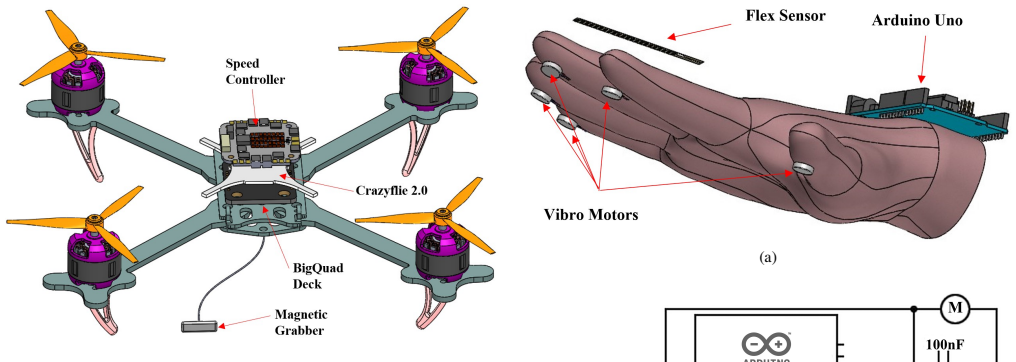
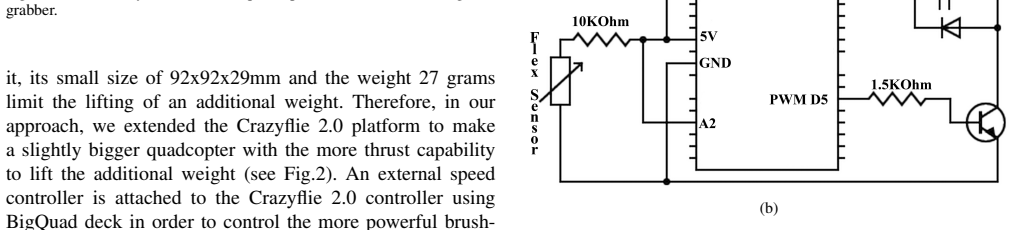
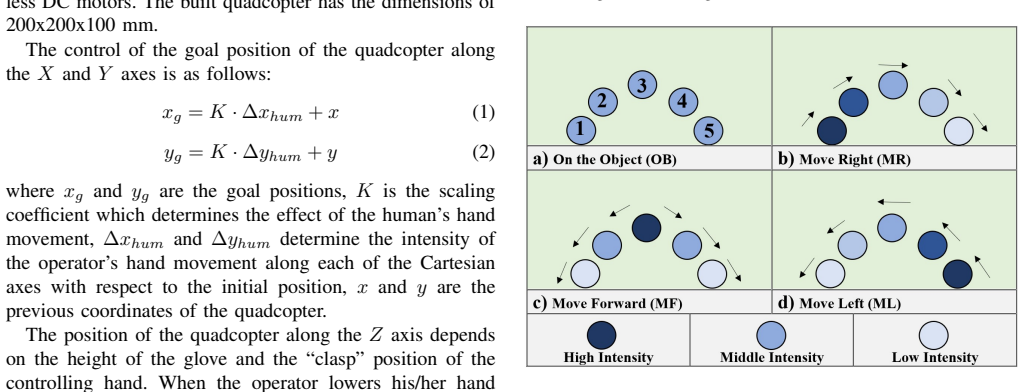
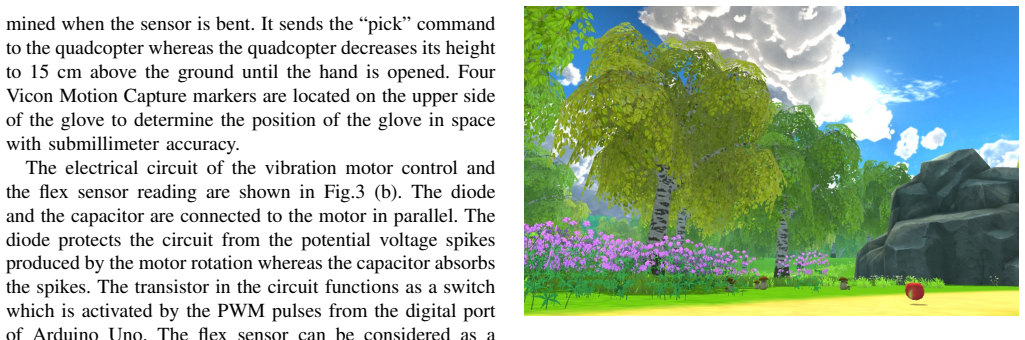
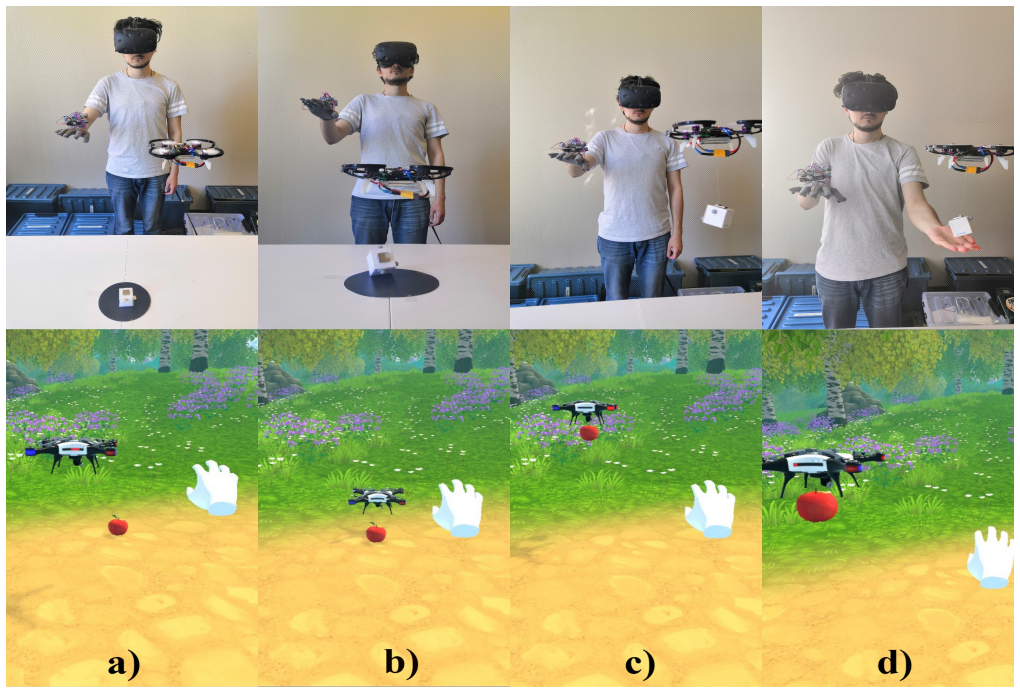
The load-bearing mechanism is the tactile glove and its four vibration patterns, driven by an Arduino Uno and ERM motors at the fingertips. Each pattern encodes one geometric relation between drone and object: equal vibration on all fingers means 'on the object,' a thumb-heavy gradient means 'move right,' a little-finger-heavy gradient means 'move left,' and a distinct forward cue means 'move forward.' The glove's position, tracked by four Vicon markers with submillimeter accuracy, is linearly mapped to drone goal positions through $x_g = K \Delta x_{hum} + x$ and $y_g = K \Delta y_{hum} + y$; lowering the hand below 1 m lands the drone, and bending the flex sensor on the middle finger sends the 'pick' command. A Unity-based VR application mirrors the drone, object, and gloved hand, while air flow from the real drone helps the operator retrieve the delivered object.
What would settle it
Run repeated pick trials in the Vicon arena and record the drone's horizontal position at the moment the operator clasps the hand; if the distance from that position to the object's center exceeds the magnetic grabber's capture radius in a substantial fraction of trials, the claimed pick accuracy does not hold. A shorter version: compare pick success rates with haptic feedback active against the same trials with vibration disabled.
Extended reading notes
Core claim
The central discovery is that four spatially mapped vibrotactile patterns delivered to the fingertips are enough for users to tell where a remote object is relative to a quadcopter, and that combining this haptic channel with a VR simulation lets an operator command a picking and delivery mission by hand gestures alone. In the user study, the 'On the Object', 'Move Left', 'Move Right', and 'Move Forward' patterns were recognized at 100%, 100%, 99%, and 97% respectively, with the average recognition time 2.36 seconds. The same interface was implemented on a real Crazyflie-based quadcopter with a magnetic grabber: the operator approaches the object, clasps the hand to trigger descent, and the drone picks, delivers, and releases the object to the human. The paper's argument is that continuous haptic feedback closes the loop that visual feedback alone leaves open, especially when the object and drone share an X or Y coordinate.
Load-bearing premise
The claim of accurate teleoperation rests on the untested assumption that the linear mapping from hand position to drone position, together with submillimeter Vicon tracking and VR alignment, lets the operator place the drone directly above the object; the paper does not measure alignment error or tracking latency, so a poor fit there would break the mission even though the vibration patterns are recognized correctly.
Editorial extensions
If this is right
- If DronePick works as reported, a human operator can perform remote pick-and-deliver tasks without joystick training.
- Users can reliably distinguish the four directional tactile patterns quickly enough for real-time control: 99% average recognition and 2.36 seconds average recognition time.
- The combination of VR and haptics should reduce the cognitive load of aligning the drone, because the tactile channel disambiguates left, right, and forward cases that visual perspective makes ambiguous.
- The demonstrated real-life sequence suggests the same hand-gesture interface could be extended to other aerial manipulation tasks.
Reading between the lines
- The reported recognition rates measure pattern comprehension, not mission success; a natural next experiment is to compare pick success and total task time with haptics on versus off, predicted to show that the tactile channel carries most of the alignment precision.
- The magnetic grabber restricts the system to ferromagnetic objects; swapping in a different end-effector would test whether the hand-gesture control loop generalizes beyond the demonstrated pick-and-deliver scenario.
- The reliance on Vicon motion capture and a wired Arduino makes the current system lab-bound; an onboard visual or UWB localization variant would be the test of whether the interface can scale outside the room.
- The four patterns encode only coarse left, right, forward, and on-object relations; adding distance or altitude cues would be a direct extension that the recognition-time data suggest is feasible.
Signed reviews
Editorial analysis
A structured set of objections, weighed in public.
Referee Report
Summary. The paper proposes DronePick, a teleoperation system in which a human operator controls a quadcopter through hand motion and receives vibrotactile feedback from a glove. The quadcopter is a Crazyflie 2.0 extended with a magnetic grabber, and the operator sees a simulated drone, object, and hand in a VR environment. The glove delivers four vibrotactile patterns that encode whether the drone is above the object or must move left, right, or forward. The paper reports a recognition experiment with ten volunteers showing a 99.0% average recognition rate and 2.36 s average recognition time for the four patterns, and it presents a single real-life pick-and-deliver sequence in Figure 6. The authors conclude that the system provides accurate teleoperation and that the tactile patterns help the operator position the drone, while noting that a complete user study is future work.
Significance. If the claimed performance were fully substantiated, the paper would be a useful demonstration of combining VR and wearable vibrotactile feedback for drone teleoperation without a joystick. The system integrates several components, the four vibration patterns are a reasonable design choice, and the confusion-matrix data, as far as they go, are internally consistent. The authors are also honest in Section V that a complete user study comparing interfaces remains future work. However, the central claim of 'accurate teleoperation' is not measured: the quantitative results concern isolated pattern recognition, not the alignment, picking, or delivery task. The real-life demo is anecdotal, and the control mapping is under-specified. The value of the paper at present is as a proof-of-concept demonstration, not as a validated human-robot interaction study.
major comments (3)
- [Section IV and Section V] The headline claim in the abstract and conclusion that DronePick enables accurate teleoperation is not supported by the reported evidence. Table I measures only whether users can identify four isolated vibrotactile patterns, which is a perception task; it does not measure whether the operator can use those patterns to align the drone, pick the object, or deliver it. The real-life demonstration in Figure 6 is an anecdotal sequence with no success rate, completion time, alignment error, or comparison condition. Section V explicitly defers 'the complete user study' to future work, so the paper should either add task-level performance data or reframe its claims as preliminary feasibility results.
- [Section III-A, Eqs. (1)-(2)] The hand-to-drone control mapping is under-specified in ways that directly affect the accuracy claim. The scaling coefficient K is never given, and the variables x and y are described only as 'previous coordinates,' so holding the hand off-center creates an integrating command with no stated deadzone or stop condition. The altitude rule is also described only textually: the drone lands when the hand is below 1 m and descends to 15 cm when the hand clasps. Without specifying the coordinate frame, K, and the deadzone or saturation behavior, the claimed precise alignment cannot be reproduced or assessed.
- [Section IV, Tables I and II] The recognition experiment is reported only as averaged percentages, with no standard deviations, confidence intervals, per-subject breakdowns, or statistical tests. With ten volunteers and ten presentations per pattern, a 97% recognition rate represents only a handful of errors, so the robustness of the headline 99.0% figure is unclear. Since this number is the main quantitative anchor of the paper, the authors should report variance and a statistical analysis, or explicitly present the result as an informal pilot.
minor comments (6)
- [Section IV, paragraph on recognition rates] The text says 'Move Right (MR)' and 'Move Forward (ML)' but the correct acronym for the forward pattern is MF, not ML; please correct this in the sentence and anywhere else the acronym appears.
- [Figure 4 caption] The caption says the circles represent the right hand's fingers viewed from the dorsal side, but the thumb position and the correspondence between the diagram and the glove's vibration motors could be clearer; labeling the fingertips in the figure would help readers understand the pattern-mapping.
- [Section IV, Table II] The recognition-time results are reported without any measure of variance, and the text states that recording started after the pattern stopped playing, but it does not specify whether the time includes only the response interval or also any motor memory effects; please make the timing protocol explicit.
- [Abstract and Conclusion] The phrase 'accurate teleoperation' overstates the evidence, which is limited to pattern recognition and a single proof-of-concept; consider replacing it with 'promising teleoperation concept' or similar language until a task-level evaluation is performed.
- [Section II-D] The claim that no piloting skills or high concentration are required is an assertion, not a measured outcome; either provide supporting task-performance data or soften this claim in the introduction.
- [Section III-B] The text says the vibration intensity varies from 100 Hz to 200 Hz, but ERM motors are typically controlled by voltage; please clarify whether the frequency or the amplitude of the PWM signal is being changed, since 'intensity' is ambiguous.
Circularity Check
No circularity: the claimed results are empirical measurements and a hardware demonstration, not quantities derived from fitted inputs or self-citations.
full rationale
The paper's central quantitative claim is the tactile-pattern recognition result (average 99% recognition rate, average 2.36 s recognition time) obtained from a perceptual user experiment (Section IV, Tables I and II). This is a measured outcome, not a value forced by an assumed model or by a fitted parameter. The control law in Eqs. (1)-(2) is an under-specified mapping with an unreported gain K, but the evaluation does not use the recognition data to recover or validate that gain, so there is no fitted-input-called-prediction structure. The real-life pick-and-deliver demonstration in Fig. 6 is anecdotal and lacks quantitative teleoperation metrics, and the authors explicitly state in Section V that the complete user study is future work; these are evidentiary limitations, not circular reasoning. Self-citations appear only in the related-work discussion of prior tactile swarm interfaces and are not load-bearing for the present system's claims. No derived result in the paper reduces by construction to its own inputs, and no uniqueness or ansatz is smuggled in through self-citation. The derivation chain is therefore self-contained empirically, and the appropriate circularity score is 0.
Assumptions & free parameters
free parameters (2)
- K (hand-to-drone scaling coefficient)
- Pick landing altitude =
15 cm
assumptions (3)
- domain assumption Linear mapping between hand displacement and drone goal position (Eqs. 1-2) is sufficient for accurate teleoperation.
- domain assumption Vicon motion capture provides submillimeter-accurate tracking of the glove and objects in both real and VR scenes.
- domain assumption The VR scene accurately mirrors the real environment's geometry and the operator's hand position.
Cite this review
Pith. "Pith review of DronePick: Object Picking and Delivery Teleoperation with the Drone Controlled by a Wearable Tactile Display." pith.science (2026). https://pith.science/paper/EF3772ZJ
@misc{pith2026190802432,
  author       = {Pith},
  title        = {Pith review of: DronePick: Object Picking and Delivery Teleoperation with the Drone Controlled by a Wearable Tactile Display},
  year         = {2026},
  howpublished = {\url{https://pith.science/paper/EF3772ZJ}},
  note         = {Machine review of arXiv:1908.02432}
}
read the original abstract
We report on the teleoperation system DronePick which provides remote object picking and delivery by a human-controlled quadcopter. The main novelty of the proposed system is that the human user continuously gets the visual and haptic feedback for accurate teleoperation. DronePick consists of a quadcopter equipped with a magnetic grabber, a tactile glove with finger motion tracking sensor, hand tracking system, and the Virtual Reality (VR) application. The human operator teleoperates the quadcopter by changing the position of the hand. The proposed vibrotactile patterns representing the location of the remote object relative to the quadcopter are delivered to the glove. It helps the operator to determine when the quadcopter is right above the object. When the "pick" command is sent by clasping the hand in the glove, the quadcopter decreases its altitude and the magnetic grabber attaches the target object. The whole scenario is in parallel simulated in VR. The air flow from the quadcopter and the relative positions of VR objects help the operator to determine the exact position of the delivered object to be picked. The experiments showed that the vibrotactile patterns were recognized by the users at the high recognition rates: the average 99% recognition rate and the average 2.36s recognition time. The real-life implementation of DronePick featuring object picking and delivering to the human was developed and tested.
Figures

Figures from the paper (3 more)
Reference graph
Works this paper leans on
-
[1]
Tachi, Telexistence (2nd Edition)
S. Tachi, Telexistence (2nd Edition) . World Scientific Pub Co Inc, 2015
work page 2015
-
[2]
Medical robots: current systems and research direc- tions,
R. A. Beasley, “Medical robots: current systems and research direc- tions,” Journal of Robotics , vol. 2012, 2012
work page 2012
-
[3]
P. Arbeille, G. Poisson, P. Vieyres, J. Ayoub, M. Porcher, and J. L. Boulay, “Echographic examination in isolated sites controlled from an expert center using a 2-d echograph guided by a teleoperated robotic arm,” Ultrasound in medicine & biology , vol. 29, no. 7, pp. 993–1000, 2003
work page 2003
-
[4]
A networking framework for teleoperation in safety, security, and rescue robotics,
A. Birk, S. Schwertfeger, and K. Pathak, “A networking framework for teleoperation in safety, security, and rescue robotics,” IEEE Wireless Communications, vol. 16, no. 1, pp. 6–13, 2009
work page 2009
-
[5]
Immersive 3-d teleoperation of a search and rescue robot using a head-mounted display,
H. Martins and R. Ventura, “Immersive 3-d teleoperation of a search and rescue robot using a head-mounted display,” in 2009 IEEE Conference on Emerging Technologies & Factory Automation . IEEE, 2009, pp. 1–8
work page 2009
-
[6]
Android tele-operation through brain-computer interfacing: A real- world demo with non-expert users,
C. Christoforou, N. Mavridis, E. L. Machado, and G. Spanoudis, “Android tele-operation through brain-computer interfacing: A real- world demo with non-expert users,” inProceedings of the International Symposium on Robotics and Intelligent Sensors (IRIS) , 2010, pp. 294– 299
work page 2010
-
[7]
High precision formation control of mobile robots using virtual structures,
M. A. Lewis and K.-H. Tan, “High precision formation control of mobile robots using virtual structures,” Autonomous robots , vol. 4, no. 4, pp. 387–403, 1997
work page 1997
-
[8]
Formation feedback control for multiple spacecraft via virtual structures,
W. Ren and R. W. Beard, “Formation feedback control for multiple spacecraft via virtual structures,” IEE Proceedings-Control Theory and Applications, vol. 151, no. 3, pp. 357–368, 2004
work page 2004
Show all 25 references
-
[9]
Agile coordination and assistive collision avoidance for quadrotor swarms using virtual structures,
D. Zhou, Z. Wang, and M. Schwager, “Agile coordination and assistive collision avoidance for quadrotor swarms using virtual structures,” IEEE Transactions on Robotics , vol. 34, no. 4, pp. 916–923, 2018
2018
-
[10]
Virtual rigid bodies for coordinated agile maneuvering of teams of micro aerial vehicles,
D. Zhou and M. Schwager, “Virtual rigid bodies for coordinated agile maneuvering of teams of micro aerial vehicles,” in 2015 IEEE International Conference on Robotics and Automation (ICRA) . IEEE, 2015, pp. 1737–1742
2015
-
[11]
Teleoperation of a mobile robot using a force-reflection joystick with sensing mechanism of rotating magnetic field,
S. K. Cho, H. Z. Jin, J. M. Lee, and B. Yao, “Teleoperation of a mobile robot using a force-reflection joystick with sensing mechanism of rotating magnetic field,” IEEE/ASME Transactions On Mechatronics , vol. 15, no. 1, pp. 17–26, 2010
2010
-
[12]
Dronectrl: A tangible remote input control for quadcopters,
T. Kosch, M. Funk, D. Vietz, M. Weise, T. M ¨uller, and A. Schmidt, “Dronectrl: A tangible remote input control for quadcopters,” in The 31st Annual ACM Symposium on User Interface Software and Technology Adjunct Proceedings . ACM, 2018, pp. 120–122
2018
-
[13]
Visual gesture recognition for human-machine interface of robot teleoperation,
C. Hu, M. Q. Meng, P. X. Liu, and X. Wang, “Visual gesture recognition for human-machine interface of robot teleoperation,” in Proceedings 2003 IEEE/RSJ International Conference on Intelligent Robots and Systems (IROS 2003)(Cat. No. 03CH37453) , vol. 2. IEEE, 2003, pp. 1560–1565
2003
-
[14]
Gesturing at subswarms: Towards direct human control of robot swarms,
G. Podevijn, R. O’Grady, Y . S. Nashed, and M. Dorigo, “Gesturing at subswarms: Towards direct human control of robot swarms,” in Conference Towards Autonomous Robotic Systems . Springer, 2013, pp. 390–403
2013
-
[15]
Multi- operator gesture control of robotic swarms using wearable devices,
S. Nagavalli, M. Chandarana, K. Sycara, and M. Lewis, “Multi- operator gesture control of robotic swarms using wearable devices,” in Proceedings of the Tenth International Conference on Advances in Computer-Human Interactions. IARIA, 2017
2017
-
[16]
Wisdom of the swarm for cooperative decision-making in human-swarm in- teraction,
J. Nagi, H. Ngo, L. M. Gambardella, and G. A. Di Caro, “Wisdom of the swarm for cooperative decision-making in human-swarm in- teraction,” in 2015 IEEE International Conference on Robotics and Automation (ICRA) . IEEE, 2015, pp. 1802–1808
2015
-
[17]
Human performance issues and user interface design for teleoperated robots,
J. Y . Chen, E. C. Haas, and M. J. Barnes, “Human performance issues and user interface design for teleoperated robots,” IEEE Transactions on Systems, Man, and Cybernetics, Part C (Applications and Reviews) , vol. 37, no. 6, pp. 1231–1245, 2007
2007
-
[18]
Swarmtouch: Tactile interaction of human with impedance controlled swarm of nano-quadrotors,
E. Tsykunov, L. Labazanova, A. Tleugazy, and D. Tsetserukou, “Swarmtouch: Tactile interaction of human with impedance controlled swarm of nano-quadrotors,” in 2018 IEEE/RSJ International Confer- ence on Intelligent Robots and Systems (IROS) . IEEE, 2018, pp. 4204–4209
2018
-
[19]
Swarmglove: A wearable tactile device for navigation of swarm of drones in vr environment,
L. Labazanova, A. Tleugazy, E. Tsykunov, and D. Tsetserukou, “Swarmglove: A wearable tactile device for navigation of swarm of drones in vr environment,” in International AsiaHaptics conference . Springer, 2018, pp. 304–309
2018
-
[20]
Swarmtouch: Guiding a swarm of micro- quadrotors with impedance control using a wearable tactile interface
E. Tsykunov, R. Agishev, R. Ibrahimov, L. Labazanova, A. Tleugazy, and D. Tsetserukou, “Swarmtouch: Guiding a swarm of micro- quadrotors with impedance control using a wearable tactile interface.” IEEE transactions on haptics , 2019
2019
-
[21]
Belt tactile interface for communication with mobile robot allowing intelligent obstacle detection,
D. Tsetserukou, J. Sugiyama, and J. Miura, “Belt tactile interface for communication with mobile robot allowing intelligent obstacle detection,” in 2011 IEEE World Haptics Conference . IEEE, 2011, pp. 113–118
2011
-
[22]
Human-robot formation control via visual and vibrotactile haptic feedback,
S. Scheggi, F. Morbidi, and D. Prattichizzo, “Human-robot formation control via visual and vibrotactile haptic feedback,” IEEE Transactions on Haptics , vol. 7, no. 4, pp. 499–511, 2014
2014
-
[23]
Summary of tactile user interfaces techniques and systems,
L. Spirkovska, “Summary of tactile user interfaces techniques and systems,” NASA Ames Research Center, Moffett Field, California CA, Tech. Rep., 2005
2005
-
[24]
Identifying virtual 3d geometric shapes with a vibrotactile glove,
J. Mart ´ınez, A. Garc ´ıa, M. Oliver, J. P. Molina, and P. Gonz ´alez, “Identifying virtual 3d geometric shapes with a vibrotactile glove,” IEEE computer graphics and applications , vol. 36, no. 1, pp. 42–51, 2014
2014
-
[25]
Wearable vibrotactile haptic device for stiffness discrimination during virtual interactions,
A. T. Maereg, A. Nagar, D. Reid, and E. L. Secco, “Wearable vibrotactile haptic device for stiffness discrimination during virtual interactions,” Frontiers in Robotics and AI , vol. 4, p. 42, 2017
2017
Reviewed August 14, 2026 · model on record in the stance chip above.
Discussion (0). Continue with ORCID to comment.