REVIEW 4 major objections 5 minor 29 references
Significant reduction of lattice thermal conductivity in suspended graphene by charge doping
T0 review · 4 major / 5 minor · reviewed 2026-08-14 · deepseek-v4-flash
Pith's one-line read Charge doping can cut suspended graphene's lattice thermal conductivity by about half at 200 K.
desk verdict A clean, plausible first-principles prediction that charge doping can cut graphene's lattice thermal conductivity by ~50% at 200 K, but the missing pristine baseline and unexamined rigid-band assumption at high doping are the real caveats. read the letter →
The pith
A machine-rendered reading of the paper's core claim, the machinery that carries it, and where it could break.
The reading
What carries the argument
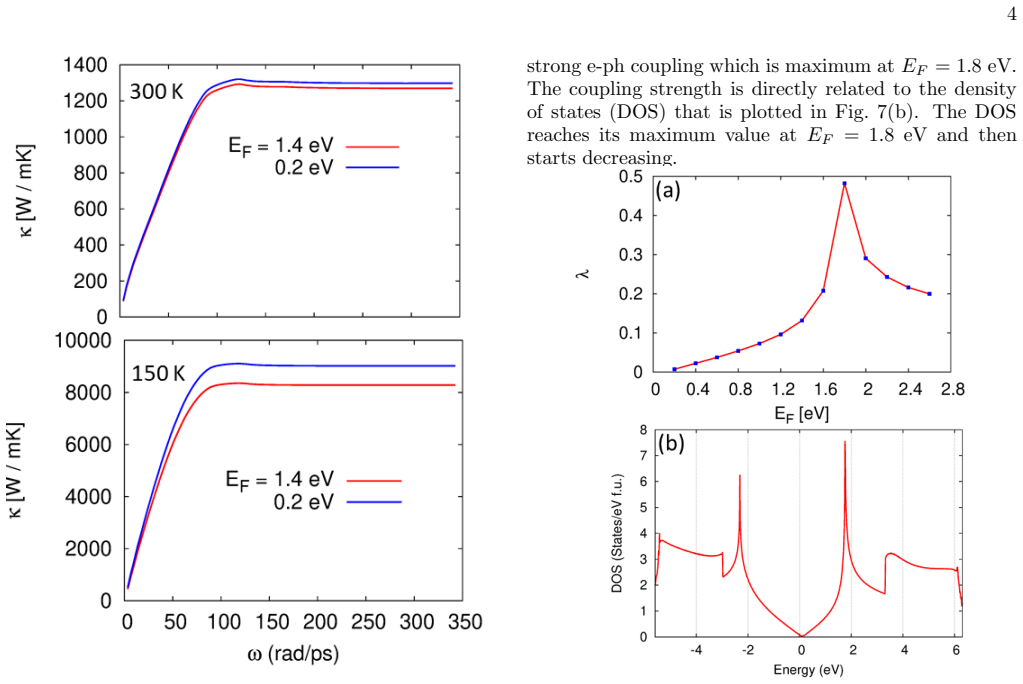
The load-bearing object is the phonon–electron scattering rate computed with the standard relaxation-time model for electron–phonon coupling and added to the phonon Boltzmann transport equation, alongside three-phonon anharmonic rates obtained from second- and third-order force constants. Shifting the Fermi energy rigidly into the unoccupied states changes only the electron occupation factors and the phase space for scattering, so the same first-principles electron–phonon matrix elements produce larger scattering rates as the density of states at the Fermi level grows. The peak coupling near $E_F = 1.8$ eV is what produces the maximum reduction in phonon lifetimes and hence in $\kappa_{\mathrm{ph}}$.
What would settle it
Measure the lattice thermal conductivity of a suspended graphene device at 200 K while sweeping a back gate through the density range corresponding to Fermi energies between roughly 0.2 and 2 eV; if the conductivity does not fall by roughly half and pass through a minimum near $E_F \approx 1.8$ eV, the central claim is contradicted.
Extended reading notes
Core claim
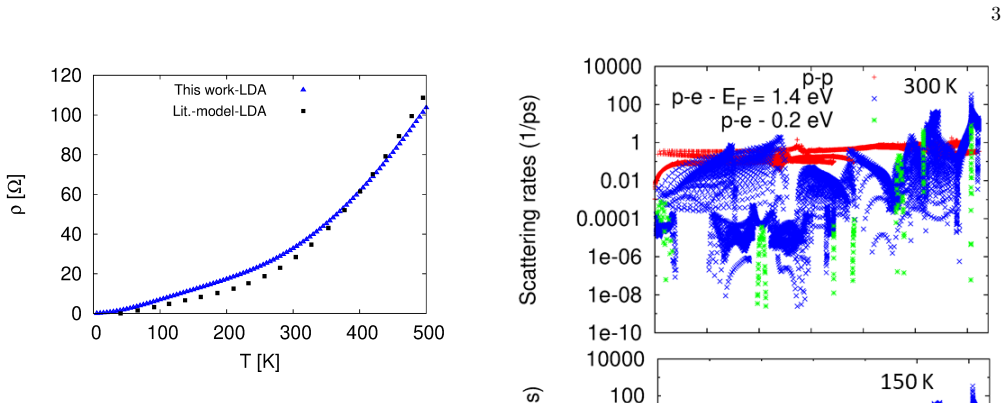
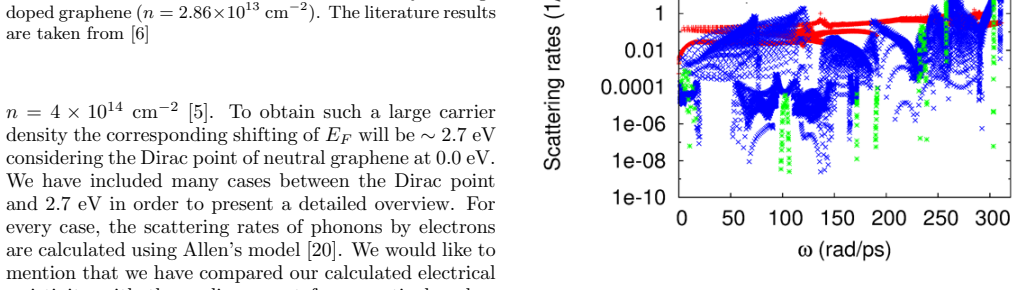
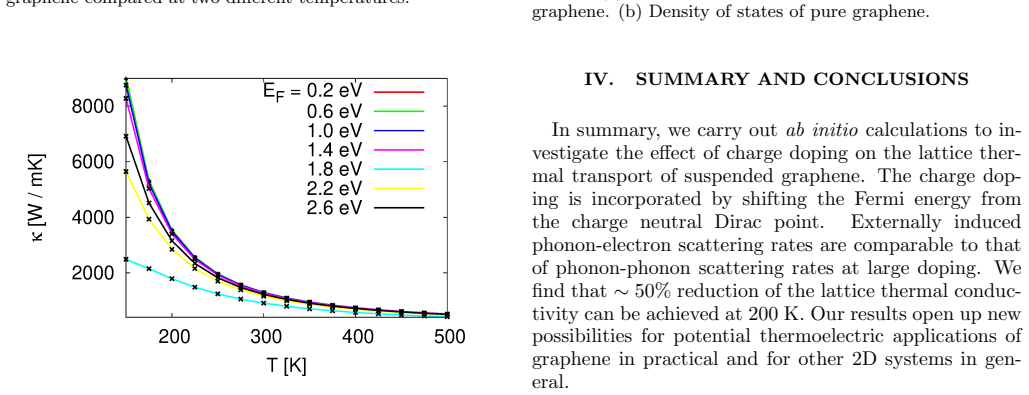
The central claim is that externally induced electron doping can cut the lattice thermal conductivity of suspended graphene by about half at 200 K. The reduction is not monotonic: the conductivity falls as the Fermi energy rises, reaches a minimum near $E_F = 1.8$ eV, and then recovers, because the electron–phonon coupling strength tracks the density of states, which peaks near that energy. At high doping the phonon–electron scattering rates become comparable to the intrinsic anharmonic phonon–phonon rates, especially for the low-frequency acoustic phonons that carry most of the heat. The authors verify their electron–phonon scattering rates by comparing the computed electrical resistivity with published data, and they find the doping effect is strongest at lower temperatures and weakens as temperature increases.
Load-bearing premise
The calculation assumes that rigidly shifting the Fermi energy into the conduction band, leaving the band structure and electron–phonon matrix elements unchanged, accurately gives the phonon–electron scattering rates up to about 1.8 eV above the Dirac point; if that rigid-band picture or the relaxation-time model's coupling to the low-energy flexural phonons is inaccurate, the 50 percent reduction would shrink or move.
Editorial extensions
If this is right
- Gating becomes a reversible, contact-free way to lower graphene's lattice thermal conductivity, complementing defect- or isotope-based reduction strategies.
- The same phonon Boltzmann framework predicts that the relative reduction is larger at lower temperatures, so 200 K is not the optimum but a representative operating point.
- Because the effect peaks near $E_F = 1.8$ eV, experiments should target carrier densities near that Fermi-level shift rather than monotonically higher doping.
- The mechanism should transfer to other two-dimensional materials whose Fermi level can be tuned electrostatically, provided their electron–phonon coupling also grows with doping.
Reading between the lines
- A natural testable extension is to measure the thermal conductivity of a suspended graphene device versus back-gate voltage at fixed temperature; the predicted non-monotonic minimum near $E_F \approx 1.8$ eV would distinguish this mechanism from ordinary impurity scattering.
- If the rigid-band shift is replaced by a full self-consistent band structure at high doping, the optimal Fermi energy and the 50 percent figure could shift; comparing the two would show how much of the result depends on the rigid-band assumption.
- The paper's emphasis on electron doping leaves hole doping as a nearby asymmetry: because the coupling strength is predicted to be smaller for holes at high Fermi energies, a smaller thermal-conductivity reduction would support the electron–phonon mechanism rather than a generic doping effect.
Signed reviews
Editorial analysis
A structured set of objections, weighed in public.
Referee Report
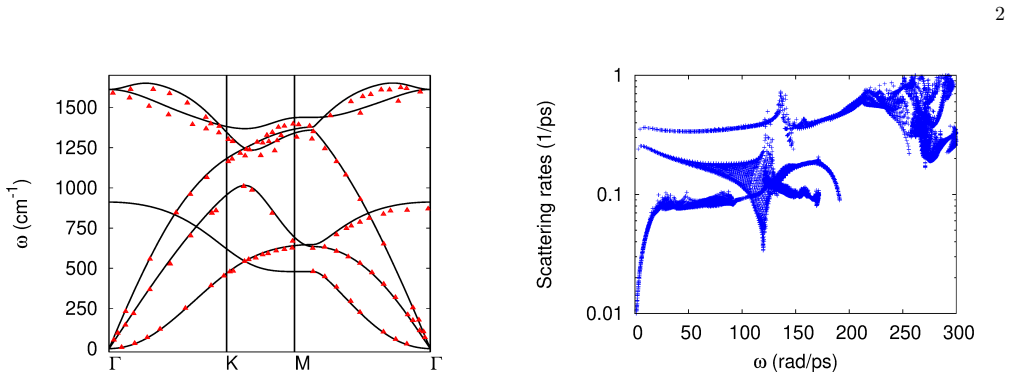
Summary. The manuscript reports first-principles calculations of the lattice thermal conductivity of suspended graphene including phonon-electron (p-e) scattering, with the Fermi level rigidly shifted to simulate electron doping. Phonon-phonon (p-p) scattering rates are computed with a modified ShengBTE package, and p-e scattering rates with Allen's model using EPW electron-phonon matrix elements. The main claim is that at large electron doping the lattice thermal conductivity can be reduced by about 50% at 200 K, specifically when comparing EF = 0.2 eV with EF = 1.8 eV, where the electron density of states and electron-phonon coupling are maximal. The authors also compare the calculated phonon dispersion with inelastic x-ray data and the electrical resistivity with a prior calculation at n = 2.86e13 cm^-2.
Significance. If the central claim holds, the paper identifies a practical, gate-controlled route to reducing graphene's lattice thermal conductivity, which would be relevant for thermoelectric applications. The work has notable strengths: the calculations involve no post-hoc fitting; the resistivity benchmark in Fig. 3 uses an independent earlier calculation; the phonon dispersion in Fig. 1 is validated against experiment; and the p-p scattering rates in Fig. 2 reproduce the expected asymptotic behavior for acoustic modes. However, the quantitative 50% reduction rests on a rigid-band Fermi shift into the LDA Van Hove singularity, and the manuscript does not report the undoped baseline or any convergence tests. These gaps make the central quantitative claim less secure than the presentation suggests.
major comments (4)
- [Abstract and Sec. III (Fig. 6)] The 50% reduction is defined as the difference between EF = 0.2 eV and EF = 1.8 eV, not as a reduction relative to undoped graphene. The abstract states a '~50% reduction of the lattice thermal conductivity at 200 K' without specifying this baseline, which is misleading because the practically relevant quantity for thermoelectric figures of merit is the reduction relative to the pristine, undoped value. The authors should report the undoped lattice thermal conductivity at 200 K and state the baseline explicitly in the abstract and conclusions.
- [Secs. II and III, especially Fig. 7(b)] The central result relies on the rigid-band approximation at EF = 1.8 eV, where the LDA density of states reaches its maximum at the M-point Van Hove singularity. The manuscript provides no self-consistent treatment of the doped electron system, no assessment of screening-induced band-structure renormalization, and no sensitivity test for the Gaussian smearing of 0.025 Ry, which smooths the singularity. If the true doped DOS at EF is lower than the rigid-shift LDA value, the p-e scattering rates and hence the predicted 50% reduction would be reduced. The authors should test this by performing self-consistent doped calculations (e.g., with a Fermi-level smearing approach) or at least by varying the smearing and showing that the predicted reduction is robust.
- [Sec. II (computational parameters)] No convergence tests are reported for the 140x140x1 q-grid, the 200x200x1 k-grid, the 0.025 Ry Gaussian smearing, or the 10-nearest-neighbor cutoff for third-order force constants. Since the p-e scattering rates depend on electronic states near EF and the DOS peak, numerical broadening may affect the quantitative result. The authors should provide convergence tests with respect to these parameters, particularly for the p-e rates at EF = 1.8 eV.
- [Sec. III (Figs. 1, 2, and text)] The undoped lattice thermal conductivity is never quoted or compared with the well-known experimental range of 2600-5300 W/mK (Refs. [1-3]). The phonon dispersion comparison (Fig. 1) and the asymptotic behavior of p-p rates (Fig. 2) are encouraging but do not quantitatively validate the BTE setup. Without this baseline, the reader cannot judge whether the computed absolute values, and hence the 50% reduction, are trustworthy.
minor comments (5)
- [Abstract] The phrasing 'Declining the lattice thermal conductivity' is unconventional; 'Reducing' or 'Suppressing' would be clearer.
- [Fig. 1 caption] There is a typo: 'symmetery' should be 'symmetry'.
- [Sec. III (Fig. 3)] The comparison with Ref. [6] is described only as 'matches well'; more quantitative detail (e.g., a range of T over which agreement holds) would strengthen the validation.
- [Sec. III (Fig. 4)] The discrete scattering rates for EF = 0.2 eV are attributed to intervalley scattering at the K point, but the figure is not fully described; a few sentences explaining the origin and numerical representation of these discrete features would improve readability.
- [Sec. II and III] The phrase 'first-principle calculations' should be 'first-principles calculations' for consistency.
Circularity Check
No circularity: the 50% reduction is an emergent BTE result from independent first-principles inputs.
full rationale
The paper's derivation chain is self-contained: harmonic and anharmonic force constants come from DFPT/DFT supercell calculations, phonon-electron scattering rates come from EPW with Allen's model, and the thermal conductivity is obtained by solving the phonon Boltzmann transport equation. The two self-citations (ShengBTE and the BTE solver, Refs. [17] and [19]) are tool citations to an established, externally benchmarked code, not load-bearing circularity. The prediction is not a fit: the roughly 50% reduction at 200 K is obtained by comparing computed conductivities at EF = 0.2 eV and EF = 1.8 eV, and no parameter is adjusted to match the target. The choice of EF = 1.8 eV as the maximum-effect case follows from the computed density of states, but the comparison is an output of the calculation, not an imposed input. The main vulnerability, rigid-band shifting to high doping without a self-consistent treatment, is a correctness risk rather than a circularity.
Assumptions & free parameters
free parameters (1)
- Fermi energy shift EF =
0.2 to 2.6 eV in 0.2 eV steps; main result at 1.8 eV
assumptions (5)
- domain assumption Doping can be represented by a rigid shift of the Fermi energy, leaving the band structure and electron-phonon matrix elements unchanged.
- domain assumption Allen's model provides accurate phonon-electron scattering rates for graphene at high electron densities.
- domain assumption Third-order interatomic force constants from one 8x8x1 supercell with up to ten nearest neighbors are converged.
- domain assumption LDA pseudopotentials, a 60 Ry cutoff, and a 140x140x1 q-grid yield converged phonon and electron-phonon quantities.
- domain assumption Doping does not alter the phonon dispersion or the anharmonic phonon-phonon scattering rates.
Cite this review
Pith. "Pith review of Significant reduction of lattice thermal conductivity in suspended graphene by charge doping." pith.science (2026). https://pith.science/paper/TK7VLFCL
@misc{pith2026190802433,
  author       = {Pith},
  title        = {Pith review of: Significant reduction of lattice thermal conductivity in suspended graphene by charge doping},
  year         = {2026},
  howpublished = {\url{https://pith.science/paper/TK7VLFCL}},
  note         = {Machine review of arXiv:1908.02433}
}
abstract
Declining the lattice thermal conductivity in graphene is essential for its thermoelectric applications. In high electron density systems, scatterings of phonons by electrons are no less than the phonon scatterings by other phonons. With the aid of first-principle calculations we examine the lattice thermal conductivity in graphene by inducing electron-phonon scattering externally. With experimentally tunable charge carrier density we find $\sim 50\%$ reduction of the lattice thermal conductivity at 200 K. The present study opens up new avenues for potential thermoelectric applications of graphene.
Figures
Figures from the paper (2 more)
Reference graph
Works this paper leans on
-
[1]
A. A. Balandin et al. , Nano Lett. 8, 902 (2008)
work page 2008
- [2]
-
[3]
J. H. Seol et al. , Science 328, 213 (2010). 5
work page 2010
-
[4]
T. Y. Kim, C.-H. Park, and N. Marzari, Nano Lett. 16, 2439 (2016)
work page 2016
-
[5]
D. K. Efetov and P. Kim, Phys. Rev. Lett. 105, 256805 (2010)
2010
-
[6]
C.-H. Park, N. Bonini, T. Sohier, G. Samsonidze, B. Kozinsky, M. Calandra, F. Mauri, and N. Marzari, Nano Lett. 14, 1113 (2014)
2014
-
[7]
J. Yan, Y. Zhang, P. Kim, and A. Pinczuk, Phys. Rev. Lett. 98, 166802 (2007)
work page 2007
-
[8]
C.-H. Park, F. Giustino, M. L. Cohen, and S. G. Louie, Phys. Rev. Lett. 99, 086804 (2007)
work page 2007
Show all 29 references
-
[9]
C.-H. Park, F. Giustino, M. L. Cohen, and S. G. Louie, Nano Lett. 8, 4229 (2008)
2008
-
[10]
Adamyan and V
V. Adamyan and V. Zavalniuk, J. Phys.: Condens. Mat- ter 24, 415401 (2012)
2012
-
[11]
B. S. Lee and J. S. Lee, Appl. Phys. A 121, 1193 (2015)
2015
-
[12]
S. Hu, J. Chen, N. Yang, and B. Li, Carbon 116, 139 (2017)
2017
-
[13]
K. S. Novoselov et al., Nature (London) 438, 197 (2005)
2005
-
[14]
Zhang, Y.-W
Y. Zhang, Y.-W. Tan, H. L. Stormer, and P. Kim, Nature (London) 438, 201 (2005)
2005
-
[15]
Lindsay, D
L. Lindsay, D. A. Broido, and T. L. Reinecke, Phys. Rev. Lett. 109, 095901 (2012)
2012
-
[16]
Lindsay, D
L. Lindsay, D. A. Broido, and T. L. Reinecke, Phys. Rev. Lett. 111, 025901 (2013)
2013
-
[17]
to calculate κph by supplying second and third or- arXiv:1908.02433v1 [cond-mat.mtrl-sci] 7 Aug 2019 2 FIG. 1. Phonon dispersion relation of graphene along the high symmetry-lines of hexagonal lattice. The triangles represent the experimental data from [22] obtained by inelast...
1908 arXiv
-
[18]
W. Li, J. Carrete, N. A. Katcho, and N. Mingo, Comput. Phys. Commun. 185, 1747 (2014)
2014
-
[19]
Ponc´ e, E
S. Ponc´ e, E. R. Margine, C. Verdi, and F. Giustino, Comput. Phys. Commun. 209, 116 (2016)
2016
-
[20]
Li, Phys
W. Li, Phys. Rev. B 92, 075405 (2015)
2015
-
[21]
P. B. Allen, Phys. Rev. B 17, 3725 (1978)
1978
-
[22]
Giannozzi et al., J
P. Giannozzi et al., J. Phys.: Condens. Matter 21, 395502 (2009)
2009
-
[23]
Mohr et al
M. Mohr et al. , Phys. Rev. B 76, 035439 (2007)
2007
-
[24]
Saito, G
R. Saito, G. Dresselhaus, and M. Dresselhaus, Imperial College Press, London (1998)
1998
-
[25]
Bonini, J
N. Bonini, J. Garg, and N. Marzari, Nano Lett. 12, 2673 (2012)
2012
-
[26]
Lindsay, W
L. Lindsay, W. Li, J. Carrete, N. Mingo, D. A. Broido, and T. L. Reinecke, Phys. Rev. B 89, 155426 (2014)
2014
-
[27]
Holland, Phys
M. Holland, Phys. Rev. 132, 2461 (1963)
1963
-
[28]
B. Liao, B. Qiu, J. Zhou, S. Huberman, K. Esfarjani, and G. Chen, Phys. Rev. Lett. 114, 115901 (2015)
2015
-
[29]
Jain and A
A. Jain and A. J. H. McGaughey, Phys. Rev. B 93, 081206(R) (2016)
2016
Reviewed August 14, 2026 · model on record in the stance chip above.
Discussion (0). Continue with ORCID to comment.