REVIEW 4 major objections 3 minor 37 references
Optimization-Based Learning Control for Nonlinear Time-Varying Systems
T0 review · 4 major / 3 minor · reviewed 2026-08-14 · deepseek-v4-flash
Pith's one-line read A purely data-driven iterative learning law can drive an unknown nonlinear time-varying system to perfect tracking using only measured input/output data.
desk verdict A competent extension of data-driven ILC with a real proof gap in Theorem 1 and an overstated T-independence claim; worth review after major revision. read the letter →
The pith
A machine-rendered reading of the paper's core claim, the machinery that carries it, and where it could break.
The reading
What carries the argument
The central object is the extended dynamical linearization (Lemma 1), which expresses the output difference between two iterations as $\Theta_{i,j}\Delta u$, a lower-triangular matrix whose entries are uniformly bounded and whose diagonal entries are the input-output coupling derivatives, kept positive and bounded away from zero by Assumption (A1). Around it the paper builds an optimization-based adaptive estimator (Lemma 3/step (S2)) whose cost includes the previous estimate's deviation and an $\ell^2$ penalty that automatically keeps the estimate bounded, and an input update (17) derived from minimizing the weighted high-order error index (3). The convergence machinery is the double-dynamics analysis: the lifted error recursion (31) and the input recursion (38) are coupled through driving signals $\kappa_k(t)$ and $\psi_k(t)$; nonnegative-matrix arguments (Lemma 10) turn the scalar condition (35) into the contraction condition (C), and induction over time steps proves boundedness and convergence. The binding condition (41) is what makes both the error matrix and the input coefficient contract simultaneously, independent of the horizon length $T$.
What would settle it
Run Algorithm 1, with gains satisfying (41), on a smooth nonlinear plant that obeys (A1) and see whether the tracking error fails to converge to zero or any estimated parameter exceeds the predicted bound $\beta_{\hat\theta}$; a single such plant would refute Theorem 2. A sharper test: replace the input-output coupling term $t/(t+2)u_k(t)$ in the paper's simulation with a smooth function that changes sign at some time step while keeping the function smooth; if the tracking error still converges, then Assumption (A1) is not necessary, and if it diverges, the sign-fixity premise is confirmed as load-bearing.
Extended reading notes
Core claim
On its own terms, the paper establishes that the unknown nonlinear time-varying system (1) can be made to track a prescribed trajectory perfectly in the limit of iterations, without any explicit model knowledge. The proof rests on an extended dynamical linearization (Lemma 1) that represents the difference of outputs between two iterations as a lower-triangular matrix $\Theta_{i,j}$ times the input difference, with all entries bounded and diagonal entries lying in $[\underline{\beta}_f,\bar{\beta}_f]$. Algorithm 1 estimates these entries by optimizing an index that penalizes the one-step prediction error, the change of the estimate along the iteration axis, and the size of the estimate; the last two terms make the estimates uniformly bounded by construction. The convergence analysis follows a double-dynamics approach: the tracking-error dynamics and the input dynamics are coupled nonrepetitive linear-like systems driven by signals that vanish when earlier time steps have converged, and induction over the time horizon completes the argument. The central parametric condition (41) is shown to be sufficient for both the error contraction and the input boundedness, and the same framework yields robust tracking (Theorem 3) under bounded nonrepetitive disturbances and initial shifts.
Load-bearing premise
The entire argument depends on Assumption (A1): the unknown plant is smooth everywhere, all its partial derivatives are globally bounded, and its input-output coupling derivative is always positive and bounded away from zero.
Editorial extensions
If this is right
- A user can implement Algorithm 1 without knowing the plant equations or their parameters; only input/output measurements from previous repetitions are required.
- The gain condition (41) is independent of the horizon length $T$, so longer tasks do not force tighter tuning of $\lambda$ and $\gamma_i$.
- Estimated linearization parameters are guaranteed bounded by the optimization itself, without an extra step-size or projection, for any input update gains.
- Under bounded nonrepetitive disturbances and initial shifts, tracking error converges to a small neighborhood of zero that shrinks with the disturbance/initial-shift bounds; perfect tracking is recovered when these uncertainties tend to zero.
- Special cases covered include first-order ILC ($m=1$), where the condition reduces to $\lambda > \gamma_1^2 \bar{\beta}_f \beta_{\hat\theta}$, and time-invariant nonlinear plants.
Reading between the lines
- The analysis gives no quantitative convergence rate; a natural extension would be to bound the contraction factor $\zeta$ in terms of the gains and plant bounds and compare it with classical contraction-mapping ILC rates.
- Since the estimator is bounded via the $\mu_2$ penalty, the method may also tolerate linearization parameters that drift slowly along the iteration axis, as the proofs appear to handle iteration-dependent parameters as long as they stay bounded.
- One could test the sign-fixity assumption empirically by monitoring the estimated diagonal $\hat\theta_{k,k-1,t}(t)$; if it repeatedly hits the floor $\varepsilon$, the plant likely violates Assumption (A1), and a sign-switching extension would be needed.
- The robust result points toward a practical stopping rule: terminate when the maximal tracking error stops decreasing and scale the terminal error by the disturbance bounds.
Signed reviews
Editorial analysis
A structured set of objections, weighed in public.
Referee Report
Summary. The paper proposes an optimization-based adaptive iterative learning control (ILC) scheme (Algorithm 1) for single-input single-output nonlinear time-varying discrete-time systems described by (1). The design relies on a dynamical linearization (Lemma 1) under a global differentiability and sign condition (Assumption (A1)), an optimization-based parameter estimator (12) with a projection/reset mechanism (16), and an input update (17) obtained from a high-order quadratic index (3). The main convergence result (Theorem 2) claims boundedness of the input and output sequences and asymptotic perfect tracking under the selection condition (41). Section V extends the scheme to systems with bounded nonrepetitive disturbances and initial shifts (51) and states a robust tracking result (Theorem 3). Simulation tests in Section VI illustrate the behavior on a nonlinear example.
Significance. If the main results are correct, the paper would offer a data-driven ILC law that does not require an explicit system model, handles nonlinear time-varying dynamics with bounded and sign-fixed input-output coupling, and avoids the usual eigenvalue-based contraction-mapping analysis by using a double-dynamics argument with nonnegative matrices. The proof of Theorem 2 is genuinely inductive and quite detailed, and the optimization-based estimator with the projection (16) is a plausible mechanism for keeping parameter estimates bounded. The paper also makes a useful robustness claim for nonrepetitive disturbances, which is not well covered by earlier optimization-based adaptive ILC results. However, several load-bearing issues remain: the proof of Theorem 1 does not account for the projection step (16), the proof of Theorem 3 is omitted for the main boundedness and tracking claims, and the claimed T-independence of condition (41) is contradicted by the definition of beta_hat in (29). These are repairable but require substantive revision.
major comments (4)
- [Section IV, Theorem 1 proof; Algorithm 1 step (S2), Eq. (16)] The proof of Theorem 1 analyzes only the unprojected update (13)/(15) and derives the bound (29) for the sequence that never experiences the reset (16). The actual Algorithm 1 resets the diagonal component to the initial estimate whenever it drops below epsilon. Since the reset can increase the Euclidean norm relative to the unprojected candidate, the recurrence (28) and the bound (29) do not apply to the implemented sequence. Because beta_hat from (29) is used in Lemma 8 and in the sufficient condition (41), the stated lambda condition may not be valid for the algorithm as written. The gap appears repairable by an induction that explicitly handles the reset, or by enlarging beta_hat to cover the reset value, but the proof must be supplied.
- [Section V, Theorem 3 proof, parts 2) and 3)] After deriving the perturbed error dynamics (59)-(60) and input dynamics (61)-(62), the proof states that the boundedness and robust/perfect tracking results follow 'by following the same steps as the proof of Theorem 2, which is thus omitted here.' These are central claims of the paper, and the omission is not acceptable: the additional disturbance and initial-shift terms in (60) and (62) affect the driving signals in the induction over t, and their boundedness and convergence must be verified explicitly. A proof (or at least a rigorous sketch covering all the new terms) is needed.
- [Remark 7 versus Eq. (29) and Eq. (41)] Remark 7 claims that the use of the double-dynamics approach makes the selection condition (41) independent of the learning time horizon T. This is not supported by the manuscript: the quantity beta_hat in Theorem 1 is defined in (29) as max_t ||theta_hat_{1,0,t}(t)||_2 + (mu_1+mu_2)/mu_2 sqrt(T) beta_theta, which depends on T. Since condition (41) contains beta_hat, it depends on T through beta_hat. The claimed improvement over the T-dependent conditions in, e.g., [27] is therefore not established and the remark should be revised or qualified.
- [Assumption (A1), Eqs. (4)-(6) and Lemma 1, Eq. (9)] The same symbol beta_f is used in (4) for the uniform upper bound on the partial derivatives and in (5) for the strictly positive lower bound on the input-output coupling derivative. This makes the interval in (6) degenerate, [beta_f, beta_f], which cannot hold for a general nonlinearity. Correspondingly, the diagonal interval in Lemma 1, Eq. (9), appears as [beta_f, beta_f]. If distinct lower and upper bounds, say underline{beta}_f and overline{beta}_f, were intended, the notation must be corrected consistently, because Lemma 8 and condition (41) rely on the lower bound beta_f via the product theta_{k,k-1,t}(t) theta_hat_{k,k-1,t}(t).
minor comments (3)
- [Section III, Algorithm 1 and Section VI] The simulation sets the initial estimate as theta_hat_{0,-1,t}(i), while step (S1) defines the initial value as theta_hat_{1,0,t}(i). Either the algorithm or the simulation notation should be made consistent.
- [Remark 3] The statement that (14) guarantees theta_hat_{1,0,t}(t) has the same sign as the coupling derivative assumes without loss of generality that the sign is positive. This is fine, but the sign convention should be stated explicitly when discussing the projection in (16).
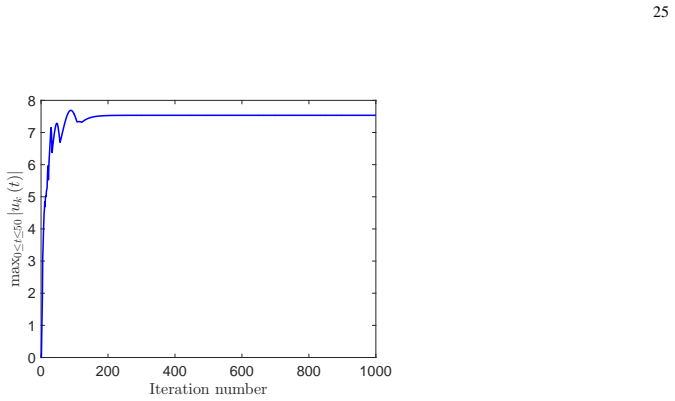
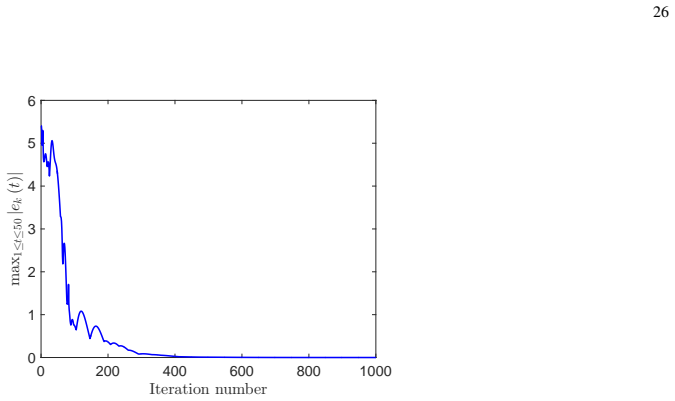
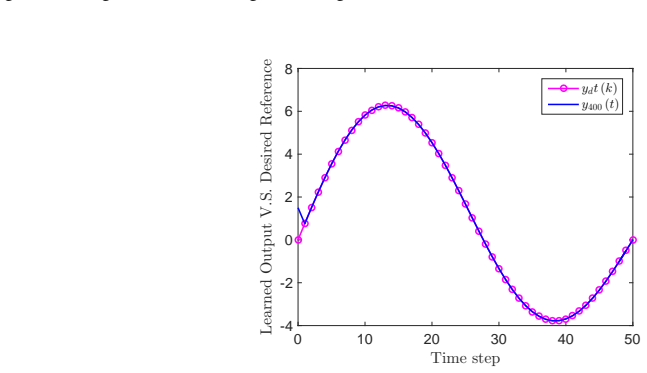
- [Section VI, Figure 4] The caption and surrounding text of Figure 4 are corrupted in places (e.g., stray 'max 50' fragments), and the figure should be cleaned up before publication.
Circularity Check
No significant circularity; the convergence argument is derived from the update laws and boundedness estimates, not from the desired tracking result.
full rationale
The paper's derivation chain is self-contained and non-circular. Lemma 1 is an extended dynamical linearization obtained from Assumption (A1) via the mean value theorem and chain-rule estimates; it does not assume tracking. Lemmas 2 and 3 are explicit optimizations of the indices (3) and (12), respectively. Theorem 1 proves boundedness of the parameter estimates through the contraction property of Q in Lemma 4, leading to the explicit bound (29); this bound is used only as a sufficient condition in Lemma 8, not as a fitted value designed to force convergence. The error and input dynamics (19) and (38) are obtained by direct substitution of the control and estimation updates into the plant relation (10), and the subsequent convergence proof uses the nonnegative-matrix condition (35) and the contraction condition (40), which Lemma 8 shows follow from the parameter condition (41). The estimates θhat are not fitted to the tracking error ek; they are updated from past input/output increments, and the theorem only requires them to be bounded and sign-consistent. The citations to [33] and [34], both by the first author, are used as published, independent technical lemmas for nonrepetitive ILC analysis; they are load-bearing tools but are not unverified assertions of the present theorem, and they do not smuggle in the conclusion. The only notable concern is a proof gap rather than circularity: the proof of Theorem 1 analyzes the unprojected update (13), while Algorithm 1 includes the reset (16), and the bound (29) is not explicitly re-derived for the projected sequence. That is an incompleteness in the proof, not a reduction of the result to its inputs. Therefore the circularity score is 0.
Assumptions & free parameters
free parameters (1)
- Learning and estimation weights lambda, gamma_i, mu1, mu2, epsilon =
Simulation values: lambda=1, gamma1=0.8, gamma2=0.14, gamma3=0.06, mu1=1, mu2=0.001, epsilon=0.01
assumptions (4)
- domain assumption Assumption (A1): f is continuously differentiable, partial derivatives with respect to the first l+n+2 variables are bounded by beta_f, and the input-output coupling derivative is uniformly positive.
- domain assumption Assumption (A2): nonrepetitive disturbances and initial shifts are bounded.
- domain assumption Lemma 5 (cited from [33, Lemma 2]): a nonrepetitive linear iteration process with block-contraction products has bounded trajectories and converges when the driving term is bounded or vanishes.
- standard math Differential mean value theorem and derivation rules for composite functions.
Cite this review
Pith. "Pith review of Optimization-Based Learning Control for Nonlinear Time-Varying Systems." pith.science (2026). https://pith.science/paper/5MLFTVKZ
@misc{pith2026190802447,
  author       = {Pith},
  title        = {Pith review of: Optimization-Based Learning Control for Nonlinear Time-Varying Systems},
  year         = {2026},
  howpublished = {\url{https://pith.science/paper/5MLFTVKZ}},
  note         = {Machine review of arXiv:1908.02447}
}
read the original abstract
Learning to perform perfect tracking tasks based on measurement data is desirable in the controller design of systems operating repetitively. This motivates the present paper to seek an optimization-based design approach for iterative learning control (ILC) of repetitive systems with unknown nonlinear time-varying dynamics. It is shown that perfect output tracking can be realized with updating inputs, where no explicit model knowledge but only measured input/output data are leveraged. In particular, adaptive updating strategies are proposed to obtain parameter estimations of nonlinearities. A double-dynamics analysis approach is applied to establish ILC convergence, together with boundedness of input, output, and estimated parameters, which benefits from employing properties of nonnegative matrices. Moreover, robust convergence is explored for optimization-based adaptive ILC in the presence of nonrepetitive uncertainties. Simulation tests are also implemented to verify the validity of our optimization-based adaptive ILC.
Figures
Reference graph
Works this paper leans on
-
[24]
Dual-stage optimal iterative learning control for nonlinear non-affine discrete-time sy stems,
R.-H. Chi and Z.-S. Hou, “Dual-stage optimal iterative learning control for nonlinear non-affine discrete-time sy stems,” Acta Automatica Sinica , vol. 33, no. 10, pp. 1061–1065, Oct. 2007
work page 2007
-
[30]
Y . Hui, R. Chi, B. Huang, and Z. Hou, “Extended state obse rver-based data-driven iterative learning control for per manent magnet linear motor with initial shifts and disturbances,” IEEE Transactions on Systems, Man, and Cybernetics: System s, to be published, doi: 10.1109/TSMC.2019.2907379
-
[33]
Robust iterative learning cont rol for nonrepetitive uncertain systems,
D. Meng and K. L. Moore, “Robust iterative learning cont rol for nonrepetitive uncertain systems,” IEEE Transactions on Automatic Control, vol. 62, no. 2, pp. 907-913, Feb. 2017
work page 2017
-
[27]
Computationally effi cient data-driven higher order optimal iterative learning control,
R. Chi, Z. Hou, S. Jin and B. Huang, “Computationally effi cient data-driven higher order optimal iterative learning control,” IEEE Transactions on Neural Networks and Learning Systems , vol. 29, no. 12, pp. 5971–5980, Dec. 2018
work page 2018
-
[1]
Bettering ope ration of robots by learning,
S. Arimoto, S. Kawamura, and F. Miyazaki, “Bettering ope ration of robots by learning,” Journal of Robotic Systems , vol. 1, no. 2, pp. 123–140, Apr. 1984
work page 1984
-
[2]
An overview of dynamic-linear ization-based data-driven control and applications,
Z. Hou, R. Chi, and H. Gao, “An overview of dynamic-linear ization-based data-driven control and applications,” IEEE Transactions on Industrial Electronics , vol. 64, no. 5, pp. 4076–4090, May 2017
work page 2017
-
[3]
D. A. Bristow, M. Tharayil, and A. G. Alleyne, “A survey of iterative learning control: A learning-based method for high-performance tracking control,” IEEE Control Systems Magazine , vol. 26, no. 3, pp. 96–114, Jun. 2006
work page 2006
-
[4]
Iterative learning c ontrol: Brief survey and categorization,
H.-S. Ahn, Y . Chen, and K. L. Moore, “Iterative learning c ontrol: Brief survey and categorization,” IEEE Transactions on Systems, Man, and Cybernetics, Part C: Applications and Rev iews, vol. 37, no. 6, pp. 1099–1121, Nov. 2007
work page 2007
Show all 37 references
-
[5]
A survey on iterative learning control for non linear systems,
J.-X. Xu, “A survey on iterative learning control for non linear systems,” International Journal of Control , vol. 84, no. 7, pp. 1275–1294, Jul. 2011
2011
-
[6]
Survey on stochastic iterative lear ning control,
D. Shen and Y . Wang, “Survey on stochastic iterative lear ning control,” Journal of Process Control , vol. 24, no. 12, pp. 64–77, Dec. 2014
2014
-
[7]
Iterative learning control for discrete-time systems with exponential rate of convergence,
N. Amann, D. H. Owens, and E. Rogers, “Iterative learning control for discrete-time systems with exponential rate of convergence,” IEE Proceedings–Control Theory and Applications , vol. 143, no. 2, pp. 217–224, Mar. 1996
1996
-
[8]
An optimal design of PD-type iter ative learning control with monotonic convergence,
Y . Chen and K. L. Moore, “An optimal design of PD-type iter ative learning control with monotonic convergence,” in Proceedings of the IEEE Internatinal Symposium on Intellig ent Control, V ancouver, Canada, pp. 55–60, Oct. 27-30, 2002
2002
-
[9]
Robust optimal design and convergen ce properties analysis of iterative learning control appro aches,
J.-X. Xu and Y . Tan, “Robust optimal design and convergen ce properties analysis of iterative learning control appro aches,” Automatica, vol. 38, no. 11, pp. 1867–1880, Nov. 2002
2002
-
[10]
Optimal iterati ve learning control design for multi-agent systems consens us tracking,
S. Yang, J.-X. Xu, D. Huang, and Y . Tan, “Optimal iterati ve learning control design for multi-agent systems consens us tracking,” Systems and Control Letters , vol. 69, pp. 80–89, Jul. 2014
2014
-
[11]
A norm optimal approach t o time-varying ILC with application to a multi-axis robotic testbed,
K. L. Barton and A. G. Alleyne, “A norm optimal approach t o time-varying ILC with application to a multi-axis robotic testbed,” IEEE Transactions on Control Systems Technology , vol. 19, no. 1, pp. 166–180, Jan. 2011
2011
-
[12]
An inverse-model approach to multivariable norm optimal iterative learning control with auxiliary optimisation,
D. H. Owens, C. T. Freeman, and B. Chu, “An inverse-model approach to multivariable norm optimal iterative learning control with auxiliary optimisation,” International Journal of Control , vol. 87, no. 8, pp. 1646–1671, Aug. 2014
2014
-
[13]
Generalizatio n of norm optimal ILC for nonlinear systems with constraints ,
M. V olckaert, M. Diehl, and J. Swevers, “Generalizatio n of norm optimal ILC for nonlinear systems with constraints ,” Mechanical Systems and Signal Processing , vol. 39, nos. 1-2, pp. 280–296, Aug.-Sept. 2013
2013
-
[14]
A data-driv en constrained norm-optimal iterative learning control fr amework for LTI systems,
P . Janssens, G. Pipeleers, and J. Swevers, “A data-driv en constrained norm-optimal iterative learning control fr amework for LTI systems,” IEEE Transactions on Control Systems Technology , vol. 21, no. 2, pp. 546–551, Mar. 2013
2013
-
[15]
Robust monoton ic convergent iterative learning control,
T. D. Son, G. Pipeleers, and J. Swevers, “Robust monoton ic convergent iterative learning control,” IEEE Transactions on Automatic Control, vol. 61, no. 4, pp. 1063–1068, Apr. 2016
2016
-
[16]
Frequency-domain anal ysis of robust monotonic convergence of norm-optimal itera tive learning control,
X. Ge, J. L. Stein, and T. Ersal, “Frequency-domain anal ysis of robust monotonic convergence of norm-optimal itera tive learning control,” IEEE Transactions on Control Systems Technology , vol. 26, no. 2, pp. 637–651, Mar. 2018
2018
-
[17]
Linear computa tional complexity robust ILC for lifted systems,
A. Haber, R. Fraanje, and M. V erhaegen, “Linear computa tional complexity robust ILC for lifted systems,” Automatica, vol. 48, no. 6, pp. 1102–1110, Jun. 2012
2012
-
[18]
A computationally efficient no rm optimal iterative learning control approach for LTV syst ems,
H. Sun and A. G. Alleyne, “A computationally efficient no rm optimal iterative learning control approach for LTV syst ems,” Automatica, vol. 50, pp. 141–148, Jan. 2014
2014
-
[19]
Estimation -based norm-optimal iterative learning control,
P . Axelsson, R. Karlsson, and M. Norrl¨ of, “Estimation -based norm-optimal iterative learning control,” Systems and Control Letters, vol. 73, pp. 76–80, Nov. 2014
2014
-
[20]
A discrete-time stochastic learning contr ol algorithm,
S. S. Saab, “A discrete-time stochastic learning contr ol algorithm,” IEEE Transactions on Automatic Control , vol. 46, no. 6, pp. 877–887, Jun. 2001
2001
-
[21]
On a discrete-time stochastic learning con trol algorithm,
S. S. Saab, “On a discrete-time stochastic learning con trol algorithm,” IEEE Transactions on Automatic Control , vol. 46, no. 8, pp. 1333–1336, Aug. 2001
2001
-
[22]
Optimality of first-order ILC among higher o rder ILC,
S. S. Saab, “Optimality of first-order ILC among higher o rder ILC,” IEEE Transactions on Automatic Control , vol. 51, no. 8, pp. 1332–1336, Aug. 2006. 41
2006
-
[23]
A structured matrix approa ch to efficient calculation of LQG repetitive learning contr ollers in the lifted setting,
J. K. Rice and M. V erhaegen, “A structured matrix approa ch to efficient calculation of LQG repetitive learning contr ollers in the lifted setting,” International Journal of Control , vol. 83, no. 6, pp. 1265–1276, Jun. 2010
2010
-
[25]
Hou and S
Z. Hou and S. Jin, Model Free Adaptive Control: Theory and Applications . Boca Raton: CRC Press, 2013
2013
-
[26]
A unified data-drive n design framework of optimality-based generalized iterat ive learning control,
R. Chi, Z. Hou, B. Huang, and S. Jin, “A unified data-drive n design framework of optimality-based generalized iterat ive learning control,” Computers and Chemical Engineering , vol. 77, pp. 10–23, Jun. 2015
2015
-
[28]
Data-driven high-or der terminal iterative learning control with a faster conve rgence speed,
R. Chi, B. Huang, Z. Hou and S. Jin, “Data-driven high-or der terminal iterative learning control with a faster conve rgence speed,” International Journal Robust and Nonlinear Control , vol. 28, no. 1, pp. 103–119, Jan. 2018
2018
-
[29]
Model free adaptive ite rative learning consensus tracking control for a class of nonlinear multiagent systems,
X. Bu, Q. Y u, Z. Hou, and W. Qian, “Model free adaptive ite rative learning consensus tracking control for a class of nonlinear multiagent systems,” IEEE Transactions on Systems, Man, and Cybernetics: System s, vol. 49, no. 4, pp. 677– 686, Apr. 2019
2019
-
[31]
W. J. Rugh, Linear System Theory . Upper Saddle River, NJ: Prientice Hall, 1996
1996
-
[32]
Stability of varying two-dim ensional roesser systems and its application to iterative l earning control convergence analysis,
D. Meng, Y . Jia, and J. Du, “Stability of varying two-dim ensional roesser systems and its application to iterative l earning control convergence analysis,” IET Control Theory and Applications , vol. 9, no. 8, pp. 1221-1228, May 2015
2015
-
[34]
Robust tracking of nonrepetitive learning control systems with iteration-dependent refere nces,
D. Meng and J. Zhang, “Robust tracking of nonrepetitive learning control systems with iteration-dependent refere nces,” IEEE Transactions on Systems, Man, and Cybernetics: System s, to be published, DOI: 10.1109/TSMC.2018.2883383
2018
-
[35]
Robust adaptive iterative le arning control for discrete-time nonlinear systems with bo th parametric and nonparametric uncertainties,
M. Y u, D. Huang, and W. He, “Robust adaptive iterative le arning control for discrete-time nonlinear systems with bo th parametric and nonparametric uncertainties,” International Journal of Adaptive Control and Signal Proce ssing, vol. 30, no. 7, pp. 972–985, Jul. 2016
2016
-
[36]
H. K. Khalil, Nonlinear Systems . Upper Saddle River, New Jersey: Prientice Hall, 2002
2002
-
[37]
R. A. Horn and C. R. Johnson, Matrix Analysis . Cambridge: Cambridge University Press, 1985
1985
Reviewed August 14, 2026 · model on record in the stance chip above.
Discussion (0). Continue with ORCID to comment.