REVIEW 2 major objections 6 minor 33 references
Multi-Dimensional Spatially-Coupled Code Design: Enhancing the Cycle Properties
T0 review · 2 major / 6 minor · reviewed 2026-08-14 · deepseek-v4-flash
Pith's one-line read A score-voting relocation scheme rewires the circulants that cause the most short cycles, converting them into longer cycles in multi-dimensional spatially-coupled codes.
desk verdict A systematic, tunable MD-SC construction that delivers large measured cycle and BER gains; the main gap is that the optimization scores a proxy (active cycles of one constituent) rather than total short cycles, but the reported totals keep the claims honest. read the letter →
The pith
A machine-rendered reading of the paper's core claim, the machinery that carries it, and where it could break.
The reading
What carries the argument
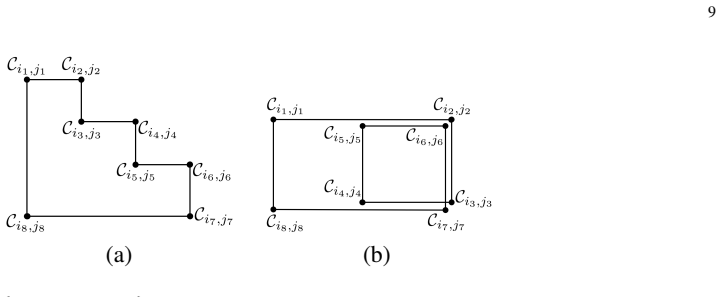
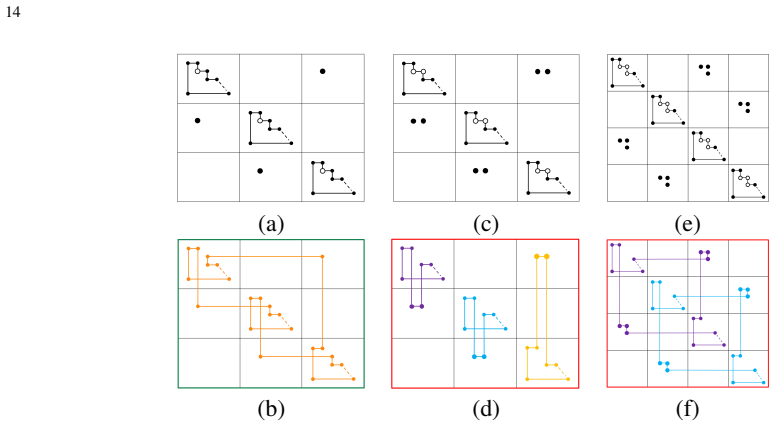
The load-bearing object is the Ineffective Relocation Condition (IRC), the congruence $\sum_{u=1}^k (-1)^u M(C_{i_u,j_u})\equiv 0 \pmod{L_2}$, which detects whether the relocated instances of a cycle still close within one segment. Around it the paper builds a score: for a cycle $O_k$ and a relocation option $t$, the score is $R(O_k,t)=L_2/\gcd(L_2,\Delta_{O_k})$, the length of the cycles that option produces. Algorithm 1 assigns these scores over all active cycles visiting a targeted circulant; Algorithm 2 grows a tree of relocation sequences, always moving the circulant visited by the most active cycles, expanding all surviving options, and trimming every branch whose active-cycle count is not minimal. This machinery carries the whole argument because it converts the design goal, fewer small cycles, into a tractable greedy search over circulant relocations.
What would settle it
Enumerate every cycle of length $k$ and length $2k$ in the final parity-check matrix $H_{\mathrm{MD}}^{\mathrm{SC}}$ for the codes studied in the paper, using the reported mapping matrices, and compare the total counts with the active-cycle counts used by the construction. A single case in which a code with fewer active cycles has more total short cycles, especially cycles that travel through more than one constituent chain, would show that the optimization target is not the quantity being improved.
Extended reading notes
Core claim
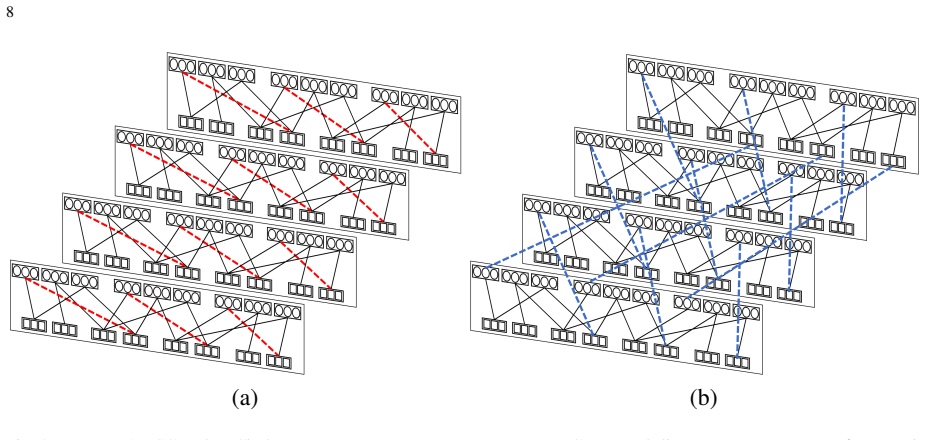
The central discovery is an exact rule for what happens to a short cycle when some of its circulants are moved between coupled SC chains. For a cycle $O_k$ of length $k$ in a constituent 1D-SC code, let $M(C_{i,j})$ be the auxiliary matrix index to which each visited circulant is relocated. The instances of the cycle across the $L_2$ constituent chains merge into $\tau$ cycles of length $L_2 k/\tau$, where $\tau = \gcd(L_2,\Delta_{O_k})$ and $\Delta_{O_k}$ is the alternating sum of the relocation indices modulo $L_2$; when the Ineffective Relocation Condition $\sum_{u=1}^k (-1)^u M(C_{i_u,j_u})\equiv 0 \pmod{L_2}$ holds, $\tau=L_2$ and the short cycles survive unchanged. The construction algorithm, by relocating the circulants that belong to the most active cycles so that this congruence fails, converts those short cycles into cycles of length up to $L_2 k$ while keeping the overall parity-check matrix diagonal and locally structured. Simulations then show the resulting MD-SC codes have far smaller counts of cycles-6 and cycles-8 than one-dimensional SC codes of the same length and rate, with BER gains reaching several orders of magnitude in the waterfall and error-floor region.
Load-bearing premise
The whole design rests on the assumption that the count of active short cycles, cycles of the constituent code that pass through the middle replica and survive relocation, faithfully represents how many short cycles the finished multi-dimensional code will have, even though cycles that cross between constituent chains are never counted.
Editorial extensions
If this is right
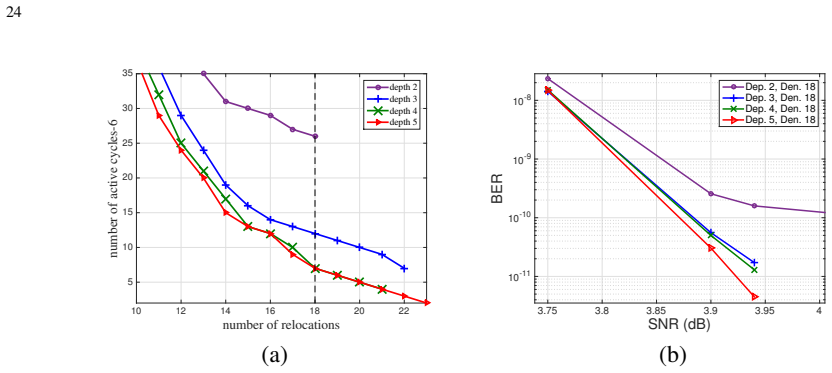
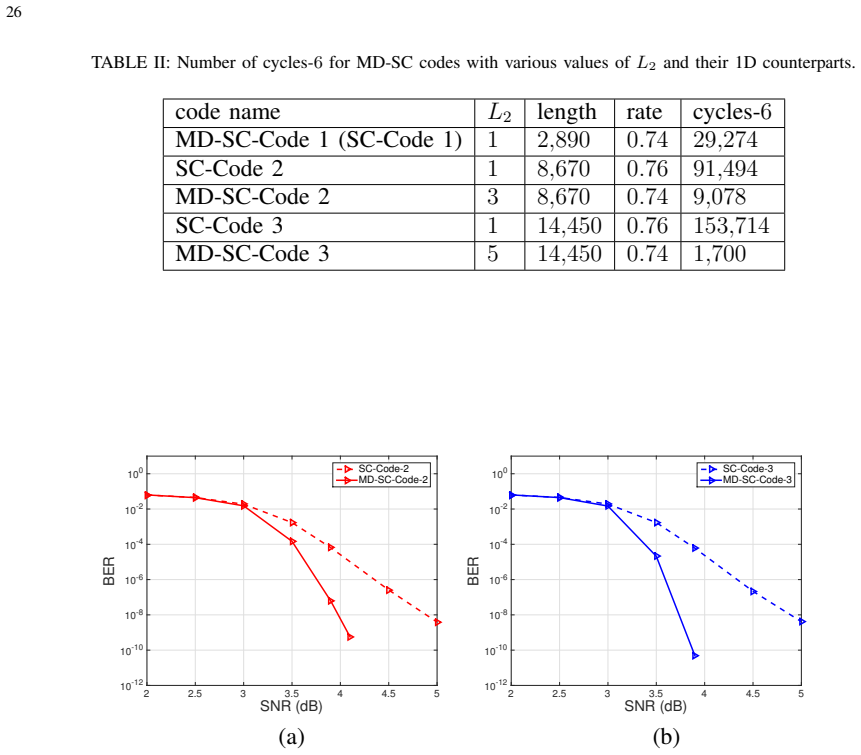
- For the girth-6 constituent code, MD-SC codes with $L_2=5$ and depth $d=5$ cut the number of cycles-6 by about 99 percent relative to a one-dimensional SC code of the same length, which the paper reports as BER gains of several orders of magnitude near $3.85$ dB.
- For the girth-8 constituent code, increasing the depth beyond $d=2$ gives smaller additional gains; depth $d=4$ cuts active cycles-8 by roughly 82 percent compared with the one-dimensional counterpart, suggesting modest depth is enough for error-floor improvement.
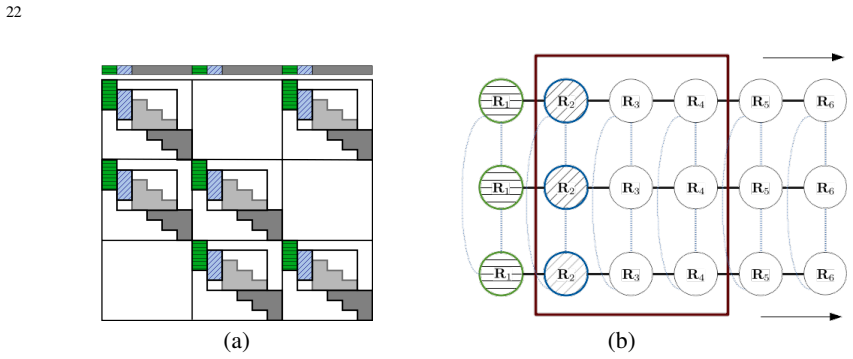
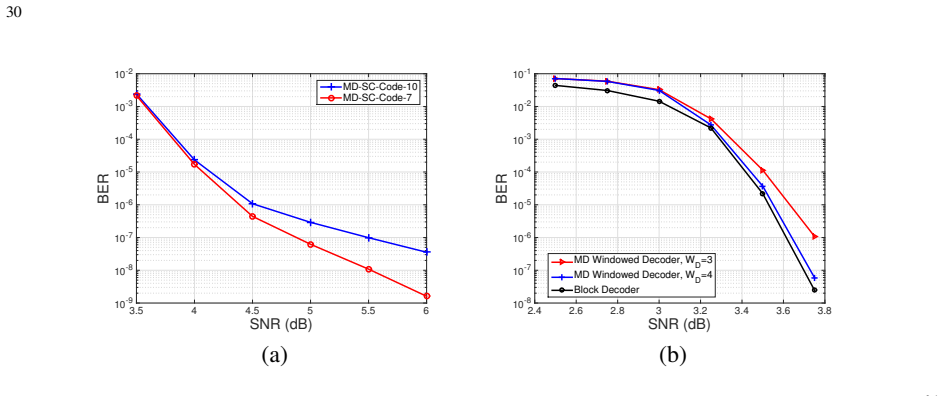
- Because relocations always copy a circulant to the same position in another segment, the window structure of each constituent chain is preserved, so the MD windowed decoder has identical window configurations and its latency is bounded by $(W_D+m)/L$ times the block decoder latency.
- The framework is parameterized by the number of constituent chains $L_2$, the coupling depth $d$, the density $T$ of relocated circulants, and the target cycle length $k$, so the same algorithm applies to other underlying SC codes and to channels that have a known problematic cycle length.
Reading between the lines
- Because the Ineffective Relocation Condition mirrors the Fossorier cycle condition for quasi-cyclic lifting, the same relocation score could probably be adapted to target other graph objects, such as absorbing sets, trapping sets, or minimum-distance bounds, by scoring a different cycle length.
- The paper's optimization counts only cycles that live within a single constituent SC code; an immediate testable extension is to add cross-chain cycles to the objective and see whether the active-cycle proxy or the BER estimates change.
- The early termination seen when the relocation density $T$ grows suggests a trade-off curve between density and depth; choosing both jointly by tracking the marginal reduction in active cycles is a natural refinement that Algorithm 2 already exposes.
Signed reviews
Editorial analysis
A structured set of objections, weighed in public.
Referee Report
Summary. The paper proposes a framework for constructing multi-dimensional spatially-coupled (MD-SC) LDPC codes by relocating problematic circulants from constituent 1D-SC codes into auxiliary coupling matrices. The construction is defined by the MD coupling depth d, coupling length L2, and density T, and the relocation decisions are made by a greedy tree-search algorithm driven by a score-voting scheme. Theorems 1 and 2 characterize how the L2 instances of a short cycle in a constituent code are transformed into cycles of length k, 2k, or L2k depending on the relocation mapping, with the Ineffective Relocation Condition (IRC) identifying when relocations fail to lengthen cycles. The paper also presents a multi-dimensional windowed decoder with latency analysis. Simulations for girth-6 and girth-8 constituent codes report large reductions in cycle counts and BER compared to 1D-SC counterparts and to random MD-SC constructions.
Significance. If the framework is understood as a heuristic design method, it is a useful and substantial contribution: it generalizes MD-SC construction beyond random or topology-specific designs, allows arbitrary L2 and d, and provides explicit mapping matrices for reproducibility. Theorems 1 and 2 are internally consistent and the cycle-count and BER simulations are detailed. The comparison with random relocation policies in Section VI.C is valuable and gives direct evidence that informed relocation matters. The main significance is therefore practical: a systematic, validated construction and a low-latency decoder for MD-SC codes. The theoretical guarantee, however, is per-base-cycle rather than a global minimization of the short-cycle population, and the greedy algorithm optimizes a proxy; this limits the strength of the theoretical claims but not the empirical contribution.
major comments (2)
- [Section IV.B, Algorithm 2 (steps 7 and 19-20)] The search and trimming in Algorithm 2 optimize the number of active cycles-k (cycles of H_SC visiting the middle replica for which IRC holds), but the stated goal and the reported tables are about the total short-cycle population of H_MD. The paper does not establish that minimizing the active-cycle count also minimizes the total number of cycles in H_MD, nor does it quantify cycles not represented in Γ, such as base cycles of H_SC that do not visit the middle replica or cycles whose projection traverses several constituent codes. Please provide either a dominance argument or an empirical comparison of the proxy against total cycles-6 and cycles-8 at each trimming step; without this, the connection between the optimization objective and the claimed cycle enhancement remains a heuristic rather than a property of the framework.
- [Section IV.A, Theorems 1-2] Theorems 1 and 2 analyze only the L2 instances of a single fixed cycle O_k of one constituent code, but the final matrix (3) also contains cycles that are not such instances. I believe every cycle in H_MD projects to a closed walk in H_SC because circulant powers are unchanged by relocation, but the manuscript does not state or prove this, and it does not show that all projected base cycles are captured by the set Γ of middle-replica cycles. Please add a formal statement of the correspondence between cycles of H_MD and cycles of H_SC, and clarify the exact scope of the per-cycle guarantees; this would also sharpen the discussion of what Algorithm 2 can and cannot be expected to control.
minor comments (6)
- [Section IV.A, Eq. (4)-(6)] Equation (4) and the expressions for δH, δV, and Δ_Ok use equality where they mean congruence modulo L2. Please make the modular notation explicit, since the proof and the scores R(O_k,t) depend on this distinction.
- [Algorithm 1, step 10] The condition "if L2/x = 0" is ambiguous; it should read "if x divides L2" or "if (L2 mod x) = 0".
- [Section VI] There are several typos and draft artifacts: "perfromance" on page 26, "blueto" in Example 3, "girthblues" in Section VI, and stray "blue" and "magenta" color commands in Sections III and VI. These should be cleaned in the final version.
- [Section V.A] The phrasing "if two VNs do not to share CNs" is grammatically incorrect and appears twice; please revise to "do not share CNs".
- [Section VI, Figs. 7-9] The BER comparisons use SNR in dB while the MD-SC codes have slightly lower rates than their 1D counterparts (0.74 vs. 0.76 and 0.81 vs. 0.83). Reporting Eb/N0 as well would remove any concern that the small rate difference contributes to the observed gains.
- [Section VII, Appendix] The printed MD mapping matrices M2-M8 are hard to verify without row and column labels; a short explanation of the correspondence between matrix entries and the constituent codes would aid reproducibility.
Circularity Check
No significant circularity: the core cycle-length analysis is derivational, and the reported gains are independently simulated.
full rationale
The paper's central derivation (Theorems 1 and 2) is self-contained: it starts from the explicit definition of relocation and the MD mapping M in Definition 1 and the block-circulant structure of H_MD^SC in Eq. (3), and proves that a cycle O_k of a constituent SC code either persists as k-cycles when the Ineffective Relocation Condition (Eq. (4)) holds or is stretched to length L2*k/tau otherwise. This is a mathematical consequence of the shift counting in Eq. (5), not an assumption imported from prior work. The score-voting algorithm minimizes the number of active cycles-k, but the paper's claims about cycle populations are checked by independent enumeration of the final MD-SC matrices (Tables I-III), and the BER claims are supported by simulations (Figs. 7-10). The use of the authors' OO-CPO constituent codes is explicitly disclaimed as unnecessary in Section II: 'choosing high-performance 1D-SC codes as constituent SC codes is not necessary in our MD-SC construction, and it only results in a better start point in a framework that further improves the performance via MD coupling.' Thus the self-citations to [1], [2], [7], [19] are not load-bearing. The skeptical concern that cross-segment cycles are not modeled by the active-cycles-k objective is a completeness/robustness risk about a greedy proxy, not a circularity: nothing in the paper defines H_MD^SC in terms of the number of active cycles, and the final cycle counts are obtained from the actual matrix, not from the proxy. No step was found in which a prediction is equivalent by construction to a fitted input or in which an external result is replaced by a self-citation chain.
Assumptions & free parameters
free parameters (5)
- T (MD coupling density) =
18, 23, 19, 9 in different simulations
- d (MD coupling depth) =
2, 3, 4, 5
- L2 (MD coupling length) =
3, 4, 5
- k (target cycle length) =
6 and 8
- Constituent SC code design from OO-CPO [7] =
SC-Code 1: kappa=z=17, gamma=4, m=1, L=10; SC-Code 4: kappa=19, z=23, gamma=3, m=2, L=10; SC-Code 6: kappa=17, z=17…
assumptions (7)
- domain assumption Short cycles are the dominant cause of performance degradation under iterative decoding, so reducing their population improves BER and error floor.
- domain assumption Each circulant in the base matrix is a weight-1 permutation matrix.
- domain assumption The OO-CPO technique [7] produces high-quality constituent 1D-SC codes, and the middle replica contains all possible cycle contributions.
- standard math The Ineffective Relocation Condition correctly captures cycle survival after relocation.
- domain assumption Relocating circulants to the same positions in other chains preserves the locality property needed for windowed decoding.
- domain assumption A greedy tree search with trimming by active cycles-k finds a good, not necessarily optimal, relocation sequence.
- domain assumption Local windows in the MD windowed decoder can be processed in parallel for the latency analysis.
Cite this review
Pith. "Pith review of Multi-Dimensional Spatially-Coupled Code Design: Enhancing the Cycle Properties." pith.science (2026). https://pith.science/paper/66BJV3G2
@misc{pith2026190802462,
  author       = {Pith},
  title        = {Pith review of: Multi-Dimensional Spatially-Coupled Code Design: Enhancing the Cycle Properties},
  year         = {2026},
  howpublished = {\url{https://pith.science/paper/66BJV3G2}},
  note         = {Machine review of arXiv:1908.02462}
}
read the original abstract
A circulant-based spatially-coupled (SC) code is constructed by partitioning the circulants in the parity-check matrix of a block code into several components and piecing copies of these components in a diagonal structure. By connecting several SC codes, multi-dimensional SC (MD-SC) codes are constructed. In this paper, we present a systematic framework for constructing MD-SC codes with notably better cycle properties than their one-dimensional counterparts. In our framework, the multi-dimensional coupling is performed via an informed relocation of problematic circulants. This work is general in the terms of the number of constituent SC codes that are connected together, the number of neighboring SC codes that each constituent SC code is connected to, and the length of the cycles whose populations we aim to reduce. Finally, we present a decoding algorithm that utilizes the structures of the MD-SC code to achieve lower decoding latency. Compared to the conventional SC codes, our MD-SC codes have a notably lower population of small cycles, and a dramatic BER improvement. The results of this work can be particularly beneficial in data storage systems, e.g., 2D magnetic recording and 3D Flash systems, as high-performance MD-SC codes are robust against various channel impairments and non-uniformity.
Figures

Figures from the paper (7 more)


Reference graph
Works this paper leans on
-
[1]
Multi-dimensional spatially-coupled code design through informed relocation of circulants,
H. Esfahanizadeh, A. Hareedy, and L. Dolecek, “Multi-dimensional spatially-coupled code design through informed relocation of circulants,” in Proc. Annual Allerton Conf. Commun., Control and Comp. , Oct. 2018, pp. 695–701
work page 2018
-
[2]
Multi-dimensional spatially-coupled code design with improved cycle properties,
H. Esfahanizadeh, A. Hareedy, and L. Dolecek, “Multi-dimensional spatially-coupled code design with improved cycle properties,” in Proc. Annual Non-Volatile Memories Workshop , Mar. 2019
work page 2019
-
[3]
Time-varying periodic convolutional codes with low-density parity-check matrix,
A. J. Felstrom and K. S. Zigangirov, “Time-varying periodic convolutional codes with low-density parity-check matrix,” IEEE Trans. Inf. Theory , vol. 45, no. 6, pp. 2181–2191, Sep. 1999. DRAFT 33
work page 1999
-
[4]
LDPC block and convolutional codes based on circulant matrices,
R. M. Tanner, D. Sridhara, A. Sridharan, T. E. Fuja, and D. J. Costello, “LDPC block and convolutional codes based on circulant matrices,” IEEE Trans. Inf. Theory , vol. 50, no. 12, pp. 2966–2984, Dec. 2004
work page 2004
-
[5]
Iterative decoding threshold analysis for LDPC convolutional codes,
M. Lentmaier, A. Sridharan, D. J. Costello, and K. S. Zigangirov, “Iterative decoding threshold analysis for LDPC convolutional codes,” IEEE Trans. Inf. Theory , vol. 56, no. 10, pp. 5274–5289, Oct. 2010
work page 2010
-
[6]
Spatially coupled ensembles universally achieve capacity under belief propagation,
S. Kudekar, T. Richardson, and R. L. Urbanke, “Spatially coupled ensembles universally achieve capacity under belief propagation,” IEEE Trans. Info. Theory , vol. 59, no. 12, pp. 7761–7813, Dec. 2013
work page 2013
-
[7]
H. Esfahanizadeh, A. Hareedy, and L. Dolecek, “Finite-Length Construction of High Performance Spatially-Coupled Codes via Optimized Partitioning and Lifting,” IEEE Trans. Commun. , vol. 67, no. 1, pp. 3–16, Jan. 2019
work page 2019
-
[8]
Edge spreading design of high rate array-based SC-LDPC codes,
D. G. M. Mitchell and E. Rosnes, “Edge spreading design of high rate array-based SC-LDPC codes,” in Proc. IEEE Int. Symp. Inf. Theory , Jun. 2017, pp. 2940–2944
work page 2017
Show all 33 references
-
[9]
Avoiding trapping sets in SC-LDPC codes under windowed decoding,
A. Beemer and C. A. Kelley, “Avoiding trapping sets in SC-LDPC codes under windowed decoding,” in Proc. IEEE Int. Symp. Inf. Theory and Its Applications , Oct. 2016, pp. 206–210
2016
-
[10]
New codes on graphs constructed by connecting spatially coupled chains,
D. Truhachev, D. G. M. Mitchell, M. Lentmaier, and D. J. Costello, “New codes on graphs constructed by connecting spatially coupled chains,” in Proc. Inf. Theory and App. Workshop , Feb. 2012, pp. 392–397
2012
-
[11]
Multi-dimensional spatially-coupled codes,
R. Ohashi, K. Kasai, and K. Takeuchi, “Multi-dimensional spatially-coupled codes,” in Proc. IEEE Int. Symp. Inf. Theory , Jul. 2013, pp. 2448–2452
2013
-
[12]
Connecting spatially coupled LDPC code chains,
D. Truhachev, D. G. M. Mitchell, M. Lentmaier, and D. J. Costello, “Connecting spatially coupled LDPC code chains,” in Proc. IEEE Int. Conf. Commun. , Jun. 2012, pp. 2176–2180
2012
-
[13]
A finite length performance analysis of LDPC codes constructed by connecting spatially coupled chains,
P. M. Olmos, D. G. M. Mitchell, D. Truhachev, and D. J. Costello, “A finite length performance analysis of LDPC codes constructed by connecting spatially coupled chains,” in Proc. IEEE Inf. Theory Workshop , Sep. 2013, pp. 1–5
2013
-
[14]
Laterally connected spatially coupled code chains for transmission over unstable parallel channels,
L. Schmalen and K. Mahdaviani, “Laterally connected spatially coupled code chains for transmission over unstable parallel channels,” in Proc. Int. Symp. Turbo Codes Iterative Inf. Processing , Aug. 2014, pp. 77–81
2014
-
[15]
Spatially coupled LDPC codes constructed by parallelly connecting multiple chains,
Y . Liu, Y . Li, and Y . Chi, “Spatially coupled LDPC codes constructed by parallelly connecting multiple chains,” IEEE Commun. Letters, vol. 19, no. 9, pp. 1472–1475, Sep. 2015
2015
-
[16]
Robust coded cooperation based on multi-dimensional spatially-coupled repeat-accumulate codes,
R. Tanaka and K. Ishibashi, “Robust coded cooperation based on multi-dimensional spatially-coupled repeat-accumulate codes,” in Proc. IEEE Wireless Commun. and Networking Conf. , Mar. 2017, pp. 1–6
2017
-
[17]
Protograph-based folded spatially coupled LDPC codes for burst erasure channels,
I. Ali, H. Lee, A. Hussain, and S. Kim, “Protograph-based folded spatially coupled LDPC codes for burst erasure channels,” IEEE Wireless Commun. Letters , pp. 1–1, 2018
2018
-
[18]
Hierarchical and high-girth QC LDPC codes,
Y . Wang, S. C. Draper, and J. S. Yedidia, “Hierarchical and high-girth QC LDPC codes,” IEEE Trans. Info. Theory , vol. 59, no. 7, pp. 4553–4583, Jul. 2013
2013
-
[19]
Spatially-coupled code design for partial-response channels: Optimal object-minimization approach,
A. Hareedy, H. Esfahanizadeh, A. Tan, and L. Dolecek, “Spatially-coupled code design for partial-response channels: Optimal object-minimization approach,” in Proc. IEEE Global Commun. Conf. , Dec. 2018, pp. 1–7
2018
-
[20]
Error floors of LDPC codes,
T. Richardson, “Error floors of LDPC codes,” in Proc. Annual Allerton Conf. Commun., Control and Comp. , Oct. 2003, pp. 1426–1435. DRAFT 34
2003
-
[21]
Analysis of absorbing sets and fully absorbing sets of array-based LDPC codes,
L. Dolecek, Z. Zhang, V . Anantharam, M. J. Wainwright, and B. Nikolic, “Analysis of absorbing sets and fully absorbing sets of array-based LDPC codes,” IEEE Trans. Inf. Theory , vol. 56, no. 1, pp. 181–201, Jan. 2010
2010
-
[22]
On characterization of elementary trapping sets of variable-regular LDPC codes,
M. Karimi and A. H. Banihashemi, “On characterization of elementary trapping sets of variable-regular LDPC codes,” IEEE Trans. Info. Theory , vol. 60, no. 9, pp. 5188–5203, Sep. 2014
2014
-
[23]
New characterization and efficient exhaustive search algorithm for leafless elementary trapping sets of variable-regular LDPC codes,
Y . Hashemi and A. H. Banihashemi, “New characterization and efficient exhaustive search algorithm for leafless elementary trapping sets of variable-regular LDPC codes,” IEEE Trans. Info. Theory , vol. 62, no. 12, pp. 6713–6736, Dec. 2016
2016
-
[24]
Quasi-cyclic LDPC codes: Influence of proto- and tanner-graph structure on minimum hamming distance upper bounds,
R. Smarandache and P. O. V ontobel, “Quasi-cyclic LDPC codes: Influence of proto- and tanner-graph structure on minimum hamming distance upper bounds,” IEEE Trans. Info. Theory , vol. 58, no. 2, pp. 585–607, Feb. 2012
2012
-
[25]
Connections between low-weight codewords and cycles in spatially coupled LDPC convolutional codes,
M. Battaglioni, M. Baldi, and G. Cancellieri, “Connections between low-weight codewords and cycles in spatially coupled LDPC convolutional codes,” IEEE Trans. Commun. , vol. 66, no. 8, pp. 3268–3280, Aug. 2018
2018
-
[26]
Good error-correcting codes based on very sparse matrices,
D. J. C. MacKay, “Good error-correcting codes based on very sparse matrices,” IEEE Trans. Inf. Theory , vol. 45, no. 2, pp. 399–431, Mar. 1999
1999
-
[27]
Spatially coupled codes optimized for magnetic recording applications,
H. Esfahanizadeh, A. Hareedy, and L. Dolecek, “Spatially coupled codes optimized for magnetic recording applications,” IEEE Trans. Magnetics, vol. 53, no. 2, pp. 1–11, Feb. 2017
2017
-
[28]
High performance non-binary spatially-coupled codes for flash memories,
A. Hareedy, H. Esfahanizadeh, and L. Dolecek, “High performance non-binary spatially-coupled codes for flash memories,” in Proc. IEEE Inf. Theory Workshop , Nov. 2017, pp. 229–233
2017
-
[29]
Quasi-cyclic low-density parity-check codes from circulant permutation matrices,
M. P. C. Fossorier, “Quasi-cyclic low-density parity-check codes from circulant permutation matrices,” IEEE Trans. Inf. Theory, vol. 50, no. 8, pp. 1788–1793, Aug. 2004
2004
-
[30]
Efficient search and elimination of harmful objects in optimized QC SC-LDPC codes,
M. Battaglioni, F. Chiaraluce, M. Baldi, and D. Mitchell, “Efficient search and elimination of harmful objects in optimized QC SC-LDPC codes,” CoRR, vol. abs/1904.07158, 2019. [Online]. Available: http://arxiv.org/abs/1904.07158
1904 arXiv
-
[31]
Windowed decoding of protograph-based LDPC convolutional codes over erasure channels,
A. R. Iyengar, M. Papaleo, P. H. Siegel, J. K. Wolf, A. Vanelli-Coralli, and G. E. Corazza, “Windowed decoding of protograph-based LDPC convolutional codes over erasure channels,” IEEE Trans. Info. Theory, vol. 58, no. 4, pp. 2303–2320, 2012
2012
-
[32]
Windowed decoding of spatially coupled codes,
A. R. Iyengar, P. H. Siegel, R. L. Urbanke, and J. K. Wolf, “Windowed decoding of spatially coupled codes,” IEEE Trans. Inf. Theory, vol. 59, no. 4, pp. 2277–2292, Apr. 2013
2013
-
[33]
Threshold saturation via spatial coupling: Why convolutional LDPC ensembles perform so well over the BEC,
S. Kudekar, T. J. Richardson, and R. L. Urbanke, “Threshold saturation via spatial coupling: Why convolutional LDPC ensembles perform so well over the BEC,” IEEE Trans. Inf. Theory , vol. 57, no. 2, pp. 803–834, Feb. 2011. DRAFT
2011
Reviewed August 14, 2026 · model on record in the stance chip above.
Discussion (0). Continue with ORCID to comment.