REVIEW 4 major objections 5 minor 54 references
Continuum limit of discrete Sommerfeld problems on square lattice
T0 review · 4 major / 5 minor · reviewed 2026-08-14 · deepseek-v4-flash
Pith's one-line read The paper proves that as the lattice spacing tends to zero, exact solutions of the discrete Sommerfeld diffraction problems converge in fractional-order discrete Sobolev norms to the continuous Sommerfeld solution for both Dirichlet and…
desk verdict A plausible theorem with a repairable sign error in the coercivity step; the paper deserves serious refereeing after revision. read the letter →
The pith
A machine-rendered reading of the paper's core claim, the machinery that carries it, and where it could break.
The reading
What carries the argument
The load-bearing object is a family of $\varepsilon$-dependent discrete Sobolev spaces $H^s(\varepsilon \mathbb{Z})$ defined through the weight $\varpi_\varepsilon(\xi) = (1 + 4\varepsilon^{-2}\sin^2(\xi/2))^{1/2}$ and the norm $\|u^\varepsilon\|_s = (\varepsilon/2\pi)^{1/2}\,\|\varpi_\varepsilon^s u^\varepsilon_F\|_{L^2(I)}$. Restriction operators $R_\varepsilon$ from the continuum spaces to the lattice spaces, and prolongation operators in the opposite direction, are chosen so that $P_\varepsilon R_\varepsilon$ approximates the identity in operator norm as $\varepsilon\to0$. The discrete Wiener-Hopf symbols are matched to the continuous symbols through the asymptotics $\frac{1}{2\varepsilon}\frac{Q(z)}{h(z)r(z)} \sim \frac{i}{2}(\xi^2 - \varepsilon^2\omega^2)^{-1/2}$ for Dirichlet and $-\varepsilon^{-1}\frac{h(z)}{r(z)} \sim -\frac{i}{2}(\xi^2 - \varepsilon^2\omega^2)^{1/2}$ for Neumann, with $z=e^{-i\xi}$; these identities make the Riemann-sum error small. The argument then uses additive Wiener-Hopf factorization of the symbols, uniform boundedness of $K^\varepsilon$, and the coercivity bound with constant $\alpha = \omega_2^{\pm 1}$ independent of $\varepsilon$ to control $K^{\varepsilon,-1}$ as $\varepsilon\to0$.
What would settle it
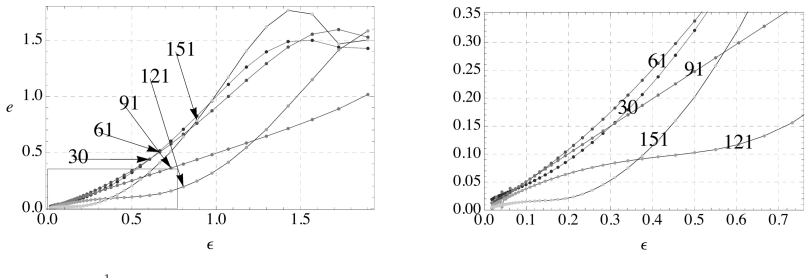
Compute the minimum of $\Re (k^\varepsilon)^F(\xi)$ over $\xi\in[-\pi,\pi]$ for a sequence $\varepsilon_n\to0$ at fixed $\omega_2>0$; if the minimum tends to zero, the coercivity constant cannot be independent of $\varepsilon$ and the proof of Theorem 3.1 collapses. A direct numerical check of the relative error $e(\varepsilon)$ in (64) for the Dirichlet problem at fixed small $\omega_2$ that does not approach zero would also contradict the theorem.
Extended reading notes
Core claim
The central claim is Theorem 3.1: for $\omega_2 > 0$, $\|x^\varepsilon - R_\varepsilon x\|_{\mp 1/2} \to 0$ as $\varepsilon \to 0$, where $x^\varepsilon$ solves the discrete Wiener-Hopf equation (20) with kernel $k^\varepsilon$ and $x$ solves the continuous Wiener-Hopf equation (9). The proof splits the error into the discrepancy between discrete and continuous forcing terms, estimated as $O(\sqrt{\varepsilon})$ for Dirichlet and $O(\varepsilon)$ for Neumann, and the error incurred when the continuous convolution is replaced by its discrete Riemann-sum analogue. The singular part of the Neumann kernel requires a refined splitting with parameter $\beta = \pi/4$ to control the hypersingular contribution. The theorem is stated for both boundary conditions and rests on uniform boundedness and coercivity of the discrete operators $K^\varepsilon$, with constants independent of $\varepsilon$; it thereby converts the earlier heuristic asymptotics into a proven statement in fractional-order discrete Sobolev spaces.
Load-bearing premise
The load-bearing premise is that the discrete Wiener-Hopf operators stay uniformly invertible as $\varepsilon\to0$, expressed by the asserted coercivity bound $\Re (k^\varepsilon)^F(\xi) \ge \alpha$ with $\alpha = \omega_2^{\pm1}$ independent of $\varepsilon$; if that bound fails, the main error estimate has no foundation.
Editorial extensions
If this is right
- If Theorem 3.1 is correct, the heuristic low-frequency approximations for both lattice diffraction problems become rigorous limits: exact discrete solutions approach the classical Sommerfeld half-plane solution in the appropriate discrete Sobolev norm.
- The forcing discrepancy estimates imply the convergence rate is at least $O(\varepsilon^{1/2})$ for the Dirichlet problem and $O(\varepsilon)$ for the Neumann problem in the relevant discrete Sobolev norm.
- The result validates the 5-point square-lattice model as an operator-level consistent discretization of the continuous Wiener-Hopf equation, not merely of the underlying Helmholtz equation.
- The theorem implies that, for small lattice spacing relative to wavelength, the discrete diffraction pattern is quantitatively close to the continuum Sommerfeld solution in the $\mp 1/2$ Sobolev norm.
Reading between the lines
- If a uniform coercivity bound could be proved at $\omega_2 = 0$, the continuum limit would likely extend to purely real wavenumbers; the paper explicitly leaves that case open, and the hypersingular Neumann kernel would need a refinement of the $\beta = \pi/4$ splitting.
- The norm convergence should imply convergence of integrated far-field quantities such as diffraction amplitudes, even though the near-tip lattice field has a different structure from the continuum near-tip field.
- A natural extension would replace the square lattice by other Bravais lattices or longer-range interactions; the main obstacle would be a uniform coercivity bound generalizing the one asserted in the paper, since the symbol asymptotics would change.
Signed reviews
Editorial analysis
A structured set of objections, weighed in public.
Referee Report
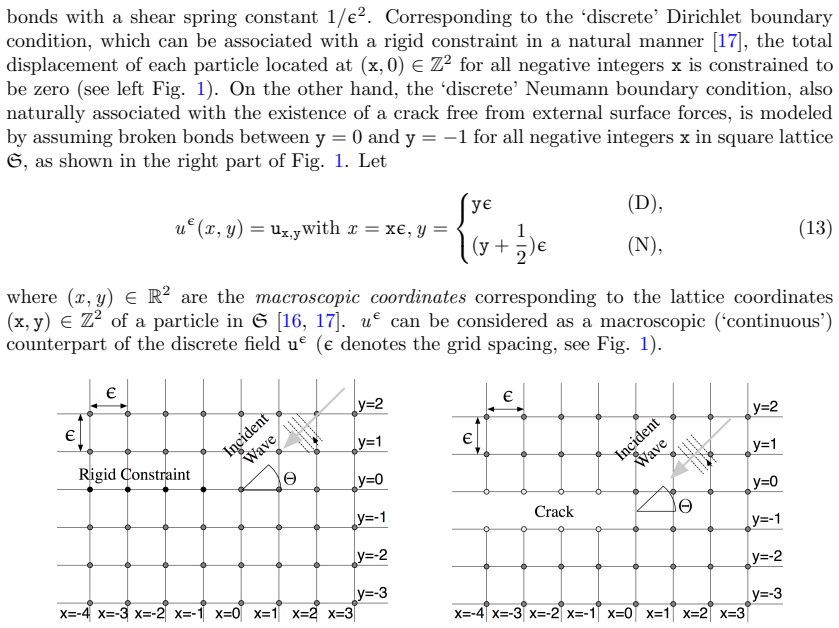
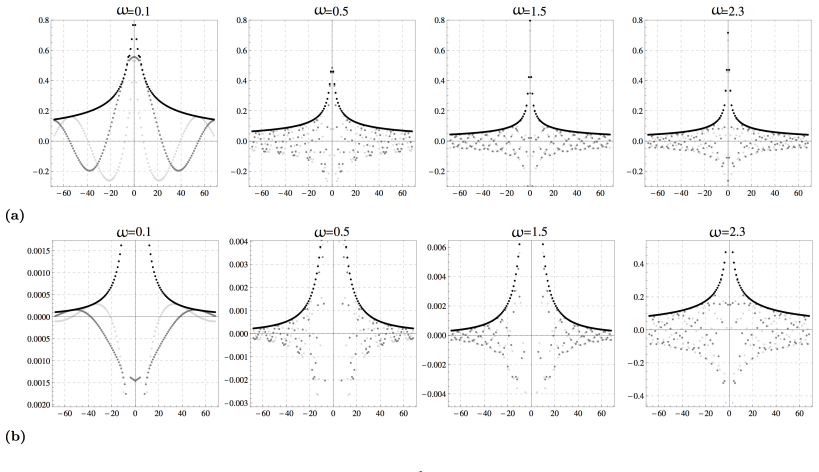
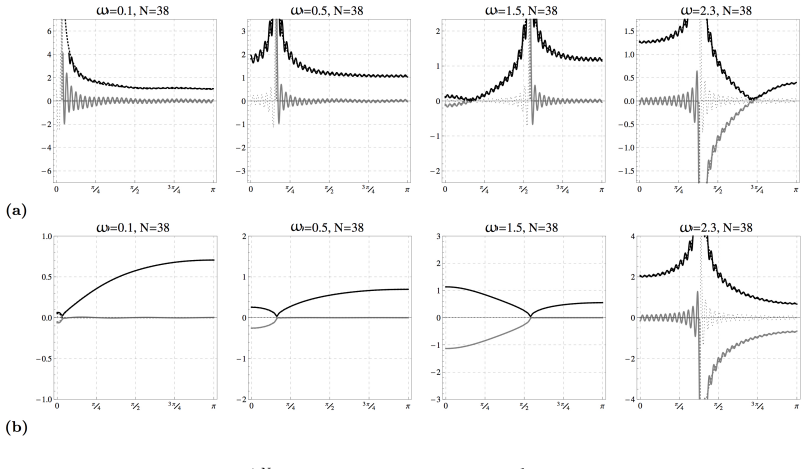
Summary. The paper studies the continuum limit of two discrete Sommerfeld diffraction problems on the square lattice: scattering by a semi-infinite Dirichlet half-plane (rigid constraint) and by a semi-infinite Neumann half-plane (crack). The discrete problems are formulated as discrete Wiener-Hopf convolution equations (20), while the continuous Sommerfeld problems are formulated as continuous Wiener-Hopf equations (9). The main result, Theorem 3.1, asserts that for omega2 > 0 the exact discrete solution x^epsilon converges to the restriction of the continuous solution x in the Hackbusch discrete Sobolev spaces H^{∓1/2} as the lattice spacing epsilon tends to zero. The proof splits the difference via (50) into a data error term and a scheme-error term, estimates the data error using Lemma 2.10, and estimates the scheme error by comparing the continuous convolution kernel with its discrete counterpart through a decomposition into non-singular and singular parts. The paper also includes a numerical illustration (Figure 5) and explicitly states that the limit omega2 -> 0+ remains open.
Significance. If Theorem 3.1 were established by a complete proof, it would provide a rigorous justification for the low-frequency asymptotics announced in the author's earlier papers and would connect discrete lattice diffraction to the classical continuous Sommerfeld theory in a normed setting. The paper has genuine strengths: it formulates the problem in a precise operator-theoretic framework, states a clear theorem, gives a concrete candidate strategy of proof, and is transparent about the unresolved conservative case omega2 = 0. The numerical illustration is a useful sanity check, though it is not a substitute for the estimates. However, the proof as written contains load-bearing gaps, including a coercivity assertion that is false for the Neumann symbol, and a reliance on a heuristic asymptotic from earlier work. These issues prevent the paper from establishing the advertised convergence in its current form, although the theorem itself may still be true and repairable.
major comments (4)
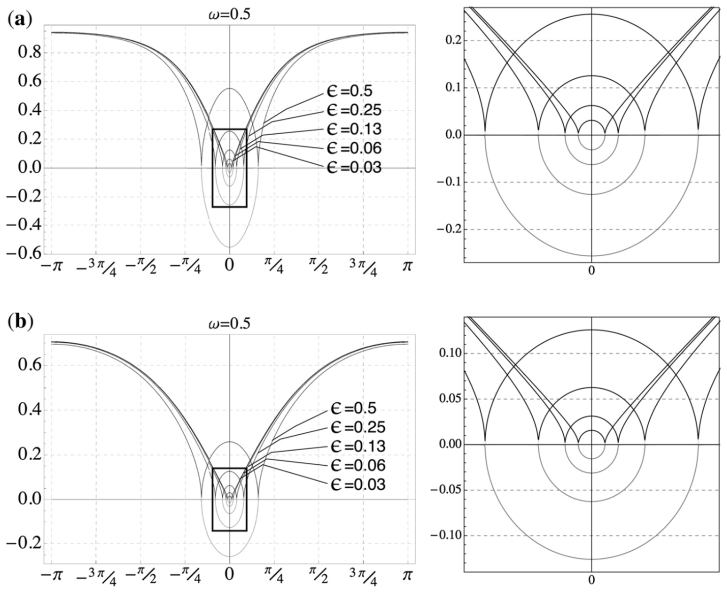
- [§2, Eq. (48)] The uniform coercivity bound in (48), which is used to conclude that K^epsilon is invertible uniformly as epsilon -> 0, is false for the Neumann problem as stated. From (21a), (22), and (23), the symbol of K^epsilon is (k^epsilon)^F(xi) = -epsilon^{-1} h(z)/r(z) with z = e^{-i xi}. At xi = 0, H(1) = Q(1) - 2 = -epsilon^2 omega^2 and R(1) = 4 - epsilon^2 omega^2; for omega = i (so omega2 = 1), h(1) = epsilon and r(1) = sqrt(4 + epsilon^2), so the symbol is a negative real number. No positive alpha can satisfy Re(k^epsilon)^F(xi) >= alpha on I. Since the bound on ||K^{epsilon,-1}|| is load-bearing in the splitting (50) and in the final estimate (62), the proof needs a different argument for uniform invertibility, such as coercivity of -K^epsilon or a direct symbol estimate with a correct sign and epsilon-independent lower bound. This is not a cosmetic issue: as written, the Lax-Milgram step in (48) does not apply.
- [§2, Lemma 2.10 and Eq. (41)] The Dirichlet part of Lemma 2.10 is not rigorously supported. The proof of (41) uses the asymptotic ut_{0,0} ~ sqrt(epsilon) from reference [17], but the introduction itself describes the results of [16]-[23] as 'mostly heuristic asymptotic approximations, supported by graphical illustrations'. No independent proof or rigorous citation is given for this asymptotic, and it directly controls the O(sqrt(epsilon)) rate in (43) for the Dirichlet case. Because the data error term is the first term in (50), Lemma 2.10 is load-bearing for Theorem 3.1. The author must either prove the needed boundary-datum estimate rigorously or supply a rigorous reference; otherwise the convergence claim for the Dirichlet problem is not established.
- [§3, proof of Theorem 3.1, Eqs. (57)-(63)] Several key estimates in the proof of Theorem 3.1 are asserted rather than demonstrated. Equation (57), which is the exponential far-field comparison between k^epsilon and k, is dismissed with 'it can be easily shown', yet it underlies the Riemann-sum estimate for the second term in (55). Equation (60) asserts that choosing beta = pi/4 makes the first singular term controlled, but no explicit computation is provided to show the required cancellation for the hypersingular Neumann kernel. In addition, the chain (55)-(63) mixes objects of different types: sums over j in S^epsilon are controlled by meas(S^epsilon) without explaining how the discrete norm (66), which carries an epsilon weight, applies to such finite sums, and K^{sing} is treated as a bounded operator even though k_sing is singular. Consequently, the second term in (50) is not proven to vanish. This is a central gap in the only proof of the main theorem.
- [§3, Eq. (62)] The final estimate (62) also contains notational and logical ambiguities that affect the conclusion. The term ||-P^epsilon R^epsilon|| should presumably be ||id - P^epsilon R^epsilon||, and it appears twice. More importantly, the expression ||sum_{j in S^epsilon} O(1) x(j epsilon)||_{∓1/2} is bounded by meas(S^epsilon) without a definition of the norm of such a finite sum; the discrete Sobolev norm in (66) scales with epsilon, so the control by a Lebesgue measure of a continuum set is not automatic. These points should be clarified and justified before the convergence statement can be accepted.
minor comments (5)
- [§3, Remark 3.5] In Remark 3.5 the text refers to 'Theorem 49'; this should be 'Theorem 3.1'.
- [§3, Eq. (62)] The expression ||-P^epsilon R^epsilon|| should read ||id - P^epsilon R^epsilon|| throughout the estimate; as written, the minus sign in front of an operator name is not meaningful.
- [§1, Remark 1.2 and §2] The paper sets aside the possible exponential growth of f(x) as x -> -infty in a remark, but the half-line Wiener-Hopf setting with complex k requires careful handling of this issue. A sentence in the main theorem or in the proof indicating where this technical point is addressed would improve clarity.
- [§0, Abstract] The abstract says 'the imaginary part of incident wavenumber is positive', but the theorem and proof use the imaginary part of the frequency omega, not of the wavenumber k; the wording should be aligned with the notation in (7).
- [§2, Eqs. (31)-(32)] The uniform boundedness proof in Lemma 2.6 states 'it is easy to see' that C^epsilon is bounded independent of epsilon, but the displayed lines contain o(epsilon) and O(1) terms whose dependence on omega2 is not quantified. A short derivation, or at least a precise statement of the constants, would make this lemma self-contained.
Circularity Check
Theorem 3.1's Dirichlet convergence rate is carried by a heuristic self-citation: the tip asymptotics u^t_{0,0}~√ε imported from the author's [17].
-
ansatz smuggled in via citation
[Section 2, Lemma 2.10, Eqs. (40)-(43); used in Theorem 3.1, Eqs. (50)-(62)]
"in the papers [16]–[23]1, mostly heuristic asymptotic approximations, supported by graphical illustrations, are provided towards the analysis of low frequency approximation of the discrete model ... Around ξ = 0, in the Dirichlet case of (40), using the expression of the solution provided by [17], ut_{0,0}∼√ϵ asϵ→ 0, so that f ϵ x − (Rϵf )x∼ ... ∼O( 1√ϵ)."
The Dirichlet part of Lemma 2.10, which supplies the ||f^ϵ − R_ϵ f||_{+1/2} → 0 rate used in the final estimate (62), is obtained by inserting u^t_{0,0} ∼ √ϵ 'provided by [17]'. The introduction explicitly classifies [16]–[23] as 'mostly heuristic asymptotic approximations' of the low-frequency/continuum limit, and [17] is one of those papers. Thus the proof imports, as a lemma, the very asymptotic correspondence between the discrete Sommerfeld tip field and the continuum solution that Theorem 3.1 is meant to establish. No independent derivation of this asymptotic is given in the present paper, and the estimate is load-bearing for the Dirichlet convergence rate. Unless [17]'s asymptotic is proven from assumptions that do not presuppose the continuum limit, this is circular by construction.
full rationale
Most of the paper is a genuinely self-contained error analysis: the discrete and continuous Wiener–Hopf problems are set up independently, the symbol asymptotics (27)–(28) are direct expansions, and the proof of (52)–(61) performs a nontrivial Riemann-sum/singular-kernel decomposition. The Neumann half of Lemma 2.10 is derived in-paper. However, the Dirichlet half of Lemma 2.10 relies on the author's earlier result u^t_{0,0} ∼ √ε from [17], which the introduction itself describes as part of the 'mostly heuristic asymptotic approximations' of the continuum limit. That estimate enters (50) and (62) directly, so the claimed convergence for the Dirichlet problem is not derived from first principles in this paper; it is partly a rigorous repackaging of a heuristic self-citation. This warrants a circularity score of 5 rather than 0. Separately, the proof's uniform-invertibility step (48) is asserted via 'α = ω_2^{±1} (independent of ε)' without proof and is, for the Neumann symbol, false as written (the real part of the symbol is negative at ξ = 0); that is a correctness gap in the argument, not a circular step, but it reinforces how much load the unproved and heuristic inputs carry. Were the imported tip asymptotic independently proved and the coercivity display repaired, the central theorem would have substantial independent content.
Assumptions & free parameters
free parameters (1)
- beta (proof constant) =
pi/4
assumptions (6)
- domain assumption The continuous Sommerfeld problem is equivalently a Wiener-Hopf equation (9)-(10) with kernel symbol (11), and the associated operator is bijective between H^{-1/2}(R-) and H^{1/2}(R-) as stated in (12).
- domain assumption The discrete Sommerfeld problems are exactly represented by the discrete Wiener-Hopf equations (20)-(21) built on the square lattice Green's function (19), and these equations are uniquely solvable on l2 when omega2 > 0.
- standard math The Hackbusch-Stevenson discrete Sobolev spaces H^s(epsilon Z) satisfy the stated norm equivalences, Fourier characterizations, and the existence of restriction and prolongation operators with ||id - P_epsilon R_epsilon|| going to 0.
- domain assumption The far-field expansion (57) for k^epsilon_x minus epsilon k(x epsilon) holds uniformly with exponential decay in |x|, and the factor (1/L_c)_- is analytic in a disk of radius e^{kappa2} greater than 1.
- ad hoc to paper The symbol of K^epsilon satisfies Re((k^epsilon)^F)(xi) >= alpha = omega_2^{±1} independent of epsilon, making K^epsilon uniformly coercive and invertible as epsilon goes to 0.
- domain assumption The incident wave has positive imaginary part of the wavenumber, meaning omega2 > 0 and kappa2 > 0, yielding exponential decay of the field and invertibility of the Toeplitz operators.
Cite this review
Pith. "Pith review of Continuum limit of discrete Sommerfeld problems on square lattice." pith.science (2026). https://pith.science/paper/6W4EJI3E
@misc{pith2026190802469,
  author       = {Pith},
  title        = {Pith review of: Continuum limit of discrete Sommerfeld problems on square lattice},
  year         = {2026},
  howpublished = {\url{https://pith.science/paper/6W4EJI3E}},
  note         = {Machine review of arXiv:1908.02469}
}
read the original abstract
A low frequency approximation of the discrete Sommerfeld diffraction problems, involving the scattering of a time harmonic lattice wave incident on square lattice by a discrete Dirichlet or a discrete Neumann half-plane, is investigated. It is established that the exact solution of the discrete model converges to the solution of the continuum model, i.e. the continuous Sommerfeld problem, in certain discrete Sobolev space defined by W. Hackbusch. The proof of convergence has been provided for both types of boundary conditions when the imaginary part of incident wavenumber is positive.
Figures
Figures from the paper (2 more)
Reference graph
Works this paper leans on
-
[17]
Diffraction of waves on square lattice by semi-infinite rigid constraint
Basant Lal Sharma. Diffraction of waves on square lattice by semi-infinite rigid constraint. 59:52–68
-
[16]
Diffraction of waves on square lattice by semi-infinite crack
Basant Lal Sharma. Diffraction of waves on square lattice by semi-infinite crack. 75(3):1171– 1192
-
[23]
Near-tip field for diffraction on square lattice by rigid constraint
Basant Lal Sharma. Near-tip field for diffraction on square lattice by rigid constraint. 66(5):2719–2740
- [1]
-
[2]
J.S. Schwinger and D.S. Saxon. Discontinuities in Waveguides: Notes on Lectures by Julian Schwinger. Documents on modern physics. Gordon and Breach
-
[3]
H. Levine and J. Schwinger. On the theory of diffraction by an aperture in an infinite plane screen. I. 74:958–974. 22
-
[4]
H. Levine and J. Schwinger. On the theory of diffraction by an aperture in an infinite plane screen. II. 75:1423–1432
-
[5]
H. Levine and J. S. Schwinger. On the radiation of sound from an unflanged circular pipe. 73(2):383–406
Show all 54 references
-
[6]
Milton and J
Kimball A. Milton and J. Schwinger. Electromagnetic radiation: variational methods, waveguides and accelerators. Springer-Verlag, Berlin
-
[7]
Wiener and E
N. Wiener and E. Hopf. ¨Uber eine klasse singul¨ arer integralgleichungen. 32:696–706
-
[8]
Raymond E. A. C. Paley and Norbert Wiener. Fourier transforms in the complex domain . American Mathematical Society
-
[9]
C. J. Bouwkamp. Diffraction theory. 17:35–100
-
[10]
E. T. Copson. On an integral equation arising in the theory of diffraction. 17:19–34
-
[11]
A. E. Heins. The radiation and transmission properties of a pair of semi-infinite parallel plates. II. 6:215–220
-
[12]
Meister and F.-O
E. Meister and F.-O. Speck. Modern Wiener–Hopf methods in diffraction theory. In Ordi- nary and partial differential equations, Vol. II (Dundee, 1988) , Pitman Res. Notes Math. Ser., 216, pages 130–171. Longman
1988
-
[13]
F.-O. Speck. Mixed boundary value problems of the type of Sommerfeld’s half-plane prob- lem. 104 A:261–277
-
[14]
F.-O. Speck. General Wiener–Hopf factorization methods . Pitman
-
[15]
B¨ ottcher and B
A. B¨ ottcher and B. Silbermann. Analysis of Toeplitz operators. Springer, 2nd edition
-
[18]
D. S. Jones. A simplifying technique in the solution of a class of diffraction problems. 3:189
-
[19]
Methods based on the Wiener–Hopf technique
Ben Noble. Methods based on the Wiener–Hopf technique . Pergamon Press
-
[20]
D. S. Jones. The theory of electromagnetism . Macmillan
-
[21]
Leonid I. Slepyan. Models and phenomena in fracture mechanics . Springer
-
[22]
Near-tip field for diffraction on square lattice by crack
Basant Lal Sharma. Near-tip field for diffraction on square lattice by crack. 75(4):1915– 1940
1915
-
[24]
Katsura and S
S. Katsura and S. Inawashiro. Lattice Green’s functions for the rectangular and the square lattices at arbitrary points. 12:1622–1630
-
[25]
E. N. Economou. Green’s functions in quantum physics . Springer, second edition. 23
-
[26]
Blanc, C
X. Blanc, C. Le Bris, and P.-L. Lions. From molecular models to continuum mechanics. 164(4):341–381
-
[27]
Braides and M.S
A. Braides and M.S. Gelli. Continuum limits of discrete systems without convexity hy- potheses. 7(-):41–66
-
[28]
P. A. Martin. Discrete scattering theory: Green’s function for a square lattice. 43:619–629
-
[29]
Hackbusch
W. Hackbusch. On the regularity of difference schemes. 19(1–2):71–95
-
[30]
Stevenson
R. Stevenson. Discrete sobolev spaces and regularity of elliptic difference schemes. 25(5):607–640
-
[31]
J. D. Achenbach. Wave propagation in elastic solids . North-Holland publishing company
-
[32]
L. B. Felsen and N. Marcuvitz. Radiation and Scattering of Waves . Prentice–Halls
-
[33]
A. A. Maradudin. Screw dislocations and discrete elastic theory. 9(1):1–20
-
[34]
A. A. Maradudin, E. W. Montroll, G. H. Weiss, and I. P. Ipatova.Theory of lattice dynamics in the harmonic approximation . Academic Press, second edition
-
[35]
Leonid I. Slepyan. Antiplane problem of a crack in a lattice. 17(5):101–114
-
[36]
John G. Harris. Elastic waves at high frequencies: techniques for radiation and diffraction of elastic and surface waves . Cambridge University Press
-
[37]
Stegun, editors
Milton Abramowitz and Irene A. Stegun, editors. Handbook of mathematical functions with formulas, graphs, and mathematical tables . U.S. Govt. Print. Off
-
[38]
Arnold Sommerfeld. Optics. lectures on theoretical physics, Vol IV . Academic Press
-
[39]
Gohberg and I
I. Gohberg and I. Feldman. Convolution equations and projection methods for their solu- tions. Math. Monogr., 41, AMS
-
[40]
E. P. Stephan and W. L. Wendland. A hypersingular boundary integral method for two- dimensional screen and crack problems. 112:363–390
-
[41]
E. P. Stephan. Boundary integral equations for screen problem in R3. 10:257–263
-
[42]
H. Holm, M. Maischak, and E. P. Stephan. The hp-version of the boundary element method for Helmholtz screen problems. 57:105–134
-
[43]
R. A. Adams. Sobolev spaces. Academic Press
-
[44]
J. L. Lions and E. Magenes. Non-homogeneous boundary value problems and applications, Vol. 1. Springer
-
[45]
Greenspan and P
D. Greenspan and P. Werner. A numerical method for the exterior Dirichlet problem for the reduced wave equation. 23(4):288–316
-
[46]
L. Collatz. The numerical treatment of differential equations. Springer, third edition edition
-
[47]
Shaban and B
W. Shaban and B. Vainberg. Radiation conditions for the difference Schr¨ odinger operators. 80:525–556
-
[48]
A. Zemla. On the fundamental solutions for the difference Helmholtz operator. 32(2):560– 570. 24
-
[49]
M. G. Krein. Integral equations on a half-line with kernel depending upon the difference of the arguments. 22:163–288
-
[50]
Calder´ on, F
A. Calder´ on, F. Spitzer, and H. Widom. Inversion of Toeplitz matrices. 3:490–498
-
[51]
P. D. Lax and A. N. Milgram. Parabolic equations. In Contributions to the theory of partial differential equations, Annals of Mathematics Studies, no. 33, pages 167–190. Princeton University Press, Princeton, N. J
-
[52]
S. A. Thau and Y.-H. Pao. Diffraction of horizontal shear waves by a parabolic cylinder and dynamic stress concentrations. 33(4):785–792
-
[53]
P. P. B. Eggermont and Ch. Lubich. Operational quadrature methods for Wiener–Hopf integral equations. 60(202):699–718
-
[54]
Banjai, C
L. Banjai, C. Lubich, and J. M. Melenk. Runge–kutta convolution quadrature for operators arising in wave propagation. 119(-):1–20. 25
Reviewed August 14, 2026 · model on record in the stance chip above.
Discussion (0). Continue with ORCID to comment.