REVIEW 4 major objections 6 minor 34 references
Towards model based control of the Vertical Gradient Freeze crystal growth process
T0 review · 4 major / 6 minor · reviewed 2026-08-14 · deepseek-v4-flash
Pith's one-line read The paper presents what it identifies as the first output-feedback tracking controllers for a one-dimensional two-phase Stefan problem, combining collocated and flatness-based state feedback with a Riccati-based observer, and shows them…
desk verdict A solid, honest extension of flatness/collocated control to the two-phase Stefan problem with observer-based output feedback; the main formal gaps are a general-reference stability proof and truncation error bounds, but the paper deserves peer review. read the letter →
The pith
A machine-rendered reading of the paper's core claim, the machinery that carries it, and where it could break.
The reading
What carries the argument
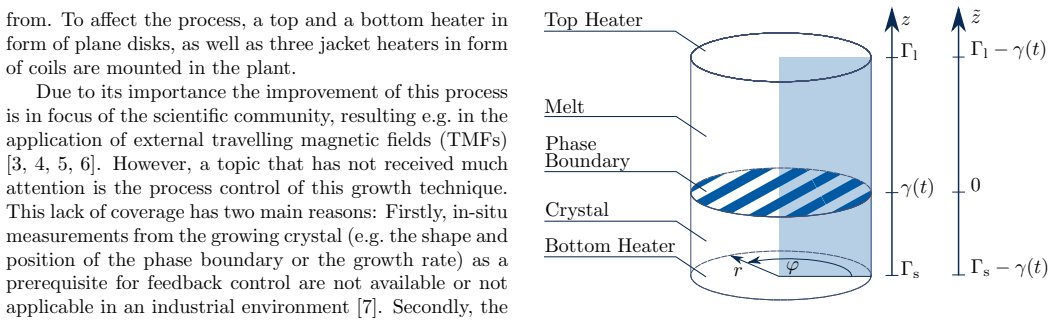
The machinery is the flat parametrisation of the two-phase Stefan problem. After moving to a coordinate frame attached to the interface, the temperature in each phase is expanded as a power series in the shifted spatial coordinate, and the Stefan condition fixes all series coefficients from just two quantities: the interface position $\gamma(t)$ and the solid-side gradient at the interface $\partial_{\tilde z} T_s(0,t)$. That pair is the flat output. Truncating the series defines a finite-dimensional state in flat coordinates on which the distributed controller and observer are built, while the original infinite-dimensional PDE is retained as the simulated plant. The collocated controller instead relies on a shifted temperature error and a Lyapunov function over the spatial temperature error, with stability certified for a spatially constant reference.
What would settle it
Run the open-loop flat parametrisation at truncation orders N=5, 10 and 20 and compare the resulting temperature profiles and interface trajectories with the FEM boundary-immobilisation solution over the full 25-hour benchmark; if the error does not decrease with N, or if the N=5 and N=10 closed-loop responses diverge, the low-order model used for control is not a faithful representation of the plant.
Extended reading notes
Core claim
The central claim is that the two-phase Stefan problem can be tracked with output feedback using two boundary heat inputs, and that the key to the design is differential flatness: everything needed for control can be generated from the interface position and the solid-side temperature gradient at the interface, together with a finite number of their time derivatives. Truncating the associated power-series parametrisation at order N=5 yields a low-dimensional state in flat coordinates, on which the feedback law imposes decoupled linear error dynamics and on which the observer is constructed. A separate collocated design uses a spatially shifted error that compares each phase with the same phase of the reference, so that tracking the interface velocity does not force remelting of already grown crystal; for a simplified reference profile the authors prove convergence with a Lyapunov argument. The claimed novelty is that these are the first tracking designs for the two-phase Stefan problem via output feedback with multiple inputs, with performance demonstrated in simulation rather than by a full closed-loop stability proof.
Load-bearing premise
Correctness rests on the assumption that the fifth-order power-series truncation of the two-phase Stefan problem faithfully represents the infinite-dimensional plant over the whole simulation horizon, because neither the flatness-based feedback nor the observer carries an error bound to the full PDE, and the general-case stability argument needs a total-variation bound on the phase-boundary error that the authors state is 'hard to show'.
Editorial extensions
If this is right
- Furnace control can in principle be built from the two boundary temperatures plus the observer, removing the need for in-situ measurements of the phase boundary.
- The flatness-based feedback turns the nonlinear moving-boundary tracking problem into two decoupled linear error equations, so engineers can tune the transient by choosing pole locations.
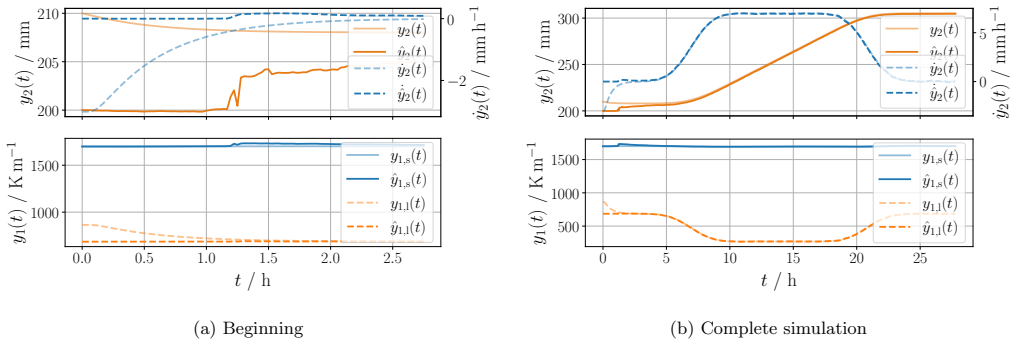
- The shifted-error collocated variant offers a no-remelting mode: it corrects growth-rate error quickly while tolerating a stationary offset in interface position, which matches the process goal of not destroying the grown crystal.
- The observer gain is computed offline from the reference trajectory, so the online output-feedback loop is cheap to implement once the reference profile is known.
- The same feedforward parametrisation supplies reference profiles, reference inputs, and the model used by the observer, so all components of the control system share one consistent representation.
Reading between the lines
- If future work supplies rigorous error bounds between the N-order power-series model and the full Stefan PDE, the same flatness-based controller could be extended to axisymmetric two-dimensional VGF models where the interface is not forced to be flat; the parametrisation is spatial rather than intrinsically one-dimensional.
- The 'track interface velocity, accept position offset' principle embodied in the shifted-error designs is a transferable control objective for other seeded melt-growth processes, where remelting is equally damaging.
- The current observer linearizes the error dynamics along the reference trajectory; a gain-scheduled or moving-horizon observer would be a direct testable upgrade if disturbances drive the state far from that trajectory.
- The stability proof covers only a spatially constant reference profile, and the paper itself flags that the total-variation bound needed for general reference profiles is hard to show; a rigorous general proof is the most pressing open step.
Signed reviews
Editorial analysis
A structured set of objections, weighed in public.
Referee Report
Summary. The paper considers one-dimensional, two-phase Stefan problem models for the Vertical Gradient Freeze crystal growth process. It derives a flatness-based feedforward control, a collocated state feedback with Lyapunov stability analysis, a distributed flatness-based feedback on a truncated power-series state, and an observer based on the same finite-dimensional flat model. All components are validated in simulations against an independent finite-element (FEM) model of the Stefan problem, and the paper claims to introduce the first output-feedback tracking control methods for the two-phase Stefan problem with multiple inputs.
Significance. If fully established, the paper would fill a genuine gap in moving-boundary system control: output-feedback tracking for a two-phase Stefan problem with multiple boundary inputs. The flatness-based parameterization is used consistently for feedforward, feedback, and observer design, and the use of an independent FEM plant in Section 7 is a strong point in favor of the practical relevance of the approach. The explicit comparison between fixed and shifted error definitions, motivated by avoiding remelting of the already solidified crystal, is also valuable. However, the theoretical support for the central claim is incomplete: the main feedback and observer designs rely on an unvalidated low-order truncation of the power series, and the Lyapunov proof for the collocated controller is only completed for a constant reference profile.
major comments (4)
- [Section 5.1, Eq. (31)] The distributed feedback (Section 5) and the observer (Section 6) are designed on the truncated flat-state model of order N=5 (Table 1). Equation (31) determines c_{N+1} from the boundary condition, but no estimate is given for the neglected tail coefficients of the power series (8). Consequently, the linear error dynamics (35) are proven stable only for the truncated state χ^N, and there is no theoretical link to convergence of the full infinite-dimensional Stefan state. The independent FEM simulations in Section 7 are encouraging numerical evidence, but they do not quantify the approximation error. Please add a truncation-error bound, or at least a systematic convergence study with increasing N (e.g., N=3, 5, 7, 10) for the closed-loop trajectories.
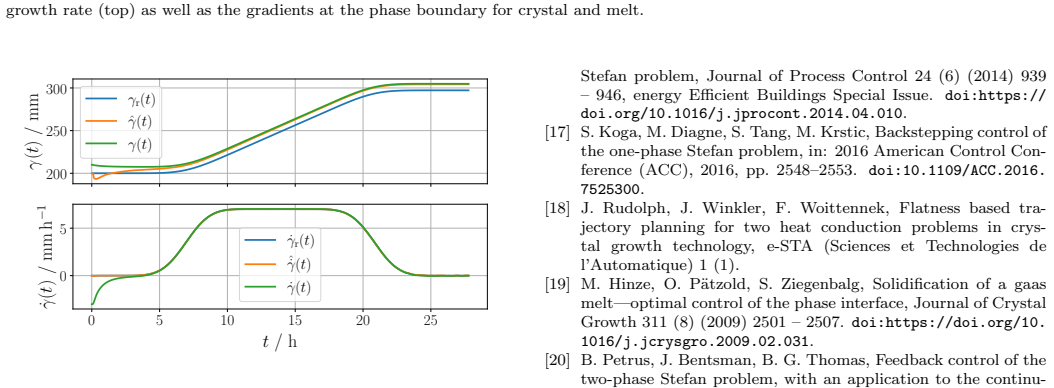
- [Section 4.3 and Appendix B, Eq. (B.10)] The Lyapunov analysis for the collocated feedback is carried out only for the constant reference profile T_r^0 ≡ T_m (Appendix B, 'Simplified variant'). For general reference profiles the derivation stops at condition (B.10), which requires the total variation Ψ_t^0(Δγ) to grow at most linearly in t; the authors state this is 'hard to show' (Section 4.3). Since the VGF benchmark uses a nonconstant reference trajectory (Figures 3 and 4), this is a load-bearing gap in the tracking claim. The statement that simulations show convergence for non-trivial reference profiles is empirical evidence, not a proof. Please either prove (B.10), provide a bound on Δγ̇ that implies it, or state the stability theorem with the constant-reference caveat.
- [Section 6 and Section 7.4] The observer is designed from a linearisation (41) of the finite-dimensional error dynamics, and the complete observer-based output-feedback loop is validated only by simulation (Figure 8). No separation theorem or stability proof is given for the interconnection of the observer with either feedback law on the infinite-dimensional two-phase Stefan plant. Since output feedback is part of the stated contribution (Section 1.1), the paper should either provide such a proof or explicitly frame Sections 5-7 as a design procedure whose stability is demonstrated numerically for the reported parameter set.
- [Section 8] The paper acknowledges that the power-series parameterisation used for the feedforward and feedback designs may not converge for smaller transition times. This restricts the class of admissible reference trajectories and therefore the scope of the claimed tracking result. Please formulate the main claim with this restriction and, if possible, quantify the admissible range of the transition time ϑ in (14) for the parameters in Table 1.
minor comments (6)
- [Section 4.1] The sentence 'in order to meat the technological requirements' contains a typo ('meat' should be 'meet').
- [Section 5.2] The sentence 'by using (36) and (16) with ˜v2(t) instead of ˜v2(t)' contains the same symbol twice; it should distinguish ˜v2(t) from v2(t).
- [Section 5.1, Eq. (31)] In equation (31), the summation should be evaluated at the boundary coordinate ˜Γ◦(t), with the time dependence made explicit; as written, ˜z^i without evaluation at the boundary does not reproduce the boundary condition (7b).
- [Section 5.1] The maps ¯ψ^N and ¯ψ^{N+1} appearing in (28), (30), (33), and (36) are not defined; please define them explicitly.
- [Appendix D] The entries of the scaling matrix T^5 mix dimensionless factors and entries with units (m, m^2), but the units are not specified per entry; please state the units of each diagonal entry.
- [Figure 5] The caption states that the dashed orange and dashed green curves are nearly equal; if that is the intended message, separate panels or a close-up view would make the comparison clearer.
Circularity Check
No circularity: the flatness parametrisation is re-derived from the Stefan PDE, all feedback/observer designs are model-based, and the closed-loop claims are checked against an independent FEM simulation rather than the design model.
full rationale
The paper's derivation chain is self-contained. Section 3 starts from the two-phase Stefan PDE (2)-(3) and re-derives the power-series flat parametrisation: the ansatz (8), recursion (9), flat output (12), and input map (16) are all exhibited in the text. Prior self-citations [18,23] are cited as background and as a source of the flatness-based trajectory-planning idea, but the load-bearing recursion is not imported as a black box; it is written out and used consistently. The feedback designs (Sections 4-5) and observer (Section 6) are explicitly model-based on this parametrisation, and no free parameter is fitted to data and then renamed as a prediction. The claims are evaluated in Section 7 against a finite-element approximation using the boundary-immobilisation method, which is an independent numerical plant, not the truncated power-series model used for controller/observer design. Thus the simulation results are not forced by construction. The missing truncation-error bound and the unproven total-variation condition (B.10) are correctness/completeness limitations, and the paper itself flags them (Section 8 and Appendix B), but they are not circular reductions: no output is defined in terms of the quantity it is supposed to predict, and no fitted input is relabelled as a prediction. Consequently, no circularity step meeting the quoted-evidence standard was found.
Assumptions & free parameters
free parameters (4)
- Collocated feedback gains κs, κl =
20 m^-1
- Distributed feedback gains κ1,0, κ1,1, κ2,0, κ2,1, κ2,2, κ2,0, κ2,1 =
See Appendix D
- Observer weighting matrices S, R, Q =
1e-3 to 1e-4 (Table 1)
- Approximation orders N_ff, N_ob, N_fb =
10, 5, 5
assumptions (5)
- domain assumption 1D radial-mean model with no convection, rotational symmetry, and lateral heaters preventing radial heat loss
- domain assumption Piecewise constant material parameters in solid and liquid phases
- standard math Convergence of the power series (8) for the chosen Gevrey trajectories
- ad hoc to paper Finite-dimensional approximation of order 5 is adequate for control and observer design
- domain assumption Boundary temperature measurements at z=Γs and z=Γl are available without time delay
Cite this review
Pith. "Pith review of Towards model based control of the Vertical Gradient Freeze crystal growth process." pith.science (2026). https://pith.science/paper/E2USWOHV
@misc{pith2026190802519,
  author       = {Pith},
  title        = {Pith review of: Towards model based control of the Vertical Gradient Freeze crystal growth process},
  year         = {2026},
  howpublished = {\url{https://pith.science/paper/E2USWOHV}},
  note         = {Machine review of arXiv:1908.02519}
}
read the original abstract
In this contribution tracking control designs using output feedback are presented for a two-phase Stefan problem arising in the modeling of the Vertical Gradient Freeze process. The two-phase Stefan problem, consisting of two coupled free boundary problems, is a vital part of many crystal growth processes due to the temporally varying extent of the solid and liquid domains during growth. After discussing the special needs of the process, collocated as well as flatness-based state feedback designs are carried out. To render the setup complete, an observer design is performed, using a flatness-based approximation of the original distributed parameter system. The quality of the provided approximations as well as the performance of the open and closed loop control setups is analysed in several simulations.
Figures


Figures from the paper (5 more)


Reference graph
Works this paper leans on
-
[1]
M. Jurisch, F. B¨ orner, T. B¨ unger, S. Eichler, T. Flade, U. Kret- zer, A. K¨ ohler, J. Stenzenberger, B. Weinert, LEC- and VGF- growth of SI GaAs single crystals—recent developments and current issues, Journal of Crystal Growth 275 (1) (2005) 283 – 291, proceedings of the 14th International Conference on Crys- tal Growth and the 12th International Conf...
-
[2]
J. Vanhellemont, The v/g criterion for defect-free silicon sin- gle crystal growth from a melt revisited: Implications for large diameter crystals, Journal of Crystal Growth 381 (2013) 134 –
work page 2013
-
[3]
C. Frank-Rotsch, N. Dropka, A. Glacki, U. Juda, VGF growth of GaAs utilizing heater-magnet module, Journal of Crystal Growth 401 (2014) 702–707
work page 2014
- [4]
-
[5]
N. Dropka, C. Frank-Rotsch, Enhanced VGF-GaAs growth us- ing pulsed unidirectional TMF, Journal of Crystal Growth 386 (2014) 146 – 153. doi:10.1016/j.jcrysgro.2013.09.027
- [6]
-
[7]
P.Wellmann, G. Neubauer, L. Fahlbusch, M. Salamon, N. Uhlmann, Growth of SiC bulk crystals for application in power electronic devices – process design, 2D and 3D X-ray in situ visualization and advanced doping, Cryst. Res. Technol. 50 (2015) 2–9
work page 2015
-
[8]
J. Crank, Free and Moving Boundary Problems (Oxford Science Publications), Oxford Science Publications, Oxford University Press, 1984
work page 1984
Show all 34 references
-
[9]
S. Koga, M. Diagne, M. Krstic, Output feedback control of the one-phase Stefan problem, in: 2016 IEEE 55th Conference on Decision and Control (CDC), 2016, pp. 526–531. doi:10.1109/ CDC.2016.7798322. 8 200 205 210y2(t) / mm y2(t)ˆy2(t) 0.0 0.5 1.0 1.5 2.0 2.5t/ h 1000 1500y1(t)...
2016
-
[10]
Brusche, A
J. Brusche, A. Segal, C. Vuik, H. Urbach, A comparison of en- thalpy and temperature methods for melting problems on com- posite domains, Numerical Mathematics and Advanced Appli- cations
-
[11]
S. Chen, B. Merriman, S. Osher, P.Smereka, A simple level set method for solving Stefan problems, Journal of Computational Physics
-
[12]
Beckett, J
G. Beckett, J. A. Mackenzie, M. L. Robertson, A moving mesh finite element method for the solution of two-dimensional Ste- fan problems, Journal of Computational Physics doi:10.1006/ jcph.2001.6721
2001
-
[13]
W. B. Dunbar, N. Petit, P. Rouchon, P. Martin, Motion plan- ning for a nonlinear Stefan problem, European Series in Applied and Industrial Mathematics (ESAIM): Control, Optimization and Calculus of Variations 9 (2003) 275–296
2003
-
[14]
Petrus, J
B. Petrus, J. Bentsman, B. Thomas, Enthalpy-based feedback control algorithms for the Stefan problem, in: Proceedings of the IEEE Conference on Decision and Control, 2012, pp. 7037– 7042
2012
-
[15]
Petrus, J
B. Petrus, J. Bentsman, B. G. Thomas, Application of enthalpy- based feedback control methodology to the two-sided stefan problem, in: 2014 American Control Conference, 2014, pp. 1015–1020. doi:10.1109/ACC.2014.6859062
2014
-
[16]
Maidi, J.-P
A. Maidi, J.-P. Corriou, Boundary geometric control of a linear Stefan problem, Journal of Process Control 24 (6) (2014) 939 – 946, energy Efficient Buildings Special Issue. doi:https:// doi.org/10.1016/j.jprocont.2014.04.010
2014 doi
-
[17]
S. Koga, M. Diagne, S. Tang, M. Krstic, Backstepping control of the one-phase Stefan problem, in: 2016 American Control Con- ference (ACC), 2016, pp. 2548–2553. doi:10.1109/ACC.2016. 7525300
2016 doi
-
[18]
Rudolph, J
J. Rudolph, J. Winkler, F. Woittennek, Flatness based tra- jectory planning for two heat conduction problems in crys- tal growth technology, e-STA (Sciences et Technologies de l’Automatique) 1 (1)
-
[19]
Hinze, O
M. Hinze, O. P¨ atzold, S. Ziegenbalg, Solidification of a gaas melt—optimal control of the phase interface, Journal of Crystal Growth 311 (8) (2009) 2501 – 2507. doi:https://doi.org/10. 1016/j.jcrysgro.2009.02.031
2009
-
[20]
Petrus, J
B. Petrus, J. Bentsman, B. G. Thomas, Feedback control of the two-phase Stefan problem, with an application to the continu- ous casting of steel, in: 49th IEEE Conference on Decision and Control (CDC), 2010, pp. 1731–1736. doi:10.1109/CDC.2010. 5717456
2010 doi
-
[21]
J. R. Cannon, The One-Dimensional Heat Equation, Vol. 23 of Encyclopedia of Mathematics and its Applications, Addison- Wesley, 1984
1984
-
[22]
Stefan, ¨Uber die Theorie der Eisbildung, insbesondere ¨ uber die Eisbildung in Polarmeere, Annalen der Physikalischen Chemie (1891) 269–286
J. Stefan, ¨Uber die Theorie der Eisbildung, insbesondere ¨ uber die Eisbildung in Polarmeere, Annalen der Physikalischen Chemie (1891) 269–286
-
[23]
Rudolph, J
J. Rudolph, J. Winkler, F. Woittennek, Flatness based con- trol of distributed parameter systems: Examples and com- puter exercises from various technological domains, Berichte aus der Steuerungs- und Regelungstechnik, Shaker Verlag, Aachen, 2003
2003
-
[24]
Gevrey, Sur la nature analytique des solutions des ´ equations aux d´ eriv´ ees partielles
M. Gevrey, Sur la nature analytique des solutions des ´ equations aux d´ eriv´ ees partielles. premier m´ emoire, Annales scientifiques de l’ ´Ecole Normale Sup´ erieure 35 (1918) 129–190. URL http://eudml.org/doc/81374
1918
-
[25]
V. I. Zubov, Methods of A.M. Lyapunov and their application, P. Noordhoff, Groningen, 1964
1964
-
[26]
Mironchenko, F
A. Mironchenko, F. Wirth, A non-coercive Lyapunov framework for stability of distributed parameter systems, in: 2017 IEEE 56th Annual Conference on Decision and Control (CDC), 2017, pp. 1900–1905. doi:10.1109/CDC.2017.8263927
2017
-
[27]
Meurer, Feedforward and feedback tracking control of diffusion-convection-reaction systems using summability meth- ods, Ph.D
T. Meurer, Feedforward and feedback tracking control of diffusion-convection-reaction systems using summability meth- ods, Ph.D. thesis, University of Stuttgart (2005). doi:http: //dx.doi.org/10.18419/opus-4075
2005 doi
-
[28]
Meurer, M
T. Meurer, M. Zeitz, Feedforward and feedback tracking con- trol of nonlinear diffusion–convection–reaction systems using summability methods, Industrial & Engineering Chemistry Re- 9 search 44 (8) (2005) 2532–2548. arXiv:https://doi.org/10. 1021/ie0495729, doi:10.1021/ie049572...
2005 doi
-
[29]
E. D. Sontag, Mathematical Control Theory, 2nd Edition, Vol. 6 of Texts in Applied Mathematics, Springer-Verlag, 1998
1998
-
[30]
Meurer, M
T. Meurer, M. Zeitz, Flatness-based feedback control of diffusion-convection-reaction systems via k-summable power se- ries, IFAC Proceedings Volumes 37 (13) (2004) 177 – 182, 6th IFAC Symposium on Nonlinear Control Systems 2004 (NOL- COS 2004), Stuttgart, Germany, 1-3 Septembe...
2004 doi
-
[31]
Meurer, A
T. Meurer, A. Kugi, Tracking control for boundary controlled parabolic pdes with varying parameters: Combining backstep- ping and differential flatness, Automatica 45 (5) (2009) 1182 –
2009
-
[32]
A. S. Miroslav Krstic, Boundary control of PDEs: a course on backstepping designs, siam Edition, Advances in Design and Control, Society for Industrial and Applied Mathematic, 2008. Appendix A. Transformations Appendix A.1. Moving reference system The coordinate transform ˜T (...
2008
-
[138]
doi:https://doi.org/10.1016/j.jcrysgro.2013.06.039
2013 doi
-
[1194]
doi:https://doi.org/10.1016/j.automatica.2009.01. 006. URL http://www.sciencedirect.com/science/article/pii/ S0005109809000478
2009 doi
Reviewed August 14, 2026 · model on record in the stance chip above.
Discussion (0). Continue with ORCID to comment.