REVIEW 3 major objections 5 minor 26 references
Cross-Router Covert Channels
T0 review · 3 major / 5 minor · reviewed 2026-08-14 · deepseek-v4-flash
Pith's one-line read Logical host/guest network isolation is not a sufficient security boundary: this paper shows that all seven routers surveyed leak data across the split through covert channels that use the router as a shared medium.
desk verdict Cross-router covert channels are a real and useful result, but the timing-channel evidence needs a BER or end-to-end demo before the 'all routers vulnerable' claim carries its weight. read the letter →
The pith
A machine-rendered reading of the paper's core claim, the machinery that carries it, and where it could break.
The reading
What carries the argument
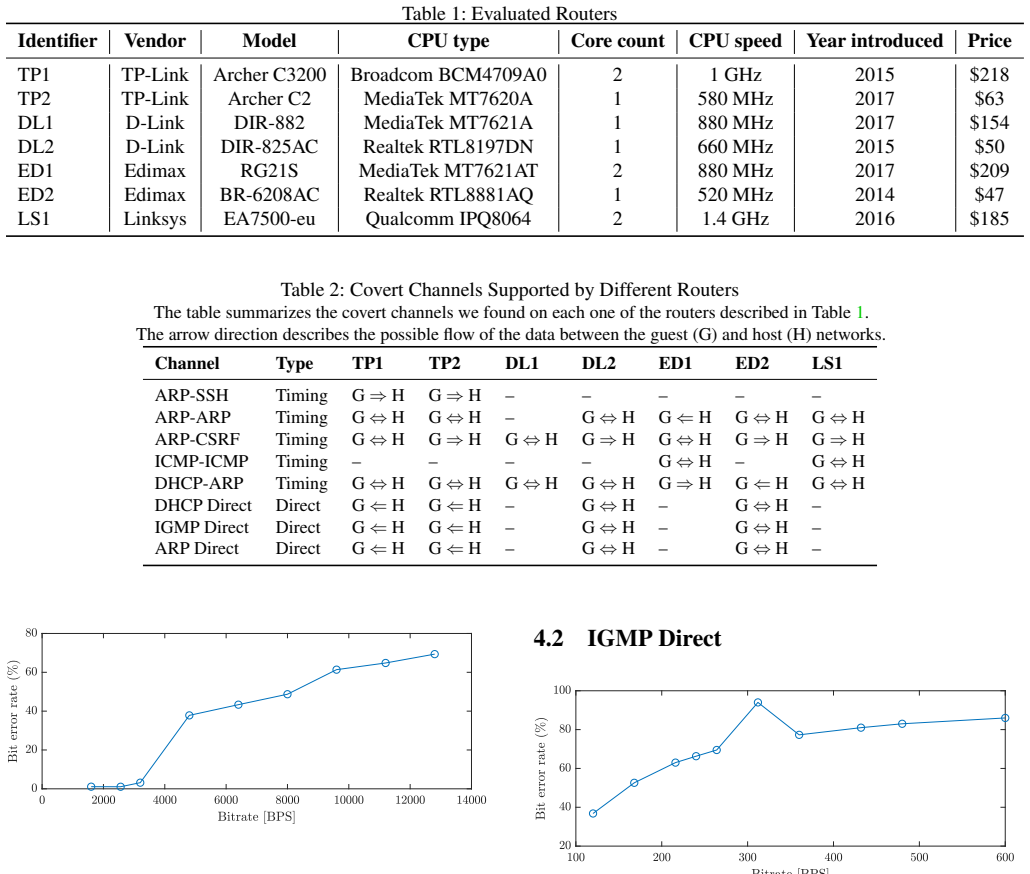
The load-bearing object is the router's control plane, the software path that answers protocol requests (DHCP, ARP, ICMP, SSH, and the web management interface) as opposed to the hardware forwarding plane that passes ordinary packets at line speed. A covert channel is assembled from a sender gadget, which forces the control plane to do extra work, and a receiver gadget, which samples the resulting slowdown; the paper combines these into named channel pairs such as ARP-SSH, ARP-ARP, ARP-CSRF, ICMP-ICMP, and DHCP-ARP, and pairs them with direct channels that carry data in the payload fields of mistakenly forwarded protocol messages. The identity doing the work is contention for the router's CPU: when one side generates enough requests, the other side's response times shift measurably.
What would settle it
Pick a router where the paper reports only a timing channel (for example, ED1 for ARP-ARP), implement a sender that modulates a known bit sequence by toggling the sender gadget on and off, and have the receiver decode bits from the response-time distribution. If the decoded bit error rate is near 50 percent or the receiver cannot recover the sequence without knowing it in advance, the t-test result does not correspond to a usable covert channel; for direct channels, the equivalent test is whether the forwarded packet actually appears on the other network after a factory reset with isolation enabled.
Extended reading notes
Core claim
On the paper's own terms, the central discovery is that logical network isolation on commodity routers can be bypassed by turning the router's control plane into a covert communication medium. The authors identify two mechanisms: direct channels, where the router erroneously forwards protocol messages (a DHCP NAK, an IGMP membership query, an ARP request) from one network to the other with attacker-controlled fields carrying the data, and timing channels, where a sender gadget on one side loads the router's CPU and a receiver gadget on the other side measures the resulting change in response time. Across a survey of seven routers from multiple vendors and price points, every device was vulnerable to at least one channel class. The highest-rate channels are the direct ones, reaching thousands of bits per second, while the timing channels are slower but more pervasive; the ARP-CSRF combination can be driven from the host side using only an iframe of malicious JavaScript.
Load-bearing premise
The load-bearing premise is that a statistically significant difference in router response times, measured as a t-test with p<0.05 on 1,000 samples, is enough to call a timing-based covert channel real, even though the paper does not demonstrate a bit error rate or an end-to-end data transfer for those channels.
Editorial extensions
If this is right
- Any deployment that relies on host/guest isolation on a single commodity router should treat that isolation as a covert-channel risk rather than a hard boundary.
- The ARP-CSRF result implies that a host-side victim who merely visits an attacker-controlled page can participate in a leak, since the iframe needs no special permissions beyond loading the router's web interface.
- Direct DHCP and IGMP channels carry thousands of bits per second, so even moderately sized secrets can be exfiltrated before a session ends.
- Timing channels are not fixable by firewall rules alone; the paper's proposed countermeasures are resource time-slicing, random response delays, or hardware-level separation.
- Detection is possible by monitoring polling rates and correlated concurrent requests from both segments, but reducing the channel rate can defeat such detection.
Reading between the lines
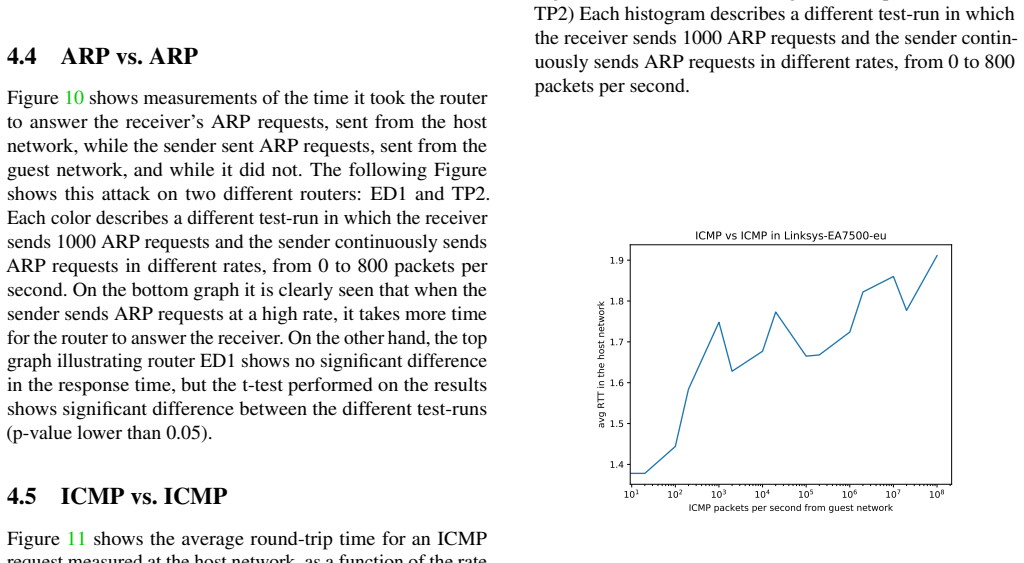
- The t-test criterion (p<0.05 over 1,000 samples) may declare a timing channel usable when the response-time distributions overlap heavily, as the ED1 ARP-ARP histograms suggest; a natural follow-up is to encode a known bitstream over each timing channel and measure its actual bit error rate and capacity.
- The same shared-medium logic should transfer to other devices that serve two isolated segments, such as managed switches, VPN gateways, or ISP routers, where a similar gadget construction could be tested.
- If timing channels are intrinsic to any software control plane, then router vendors could inject randomized delays into control-plane responses; the paper's framework predicts this would raise the channel's error rate, an experiment that is directly testable against their measurements.
- Combining the direct and timing channels into one bidirectional link would yield an exfiltration pipe that is harder to block because each direction uses a different mechanism.
Signed reviews
Editorial analysis
A structured set of objections, weighed in public.
Referee Report
Summary. The paper presents an empirical survey of cross-router covert channels that bypass software-enforced host/guest network isolation on commodity home/small-office routers. The authors describe direct channels (DHCP, IGMP, ARP forwarding bugs) and timing channels built from sender and receiver gadgets (ARP, SSH, CSRF, ICMP, DHCP), and report that all seven surveyed routers are vulnerable to at least one channel. Direct channels are supported by bit error rate measurements and an end-to-end chat demo; timing channels are claimed to exist when a Student's t-test (p < 0.05) distinguishes 1,000 receiver timings with and without the sender gadget. The paper also proposes qualitative metrics for channel quality and discusses detection, prevention, and responsible disclosure.
Significance. If the central claim holds, this is a practically important result: it demonstrates that logical host/guest isolation on consumer routers is not a sufficient security boundary, and it does so across multiple vendors and price points. The direct channels are convincingly demonstrated with BER curves and a working chat transfer, and the responsible-disclosure record (nine CVEs) adds credibility. The timing channels, if properly validated, would substantially broaden the attack surface because some variants require only JavaScript in an iframe. The main weakness is that the timing-channel existence criterion is statistical significance alone, with no demonstrated bit error rate, synchronization, or data transfer; because two of the routers (DL1 and ED1) rely solely on timing channels in Table 2, this weakness is load-bearing for the headline 'all routers are vulnerable' claim.
major comments (3)
- [Section 4, Table 2] The existence criterion for every timing-based channel is only a significant Student's t-test (p < 0.05) over two sets of 1,000 timings. No timing channel is accompanied by a bit error rate, a modulation/demodulation scheme, a synchronization preamble, or an end-to-end transfer. Since Table 2 shows that DL1 has only ARP-CSRF and DHCP-ARP timing channels and ED1 has only ARP-ARP, ARP-CSRF, ICMP-ICMP, and DHCP-ARP timing channels, the abstract and conclusion's claim that 'all of the routers we surveyed are vulnerable to at least one class of covert channel' is currently supported for these two routers only by the statistical criterion. Please add a decoding experiment that transmits actual data over each timing channel and reports BER or capacity, or at minimum a detailed feasibility argument showing how a receiver would map the measured timings to bits.
- [Figure 10, Section 4.4] The top panel of Figure 10 (labeled 'ED2' in the caption but 'ED1' in the text) shows heavily overlapping response-time histograms with no visible separation, yet the t-test is reported as significant. This pattern indicates that a naive threshold decoder would likely produce bit errors near 0.5, and it calls into question whether the significant t-test corresponds to a usable communication channel. Please report the effect size (e.g., Cohen's d) for all timing channels, and for this specific router show the BER of a threshold decoder or an alternative decoding strategy.
- [Section 4.5, Figure 11] The ICMP-ICMP result on LS1 is presented only as a plot of average round-trip time versus sender packet rate, without distribution information, error bars, or a t-test result. This makes it impossible to assess whether a receiver could reliably distinguish sender bit values, especially at the lower rates shown. Please provide the same statistical evidence (or a full BER experiment) for this channel as for the other timing channels.
minor comments (5)
- [Figure 10 caption] The caption states 'top: ED2', while the text in Section 4.4 says the attack was performed on ED1; please correct the mismatch so the reader can map the figure to Table 1.
- [Figure 8 caption] The caption says 'above 170 bits per second the error rate becomes than 50 percent'; this appears to be missing a word such as 'greater than' or 'higher than'.
- [Section 4.3 and Figure 9] The description says 'the time it took the router to answer the receiver's SSH requests' while the channel is named ARP-SSH; please clarify which gadget is the sender and which is the receiver in this experiment, and align the figure axes and text accordingly.
- [Section 3.1 and Table 3] The three quality metrics (pervasiveness, rate, covertness) are rated with qualitative '+', '++', '+++' symbols, but no precise definition of the rating scale is given; please define what each level means quantitatively (e.g., packet rates, number of routers, log artifacts).
- [Section 2.2.2] The CSRF gadget is described as repeatedly loading the router's web page in an iframe and measuring load time, which is not a cross-site request forgery in the traditional sense; consider renaming this gadget (e.g., 'Web-management timing') to avoid confusion with the standard CSRF attack definition.
Circularity Check
No significant circularity: the survey's claims are empirical and self-contained; the only self-citation is used for contrast and is not load-bearing.
full rationale
The paper's central claim, that all seven surveyed routers are vulnerable to at least one cross-router covert channel, is supported by direct measurements on physical devices (Table 2, Section 4). Direct channels (DHCP, IGMP, ARP) are demonstrated with bit-error-rate curves and an end-to-end chat implementation (Section 4.1), so those findings do not reduce to an input assumption. Timing channels are defined through an explicit statistical criterion: Student's t-test on 1,000 timings with and without the sender gadget at p<0.05 (Section 4). This criterion is an arbitrary threshold, and one might reasonably argue it is too weak to establish a usable covert channel (e.g., Figure 10 top shows overlapping histograms). However, that is a validity/correctness concern, not a circularity concern: the timing channel existence is not derived from a fitted parameter, nor is the criterion defined in terms of the claimed outcome. The paper's methodology is openly empirical: it inspects router behavior, verifies isolation, and then tests whether crafted traffic creates measurable differences. The only self-citation, Ref. [15] by two of the present authors (Ogen and Oren), is used in Related Work for comparison ('In contrast to the channel developed by [15]...') and does not carry any load-bearing premise. No self-definitional step, renamed fit, or imported uniqueness theorem appears. Hence the score is 0.
Assumptions & free parameters
free parameters (1)
- timing-channel significance threshold =
p < 0.05
assumptions (4)
- domain assumption A router must expose ARP, DHCP, and typically DNS and ICMP to the guest network for basic connectivity.
- domain assumption The router's control-plane CPU is a shared resource between host and guest networks, so demand from one side measurably changes response times on the other side.
- domain assumption During experiments, the router WAN port is disconnected so that no third-party Internet server can serve as a shared medium.
- standard math Student's independent two-sample t-test is a valid test for comparing the router response-time distributions.
Cite this review
Pith. "Pith review of Cross-Router Covert Channels." pith.science (2026). https://pith.science/paper/CXTDGRTV
@misc{pith2026190802524,
  author       = {Pith},
  title        = {Pith review of: Cross-Router Covert Channels},
  year         = {2026},
  howpublished = {\url{https://pith.science/paper/CXTDGRTV}},
  note         = {Machine review of arXiv:1908.02524}
}
read the original abstract
Many organizations protect secure networked devices from non-secure networked devices by assigning each class of devices to a different logical network. These two logical networks, commonly called the host network and the guest network, use the same router hardware, which is designed to isolate the two networks in software. In this work we show that logical network isolation based on host and guest networks can be overcome by the use of cross-router covert channels. Using specially-crafted network traffic, these channels make it possible to leak data between the host network and the guest network, and vice versa, through the use of the router as a shared medium. We performed a survey of routers representing multiple vendors and price points, and discovered that all of the routers we surveyed are vulnerable to at least one class of covert channel. Our attack can succeed even if the attacker has very limited permissions on the infected device, and even an iframe hosting malicious JavaScript code can be used for this purpose. We provide several metrics for the effectiveness of such channels, based on their pervasiveness, rate and covertness, and discuss possible ways of identifying and preventing these leakages.
Figures


Figures from the paper (7 more)




Reference graph
Works this paper leans on
-
[15]
Sensorless, permissionless information exfiltration with wi-fi micro-jamming
Rom Ogen, Kfir Zvi, Omer Shwartz, and Yossi Oren. Sensorless, permissionless information exfiltration with wi-fi micro-jamming. In 12th{USENIX} Workshop on Offensive Technologies ({WOOT} 18), 2018
work page 2018
-
[1]
Medical device security, V A enterprise design patterns privacy and security, January 2017
work page 2017
-
[2]
Covert channel analysis and data hiding in tcp/ip
Kamran Ahsan. Covert channel analysis and data hiding in tcp/ip. Canada, University of Toronto, 2002
work page 2002
-
[3]
A. Barth. The web origin concept. RFC 6454, RFC Ed- itor, December 2011. http://www.rfc-editor.org/ rfc/rfc6454.txt
work page 2011
-
[4]
Serdar Cabuk, Carla E. Brodley, and Clay Shields. IP covert timing channels: design and detection. In Vi- jayalakshmi Atluri, Birgit Pfitzmann, and Patrick D. McDaniel, editors, Proceedings of the 11th ACM Con- ference on Computer and Communications Security, CCS 2004, Washington, DC, USA, October 25-29, 2004 , pages 178–187. ACM, 2004
work page 2004
-
[5]
Dynamic host configuration protocol
Ralph Droms. Dynamic host configuration protocol. RFC 2131, RFC Editor, March 1997. http://www. rfc-editor.org/rfc/rfc2131.txt
work page 1997
-
[6]
William C. Fenner. Internet group management protocol, version 2. RFC 2236, RFC Editor, November 1997. http://www.rfc-editor.org/rfc/rfc2236.txt
work page 1997
-
[7]
Hiding data in the OSI network model
Theodore G Handel and Maxwell T Sandford. Hiding data in the OSI network model. In International Work- shop on Information Hiding , pages 23–38. Springer, 1996
work page 1996
Show all 26 references
-
[8]
Network intrusion detection: Evasion, traffic normaliza- tion, and end-to-end protocol semantics
Mark Handley, Vern Paxson, and Christian Kreibich. Network intrusion detection: Evasion, traffic normaliza- tion, and end-to-end protocol semantics. In Dan S. Wal- lach, editor, 10th USENIX Security Symposium, August 13-17, 2001, Washington, D.C., USA. USENIX, 2001
2001
-
[9]
D. Hardt. The oauth 2.0 authorization framework. RFC 6749, RFC Editor, October 2012. http://www. rfc-editor.org/rfc/rfc6749.txt
2012
-
[10]
Computer Networking: A Top-Down Approach (7th Edition)
James Kurose and Keith Ross. Computer Networking: A Top-Down Approach (7th Edition). Pearson, 2016
2016
-
[11]
Butler W. Lampson. A note on the confinement problem. Commun. ACM, 16(10):613–615, 1973
1973
-
[12]
C5: cross-cores cache covert channel
Clémentine Maurice, Christoph Neumann, Olivier Heen, and Aurélien Francillon. C5: cross-cores cache covert channel. In Magnus Almgren, Vincenzo Gulisano, and Federico Maggi, editors, Detection of Intrusions and Malware, and Vulnerability Assessment - 12th Interna- tional Confe...
2015
-
[13]
Hello from the other side: Ssh over robust cache covert channels in the cloud
Clémentine Maurice, Manuel Weber, Michael Schwarz, Lukas Giner, Daniel Gruss, Carlo Alberto Boano, Ste- fan Mangard, and Kay Römer. Hello from the other side: Ssh over robust cache covert channels in the cloud. NDSS, San Diego, CA, US , 2017
2017
-
[14]
Mockapetris
P. Mockapetris. Domain names - concepts and facilities. STD 13, RFC Editor, November 1987. http://www. rfc-editor.org/rfc/rfc1034.txt
1987
-
[16]
David C. Plummer. Ethernet address resolution pro- tocol: Or converting network protocol addresses to 48.bit ethernet address for transmission on ethernet hard- ware. STD 37, RFC Editor, November 1982. http: //www.rfc-editor.org/rfc/rfc826.txt
1982
-
[17]
J. Postel. Internet control message protocol. STD 5, RFC Editor, September 1981. http://www. rfc-editor.org/rfc/rfc792.txt
1981
-
[18]
Craig H. Rowland. Covert channels in the TCP/IP pro- tocol suite. First Monday, 2(5), 1997
1997
-
[19]
Rozenblit, Roman L
Johannes Sametinger, Jerzy W. Rozenblit, Roman L. Lysecky, and Peter Ott. Security challenges for medical devices. Commun. ACM, 58(4):74–82, 2015
2015
-
[20]
Guide to industrial control systems (ics) security
Keith Stouffer, Joe Falco, and Karen Scarfone. Guide to industrial control systems (ics) security. NIST special publication, 800(82):16–16, 2011
2011
-
[21]
Pattern-based survey and cate- gorization of network covert channel techniques
Steffen Wendzel, Sebastian Zander, Bernhard Fechner, and Christian Herdin. Pattern-based survey and cate- gorization of network covert channel techniques. ACM Comput. Surv., 47(3):50:1–50:26, 2015
2015
-
[22]
Ylonen and C
T. Ylonen and C. Lonvick. The secure shell (ssh) trans- port layer protocol. RFC 4253, RFC Editor, January
-
[23]
Armitage, and Philip Branch
Sebastian Zander, Grenville J. Armitage, and Philip Branch. A survey of covert channels and countermea- sures in computer network protocols. IEEE Communi- cations Surveys and Tutorials, 9(1-4):44–57, 2007
2007
-
[24]
Iot security: Ongoing challenges and research oppor- tunities
Zhi-Kai Zhang, Michael Cheng Yi Cho, Chia-Wei Wang, Chia-Wei Hsu, Chong Kuan Chen, and Shiuhpyng Shieh. Iot security: Ongoing challenges and research oppor- tunities. In 7th IEEE International Conference on Service-Oriented Computing and Applications, SOCA 2014, Matsue, Japan,...
2014
-
[234]
IEEE Computer Society, 2014
2014
-
[2006]
http://www.rfc-editor.org/rfc/rfc4253. txt
Reviewed August 14, 2026 · model on record in the stance chip above.
Discussion (0). Continue with ORCID to comment.