REVIEW 3 major objections 4 minor 28 references
Environmental Disorder Regulation of Invasion and Genetic Loss
T0 review · 3 major / 4 minor · reviewed 2026-08-14 · deepseek-v4-flash
Pith's one-line read Spatial fluctuations in movement speed regulate genetic loss during range expansion, with weak disorder slowing it and strong disorder accelerating it.
desk verdict Front-wandering scaling may be real, but the genetic-loss headline rests on a false homogeneous-extinction baseline. read the letter →
The pith
A machine-rendered reading of the paper's core claim, the machinery that carries it, and where it could break.
The reading
What carries the argument
The argument is carried by a perturbative treatment of the stochastic reaction-diffusion equation in a comoving frame. Writing the density as $C(\zeta,t)\approx C_0(\zeta+\eta(t),t)+\delta C_1(\zeta,t)$, with $C_0$ the solution of the unperturbed linearized equation, the authors project the noise term onto the zero eigenfunction $e^{\sqrt{R/D_0}\,\zeta}$ of the adjoint operator. This yields an equation of motion for the front displacement $\eta(t)$ and, after ensemble averaging $\langle f(x)f(y)\rangle=\delta(x-y)$, the effective diffusion coefficient $D_C$. For genetic loss, the key object is the difference field $\Upsilon=C_2-C_1$ and its squared integral $\kappa(t)=\int \Upsilon^2\,dx$; a Green-function calculation gives $\langle\Delta\kappa^2\rangle$, and direct simulation of the two-population equation supplies the heterozygosity $H=\langle\int C_1C_2\,dx\rangle$ that exhibits the non-monotonic dependence on $\xi$.
What would settle it
A direct test is to integrate the deterministic two-population PDE (13) with $\xi=0$, equal fitness and no demographic noise, starting from $C_1=0.49$, $C_2=0.51$: if the minority population does not go extinct asymptotically, the paper's reference behavior for 'genetic loss' is invalid. A complementary experiment would track heterozygosity in a microbial or cell range expansion on substrates with controlled diffusivity variance, looking for the predicted non-monotonic response with a minimum of genetic loss near $\xi\approx0.2$.
Extended reading notes
Core claim
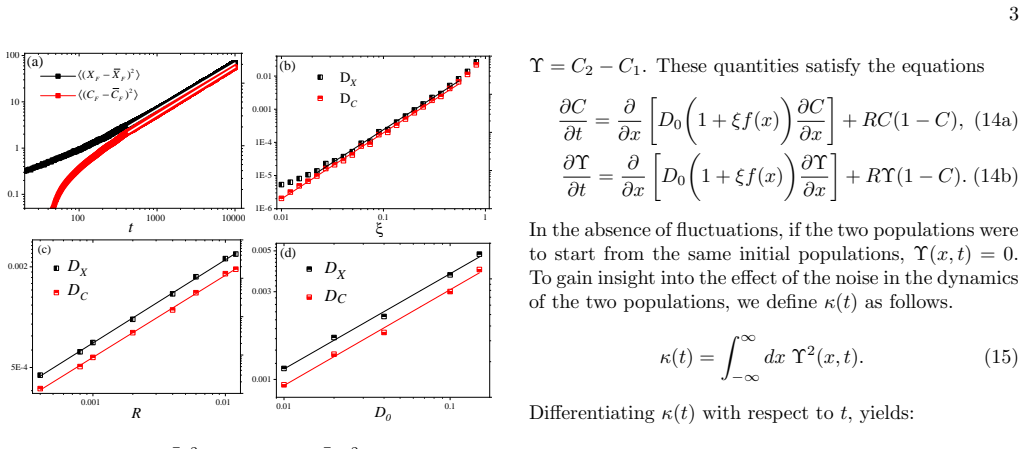
The central discovery is that spatially random diffusivity acts non-monotonically on genetic loss during range expansion. In the paper's two-population model, starting from nearly equal densities $C_1=0.5-\epsilon$ and $C_2=0.5+\epsilon$, the minority population eventually disappears in a uniform environment; introducing disorder of amplitude $\xi$ delays that loss for $\xi\lesssim0.2$ and speeds it up for $\xi\gtrsim0.2$. The front itself performs an unbiased random walk, so the invasion border wanders as $\langle (X_F-\bar X_F)^2\rangle \sim 2D_C t$ with $D_C=\frac18\xi^2\sqrt{RD_0}$. The authors interpret this as evidence that regional differences in the intensity of genetic drift—such as those observed in human expansions and tumor mutational landscapes—can be produced by environmental heterogeneity alone.
Load-bearing premise
The load-bearing premise is that, in a perfectly uniform environment, the initially less abundant population is doomed to extinction; if that deterministic baseline is not accurate, the paper's claim that weak disorder delays genetic loss is measured against the wrong reference.
Editorial extensions
If this is right
- An invasion front in a habitat with random motility performs an unbiased random walk, so the position variance grows linearly in time with coefficient $\frac18\xi^2\sqrt{RD_0}$; this can be tested by tracking range edges in experiments or field data.
- Weak environmental disorder (roughly $\xi<0.2$) preserves genetic diversity at the advancing front by delaying the extinction of less abundant populations.
- Strong disorder ($\xi>0.2$) does the opposite, accelerating genetic loss and making the loss spatially patchy even when fitness is equal.
- Observed regional differences in human genetic loss intensity could be explained by differences in environmental variability rather than by distinct demographic histories alone.
- In tumors, clonal diversity (and hence mutational heterogeneity) may be shaped by the physical disorder of the surrounding tissue through the same mechanism.
Reading between the lines
- Inference: a similar non-monotonic response should appear in two- and three-dimensional expansions, where the disorder variance replaces the one-dimensional $\xi^2$; the transition point may shift with dimension and with the correlation length of the noise.
- Inference: the model predicts an experimentally accessible control variable—substrate heterogeneity in microbial range expansions—so the claim can be tested by growing populations on surfaces with engineered patches of different motility and measuring heterozygosity.
- Inference: if this mechanism operates in humans, genetic-loss rates should correlate with measurable environmental variance (terrain ruggedness, resource patchiness) along the expansion path, not just with distance from the origin.
- Inference: because the theory only requires a fluctuating diffusion constant, any process that modulates dispersal—seasonality, climate variability, or tissue stiffness—could play the same regulatory role, broadening the relevance beyond the paper's examples.
Signed reviews
Editorial analysis
A structured set of objections, weighed in public.
Referee Report
Summary. The manuscript studies a one-dimensional FKPP-type reaction-diffusion equation with a spatially fluctuating diffusion coefficient, D(x) = D0(1 + ξ f(x)), where f(x) is introduced as uniform noise in [-1,1]. The authors derive a Langevin description for the position of the invasion front and obtain an effective diffusion coefficient D_C = (1/8) ξ^2 sqrt(R D0) for front wanderings, which they support with numerical fits reproducing the scaling in ξ, R, and D0. The second part addresses genetic loss by considering two neutral populations with slightly different initial densities and analyzes how spatial disorder in diffusivity affects their coexistence. The paper claims that weak environmental fluctuations (small ξ) delay genetic loss, while strong fluctuations (large ξ) intensify it, and it interprets this as a potential explanation for regional differences in human genetic diversity and tumor heterogeneity.
Significance. If correct, the front-wandering result would be a useful quantitative contribution to the theory of reaction-diffusion fronts in heterogeneous media, and the genetic-loss result would be a striking and biologically relevant prediction. The numerical validation of the D_C scaling is, on its face, well executed: the paper reports scaling exponents and R² values, and the perturbation derivation follows a standard route. The genetic-loss claim, however, is the central novelty of the paper, and it rests on assumptions that contradict the model equations. Because the claimed regulatory role of environmental disorder on genetic loss is not established by the reported analysis, the overall significance of the paper is substantially diminished. The front-wandering part may be salvageable, but the genetic-loss claim as presented is not.
major comments (3)
- [Model and Invasion Front Wanderings, Eq. (2) and Eq. (9)] The noise prescription is internally inconsistent: the model defines f as 'uniform white noise in the range [-1,1]', but the ensemble average leading to Eq. (9) uses <f(x)f(y)> = δ(x-y), which is the correlation of Gaussian white noise with unit variance, not of bounded uniform noise. For uniform noise in [-1,1] one would have <f(x)f(y)> = (1/3)δ(x-y), changing the prefactor in Eq. (11). The numerical fits in Fig. 2 compare only scaling exponents and do not verify the prefactor 1/8. The derivation of D_C is therefore not a parameter-free quantitative prediction for the simulated model.
- [Genetic loss, paragraph before Fig. 3] The baseline for the genetic-loss claim is incorrect. The text states that for non-zero ε in a homogeneous environment C1 will be extinct 'due to its smaller initial value', but this contradicts Eq. (14b). The difference Υ = C2 - C1 satisfies a linear equation with diffusion and growth term R(1-C)Υ, with R(1-C) ≥ 0, so starting from Υ(x,0) = 2ε > 0 yields Υ(x,t) > 0 for all time. The minority population cannot go extinct in the deterministic continuum model. The ξ=0 extinction curve in Fig. 3(a) is therefore a numerical artifact, most plausibly the discretization rule that rounds all flows to integer multiples of 10^-10. The comparison showing that weak disorder 'delays' extinction has no valid baseline.
- [Genetic loss, Eqs. (16)-(19)] The analytic derivation of noise-induced fluctuations in κ rests on an uncontrolled approximation. In Eq. (16) the authors neglect the term 2R∫ C Υ² dx by asserting that C≈1 only where Υ≈0 and C≈0 only where Υ≈1. In a traveling front, however, there is a finite interfacial region where C and Υ are both of order unity, and there is no separation of scales that makes the product negligibly small. Since this approximation is the basis for Eqs. (17)-(19) and for the claimed fluctuation <Δκ²>, the analytic support for the genetic-loss result is not established.
minor comments (4)
- [Model section and Eq. (2)] The text writes f(x) as spatial noise but Eq. (2) uses f(x,t); the time dependence is not defined and is later dropped. Please clarify the notation.
- [Model section] The phrase 'uniform white noise in the range [-1,1]' is ambiguous: it could mean uncorrelated uniform spatial noise, but 'white noise' usually implies Gaussian delta-correlated noise. The normalization and correlation function of f should be stated precisely.
- [Fig. 3 caption] The caption uses 'adimensional time'; the correct term is 'dimensionless time'.
- [Throughout] The paper does not provide a clear definition of the ensemble average notation; Fig. 2 uses <(X−Xbar)²> and <(C_F−C_Fbar)²> without specifying how the average over disorder realizations is taken or how many realizations are used. Reporting the number of realizations and error bars would strengthen the numerical claims.
Circularity Check
No significant circularity: the front-diffusion coefficient is derived analytically and then tested against independent numerics, and the genetic-loss claims are simulation-based with no fitted parameter renamed as a prediction.
full rationale
Walking the derivation chain, the effective front diffusion coefficient is obtained by a perturbative calculation, Eq. (2)-(11), that starts from the stochastic FKPP equation and the noise correlation <f(x)f(y)>=delta(x-y). The result D_C = (1/8) xi^2 sqrt(R D0) contains no parameter fitted from the data used for validation. The numerical test in Fig. 2 compares best-fit scaling exponents (xi^2.00+/-0.01, R^0.50+/-0.02, D0^0.50+/-0.02) against the derived formula, which is the correct, non-circular direction. For the genetic-loss part, the two-population model in Eq. (13) and the derived variance expression Eq. (19) are not used to select the nonmonotonic heterozygosity curve; the heterozygosity behavior in Fig. 3 comes from direct numerical solution of Eq. (13) across different xi values. There is no fitted parameter being fed back into a 'prediction' and no self-citation chain carrying the central claim; the cited references [5,20] supply a standard perturbation method, not an imported uniqueness result. One substantive correctness issue exists -- the homogeneous-environment baseline assertion that C1 'will be extinct, due to its smaller initial value' is doubtful because Eq. (14b) is a deterministic linear PDE for Y=C2-C1 with no stochastic source and a nonnegative growth term, so extinction is not an automatic consequence -- but this is a modeling/reference-behavior concern, not a circular reduction of the paper's derivation to its own inputs. Accordingly, the appropriate circularity score is 0.
Assumptions & free parameters
free parameters (1)
- xi_c threshold separating weak and strong disorder =
approximately 0.2 (simulation-dependent; no analytic expression)
assumptions (5)
- domain assumption The Fisher-KPP reaction-diffusion equation with logistic growth describes invasion fronts and genetic competition.
- ad hoc to paper The disorder function f(x) can be treated both as bounded uniform noise in [-1,1] and as delta-correlated Gaussian white noise with <f(x)f(y)> = delta(x-y).
- domain assumption At long times the front speed v equals 2 sqrt(R D0) even in the presence of weak spatial diffusivity disorder.
- ad hoc to paper The product C times Upsilon squared can be neglected in Eq. (16) because C is near 1 where Upsilon is near 0 and C is near 0 where Upsilon is near 1.
- ad hoc to paper In a homogeneous environment the initially less abundant population C1 goes extinct due to its smaller initial value.
Cite this review
Pith. "Pith review of Environmental Disorder Regulation of Invasion and Genetic Loss." pith.science (2026). https://pith.science/paper/IKZX7TEG
@misc{pith2026190802532,
  author       = {Pith},
  title        = {Pith review of: Environmental Disorder Regulation of Invasion and Genetic Loss},
  year         = {2026},
  howpublished = {\url{https://pith.science/paper/IKZX7TEG}},
  note         = {Machine review of arXiv:1908.02532}
}
read the original abstract
Many physical and natural systems, including the population of species, evolve in habitats with spatial stochastic variations of the individuals' motility. We study here the effect of those fluctuations on invasion and genetic loss. A Langevin equation for the \textit{position} and \textit{border} of the invasion front is obtained. A striking result is that small/large fluctuations of diffusivity suppress/intensify genetic loss. Our findings reveal the potential role of environmental fluctuations as a regulating factor for genetic loss and provide a simple explanation for the regional differences in the intensity of genetic drift observed during the final stages of human evolution and in tumor mutational landscapes.
Figures


Reference graph
Works this paper leans on
- [1]
-
[2]
J. D. Murray, Mathematical Biology I: An Introduction (2003)
work page 2003
-
[3]
Hallatschek, Proceedings of the National Academy of Sciences 108, 1783 (2011)
O. Hallatschek, Proceedings of the National Academy of Sciences 108, 1783 (2011)
work page 2011
-
[4]
O. Hallatschek and K. Korolev, Physical Review Letters 103, 108103 (2009)
work page 2009
- [5]
-
[6]
K. R. Swanson, C. Bridge, J. Murray, and E. C. Alvord Jr, Journal of The Neurological Sciences 216, 1 (2003)
work page 2003
-
[7]
E. Mandonnet, R. Van Effenterre, E. C. Alvord Jr, and L. Capelle, Annals of Neurology 53, 524 (2003)
work page 2003
-
[8]
F. Bordeleau et al., J. Huynh, , Proceedings of the Na- tional Academy of Sciences 114, 492 (2017)
work page 2017
Show all 28 references
-
[9]
B. N. Mason, A. Starchenko, R. M. Williams, L. J. Bonas- sar, and C. A. Reinhart-King, Acta biomaterialia 9, 4635 (2013)
2013
-
[10]
Jamin, et al., Cancer Research (2015)
Y. Jamin, et al., Cancer Research (2015)
2015
-
[11]
Plodinec, et al., Nature Nanotechnology 7, 757 (2012)
M. Plodinec, et al., Nature Nanotechnology 7, 757 (2012)
2012
-
[12]
P. E. Howell, E. Muths, B. R. Hossack, B. H. Sigafus, and R. B. Chandler, Ecology 99, 1119 (2018)
2018
-
[13]
F. W. Allendorf, Zoo biology 5, 181 (1986)
1986
-
[14]
Hallatschek, P
O. Hallatschek, P. Hersen, S. Ramanathan, and D. R. Nelson, Proceedings of the National Academy of Sciences 104, 19926 (2007)
2007
-
[15]
Slatkin and L
M. Slatkin and L. Excoffier, Genetics 191, 171 (2012)
2012
-
[16]
Birzu, S
G. Birzu, S. Matin, O. Hallatschek, and K. S. Korolev, arXiv preprint arXiv:1903.11627 (2019)
2019 arXiv
-
[17]
Reiter, S
M. Reiter, S. Rulands, and E. Frey, Physical review let- ters 112, 148103 (2014)
2014
-
[18]
L. L. Cavalli-Sforza, P. Menozzi, and A. Piazza, Science 259, 639 (1993)
1993
-
[19]
Keinan, J
A. Keinan, J. C. Mullikin, N. Patterson, and D. Reich, Nature Genetics 39, 1251 (2007). 5
2007
-
[20]
Mikhailov, L
A. Mikhailov, L. Schimansky-Geier, and W. Ebeling, Physics Letters A 96, 453 (1983)
1983
-
[21]
Brunet and B
´E. Brunet and B. Derrida, Journal of Statistical Physics 103, 269 (2001)
2001
-
[22]
Sahimi, B
M. Sahimi, B. D. Hughes, L. Scriven, and H. T. Davis, Journal of Chemical Physics 78, 6849 (1983)
1983
-
[23]
M. J. Williams, B. Werner, C. P. Barnes, T. A. Graham, and A. Sottoriva, Nature genetics 48, 238 (2016)
2016
-
[24]
T. O. McDonald, S. Chakrabarti, and F. Michor, Nature genetics 50, 1620 (2018)
2018
-
[25]
Keinan, J
A. Keinan, J. C. Mullikin, N. Patterson, and D. Reich, Nature Genetics 41, 66 (2009)
2009
-
[26]
Fort and V
J. Fort and V. M´ endez, Physical Review Letters82, 867 (1999)
1999
-
[27]
M. O. Vlad and J. Ross, Physical Review E 66, 061908 (2002)
2002
-
[28]
J. Fort, J. P´ erez-Losada, and N. Isern, Physical Review E 76, 031913 (2007)
2007
Reviewed August 14, 2026 · model on record in the stance chip above.
Discussion (0). Continue with ORCID to comment.