REVIEW 3 major objections 5 minor 31 references
A nano-carbon route to rare earth free permanent magnetism
T0 review · 3 major / 5 minor · reviewed 2026-08-14 · deepseek-v4-flash
Pith's one-line read A spin-dependent electric dipole at the Co/C60 interface creates a new form of magnetic anisotropy, pi-anisotropy, that pins magnetization without rare-earth elements.
desk verdict Well-controlled experiment with a genuinely new mechanism, but the quantitative anchor for pi-anisotropy is borrowed from another material and the key C60 rotation is inferred, so the paper earns publication as a hypothesis, not a proof. read the letter →
The pith
A machine-rendered reading of the paper's core claim, the machinery that carries it, and where it could break.
The reading
What carries the argument
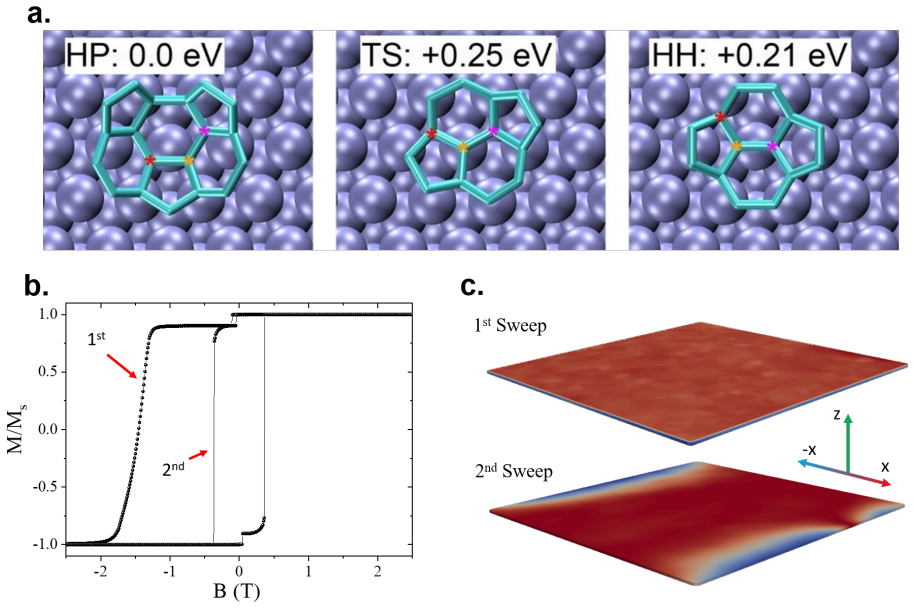
The load-bearing mechanism is the spin-dependent electric dipole, defined as $\vec{P} = \sum_{i,j} A_{ij} (|S_i| |r_{ij}| \cos\theta_{ij})^2 \hat{r}_{ij}$, where the sum runs over all transition-metal–light-atom bonds at the interface, $S_i$ is the metal spin, $r_{ij}$ is the bond vector, $\theta_{ij}$ is the angle between spin and bond, and $A_{ij}$ is the magneto-electric coupling strength. In the HP adsorption geometry the symmetry is broken, so an in-plane rotation of the Co spins changes the magnitude of the out-of-plane dipole, and its interaction with the interfacial potential creates an electrostatic barrier that pins the surface magnetization; in the symmetric HH geometry the in-plane components cancel, removing the pinning and explaining the single-cycle loss of the effect.
What would settle it
Measure the orientation of interfacial C60 molecules during the first hysteresis sweep, for example with in-situ STM, surface infrared or Raman spectroscopy, or low-energy electron diffraction. If the cages do not rotate from HP to HH when the coercivity collapses, the pi-anisotropy mechanism is wrong. Alternatively, if a similarly offset loop with one-shot training persists in a system where molecular rotation is sterically blocked, the rotation-based explanation would also be falsified.
Extended reading notes
Core claim
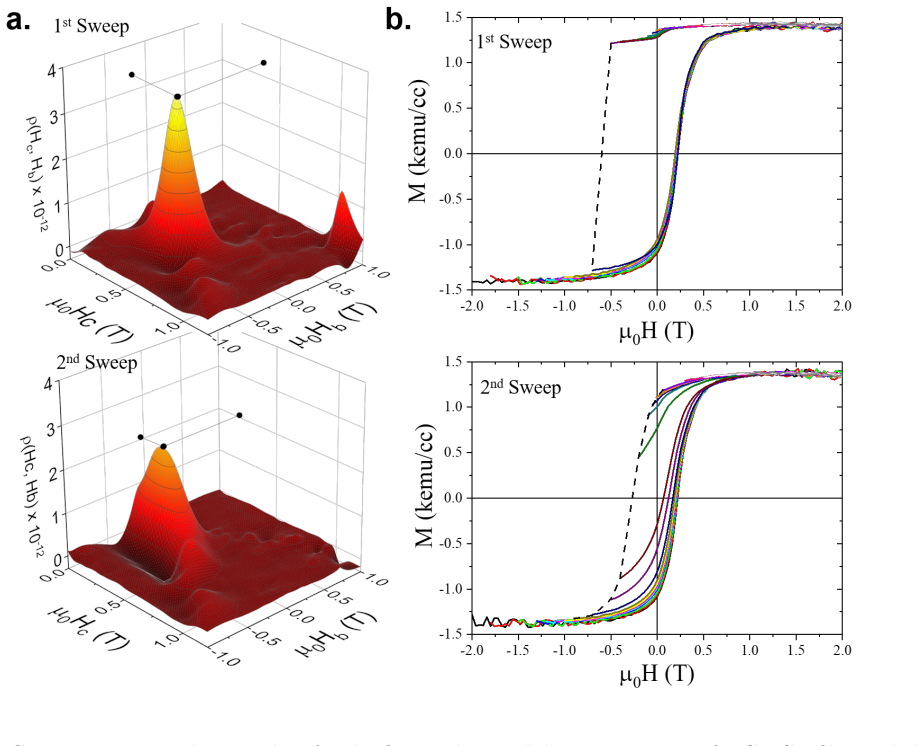
The central claim is that a spin-dependent electric dipole forms at the Co/C60 interface because C60 adsorbs with hexagon–pentagon (HP) symmetry, so the sum of the spin-dependent p–d hybrid polarizations does not cancel. Rotating the in-plane magnetization changes the out-of-plane dipole, and the interaction of that dipole with the work-function-induced interfacial potential adds a spin-dependent electrostatic term to the surface anisotropy, estimated at 10–100 meV. This barrier pins the surface spins, producing coercivity as high as 1.5 T and a loop asymmetry that mimics exchange bias. When the magneto-electric torque rotates the cage to the symmetric hexagon–hexagon (HH) configuration during the first demagnetization, the pinning disappears and the loop narrows to about 0.3 T. The paper argues that this one-shot training behavior is not conventional exchange bias, and supports the model with micromagnetic simulations, FORC analysis, transport measurements, and control experiments with C70 and with the C60 removed.
Load-bearing premise
The argument depends on C60 molecules actually rotating from the asymmetric HP configuration to the symmetric HH configuration during the first demagnetization, with that rotation removing the pinning; no measurement in the paper tracks the molecular orientation during the loop.
Editorial extensions
If this is right
- If correct, a single molecular layer can act as a strong magnetic pinning layer, potentially replacing rare-earth-based exchange-bias layers and hard magnets in thin-film devices.
- The predicted interfacial energy density of about 32 mJ/m2, roughly 15 times that of Co/IrMn, implies that molecular interfaces could produce exceptionally strong domain-wall pinning without antiferromagnetic order.
- Because the critical temperature is limited by molecular rotation rather than by magnetic ordering, chemically locking or functionalizing the molecules, or choosing lower-symmetry cages, could raise the operating temperature toward room temperature.
- The demonstration that loop asymmetry and one-shot training can occur without unidirectional anisotropy means that such loop features are not, by themselves, evidence of exchange bias.
- Tuning the metal surface structure, as shown by the Ta seed-layer thickness window, can enhance the pi-anisotropy effect, suggesting that interface engineering can maximize coercivity and energy product.
Reading between the lines
- The model implies that any metal–molecule interface with an asymmetric adsorption site and strong p–d hybridization should exhibit a magneto-electric torque; this could be tested by scanning tunneling microscopy under an in-plane magnetic field, where the HP-to-HH rotation should appear as an orientation change during the first hysteresis sweep.
- Because the magnitude of the magneto-electric coupling $A_{ij}$ is borrowed from cobalt-ferrite, the quantitative estimate of the 10–100 meV barrier is uncertain; measuring the dipole change directly, for example by surface Kelvin-probe microscopy or torque magnetometry on a single adsorbed molecule, would sharpen the prediction.
- The design rule suggested by the paper—use molecules with a rigid asymmetric adsorption configuration and a high rotational barrier—could be explored by computational screening of fullerene derivatives and other pi-conjugated molecules on Co and Fe surfaces, searching for room-temperature stability.
- If the effect scales with the number of pinned interfaces, multilayer stacks of Co/C60 might multiply the energy product beyond the single-interface value; this is an untested extrapolation the paper does not make.
Signed reviews
Editorial analysis
A structured set of objections, weighed in public.
Referee Report
Summary. The manuscript reports that a 3 nm Co film capped with C60 exhibits coercivity up to 1.5 T and a loop asymmetry after field cooling, with the effect disappearing after a single demagnetization sweep. The authors attribute this to a new mechanism, 'pi-anisotropy,' arising from a spin-dependent electric dipole generated by asymmetric pi-d hybridization at the Co/C60 interface. They support this with SQUID magnetometry, FORC, AMR, control experiments (C70, solvent/UV removal of C60, Ta seed thickness), DFT calculations of adsorption and rotational barriers, and micromagnetic simulations. The key claim is that the dipole imposes an electrostatic barrier of 10-100 meV that pins surface magnetization, and that the C60 rotates from a high-symmetry HP to a symmetric HH configuration during the first sweep, removing the pinning and explaining the training-like behavior without unidirectional anisotropy.
Significance. If the mechanism is correct, this is a conceptually new form of interfacial magnetic anisotropy that could inform rare-earth-free permanent magnet design. The paper is strong on experimental phenomenology: the C60-specificity (not C70), the removal control, the Ta seed window, and the FORC/AMR evidence for a change in reversal mechanism after one sweep are convincing and well executed. The central theoretical mechanism, however, is not yet quantitatively anchored for Co/C60 because the magneto-electric coupling constant is unknown and the key estimate is imported from a different material. The manuscript is honest about this limitation, but as it stands the numerical claim (10-100 meV barrier) is an estimate, not a determination.
major comments (3)
- [Section III, Eq. (5)] The central quantitative anchor for pi-anisotropy is missing. Eq. (5) defines the spin-dependent polarization through a magneto-electric coupling Aij, and the text states that Aij for Co/C60 is 'currently unknown.' The value that carries the argument—a spin-dependent dipole density change of ~1e-6 e/Å for a 90° spin rotation—is taken from cobalt ferrite (Ref. 23), not from a Co/C60 calculation or measurement. Since the same Aij governs both the proposed 10-100 meV barrier and the magneto-electric torque invoked to rotate C60, the one-shot training model inherits the same uncalibrated constant. The static adsorption dipole from DFT (3.79e-3 e/Å) is not the spin-dependent quantity that enters Eq. (5). The authors should provide a Co/C60-specific first-principles estimate of the spin-dependent dipole (or a direct experimental measure of the magneto-electric coupling) before the mechanism can be regarded as quantitatively established.
- [Section III and Appendix A (Fig. 3b)] The micromagnetic simulation is a fit, not a prediction. The interface anisotropy K = 27 MJ/m3 is chosen to match the measured coercivity, and K = 1 MJ/m3 for the second sweep is chosen to reproduce the reduced coercivity; the Methods state 'Values were chosen to match the simulated coercivity to experimental data.' Consequently, the simulated loop in Fig. 3b cannot validate the magnitude of the proposed interface anisotropy. It does illustrate that the proposed reversal mechanism (vertical domain wall for the first sweep, in-plane domains for the second) is consistent with the experimental loops, but the text's claim that the simulation 'replicates' the experiment overstates what a parameter-matched calculation can establish.
- [Section III (C60 rotation mechanism)] The explanation of the single-cycle loss of pinning relies on an inferred rotation of C60 from the HP to the HH configuration induced by the magneto-electric torque during the first demagnetization. No experimental measurement tracks the molecular orientation through the hysteresis cycle. The supporting evidence—the coincidence of the pinning transition temperature with bulk C60 rotational freezing and DFT barriers of 0.25 eV/40 meV—is circumstantial, and the 0.25 eV transition-state barrier actually shows that thermal rotation at low temperature is inactive unless the torque overcomes it. As a result, the manuscript does not exclude alternative interfacial changes (e.g., rehybridization, local oxidation, or Ta/Co intermixing) as the cause of the one-shot depinning. A direct in-situ probe of molecular orientation, or a falsifiable prediction of how the effect depends on molecular flexibility, is needed to support this load-bearing step.
minor comments (5)
- [Section II] The word 'tempature' appears in the text and should be 'temperature.'
- [Fig. 1 caption] The caption reads 'two indentical' and should read 'two identical.'
- [Section III] There are typos 'signficicantly' and 'adsoprtion'; these should be 'significantly' and 'adsorption.'
- [Section IV] The exchange-spring interpretation is cited to Ref. 27 (Pike and Fernandez), which is a FORC methodology paper; a dedicated exchange-spring reference would be more appropriate.
- [Fig. 2a] The FORC density plots would be easier to interpret with explicit axis labels and a color scale bar, and the definition of the hysteron density normalization should be stated.
Circularity Check
The micromagnetic 'replication' is a fit, not a prediction; the 10.8 meV pinning energy is a JA fit parameter compared with an uncalibrated barrier range. The central pi-anisotropy mechanism retains independent DFT and control-sample support.
-
fitted input called prediction
[Section III (micromagnetic simulation) and Appendix A (Methods)]
"The antiferromagnetic interface anisotropy barrier is 27 MJ/m3. Values were chosen to match the simulated coercivity to experimental data. These simulations show coercivity of 1.5 T ... The full simulated loop replicates that observed experimentally despite the simulation having no unidirectional anisotropy."
The surface-pinning anisotropy K = 27 MJ/m3 in the simulation is a free parameter adjusted so that the computed first-sweep coercivity equals the measured 1.5 T. The statement that the loop is 'replicated' is therefore a restatement of the fitting condition, not an independent prediction of pi-anisotropy. The second sweep is produced by manually lowering K to 1 MJ/m3 to encode the assumed C60 rotation/depinning, so the reduced coercivity and loss of vertical domain walls are also imposed inputs. The simulation can illustrate the model but cannot confirm it.
-
fitted input called prediction
[Section III, paragraph following Eq. (5)]
"The observed surface exchange energy density at 3 K is 10.8 meV and the thermal energy corresponding to the centre of the transition in figure 1b is 12.8 meV. ... The magnitude of the spin-dependent dipole is dependent on the magneto-electric coupling, Aij, of Co/C60, which is currently unknown. However, using example values for cobalt-ferrite gives a change in the spin dependent dipole density of approximately 1×10⁻⁶ e/Å ... This change in interfacial dipole density means that there is an electrostatic barrier of 10 - 100 meV preventing the surface magnetisation from rotating in-plane."
The 10.8 meV 'observed surface exchange energy density' is the low-temperature pinning factor k(0) obtained by fitting the coercivity-temperature data with the Jiles-Atherton model (Eq. 1); it is a fit parameter, not an independent thermodynamic measurement. The 10-100 meV barrier is not computed for Co/C60 because Aij is stated to be unknown; the range is borrowed from cobalt-ferrite values and is wide enough that any k(0) in that decade would 'agree.' Comparing a fitted pinning factor with an uncalibrated, material-transferred estimate is consistency tuning, so this step does not independently confirm the pi-anisotropy barrier.
full rationale
The paper contains a genuinely new physical idea: asymmetric pi-d hybridization at the Co/C60 interface creates a spin-dependent electric dipole that adds a spin-dependent electrostatic term to the surface anisotropy, and the symmetry difference between HP and HH adsorption configurations naturally explains the one-shot loss of pinning. Much of the evidence is non-circular: the DFT adsorption geometry and 0.25 eV rotation barrier are first-principles results; the C70 control, the solvent/UV removal control, and the Ta seed-layer thickness window are external falsification tests; and the absence of a unidirectional anisotropy in the FORC/transport data is an independent experimental observation. The circularity is partial and localized. First, the micromagnetic simulation sets the interface anisotropy K to match the measured coercivity and then presents the match as a replication of the experiment; this is a fitted input, not a prediction. Second, the 10.8 meV 'observed' surface exchange energy density is a JA-model fit parameter that is checked against a 10-100 meV barrier range derived from an unknown Aij and cobalt-ferrite example values, so the agreement is not a Co/C60-specific first-principles confirmation. These two steps inflate the apparent support for the model, but they do not by themselves make the central mechanism definitionally equivalent to the data; the model has independent content. Hence a score of 6 rather than 0-2 or 8-10.
Assumptions & free parameters
free parameters (3)
- Aij (magneto-electric coupling strength) =
Not measured; cobalt-ferrite example value used
- Micromagnetic interface anisotropy K =
27 MJ/m^3 for first sweep; 1 MJ/m^3 for second sweep
- Jiles-Atherton pinning parameters =
Tc high ~739 K, Tc low ~351 K, k(0) values not stated
assumptions (5)
- domain assumption Spin-dependent polarization formula (Eq. 5) is valid at metal-molecule interfaces with a scalar magneto-electric coupling Aij.
- domain assumption DFT (PAW/VASP) correctly describes C60 adsorption geometry and rotation barriers on Co(111).
- domain assumption The rotational freezing of C60 at about 90 K in bulk fullerene films applies to C60 molecules at the Co interface.
- domain assumption Interfacial charge transfer and pi-d hybrid interface states exist at Co/C60 as described in prior work.
- ad hoc to paper The loop asymmetry is a superposition of high- and low-coercivity loops rather than conventional exchange bias.
invented entities (1)
-
pi-anisotropy (spin-dependent electric dipole surface anisotropy)
Cite this review
Pith. "Pith review of A nano-carbon route to rare earth free permanent magnetism." pith.science (2026). https://pith.science/paper/CFG6BR4A
@misc{pith2026190802544,
  author       = {Pith},
  title        = {Pith review of: A nano-carbon route to rare earth free permanent magnetism},
  year         = {2026},
  howpublished = {\url{https://pith.science/paper/CFG6BR4A}},
  note         = {Machine review of arXiv:1908.02544}
}
read the original abstract
High coercivity magnets are an important resource for renewable energy, electric vehicles and memory technologies. Most hard magnetic materials incorporate rare-earths such as neodymium and samarium, but the concerns about the environmental impact and supply stability of these materials is prompting research into alternatives. Here, we present a hybrid bilayer of cobalt and the nano-carbon molecule C60 which exhibits significantly enhanced coercivity with minimal reduction in magnetisation. We demonstrate how this anisotropy enhancing effect cannot be described by existing models of molecule-metal magnetic interfaces. We outline a new form of magnetic anisotropy, arising from asymmetric magneto-electric coupling in the metal-molecule interface. Because this phenomenon arises from pi-d hybrid orbitals, we propose calling this effect pi-anisotropy. While the critical temperature of this effect is currently limited by the rotational degree of freedom of the chosen molecule, C60, we describe how surface functionalisation would allow for the design of room-temperature, carbon based hard magnetic films.
Figures

Figures from the paper (1 more)

Reference graph
Works this paper leans on
-
[1]
author author O. Cespedes , author M. S. \ Ferreira , author M. K. \ S Sanvito , \ and\ author J. M. D. \ Coey ,\ @noop journal journal Journal of Physics Condensed Matter \ volume 16 ( year 2004 ) NoStop
work page 2004
-
[2]
Sanvito ,\ @noop journal journal Nature Physics \ volume 6 ( year 2010 ) NoStop
author author S. Sanvito ,\ @noop journal journal Nature Physics \ volume 6 ( year 2010 ) NoStop
work page 2010
-
[3]
author author T. Moorsom , author M. Wheeler , author T. M. \ Khan , author F. A. \ Ma'Mari , author C. Kinane , author S. Langridge , author d Ciudad , author A. Bedoya-Pinto , author L. Hueso , author G. Teobaldi , author V. K. \ Lazarov , author D. Gilks , author G. Burnell , author B. J. \ Hickey , \ and\ author O. Cespedes ,\ @noop journal journal Ph...
work page 2014
-
[4]
author author K. Bairagi , author A. Bellec , author V. Repain , author C. Chacon , author Y. Girard , author Y. Garreau , author J. Lagoute , author S. Rousset , author P. Brietwieser , author Y.-C. \ Hu , author Y. C. \ Chao , author W. W. \ Pai , author A. Smogunov , \ and\ author C. Barreteau ,\ @noop journal journal Physical Review Letters \ volume 1...
work page 2015
-
[5]
author author F. A. \ Ma'Mari , author T. Moorsom , author G. Teobaldi , author W. Deacon , author T. Prokscha , author H. Luetkens , author S. Lee , author G. E. \ Sterbinsky , author D. A. \ Arena , author D. A. \ MacLaren , author M. Flokstra , author M. Ali , author M. C. \ Wheeler , author G. Burnell , author B. J. \ Hickey , \ and\ author O. Cespede...
work page 2015
-
[6]
author author F. Al Ma'Mari , author M. Rogers , author S. Alghamdi , author T. Moorsom , author S. Lee , author T. Prokscha , author H. Luetkens , author M. Valvidares , author G. Teobaldi , author M. Flokstra , author R. Stewart , author P. Gargiani , author M. Ali , author G. Burnell , author B. J. \ Hickey , \ and\ author O. Cespedes ,\ 10.1073/pnas.1...
-
[7]
author author L. Martín-Olivera , author D. G. \ Shchukin , \ and\ author G. Teobaldi ,\ 10.1021/acs.jpcc.7b08476 journal journal The Journal of Physical Chemistry C \ volume 121 ,\ pages 23777 ( year 2017 ) ,\ http://arxiv.org/abs/https://doi.org/10.1021/acs.jpcc.7b08476 https://doi.org/10.1021/acs.jpcc.7b08476 NoStop
-
[8]
author author X. Lu , author M. Grobis , author K. H. \ Khoo , author S. G. \ Louie , \ and\ author M. F. \ Crommie ,\ 10.1103/PhysRevB.70.115418 journal journal Phys. Rev. B \ volume 70 ,\ pages 115418 ( year 2004 ) NoStop
Show all 31 references
-
[9]
author author J. D. \ Sau , author J. B. \ Neaton , author H. J. \ Choi , author S. G. \ Louie , \ and\ author M. L. \ Cohen ,\ 10.1103/PhysRevLett.101.026804 journal journal Phys. Rev. Lett. \ volume 101 ,\ pages 026804 ( year 2008 ) NoStop
-
[10]
Barraud , author P
author author C. Barraud , author P. Seneor , author R. Mattana , author S. Fusil , author K. Bouzehouane , author C. Deranlot , author P. Graziosi , author L. Hueso , author I. Bergenti , author V. dediu , author F. Petroff , \ and\ author A. Fert ,\ @noop journal journal Nat...
2010
-
[11]
author author K. V. \ Raman , author A. M. \ Kamerbeek , author A. Mukherjee , author N. Atodiresei , author T. K. \ Sen , author P. Lazić , author V. Caciuc , author R. Michel , author D. Stalke , author S. K. \ Mandal , author S. Blügel , author M. Münzenberg , \ and\ author...
2013
-
[12]
Djeghloul , author M
author author F. Djeghloul , author M. Gruber , author E. Urbain , author D. Xenioti , author L. Joly , author S. Boukari , author J. Arabski , author H. Bulou , author F. Scheurer , author F. Bertran , author P. Le Fèvre , author A. Taleb-Ibrahimi , author W. Wulfhekel , auth...
-
[13]
Raghunathan , author Y
author author A. Raghunathan , author Y. Melikhov , author J. E. \ Snyder , \ and\ author D. C. \ Jiles ,\ 10.1109/TMAG.2009.2022744 journal journal IEEE Transactions on Magnetics \ volume 45 ,\ pages 3954 ( year 2009 ) NoStop
2009
-
[14]
author author W. H. \ Meiklejohn \ and\ author C. P. \ Bean ,\ 10.1103/PhysRev.105.904 journal journal Phys. Rev. \ volume 105 ,\ pages 904 ( year 1957 ) NoStop
1957 doi
-
[15]
Ali , author C
author author M. Ali , author C. H. \ Marrows , \ and\ author B. J. \ Hickey ,\ 10.1103/PhysRevB.67.172405 journal journal Phys. Rev. B \ volume 67 ,\ pages 172405 ( year 2003 ) NoStop
2003 doi
-
[16]
Binek ,\ @noop journal journal Physical review B \ volume 70 ,\ pages 014421 ( year 2004 ) NoStop
author author C. Binek ,\ @noop journal journal Physical review B \ volume 70 ,\ pages 014421 ( year 2004 ) NoStop
2004
-
[17]
author author J. E. \ Davies , author O. Hellwig , author E. E. \ Fullerton , author J. S. \ Jiang , author S. D. \ Bader , author G. T. \ Zimanyi , \ and\ author K. Liu ,\ @noop journal journal Applied Physics Letter \ volume 86 ( year 2005 ) NoStop
2005
-
[18]
author author W. I. F. \ David , author R. M. \ Ibberson , author T. J. S. \ Dennis , author J. P. \ Hare , \ and\ author K. Prassides ,\ 10.1209/0295-5075/18/8/012 journal journal Europhysics Letters ( EPL ) \ volume 18 ,\ pages 735 ( year 1992 ) NoStop
-
[19]
Brems , author K
author author S. Brems , author K. Temst , \ and\ author C. Van Haesendonck ,\ 10.1103/PhysRevLett.99.067201 journal journal Phys. Rev. Lett. \ volume 99 ,\ pages 067201 ( year 2007 ) NoStop
2007 doi
-
[20]
Li , author C
author author D. Li , author C. Barreteau , author S. L. \ Kawahara , author J. Lagoute , author C. Chacon , \ and\ author Y. Gi ,\ @noop journal journal Physical review B \ volume 93 ,\ pages 085425 ( year 2016 ) NoStop
2016
-
[21]
Murakawa , author Y
author author H. Murakawa , author Y. Onose , author S. Miyahara , author N. Furukawa , \ and\ author Y. Tokura ,\ 10.1103/PhysRevLett.105.137202 journal journal Phys. Rev. Lett. \ volume 105 ,\ pages 137202 ( year 2010 ) NoStop
2010 doi
-
[22]
author author J. S. \ Lim , author D. Saldana-Greco , \ and\ author A. M. \ Rappe ,\ 10.1103/PhysRevB.97.045115 journal journal Phys. Rev. B \ volume 97 ,\ pages 045115 ( year 2018 ) NoStop
2018 doi
-
[23]
Etier , author C
author author M. Etier , author C. Schmitz-Antoniak , author S. Salamon , author H. Trivedi , author Y. Gao , author A. Nazrabi , author J. Landers , author D. Gautam , author M. Winterer , author D. Schmitz , author H. Wende , author V. V. \ Shvartsman , \ and\ author D. C. \...
2015
-
[24]
\ Chu , author C.-H
author author Y.-H. \ Chu , author C.-H. \ Hsu , author C.-I. \ Lu , author H.-H. \ Yang , author T.-H. \ yang , author C.-H. \ Luo , author K.-J. \ Yang , author S.-H. \ Hsu , author G. Hoffmann , author C.-C. \ Kaun , \ and\ author M.-T. \ Lin ,\ @noop journal journal ACS Na...
2015
-
[25]
Szunyogh , author B
author author L. Szunyogh , author B. Lazarovits , author L. Udvardi , author J. Jackson , \ and\ author U. Nowak ,\ 10.1103/PhysRevB.79.020403 journal journal Phys. Rev. B \ volume 79 ,\ pages 020403 ( year 2009 ) NoStop
2009 doi
-
[26]
Gruber , author F
author author M. Gruber , author F. Ibrahim , author S. Boukari , author H. Isshiki , author L. Joly , author M. Peter , author M. Studniarek , author V. da Costa , author H. Jabbar , author V. Davesne , author U. Halisdemir , author J. Chen , author J. Arabski , author E. Ote...
2015
-
[27]
Pike \ and\ author A
author author C. Pike \ and\ author A. Fernandez ,\ 10.1063/1.370177 journal journal Journal of Applied Physics \ volume 85 ,\ pages 6668 ( year 1999 ) ,\ http://arxiv.org/abs/https://doi.org/10.1063/1.370177 https://doi.org/10.1063/1.370177 NoStop
1999 doi
-
[28]
Tatara \ and\ author H
author author G. Tatara \ and\ author H. Fukuyama ,\ @noop journal journal Physical Review Letters \ volume 78 ,\ pages 19 ( year 1997 ) NoStop
1997
-
[29]
Jo , author J
author author J. Jo , author J. Byun , author I. Oh , author J. Park , author M.-J. \ Jin , author B.-C. \ Min , author J. Lee , \ and\ author J.-W. \ Yoo ,\ 10.1021/acsnano.8b08689 journal journal ACS Nano \ volume 13 ,\ pages 894 ( year 2019 ) ,\ http://arxiv.org/abs/https:/...
-
[30]
\ Bisotti , author M
author author M.-A. \ Bisotti , author M. Beg , author W. Wang , author M. Albert , author D. Chernyshenko , author D. Cortés-Ortuño , author R. A. \ Pepper , author M. Vousden , author R. Carey , author H. Fuchs , author A. Johansen , author G. Balaban , author L. Breth , aut...
-
[31]
Kresse \ and\ author J
author author G. Kresse \ and\ author J. Furthmuller ,\ @noop journal journal Physical Review B \ volume 54 ,\ pages 11169 ( year 1996 ) NoStop
1996
Reviewed August 14, 2026 · model on record in the stance chip above.
Discussion (0). Continue with ORCID to comment.