REVIEW 3 major objections 4 minor 16 references
A Repairable System Supported by Two Spare Units and Serviced by Two Types of Repairers
T0 review · 3 major / 4 minor · reviewed 2026-08-14 · deepseek-v4-flash
Pith's one-line read For all four repair policies, the long-run availability and profit of a two-spare repairable system are derived exactly from a six-state semi-Markov process.
desk verdict The two-spare random-patience models are a solid but modest extension; the deterministic-patience models have a load-bearing Markovianity flaw that sinks the paper's headline recommendation. read the letter →
The pith
A machine-rendered reading of the paper's core claim, the machinery that carries it, and where it could break.
The reading
What carries the argument
The central object is the six-state semi-Markov process, a process that moves between states by a Markov chain after random sojourn times, with states recording how many units are operating, on standby, under regular repair, under expert repair, or awaiting repair. The load-bearing identity is $\theta_k = \pi_k \mu_k / \sum_{j=1}^6 \pi_j \mu_j$, which converts the embedded chain's stationary probabilities and mean sojourn times into long-run occupancy proportions; the paper then computes availability as $A_\infty = 1 - \theta_6$ and profit per unit time as $\omega = A_\infty(R_p-C_p) - [\Theta_r C_r + \Theta_e C_e + C_l/\tau]$, with $\tau$ obtained from recursive expected-cycle equations.
What would settle it
Compare the paper's $P_{45}$ with the value obtained by conditioning on the actual event that the system enters State 4, namely $X < \min(Y,T)$, rather than only on $X < T$; a discrepancy in the transition probability, or a mismatch between simulated $\theta_6$ and equations (4.20) or (4.23), would show that the deterministic-patience models are approximations.
Extended reading notes
Core claim
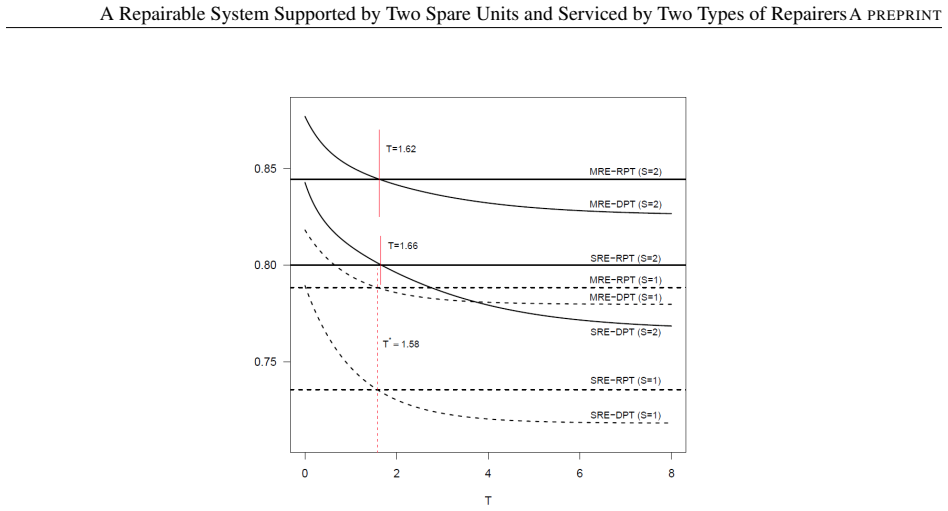
Under exponential life and repair times (lifetime rate $\lambda$, regular repair rate $\beta$, expert repair rate $\gamma$, patience rate $\alpha$), the system is modeled as a semi-Markov process whose embedded chain has six states recording how many units are operating, on standby, under regular repair, under expert repair, or awaiting repair. The paper derives the transition matrix $P$, the stationary distribution $\pi$ of the embedded chain, and the mean sojourn times $\mu_k$ for each of the four models, and applies $\theta_k = \pi_k \mu_k / \sum_j \pi_j \mu_j$. This yields $A_\infty = 1 - \theta_6$ and the profit rate $\omega = A_\infty(R_p-C_p) - (\Theta_r C_r + \Theta_e C_e + C_l/\tau)$, where $\tau$ is the expected cycle time obtained by solving recursive relations and $C_l/\tau$ follows from Wald's identity. The paper concludes that multiple-repair-by-expert dominates single-repair-by-expert in availability, that adding a second spare raises both availability and profit, and that for any cost parameters there is a threshold expert rate separating when MRE or SRE is more profitable, along with an optimal patience time under the deterministic-patience policy.
Load-bearing premise
The exact formulas for the deterministic-patience models assume the six-state embedded chain remains Markovian after part of the patience time has already elapsed; if the remaining patience depends on that elapsed time in a way the state does not record, Models 3 and 4 are approximations rather than exact.
Editorial extensions
If this is right
- The paper concludes that MRE yields higher limiting availability than SRE for both random and deterministic patience times, so if uptime is the priority and the expert can be afforded, the expert should repair all failed units during a visit.
- A system with two cold-standby spares has higher limiting availability and limiting profit than the same system with one spare across all four policies, which quantifies the value of the extra spare when availability falls below an acceptable threshold.
- For any parameter choice there is a patience-time interval where the deterministic-patience policy dominates the random-patience policy in profit, and within the deterministic policy there is an optimal patience time $T$ maximizing $\omega$, so an engineer who prefers the logistically simpler deterministic rule can use that interval.
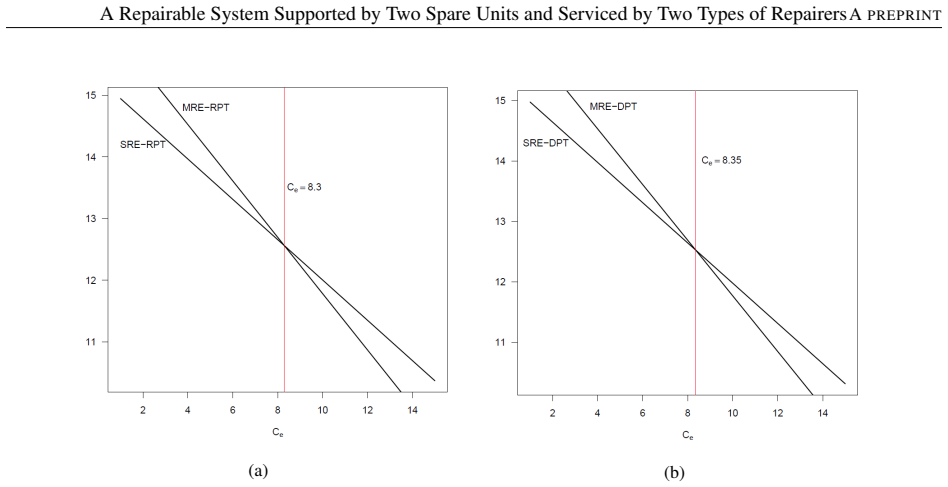
- There is a threshold on the expert's cost rate: below it MRE is more profitable than SRE, above it SRE is more profitable, and knowing this threshold decides how many failed units the expert should repair per visit.
Reading between the lines
- A natural extension not pursued in the paper is to re-derive the deterministic-patience models with an augmented state recording the remaining patience time; comparing those formulas with the paper's closed forms would show how much accuracy the six-state approximation sacrifices.
- The same semi-Markov setup should extend to three or more spares by adding states for queues of failed units, with availability approaching one but profit eventually bounded by repair and trip costs.
- A concrete numerical check would simulate the four models at the paper's example parameters to confirm that MRE-DPT maximizes both $A_\infty$ and $\omega$ in the patience interval $[1.45, 1.62]$ and that $\omega$ peaks near $T=2.19$; this would also expose any bias introduced by the deterministic-patience Markov assumption.
Signed reviews
Editorial analysis
A structured set of objections, weighed in public.
Referee Report
Summary. The manuscript extends the one-spare-unit system of Bieth, Hong, and Sarkar [2] to a one-unit system supported by two cold-standby spares, serviced by a regular in-house repairer and a visiting expert repairer. Four policies are considered, formed by crossing single versus multiple repair by the expert (SRE versus MRE) with random versus deterministic patience time (RPT versus DPT). The authors model the system as a six-state semi-Markov process (SMP), derive the stationary state proportions in closed form, and use them to compute the limiting availability A_inf and limiting profit per unit time omega for each model. The main advertised conclusions are that MRE dominates SRE in availability, that for suitable deterministic patience time the DPT policy dominates the RPT policy in profit, and that for the numerical example the MRE-DPT model is optimal for patience times in [1.45,1.62].
Significance. If the derivations were correct, the paper would provide a useful extension of [2] and a concrete maintenance-engineering decision rule. The RPT models (Sections 4.1 and 4.2) are standard SMP calculations and appear internally coherent; the extension from one to two spare units is natural, and the explicit algebraic formulas are a strength. However, the DPT models (Sections 4.3 and 4.4) are not valid SMPs: the residual patience time is not Markovian in the six-state chain, and the transition probabilities out of State 4 are derived using an incorrect conditioning. Since the central profit comparison, including the claimed optimal DPT range, depends on these models, the main new conclusions are unsupported. The paper also makes useful numerically illustrated comparisons, but no code is provided.
major comments (3)
- [Section 4, Theorem 4.1 and Sections 4.3-4.4] The justification that the process is an SMP applies only to the RPT models. Under a deterministic patience time T, the remaining patience when the system enters State 4 is T' = T - X, where X is the already-realized lifetime in State 2; this quantity is not exponentially distributed and is not part of the six-state description. Consequently the transition probabilities out of State 4 depend on the history X, the embedded six-state chain is not a Markov chain, and Theorem 4.1 cannot be applied to Models 3 and 4. The paper itself notes in Section 6(ii) that the Markovian property fails under the DPT policy in a related setting. Because the formulas (4.18)-(4.23) and the Section 5 conclusions, including the optimal range [1.45,1.62], rest on this application, the DPT-based central claims are not supported.
- [Section 4.3, Eq. (4.18), derivation of P45] The derivation of P45 conditions on the wrong event and uses the wrong density. State 4 is entered from State 2 when X < min(Y,T), not merely when X < T, and the conditional density of X given this entry event is (lambda+beta)e^{-(lambda+beta)x}/(1-e^{-(lambda+beta)T}) for x in [0,T], not the unconditional density lambda e^{-lambda x}. The displayed integral has no conditioning denominator and therefore yields the incorrect value lambda e^{-lambda T}(1-e^{-beta T})/beta. Conditioning correctly gives P45 = (lambda+beta)T e^{-(lambda+beta)T}/(1-e^{-(lambda+beta)T}). Since P42 and P46 are then defined from this P45, the transition probabilities and the stationary distribution (4.19) are incorrect.
- [Section 4.4, Eq. (4.21), SRE-DPT model] In the SRE model the transition matrix sends State 6 to State 4, so State 4 is reached not only from State 2 (with residual patience T-X) but also after an expert visit. The paper simply reuses the MRE-DPT values of P42, P45, and P46 in equation (4.21). These two entry paths have different patience-time clocks unless the model explicitly specifies that patience restarts and unless the state label encodes the entry type. Without such an augmentation, the transition probabilities out of State 4 are path-dependent, and the stationary distribution (4.22) together with the SRE-DPT values of A_inf and omega are unsupported.
minor comments (4)
- [Title page / affiliation] The affiliation line contains a typo: "Indiana Universiry-Purdue University Indianapolis" should read "Indiana University-Purdue University Indianapolis."
- [Section 3, Eq. (3.2)] The statement that Wald's First Identity gives the expected number of expert visits per unit time as the reciprocal of the cycle length is imprecise; the renewal reward theorem is the standard result for the long-run rate of renewals, and citing it would be more accurate.
- [Section 5, item after Figure 4] There is a typo: "th opposite" should be "the opposite."
- [Sections 5, Figures 2 and 3] The numerical comparisons are presented for a single parameter set without supporting code or tabulated values; since the paper's main claim is a comparison across policies, it would be helpful to state explicitly whether the figures are generated from the displayed closed forms or by simulation, and ideally to provide the data or code used.
Circularity Check
No significant circularity; the central two-spare SMP derivations are self-contained, with only a minor non-load-bearing self-citation.
full rationale
The paper's central claims — the limiting availability A_inf and limiting profit omega for the four two-spare models — are obtained algebraically from explicitly stated transition matrices, sojourn-time expectations, and the standard SMP formula in Theorem 4.1. No fitted parameter is later renamed as a prediction, and no target quantity is used as an input to its own derivation. The only self-citation is reference [2], by Bieth, Hong, and Sarkar (Sarkar is a co-author of this paper), which is used as a one-spare-unit baseline and for the one-spare crossover time T*; it is not load-bearing for the new two-spare formulas. The paper is self-contained in deriving the two-spare results, and its comparisons with the one-spare system are external benchmarks rather than circular inputs. A genuine concern exists that the DPT models are not semi-Markov because the remaining patience time T' = T - X after entering State 4 depends on the history, and the paper itself notes in Section 6(ii) that 'the Markovian property fails under the DPT policy' in a related setting; however, that is a mathematical validity issue, not a circularity pattern under the specified definitions. Accordingly, the circularity score is low.
Assumptions & free parameters
assumptions (4)
- domain assumption Life times, repair times, and patience times are exponentially distributed and mutually independent.
- standard math The embedded six-state discrete-time chain is irreducible with finite mean and non-lattice recurrence times, so the SMP limiting-probability theorem applies.
- ad hoc to paper For deterministic patience, the process remains an SMP with the same six-state chain even though the residual patience T-X is not part of the state.
- standard math Each cycle contains exactly one expert visit, so Wald's identity gives the trip charge per unit time as Cl divided by the expected cycle length.
Cite this review
Pith. "Pith review of A Repairable System Supported by Two Spare Units and Serviced by Two Types of Repairers." pith.science (2026). https://pith.science/paper/G2M44ZEM
@misc{pith2026190802547,
  author       = {Pith},
  title        = {Pith review of: A Repairable System Supported by Two Spare Units and Serviced by Two Types of Repairers},
  year         = {2026},
  howpublished = {\url{https://pith.science/paper/G2M44ZEM}},
  note         = {Machine review of arXiv:1908.02547}
}
abstract
We study a one-unit repairable system, supported by two identical spare units on cold standby, and serviced by two types of repairers. The model applies, for instance, to ANSI (American National Standard Institute) centrifugal pumps in a chemical plant. The failed unit undergoes repair either by an in-house repairer within a random or deterministic patience time, or else by a visiting expert repairer. The expert repairs one or all failed units before leaving, and does so faster but at a higher cost rate than the regular repairer. Four models arise depending on the number of repairs done by the expert and the nature of the patience time. We compare these models based on the limiting availability $A_{\infty}$, and the limiting profit per unit time $\omega$, using semi-Markov processes, when all distributions are exponential. As anticipated, to maximize $A_{\infty}$, the expert should repair all failed units. To maximize $\omega$, a suitably chosen deterministic patience time is better than a random patience time. Furthermore, given all cost parameters, we determine the optimum number of repairs the expert should complete, and the optimum patience time given to the regular repairer in order to maximize $\omega$.
Figures


Figures from the paper (1 more)
Reference graph
Works this paper leans on
-
[2]
A standby system with two types of repair persons
Bruno Bieth, Liang Hong, and Jyotirmoy Sarkar. A standby system with two types of repair persons. Applied Stochastic Models in Business and Industry, 26(5):577–594, 2010. https://doi.org/10.1002/asmb.801
-
[1]
An introduction to probability theory and its applications, volume 1
William Feller. An introduction to probability theory and its applications, volume 1. Wiley, New York, 1968
work page 1968
-
[3]
Limiting average availability of a system supported by several spares and several repair facilities
Jyotirmoy Sarkar and Fang Li. Limiting average availability of a system supported by several spares and several repair facilities. Statistics & probability letters, 76(18):1965–1974, 2006. https://doi.org/10.1016/j.spl. 2006.04.046. 12 A Repairable System Supported by Two Spare Units and Serviced by Two Types of RepairersA PREPRINT
doi:10.1016/j.spl 1965
-
[4]
Availability of a one-unit system supported by several spares and repair facilities
Jyotirmoy Sarkar and Atanu Biswas. Availability of a one-unit system supported by several spares and repair facilities. Journal of the Korean Statistical Society, 39(2):165–176, 2010. https://doi.org/10.1016/j.jkss. 2009.05.001
doi:10.1016/j.jkss 2010
-
[5]
Kuo-Hsiung Wang, Jyh-Bin Ke, and Wen-Chiung Lee. Reliability and sensitivity analysis of a repairable system with warm standbys and r unreliable service stations. The International Journal of Advanced Manufacturing Technology, 31(11-12):1223–1232, 2007. https://doi.org/10.1007/s00170-005-0298-0
-
[6]
Yuan Lin Zhang and Guan Jun Wang. A deteriorating cold standby repairable system with priority in use.European Journal of Operational Research, 183(1):278–295, 2007. https://doi.org/10.1016/j.ejor.2006.09.075
-
[7]
Optimal design of a maintainable cold-standby system
Haiyang Yu, Farouk Yalaoui, ˙Eric Châtelet, and Chengbin Chu. Optimal design of a maintainable cold-standby system. Reliability Engineering & System Safety, 92(1):85–91, 2007. https://doi.org/10.1016/j.ress. 2005.11.001
doi:10.1016/j.ress 2007
-
[8]
Stochastic analysis of a two-unit cold standby system with two-stage repair and waiting time
Khaled M El-Said and Mohamed S El-Sherbeny. Stochastic analysis of a two-unit cold standby system with two-stage repair and waiting time. Sankhya B , 72(1):1–10, 2010. https://doi.org/10.1007/ s13571-010-0001-9
work page 2010
Show all 16 references
-
[9]
New interval availability indexes for markov repairable systems.Reliability Engineering & System Safety, 168:12–17, 2017
Lirong Cui, Jianhui Chen, and Bei Wu. New interval availability indexes for markov repairable systems.Reliability Engineering & System Safety, 168:12–17, 2017. https://doi.org/10.1016/j.ress.2017.03.016
2017 doi
-
[10]
Stochastic properties and reliability measures of discrete-time semi-markovian systems
He Yi, Lirong Cui, Jingyuan Shen, and Yan Li. Stochastic properties and reliability measures of discrete-time semi-markovian systems. Reliability Engineering & System Safety, 176:162–173, 2018. https://doi.org/10. 1016/j.ress.2018.04.014
2018
-
[11]
Stochastic modeling for systems with delayed failures
Ji Hwan Cha and Maxim Finkelstein. Stochastic modeling for systems with delayed failures. Reliability Engineering & System Safety, 2019. https://doi.org/10.1016/j.ress.2019.03.017
2019 doi
-
[12]
Comparative study of the profit of a two server system including patience time and instruction time
A Kumar, SK Gupta, and G Taneja. Comparative study of the profit of a two server system including patience time and instruction time. Microelectronics and reliability, 36:1595–1601, 1996. https://doi.org/10.1016/ 0026-2714(95)00075-5
1996
-
[13]
Stochastic behaviour of a two-unit standby system with two types of repairmen and patience time
V Sridharan and P Mohanavadivu. Stochastic behaviour of a two-unit standby system with two types of repairmen and patience time. Mathematical and computer modelling, 28(9):63–71, 1998. https://doi.org/10.1016/ S0895-7177(98)00145-9
1998
-
[14]
Probabilistic measures of redundant system with two types of repairmen, sensing device and analytical approach to find the optimium interchanging time
V Sridharan. Probabilistic measures of redundant system with two types of repairmen, sensing device and analytical approach to find the optimium interchanging time. International Journal of Quality & Reliability Management, 17(9):984–1002, 2000. https://doi.org/10.1108/02656710...
-
[15]
Reliability and profit evaluation of a plc hot standby system based on a master-slave concept and two types of repair facilities
Bhupender Parashar and Gulshan Taneja. Reliability and profit evaluation of a plc hot standby system based on a master-slave concept and two types of repair facilities. IEEE Transactions on reliability, 56(3):534–539, 2007. https://doi.org/10.1109/TR.2007.903151
2007
-
[16]
Stochastic Processes
Sheldon Ross. Stochastic Processes. Wiley, New York, 1966. 13
1966
Reviewed August 14, 2026 · model on record in the stance chip above.
Discussion (0). Continue with ORCID to comment.