REVIEW 1 major objections 4 minor 37 references
Security measurement of a medical communication scheme based on chaos and DNA coding
T0 review · 1 major / 4 minor · reviewed 2026-08-14 · deepseek-v4-flash
Pith's one-line read A chosen-plaintext attack recovers the full equivalent key of the MPPS medical image cipher using only ceil(log_256(3MN))+4 chosen plain-images.
desk verdict Competent chosen-plaintext break of a published DNA-chaos image cipher, but the attack's anchoring to the paper's simplified MPPS description is not proven. read the letter →
The pith
A machine-rendered reading of the paper's core claim, the machinery that carries it, and where it could break.
The reading
What carries the argument
The key object is the pair of composite maps F_{s,t}(x) = $f_t^{{-1}}$(f_s(x)) and G_{s,t}(x) = $f_t^{{-1}}$(g(f_s(x))), where f_s and f_t are DNA encoding and decoding rules from Table I and g is the DNA-complement 4-cycle. Over the four 2-bit values these maps have only 8 and 16 distinct forms respectively, and Property 2 says that for x0 xor x1 = 3, F_{s,t}(x0) xor F_{s,t}(x1) = 3 but G_{s,t}(x0) xor G_{s,t}(x1) is in {1,2}. This direct differential signature turns the hidden binary sequence S3, which chooses between F and G for each 2-bit position, into a quantity readable from ciphertext XOR differences, after Property 1 removes the effects of the keystreams S4 through S6.
What would settle it
Implement the original MPPS algorithm exactly as published in reference [33] and run the proposed chosen-plaintext attack on images larger than 2 by 2 pixels; if the recovered equivalent keys fail to decrypt a fresh test image, or if the number of chosen images needed grows faster than the claimed bound, the central claim is refuted. A quick check is to compare Eq. (10) of this paper with the original source code to see whether the DNA complement acts on the red channel alone.
Extended reading notes
Core claim
The central discovery is that the combined effect of DNA encoding, DNA complement, and DNA decoding can be represented as a small family of maps, eight maps F_{s,t} and sixteen maps G_{s,t}, on the four 2-bit values, and that these maps satisfy a differential signature: when two input nibbles differ by (11)_2, applying F preserves the difference (11)_2 while applying G turns it into (10)_2 or (01)_2. This signature lets the attacker read off the binary sequence S3 directly from XOR differences between selected cipher-images, without knowing the DNA rules or the keystreams. Once S3 is known, exhaustive search over the few DNA rule combinations and consistency checks across four chosen plain-images recover the DNA coding rules and the keystreams; the remaining permutation index is then recovered by standard permutation-only cipher cryptanalysis. The whole equivalent key is recovered with only ceil(log_256(3MN))+4 chosen plain-images.
Load-bearing premise
The attack is derived from the paper's condensed description of MPPS, in which the DNA complement step is applied only to the red channel; if the original implementation applies complement to all three color channels or uses a different complement map, the differential signature in Property 2 would not hold and the recovery of S3 would fail.
Editorial extensions
If this is right
- The designers' claim that MPPS resists chosen-plaintext attacks is disproven, and the scheme cannot be considered secure for protecting medical images.
- Any DNA-based image cipher with the same channel layout, complement applied only on the red channel and cross-channel diffusion, inherits the same break.
- The effective key space of MPPS is far smaller than claimed because many distinct secret keys map to identical encryption behavior, as shown by the candidate equivalent sub-key classes.
- The attack shows that DNA coding in this scheme contributes no meaningful security; it is equivalent to a handful of fixed S-boxes on 2-bit values, easily enumerated by an attacker.
Reading between the lines
- The same differential-signature technique could serve as a general litmus test for whether a DNA-coding layer in any chaos-based cipher actually changes the diffusion behavior; if the layer collapses to the F/G dichotomy on Z_4, the cipher is likely breakable in this way.
- The count ceil(log_256(3MN))+4 is dominated by the permutation-recovery stage, so schemes that omit the permutation step or use grayscale images would require even fewer chosen plain-images.
- The attack assumes the same key is reused across the chosen plain-images, a common situation in practice; if a hospital reuses a long-lived key, the attack becomes a realistic threat to intercepted DICOM transmissions.
Signed reviews
Editorial analysis
A structured set of objections, weighed in public.
Referee Report
Summary. The paper presents a chosen-plaintext attack on MPPS, a medical privacy protection scheme based on chaos and DNA coding proposed by Ravichandran et al. in IEEE Transactions on Nanobioscience (2017). The authors first give a concise description of the scheme (Sec. II), then prove several properties of DNA coding maps (Sec. III-A), and use them to devise a divide-and-conquer attack that recovers an equivalent key (S1, S2/DNA rules, S3, S4, S5, S6) using at most ceil(log_256(3MN))+4 chosen plain-images and corresponding cipher-images (Sec. III-B). The attack is illustrated on a 2x2 RGB image (Sec. III-C), and the paper further criticizes the original scheme's claimed security properties such as key space, statistical resistance, differential attack resistance, and cropping robustness (Sec. III-D). The central claim is that MPPS is insecure under chosen-plaintext attack despite the designers' claims to the contrary.
Significance. If the attack is valid for the actually published MPPS, this is a significant cryptanalytic result: it would refute the designers' security claim and provide a concrete, low-complexity attack on a published medical image encryption scheme. The attack's internal mathematics is largely self-contained and checkable: no fitted parameters appear, secret quantities are cancelled via ciphertext differences, DNA rule candidates are enumerated, and the data-complexity bound follows from counting. The worked 2x2 example supports the attack end-to-end for the described variant, and the paper gives explicit algorithms (e.g., Algorithm 1) and properties (Properties 1-5). The main weaknesses are the unverified fidelity of the Sec. II description to the original MPPS and the lack of a proof that the final cross-channel pruning yields a unique or functionally equivalent key for general image sizes.
major comments (1)
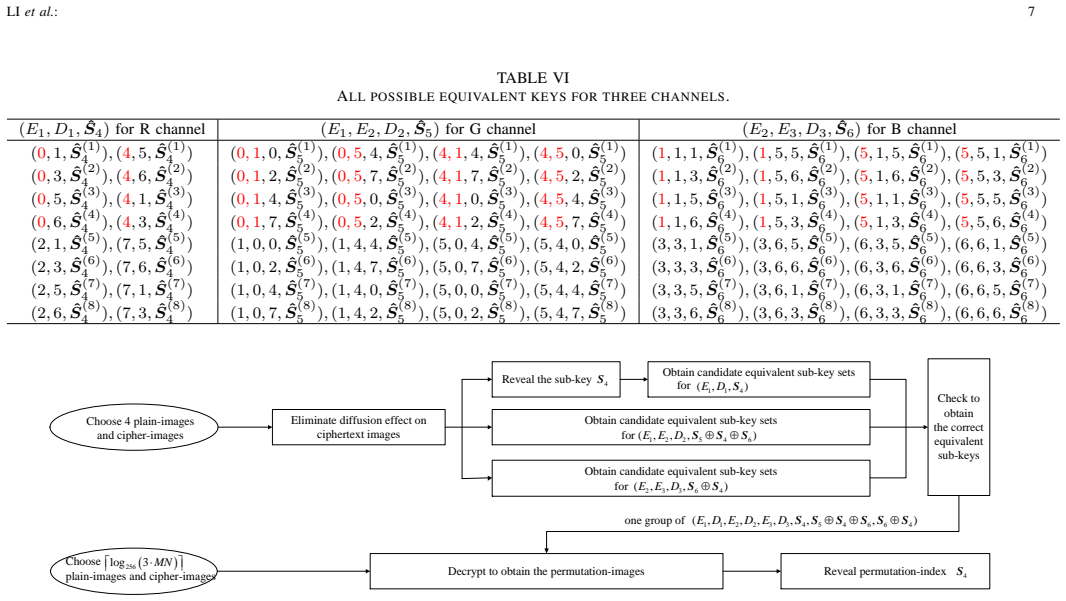
- [Sec. II, footnote 2; Eqs. (10)-(12); Property 2 and Eq. (25)] The paper's final claim that the whole equivalent key is recovered with ceil(log_256(3MN))+4 chosen plain-images is not fully supported by the presented analysis. After the cross-channel consistency check, the 2x2 example leaves 8x8x16 = 1024 candidate tuples (Sec. III-C, Table VI), and the manuscript does not prove that all remaining candidates are functionally equivalent nor does it give a deterministic procedure, within the stated chosen-image budget, to select the tuple that decrypts correctly. The example simply picks one tuple 'such as' without explaining why it is identifiable. If additional verification images are required or if some candidates are not functionally equivalent, the claimed data complexity is not established. The authors should either prove that any surviving candidate yields the same plaintext for all images, or add an explicit verification step (and count it in the complexity).
minor comments (4)
- [Sec. III-C, Table VII] In Table VII, the displayed S3 sequence contains a typographical double comma: '{0, 0, 1, 1, 1, 1,, 0, ...}'. Please fix.
- [Sec. III-C, text after Eq. (28)] The word 'Hoverer' appears in the paragraph discussing Table VI; it should be 'However'.
- [Sec. II and III (notation)] The paper uses several visually similar superscript symbols for intermediate images (I*, I⋆, I⋆⋆, I**), and the 2D/1D indexing is sometimes implicit. A brief notation table or a more careful distinction between I⋆ (permuted) and I⋆⋆ (after DNA diffusion) would improve readability, especially in Sec. III-C where I∗∗ is introduced without a formal definition.
- [Sec. III-B1, Eq. (25) and Sec. III-C] The ordering of 2-bit chunks in the worked example appears inconsistent with the LSB-first indexing implied by Eq. (9) and by l = 4i-4+n+1. The recovered S3 matches the true S3, so the attack is internally consistent, but the presentation should clarify the bit-ordering convention used when applying Eq. (25) to byte-wise differences.
Circularity Check
No significant circularity: the cryptanalysis is self-contained and its key-recovery steps follow from the scheme's equations and enumerated DNA rules, not from its own conclusions.
full rationale
The paper's attack is not circular. The secret quantities are cancelled through ciphertext XOR differences rather than fitted: Property 1 removes the keystreams S4, S5, S6 from the ciphertext differences, and Eq. (25) recovers S3 directly from Property 2, which is proved from the DNA complement map g and the DNA addition/subtraction tables. The DNA rule candidates (E1, D1) are enumerated over 64 possibilities and verified by consistency across four plaintext-ciphertext pairs in Algorithm 1, and the Green/Blue channel candidates are enumerated over 512 possibilities and pruned by cross-channel consistency. No fitted parameter is renamed as a prediction; the claimed data complexity count is derived by counting the chosen images needed for the DNA-diffusion part plus the permutation part. The only self-citations that matter are [34] and [35] for breaking the remaining permutation-only cipher, and those are prior general results on permutation-only ciphers, not tailored assumptions about MPPS, so they are independent support rather than load-bearing self-citation. The footnote-2 modification of symbols and details of the original scheme [33] is a faithfulness caveat about the target description, not a circular reduction: the attack is built on the equations as stated in Sec. II and would fail if those equations misdescribe the original, but that is a correctness risk, not a circularity. No equation in the derivation is identical by construction to an input, and no conclusion is assumed in its own premise. Score 0 is therefore appropriate.
Assumptions & free parameters
assumptions (3)
- domain assumption The condensed description of MPPS in Sec. II, including the R-channel-only DNA complement in Eqs. (10)-(12), preserves the security behavior of the original scheme in [33].
- domain assumption The known permutation-only cryptanalysis from [34] applies to the permutation stage of MPPS and needs ceil(log_256(3L)) chosen images.
- domain assumption The attacker operates in the standard chosen-plaintext model and can submit arbitrary full-color plaintext images to the encryption oracle.
Cite this review
Pith. "Pith review of Security measurement of a medical communication scheme based on chaos and DNA coding." pith.science (2026). https://pith.science/paper/7LFL5WHK
@misc{pith2026190802553,
  author       = {Pith},
  title        = {Pith review of: Security measurement of a medical communication scheme based on chaos and DNA coding},
  year         = {2026},
  howpublished = {\url{https://pith.science/paper/7LFL5WHK}},
  note         = {Machine review of arXiv:1908.02553}
}
abstract
To encrypt sensitive information existing in a color DICOM images, a medical privacy protection scheme (called as MPPS) based on chaos and DNA coding was proposed by using two coupled chaotic systems to produce cryptographic primitives. Relying on some empirical analyses and experimental results, the designers of MPPS claimed that it can withstand a chosen-plaintext attack and some other classic attacking models. However, this statement is groundless. In this paper, we investigate the essential properties of MPPS and DNA coding, and we then propose an efficient chosen-plaintext attack to disclose its equivalent secret-key. The attack only needs $\lceil \log_{256}(3\cdot M\cdot N)\rceil+4$ pair of chosen plain-images and the corresponding cipher-images, where $M \times N$ and ``3" are the size of the RGB color image and the number of color channels, respectively. In addition, the other claimed superiorities are questioned from the perspective of modern cryptography. Both theoretical and experimental results are presented to support the efficiency of the proposed attack and the other reported security faults. The proposed cryptanalysis results will promote the proper application of DNA encoding to protect multimedia privacy data, especially that in a DICOM image.
Figures

Figures from the paper (3 more)

Reference graph
Works this paper leans on
-
[33]
DNA chaos blend to secure medical privacy,
D. Ravichandran, P. Praveenkumar, J. B. B. Rayappan, and R. Amirtharajan, “DNA chaos blend to secure medical privacy,” IEEE Transactions on Nanobioscience, vol. 16, no. 8, pp. 850–858, Dec 2017
work page 2017
-
[1]
Molecular computation of solutions to combinatorial problems,
L. M. Adleman, “Molecular computation of solutions to combinatorial problems,” Science, pp. 1021–1024, 1994
work page 1994
-
[2]
DNA solution of hard computational problems,
R. J. Lipton, “DNA solution of hard computational problems,” Science, vol. 268, no. 5210, pp. 542–545, 1995
work page 1995
-
[3]
Solution of a 20-variable 3-sat problem on a DNA computer,
R. S. Braich, N. Chelyapov, C. Johnson, P. W. Rothemund, and L. Adle- man, “Solution of a 20-variable 3-sat problem on a DNA computer,” Science, vol. 296, no. 5567, pp. 499–502, 2002
work page 2002
-
[4]
Hiding messages in DNA microdots,
C. T. Clelland, V . Risca, and C. Bancroft, “Hiding messages in DNA microdots,” Nature, vol. 399, no. 6736, pp. 533–534, 1999
work page 1999
-
[5]
Cryptography with DNA binary strands,
A. Leier, C. Richter, W. Banzhaf, and H. Rauhe, “Cryptography with DNA binary strands,” Biosystems, vol. 57, no. 1, pp. 13–22, 2000
work page 2000
-
[6]
Lossless chaotic color image cryptosystem based on DNA encryption and entropy,
X. Wu, K. Wang, X. Wang, and H. Kan, “Lossless chaotic color image cryptosystem based on DNA encryption and entropy,” Nonlinear Dynamics, vol. 90, no. 2, pp. 855–875, Oct 2017
work page 2017
-
[7]
Image encryption using 2D henon-sine map and DNA approach,
J. Wu, X. Liao, and B. Yang, “Image encryption using 2D henon-sine map and DNA approach,” Signal Processing, vol. 153, pp. 11–23, DEC 2018
work page 2018
Show all 37 references
-
[8]
DNA-based cryptography,
A. Gehani, T. LaBean, and J. Reif, “DNA-based cryptography,” Lecture Notes in Computer Science , vol. 2950, pp. 167–188, 2004
2004
-
[9]
Breaking a novel image fusion encryption algorithm based on DNA sequence operation and hyper-chaotic system,
T. Xie, Y . Liu, and J. Tang, “Breaking a novel image fusion encryption algorithm based on DNA sequence operation and hyper-chaotic system,” Optik, vol. 125, no. 24, pp. 7166–7169, 2014
2014
-
[10]
Security analysis of an image encryption algorithm based on a DNA addition combining with chaotic maps,
H. Hermassi, A. Belazi, R. Rhouma, and S. M. Belghith, “Security analysis of an image encryption algorithm based on a DNA addition combining with chaotic maps,” Multimedia Tools and Applications , vol. 72, no. 3, pp. 2211–2224, Oct 2014
2014
-
[11]
Algebraic analysis of a RGB image encryption algorithm based on DNA encoding and chaotic map,
A. Belazi, H. Hermassi, R. Rhouma, and S. Belghith, “Algebraic analysis of a RGB image encryption algorithm based on DNA encoding and chaotic map,” Nonlinear Dynamics, vol. 76, no. 4, pp. 1989–2004, 2014
1989
-
[12]
Cryptanalysis of a novel image fusion encryption algorithm based on DNA sequence operation and hyper-chaotic system,
Y . Zhang, “Cryptanalysis of a novel image fusion encryption algorithm based on DNA sequence operation and hyper-chaotic system,” Optik, vol. 126, no. 2, pp. 223–229, 2015
2015
-
[13]
Security analysis on a color image encryption based on DNA encoding and chaos map,
Y . Wang, P. Lei, H. Yang, and H. Cao, “Security analysis on a color image encryption based on DNA encoding and chaos map,” Computers & Electrical Engineering , vol. 46, pp. 433–446, Aug 2015
2015
-
[14]
Cryptanalysis of a chaos-based image encryption scheme combining DNA coding and entropy,
X. Su, W. Li, and H. Hu, “Cryptanalysis of a chaos-based image encryption scheme combining DNA coding and entropy,” Multimedia Tools and Applications, vol. 76, no. 12, pp. 14 021–14 033, Jun 2017
2017
-
[15]
Cryptanalysis of an image encryption algorithm based on DNA encoding,
A. Akhavan, A. Samsudin, and A. Akhshani, “Cryptanalysis of an image encryption algorithm based on DNA encoding,” Optics and Laser Technology, vol. 95, pp. 94–99, 2017
2017
-
[16]
Breaking an image encryption algorithm based on DNA encoding and spatiotemporal chaos,
H. Wen, S. Yu, and J. L ¨u, “Breaking an image encryption algorithm based on DNA encoding and spatiotemporal chaos,” Entropy, vol. 21, no. 3, p. art. no. 246, 2019
2019
-
[17]
Cryptanalysis and improvement of a color image encryption scheme based on DNA sequences and multiple 1D chaotic maps,
R. K. P. Kirtee Panwar and A. Jain, “Cryptanalysis and improvement of a color image encryption scheme based on DNA sequences and multiple 1D chaotic maps,” International Journal of Bifurcation and Chaos, vol. 29, no. 8, p. art. no. 1950103, 2019
2019
-
[18]
Cryptanalysis of a DNA-based image encryption scheme,
J. Chen, L. Chen, and Y . Zhou, “Cryptanalysis of a DNA-based image encryption scheme,” Information Sciences, vol. 520, pp. 130–141, 2020
2020
-
[19]
Compact storage of medical images with patient information,
U. R. Acharya, D. Acharya, P. S. Bhat, and U. Niranjan, “Compact storage of medical images with patient information,” IEEE Transactions on Information Technology in Biomedicine , vol. 5, no. 4, pp. 320–323, 2001
2001
-
[20]
Security analysis of an image encryption algorithm based on chaos and DNA encoding,
F. Ozkaynak, A. B. Ozer, and S. Yavuz, “Security analysis of an image encryption algorithm based on chaos and DNA encoding,” inProceeding of the 21ST signal processing and communications applications confer- ence, 2013
2013
-
[21]
Differential cryptanalysis of a medical im- age cryptosystem with multiple rounds,
L. Chen and S. Wang, “Differential cryptanalysis of a medical im- age cryptosystem with multiple rounds,” Computers in Biology and Medicine, vol. 65, pp. 69–75, 2015
2015
-
[22]
Cryptanalyzing and improving a novel color image encryption algorithm using RT-enhanced chaotic tent maps,
C. Zhu and K. Sun, “Cryptanalyzing and improving a novel color image encryption algorithm using RT-enhanced chaotic tent maps,” IEEE Access, vol. 6, pp. 18 759–18 770, 2018
2018
-
[23]
Cryptanalysis and improvement in an image encryption scheme using combination of the 1d chaotic map,
J. Chen, F. Han, W. Qian, Y .-D. Yao, and Z.-l. Zhu, “Cryptanalysis and improvement in an image encryption scheme using combination of the 1d chaotic map,” Nonlinear Dynamics , vol. 93, no. 4, pp. 2399–2413, 2018. LI et al.: 11
2018
-
[24]
Cryptanalyzing an image encryp- tion algorithm based on autoblocking and electrocardiography,
C. Li, D. Lin, J. L ¨u, and F. Hao, “Cryptanalyzing an image encryp- tion algorithm based on autoblocking and electrocardiography,” IEEE MultiMedia, vol. 25, no. 4, pp. 46–56, 2018
2018
-
[25]
Cryptanalysis of an image block encryption algorithm based on chaotic maps,
Y . Ma, C. Li, and B. Ou, “Cryptanalysis of an image block encryption algorithm based on chaotic maps,” Journal of Information Security and Applications, vol. 54, p. art. no. 102566, 2020
2020
-
[26]
Dynamic analysis of digital chaotic maps via state-mapping networks,
C. Li, B. Feng, S. Li, J. Kurths, and G. Chen, “Dynamic analysis of digital chaotic maps via state-mapping networks,” IEEE Transactions on Circuits and Systems I: Regular Papers , vol. 66, no. 6, pp. 2322–2335, 2019
2019
-
[27]
Medical image encryption using high-speed scrambling and pixel adaptive diffusion,
Z. Hua, S. Yi, and Y . Zhou, “Medical image encryption using high-speed scrambling and pixel adaptive diffusion,” Signal Processing, vol. 144, pp. 134–144, 2018
2018
-
[28]
Sine-transform-based chaotic system with FPGA implementation,
Z. Hua, B. Zhou, and Y . Zhou, “Sine-transform-based chaotic system with FPGA implementation,” IEEE Transactions on Industrial Electron- ics, vol. 65, no. 3, pp. 2557–2566, 2018
2018
-
[29]
Generating multi- scroll chua’s attractors via simplified piecewise-linear chua’s diode,
N. Wang, C. Li, H. Bao, M. Chen, and B. Bao, “Generating multi- scroll chua’s attractors via simplified piecewise-linear chua’s diode,” IEEE Transactions on Circuits and Systems I: Regular Papers , vol. 66, no. 12, pp. 4767–4779, 2019
2019
-
[30]
Some basic cryptographic requirements for chaos- based cryptosystems,
G. Alvarez and S. Li, “Some basic cryptographic requirements for chaos- based cryptosystems,” International Journal of Bifurcation and Chaos , vol. 16, no. 8, pp. 2129–2151, 2006
2006
-
[31]
Brief review on application of nonlinear dynamics in image encryption,
F. ¨Ozkaynak, “Brief review on application of nonlinear dynamics in image encryption,” Nonlinear Dynamics , vol. 92, no. 2, pp. 305–313, 2018
2018
-
[32]
When an attacker meets a cipher- image in 2018: A Year in Review,
C. Li, Y . Zhang, and E. Y . Xie, “When an attacker meets a cipher- image in 2018: A Year in Review,” Journal of Information Security and Applications, vol. 48, p. art. no. 102361, 2019
2018
-
[34]
Optimal quantitative cryptanalysis of permutation- only multimedia ciphers against plaintext attacks,
C. Li and K.-T. Lo, “Optimal quantitative cryptanalysis of permutation- only multimedia ciphers against plaintext attacks,” Signal Processing , vol. 91, no. 4, pp. 949–954, 2011
2011
-
[35]
Cryptanalyzing an image-scrambling encryp- tion algorithm of pixel bits,
C. Li, D. Lin, and J. L ¨u, “Cryptanalyzing an image-scrambling encryp- tion algorithm of pixel bits,”IEEE MultiMedia, vol. 24, no. 3, pp. 64–71, 2017
2017
-
[36]
Cryptanalysis of a chaotic image encryption algorithm based on information entropy,
C. Li, D. Lin, B. Feng, J. L ¨u, and F. Hao, “Cryptanalysis of a chaotic image encryption algorithm based on information entropy,”IEEE Access, vol. 6, pp. 75 834–75 842, 2018
2018
-
[37]
Depreciating motivation and empirical security analysis of chaos-based image and video encryption,
M. Preishuber, T. Hutter, S. Katzenbeisser, and A. Uhl, “Depreciating motivation and empirical security analysis of chaos-based image and video encryption,” IEEE Transactions on Information Forensics and Security, vol. 13, no. 9, pp. 2137–2150, 2018
2018
Reviewed August 14, 2026 · model on record in the stance chip above.
Discussion (0). Continue with ORCID to comment.