REVIEW 4 major objections 6 minor 66 references
Beyond the mini-solar maximum of solar cycle 24: Declining solar magnetic fields and the response of the terrestrial magnetosphere
T0 review · 4 major / 6 minor · reviewed 2026-08-14 · deepseek-v4-flash
Pith's one-line read Earth's magnetopause has expanded by about 15 percent since the mid-1990s, and this paper ties that expansion to a two-decade decline in solar magnetic fields.
desk verdict The ~15% magnetopause expansion is a model-output trend that is plausible but not validated, and its magnitude is weaker than claimed once you account for the pressure scaling; the paper is still a useful update with some new comparative material. read the letter →
The pith
A machine-rendered reading of the paper's core claim, the machinery that carries it, and where it could break.
The reading
What carries the argument
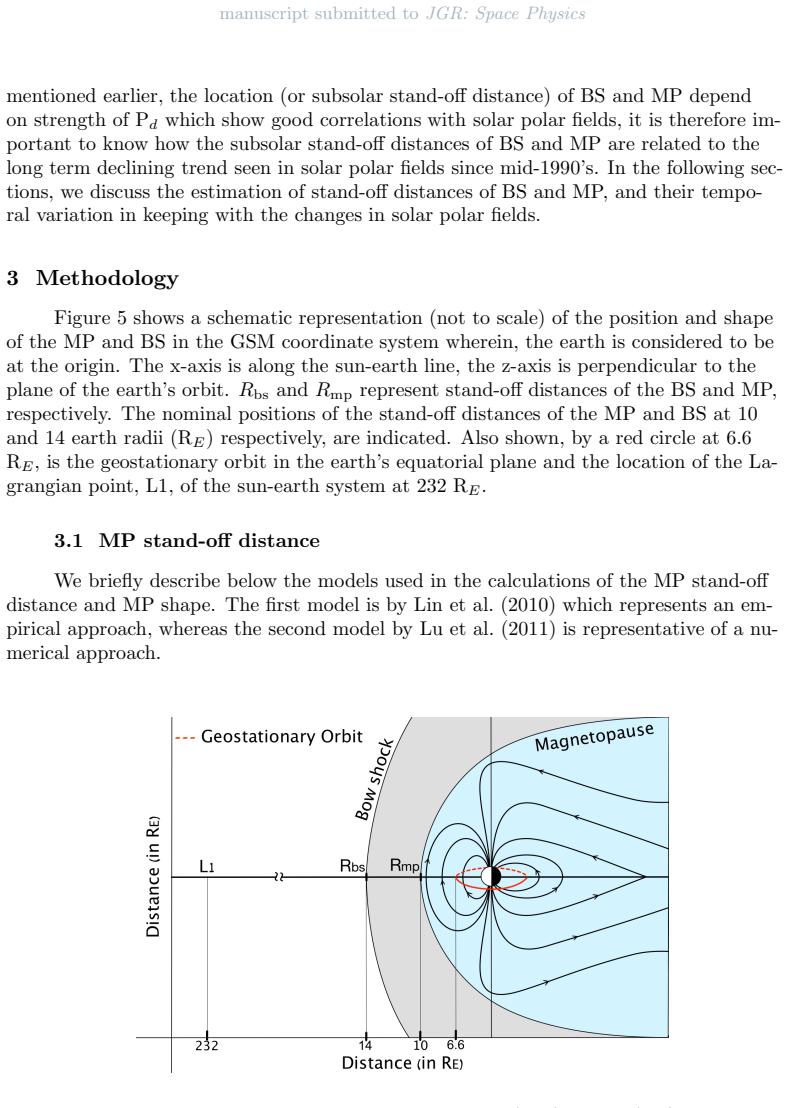
The central quantity is the subsolar stand-off distance of the magnetopause, $r_{mp}$, the distance from Earth's center to the dayside boundary of the magnetosphere along the Sun-Earth line. The paper computes it with two independent tools: an empirical model in which $r_{mp}$ is a fitted function of solar wind dynamic plus magnetic pressure and IMF $B_z$, and a global MHD simulation-based model with a similar power-law dependence on dynamic pressure. Pressure balance with Earth's dipole field is the physical mechanism: weaker solar wind dynamic pressure lets the boundary sit farther out. The same daily pressure and IMF inputs drive bow shock stand-off distances through an empirical power law and an MHD-based model that also includes Alfvén Mach number, and the magnetopause shape is traced through a flaring-angle formula parametrized by pressure and $B_z$.
What would settle it
Compile actual magnetopause crossing distances from 1995–2017 and check whether their subsolar distances cluster around the model-computed $10.7\,R_E$ average rather than the $9.7\,R_E$ baseline; a flat or declining observed trend would disprove the claimed 15 percent expansion.
Extended reading notes
Core claim
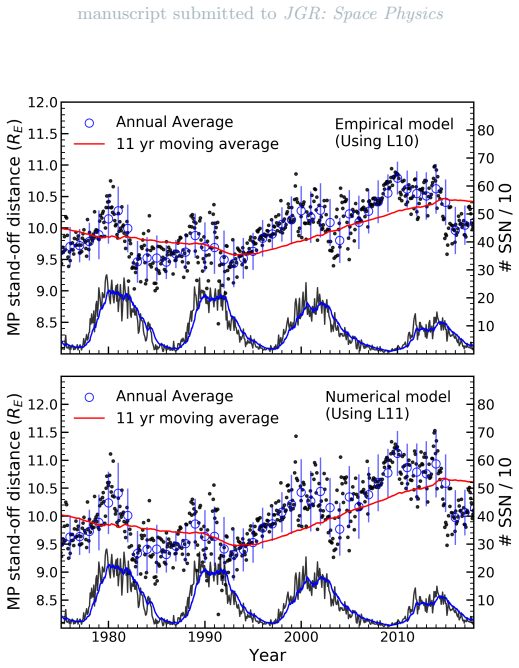
The central discovery is that the terrestrial magnetopause has been inflating for more than two decades: using daily solar wind measurements from 1975–2017 as input to an empirical magnetopause model and to a global MHD-based numerical model, the paper finds a steady increase of about 15 percent in the subsolar stand-off distance beginning in the mid-1990s, with the 1974–1994 average at $9.7\,R_E$ and the 1995–2017 average at $10.7\,R_E$. The same inputs drive a corresponding expansion of the bow shock stand-off distance and of the dayside magnetopause shape, and the paper reports a more than 40 percent increase after 1995 in days when the bow shock stands well beyond its average position. These changes are interpreted as the magnetosphere's response to a sustained decline in solar high-latitude photospheric fields, solar wind micro-turbulence, and 1 AU solar wind parameters such as IMF strength and dynamic pressure. The paper also forecasts the 2020 solar-minimum magnetopause shape as larger than in 1996 but smaller than in 2008, and it highlights three events when the computed magnetopause distance fell close to geostationary orbit at $6.6\,R_E$, warning that such compressions threaten satellites.
Load-bearing premise
The entire inference hangs on the assumption that the empirical and numerical magnetopause models, calibrated on spacecraft crossings from various eras, stay unbiased under the unusually weak solar wind conditions after 1995; a systematic bias at low dynamic pressure would manufacture the 15 percent expansion from nothing.
Editorial extensions
If this is right
- If the magnetopause stand-off distance really has risen about 15 percent since the mid-1990s, the average protective boundary now sits roughly $1\,R_E$ farther out during ordinary solar wind conditions than it did during cycles 21–22.
- The decline in solar wind dynamic pressure and IMF strength shifts the statistics of extreme compressions: events pushing the magnetopause down to geostationary orbit at $6.6\,R_E$ become less frequent, though the 2005 event shows they still occur.
- The forecast magnetopause shape at the 2020 minimum, larger than in 1996 but smaller than in 2008, implies the expansion is not monotonic and will track the strength of the upcoming cycle.
- If the decline in high-latitude photospheric fields continues through 2020 and beyond, the paper expects a weaker cycle 25 and, eventually, a prolonged low-activity state reminiscent of a grand solar minimum.
Reading between the lines
- A direct test the paper leaves open is to compare the model-computed daily stand-off distances against actual magnetopause crossings from 1995–2017; if observed crossings do not track the $10.7\,R_E$ average, the expansion is a modeling artifact rather than a physical change.
- The same solar-wind pressure decline should have inflated the magnetospheres of other magnetized planets and the heliosphere itself; this is a neighboring prediction that follows from the paper's pressure-based mechanism but is not tested here.
- The 2020 shape forecast rests mainly on dynamic pressure because the paper finds IMF $B_z$ essentially stochastic; re-running the forecast with $B_z$ fixed to zero would quantify how much of the predicted shape change is pressure-driven.
- The paper's argument implies that satellite operators' radiation-belt and surface-charging risk assessments should incorporate the decadal drift in magnetopause location, not just solar-cycle phase; that application is not developed in the paper.
Signed reviews
Editorial analysis
A structured set of objections, weighed in public.
Referee Report
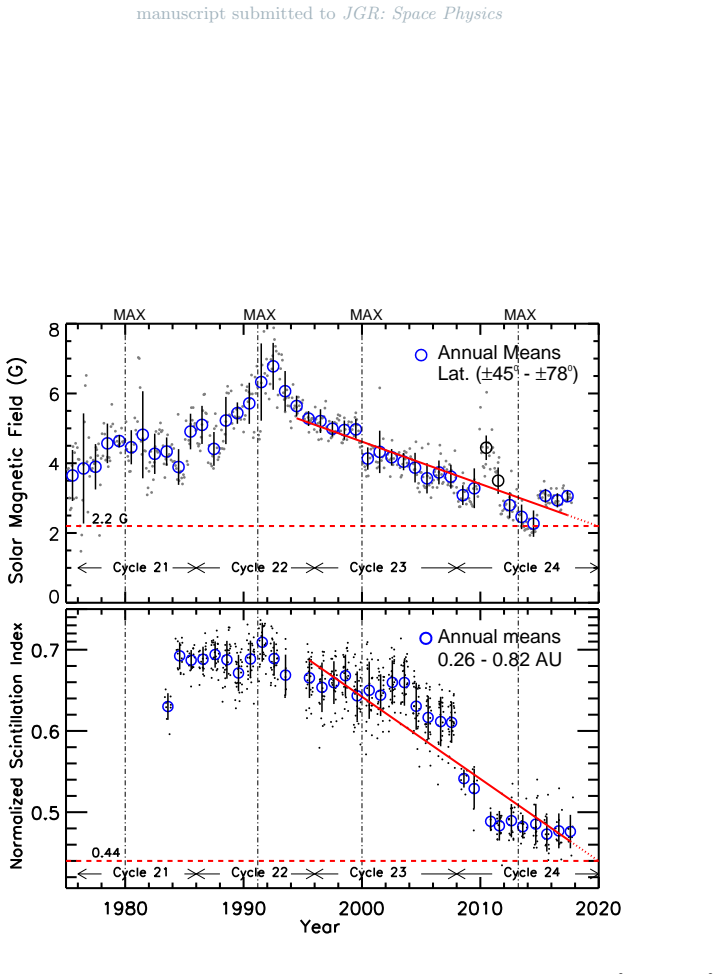
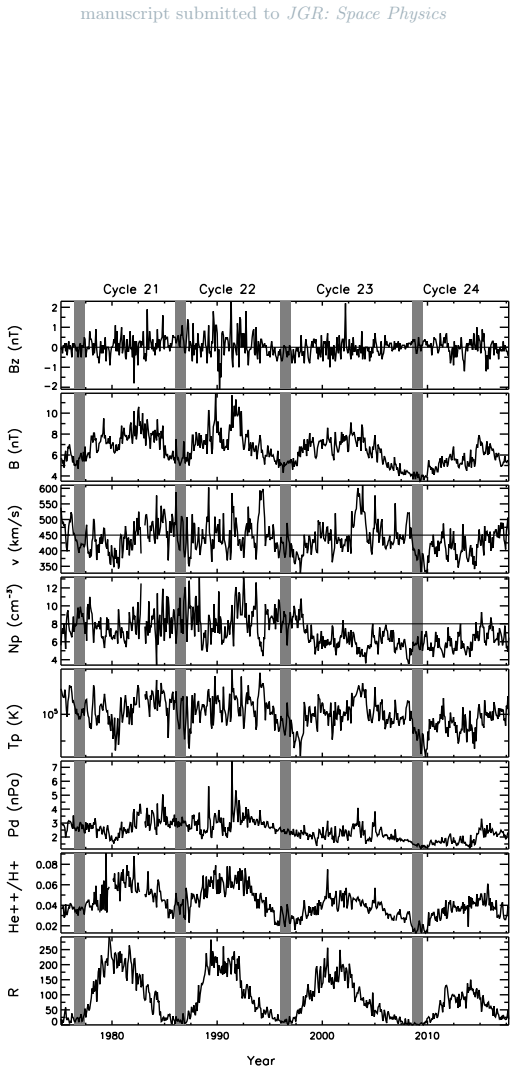
Summary. The manuscript uses public OMNI solar wind data (1975–2017), NSO/KP and SOLIS synoptic magnetograms, and ISEE IPS scintillation measurements to document long-term declines in solar high-latitude photospheric fields, inner-heliospheric microturbulence, and 1 AU solar wind parameters. It passes daily dynamic pressure and IMF-Bz through two magnetopause stand-off models (Lin et al. 2010, Eq. 2; Lu et al. 2011, Eq. 6), two bow shock models (Jelinek et al. 2012, Eq. 9; Chapman and Cairns 2003, Eq. 10), computes magnetopause shapes at solar minima, and reports that the subsolar stand-off distance has increased by about 15% since the mid-1990s irrespective of model, with more than 40% more bow-shock 'events' after 1995 and an expanded magnetopause shape between 1996 and 2008. It identifies three 1978/1991/2005 events with stand-off distances near 6.6 Earth radii and forecasts an expanded magnetopause shape for 2020 using ARIMA extrapolation of Bz and Pd.
Significance. If the central claim holds, the paper provides a coherent end-to-end picture from declining solar polar fields to a statistically measurable expansion of the terrestrial magnetosphere over four solar cycles, with practical implications for geostationary satellite exposure. The analysis is transparent and largely reproducible: the formulas are published, the OMNI/NSO/IPS data are public, and the computed trends are deterministic functions of the input time series. The reported increase is also qualitatively consistent with McComas et al. (2013) and Samsonov et al. (2019). However, the specific 15% magnitude and the claim of model-independence are not yet established, because the two magnetopause models are not independent and neither is validated against in-situ boundary crossings in the low-pressure post-1995 regime. The manuscript currently supports a weaker statement: model-predicted stand-off distance has increased.
major comments (4)
- [§5.1 (Eqs. 2 and 6)] The central claim of a ~15% secular increase in subsolar stand-off distance is never checked against direct observations of the magnetopause or bow shock during 1975–2017. Equations (2) and (6) are both pressure-driven fits whose calibration data are concentrated at ordinary solar-wind conditions; the post-1995 interval is dominated by low dynamic pressures, where the fits are least constrained. Because every trend line in Fig. 6 is obtained by feeding the same OMNI pressure series through these monotone formulas, a systematic low-pressure bias in either model would masquerade as an expansion. I ask the authors to validate the predicted stand-off distances against spacecraft crossings (e.g., THEMIS, Geotail, Cluster, or MMS) in the post-1995 interval, or at least to tabulate model residuals versus Pd in bins covering the low-pressure regime.
- [§5.1 and §6] The reported magnitude of the trend is not internally consistent. Section 6 states the 1974–1994 and 1995–2017 epoch-mean stand-off distances as 9.7 and 10.7 Earth radii, which is a ~10% increase, while §5.1 reports '~15%' from the 11-year moving average. The mean Pd decline from ~2.9 to ~2.0 nPa, inserted into the Pd^{-1/5.2} law of Eq. (6), yields only ~7% expansion, so the remaining ~8 percentage points of the 15% claim (or ~3 percentage points of the epoch-mean claim) must come from Bz and magnetic-pressure terms plus endpoint effects of the 11-year smoother. The paper should state explicitly which quantity the 15% refers to and should report the trend with a standard error obtained from a well-defined detrending procedure.
- [§3.1.2 and §5.1] The agreement between L10 and L11 is presented as evidence that the trend is model-independent, but Eq. (6) is not a numerical simulation of the 1975–2017 interval; it is an analytic power-law fit to SWMF runs, with the same Shue-type functional dependence on Pd and Bz as the empirical L10 formula. The two models are therefore strongly correlated by construction, and their agreement cannot confirm the low-pressure behavior. An independent check, such as a non-pressure-based magnetopause model, a machine-learning model with different inputs, or direct boundary crossings, is needed before the claim 'irrespective of the empirical or numerical model used' can be supported.
- [§5.2 and Appendix A] The 2020 magnetopause-shape forecast relies on an ARIMA forecast of Bz that the authors themselves describe as 'a simple linear extrapolation curve without any variations' (Appendix A). The 95% confidence band in Fig. 8 is propagated from the ARIMA fit and does not include the acknowledged failure of the Bz model or the uncertainty of the linear extrapolation of photospheric fields and scintillation index beyond 2017. Please reframe this as an illustrative scenario and provide a sensitivity check on the assumed Bz and on the continued linear decline.
minor comments (6)
- [Abstract; Table 1] The abstract says 'two instances between 1968 and 1991,' while Table 1 lists 1978-06-02 and 1991-06-05 and the text says 'between the year 1968 and 1995'; these date ranges should be made consistent.
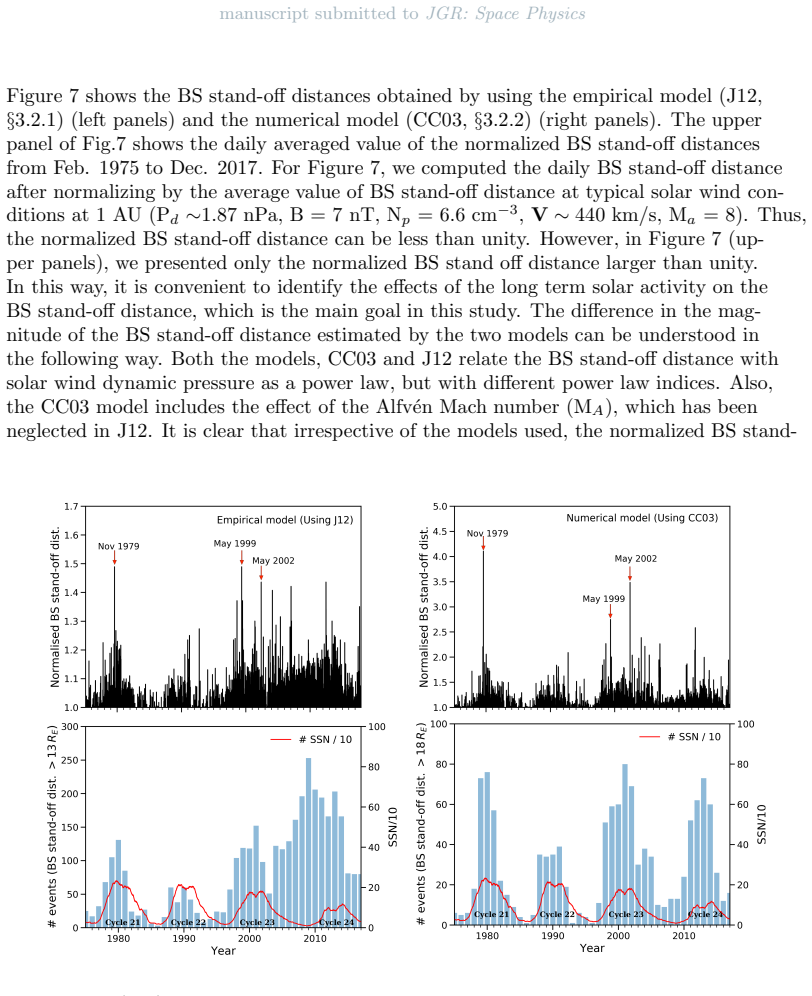
- [§5.1, Fig. 7] The sentence describing 'a significant increase in the number of events with the BS stand-off distance exceeding well below the average value' is self-contradictory; clarify whether the events exceed or fall below the average stand-off distance.
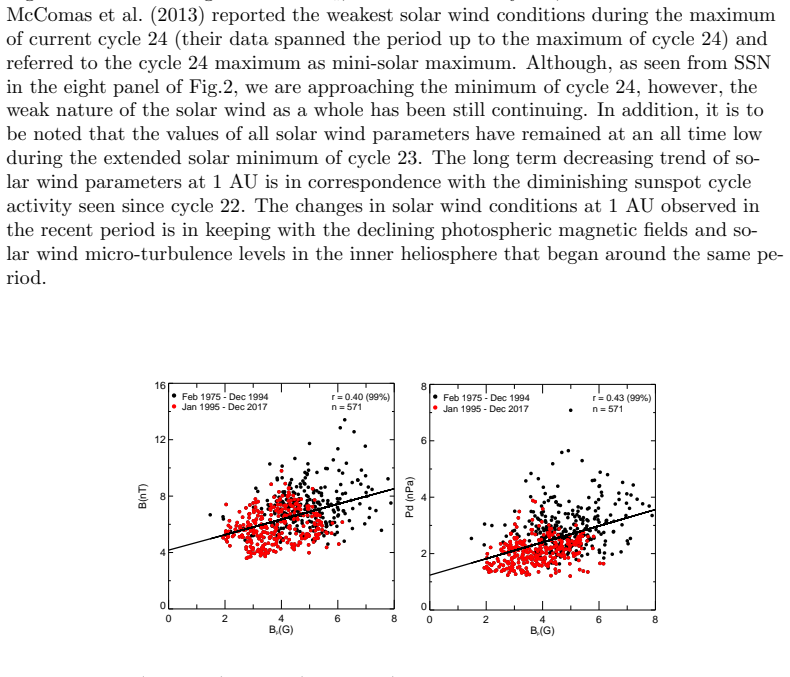
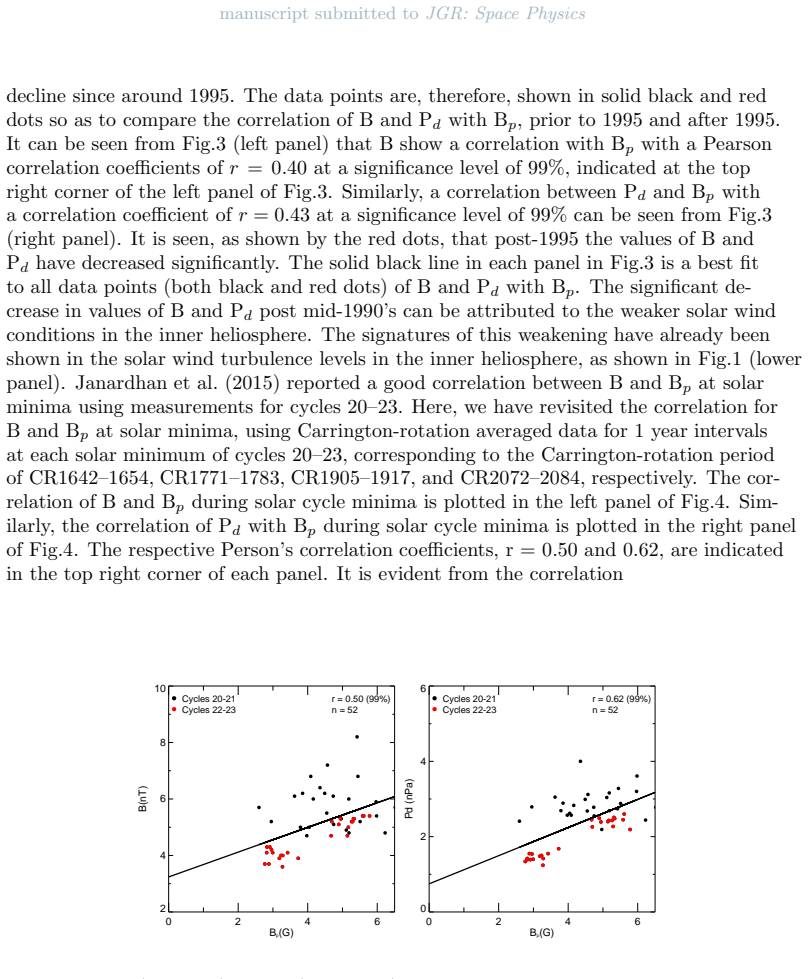
- [§6, Figs. 3–4] The word 'causal' is used for correlations between B, Pd, and solar polar fields; because the 27-day averaged data are serially correlated, the effective degrees of freedom are much lower than n = 571, so the 99% significance levels should be evaluated with autocorrelation-aware tests or at least stated with this caveat.
- [§2.3; §6] The data period is Feb. 1975 through Dec. 2017, but the text repeatedly refers to 1974–1994 epoch averages; clarify whether pre-1975 data are used or whether 1974 is a calendar-year indexing convention.
- [Appendix A] The ARIMA orders are reported for Bz and Pd but not for rmp; state the rmp model orders or explain explicitly why only Bz and Pd are modeled.
- [§5.1, Fig. 6] The 11-year moving average is applied to daily values, but the paper does not specify whether the window is centered or trailing; this matters because the reported 15% increase is read from that smoothed curve.
Circularity Check
No significant circularity: the magnetopause stand-off increase is a forward-model consequence of independently observed OMNI pressure/IMF inputs, and the solar-field decline is re-derived from external magnetogram and IPS data, so no fitted parameter is renamed as a prediction.
full rationale
The paper's central trend is obtained by inserting daily OMNI dynamic pressure and IMF-Bz into four externally calibrated models: L10 eq. (2), L11 eq. (6), J12 eq. (9), and CC03 eq. (10). None of these models is fitted in the present paper, and none is fitted to the 1975-2017 stand-off distance time series that constitutes the target quantity. The reported ~15% increase in rmp is therefore a forward-model implication of the independently observed decline in Pd and Bz, not a parameter fit to the target data and then relabeled as a prediction. The solar high-latitude field decline, which is the external correlate, is re-derived in Fig. 1 from NSO/KP and SOLIS synoptic magnetograms and ISEE IPS scintillation data; the self-citations to Janardhan et al. and Bisoi et al. are pointers to earlier analyses of the same or related data, not the sole evidence. The 2020 forecast is an ARIMA extrapolation of OMNI Pd/Bz fed through the same published models; its validation against 2018-2019 observed OMNI Pd is legitimate, and comparing predicted rmp with model-estimated rmp is a self-consistency check rather than the basis of the main claim. Correlations between Pd/B and polar fields are statistical associations, not circular derivations. Concerns about the non-independence of the L10 and L11 functional forms and about extrapolation into low-dynamic-pressure regimes are correctness and validation risks, which the circularity rules exclude unless a specific reduction to fitted inputs is exhibited; no such reduction appears in the text.
Assumptions & free parameters
free parameters (3)
- ARIMA model orders for Bz and Pd =
Bz: (1,0,1)x(0,0,1,12); Pd: (1,1,1)x(0,0,1,12)
- 2020 high-latitude field extrapolation =
2.2 ± 0.08 G
- 2020 scintillation index extrapolation =
0.44
assumptions (5)
- domain assumption The empirical and numerical magnetopause and bow shock models (L10, L11, J12, CC03) are valid for the solar wind conditions encountered since the mid-1990s.
- domain assumption The declining trend in solar high-latitude photospheric fields will continue at least until 2020.
- domain assumption The effect of Earth's dipole tilt and secular dipole decay on MP shape is negligible for this study.
- domain assumption The IMF orientation angle is fixed at 90 degrees for the CC03 bow shock model.
- domain assumption Correlations between Bp and B/Pd indicate a causal connection between polar field decline and solar wind weakening.
Cite this review
Pith. "Pith review of Beyond the mini-solar maximum of solar cycle 24: Declining solar magnetic fields and the response of the terrestrial magnetosphere." pith.science (2026). https://pith.science/paper/I2ZV2AWS
@misc{pith2026190802576,
  author       = {Pith},
  title        = {Pith review of: Beyond the mini-solar maximum of solar cycle 24: Declining solar magnetic fields and the response of the terrestrial magnetosphere},
  year         = {2026},
  howpublished = {\url{https://pith.science/paper/I2ZV2AWS}},
  note         = {Machine review of arXiv:1908.02576}
}
abstract
The present study examines the response of the terrestrial magnetosphere to the long-term steady declining trends observed in solar magnetic fields and solar wind micro-turbulence levels since mid-1990's that has been continuing beyond the mini-solar maximum of cycle 24. A detailed analysis of the response of the terrestrial magnetosphere has been carried out by studying the extent and shape of the Earth's magnetopause and bow shock over the past four solar cycles. We estimate sub-solar stand-off distance of the magnetopause and bow shock, and the shape of the magnetopause using numerical as well as empirical models. The computed magnetopause and bow shock stand-off distances have been found to be increasing steadily since around mid-1990's, consistent with the steady declining trend seen in solar magnetic fields and solar wind micro-turbulence levels. Similarly, we find an expansion in the shape of the magnetopause since 1996. The implications of the increasing trend seen in the magnetopause and bow shock stand-off distances are discussed and a forecast of the shape of the magnetopause in 2020, the minimum of cycle 24, has been made. Importantly, we also find two instances between 1968 and 1991 when the magnetopause stand-off distance dropped to values close to 6.6 earth radii, the geostationary orbit, for duration ranging from 9$-$11 hours and one event in 2005, post 1995 when the decline in photospheric fields began. Though there have been no such events since 2005, it represents a clear and present danger to our satellite systems.
Figures
Figures from the paper (6 more)

Reference graph
Works this paper leans on
-
[1]
ABJ95 APACrefauthors Ananthakrishnan , S. , Balasubramanian , V. \ Janardhan , P. APACrefauthors \ 1995 04 . Latitudinal Variation of Solar Wind Velocity Latitudinal Variation of Solar Wind Velocity . 72 229-232 . APACrefDOI doi:10.1007/BF00768784 APACrefDOI
-
[2]
ACK80 APACrefauthors Ananthakrishnan , S. , Coles , W A. \ Kaufman , J J. APACrefauthors \ 1980 11 . Microturbulence in solar wind streams Microturbulence in solar wind streams . 85 6025-6030 . APACrefDOI doi:10.1029/JA085iA11p06025 APACrefDOI
-
[3]
BaJ03 APACrefauthors Balasubramanian , V. , Janardhan , P. , Srinivasan , S. \ Ananthakrishnan , S. APACrefauthors \ 2003 03 . Interplanetary scintillation observations of the solar wind disappearance event of May 1999 Interplanetary scintillation observations of the solar wind disappearance event of May 1999 . 108 1121-+ . APACrefDOI doi:10.1029/2002JA00...
-
[4]
Bea60 APACrefauthors Beard , D B. APACrefauthors \ 1960 . 65 3559-3568 . APACrefDOI doi:10.1029/JZ065i011p03559 APACrefDOI
-
[5]
BNa18 APACrefauthors Bhowmik , P. \ Nandy , D. APACrefauthors \ 2018 12 . Prediction of the strength and timing of sunspot cycle 25 reveal decadal-scale space environmental conditions Prediction of the strength and timing of sunspot cycle 25 reveal decadal-scale space environmental conditions . Nature Communications . APACrefDOI doi:10.1038/s41467-018-076...
-
[6]
BiJ14 APACrefauthors Bisoi , S K. , Janardhan , P. , Chakrabarty , D. , Ananthakrishnan , S. \ Divekar , A. APACrefauthors \ 2014 01 . Changes in Quasi-periodic Variations of Solar Photospheric Fields: Precursor to the Deep Solar Minimum in Cycle 23? Changes in Quasi-periodic Variations of Solar Photospheric Fields: Precursor to the Deep Solar Minimum in ...
-
[7]
BiJ14b APACrefauthors Bisoi , S K. , Janardhan , P. , Ingale , M. , Subramanian , P. , Ananthakrishnan , S. , Tokumaru , M. \ Fujiki , K. APACrefauthors \ 2014 08 . A study of density modulation index in the inner heliospheric solar wind during solar cycle 23 A study of density modulation index in the inner heliospheric solar wind during solar cycle 23 . 793 8-15
work page 2014
-
[8]
BoE00 APACrefauthors Boardsen , S A. , Eastman , T E. , Sotirelis , T. \ Green, J L. APACrefauthors \ 2000 . 105 23,193–23,219 . APACrefDOI doi:10.1029/1998JA000143 APACrefDOI
Show all 66 references
-
[9]
APACrefauthors \ 2017
Bro17 APACrefauthors Brownlee, J. APACrefauthors \ 2017 . Introduction to Time Series Forecasting with Python: How to Prepare Data and Develop Models to Predict the Future Introduction to time series forecasting with python: How to prepare data and develop models to predict th...
2017
-
[10]
\ Grabbe , C L
CGr94 APACrefauthors Cairns , I H. \ Grabbe , C L. APACrefauthors \ 1994 12 . Towards an MHD theory for the standoff distance of Earth's bow shock Towards an MHD theory for the standoff distance of Earth's bow shock . 21 2781-2784 . APACrefDOI doi:10.1029/94GL02551 APACrefDOI
1994 doi
-
[11]
\ Lyon , J G
CLy95 APACrefauthors Cairns , I H. \ Lyon , J G. APACrefauthors \ 1995 09 . MHD simulations of Earth's bow shock at low Mach numbers: Standoff distances MHD simulations of Earth's bow shock at low Mach numbers: Standoff distances . 100 17173-17180 . APACrefDOI doi:10.1029/95JA...
1995 doi
-
[12]
\ Lyon , J G
CLy96 APACrefauthors Cairns , I H. \ Lyon , J G. APACrefauthors \ 1996 . Magnetic field orientation effects on the standoff distance of Earth's bow shock Magnetic field orientation effects on the standoff distance of Earth's bow shock . 23 2883-2886 . APACrefDOI doi:10.1029/96...
1996 doi
-
[13]
, Jiang , J
CJS16 APACrefauthors Cameron , R H. , Jiang , J. \ Sch \"u ssler , M. APACrefauthors \ 2016 06 . Solar Cycle 25: Another Moderate Cycle? Solar Cycle 25: Another Moderate Cycle? 823 L22 . APACrefDOI doi:10.3847/2041-8205/823/2/L22 APACrefDOI
2016 doi
-
[14]
\ Cairns , I H
CCa03 APACrefauthors Chapman , J F. \ Cairns , I H. APACrefauthors \ 2003 05 . Three-dimensional modeling of Earth's bow shock: Shock shape as a function of Alfv \'e n Mach number Three-dimensional modeling of Earth's bow shock: Shock shape as a function of Alfv \'e n Mach num...
2003 doi
-
[15]
\ Ferraro , V C A
CFe31 APACrefauthors Chapman , S. \ Ferraro , V C A. APACrefauthors \ 1931 . A new theory of magnetic storms. Terrestrial Magnetism and Atmospheric Electricity A new theory of magnetic storms. Terrestrial Magnetism and Atmospheric Electricity . Terr. Magn. Atmos. Electr. 36 77...
1931 doi
-
[16]
APACrefauthors \ 2011 12
Tom11 APACrefauthors de Toma , G. APACrefauthors \ 2011 12 . Evolution of Coronal Holes and Implications for High-Speed Solar Wind During the Minimum Between Cycles 23 and 24 Evolution of Coronal Holes and Implications for High-Speed Solar Wind During the Minimum Between Cycle...
2011 doi
-
[17]
\ Choudhuri , A R
DCh93 APACrefauthors D'Silva , S. \ Choudhuri , A R. APACrefauthors \ 1993 05 . A theoretical model for tilts of bipolar magnetic regions A theoretical model for tilts of bipolar magnetic regions . 272 621
1993
-
[18]
\ Winglee , R M
EWi97 APACrefauthors Elsen , R K. \ Winglee , R M. APACrefauthors \ 1997 03 . The average shape of the Magnetopause: A comparison of three-dimensional global MHD and empirical models The average shape of the Magnetopause: A comparison of three-dimensional global MHD and empiri...
1997 doi
-
[19]
APACrefauthors \ 1971
Fai71 APACrefauthors Fairfield , D H. APACrefauthors \ 1971 . Average and unusual locations of the Earth's magnetopause and bow shock Average and unusual locations of the Earth's magnetopause and bow shock . 76 6700 . APACrefDOI doi:10.1029/JA076i028p06700 APACrefDOI
1971 doi
-
[20]
, Cairns , I H
FaC01 APACrefauthors Fairfield , D H. , Cairns , I H. , Desch , M D. , Szabo , A. , Lazarus , A J. \ Aellig , M R. APACrefauthors \ 2001 11 . The location of low Mach number bow shocks at Earth The location of low Mach number bow shocks at Earth . 106 25361-25376 . APACrefDOI ...
2001 doi
-
[21]
\ Russell , C T
FRu94 APACrefauthors Farris , M H. \ Russell , C T. APACrefauthors \ 1994 09 . Determining the standoff distance of the bow shock: Mach number dependence and use of models Determining the standoff distance of the bow shock: Mach number dependence and use of models . 99 17 . AP...
1994 doi
-
[22]
APACrefauthors \ 1979 12
For79 APACrefauthors Formisano , V. APACrefauthors \ 1979 12 . The three-dimensional shape of the bow shock The three-dimensional shape of the bow shock . Nuovo Cimento C Geophysics Space Physics C 2 681-692 . APACrefDOI doi:10.1007/BF02558125 APACrefDOI
1979 doi
-
[23]
, Tokumaru , M
FuT16 APACrefauthors Fujiki , K. , Tokumaru , M. , Hayashi , K. , Satonaka , D. \ Hakamada , K. APACrefauthors \ 2016 08 . Long-term Trend of Solar Coronal Hole Distribution from 1975 to 2014 Long-term Trend of Solar Coronal Hole Distribution from 1975 to 2014 . 827 L41 . APAC...
2016 doi
-
[24]
\ Hughes , W J
GHu07 APACrefauthors Garc \' A , K S. \ Hughes , W J. APACrefauthors \ 2007 06 . Finding the Lyon-Fedder-Mobarry magnetopause: A statistical perspective Finding the Lyon-Fedder-Mobarry magnetopause: A statistical perspective . Journal of Geophysical Research (Space Physics) 11...
2007 doi
-
[25]
, Yashiro , S
GYa16 APACrefauthors Gopalswamy , N. , Yashiro , S. \ Akiyama , S. APACrefauthors \ 2016 05 . Unusual Polar Conditions in Solar Cycle 24 and Their Implications for Cycle 25 Unusual Polar Conditions in Solar Cycle 24 and Their Implications for Cycle 25 . 823 L15 . APACrefDOI do...
2016 doi
-
[26]
, Yashiro , S
GoY12 APACrefauthors Gopalswamy , N. , Yashiro , S. , M \"a kel \"a , P. , Michalek , G. , Shibasaki , K. \ Hathaway , D H. APACrefauthors \ 2012 05 . Behavior of Solar Cycles 23 and 24 Revealed by Microwave Observations Behavior of Solar Cycles 23 and 24 Revealed by Microwave...
2012 doi
-
[27]
\ Alurkar , S K
JAl93 APACrefauthors Janardhan , P. \ Alurkar , S K. APACrefauthors \ 1993 03 . Angular source size measurements and interstellar scattering at 103 MHz using interplanetary scintillation Angular source size measurements and interstellar scattering at 103 MHz using interplaneta...
1993
-
[28]
, Bisoi , S K
JaB11 APACrefauthors Janardhan , P. , Bisoi , S K. , Ananthakrishnan , S. , Tokumaru , M. \ Fujiki , K. APACrefauthors \ 2011 10 . The prelude to the deep minimum between solar cycles 23 and 24: Interplanetary scintillation signatures in the inner heliosphere The prelude to th...
2011 doi
-
[29]
, Bisoi , S K
JaB15 APACrefauthors Janardhan , P. , Bisoi , S K. , Ananthakrishnan , S. , Tokumaru , M. , Fujiki , K. , Jose , L. \ Sridharan , R. APACrefauthors \ 2015 07 . A 20 year decline in solar photospheric magnetic fields: Inner-heliospheric signatures and possible implications A 20...
2015 doi
-
[30]
, Bisoi , S K
JBG10 APACrefauthors Janardhan , P. , Bisoi , S K. \ Gosain , S. APACrefauthors \ 2010 12 . Solar Polar Fields During Cycles 21 - 23: Correlation with Meridional Flows Solar Polar Fields During Cycles 21 - 23: Correlation with Meridional Flows . 267 267-277 . APACrefDOI doi:10...
2010 doi
-
[31]
, Fujiki , K
JaF18 APACrefauthors Janardhan , P. , Fujiki , K. , Ingale , M. , Bisoi , S K. \ Rout , D. APACrefauthors \ 2018 10 . Solar cycle 24: An unusual polar field reversal Solar cycle 24: An unusual polar field reversal . 618 A148 . APACrefDOI doi:10.1051/0004-6361/201832981 APACrefDOI
2018 doi
-
[32]
, Fujiki , K
JaF05 APACrefauthors Janardhan , P. , Fujiki , K. , Kojima , M. , Tokumaru , M. \ Hakamada , K. APACrefauthors \ 2005 08 . Resolving the enigmatic solar wind disappearance event of 11 May 1999 Resolving the enigmatic solar wind disappearance event of 11 May 1999 . 110 8101-+ ....
2005 doi
-
[33]
, Fujiki , K
JaF08 APACrefauthors Janardhan , P. , Fujiki , K. , Sawant , H S. , Kojima , M. , Hakamada , K. \ Krishnan , R. APACrefauthors \ 2008 03 . Source regions of solar wind disappearance events Source regions of solar wind disappearance events . 113 3102-+ . APACrefDOI doi:10.1029/...
2008 doi
-
[34]
, Tripathi , D
JDM08 APACrefauthors Janardhan , P. , Tripathi , D. \ Mason , H E. APACrefauthors \ 2008 09 . The solar wind disappearance event of 11 May 1999: source region evolution The solar wind disappearance event of 11 May 1999: source region evolution . 488 L1-L4 . APACrefDOI doi:10.1...
2008 doi
-
[35]
, N e me c ek , Z
JNS12 APACrefauthors Jel \' nek , K. , N e me c ek , Z. \ S afr \'a nkov \'a , J. APACrefauthors \ 2012 05 . A new approach to magnetopause and bow shock modeling based on automated region identification A new approach to magnetopause and bow shock modeling based on automated ...
2012 doi
-
[36]
, Russell , C T
JRL11 APACrefauthors Jian , L K. , Russell , C T. \ Luhmann , J G. APACrefauthors \ 2011 12 . Comparing Solar Minimum 23/24 with Historical Solar Wind Records at 1 AU Comparing Solar Minimum 23/24 with Historical Solar Wind Records at 1 AU . 274 321-344 . APACrefDOI doi:10.100...
2011 doi
-
[37]
, Zhang , X X
LiZ10 APACrefauthors Lin , R L. , Zhang , X X. , Liu , S Q. , Wang , Y L. \ Gong , J C. APACrefauthors \ 2010 04 . A three-dimensional asymmetric magnetopause model A three-dimensional asymmetric magnetopause model . Journal of Geophysical Research (Space Physics) 115 A04207 ....
2010 doi
-
[38]
, Liu , Z Q
LuL11 APACrefauthors Lu , J Y. , Liu , Z Q. , Kabin , K. , Zhao , M X. , Liu , D D. , Zhou , Q. \ Xiao , Y. APACrefauthors \ 2011 09 . Three dimensional shape of the magnetopause: Global MHD results Three dimensional shape of the magnetopause: Global MHD results . Journal of G...
2011 doi
-
[39]
, Angold , N
McA13 APACrefauthors McComas , D J. , Angold , N. , Elliott , H A. , Livadiotis , G. , Schwadron , N A. , Skoug , R M. \ Smith , C W. APACrefauthors \ 2013 12 . Weakest Solar Wind of the Space Age and the Current ''Mini'' Solar Maximum Weakest Solar Wind of the Space Age and t...
2013 doi
-
[40]
, Elliott , H A
McE03 APACrefauthors McComas , D J. , Elliott , H A. , Schwadron , N A. , Gosling , J T. , Skoug , R M. \ Goldstein , B E. APACrefauthors \ 2003 05 . The three-dimensional solar wind around solar maximum The three-dimensional solar wind around solar maximum . 30 10 1517 . APAC...
2003 doi
-
[41]
\ Beard , D B
MBe64 APACrefauthors Mead , G D. \ Beard , D B. APACrefauthors \ 1964 . Shape of the Geomagnetic Field Solar Wind Boundary Shape of the Geomagnetic Field Solar Wind Boundary . 69 1169–1179 . APACrefDOI doi:10.1029/JZ069i007p01169 APACrefDOI
1964 doi
-
[42]
, Sheeley , N R
MuS12 APACrefauthors Mu \ n oz-Jaramillo , A. , Sheeley , N R. , Zhang , J. \ DeLuca , E E. APACrefauthors \ 2012 07 . Calibrating 100 Years of Polar Faculae Measurements: Implications for the Evolution of the Heliospheric Magnetic Field Calibrating 100 Years of Polar Faculae ...
2012 doi
-
[43]
\ Safrankova , J
NSa91 APACrefauthors Nemecek , Z. \ Safrankova , J. APACrefauthors \ 1991 12 . The earth's bow shock and magnetopause position as a result of the solar wind-magnetosphere interaction The earth's bow shock and magnetopause position as a result of the solar wind-magnetosphere in...
1991 doi
-
[44]
APACrefauthors \ 1969
Ols69 APACrefauthors Olson , W P. APACrefauthors \ 1969 . The shape of the tilted magnetopause The shape of the tilted magnetopause . 74 5642 . APACrefDOI doi:10.1029/JA074i024p05642 APACrefDOI
1969 doi
-
[45]
, Slavin , J A
PeS95 APACrefauthors Peredo , M. , Slavin , J A. , Mazur , E. \ Curtis , S A. APACrefauthors \ 1995 05 . Three-dimensional position and shape of the bow shock and their variation with Alfvenic, sonic and magnetosonic Mach numbers and interplanetary magnetic field orientation T...
1995 doi
-
[46]
\ Russell , C T
PRu96 APACrefauthors Petrinec , S M. \ Russell , C T. APACrefauthors \ 1996 01 . Near-Earth magnetotail shape and size as determined from the magnetopause flaring angle Near-Earth magnetotail shape and size as determined from the magnetopause flaring angle . 101 137-152 . APAC...
1996 doi
-
[47]
\ Hewish , A
RHe72 APACrefauthors Readhead , A C S. \ Hewish , A. APACrefauthors \ 1972 04 . Galactic Structure and the Apparent Size of Radio Sources Galactic Structure and the Apparent Size of Radio Sources . 236 440-443 . APACrefDOI doi:10.1038/236440a0 APACrefDOI
1972 doi
-
[48]
, Wang , C
RWP01 APACrefauthors Richardson , J D. , Wang , C. \ Paularena , K I. APACrefauthors \ 2001 . The solar wind: from solar minimum to solar maximum The solar wind: from solar minimum to solar maximum . Advances in Space Research 27 471-479 . APACrefDOI doi:10.1016/S0273-1177(01)...
2001 doi
-
[49]
, Lionello , R
RiL15 APACrefauthors Riley , P. , Lionello , R. , Linker , J A. , Cliver , E. , Balogh , A. , Beer , J. Koutchmy , S. APACrefauthors \ 2015 04 . Inferring the Structure of the Solar Corona and Inner Heliosphere During the Maunder Minimum Using Global Thermodynamic Magnetohydro...
2015 doi
-
[50]
, Bogdanova, Y V
SaB19 APACrefauthors Samsonov, A A. , Bogdanova, Y V. , Branduardi-Raymont, G. , Safrankova, J. , Nemecek, Z. \ Park, J S. APACrefauthors \ 2019 . Long-Term Variations in Solar Wind Parameters, Magnetopause Location, and Geomagnetic Activity Over the Last Five Solar Cycles Lon...
2019 doi
-
[51]
APACrefauthors \ 2016 07
San16 APACrefauthors S \'a nchez-Sesma , J. APACrefauthors \ 2016 07 . Evidence of cosmic recurrent and lagged millennia-scale patterns and consequent forecasts: multi-scale responses of solar activity (SA) to planetary gravitational forcing (PGF) Evidence of cosmic recurrent ...
2016 doi
-
[52]
\ Pesnell , W D
SPe93 APACrefauthors Schatten , K H. \ Pesnell , W D. APACrefauthors \ 1993 10 . An early solar dynamo prediction: Cycle 23 is approximately cycle 22 An early solar dynamo prediction: Cycle 23 is approximately cycle 22 . 20 2275-2278 . APACrefDOI doi:10.1029/93GL02431 APACrefDOI
1993 doi
-
[53]
, Chao , J K
ShC97 APACrefauthors Shue , J H. , Chao , J K. , Fu , H C. , Russell , C T. , Song , P. , Khurana , K K. \ Singer , H J. APACrefauthors \ 1997 05 . A new functional form to study the solar wind control of the magnetopause size and shape A new functional form to study the solar...
1997 doi
-
[54]
, Song , P
ShS98 APACrefauthors Shue , J H. , Song , P. , Russell , C T. , Steinberg , J T. , Chao , J K. , Zastenker , G. Kawano , H. APACrefauthors \ 1998 08 . Magnetopause location under extreme solar wind conditions Magnetopause location under extreme solar wind conditions . 103 1769...
1998 doi
-
[55]
\ Gordeev, E
SGo15 APACrefauthors Shukhtina, M A. \ Gordeev, E. APACrefauthors \ 2015 . In situ magnetotail magnetic flux calculation In situ magnetotail magnetic flux calculation . Annales Geophysicae 33 6 769-781 . APACrefURL http://www.ann-geophys.net/33/769/2015/ APACrefURL APACrefDOI ...
2015 doi
-
[56]
, Lopez , R E
SLR91 APACrefauthors Sibeck , D G. , Lopez , R E. \ Roelof , E C. APACrefauthors \ 1991 04 . Solar wind control of the magnetopause shape, location, and motion Solar wind control of the magnetopause shape, location, and motion . 96 5489-5495 . APACrefDOI doi:10.1029/90JA02464 ...
1991 doi
-
[57]
\ Briggs , B R
SBr62 APACrefauthors Spreiter , J R. \ Briggs , B R. APACrefauthors \ 1962 01 . Theoretical Determination of the Form of the Boundary of the Solar Corpuscular Strea Produced by Interaction with the Magnetic Dipole Field of the Earth Theoretical Determination of the Form of the...
1962 doi
-
[58]
, Hoeksema , J T
SuH15 APACrefauthors Sun , X. , Hoeksema , J T. , Liu , Y. \ Zhao , J. APACrefauthors \ 2015 01 . On Polar Magnetic Field Reversal and Surface Flux Transport During Solar Cycle 24 On Polar Magnetic Field Reversal and Surface Flux Transport During Solar Cycle 24 . 798 114 . APA...
2015 doi
-
[59]
, Sokolov , I V
ToS05 APACrefauthors T \'o th , G. , Sokolov , I V. , Gombosi , T I. , Chesney , D R. , Clauer , C R. , De Zeeuw , D L. K \'o ta , J. APACrefauthors \ 2005 12 . Space Weather Modeling Framework: A new tool for the space science community Space Weather Modeling Framework: A new...
2005 doi
-
[60]
\ Hathaway , D H
UHa18 APACrefauthors Upton , L A. \ Hathaway , D H. APACrefauthors \ 2018 08 . An Updated Solar Cycle 25 Prediction With AFT: The Modern Minimum An Updated Solar Cycle 25 Prediction With AFT: The Modern Minimum . 45 8091-8095 . APACrefDOI doi:10.1029/2018GL078387 APACrefDOI
2018 doi
-
[61]
, Sibeck , D G
WaS13 APACrefauthors Wang , Y. , Sibeck , D G. , Merka , J. , Boardsen , S A. , Karimabadi , H. , Sipes , T B. Lin , R. APACrefauthors \ 2013 05 . A new three-dimensional magnetopause model with a support vector regression machine and a large database of multiple spacecraft ob...
2013
-
[62]
, Chao , J K
YaC03 APACrefauthors Yang , Y H. , Chao , J K. , Dmitriev , A V. , Lin , C H. \ Ober , D M. APACrefauthors \ 2003 03 . Saturation of IMF B _ z influence on the position of dayside magnetopause Saturation of IMF B _ z influence on the position of dayside magnetopause . Journal ...
2003 doi
-
[63]
\ Gkana , A
ZGk15 APACrefauthors Zachilas , L. \ Gkana , A. APACrefauthors \ 2015 05 . On the Verge of a Grand Solar Minimum: A Second Maunder Minimum? On the Verge of a Grand Solar Minimum: A Second Maunder Minimum? 290 1457-1477 . APACrefDOI doi:10.1007/s11207-015-0684-1 APACrefDOI
2015 doi
-
[64]
\ Romishevskii , E A
ZRo59 APACrefauthors Zhigulevsk , V N. \ Romishevskii , E A. APACrefauthors \ 1959 . Soviet Phys. Doklady 5 1001-1004
1959
-
[65]
, Wan , W X
ZhW14 APACrefauthors Zhong , J. , Wan , W X. , Wei , Y. , Fu , S Y. , Jiao , W X. , Rong , Z J. Han , X H. APACrefauthors \ 2014 12 . Increasing exposure of geosynchronous orbit in solar wind due to decay of Earth's dipole field Increasing exposure of geosynchronous orbit in s...
2014 doi
-
[66]
\ Ponyavin , D I
ZPo14 APACrefauthors Zolotova , N V. \ Ponyavin , D I. APACrefauthors \ 2014 05 . Is the new Grand minimum in progress? Is the new Grand minimum in progress? Journal of Geophysical Research (Space Physics) 119 3281-3285 . APACrefDOI doi:10.1002/2013JA019751 APACrefDOI
2014 doi
Reviewed August 14, 2026 · model on record in the stance chip above.
Discussion (0). Continue with ORCID to comment.