REVIEW 3 major objections 3 minor 104 references
Linking planetesimal and dust content in protoplanetary disks via a local toy model
T0 review · 3 major / 3 minor · reviewed 2026-08-14 · deepseek-v4-flash
Pith's one-line read A local model of a protoplanetary disk shows that planetesimals can form fast and everywhere, locking more than 98% of the solid mass into bodies too faint to observe within about a million years.
desk verdict Transparent local toy model of dust, pebbles, and planetesimals, but the default parameters sit in a regime where the neglected radial drift is faster than the assumed conversion, so the quantitative mapping needs a major caveat. read the letter →
The pith
A machine-rendered reading of the paper's core claim, the machinery that carries it, and where it could break.
The reading
What carries the argument
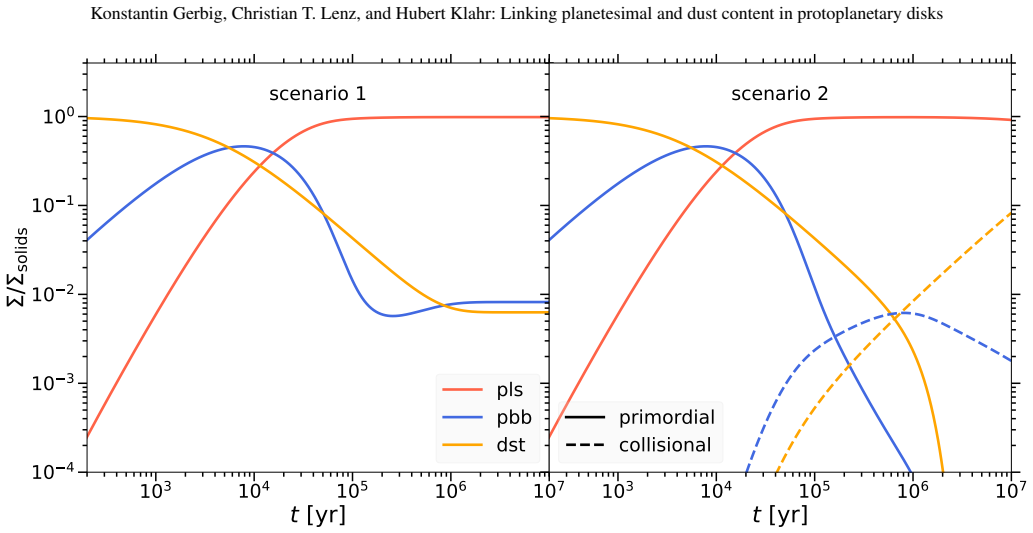
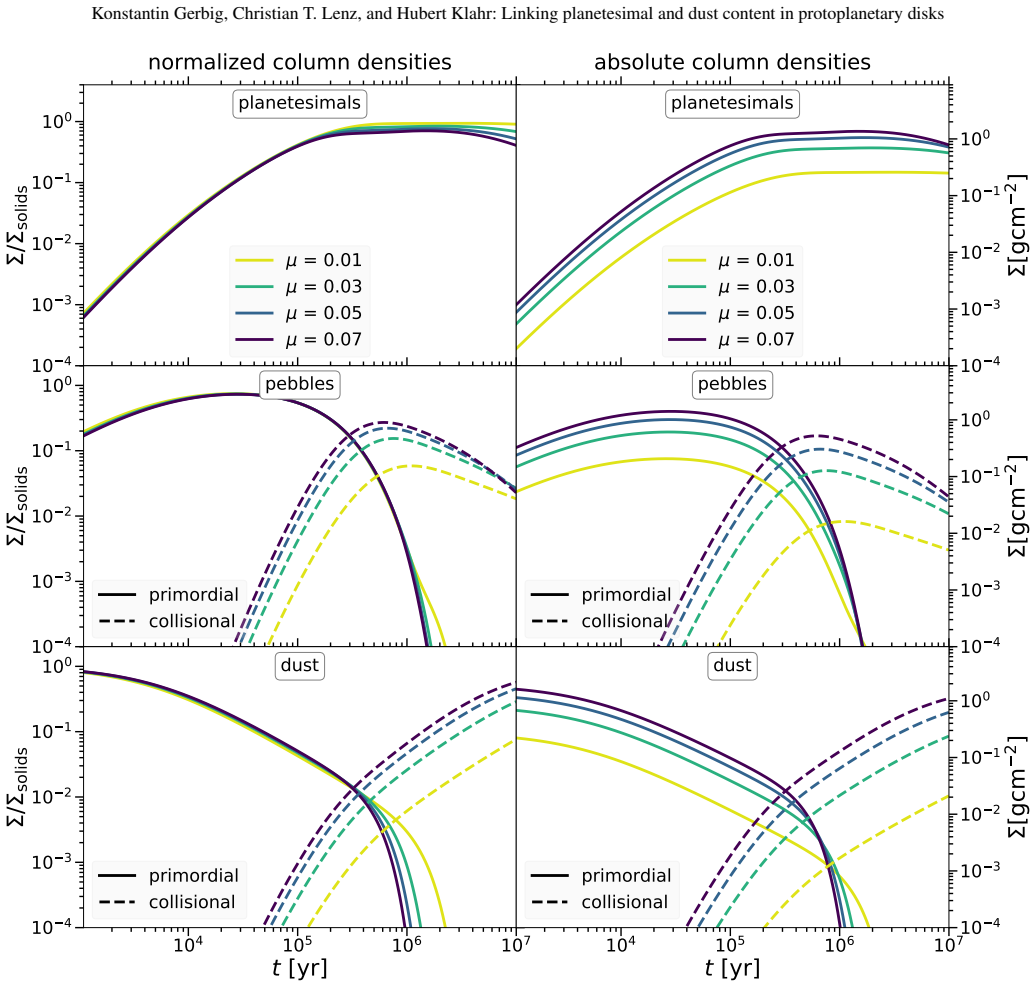
The load-bearing object is a closed set of coupled rate equations for the column densities of three solid species — dust, pebbles, and planetesimals — evolved at one radius while holding the total solid column density fixed, since radial transport is neglected. Three rates carry the argument: dust grows into pebbles on an exponential growth timescale from the two-population dust-growth model, with growth rate $\dot\Sigma_{\rm growth}=\Sigma_{\rm dst}/\tau_{\rm growth}\propto\Sigma_{\rm dst}^2$; pebbles are converted into planetesimals at the rate $\dot\Sigma_{\rm form}=|v_{\rm drift}|\,\Sigma_{\rm pbb}/l$, where the conversion length $l=d/\epsilon$ is the trap spacing divided by the trap efficiency; and planetesimals fragment collisionally at a rate $\dot\Sigma_{\rm col}\propto\Sigma_{\rm pls}^2$, with fragments distributed among the three species by a collisional-cascade power law of slope $\xi=1.83$. In the scenario used for the parameter study, collisional dust is treated as too compact to grow again, so the system never reaches equilibrium: primordial dust drains monotonically, planetesimals dominate for a phase, and collisional debris accumulates at late times. The identity that enables the mapping is strict local mass conservation, $\partial(\Sigma_{\rm dst}+\Sigma_{\rm pbb}+\Sigma_{\rm pls})/\partial t=0$, which ties any observed decrease in small-particle column density directly to the hidden planetesimal column density.
What would settle it
Measure the millimeter-sized dust mass of a sample of protoplanetary disks with well-determined ages in the range $10^4$–$10^6$ yr and compare it with the model's predicted small-particle fraction: the model predicts that by roughly $10^5$–$10^6$ yr the dust-and-pebble reservoir falls to a few percent of the initial solid mass (before collisions replenish it at later times), so disks of that age that still hold dust close to their initial dust reservoir would contradict fast, universal planetesimal formation.
Extended reading notes
Core claim
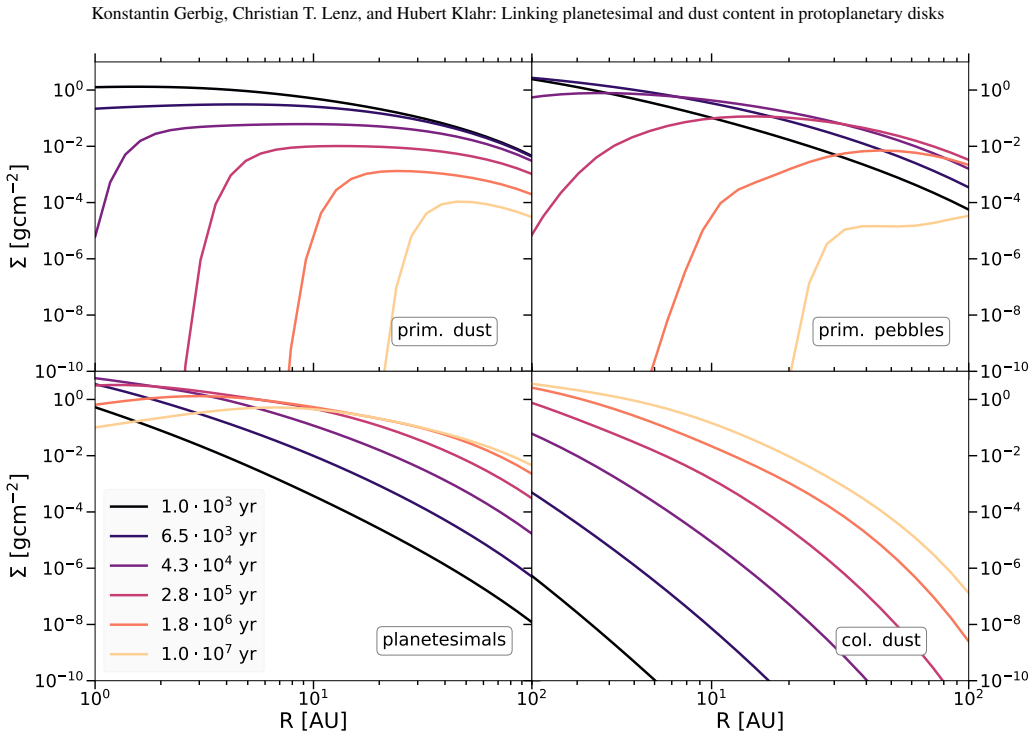
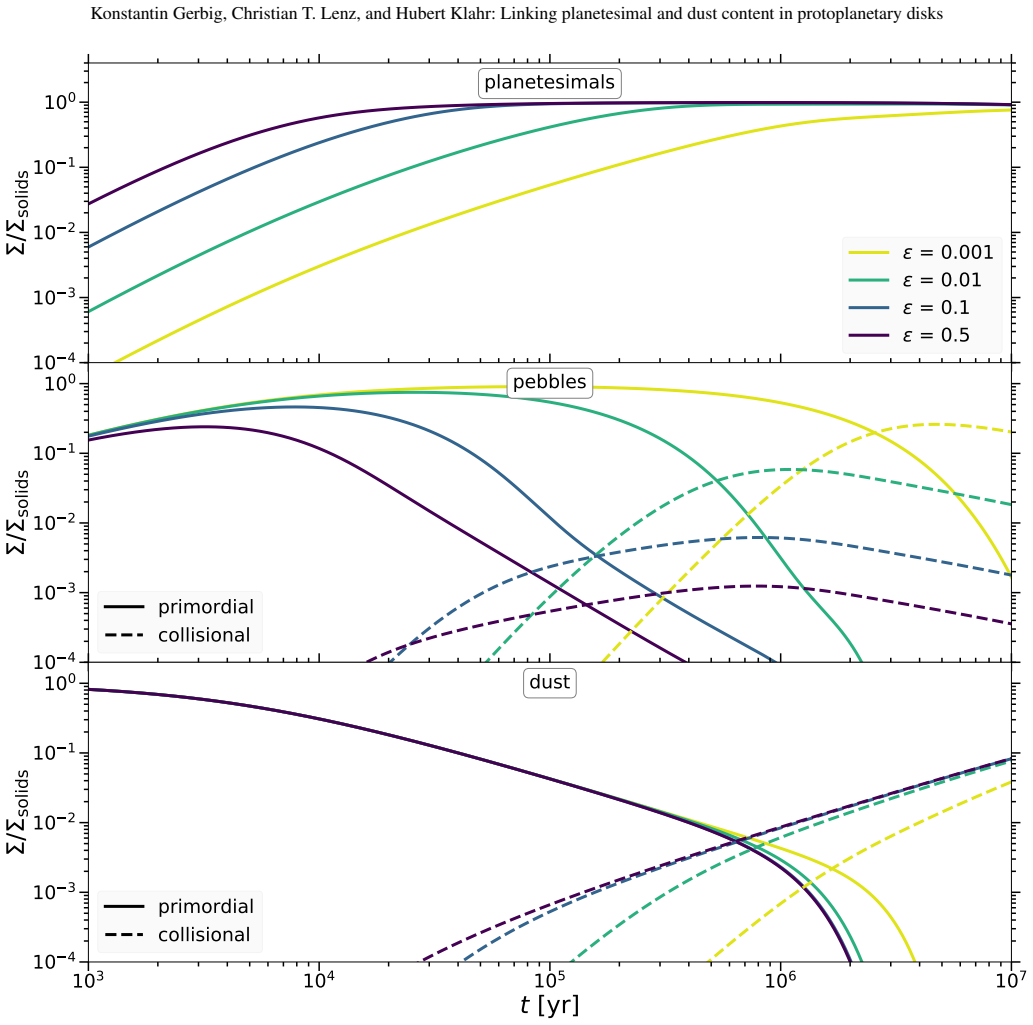
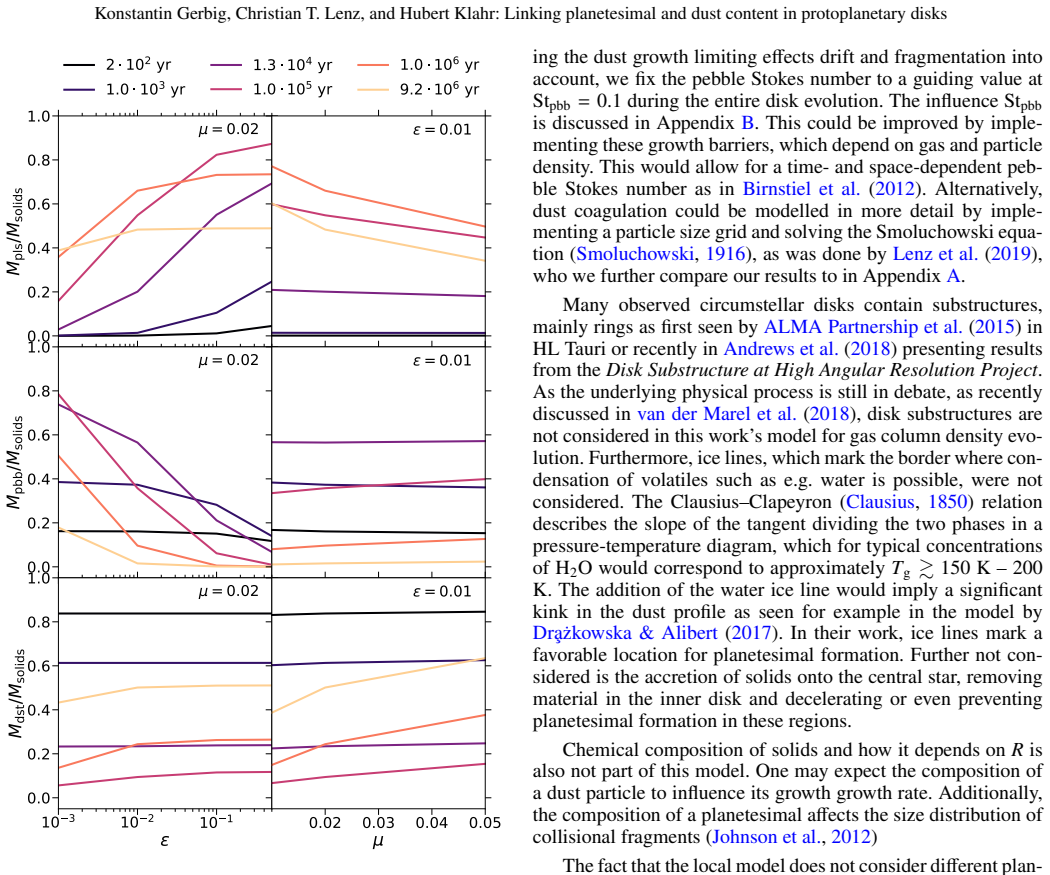
The paper's central claim is that planetesimals form quickly and at every radius in a protoplanetary disk: in the fiducial run the planetesimal column density exceeds 98% of the total solid column density starting around $5\times10^4$ yr, and across the explored parameters a planetesimal-dominated phase begins between roughly $10^4$ and $10^6$ yr. Planetesimal collisions take over after about $10^6$ yr and resupply dust and pebbles, so a late disk can look dust-rich even though most of its mass was once locked in large bodies. The authors therefore propose a conditional relation between observables and hidden mass: given the formation efficiency $\epsilon$ and an independent estimate of the total disk mass, the observed dust-and-pebble fraction at a known disk age determines how much mass sits in planetesimals, with more observed dust implying relatively less mass in large bodies. Quantitatively, the timing of the planetesimal-dominated phase and its peak mass depend strongly on the distance to the star $R$, the initial disk mass, and $\epsilon$, and more massive disks end up with lower relative planetesimal fractions because their stronger collision activity recycles solids back into small particles.
Load-bearing premise
Pebbles must be converted into planetesimals faster than they drift inward toward the star; if conversion is too slow, solid material cannot be treated as staying at one radius, and the predicted timescales and mass fractions change.
Editorial extensions
If this is right
- Because planetesimals can absorb more than 98% of the solid column density within $10^5$–$10^6$ yr, millimeter-continuum dust mass is not a proxy for the total solid mass of a disk.
- After roughly $10^6$ yr, planetesimal collisions resupply dust and pebbles, so an older disk can appear dust-rich even though its solids were earlier locked in planetesimals; dust-based mass estimates must include the collision channel.
- For a fixed formation efficiency, the observed dust-and-pebble fraction at a known disk age, plus an independent total disk mass, determines the hidden planetesimal mass — more observed dust implies relatively less mass in planetesimals.
- Planetesimal formation proceeds inside-out: the inner disk depletes its pebbles and forms planetesimals first, and the peak planetesimal column density migrates outward with time.
- More massive disks have lower relative planetesimal fractions because their higher collision rates recycle solids back into small fragments sooner; the lowest-mass disks in the study convert solids into planetesimals most efficiently.
Reading between the lines
- Editorial inference: the 'over 98% within about $10^5$ yr' result is a model prediction tied to the chosen trap parameters, not an observed fact; comparing millimeter dust masses of roughly 1 Myr-old disks against the predicted small-particle fraction would directly bracket the effective trap efficiency $\epsilon$.
- Editorial inference: the model exposes a practical degeneracy — pairs of formation efficiency and disk mass can give nearly identical dust evolution, so real observations constrain a curve of hidden planetesimal mass rather than a single value unless total disk mass is measured independently.
- Editorial inference: the omitted process with the largest lever is inward pebble drift; a transport-inclusive version of the model should delay planetesimal growth in the outer disk, which would turn the inferred planetesimal masses into upper limits for disks near 1 Myr.
- Editorial inference: the two scenarios diverge only after about $10^6$ yr, so multi-wavelength observations separating small grains from larger pebbles in older disks could test whether collisional fragments regrow or stay inert.
Signed reviews
Editorial analysis
A structured set of objections, weighed in public.
Referee Report
Summary. The paper formulates a 0-dimensional, local model of solid evolution in a protoplanetary disk, coupling dust growth to pebbles (Birnstiel et al. 2012), pebble-flux-regulated planetesimal formation (Lenz et al. 2019), and destructive planetesimal collisions. The model is written as a small set of coupled ODEs for the column densities of dust, pebbles, and planetesimals, with two scenarios for whether collisional dust can regrow. The authors integrate the model locally for a grid of radii and combine the solutions to estimate global mass fractions. They report that planetesimals form quickly and everywhere, dominate the solid mass after roughly 10^4–10^6 yr depending on parameters, and that collisions later resupply dust and pebbles. They propose that, for a given planetesimal-formation efficiency, the observed dust content and disk age can be mapped to the hidden planetesimal mass.
Significance. If the central claims survive scrutiny, the paper offers a simple heuristic tool for estimating unobservable planetesimal mass from observable dust mass and age, and a clear framework for testing how trapping efficiency and disk mass affect the solid inventory. Its strengths are the transparent derivation of the rate equations from cited models, the explicit two-scenario treatment, a parameter study that spans relevant disk conditions, and an honest limitations section. The main quantitative conclusions are, however, contingent on the locality assumption and on the unconstrained efficiency parameter, and the default parameter set lies outside the regime where the locality assumption is valid; the paper is therefore best viewed as a conceptual toy model at present rather than a calibrated predictor.
major comments (3)
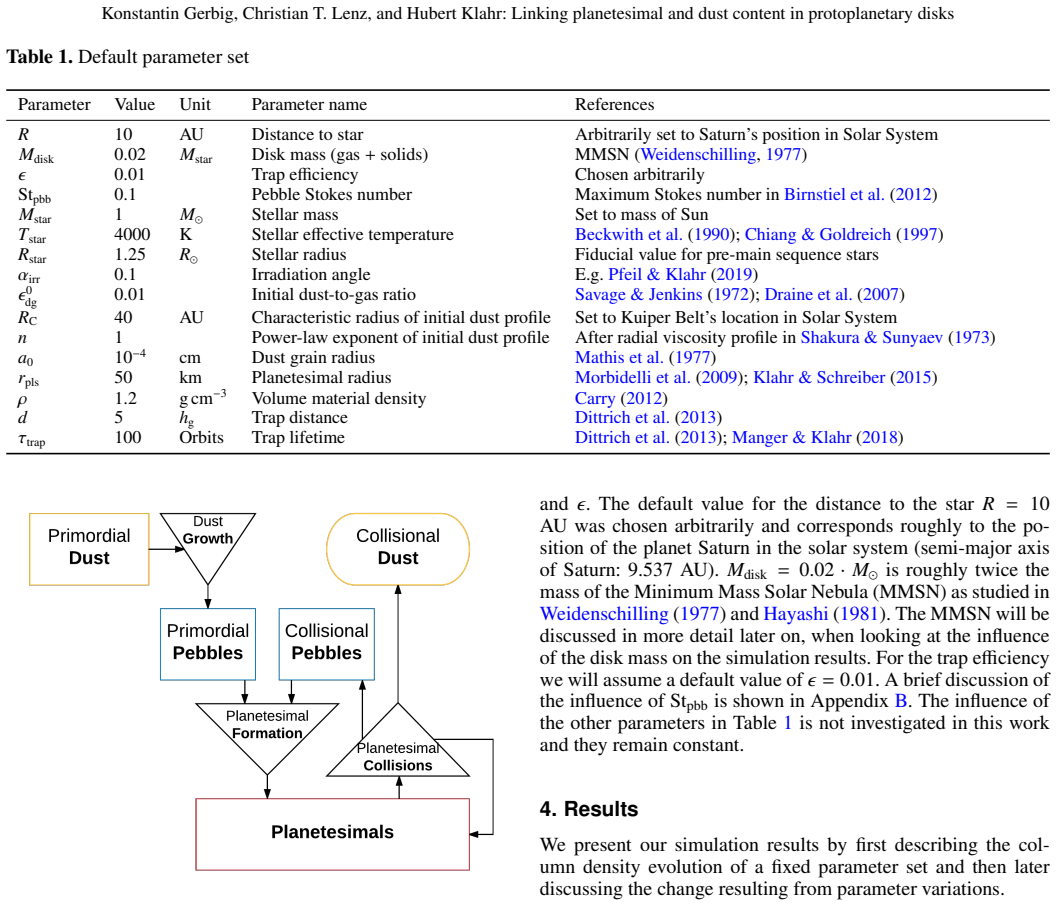
- [Introduction, §2.3, §5 (Eqs. (2), (18), (20), (21); Table 1; Figs. 4–7)] The model's own validity condition is that radial transport can be neglected only when pebble conversion into planetesimals is faster than inward drift. Using the paper's expressions, with the default parameters R=10 AU, St_pbb=0.1, eps=0.01, and d=5 h_g, the conversion length l=d/eps is approximately 250 AU, whereas a pebble drifting at the speed in Eq. (18) traverses only about 10 AU in the same time; equivalently, the conversion timescale is about 1.9e5 yr and the drift timescale is about 7.5e3 yr. The conversion length thus exceeds the drift length by roughly a factor of 25, so the no-transport assumption behind Eq. (2) fails for the default parameters and for most of the parameter space explored in Figs. 4–7 (eps=0.001–0.5 at R=10 AU). Because the reported onset times, maximal planetesimal fractions, and the dust-to-planetesimal mapping in Section 6 all depend on the local pebble supply, this is a load-bearing inconsistency, not merely a limitation; the authors should either restrict the study to the self-consistent regime (approximately eps ≥ 0.25 at 10 AU with the default disk parameters) or include the radial advection term and revisit the results.
- [§4.2.3] The sentence "Less massive disks have a lower relative planetesimal fraction than more massive disks" is the opposite of the abstract's finding that planetesimal collisions are more significant in more massive disks and lead to lower relative planetesimal fractions compared to less massive disks; it also contradicts the bullet summary in Section 6 and the trend visible in Fig. 5, top-left panel. This appears to be a sign error in the wording, but because it is one of the paper's headline parameter-study results, it must be corrected and checked against the figure.
- [Appendix A] The only direct benchmark, Appendix A, shows that the two-population growth model makes planetesimal formation set in earlier than in Lenz et al. (2019), which includes radial transport and a resolved size grid. Since the paper's central timescales (e.g., planetesimal dominance by 10^4–10^6 yr) feed directly into the proposed age-based mapping in Section 6, the authors should state explicitly whether the predicted onset times are to be read as lower limits and should quantify the offset from a transport-including model.
minor comments (3)
- [Table 1, Fig. 2, Fig. 4] The default parameter set is inconsistently reported: Table 1 lists eps=0.01 and Mdisk=0.02 M_sun, while Fig. 2 and Section 4.1 use eps=0.1 and Mdisk=0.01, and Fig. 4 also says Mdisk=0.01. The default set should be defined once and used consistently in captions and text.
- [Eq. (C.5)] Equation (C.5) appears to have a bracket or formatting error in the printed polynomial; check the typesetting.
- [Section 5] The limitations paragraph correctly identifies the locality assumption as a strong limitation, but the abstract and conclusions do not hedge the headline claims accordingly; consider adding a sentence that the quantitative mapping is only valid where the local approximation holds.
Circularity Check
No significant circularity: this is a self-contained forward 0-d parameter study whose results are explicitly conditional on the openly stated input epsilon; the only exhibit-able reduction is the disclosed locality-regime violation at the default parameters, not a hidden fit.
-
other
[Introduction (locality premise); Sect. 2.3, Eqs. (20)-(21); Table 1; Sect. 5 (limitations)]
"we ignore spatial transport of material, which is only important if inward drift of pebbles occurs on shorter timescales than their transformation into planetesimals. ... its locality and the resulting absence of spatial transport of material constitutes a strong limitation, as our model can not currently cover scenarios where the pebble drift timescale is shorter than the conversion timescale for pebbles into planetesimals."
Section 5 concedes the model can not cover scenarios where the pebble drift timescale is shorter than the conversion timescale, yet that is exactly the default regime. The conversion timescale is set by the paper's own Eqs. (20)-(21) to l/|v_drift| with l := d/epsilon and epsilon chosen arbitrarily (Table 1). At the default R = 10 AU, epsilon = 0.01, St_pbb = 0.1, Eq. (18) gives |v_drift| ~ 630 cm/s, so R/|v_drift| ~ 7.5e3 yr while l/|v_drift| ~ 1.9e5 yr: conversion is about 25 times slower than drift, and the locality premise under which Eq. (2) and the whole dust-to-planetesimal mapping hold fails. The headline that planetesimals form fast and everywhere and the claimed mapping are thus construction-level outputs of the arbitrarily chosen epsilon in a regime the paper itself excludes.
full rationale
The derivation is a self-contained forward parameter study and is not circular in the load-bearing sense. No quantity is fitted to the results it explains: the trap efficiency epsilon, the pebble Stokes number, the trap distance d, and the trap lifetime are stated inputs (Table 1), and the paper explicitly frames its mapping as conditional ('For a given epsilon, we were able to relate...'). The coupled rate equations (35a)-(35c) and (37a)-(37e) conserve total solids by construction (Eq. 36), and the reported mass fractions emerge from integrating the stated rates rather than from tuning to a target outcome. The planetesimal-formation prescription is adopted via citation from Lenz et al. (2019), whose authors overlap with two of the present authors; however, that recipe is a transparently parameterized input (l := d/epsilon, formation rate = |v_drift| times Sigma_pbb / l) with its own stated physical assumptions, and the present paper does not invoke the citation to certify its conclusions, so this is a minor same-group citation rather than a circular justification. Appendix A's comparison to Lenz et al. (2019) is an internal consistency check between two models sharing the formation prescription and does not raise the independent-support bar. The one exhibit-able reduction is the locality-regime inconsistency in the step: Section 5 discloses that the model cannot cover scenarios where the pebble drift timescale is shorter than the conversion timescale, and the default parameters realize exactly that scenario (conversion about 25 times slower than drift at R = 10 AU, epsilon = 0.01). This is a genuine and significant correctness/scope risk for the headline fast-and-everywhere claim and for the resulting dust-to-planetesimal mapping, and it should be weighed heavily when assessing the paper's conclusions; but because the authors disclose it and because it is a regime violation rather than a hidden identification of output with input, it does not raise the circularity score beyond 2.
Assumptions & free parameters
free parameters (6)
- epsilon (trap efficiency) =
0.01 (default); varied 0.001-0.5
- St_pbb (pebble Stokes number) =
0.1 (fixed; sensitivity in App. B)
- d (trap distance) =
5 h_g
- tau_trap (trap lifetime) =
100 orbits
- r_pls (planetesimal radius) =
50 km
- epsilon_dg (initial dust-to-gas ratio) =
0.01
assumptions (8)
- domain assumption Two-population dust model of Birnstiel et al. (2012) adequately represents the dust size distribution.
- domain assumption Pebble flux-regulated planetesimal formation recipe of Lenz et al. (2019) is a valid description of trap-based planetesimal formation.
- domain assumption Radial transport of pebbles and gas can be neglected over 10^7 yr.
- domain assumption Gas column density is constant in time; no viscous evolution or photoevaporation.
- domain assumption The pebble Stokes number is constant at St_pbb=0.1.
- domain assumption All planetesimals are monodisperse 100 km bodies that do not grow or accrete pebbles.
- ad hoc to paper Collisional dust is too compact to grow back into pebbles (scenario 2).
- domain assumption Dohnanyi exponent xi=1.83 describes the fragment mass distribution of planetesimal collisions.
Cite this review
Pith. "Pith review of Linking planetesimal and dust content in protoplanetary disks via a local toy model." pith.science (2026). https://pith.science/paper/IRYZFRLP
@misc{pith2026190802608,
  author       = {Pith},
  title        = {Pith review of: Linking planetesimal and dust content in protoplanetary disks via a local toy model},
  year         = {2026},
  howpublished = {\url{https://pith.science/paper/IRYZFRLP}},
  note         = {Machine review of arXiv:1908.02608}
}
abstract
If planetesimal formation is an efficient process, as suggested by several models involving gravitational collapse of pebble clouds, then, before long, a significant part of the primordial dust mass should be absorbed in many km sized objects. A good understanding of the total amount of solids in the disk around a young star is crucial for planet formation theory. But as the mass of particles above the mm size cannot be assessed observationally, one must ask how much mass is hidden in bigger objects. We perform 0-d local simulations to study how the planetesimal to dust and pebble ratio is evolving in time and to develop an understanding of the potentially existing mass in planetesimals for a certain amount of dust and pebbles at a given disk age. We perform a parameter study based on a model considering dust growth, planetesimal formation and collisional fragmentation of planetesimals, while neglecting radial transport processes. While at early times, dust is the dominant solid particle species, there is a phase during which planetesimals make up a significant portion of the total mass starting at approximately $10^4 - 10^6$ yr. The time of this phase and the maximal total planetesimal mass strongly depend on the distance to the star $R$, the initial disk mass, and the efficiency of planetesimal formation $\epsilon$. After approximately $10^6$ yr, our model predicts planetesimal collisions to dominate, which resupplies small particles. In our model, planetesimals form fast and everywhere in the disk. For a given $\epsilon$, we were able to relate the dust content and mass of a given disk to its planetesimal content, providing us with some helpful basic intuition about mass distribution of solids and its dependence on underlying physical processes.
Figures
Figures from the paper (4 more)

Reference graph
Works this paper leans on
-
[1]
, " * write output.state after.block = add.period write newline
ENTRY address archiveprefix author booktitle chapter edition editor howpublished institution eprint journal key month note number organization pages publisher school series title type volume year label extra.label sort.label short.list INTEGERS output.state before.all mid.sentence after.sentence after.block FUNCTION init.state.consts #0 'before.all := #1 ...
-
[2]
write newline
" write newline "" before.all 'output.state := FUNCTION n.dashify 't := "" t empty not t #1 #1 substring "-" = t #1 #2 substring "--" = not "--" * t #2 global.max substring 't := t #1 #1 substring "-" = "-" * t #2 global.max substring 't := while if t #1 #1 substring * t #2 global.max substring 't := if while FUNCTION word.in bbl.in " " * FUNCTION format....
-
[3]
L., P \'e rez , L
ALMA Partnership , Brogan , C. L., P \'e rez , L. M., et al. 2015, , 808, L3
2015
-
[4]
M., Huang , J., P \'e rez , L
Andrews , S. M., Huang , J., P \'e rez , L. M., et al. 2018, , 869, L41
2018
-
[5]
M., Rosenfeld , K
Andrews , S. M., Rosenfeld , K. A., Kraus , A. L., & Wilner , D. J. 2013, , 771, 129
2013
-
[6]
M., Wilner, D
Andrews, S. M., Wilner, D. J., Hughes, A. M., Qi, C., & Dullemond, C. P. 2009, , 700, 1502
2009
-
[7]
M., Wilner, D
Andrews, S. M., Wilner, D. J., Hughes, A. M., Qi, C., & Dullemond, C. P. 2010, , 723, 1241
2010
-
[8]
P., van der Marel , N., et al
Ansdell , M., Williams , J. P., van der Marel , N., et al. 2016, , 828, 46
2016
Show all 104 references
-
[9]
Balbus, S. A. & Hawley, J. F. 1998, Rev. Mod. Phys., 70, 1
1998
-
[10]
Beckwith , S. V. W., Sargent , A. I., Chini , R. S., & Guesten , R. 1990, , 99, 924
1990
-
[11]
P., & Brauer, F
Birnstiel, T., Dullemond, C. P., & Brauer, F. 2009, A&A, 503, L5
2009
-
[12]
P., & Brauer , F
Birnstiel , T., Dullemond , C. P., & Brauer , F. 2010, , 513, A79
2010
-
[13]
2016, Space Science Reviews, 205, 41
Birnstiel, T., Fang, M., & Johansen, A. 2016, Space Science Reviews, 205, 41
2016
-
[14]
2012, , 539, A148
Birnstiel , T., Klahr , H., & Ercolano , B. 2012, , 539, A148
2012
-
[15]
& M \"u nch , M
Blum , J. & M \"u nch , M. 1993, , 106, 151
1993
-
[16]
& Wurm , G
Blum , J. & Wurm , G. 2008, , 46, 21
2008
-
[17]
F., Durda, D
Bottke, W. F., Durda, D. D., Nesvorný, D., et al. 2005, Icarus, 175, 111
2005
-
[18]
P., & Henning , T
Brauer , F., Dullemond , C. P., & Henning , T. 2008, , 480, 859
2008
-
[19]
Carrera , D., Johansen , A., & Davies , M. B. 2015, , 579, A43
2015
-
[20]
2012, , 73, 98
Carry , B. 2012, , 73, 98
2012
-
[21]
Chiang, E. I. & Goldreich, P. 1997, , 490, 368
1997
-
[22]
Chokshi , A., Tielens , A. G. G. M., & Hollenbach , D. 1993, , 407, 806
1993
-
[23]
1850, Annalen der Physik, 155, 500
Clausius , R. 1850, Annalen der Physik, 155, 500
-
[24]
N., Hogan, R
Cuzzi, J. N., Hogan, R. C., & Shariff, K. 2008, , 687, 1432
2008
-
[25]
2017, Science, 357, 1026
Delbo , M., Walsh, K., Bolin, B., Avdellidou, C., & Morbidelli, A. 2017, Science, 357, 1026
2017
-
[26]
2013, , 763, 117
Dittrich, K., Klahr, H., & Johansen, A. 2013, , 763, 117
2013
-
[27]
Dohnanyi , J. S. 1969, , 74, 2531
1969
-
[28]
T., Dale , D
Draine , B. T., Dale , D. A., Bendo , G., et al. 2007, , 663, 866
2007
-
[29]
& Alibert , Y
Dr a \.z kowska , J. & Alibert , Y. 2017, , 608, A92
2017
-
[30]
2016, , 594, A105
Dr a \.z kowska , J., Alibert , Y., & Moore , B. 2016, , 594, A105
2016
-
[31]
J., Klahr , H., & Henning , T
Dzyurkevich , N., Flock , M., Turner , N. J., Klahr , H., & Henning , T. 2010, , 515, A70
2010
-
[32]
Epstein, P. S. 1924, Phys. Rev., 23, 710
1924
-
[33]
J., & Drake, J
Ercolano, B., Clarke, C. J., & Drake, J. J. 2009, , 699, 1639
2009
-
[34]
E., Henning , T., Jayawardhana , R., & Oliveira , J
Fedele , D., van den Ancker , M. E., Henning , T., Jayawardhana , R., & Oliveira , J. M. 2010, , 510, A72
2010
-
[35]
M., Hughes , A
Flaherty , K. M., Hughes , A. M., Rose , S. C., et al. 2017, , 843, 150
2017
-
[36]
P., Turner , N
Flock , M., Nelson , R. P., Turner , N. J., et al. 2017, , 850, 131
2017
-
[37]
C., Brown, M
Fraser, W. C., Brown, M. E., Morbidelli, A., Parker, A., & Batygin, K. 2014, , 782, 100
2014
-
[38]
1977, , 31, 277
Fujiwara , A., Kamimoto , G., & Tsukamoto , A. 1977, , 31, 277
1977
-
[39]
2004, Annual Review of Astronomy and Astrophysics, 42, 549
Goldreich, P., Lithwick, Y., & Sari, R. 2004, Annual Review of Astronomy and Astrophysics, 42, 549
2004
-
[40]
& Ward , W
Goldreich , P. & Ward , W. R. 1973, , 183, 1051
1973
-
[41]
1981, Progress of Theoretical Physics Supplement, 70, 35
Hayashi , C. 1981, Progress of Theoretical Physics Supplement, 70, 35
1981
-
[42]
2007, , 662, 1067
Hern \'a ndez , J., Hartmann , L., Megeath , T., et al. 2007, , 662, 1067
2007
-
[43]
Hill, G. W. 1878, American Journal of Mathematics, 1, 5
-
[44]
& Nakamoto, T
Homma, K. & Nakamoto, T. 2018, , 868, 118
2018
-
[45]
& Guillot , T
Hueso , R. & Guillot , T. 2005, A&A, 442, 703
2005
-
[46]
& Klahr , H
Johansen , A. & Klahr , H. 2005, , 634, 1353
2005
-
[47]
2006, , 636, 1121
Johansen, A., Klahr, H., & Henning, T. 2006, , 636, 1121
2006
-
[48]
S., Mac Low , M.-M., et al
Johansen , A., Oishi , J. S., Mac Low , M.-M., et al. 2007, , 448, 1022
2007
-
[49]
& Youdin, A
Johansen, A. & Youdin, A. 2007, , 662, 627
2007
-
[50]
V., Mousis, O., Lunine, J
Johnson, T. V., Mousis, O., Lunine, J. I., & Madhusudhan, N. 2012, , 757, 192
2012
-
[51]
2013, , 557, L4
Kataoka , A., Tanaka , H., Okuzumi , S., & Wada , K. 2013, , 557, L4
2013
-
[52]
& Bodenheimer , P
Klahr , H. & Bodenheimer , P. 2006, , 639, 432
2006
-
[53]
& Hubbard , A
Klahr , H. & Hubbard , A. 2014, , 788, 21
2014
-
[54]
2018, Instabilities and Flow Structures in Protoplanetary Disks: Setting the Stage for Planetesimal Formation , 138
Klahr , H., Pfeil , T., & Schreiber , A. 2018, Instabilities and Flow Structures in Protoplanetary Disks: Setting the Stage for Planetesimal Formation , 138
2018
-
[55]
& Schreiber, A
Klahr, H. & Schreiber, A. 2015, in Proceedings of the International Astronomical Union, Vol. 10, Asteroids: New Observations, New Models , 1--8
2015
-
[56]
Klahr, H. H. & Bodenheimer, P. 2003, , 582, 869
2003
-
[57]
2016, , 817, 105
Kobayashi, H., Tanaka, H., & Okuzumi, S. 2016, , 817, 105
2016
-
[58]
& Ida, S
Kokubo, E. & Ida, S. 2002, , 581, 666
2002
-
[59]
& Ida , S
Kokubo , E. & Ida , S. 2012, Progress of Theoretical and Experimental Physics, 2012, 01A308
2012
-
[60]
F., & R \'o \.z yczka , M
Kornet , K., Stepinski , T. F., & R \'o \.z yczka , M. 2001, , 378, 180
2001
-
[61]
W., Dominik , C., & Tielens , A
Krijt , S., Ormel , C. W., Dominik , C., & Tielens , A. G. G. M. 2016, , 586, A20
2016
-
[62]
A., et al
Lambrechts , M., Morbidelli , A., Jacobson , S. A., et al. 2019, arXiv e-prints, arXiv:1902.08694
2019 arXiv
-
[63]
Leinhardt , Z. M. & Stewart , S. T. 2009, , 199, 542
2009
-
[64]
T., Klahr, H., & Birnstiel, T
Lenz, C. T., Klahr, H., & Birnstiel, T. 2019, , 874, 36
2019
-
[65]
F., Duncan , M
Levison , H. F., Duncan , M. J., & Thommes , E. 2012, , 144, 119
2012
-
[66]
1952, Zeitschrift für Naturforschung A, 7, 87
L\"ust , R. 1952, Zeitschrift für Naturforschung A, 7, 87
1952
-
[67]
& Pringle , J
Lynden-Bell , D. & Pringle , J. E. 1974, , 168, 603
1974
-
[68]
Mamajek , E. E. 2009, in American Institute of Physics Conference Series, Vol. 1158, American Institute of Physics Conference Series, ed. T. Usuda , M. Tamura , & M. Ishii , 3--10
2009
-
[69]
& Klahr , H
Manger , N. & Klahr , H. 2018, , 480, 2125
2018
-
[70]
S., Rumpl , W., & Nordsieck , K
Mathis , J. S., Rumpl , W., & Nordsieck , K. H. 1977, , 217, 425
1977
-
[71]
F., Nesvorný, D., & Levison, H
Morbidelli, A., Bottke, W. F., Nesvorný, D., & Levison, H. F. 2009, Icarus, 204, 558
2009
-
[72]
1986, , 67, 375
Nakagawa , Y., Sekiya , M., & Hayashi , C. 1986, , 67, 375
1986
-
[73]
2018, , 865, 75
Nakatani, R., Hosokawa, T., Yoshida, N., Nomura, H., & Kuiper, R. 2018, , 865, 75
2018
-
[74]
P., Gressel , O., & Umurhan , O
Nelson , R. P., Gressel , O., & Umurhan , O. M. 2013, , 435, 2610
2013
-
[75]
N., Simon , J
Nesvorny , D., Li , R., Youdin , A. N., Simon , J. B., & Grundy , W. M. 2019, arXiv e-prints, arXiv:1906.11344
2019 arXiv
-
[76]
F., Noll, K., & Levison, H
Nesvorn \' y , D., Vokrouhlick \' y , D., Bottke, W. F., Noll, K., & Levison, H. F. 2011, The Astronomical Journal, 141, 159
2011
-
[77]
Ormel, C. W. 2017, The Emerging Paradigm of Pebble Accretion (Cham: Springer International Publishing), 197--228
2017
-
[78]
Ormel , C. W. & Klahr , H. H. 2010, , 520, A43
2010
-
[79]
W., Spaans , M., & Tielens , A
Ormel , C. W., Spaans , M., & Tielens , A. G. G. M. 2007, , 461, 215
2007
-
[80]
E., Ercolano , B., & Clarke , C
Owen , J. E., Ercolano , B., & Clarke , C. J. 2011, , 412, 13
2011
-
[81]
J., et al
Pascucci , I., Testi , L., Herczeg , G. J., et al. 2016, , 831, 125
2016
-
[82]
& Dominik , C
Paszun , D. & Dominik , C. 2009, , 507, 1023
2009
-
[83]
2014, , 793, L34
Pfalzner, S., Steinhausen, M., & Menten, K. 2014, , 793, L34
2014
-
[84]
& Klahr , H
Pfeil , T. & Klahr , H. 2019, , 871, 150
2019
-
[85]
E., & Weber , M
Picogna , G., Ercolano , B., Owen , J. E., & Weber , M. L. 2019, arXiv e-prints, arXiv:1904.02752
2019 arXiv
-
[86]
Pringle , J. E. 1981, , 19, 137
1981
-
[87]
M., Murray-Clay , R
Rosenthal , M. M., Murray-Clay , R. A., Perets , H. B., & Wolansky , N. 2018, , 861, 74
2018
-
[88]
Safronov, V. S. 1969, Evolution of the protoplanetary cloud and formation of the earth and planets (Nauka Press), english translation (1972), NASA TTF 677
1972
-
[89]
L., Guilera , O
San Sebasti \'a n , I. L., Guilera , O. M., & Parisi , M. G. 2019, arXiv e-prints, arXiv:1903.12288
2019 arXiv
-
[90]
Savage , B. D. & Jenkins , E. B. 1972, , 172, 491
1972
-
[91]
Shakura , N. I. & Sunyaev , R. A. 1973, , 24, 337
1973
-
[92]
& Cuzzi, J
Shariff, K. & Cuzzi, J. N. 2015, , 805, 42
2015
-
[93]
B., Armitage , P
Simon , J. B., Armitage , P. J., Li , R., & Youdin , A. N. 2016, , 822, 55
2016
-
[94]
Smoluchowski , M. V. 1916, Zeitschrift fur Physik, 17, 557
1916
-
[95]
& Hopkins , P
Squire , J. & Hopkins , P. F. 2018, , 477, 5011
2018
-
[96]
Stepinski , T. F. & Valageas , P. 1997, , 319, 1007
1997
-
[97]
M., Estrada , P
Umurhan , O. M., Estrada , P. R., & Cuzzi , J. N. 2019, arXiv e-prints, arXiv:1906.05371
2019 arXiv
-
[98]
& Brandenburg , A
Urpin , V. & Brandenburg , A. 1998, , 294, 399
1998
-
[99]
Weizs \"a cker , C
v. Weizs \"a cker , C. F. 1948, Zeitschrift Naturforschung Teil A, 3, 524
1948
-
[100]
P., & Bruderer, S
van der Marel, N., Williams, J. P., & Bruderer, S. 2018, Letters, 867, L14
2018
-
[101]
Weidenschilling , S. J. 1977, , 51, 153
1977
-
[102]
Wetherill , G. W. & Stewart , G. R. 1993, , 106, 190
1993
-
[103]
Youdin, A. N. & Goodman, J. 2005, , 620, 459
2005
-
[104]
V., Pechernikova , G
Zvyagina , E. V., Pechernikova , G. V., & Safronov , V. S. 1974, , 17, 793
1974
Reviewed August 14, 2026 · model on record in the stance chip above.
Discussion (0). Continue with ORCID to comment.