REVIEW 5 major objections 5 minor 20 references
Paired-Consistency: An Example-Based Model-Agnostic Approach to Fairness Regularization in Machine Learning
T0 review · 5 major / 5 minor · reviewed 2026-08-14 · deepseek-v4-flash
Pith's one-line read Pairing similar people lets a fairness regularizer reduce a model's reliance on protected attributes without explicit access to them.
desk verdict Paired-consistency is a clean, well-presented fairness regularizer for settings without protected attributes, but the experiments generate pairs with the protected attribute in hand, so the hard part of the claim is untested. read the letter →
The pith
A machine-rendered reading of the paper's core claim, the machinery that carries it, and where it could break.
The reading
What carries the argument
The load-bearing object is the consistency set: $M$ pairs of examples supplied by a fair domain expert, each pair differing on a protected attribute or construct yet judged to warrant the same model response. Around this set the paper builds a paired-consistency score: for classification, the fraction $\frac{1}{M}\sum_{j=1}^{M} I[\hat{y}^{(j)}_1 = \hat{y}^{(j)}_2]$; for regression, $1 - \frac{1}{M\delta_{\max}}\sum_{j=1}^{M}(\hat{y}^{(j)}_1 - \hat{y}^{(j)}_2)^2$; and a confidence-weighted variant (Equation 3). This score is the mechanism that carries the argument: as a regularizer it penalizes the model exactly where fairness, as judged by the expert, requires identical treatment, and as a post-hoc metric it ranks models by their adherence to that requirement. The tree variant encodes the same idea locally by rewarding splits that keep both members of each pair in the same child node.
What would settle it
Generate consistency pairs from actual human experts on a dataset with a known protected attribute, train with paired-consistency regularization while excluding the protected attribute from the features, and compare demographic-parity and equal-opportunity gaps against an unregularized baseline; if the gaps do not shrink, or if experts' disagreements produce worse fairness than no regularization, the load-bearing expert assumption is refuted. A sharper check: on the same Census Income setup, measure whether the fairness improvement persists when the protected attribute is fully hidden and only correlated proxies remain.
Extended reading notes
Core claim
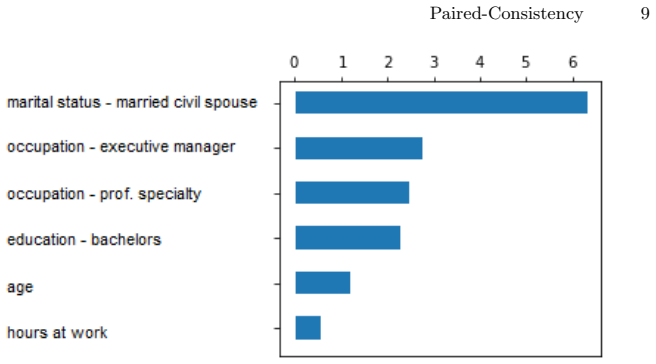
The central claim is that constraining a model to agree on a set of expert-judged pairs of examples is enough to suppress the model's use of protected information. The paper defines paired consistency as the fraction of consistency pairs on which the model assigns the same class (for classification) or a normalized squared-error closeness (for regression), and shows two ways to use it: as a regularizer, where the term is added to the loss or to a tree split criterion with a trade-off parameter, and as a post-hoc model-selection score, summarized by the PRC score, a weighted harmonic mean of precision, recall, and paired consistency. The Census Income experiments show that strengthening the regularizer monotonically reduces the importance rank of the protected variable age, that several hundred automatically generated pairs already capture most of the benefit, and that these fairness gains come with little or no accuracy loss in this dataset. The paper also compares the method against a prejudice-remover baseline and reports improvements on standard fairness metrics such as disparate impact, statistical parity difference, and equal opportunity difference.
Load-bearing premise
The method assumes a fair domain expert can reliably identify pairs of examples that differ on protected attributes but ought to receive the same prediction; if those pair judgments are incomplete or biased, the regularizer will encode a flawed notion of fairness, and the paper's experiments use automatically generated pairs rather than real expert labels.
Editorial extensions
If this is right
- With a fixed consistency set, raising the regularization weight monotonically lowers the protected feature's importance rank, reaching a plateau once all pairs are classified together (Table 2: rank 5 to 10 while accuracy rises from 82.9% to 83.0%).
- A few hundred consistency pairs are enough to capture most of the fairness benefit, which matters because expert pair labeling is costly (Table 3 and Table 5).
- The method applies to the two dominant model families: gradient-based training via a loss term and tree training via split-criterion augmentation.
- Paired consistency can double as a model-selection metric when regularization is not feasible, via the PRC score combining precision, recall, and paired consistency.
- Because the pair labels come from an expert and not from model internals, the method can be combined with other fairness techniques such as adversarial removal of protected information from learned representations.
Reading between the lines
- Editorial inference: if pair selection were made explicit as a distance or equivalence relation, paired consistency could be linked to Lipschitz-style individual fairness guarantees; the paper leaves that theoretical connection open.
- Editorial inference: the near-flat accuracy-fairness trade-off seen on Census Income is likely not universal; on datasets where the protected attribute is strongly predictive and entangled with many features, the same regularization should produce a steeper accuracy cost, and that is a testable prediction.
- Editorial inference: the choice of pairs determines which notion of fairness is optimized, so different pair-sampling strategies may collapse paired consistency onto demographic parity, equalized odds, or something new; the paper notes this as future work.
Editorial analysis
A structured set of objections, weighed in public.
Referee Report
Summary. The paper proposes paired-consistency, a model-agnostic fairness regularizer that uses a set of example pairs judged by a fair domain expert to warrant identical model responses despite differing on protected attributes. The authors define a paired-consistency score for classification and regression, show how to add it to gradient-descent and tree-split objectives, and report experiments on the Census Income dataset using automatically generated age-based pairs. They report that adding the regularizer reduces the feature-importance rank of age, leaves accuracy roughly unchanged or slightly improved, and improves a set of group and individual fairness metrics relative to baselines, including a prejudice-remover baseline.
Significance. If the empirical claims held up, this would be a useful contribution: the method addresses an under-served setting (no explicit protected attribute), is model-agnostic, and the pair-based formulation lets a domain expert encode fairness without formalizing a similarity metric. The manuscript is honest about its limitations, including the reliance on a fair domain expert and the toy nature of the automated pairs. The method is described clearly enough to implement, and the inclusion of external fairness metrics such as equalized-odds-related differences is a strength. However, the evidence base is currently too thin to support the central claims: one dataset, no error bars or significance tests, and a key assumption, namely the availability of reliable expert pairs, is never exercised experimentally.
major comments (5)
- [§3, Consistency pairs] Section 3 generates consistency pairs automatically by selecting individuals who are similar except for age, with an age gap of at least ten years, explicitly using the protected attribute that the method claims to avoid. This is an oracle construction: the setting the paper motivates in Section 2, in which no explicit protected attribute is available, is never tested. Since the reliability of a fair domain expert is a load-bearing assumption of the method, and the paper itself notes that "a fair domain expert will likely be necessary" in real use, the authors should either run a study with genuine expert-generated pairs or provide a sensitivity analysis with respect to pair noise, biased sampling, and expert disagreement; without this, the central advantage over methods requiring the protected attribute is unvalidated.
- [§3, Tables 4 and 5] The same configuration (logistic regression with paired-consistency regularization, eta = 0.4, 3,062 pairs) reports a paired-consistency score of 0.913 in Table 4 but 0.927 in Table 5. Because the paired-consistency score is the paper's headline metric, this discrepancy needs to be explained (for example, by different train/test splits or different pair subsets); as written, the evaluation protocol is not pinned down and the reported numbers are not reproducible.
- [§3, Tables 2-5] All experimental claims rest on single runs on a single dataset: no error bars, variance estimates, repeated trials, or significance tests are reported. In particular, the statement that accuracy is "virtually unaffected" (Section 3, discussion of Table 2) depends on differences of at most a few tenths of a percent; without any uncertainty quantification, the claim that fairness can be improved with little or no accuracy cost is not supported.
- [§2, Eq. (1)-(2); §3, Tables 2-3] The paired-consistency score is used both as the training objective and as a primary evaluation metric, so the near-perfect or perfect "pairs intact" values for regularized models are partly by construction. The paper should therefore lead with the external fairness metrics, such as statistical parity difference, equal opportunity difference, average odds difference, and disparate impact, when arguing for fairness gains rather than presenting 100% pair agreement as standalone evidence; the external metrics in Table 4 are the stronger part of the evidence.
- [§3, Table 4] Table 4 reports group-fairness metrics (statistical parity difference, disparate impact, equal opportunity difference, average odds difference) that are defined for a binary protected variable, but the manuscript never states how age was dichotomized to compute these metrics. Without this detail the numbers cannot be reproduced or compared across methods; this is a necessary protocol specification.
minor comments (5)
- [§3, Census Income] The description "similar in all other aspects except for age" is not operationalized; please specify the feature subset, the distance or matching criterion, and the exact procedure used to generate the 3,062 pairs.
- [Table 1; §3] There are typos: "differene" in Table 1 and "martial status" in Section 3; also "whereδmax" in Eq. (2) is missing a space and should be "where δ_max".
- [§2, PRC score] The PRC score is defined in Section 2 but is never used in the experiments; either use it in the evaluation or remove it to avoid a dangling definition.
- [Figure 3] The caption of Figure 3 does not explain the axes or the exact normalization; please describe what is plotted and how the fractional changes are computed.
- [References] Reference [16] for the eli5 package is incomplete, and the bibliographic details for [15] and [6] are sparse; please complete these entries.
Circularity Check
Paired-consistency is used both as the training objective and as the headline evaluation metric, so its reported gains are partly by construction; external fairness metrics provide independent but partial support.
-
fitted input called prediction
[Section 2 (paired-consistency score, Eqs. 1-2, and its embedding in the loss) and Tables 4-5 ('Paired consistency score' row)]
"The consistency score is embedded within the loss function as a fairness regularization term, to make the model consistency aware. This is done by adding the measure (eq. 2) to the objective, multiplied by a trade-off parameter... In addition (or alternatively for fairness-based model selection), the score is calculated post-hoc, and can be aggregated with other performance metrics."
The quantity in Eq. 2 (and its classification analogue Eq. 1) is exactly what the model is trained to optimize, and the same quantity is then reported as the 'Paired consistency score' evaluation row in Tables 4 and 5. Thus the improvement from baseline to Tree+pairs (0.976 to 1.000) and the LR+pairs scores in Table 5 are, by construction, consequences of minimizing the training loss rather than independent fairness measurements. The paper does provide independent evidence via external metrics (disparate impact, statistical parity difference, equal opportunity difference) that are not in the loss, so the circularity is partial, not total.
full rationale
The only reduction-by-construction I can exhibit is the training/evaluation metric overlap: paired-consistency (Eqs. 1-2) is added to the loss and then reused verbatim as the 'Paired consistency score' row in Tables 4-5. This makes the score gains for the regularized models internally driven rather than independently measured. The paper's central claim, however, does not rest solely on this score: it also reports reductions in age feature-importance rank (Table 2) and improvements in statistical parity difference, equal opportunity difference, and average odds difference (Table 4) relative to baselines, none of which are optimized directly. Those external metrics give the method independent content, so this is partial circularity, not a forced identity. The expert-pair assumption is a stated premise rather than a derived conclusion, and the use of automatically generated pairs with known age is a validation gap (the hidden-construct setting is not exercised), but that is a limitation in evidence, not circularity. The only author self-citation [18] is unrelated to the load-bearing argument. No uniqueness theorem or ansatz is smuggled in via citation. I therefore score 6: one evaluation metric reduces by construction, while external benchmarks provide independent support.
Assumptions & free parameters
free parameters (2)
- Regularization trade-off parameter eta =
0.1, 0.5, 1, 10 (tree) and 0.4, 0.5 (logistic regression)
- Pair generation thresholds =
age gap >= 10 years; similarity on other features
assumptions (2)
- domain assumption A fair domain expert exists who can generate pairs of examples that should receive similar model responses, with members differing only on protected attributes.
- ad hoc to paper The paired-consistency score is a valid operationalization of the desired fairness notion.
Cite this review
Pith. "Pith review of Paired-Consistency: An Example-Based Model-Agnostic Approach to Fairness Regularization in Machine Learning." pith.science (2026). https://pith.science/paper/MNEHT2BF
@misc{pith2026190802641,
  author       = {Pith},
  title        = {Pith review of: Paired-Consistency: An Example-Based Model-Agnostic Approach to Fairness Regularization in Machine Learning},
  year         = {2026},
  howpublished = {\url{https://pith.science/paper/MNEHT2BF}},
  note         = {Machine review of arXiv:1908.02641}
}
read the original abstract
As AI systems develop in complexity it is becoming increasingly hard to ensure non-discrimination on the basis of protected attributes such as gender, age, and race. Many recent methods have been developed for dealing with this issue as long as the protected attribute is explicitly available for the algorithm. We address the setting where this is not the case (with either no explicit protected attribute, or a large set of them). Instead, we assume the existence of a fair domain expert capable of generating an extension to the labeled dataset - a small set of example pairs, each having a different value on a subset of protected variables, but judged to warrant a similar model response. We define a performance metric - paired consistency. Paired consistency measures how close the output (assigned by a classifier or a regressor) is on these carefully selected pairs of examples for which fairness dictates identical decisions. In some cases consistency can be embedded within the loss function during optimization and serve as a fairness regularizer, and in others it is a tool for fair model selection. We demonstrate our method using the well studied Income Census dataset.
Figures


Reference graph
Works this paper leans on
-
[1]
arXiv preprint arXiv:1810.01943 (2018)
Bellamy, R.K., Dey, K., Hind, M., Hoffman, S.C., Houde, S., Kannan, K., Lohia, P., Martino, J., Mehta, S., Mojsilovic, A., et al.: Ai fairness 360: An extensible toolkit for detecting, understanding, and mitigating unwanted algorithmic bias. arXiv preprint arXiv:1810.01943 (2018)
arXiv 2018
-
[2]
Br¨ auer, J., Call, J., Tomasello, M.: Are apes really inequity averse? Proceedings of the Royal Society B: Biological Sciences 273(1605), 3123–3128 (2006)
work page 2006
-
[3]
Brosnan, S.F., De Waal, F.B.: Monkeys reject unequal pay. Nature 425(6955), 297 (2003)
work page 2003
-
[4]
In: 2009 IEEE International Conference on Data Mining Workshops
Calders, T., Kamiran, F., Pechenizkiy, M.: Building classifiers with independency constraints. In: 2009 IEEE International Conference on Data Mining Workshops. pp. 13–18. IEEE (2009)
work page 2009
-
[5]
Science Advances 4, eaao5580 (Jan 2018)
Dressel, J., Farid, H.: The accuracy, fairness, and limits of predicting recidivism. Science Advances 4, eaao5580 (Jan 2018). https://doi.org/10.1126/sciadv.aao5580 Paired-Consistency 15
-
[6]
Dua, D., Graff, C.: UCI machine learning repository (2017), http://archive.ics. uci.edu/ml
work page 2017
-
[7]
arXiv preprint arXiv:1808.06640 (2018)
Elazar, Y., Goldberg, Y.: Adversarial removal of demographic attributes from text data. arXiv preprint arXiv:1808.06640 (2018)
arXiv 2018
-
[8]
The quarterly journal of economics 114(3), 817–868 (1999)
Fehr, E., Schmidt, K.M.: A theory of fairness, competition, and cooperation. The quarterly journal of economics 114(3), 817–868 (1999)
work page 1999
Show all 20 references
-
[9]
Games and Economic behavior 6(3), 347–369 (1994)
Forsythe, R., Horowitz, J.L., Savin, N.E., Sefton, M.: Fairness in simple bargaining experiments. Games and Economic behavior 6(3), 347–369 (1994)
1994
-
[10]
CoRR abs/1903.03862 (2019), http://arxiv.org/abs/1903.03862
Gonen, H., Goldberg, Y.: Lipstick on a pig: Debiasing methods cover up sys- tematic gender biases in word embeddings but do not remove them. CoRR abs/1903.03862 (2019), http://arxiv.org/abs/1903.03862
2019 arXiv
-
[11]
In: Advances in neural information processing systems
Hardt, M., Price, E., Srebro, N., et al.: Equality of opportunity in supervised learning. In: Advances in neural information processing systems. pp. 3315–3323 (2016)
2016
-
[12]
Angwin, J
J. Angwin, J. Larson, S.M.L.K.: Machine bias: Theres software used across the country to predict future criminals. And its biased against blacks. propublica (May 2016), www.propublica.org/article/ machine-bias-risk-assessments-in-criminal-sentencing
2016
-
[13]
Journal of business pp
Kahneman, D., Knetsch, J.L., Thaler, R.H.: Fairness and the assumptions of eco- nomics. Journal of business pp. S285–S300 (1986)
1986
-
[14]
In: 2011 IEEE 11th International Conference on Data Mining Workshops
Kamishima, T., Akaho, S., Sakuma, J.: Fairness-aware learning through regular- ization approach. In: 2011 IEEE 11th International Conference on Data Mining Workshops. pp. 643–650. IEEE (2011)
2011
-
[15]
Kohavi, R.: Scaling up the accuracy of naive-bayes classifiers: A decision-tree hy- brid. In: Kdd. vol. 96, pp. 202–207. Citeseer (1996)
1996
-
[16]
Mikhail Korobov, K.L.: (2016), https://pypi.org/project/eli5/
2016
-
[17]
In: Pro- ceedings of the 14th ACM SIGKDD international conference on Knowledge dis- covery and data mining
Pedreshi, D., Ruggieri, S., Turini, F.: Discrimination-aware data mining. In: Pro- ceedings of the 14th ACM SIGKDD international conference on Knowledge dis- covery and data mining. pp. 560–568. ACM (2008)
2008
-
[18]
arXiv preprint arXiv:1807.03521 (2018)
Resheff, Y.S., Elazar, Y., Shahar, M., Shalom, O.S.: Privacy-adversarial user rep- resentations in recommender systems. arXiv preprint arXiv:1807.03521 (2018)
2018 arXiv
-
[19]
In: International Conference on Machine Learning
Zemel, R., Wu, Y., Swersky, K., Pitassi, T., Dwork, C.: Learning fair representa- tions. In: International Conference on Machine Learning. pp. 325–333 (2013)
2013
-
[20]
In: Proceedings of the 2018 AAAI/ACM Conference on AI, Ethics, and Society
Zhang, B.H., Lemoine, B., Mitchell, M.: Mitigating unwanted biases with adver- sarial learning. In: Proceedings of the 2018 AAAI/ACM Conference on AI, Ethics, and Society. pp. 335–340. AIES ’18, ACM, New York, NY, USA (2018)
2018
Reviewed August 14, 2026 · model on record in the stance chip above.
Discussion (0). Continue with ORCID to comment.