REVIEW 4 major objections 5 minor 24 references
Attention-Aware Linear Depthwise Convolution for Single Image Super-Resolution
T0 review · 4 major / 5 minor · reviewed 2026-08-14 · deepseek-v4-flash
Pith's one-line read Removing the ReLU between depthwise and pointwise stages and scoring filters by determinant lets a lightweight network match heavier super-resolution models.
desk verdict Plausible lightweight SR block, but the state-of-the-art claim rests on an unfair comparison and the paper's own ablations don't single out the determinant descriptor. read the letter →
The pith
A machine-rendered reading of the paper's core claim, the machinery that carries it, and where it could break.
The reading
What carries the argument
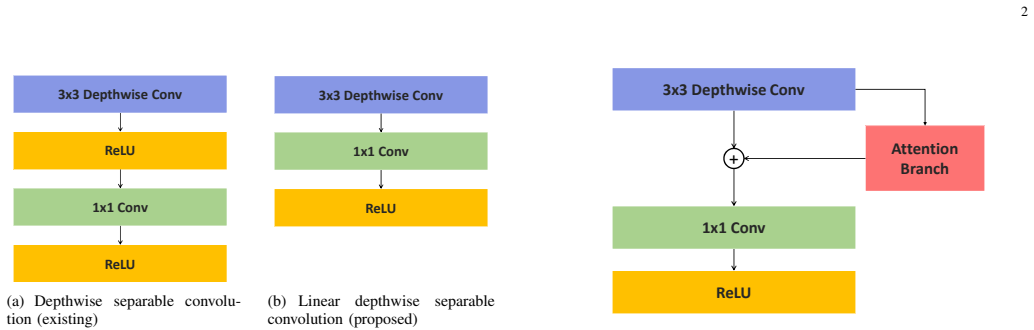
The load-bearing unit is the attention-aware linear depthwise convolution (ALD convolution). It combines a depthwise $3\times3$ convolution directly followed by a $1\times1$ pointwise convolution with no activation in between, plus a branch that computes $\det W_3^c$ for each filter, passes the $C$-dimensional descriptor vector through FC-ReLU-FC-Sigmoid with reduction ratio $r=16$, and rescales the feature map as $f_c'=s_c f_c$, followed by residual scaling $D=(1+s_c)f_c$. The determinant is the paper's chosen descriptor of filter shape: Sarrus' rule gives the $3\times3$ determinant from products of diagonal entries, so the attention is driven by interdependency among a filter's weights rather than by spatial pooling of feature maps. A local residual connection every two ALD convolutions and a bottleneck $1\times1$ fusion realize the block's memory mechanism at low parameter count.
What would settle it
Retrain VDSR, LapSRN, MemNet, and IDN on the same DIV2K 800 training images with the same 4× bicubic protocol, loss, and training scheme used for ALDSR, and compare PSNR/SSIM on the four benchmark sets; if ALDSR no longer matches or exceeds them, the paper's headline superiority claim is not established. The same experiment could also test linearity by inserting a ReLU between the depthwise and pointwise stages of ALD-RDN and checking whether Urban100 performance drops.
Extended reading notes
Core claim
The paper's central claim is that depthwise separable convolution—originally designed for image classification—can be made effective for single-image super-resolution through two modifications. The first is removing the nonlinearity between the depthwise spatial filter and the 1×1 pointwise filter, because at that intermediate stage the feature map reflects only spatial information and a ReLU there discards reconstruction details. The second is an attention branch that exploits the fact that each depthwise filter is a small square matrix: the determinant of each $3\times3$ filter is computed by Sarrus' rule, reduced by a gating network, and used to recalibrate the channel features, with a residual connection so repeated attention does not degrade performance. The paper reports that the resulting ALDSR matches or beats the published numbers of several heavier SR networks, and that when inserted into RDN the proposed block (ALD-RDN) beats a depthwise-separable RDN on all tested datasets, with the largest gain on Urban100, which contains repetitive structures.
Load-bearing premise
The comparison in Table I assumes the published PSNR/SSIM values of VDSR, LapSRN, MemNet, and IDN—trained on different, generally smaller datasets—can be directly compared with ALDSR's scores, which were produced on the 800-image DIV2K training set with a different protocol.
Editorial extensions
If this is right
- Linear depthwise convolution alone improves super-resolution: LDW-RDN beats DW-RDN on Urban100 by 0.08 dB with the same parameter count.
- Adding the attention branch improves it further: ALD-RDN beats DW-RDN on all five test sets, with a 0.17 dB gain on Urban100.
- The gains are cheap: one ALDB has 41,472 parameters versus 1,363,968 for an RDB, so the proposed block is suited to compact SR networks.
- Determinant-based attention yields the best SSIM among the tested descriptors on every benchmark except Set5 for ALD-RDN, indicating better structural reconstruction.
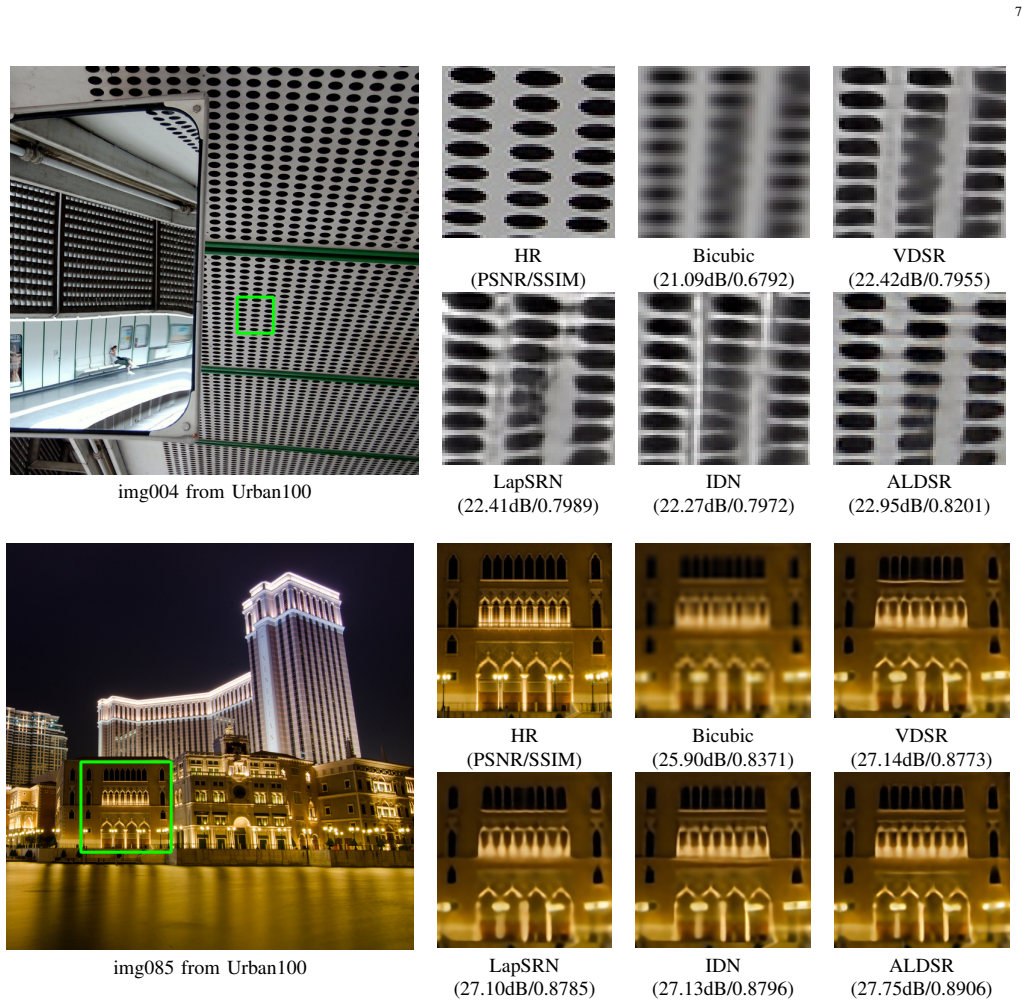
- The clearest effects appear on repeated patterns and textures, as shown on Urban100 images where ALDSR and ALD-RDN reconstruct lattices more accurately than the compared methods.
Reading between the lines
- Because the block is modular, the same linear-depthwise-plus-determinant design could plausibly transfer to other image restoration tasks such as denoising, deblurring, or JPEG artifact removal, where preserving fine details is also critical; the paper only evaluates SR.
- The determinant descriptor is one member of a family of matrix descriptors; a natural next experiment is comparing trace, spectral norm, or singular values in the attention branch, since the paper's ablation compares only determinant against average and max pooling.
- A practical consequence the authors leave implicit is that replacing standard convolutions with ALD convolutions should cut FLOPs roughly by the depthwise factor, making real-time or on-device 4× SR feasible; the parameter counts in Table III support this direction.
Signed reviews
Editorial analysis
A structured set of objections, weighed in public.
Referee Report
Summary. The paper proposes ALDNet, a super-resolution network built on attention-aware linear depthwise convolution. The linear depthwise convolution removes the ReLU between the depthwise and pointwise convolutions, and an attention branch computes the determinant of each 3x3 depthwise filter and uses a gating mechanism to recalibrate feature maps. The authors construct a lightweight baseline, ALDSR, and also adapt the Residual Dense Network into ALD-RDN by replacing standard convolutions with the proposed ALD convolutions. Experiments are reported on Set5, Set14, BSD100, Urban100, and the DIV2K validation set, with internal ablations comparing depthwise, linear depthwise, and attention-aware variants under a common training protocol.
Significance. If the results hold, the work offers a lightweight SR architecture with a novel filter-descriptor-based attention mechanism. The internal ablation design is a strength: DW-RDN, LDW-RDN, and ALD-RDN are trained under the same protocol, and Table III provides useful parameter counts for the building blocks. The central claim, however, is not established because the headline comparison in Table I is not protocol-matched, and the determinant descriptor is not consistently the best on PSNR according to the paper's own Table IV. The paper would be significantly strengthened by retraining baselines under the same protocol and by reporting repeated-run statistics.
major comments (4)
- [IV-B, Table I] The state-of-the-art comparison in Table I is not protocol-matched: ALDSR is trained on the 800-image DIV2K training set, while VDSR, LapSRN, and MemNet are commonly trained on the much smaller 291-image dataset with different augmentation and training schedules. Since SR performance is highly sensitive to training data quantity, the reported PSNR gaps do not demonstrate that ALDSR surpasses these methods. No baseline is retrained under the authors' protocol, and no error bars or multiple-seed results are provided. To support the conclusion that ALDNet achieves state-of-the-art performance, the authors must either retrain the baselines under the same protocol or visibly restrict the state-of-the-art claim to the internally re-implemented comparisons.
- [V Conclusion and IV-B, Table IV] The conclusion states that the determinant descriptor shows superior performance to average and max descriptors, but this is contradicted by Table IV. On PSNR, average pooling or max pooling beats or ties the determinant on most configurations: for ALD-RDN, max pooling gives 32.23 dB on Set5 versus 32.18 dB for determinant, average pooling gives 28.66 dB on Set14 versus 28.62 dB, and the two descriptors tie on B100 and Urban100. For ALDSR, determinant is slightly worse on Urban100 and DIV2K validation than average pooling. The discussion in Section IV-B acknowledges this, so the concluding claim should be tempered and should distinguish PSNR from SSIM.
- [IV-A, IV-B, Tables II and V] The evidence for the proposed mechanisms is based on small PSNR differences without statistical evaluation. For example, LDW-RDN outperforms DW-RDN by 0.08 dB on Urban100, and ALD-RDN outperforms DW-RDN by 0.17 dB on Urban100, but no repeated runs or variance estimates are reported. These differences may be within run-to-run variability, especially for networks trained with Adam and random patch sampling. Because these internal ablations are the main support for the claim that linearity and attention-aware depthwise convolution help SR, the authors should report the mean and standard deviation over at least two or three random seeds, or otherwise demonstrate that the improvements are reproducible.
- [II-B, Eq. (3)] The reduction ratio r in the attention branch is set to 16 with no sensitivity analysis. Since the authors emphasize the low computational cost of the proposed block, the effect of varying r on both performance and parameter count should be reported, or at least a brief justification should be given for choosing the SENet-inspired value.
minor comments (5)
- [I] There are several typos in the introduction and elsewhere, including 'depthwsie', 'mentined ealier', 'dose not', and 'convoltuion'. These should be corrected.
- [III-A] The manuscript uses 'ALDSR' and 'ALDNet' interchangeably. The relationship between the general ALDNet and the specific ALDSR baseline should be stated explicitly once in Section III.
- [Fig. 6] The text says the pointwise convolution layer is omitted from Figure 6 for simplicity, but this makes the block diagram misleading because the ALD convolution is defined as depthwise plus pointwise. The figure should include the pointwise layer or clearly annotate where it is inserted.
- [IV-B, Discussion] The discussion of why max pooling helps PSNR and determinant helps SSIM is speculative; a short quantitative connection, such as correlation of descriptor values with reconstruction error, would make the interpretation more credible.
- [References] Reference [4] (EDSR) is cited for the L1 loss and ESPCN but the discussion of batch normalization removal also relies on it; the citation is appropriate but the sentence structure could be clearer.
Circularity Check
No circularity: the paper's load-bearing claims are empirical architecture ablations, with no step reducing to its own inputs or to self-citation.
full rationale
This is an empirical architecture paper. The proposed mechanism, linear depthwise convolution, is defined independently as removal of ReLU between depthwise and pointwise convolutions, and its benefit is tested by direct ablation (Table V: DW-RDN vs. LDW-RDN). The attention mechanism uses a determinant descriptor of the depthwise filter weights and then recalibrates the feature map; this is an architectural ingredient evaluated by ablations in Tables II and IV, not a quantity fitted to the claimed result. No parameter is fitted to a subset of data and then renamed as a prediction, and no uniqueness theorem or load-bearing self-citation is invoked. The inherited reduction ratio r=16 from SENet is a hyperparameter choice, but the reported outputs are not defined in terms of it, so it is not circular. The main validity concern is that Table I compares ALDSR, trained on DIV2K, against published baseline numbers from methods trained on smaller datasets; that is an experimental fairness issue, not a circularity issue. Since no step can be exhibited as reducing to its own inputs, the circularity score is 0.
Assumptions & free parameters
free parameters (2)
- reduction ratio r =
16
- network depth/width (number of ALDBs and feature channels) =
not reported
assumptions (3)
- domain assumption Determinant of a 3x3 depthwise filter is a meaningful descriptor of filter importance for channel attention
- domain assumption Removing ReLU between depthwise and pointwise convolutions preserves information needed for SR without losing representational capacity
- standard math Sarrus rule for 3x3 determinants is valid and appropriate here
Cite this review
Pith. "Pith review of Attention-Aware Linear Depthwise Convolution for Single Image Super-Resolution." pith.science (2026). https://pith.science/paper/55DZGR2U
@misc{pith2026190802648,
  author       = {Pith},
  title        = {Pith review of: Attention-Aware Linear Depthwise Convolution for Single Image Super-Resolution},
  year         = {2026},
  howpublished = {\url{https://pith.science/paper/55DZGR2U}},
  note         = {Machine review of arXiv:1908.02648}
}
read the original abstract
Although deep convolutional neural networks (CNNs) have obtained outstanding performance in image superresolution (SR), their computational cost increases geometrically as CNN models get deeper and wider. Meanwhile, the features of intermediate layers are treated equally across the channel, thus hindering the representational capability of CNNs. In this paper, we propose an attention-aware linear depthwise network to address the problems for single image SR, named ALDNet. Specifically, linear depthwise convolution allows CNN-based SR models to preserve useful information for reconstructing a super-resolved image while reducing computational burden. Furthermore, we design an attention-aware branch that enhances the representation ability of depthwise convolution layers by making full use of depthwise filter interdependency. Experiments on publicly available benchmark datasets show that ALDNet achieves superior performance to traditional depthwise separable convolutions in terms of quantitative measurements and visual quality.
Figures


Figures from the paper (4 more)



Reference graph
Works this paper leans on
-
[1]
An edge-guided image interpolation algorithm via directional filtering and data fusion,
L. Zhang and X. Wu, “An edge-guided image interpolation algorithm via directional filtering and data fusion,” IEEE transactions on Image Processing, vol. 15, no. 8, pp. 2226–2238, 2006
work page 2006
-
[2]
Learning a deep convolu- tional network for image super-resolution,
C. Dong, C. C. Loy, K. He, and X. Tang, “Learning a deep convolu- tional network for image super-resolution,” in European conference on computer vision . Springer, 2014, pp. 184–199. 7 img004 from Urban100 HR (PSNR/SSIM) LapSRN (22.41dB/0.7989) Bicubic (21.09dB/0.6792) IDN (22.27dB/0.7972) VDSR (22.42dB/0.7955) ALDSR (22.95dB/0.8201) img085 from Urban100 ...
work page 2014
-
[3]
Accurate image super-resolution using very deep convolutional networks,
J. Kim, J. Kwon Lee, and K. Mu Lee, “Accurate image super-resolution using very deep convolutional networks,” in Proceedings of the IEEE conference on computer vision and pattern recognition , 2016, pp. 1646– 1654
work page 2016
-
[4]
Enhanced deep residual networks for single image super-resolution,
B. Lim, S. Son, H. Kim, S. Nah, and K. Mu Lee, “Enhanced deep residual networks for single image super-resolution,” in Proceedings of the IEEE conference on computer vision and pattern recognition workshops, 2017, pp. 136–144
2017
-
[5]
Residual dense network for image super-resolution,
Y . Zhang, Y . Tian, Y . Kong, B. Zhong, and Y . Fu, “Residual dense network for image super-resolution,” in Proceedings of the IEEE Con- ference on Computer Vision and Pattern Recognition , 2018, pp. 2472– 2481
2018
-
[6]
Mobilenets: Efficient convo- lutional neural networks for mobile vision applications,
A. G. Howard, M. Zhu, B. Chen, D. Kalenichenko, W. Wang, T. Weyand, M. Andreetto, and H. Adam, “Mobilenets: Efficient convo- lutional neural networks for mobile vision applications,” arXiv preprint arXiv:1704.04861, 2017
arXiv 2017
-
[7]
Batch normalization: Accelerating deep network training by reducing internal covariate shift,
S. Ioffe and C. Szegedy, “Batch normalization: Accelerating deep network training by reducing internal covariate shift,” arXiv preprint arXiv:1502.03167, 2015
arXiv 2015
-
[8]
Squeeze-and-excitation networks,
J. Hu, L. Shen, and G. Sun, “Squeeze-and-excitation networks,” in Proceedings of the IEEE conference on computer vision and pattern recognition, 2018, pp. 7132–7141
2018
Show all 24 references
-
[9]
Image super- resolution using very deep residual channel attention networks,
Y . Zhang, K. Li, K. Li, L. Wang, B. Zhong, and Y . Fu, “Image super- resolution using very deep residual channel attention networks,” in Proceedings of the European Conference on Computer Vision (ECCV) , 2018, pp. 286–301
2018
-
[10]
Second-order attention network for single image super-resolution,
T. Dai, J. Cai, Y . Zhang, S.-T. Xia, and L. Zhang, “Second-order attention network for single image super-resolution,” in Proceedings of the IEEE Conference on Computer Vision and Pattern Recognition , 2019, pp. 11 065–11 074
2019
-
[11]
Very deep convolutional networks for large-scale image recognition,
K. Simonyan and A. Zisserman, “Very deep convolutional networks for large-scale image recognition,” arXiv preprint arXiv:1409.1556 , 2014
2014 arXiv
-
[12]
Residual attention network for image classification,
F. Wang, M. Jiang, C. Qian, S. Yang, C. Li, H. Zhang, X. Wang, and X. Tang, “Residual attention network for image classification,” in Proceedings of the IEEE Conference on Computer Vision and Pattern Recognition, 2017, pp. 3156–3164
2017
-
[13]
Deep residual learning for image recognition,
K. He, X. Zhang, S. Ren, and J. Sun, “Deep residual learning for image recognition,” in Proceedings of the IEEE conference on computer vision and pattern recognition , 2016, pp. 770–778
2016
-
[14]
Real-time single image and video super- resolution using an efficient sub-pixel convolutional neural network,
W. Shi, J. Caballero, F. Husz ´ar, J. Totz, A. P. Aitken, R. Bishop, 8 img047 from Urban100 HR (PSNR/SSIM) LDW-RDN (21.94dB/0.7713) Bicubic (20.01dB/0.6282) ALD-RDN(avr) (21.96dB/0.7747) RDN(re-im) (22.16dB/0.7827) ALD-RDN(max) (21.94dB/0.7744) DW-RDN (21.90dB/0.7653) ALD-RDN(...
2016
-
[15]
Deep laplacian pyramid networks for fast and accurate super-resolution,
W.-S. Lai, J.-B. Huang, N. Ahuja, and M.-H. Yang, “Deep laplacian pyramid networks for fast and accurate super-resolution,” inProceedings of the IEEE conference on computer vision and pattern recognition , 2017, pp. 624–632
2017
-
[16]
Memnet: A persistent memory network for image restoration,
Y . Tai, J. Yang, X. Liu, and C. Xu, “Memnet: A persistent memory network for image restoration,” in Proceedings of the IEEE international conference on computer vision , 2017, pp. 4539–4547
2017
-
[17]
Fast and accurate single image super- resolution via information distillation network,
Z. Hui, X. Wang, and X. Gao, “Fast and accurate single image super- resolution via information distillation network,” in Proceedings of the IEEE conference on computer vision and pattern recognition , 2018, pp. 723–731
2018
-
[18]
Ntire 2017 challenge on single image super-resolution: Methods and results,
R. Timofte, E. Agustsson, L. Van Gool, M.-H. Yang, and L. Zhang, “Ntire 2017 challenge on single image super-resolution: Methods and results,” in Proceedings of the IEEE Conference on Computer Vision and Pattern Recognition Workshops , 2017, pp. 114–125
2017
-
[19]
Low- complexity single-image super-resolution based on nonnegative neighbor embedding,
M. Bevilacqua, A. Roumy, C. Guillemot, and M. L. Alberi-Morel, “Low- complexity single-image super-resolution based on nonnegative neighbor embedding,” 2012
2012
-
[20]
On single image scale-up using sparse-representations,
R. Zeyde, M. Elad, and M. Protter, “On single image scale-up using sparse-representations,” in International conference on curves and sur- faces. Springer, 2010, pp. 711–730
2010
-
[21]
A database of human segmented natural images and its application to evaluating segmentation algorithms and measuring ecological statistics
D. Martin, C. Fowlkes, D. Tal, J. Malik et al. , “A database of human segmented natural images and its application to evaluating segmentation algorithms and measuring ecological statistics.” Iccv Vancouver:, 2001
2001
-
[22]
Single image super-resolution from transformed self-exemplars,
J.-B. Huang, A. Singh, and N. Ahuja, “Single image super-resolution from transformed self-exemplars,” in Proceedings of the IEEE Confer- ence on Computer Vision and Pattern Recognition, 2015, pp. 5197–5206
2015
-
[23]
Adam: A method for stochastic optimization,
D. P. Kingma and J. Ba, “Adam: A method for stochastic optimization,” arXiv preprint arXiv:1412.6980 , 2014
2014 arXiv
-
[24]
Automatic differentiation in pytorch,
A. Paszke, S. Gross, S. Chintala, G. Chanan, E. Yang, Z. DeVito, Z. Lin, A. Desmaison, L. Antiga, and A. Lerer, “Automatic differentiation in pytorch,” 2017. Seongmin Hwang received the B.S. and M.S. de- grees in electronic engineering from Chonnam Na- tional University, South...
2017
Reviewed August 14, 2026 · model on record in the stance chip above.
Discussion (0). Continue with ORCID to comment.