REVIEW 6 major objections 5 minor 66 references
The need for modern computing paradigm: Science applied to computing
T0 review · 6 major / 5 minor · reviewed 2026-08-14 · deepseek-v4-flash
Pith's one-line read This paper argues that parallelized sequential computing has an inherent performance ceiling because the effective serial fraction grows with core count, and proposes an explicitly many-processor paradigm to break it.
desk verdict A visionary essay that restates Amdahl's law with fitted alphas and pushes the author's own EMPA architecture; the central claim that the serial fraction grows with core count is asserted, not derived, but the paper honestly labels its own figures as illustrative and at least raises a real problem worth arguing about. read the letter →
The pith
A machine-rendered reading of the paper's core claim, the machinery that carries it, and where it could break.
The reading
What carries the argument
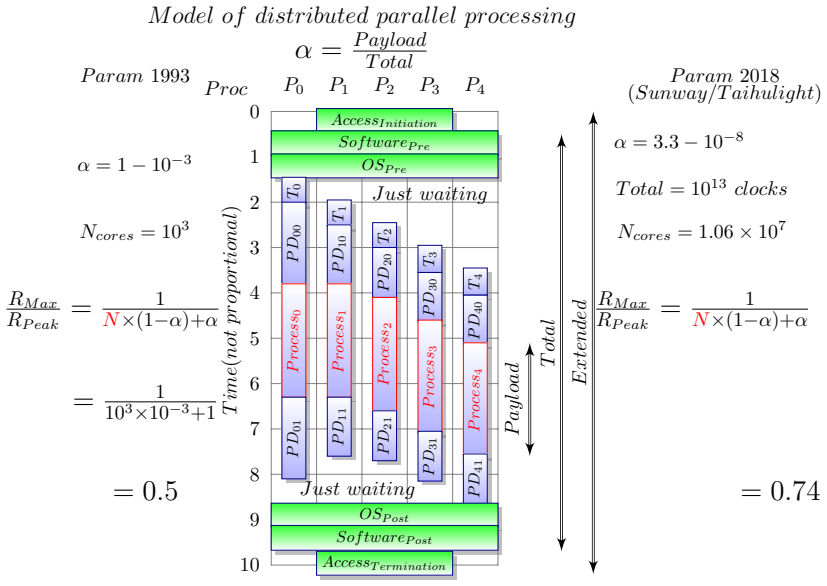
The load-bearing object is Amdahl's Law with a variable effective serial fraction, written in the paper as $\frac{R_{Max}}{R_{Peak}}=\frac{1}{N(1-\alpha)+\alpha}$, where $\alpha$ is the parallelizable payload fraction and $N$ the number of cores. The 'modern' twist is that $1-\alpha_{eff}$ is not a constant of the application: it grows with $N$ through contributions from operating-system scheduling, context switching, synchronization loops, propagation delay, and the single core that must orchestrate all others. The proposed remedy, EMPA, rests on the quasi-thread—an atomic unit that fuses one hardware core and one software fragment—plus hierarchic, direct core-to-core communication and hardware-assisted runtime mapping of virtual processors to physical cores. This machinery converts the per-core coordination overhead from a term that grows with $N$ into one that grows only logarithmically, which is what would let efficiency survive at exascale.
What would settle it
Take a scalable parallel application on a machine with millions of cores, and measure its effective serial fraction $1-\alpha_{eff}$ from Amdahl's Law as the core count rises while the per-core problem size is held constant. The paper predicts this fraction rises with $N$ and eventually pulls total performance down; observing instead that it stays flat or falls, with speedup continuing to track constant-$\alpha$ Amdahl scaling, would falsify the claimed ceiling.
Extended reading notes
Core claim
The paper's central claim is that parallelized sequential computing, as organized by the classic single-processor paradigm, has a finite 'speed of light': as the number of cores grows, the total payload performance $R_{Max}$ first tracks $N \times Perf_{single}$, then saturates and eventually declines, because the effective non-parallelizable fraction $1-\alpha_{eff}$ is itself an increasing function of $N$. This turns Amdahl's Law $\frac{R_{Max}}{R_{Peak}}=\frac{1}{N(1-\alpha)+\alpha}$ from a statement about algorithmic serial sections into a physical bound on the whole system, with contributions from operating-system overhead, context switching, propagation delay, and the 'first core must speak to all fellow cores' communication pattern. The paper reads the saturation visible in HPL and HPCG measurements of recent large supercomputers as evidence that this bound is already being approached, and it proposes EMPA as the 'modern' paradigm: processing capacity treated as a resource, quasi-threads (hardware core plus software fragment as one atomic unit), runtime mapping of virtual processors to physical cores, hardware-managed scheduling and synchronization, and hierarchic core-to-core communication that changes the dependence on core count from linear to logarithmic. If EMPA is right, exascale is reachable; if the Amdahl bound is unavoidable under the classic paradigm, exascale is not.
Load-bearing premise
The load-bearing premise is that the non-parallelizable fraction of a task is not a fixed algorithm property that shrinks with problem size, but grows with the number of cores and has a technology floor; if a large enough problem can keep that fraction constant, Amdahl's Law does not impose an absolute ceiling.
Editorial extensions
If this is right
- Under the classic paradigm, adding cores beyond a few million does not increase payload performance; it eventually decreases it, so exascale targets cannot be met by scaling today's architecture.
- Measured efficiency gaps between HPL and HPCG benchmarks reflect different communication intensities; the more communication a workload needs, the lower its 'speed of light' ceiling.
- Processor-based full-scale brain simulation and large artificial-neural-network simulators will remain stuck orders of magnitude below their nominal capacity unless the paradigm changes, because their synchronization and communication needs collapse performance.
- Feasibility studies for national exascale programs have been missing the existence of this inherent bound; a modern paradigm such as EMPA is required.
- In EMPA, the compiler passes 'configware' meta-instructions to the processor, and the runtime maps quasi-threads to cores, so the architecture adapts to the task and removes most OS scheduling overhead.
Reading between the lines
- If the paper's mechanism holds, the same ceiling should appear in any architecture with a single orchestrating core or shared synchronization point, not just the systems analyzed here; measuring $\alpha_{eff}$ on a large many-core chip at increasing core counts would test this directly.
- The relativistic analogy suggests a dimensionless saturation constant for each interconnection technology; calibrating it on current clusters could turn the predicted wall into a design parameter for exascale planning.
- An inference the paper does not draw: architectures that avoid global synchronization—dataflow, systolic, or neuromorphic designs—should also postpone the wall, making EMPA one instance of a broader design principle.
Signed reviews
Editorial analysis
A structured set of objections, weighed in public.
Referee Report
Summary. This paper argues that parallelized sequential computing is approaching a fundamental efficiency limit analogous to the speed of light, and that standard scaling laws with a core-count-dependent serial fraction make exascale-class systems impossible under the 'classic' computing paradigm. It draws on analogies to special relativity, general relativity, quantum mechanics, and the uncertainty principle, and proposes a 'modern computing paradigm' called EMPA (Explicitly Many-Processor Approach) built around quasi-threads, hierarchical buses, configware, and hardware-supported scheduling. The central quantitative claims are that the non-parallelizable fraction grows with the number of cores, that performance is therefore absolutely capped, and that EMPA changes the dependence of performance on core count from linear to logarithmic.
Significance. If established, the paper would provide a unified explanation for the efficiency collapse of large supercomputers and would motivate a genuinely new architecture direction. The paper deserves credit for focusing on a real problem—communication and synchronization overhead destroying parallel efficiency—and for proposing concrete mechanisms (hierarchical buses, hardware-assisted thread management, direct core-to-core cooperation) rather than only criticizing the status quo. It also makes a simulator repository (EMPAthY86) available. However, the central quantitative claims are not established: the 'modern' formula reduces to standard Amdahl's law, the growth of the serial fraction with core count is asserted rather than derived, key figures are explicitly illustrative or 'guessed,' and the EMPA scaling claim is supported only by the authors' own prior references. The paper is better read as a vision statement than as a validated scientific contribution.
major comments (6)
- [Table I, Section II-A] The 'modern' performance formula Perftotal(N) = N·Perfsingle/(n·(1−α)+α) reduces to standard Amdahl's law when the lowercase n is interpreted as the number of cores N (giving Perftotal = Perfsingle/((1−α)+α/N)). The claimed new correction is therefore not a new law but a restatement of Amdahl's law; the paper should acknowledge this and then separately derive the additional N-dependence it claims for (1−α).
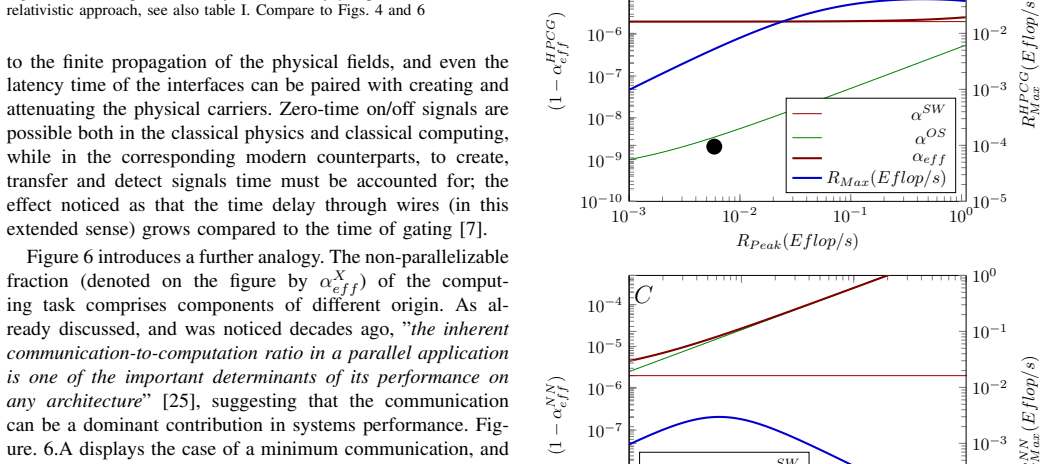
- [Section II-A, Figure 6] The load-bearing premise that the non-parallelizable fraction (1−α_eff) increases with the number of cores and has a technology floor is asserted without derivation. Figure 6's own caption states that it is 'purely illustrating the concepts; the displayed numbers are somewhat similar to the real ones,' and no equation, crossover condition, or measurement is given for the growth of (1−α_eff). Without such support, the claim that performance is 'prohibited by the laws of nature' is not justified.
- [Section II-C] The paper quotes [25] as saying that the serial fraction is a diminishing function of problem size, then asserts that at sufficiently large core counts it starts to dominate. No scaling model or data is provided to reconcile these two statements or to locate the crossover, leaving a direct gap in the core argument.
- [Section II-A, Figure 4] The α_eff values used to draw the HPL and HPCG rooflines are fitted to the same TOP15 measurements they are used to explain, and the paper reports no error budget and no comparison against a constant-α Amdahl baseline. The brain-simulation roofline is explicitly 'rather guessed' [35]. These figures therefore do not provide independent evidence for the predicted saturation.
- [Section II-A vs. Section II introduction] The paper asserts that exceeding a certain computing performance 'is prohibited by the laws of nature,' but it also states that 'unlike in the nature, the technical implementation of the critical points can be changed.' Since communication overhead is an implementation property (as the EMPA discussion itself argues), the claimed fundamental limit is internally inconsistent as stated and should be reframed as a limit of current implementations.
- [Section III-C] The central positive claim that EMPA changes the dependence on the number of cores 'from linear to logarithmic [8]' and thereby enables exascale systems is not supported by simulation results, measurements, or an independent derivation; reference [8] is the authors' own prior work. The manuscript needs at least a quantitative scaling model or simulator output before this claim can be evaluated.
minor comments (5)
- [Throughout] The manuscript contains numerous typographical and grammatical errors (e.g., 'consitutes', 'the theory was almost forgotten', inconsistent use of 'efficacy' and 'efficiency') that should be corrected in any revision.
- [Table I] The lowercase n in the computing formula is never defined; its physical meaning (if any) and its relationship to N should be clarified.
- [Figure 6] The axis labels and legend mix α and (1−α); e.g., the left scale is labeled (1−α^X_eff) while the internal curves are named α_SW, α_OS, α_eff, which is confusing and should be made consistent.
- [Figure 3] The figure plots RMax over time without error bars or source-level data for individual points; the anecdotal discussion of Gyoukou ('mystic') should be either supported by data or removed.
- [References] Load-bearing claims rely heavily on the authors' own prior or under-review papers ([8], [34], [35], [40]); independent references or direct evidence should be supplied.
Circularity Check
Central nature-imposed performance ceiling rests on a self-cited growing serial fraction, and the plotted Amdahl curves use alpha values fitted from the same data they are used to explain.
-
self citation load bearing
[Section II-B, paragraph on 'dark performance']
"Due to the classic computing principles, the first core must speak to all fellow cores, and this non-parallelizable fraction of the time increases with the number of the cores[34], [40]."
This sentence supplies the decisive premise that turns standard Amdahl's law into an absolute nature-imposed limit: if (1-alpha_eff) grows with N, then RMax saturates and eventually decreases. The cited support, [34] and [40], are both authored by the present first author; [34] is elsewhere in the paper described as 'in review'. No independent derivation, measurement, or external theorem is provided for the core-count dependence of the serial fraction. Later claims that 'this feature alone prevents building exascale supercomputers [8]' and that EMPA changes the dependence 'from linear to logarithmic [8]' inherit the same self-citation chain, so the central argument reduces to the author's prior assertion rather than to an independently checkable result.
-
fitted input called prediction
[Section II-A, Figure 4 caption and surrounding text]
"The diagram lines marked as HPL and HPCG correspond to the behavior of supercomputer Taihulight at (1−αeff) values 3.3∗ 10−8 and 2.4∗ 10−5, respectively."
The (1-alpha_eff) values used to draw the Amdahl-law curves in Figure 4 are not predicted from any model; they are inferred from Taihulight's measured RMax/RPeak and core count, i.e. from exactly the kind of efficiency points the curves are then used to 'explain' and to demonstrate saturation. Because the Amdahl formula is monotone in (1-alpha), every measured point can be assigned a value of this single free parameter that places it on the family of curves, so the agreement is tautological. No error budget, no independent dataset, and no constant-alpha baseline is given. The 'saturation effect' is therefore a fitted restatement of the data rather than an independently derived prediction.
1 more flagged steps
-
self definitional
[Figure 6 caption, Section II-B]
"The figure is purely illustrating the concepts; the displayed numbers are somewhat similar to the real ones."
Figure 6 is the only in-paper 'demonstration' of the critical inflection and the claim that 'at some critical value where an inflection point occurs, the resulting performance starts to decrease.' But the caption admits the figure is purely illustrative, with numbers chosen by the authors rather than derived from measurements or from Amdahl's law. The alpha_SW, alpha_OS, and alpha_eff curves are inputs, and the RMax curve is then computed from those chosen inputs. The predicted performance breakdown is therefore built into the construction: the conclusion is equivalent to the assumed shape of the illustrative curves, not an independent result.
full rationale
Amdahl's law and the existence of some serial fraction are standard external inputs, and the TOP500 data in Figure 4 are real measurements; the EMPA proposal itself is an independent design idea rather than a circular derivation. The circularity is concentrated in the extra, decisive step: the claim that (1-alpha_eff) grows with the number of cores and has a technology floor is not derived in this paper, but is assigned to the author's own prior works [8], [34], [35], [40]; the only in-paper visual support, Figure 6, is explicitly labeled illustrative. Additionally, the Figure 4 curves are drawn using alpha values read off Taihulight's measured efficiency, so they cannot independently verify the saturation they display. Thus the paper's quantitative core prediction, that classic-paradigm exascale is prohibited by the laws of nature, reduces to a fitted parameter and a self-citation chain. A score of 6 reflects partial circularity: the external Amdahl framework and real benchmark data keep the paper from being wholly circular, but the central 'limit' claim is not independently established.
Assumptions & free parameters
free parameters (3)
- alpha (parallel fraction) for Amdahl examples =
1 - 1e-3 (1993 example); 1 - 3.3e-8 (Taihulight HPL); 1 - 2.4e-5 (Taihulight HPCG)
- non-parallelizable fraction for brain simulation roofline =
Roughly 1e-4 to 1e-3, called 'rather guessed' in the text
- illustrative single-processor performance P =
1 Gflop/s @ 1 GHz
assumptions (5)
- standard math Amdahl's law describes the performance of parallelized sequential systems.
- ad hoc to paper The non-parallelizable fraction grows with the number of cores and has a technology-given floor.
- ad hoc to paper Relativistic and quantum physics analogies are valid guides for computing behavior.
- domain assumption TOP500 HPL and HPCG measurements represent payload performance.
- domain assumption The 1 ms biological grid time in brain simulation acts as a fixed synchronization quantum.
invented entities (2)
-
quasi-thread (QT)
-
configware
Cite this review
Pith. "Pith review of The need for modern computing paradigm: Science applied to computing." pith.science (2026). https://pith.science/paper/7PIY4AKX
@misc{pith2026190802651,
  author       = {Pith},
  title        = {Pith review of: The need for modern computing paradigm: Science applied to computing},
  year         = {2026},
  howpublished = {\url{https://pith.science/paper/7PIY4AKX}},
  note         = {Machine review of arXiv:1908.02651}
}
read the original abstract
More than hundred years ago the 'classic physics' was it in its full power, with just a few unexplained phenomena; which however led to a revolution and the development of the 'modern physics'. Today the computing is in a similar position: computing is a sound success story, with exponentially growing utilization, but with a growing number of difficulties and unexpected issues as moving towards extreme utilization conditions. In physics studying the nature under extreme conditions has lead to the understanding of the relativistic and quantal behavior. Quite similarly in computing some phenomena, acquired in connection with extreme (computing) conditions, cannot be understood based on of the 'classic computing paradigm'. The paper draws the attention that under extreme conditions qualitatively different behaviors may be encountered in both physics and computing, and pinpointing that certain, formerly unnoticed or neglected aspects enable to explain new phenomena as well as to enhance computing features. Moreover, an idea of modern computing paradigm implementation is proposed.
Figures


Figures from the paper (2 more)

Reference graph
Works this paper leans on
-
[11]
V ´egh, Renewing computing paradigms for more efficient paralleliza- tion of single-threads, ser
J. V ´egh, Renewing computing paradigms for more efficient paralleliza- tion of single-threads, ser. Advances in Parallel Computing. IOS Press, 2018, vol. 29, ch. 13, pp. 305–330
work page 2018
-
[52]
Introducing the Explicitly Many-Processor Approach,
J. V ´egh, “Introducing the Explicitly Many-Processor Approach,” Paral- lel Computing, vol. 75, pp. 28 – 40, 2018
work page 2018
-
[8]
The performance wall of large parallel computing systems,
J. V ´egh, J. V ´as´arhelyi, and D. Dr ´otos, “The performance wall of large parallel computing systems,” in Lecture Notes in Networks and Systems
-
[34]
J. V ´egh, “The performance wall of parallelized sequential computing: the roofline of supercomputer performance gain,” Parallel Computing, vol. in review, p. http://arxiv.org/abs/1908.02280, 2019
work page Pith review arXiv 1908
-
[25]
Scaling parallel programs for multiprocessors: Methodology and examples,
J. P. Singh, J. L. Hennessy, and A. Gupta, “Scaling parallel programs for multiprocessors: Methodology and examples,” Computer, vol. 26, no. 7, pp. 42–50, Jul. 1993
work page 1993
-
[35]
J. V ´egh, “How Amdahl’s Law limits the performance of large artificial neural networks: (Why the functionality of full-scale brain simula- tion on processor-based simulators is limited) ,” Brain Informatics, vol. 6, pp. 1–11, 2019
work page 2019
-
[1]
Automatic High-Speed Computing: A Progress Report on the EDV AC,
J. J. P. Eckert and J. W. Mauchly, “Automatic High-Speed Computing: A Progress Report on the EDV AC,” Moore School Library, University of Pennsylvania, Philadephia, Tech. Rep. Report of Work under Contract No. W-670-ORD-4926, Supplement No 4, September 1945
work page 1945
-
[2]
First Draft of a Report on the EDV AC,
J. von Neumann, “First Draft of a Report on the EDV AC,” http://www. wiley.com/legacy/wileychi/wang archi/supp/appendix a.pdf, 1945
work page 1945
Show all 66 references
-
[3]
The Origins, Uses, and Fate of the EDV AC,
M. R. Williams, “The Origins, Uses, and Fate of the EDV AC,” IEEE Ann. Hist. Comput. , vol. 15, no. 1, pp. 22–38, Jan. 1993. [Online]. Available: http://dx.doi.org/10.1109/85.194089
1993 doi
-
[4]
The Computer as von Neumann Planned It,
M. D. Godfrey and D. F. Hendry, “The Computer as von Neumann Planned It,” IEEE Annals of the History of Computing , vol. 15, no. 1, pp. 11–21, 1993
1993
-
[5]
Understanding sources of inefficiency in general-purpose chips,
R. Hameed, W. Qadeer, M. Wachs, O. Azizi, A. Solomatnikov, B. C. Lee, S. Richardson, C. Kozyrakis, and M. Horowitz, “Understanding sources of inefficiency in general-purpose chips,” in Proceedings of the 37th Annual International Symposium on Computer Architecture , ser. ISCA ’...
-
[6]
Report of a Roundtable Convened to Con- sider Neuromorphic Computing Basic Research Needs,
US DOE Office of Science, “Report of a Roundtable Convened to Con- sider Neuromorphic Computing Basic Research Needs,” https://science. energy.gov/∼/media/bes/pdf/reports/2016/NCFMtSA rpt.pdf, 2015
2016
-
[7]
Limits on fundamental limits to computation,
I. Markov, “Limits on fundamental limits to computation,” Nature, vol. 512(7513), pp. 147–154, 2014
2014
-
[9]
A formalization of priority inversion,
O. Babaoglu, K. Marzullo, and F. B. Schneider, “A formalization of priority inversion,” Real-Time Systems , vol. 5, no. 4, p. 285303, Oct
-
[10]
Resource-independent execution support on exa-scale systems,
S(o)OS project, “Resource-independent execution support on exa-scale systems,” http://www.soos-project.eu/index.php/related-initiatives, 2010
2010
-
[12]
Rebooting our computing models,
P. Cadareanu et al., “Rebooting our computing models,” in Design, Automation and Test in Europe Conference and Exhibition , 2019, pp. 1469 – 1476
2019
-
[13]
Validity of the Single Processor Approach to Achieving Large-Scale Computing Capabilities,
G. M. Amdahl, “Validity of the Single Processor Approach to Achieving Large-Scale Computing Capabilities,” in AFIPS Conference Proceed- ings, vol. 30, 1967, pp. 483–485
1967
-
[14]
Innovation in Computational Architecture and Design,
M. D. Godfrey, “Innovation in Computational Architecture and Design,” ICL Technical Journal, vol. 5, pp. 18–31, 1986
1986
-
[15]
S. H. Fuller and L. I. Millett, Eds., The Future of Computing Per- formance: Game Over or Next Level? National Academies Press, Washington, 2011
2011
-
[16]
How many cores are too many cores? ,
A. Mendelson, “How many cores are too many cores? ,” 2007
2007
-
[17]
Amdahl’s Law in the Multicore Era,
M. D. Hill and M. R. Marty, “Amdahl’s Law in the Multicore Era,” IEEE Computer, vol. 41, no. 7, pp. 33–38, 2008
2008
-
[18]
Exascale Is Not Your Grandfathers HPC,
M. Feldman, “Exascale Is Not Your Grandfathers HPC,” https://www. nextplatform.com/2019/10/22/exascale-is-not-your-grandfathers-hpc/, 2019
2019
-
[19]
Computing in the dark silicon era: Current trends and research challenges,
M. Shafique and S. Garg, “Computing in the dark silicon era: Current trends and research challenges,” IEEE Design and Test , vol. 34, no. 2, pp. 8–23, 4 2017
2017
-
[20]
Multi-core execution of hard real-time applications sup- porting analyzability,
T. Ungerer, “Multi-core execution of hard real-time applications sup- porting analyzability,” IEEE Micro, vol. 99, pp. 66–75, 2010
2010
-
[21]
Challenges to Keeping the Computer Industry Centered in the US,
T. M. Conte, E. P. Debenedictis, and R. S. W. sand M. D. Hill, “Challenges to Keeping the Computer Industry Centered in the US,” https://arxiv.org/abs/1706.10267, 2017
2017 arXiv
-
[22]
Hardware parallelism vs. software parallelism,
J. A. Chandy and J. Singaraju, “Hardware parallelism vs. software parallelism,” in Proceedings of the First USENIX Conference on Hot Topics in Parallelism, ser. HotPar’09. Berkeley, CA, USA: USENIX Association, 2009, pp. 2–2
2009
-
[23]
Two Different Top500 Supercomputing Benchmarks Show Two Different Top Supercomput- ers,
IEEE Spectrum, “Two Different Top500 Supercomputing Benchmarks Show Two Different Top Supercomput- ers,” https://spectrum.ieee.org/tech-talk/computing/hardware/ two-different-top500-supercomputing-benchmarks-show\ -two-different-top-supercomputers, 2017
2017
-
[24]
A figure of merit for describing the performance of scaling of parallelization,
J. V ´egh, P. Moln ´ar, and J. V ´as´arhelyi, “A figure of merit for describing the performance of scaling of parallelization,” CoRR, vol. abs/1606.02686, 2016. [Online]. Available: http://arxiv.org/abs/1606. 02686
2016 arXiv
-
[26]
Report on the Sunway TaihuLight System,
J. Dongarra, “Report on the Sunway TaihuLight System,” University of Tennessee Department of Electrical Engineering and Computer Science, Tech. Rep. Tech Report UT-EECS-16-742, June 2016. [Online]. Available: http://www.netlib.org/utk/people/JackDongarra/ PAPERS/sunway-report-2016.pdf
2016
-
[27]
How to measure perfectness of parallelization in hardware/software systems,
J. V ´egh and P. Moln ´ar, “How to measure perfectness of parallelization in hardware/software systems,” in 18th Internat. Carpathian Control Conf. ICCC, 2017, pp. 394–399
2017
-
[28]
A Report from the NSA-DOE Tech- nical Meeting on High Performance Computing,
US Government NSA and DOE, “A Report from the NSA-DOE Tech- nical Meeting on High Performance Computing,” https://www.nitrd.gov/ nitrdgroups/images/b/b4/NSA DOE HPC TechMeetingReport.pdf, De- cember 2016
2016
-
[29]
Design for U.S. exascale computer takes shape,
R. F. Service, “Design for U.S. exascale computer takes shape,” Science, vol. 359, pp. 617–618, 2018
2018
-
[30]
Implementation of the Action Plan for the European High-Performance Computing strategy,
European Commission, “Implementation of the Action Plan for the European High-Performance Computing strategy,” http://ec.europa.eu/newsroom/dae/document.cfm? doc id=15269, 2016
2016
-
[31]
Japan Tests Silicon for Exascale Computing in 2021
Extremtech, “ Japan Tests Silicon for Exascale Computing in 2021.” https://www.extremetech.com/computing/ 272558-japan-tests- silicon-for-exascale-computing -in-2021, 2018
2021
-
[32]
Moving from exascale to zettascale computing: challenges and techniques,
Liao, Xiang-ke and Lu, Kai and Yang, Can-qun and Li, Jin-wen and Yuan, Yuan and Lai, Ming-che and Huang, Li-bo and Lu, Ping-jing and Fang, Jian-bin and Ren, Jing and Shen, Jie, “Moving from exascale to zettascale computing: challenges and techniques,” Frontiers of Information ...
2018 doi
-
[33]
Exponential Laws of Computing Growth,
P. J. Denning and T. Lewis, “Exponential Laws of Computing Growth,” Communications of the ACM , pp. 54–65, Jan. 2017
2017
-
[36]
Streching supercomputers to the limit,
K. Bourzac, “Streching supercomputers to the limit,” Nature, vol. 551, pp. 554–556, 2017
2017
-
[37]
Chief of firm behind worlds fourth- fastest supercomputer arrested in Tokyo for alleged fraud,
The Japan Times, “Chief of firm behind worlds fourth- fastest supercomputer arrested in Tokyo for alleged fraud,” https://www.japantimes.co.jp/news/2017/12/05/national/crime-legal/ chief-firm-behind-worlds-fourth-fastest-supercomputer-arrested-tokyo-alleged-fraud/ #.WmQ-KXRG3CI, 2017
2017
-
[38]
Is Aurora Morphing into an Exas- cale AI Supercomputer?
Inside HPC, “Is Aurora Morphing into an Exas- cale AI Supercomputer?” https://insidehpc.com/2017/06/ told-aurora-morphing-novel-architecture-ai-supercomputer/, 2017
2017
-
[39]
Performance Comparison of the Digital Neuromorphic Hardware SpiNNaker and the Neural Network Simulation Software NEST for a Full-Scale Cortical Microcircuit Model,
S. J. van Albada, A. G. Rowley, J. Senk, M. Hopkins, M. Schmidt, A. B. Stokes, D. R. Lester, M. Diesmann, and S. B. Furber, “Performance Comparison of the Digital Neuromorphic Hardware SpiNNaker and the Neural Network Simulation Software NEST for a Full-Scale Cortical Microcir...
2018
-
[40]
V ´egh, The performance wall of the parallelized sequential computing – Can parallelization save the (computing) world? , 1st ed
J. V ´egh, The performance wall of the parallelized sequential computing – Can parallelization save the (computing) world? , 1st ed. Lambert Academic Publishing, 2019
2019
-
[41]
The impact of on-chip communication on memory technologies for neuromorphic systems,
S. Moradi and R. Manohar, “The impact of on-chip communication on memory technologies for neuromorphic systems,” Journal of Physics D: Applied Physics, vol. 52, no. 1, p. 014003, oct 2018
2018
-
[42]
Constructing Neuronal Network Models in Massively Parallel Environments,
T. Ippen, J. M. Eppler, H. E. Plesser, and M. Diesmann, “Constructing Neuronal Network Models in Massively Parallel Environments,” Fron- tiers in Neuroinformatics , vol. 11, p. 30, 2017
2017
-
[44]
The context-switch overhead inflicted by hardware interrupts (and the enigma of do-nothing loops),
D. Tsafrir, “The context-switch overhead inflicted by hardware interrupts (and the enigma of do-nothing loops),” in Proceedings of the 2007 Workshop on Experimental Computer Science , ser. ExpCS ’07. New York, NY , USA: ACM, 2007, pp. 3–3
2007
-
[45]
Context switch overheads for linux on arm platforms,
F. M. David, J. C. Carlyle, and R. H. Campbell, “Context switch overheads for linux on arm platforms,” in Proceedings of the 2007 Workshop on Experimental Computer Science , ser. ExpCS ’07. New York, NY , USA: ACM, 2007. [Online]. Available: http://doi.acm.org/10.1145/1281700.1281703
2007
-
[46]
Loihi: A Neuromorphic Manycore Processor with On-Chip Learning,
M. D. et al, “Loihi: A Neuromorphic Manycore Processor with On-Chip Learning,” IEEE Micro, vol. 38, pp. 82–99, 2018
2018
-
[47]
Overview of the SpiNNaker System Architecture,
S. B. Furber, D. R. Lester, L. A. Plana, J. D. Garside, E. Painkras, S. Temple, and A. D. Brown, “Overview of the SpiNNaker System Architecture,” IEEE Transactions on Computers , vol. 62, no. 12, pp. 2454–2467, 2013
2013
-
[48]
Spiking network simulation code for petascale computers,
S. Kunkel, M. Schmidt, J. M. Eppler, H. E. Plesser, G. Masumoto, J. Igarashi, S. Ishii, T. Fukai, A. Morrison, M. Diesmann, and M. Helias, “Spiking network simulation code for petascale computers,” Frontiers in Neuroinformatics, vol. 8, p. 78, 2014
2014
-
[49]
Co- operative computing techniques for a deeply fused and heterogeneous many-core processor architecture,
F. Zheng, H.-L. Li, H. Lv, F. Guo, X.-H. Xu, and X.-H. Xie, “Co- operative computing techniques for a deeply fused and heterogeneous many-core processor architecture,” Journal of Computer Science and Technology, vol. 30, no. 1, pp. 145–162, Jan 2015
2015
-
[50]
EPIC: Explicitly Parallel Instruction Com- puting,
M. Schlansker and B. Rau, “EPIC: Explicitly Parallel Instruction Com- puting,” Computer, vol. 33, no. 2, pp. 37–45, Feb 2000
2000
-
[51]
The Case for Energy-Proportional Com- puting,
L. A. Barroso and U. Hlzle, “The Case for Energy-Proportional Com- puting,” Computer, vol. 40, pp. 33–37, 2007
2007
-
[53]
(2011) big.LITTLE technology
ARM. (2011) big.LITTLE technology. [Online]. Available: https: //developer.arm.com/technologies/big-little
2011
-
[54]
Accelerating Sequential Applications on CMPs Using Core Spilling,
J. Congy and et al, “Accelerating Sequential Applications on CMPs Using Core Spilling,” Parallel and Distributed Systems , vol. 18, pp. 1094–1107, 2007
2007
-
[55]
CY7C026A: 16K x 16 Dual-Port Static RAM,
Cypress, “CY7C026A: 16K x 16 Dual-Port Static RAM,” http://www.cypress.com/documentation/datasheets/ cy7c026a-16k-x-16-dual-port-static-ram, 2015
2015
-
[56]
Scratchpad memory: Design alternative for cache on-chip memory in embedded systems,
R. Banakar, S. Steinke, B.-S. Lee, M. Balakrishnan, and P. Marwedel, “Scratchpad memory: Design alternative for cache on-chip memory in embedded systems,” in Proceedings of the Tenth International Symposium on Hardware/Software Codesign , ser. CODES ’02. New York, NY , USA: AC...
2002
-
[57]
Can Programming Languages Be liberated from the von Neumann Style? A Functional Style and its Algebra of Programs,
J. Backus, “Can Programming Languages Be liberated from the von Neumann Style? A Functional Style and its Algebra of Programs,” Communications of the ACM , vol. 21, pp. 613–641, 1978
1978
-
[58]
IBM CICS Asynchronous API: Concurrent Processing Made Simple,
P. Gohil and J. Horn and J. He and A. Papageorgiou and C. Poole, “IBM CICS Asynchronous API: Concurrent Processing Made Simple,” http://www.redbooks.ibm.com/redbooks/pdfs/sg248411.pdf, 2017
2017
-
[59]
Limits of instruction-level parallelism,
D. W. Wall, “Limits of instruction-level parallelism,” New York, NY , USA, pp. 176–188, Apr. 1991. [Online]. Available: http: //doi.acm.org/10.1145/106974.106991
1991
-
[60]
IBM CICS Asynchronous APIConcurrent Processing Made Sim- ple,
IBM, “IBM CICS Asynchronous APIConcurrent Processing Made Sim- ple,” http://www.redbooks.ibm.com/redbooks/pdfs/sg248411.pdf, 2019
2019
-
[61]
Can Traditional Programming Bridge the Ninja Performance Gap for Parallel Computing Applications?
N. Satish, C. Kim, J. Chhugani, H. Saito, R. Krishnaiyer, M. Smelyanskiy, M. Girkar, and P. Dubey, “Can Traditional Programming Bridge the Ninja Performance Gap for Parallel Computing Applications?” Commun. ACM , vol. 58, no. 5, pp. 77–86, Apr. 2015. [Online]. Available: http:...
2015 doi
-
[62]
Performance Optimization of the HPCG Benchmark on the Sunway TaihuLight Supercomputer,
Y . Ao, C. Yang, F. Liu, W. Yin, L. Jiang, and Q. Sun, “Performance Optimization of the HPCG Benchmark on the Sunway TaihuLight Supercomputer,” ACM Trans. Archit. Code Optim. , vol. 15, no. 1, pp. 11:1–11:20, Mar. 2018
2018
-
[63]
EMPAthY86: A cycle accurate simulator for Explicitly Many-Processor Approach (EMPA) computer
J. V ´egh, “EMPAthY86: A cycle accurate simulator for Explicitly Many-Processor Approach (EMPA) computer.” jul 2016. [Online]. Available: https://github.com/jvegh/EMPAthY86
2016
-
[64]
Bryant and David R
Randal E. Bryant and David R. O’Hallaron, Computer Systems: A Programmer’s Perspective. Pearson, 2014
2014
-
[68]
Springer, 2019, pp. 224–237
2019
-
[1993]
Available: https://doi.org/10.1007/BF01088832
[Online]. Available: https://doi.org/10.1007/BF01088832
-
[2018]
Available: http://arxiv.org/abs/1708.01462
[Online]. Available: http://arxiv.org/abs/1708.01462
Reviewed August 14, 2026 · model on record in the stance chip above.
Discussion (0). Continue with ORCID to comment.