REVIEW 3 major objections 6 minor 51 references
On the role of local many-body interactions on the thermoelectric properties of fullerene junctions
T0 review · 3 major / 6 minor · reviewed 2026-08-14 · deepseek-v4-flash
Pith's one-line read A one-level model with both electron-vibration and electron-electron interactions reproduces the measured conductance and thermopower of fullerene junctions, where the coherent one-level model fails.
desk verdict A solid application of the authors' adiabatic method to C60 junctions, but the 'only combined' claim needs a U-only control before it is proven. read the letter →
The pith
A machine-rendered reading of the paper's core claim, the machinery that carries it, and where it could break.
The reading
What carries the argument
The central object is the displacement-averaged electronic spectral function A(E), built from Eq. (24): for a fixed oscillator displacement x, it is a weighted sum of two Lorentzian peaks at energies epsilon + lambda x and epsilon + lambda x + U, with weights 1 - rho(x) and rho(x), where rho(x) is the self-consistently determined level occupancy per spin. This two-peak ansatz incorporates Coulomb blockade into the adiabatic approximation, in which the slow center-of-mass mode is treated as a classical field and transport coefficients are obtained by averaging over its equilibrium position distribution P(x). The mechanism carries the whole argument: the electron-vibration coupling shifts spectral weight and the Hubbard repulsion transfers weight to the second peak, jointly reshaping G and S.
What would settle it
Measure the full gate-voltage trace from about -40 V to +60 V at T = 100 K in an Au-C60-Au junction and look for the predicted secondary conductance peak and oscillatory Seebeck signal in the negative-gate (high-energy) region; their absence, or a peak position inconsistent with U = 0.3 eV, would falsify the two-peak weighted spectral ansatz.
Extended reading notes
Core claim
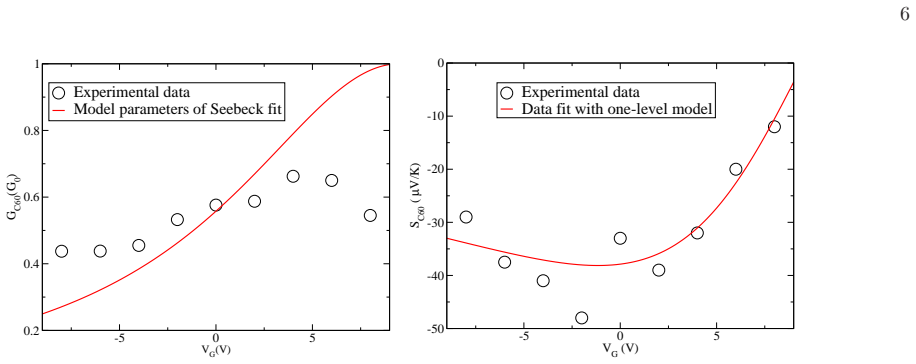
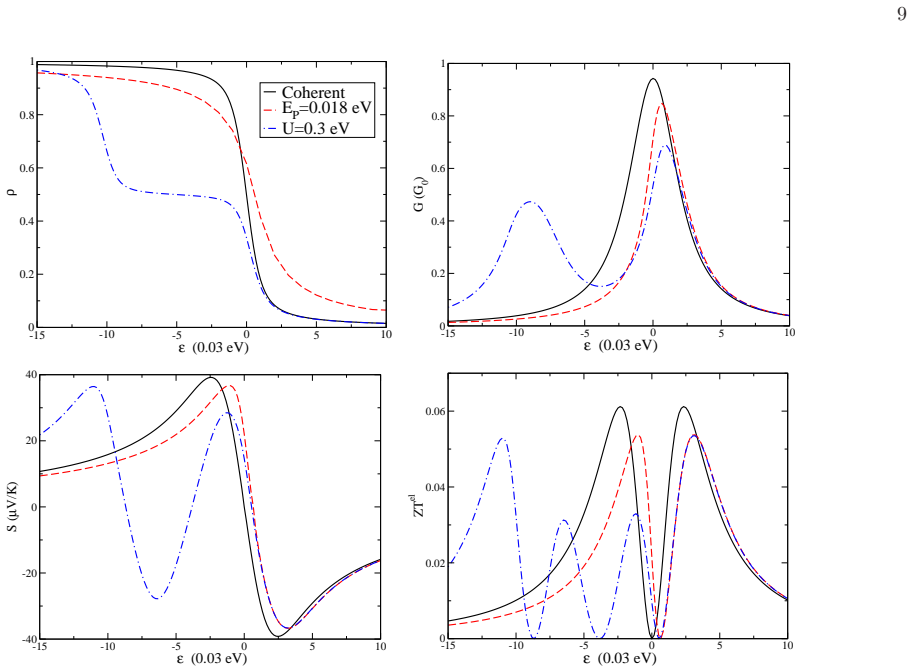
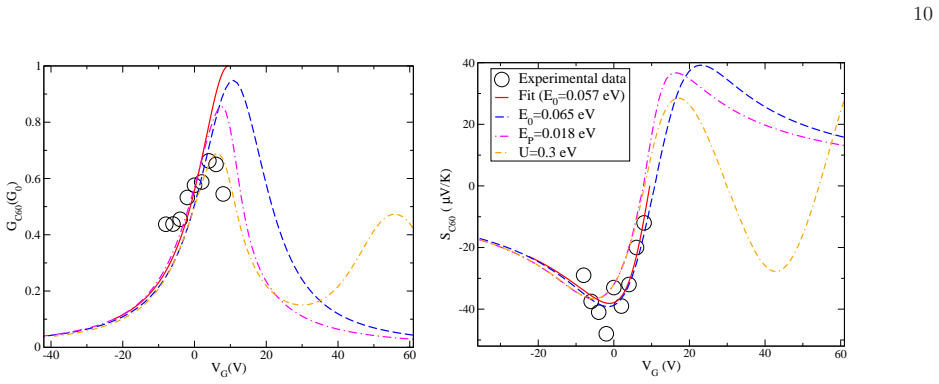
Within a single-level Anderson-Holstein-type model, the authors show that the conductance gap, peak position, and thermopower magnitude observed in gated fullerene junctions require the simultaneous presence of the electron-vibration coupling EP = 0.018 eV and a Hubbard repulsion U = 0.3 eV. The electron-vibration coupling alone shifts and narrows the conductance peak, and the Hubbard term suppresses the conductance amplitude and generates a secondary Coulomb-blockade feature. Together they bring the calculated conductance peak and Seebeck zero into agreement with the experimental data at 100 K for a level position E0 - mu = 0.065 eV, where the coherent model with E0 - mu = 0.057 eV fails. The paper also predicts an electronic thermal conductance whose gate-voltage profile closely follows the charge conductance.
Load-bearing premise
The load-bearing premise is that the strongly interacting spectral function can be represented, at every oscillator displacement, as a weighted sum of two independent Lorentzian peaks whose occupation weight is self-consistently determined, a two-peak ansatz that also assumes the oscillator distribution stays in equilibrium; the fitted parameters, with Gamma = 0.032 eV and EP = 0.018 eV, sit at the edge of the regime where that ansatz is expected to hold.
Editorial extensions
If this is right
- For fullerene junctions at 100 K, the coherent one-level model cannot fit both conductance and thermopower; the combined interactions are the minimal required ingredient.
- The conductance peak position is controlled by EP and the peak amplitude is reduced by U, so fits to G alone without Coulomb repulsion will mislocate the level.
- The Seebeck coefficient stays relatively robust near resonance, meaning thermopower data alone cannot discriminate many-body mechanisms; conductance data are the discriminating probe.
- The model predicts a secondary conductance peak and oscillatory thermopower at gate voltages far from resonance, signatures of Coulomb blockade that could be searched for experimentally.
- The predicted electronic thermal conductance is a fraction of the thermal conductance quantum and tracks the charge conductance, setting a scale for future single-molecule thermal measurements.
Reading between the lines
- The same two-Lorentzian weighted ansatz could be applied to other large molecules with a soft center-of-mass mode, predicting that a Coulomb blockade satellite peak should appear whenever the charging energy is comparable to the vibrational shift and the mode remains adiabatic.
- Because the averaging uses the equilibrium oscillator distribution, the fit at 100 K implicitly assumes current-induced heating and forces are negligible; at higher bias or lower temperature this assumption should break down, offering a testable deviation.
- The parameter set implies an effective level shift from vibrational coupling of about EP, so gate-voltage calibration in coherent fits may systematically underestimate the LUMO-to-chemical-potential distance.
- Extending the comparison to the full gate-voltage range would discriminate the two-peak ansatz from alternative multi-level interference models, since the predicted secondary peak is a distinctive Coulomb-blockade signature.
Signed reviews
Editorial analysis
A structured set of objections, weighed in public.
Referee Report
Summary. The paper develops a self-consistent adiabatic treatment of a one-level Anderson-Holstein model to describe charge conductance and Seebeck coefficient of Au-C60-Au molecular junctions at T = 100 K. The model includes a low-frequency center-of-mass vibrational mode with polaron energy EP and a local Hubbard repulsion U, and averages transport quantities over the oscillator distribution. The authors show that the coherent one-level model fitted to the Seebeck data of Ref. [17] fails to reproduce the conductance peak position, that adding electron-vibration coupling shifts and reduces the conductance peak, and that adding electron-electron interaction further reshapes the curves so that both G and S appear to match the experimental gate-voltage dependence. The paper also presents predictions for the electronic thermal conductance and the electronic figure of merit ZT_el, and concludes that only the combined effect of electron-vibration and electron-electron interactions can explain the experimental data.
Significance. If fully established, the result would be a valuable demonstration that a non-perturbative adiabatic method incorporating both electron-vibration coupling and Coulomb blockade can quantitatively capture two complementary transport observables in a molecular junction. The paper is commendable for using a well-defined one-level model, for clearly separating coherent, EP-only, and EP+U contributions, and for providing concrete predictions for Gel_K and ZT_el that are falsifiable by future experiments. However, the central 'only combined effect' claim is currently under-supported because no U-only control calculation is shown and because the quantitative agreement with the experimental data is asserted by visual inspection rather than by a goodness-of-fit measure or a parameter-sensitivity analysis. The contribution is therefore significant if the missing control calculations are supplied, but as it stands the conclusion is stronger than the evidence.
major comments (3)
- [Sec. IV, Fig. 3] The abstract and Sec. IV claim that 'only the combined effect of local electron-vibration and electron-electron interactions' can reproduce both G and S, but the paper never presents a U-only calculation. The comparison in Fig. 3 contains only the coherent result, the EP-only result, and the EP+U result. Since the level alignment E0-mu is shifted from the experimental fit value of 0.057 eV to 0.065 eV, and since a finite U alone creates a second spectral peak at epsilon = -U and transfers spectral weight from the main peak, it is possible that a U-only model with an adjusted E0 or Gamma already places the conductance peak near VG ~ 5 V and produces an acceptable Seebeck curve. Showing that the U-only model fails over the full plausible parameter range is essential to support the 'only combined' necessity claim; without it, the combined model is merely sufficient, not necessary.
- [Sec. IV, Fig. 3 and Sec. III parameter values] The quantitative basis of the 'very good agreement' statement is not established. The parameters EP = 0.018 eV, U = 0.3 eV, and the shifted E0 - mu = 0.065 eV are order-of-magnitude estimates or ad hoc adjustments, and no error metric, confidence interval, or sensitivity study is provided. The authors should report, for example, the root-mean-square deviation between theory and experiment for G and S in the relevant VG range, and show how the agreement degrades when EP, U, Gamma, and alpha are varied within physically motivated ranges. Without such an analysis, the reader cannot distinguish a robust physical description from an overfit to a single dataset.
- [Eq. (24) and parameter regime discussed after it] The spectral function in Eq. (24) is written as a weighted sum of two independent Lorentzians of equal width Gamma, and the text states that this approximation is valid when Gamma ~ EP << U. The chosen parameters give EP/Gamma = 0.018/0.032 ~ 0.56, so the stated scale separation is not well satisfied, even though U >> Gamma ensures that the two Coulomb peaks are well separated. The authors should assess the error introduced by the two-peak ansatz at EP/Gamma ~ 0.56, either by benchmarking against a numerically exact or established approximate method in this parameter regime, or by estimating the neglected interference and non-Lorentzian corrections. If those corrections are non-negligible, the computed G and S curves would not reliably reflect the underlying many-body model.
minor comments (6)
- [Title and abstract] There is a typographical error in the title/abstract: 'thermoele ctric' should be 'thermoelectric'.
- [Sec. I, fourth paragraph] The sentence 'only very the thermal conductance of single-molecule junctions has been fully characterized' appears to be missing a word; it should probably read 'only very recently has the thermal conductance...'.
- [Sec. II, after Eq. (6)] The definition of the hybridization width matrix contains a redundant repetition: 'Γ m,n = ∑α Γ m,n α = ∑α Γ m,n α' should be a single sum with the same symbol.
- [Fig. 1 and Fig. 3 captions] The axis labels 'SC60' and 'GC60' should be typeset as 'S_{C60}' and 'G_{C60}', and the unit of S is written as 'K/V' instead of 'V/K' in the caption of Fig. 1.
- [Sec. III] The text estimates EP ~ 0.030 eV from experimental parameters but then uses EP = 0.018 eV in the calculations; the reason for choosing the lower value should be stated explicitly, beyond the statement that increasing EP shifts the peak too much.
- [Sec. IV] The phrase 'in the unities chosen in Figure 4' should be 'in the units chosen in Figure 4'.
Circularity Check
The central G/S comparison is an optimized fit presented as a prediction; the thermal-conductance prediction is independent, so the circularity is partial rather than total.
-
fitted input called prediction
[Abstract; Section IV, Figure 3 and surrounding text]
"We demonstrate that only the combined effect of local electron-vibration and electron-electron interactions is able to predict the correct behavior of both the charge conductance and the Seebeck coefficient in very good agreement with available experimental data. ... This energy shift is introduced to counteract the shifts of the peaks (conductance) or zeroes (Seebeck) introduced by many-body interactions ... The aim of this paper is to provide an optimal description for both charge conductance G and Seebeck coefficient S."
The G and S curves in Fig. 3 are the evidence offered for the abstract's 'predict' claim, but the model parameters are chosen for that same comparison: E0 is shifted from the Seebeck-fit value 0.057 eV to 0.065 eV explicitly to counteract interaction shifts, EP = 0.018 eV is selected in the intermediate regime, and U = 0.3 eV is an order-of-magnitude estimate from the conductance gap. Hence the agreement between the EP+U curves and the experimental G and S data is an optimized description, not an independent test; the central claim reduces to a fit of those data. The independent thermal-conductance prediction in Fig. 4 is real but does not validate the 'only combined' claim, which lacks a U-only control.
full rationale
The transport integrals (Eqs. 25-28) follow from the spectral function via standard linear-response formulas; that part of the derivation is not circular. The main circular element is evidential: the gate-voltage dependence of G and S is computed with E0, EP, and U adjusted so that the model reproduces those same experimental curves, so the abstract's 'predict' overstates an optimized fit. This is not a definitional equivalence, but it is a fitted-input-called-prediction pattern and warrants a partial-circularity score of 6. The missing U-only comparison is a control gap rather than circularity. Eq. (24) is the two-peak spectral ansatz imported from the authors' prior work [40]; since it is stated as an approximation with a validity condition rather than as a forced theorem, I do not treat it as a separate circular step, though it is a self-citation worth noting. The thermal-conductance curve of Fig. 4 is an independent output, which prevents the paper from being fully circular.
Assumptions & free parameters
free parameters (5)
- E0 - mu (level alignment at zero gate) =
0.065 eV
- EP (polaron energy, electron-vibration coupling) =
0.018 eV
- U (Hubbard repulsion) =
0.3 eV
- Gamma (hybridization width) =
0.032 eV
- alpha (gate effectiveness) =
0.006 eV/V
assumptions (6)
- domain assumption Adiabatic separation of timescales: omega_0 <= k_B T < Gamma, with omega_0 ~ 5 meV.
- domain assumption One-level model: the LUMO of C60 is well separated from other levels and is the only relevant transport level.
- domain assumption Two independent Coulomb-blockade peaks in the spectral function (Eq. 24).
- domain assumption The oscillator distribution P(x) is the equilibrium distribution at temperature T.
- standard math Wide-band approximation and symmetric coupling to leads.
- standard math Linear response regime (V_bias -> 0, Delta T -> 0).
Cite this review
Pith. "Pith review of On the role of local many-body interactions on the thermoelectric properties of fullerene junctions." pith.science (2026). https://pith.science/paper/DAEDNBGX
@misc{pith2026190802665,
  author       = {Pith},
  title        = {Pith review of: On the role of local many-body interactions on the thermoelectric properties of fullerene junctions},
  year         = {2026},
  howpublished = {\url{https://pith.science/paper/DAEDNBGX}},
  note         = {Machine review of arXiv:1908.02665}
}
read the original abstract
The role of local electron-vibration and electron-electron interactions on the thermoelectric properties of molecular junctions is theoretically analyzed focusing on devices based on fullerene molecules. A self-consistent adiabatic approach is used in order to obtain a non-perturbative treatment of the electron coupling to low frequency vibrational modes, such as those of the molecule center of mass between metallic leads. The approach incorporates also the effects of strong electron-electron interactions between molecular degrees of freedom within the Coulomb blockade regime. The analysis is based on a one-level model which takes into account the relevant transport level of fullerene and its alignment to the chemical potential of the leads. We demonstrate that only the combined effect of local electron-vibration and electron-electron interactions is able to predict the correct behavior of both the charge conductance and the Seebeck coefficient in very good agreement with available experimental data.
Figures
Figures from the paper (1 more)

Reference graph
Works this paper leans on
-
[17]
Electrostatic control of thermoelectricity in molecular junctions
Kim, Y.; Jeong, W.; Kim, K.; Lee, W.; Reddy, P. Electrostatic control of thermoelectricity in molecular junctions. Nature Nanotechnol. 2014 , 9 , 881
work page 2014
-
[1]
Scheer, E.; Cuevas, J. C. Molecular electronics: an introduction to theory and experiment ; World Scientific: 2010
work page 2010
-
[2]
Heat flow and thermoelectricity in atomic and molecular junctions
Dubi, Y.; Di Ventra, M. Heat flow and thermoelectricity in atomic and molecular junctions. Rev. Mod. Phys. 2011 , 83 , 131
work page 2011
-
[3]
Thermoelectricity in molecular junctions
Reddy, P.; Jang S.-Y.; Segalman, R.A.; Majumdar A. Thermoelectricity in molecular junctions. Science 2007 315 1568
work page 2007
-
[4]
Yee, S. K.; Malen, J. A.; Majumdar, A.; Segalman, R. A. Thermoelectricity in Fullerene-Metal Heterojunctions. Nano Lett. 2011 , 11 , 4089-4094
work page 2011
-
[5]
Finch, C.M.; Garcia-Suarez, V. M.; Lambert C. J. Giant thermopower and figure of merit in single-molecule devices. Phys. Rev. B 2009 , 79 , 033405
work page 2009
-
[6]
Optimal thermoelectric figure of merit of a molecular junction
Murphy, P.; Mukerjee, S.; Moore, J. Optimal thermoelectric figure of merit of a molecular junction. Phys. Rev. B 2008 , 78 , 161406(R)
work page 2008
-
[7]
Galperin, M.; Nitzan, A.; Ratner, M.A. Inelastic effects in molecular junction transport: scattering and self-consistent calculations for the Seebeck coefficient. Mol. Phys. 2008 , 106 , 397
work page 2008
Show all 51 references
-
[8]
Thermopower of single-molecule devices
Koch, J.; von Oppen, F.; Oreg, Y.; Sela, E. Thermopower of single-molecule devices. Phys. Rev. B 2004 , 70 , 195107
2004
-
[9]
R.; Flensberg, K
Leijnse, M.; Wegewijs, M. R.; Flensberg, K. Nonlinear thermoelectric properties of molecular junctions with vibrational coupling. Phys. Rev. B 2010 , 82 , 045412
2010
-
[10]
Thermoelectric efficiency of molecular junctions
Perroni, C.A.; Ninno, D.; Cataudella, V. Thermoelectric efficiency of molecular junctions. J. Phys. Condens. Matter 2016 , 28 , 373001
2016
-
[11]
Reddy, P
Cui,L.; Miao, R.; Jiang, C.; Meyhofer, E. ; Reddy, P. Perspective: Thermal and thermoelectric transport in molecular junctions. J. Chem. Phys. 2017 , 146 , 092201
2017
-
[12]
Park, S.; Kang, H.; Yoon, H. J. Structure-thermopower relationships in molecular thermoelectrics. J. Mater. Chem. A 2019 , 7 , 14419
2019
-
[13]
Thermoelectric effect in molecular electronics
Paulsson, M.; Datta, S. Thermoelectric effect in molecular electronics. Phys. Rev. B 2003 , 67 , 241403(R)
2003
-
[14]
Lessons from Nanoelectronics: A New Perspective on Transport ; World Scientific: Singapore, 2012
Datta, S. Lessons from Nanoelectronics: A New Perspective on Transport ; World Scientific: Singapore, 2012
2012
-
[15]
Park, S.; Yoon, H. J. New Approach for Large-Area Thermoelectric Junctions with a Liquid Eutectic Gallium-Indium Electrode. Nano Lett. 2018 , 18 , 7715?7718
2018
-
[16]
J.; Song, H.; Yoon, H
Kang, S.; Park, S.; Kang, H.; Cho S. J.; Song, H.; Yoon, H. J. Tunneling and thermoelectric characteristics of N-heterocyclic carbene-based large-area molecular junctions. Chem. Commun. 2019 10.1039/C9CC01585J
2019 doi
-
[18]
Y.; Segalman, R
Wang, R. Y.; Segalman, R. A.; Majumdar, A. Room temperature thermal conductance of alkanedithiol self-assembled monolayers. Appl. Phys. Lett. 2006 , 89 , 173113
2006
-
[19]
A.; Lagutchev, A.; Koh, Y
Wang, Z.; Carter, J. A.; Lagutchev, A.; Koh, Y. K.; Seong, N.-H.; Cahill, D. G.; Dlott, D. D. Ultrafast flash thermal conductance of molecular chains. Science 2007 , 317 , 787-790
2007
-
[20]
Length-Dependent Thermal Transport along Molecular Chains
Meier, T.; Menges, F.; Nirmalraj, P.; H\"olscher, H.; Riel, H.; Gotsmann, B. Length-Dependent Thermal Transport along Molecular Chains. Phys. Rev. Lett. 2014 , 113 , 060801
2014
-
[21]
A., Kl\"ockner, J
Cui, L; Hur, S.; Akbar, Z. A., Kl\"ockner, J. C.; Jeong, W.; Pauly, F. ; Jang, S.-Y.; Reddy, P.; Meyhofer, E. Thermal conductance of single-molecule junctions. Nature https://doi.org/10.1038/s41586-019-1420-z 2019
2019 doi
-
[22]
Galperin, M.; Nitzan, A.; Ratner, M. A. Molecular transport junctions: vibrational effects. J. Phys. Condens.: Matter 2007 , 19 , 103201
2007
-
[23]
Park, H.; Park, J.; Lim, A. K. L.; Anderson, E. H.; Alivisatos, A. P.; McEuen, P. L. Nanomechanical oscillations in a single- C_ 60 transistor. Nature 2000 , 407 , 57-60
2000
-
[24]
Effect of electron-phonon coupling on the thermoelectric efficiency of single-quantum-dot devices
Zianni, X. Effect of electron-phonon coupling on the thermoelectric efficiency of single-quantum-dot devices. Phys. Rev. B 2010 , 82 , 165302
2010
-
[25]
Three-terminal thermoelectric transport through a molecular junction
Entin-Wohlman, O.; Imry, Y.; Aharony, A. Three-terminal thermoelectric transport through a molecular junction. Phys. Rev. B 2010 , 82 , 115314
2010
-
[26]
Liu, J.; Sun, Q.-F.; Xie, X. C. Enhancement of the thermoelectric figure of merit in a quantum dot due to the Coulomb blockade effect. Phys. Rev. B 2010 , 81 , 245323
2010
-
[27]
E.; Wang, C.; Li, B
Ren, J.; Zhu J.-X.; Gubernatis, J. E.; Wang, C.; Li, B. Thermoelectric transport with electron-phonon coupling and electron-electron interaction in molecular junctions. Phys. Rev. B 2012 , 85 , 155443
2012
-
[28]
Vibrational cooling and thermoelectric response of nanoelectromechanical systems
Arrachea, L.; Bode, N.; von Oppen, F. Vibrational cooling and thermoelectric response of nanoelectromechanical systems. Phys. Rev. B 2014 , 90 , 125450
2014
-
[29]
B.; Martin, I
Mozyrsky, D.; Hastings, M. B.; Martin, I. Intermittent polaron dynamics: Born-Oppenheimer approximation out of equilibrium. Phys. Rev. B 2006 , 73 , 035104
2006
-
[30]
Self-consistent theory of molecular switching
Pistolesi, F.; Blanter Ya, M.; Martin, I. Self-consistent theory of molecular switching. Phys. Rev. B 2008 , 78 , 085127
2008
-
[31]
Semiclassical dynamics of nanoelectromechanical systems
Hussein, R.; Metelmann, A.; Zedler, P.; Brandes, T. Semiclassical dynamics of nanoelectromechanical systems. Phys. Rev. B 2010 , 82 , 165406
2010
-
[32]
V.; Egger R.; von Oppen, F
Bode, N.; Kusminskiy, S. V.; Egger R.; von Oppen, F. Current-induced forces in mesoscopic systems: A scattering-matrix approach. Beilstein J. Nanotechnol. 2012 , 3 , 144-162
2012
-
[33]
A.; Marigliano Ramaglia, V.; Cataudella, V
Nocera, A.; Perroni, C. A.; Marigliano Ramaglia, V.; Cataudella, V. Stochastic dynamics for a single vibrational mode in molecular junctions. Phys. Rev. B 2011 , 83 , 115420
2011
-
[34]
A.; Marigliano Ramaglia, V.; Cataudella, V
Nocera, A.; Perroni, C. A.; Marigliano Ramaglia, V.; Cataudella, V. Probing nonlinear mechanical effects through electronic currents: The case of a nanomechanical resonator acting as an electronic transistor. Phys. Rev. B 2012 , 86 , 035420
2012
-
[35]
Magnetic effects on nonlinear mechanical properties of a suspended carbon nanotube
Nocera,A.; Perroni, C.A.; Marigliano Ramaglia, V.; Cantele, G.; Cataudella, V. Magnetic effects on nonlinear mechanical properties of a suspended carbon nanotube. Phys. Rev. B 2013 , 87 , 155435
2013
-
[36]
A.; Ninno, D.; Cataudella, V
Perroni, C. A.; Ninno, D.; Cataudella, V. Electron-vibration effects on the thermoelectric efficiency of molecular junctions. Phys. Rev. B 2014 , 90 , 125421
2014
-
[37]
A.; Nocera, A.; Cataudella, V
Perroni, C. A.; Nocera, A.; Cataudella, V. Single-parameter charge pumping in carbon nanotube resonators at low frequency. Europhys. Lett. 2013 , 103 , 58001
2013
-
[38]
Noise-assisted charge pump in elastically deformable molecular junctions
Perroni, C.A.; Romeo, F.; Nocera, A.; Marigliano Ramaglia, V.; Citro, R.; Cataudella, V. Noise-assisted charge pump in elastically deformable molecular junctions. J. Phys.: Condens. Matter 2014 , 26 , 365301
2014
-
[39]
Charge and heat transport in soft nanosystems in the presence of time-dependent perturbations
Nocera, A.; Perroni, C.A.; Marigliano Ramaglia, V.; Cataudella, V. Charge and heat transport in soft nanosystems in the presence of time-dependent perturbations. Beilstein J. Nanotechnol. 2016 , 7 , 439-464
2016
-
[40]
A.; Ninno, D.; Cataudella, V
Perroni, C. A.; Ninno, D.; Cataudella, V. Interplay between electron-electron and electron-vibration interactions on the thermoelectric properties of molecular junctions. New J. Phys. 2015 , 17 , 083050
2015
-
[41]
Quantum kinetics in transport and optics of semiconductors ; Springer: Berlin, Germany, 2008
Haug, H.; Jauho, A.-P. Quantum kinetics in transport and optics of semiconductors ; Springer: Berlin, Germany, 2008
2008
-
[42]
C.; Chiang, C.-W.; Chen, Y.-C
Hsu, B. C.; Chiang, C.-W.; Chen, Y.-C. Effect of electron-vibration interactions on the thermoelectric efficiency of molecular junctions. Nanotechnology 2012 , 23 , 275401
2012
-
[43]
Thermopower for a molecule with vibrational degrees of freedom
Kruchinin, S.; Pruschke, T. Thermopower for a molecule with vibrational degrees of freedom. Physics Letters A 2014 , 378 , 1157-1161
2014
-
[44]
H.; Louie, S
Lu, X.; Grobis, M.; Khoo, K. H.; Louie, S. G.; Crommie, M. F. Spatially Mapping the Spectral Density of a Single C _ 60 Molecule. Phys. Rev. Lett. 2003 , 90 , 096802
2003
-
[45]
Koch, J.; von Oppen, F.; Andreev, A. V. Theory of the Franck-Condon blockade regime Phys. Rev. B 2006 , 74 , 205438
2006
-
[46]
D.; Anthore, A.; Gennser, U.; Cavanna, A.; Jin, Y.; Pierre, F
Jezouin, S.; Parmentier, F. D.; Anthore, A.; Gennser, U.; Cavanna, A.; Jin, Y.; Pierre, F. Quantum Limit of Heat Flow Across a Single Electronic Channel. Science 2013 , 342 , 601-604
2013
-
[47]
Anti-resonance features of destructive quantum interference in single-molecule thiophene junctions achieved by electrochemical gating
Bai, J.; Daaoub, A.; Sangtarash, S.; Li, X.; Tang, Y.; Zou, Q.; Sadeghi, H.; Liu, S.; Huang, X.; Tan, Z.; Liu, J.; Yang,Y.; Shi, J.; Meszaros, G.; Chen, W.; Lambert, C.; Hong, W. Anti-resonance features of destructive quantum interference in single-molecule thiophene junctions...
2019
-
[48]
R.; Miyazaki, T.; Xiang, L.; Asai, Y.; Zhou, G.; Tao, N
Li, Y.; Buerkle, M.; Li, G.; Rostamian, A.; Wang, H.; Wang, Z.; Bowler, D. R.; Miyazaki, T.; Xiang, L.; Asai, Y.; Zhou, G.; Tao, N. Gate controlling of quantum interference and direct observation of anti-resonances in single molecule charge transport. Nature Mater. 2019 , 18 357-363
2019
-
[49]
A.; Marigliano Ramaglia, V
Perroni, C. A.; Marigliano Ramaglia, V. ; Cataudella, V. Effects of electron coupling to intramolecular and intermolecular vibrational modes on the transport properties of single-crystal organic semiconductors. Phys. Rev. B 2011 , 84 014303
2011
-
[50]
S.; Perroni, C
De Filippis, G.; Cataudella, V.; Mishchenko, A. S.; Perroni, C. A.; Nagaosa, N. Optical conductivity of a doped Mott insulator: The interplay between correlation and electron-phonon interaction. Phys. Rev. B 2009 , 80 195104
2009
-
[51]
A.; Cataudella, V.; De Filippis, G.; Marigliano Ramaglia, V
Perroni, C. A.; Cataudella, V.; De Filippis, G.; Marigliano Ramaglia, V. Effects of electron-phonon coupling near and within the insulating Mott phase Phys. Rev. B 2005 , 71 113107
2005
Reviewed August 14, 2026 · model on record in the stance chip above.
Discussion (0). Continue with ORCID to comment.