REVIEW 5 major objections 6 minor 44 references
Dual-reference Age Synthesis
T0 review · 5 major / 6 minor · reviewed 2026-08-14 · deepseek-v4-flash
Pith's one-line read Facial age can be copied from one photo onto another person's identity, no age labels needed.
desk verdict A genuinely new conditioning signal for face aging—reference-image age features—with a plausible framework and decent ablations, but the age feature space is under-validated and the closest baseline is missing. read the letter →
The pith
A machine-rendered reading of the paper's core claim, the machinery that carries it, and where it could break.
The reading
What carries the argument
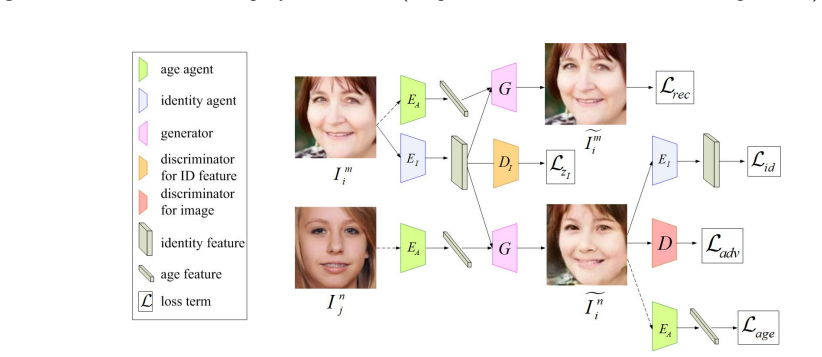
The load-bearing mechanism is the pair of feature agents and their two preservation losses. The identity agent is an encoder $E_I$ coupled to a discriminator $D_I$ that pushes identity codes toward a uniform prior, so identity features of different people separate from one another; the age agent $E_A$ is a truncated pretrained apparent-age network whose final 50-dimensional output is used as the age code. The generator receives the concatenation of the two codes, and the two Euclidean losses $\|E_I(\tilde{I}^n_i)-E_I(I^m_i)\|_2$ and $\|E_A(\tilde{I}^n_i)-E_A(I^n_j)\|_2$ are what force the output to inherit identity from one image and age from the other. The discriminator $D$ and the reconstruction loss keep the output photo-realistic and aligned with the identity reference's pixel structure.
What would settle it
Take a fixed identity image and two age reference images that human raters judge to be the same apparent age but that differ sharply in pose or expression, and generate outputs with each. If an independent age estimator or human raters judge the two outputs to differ in apparent age by about as much as outputs produced from references known to be different ages, then the age feature is carrying identity or pose information and the central transfer assumption fails.
Extended reading notes
Core claim
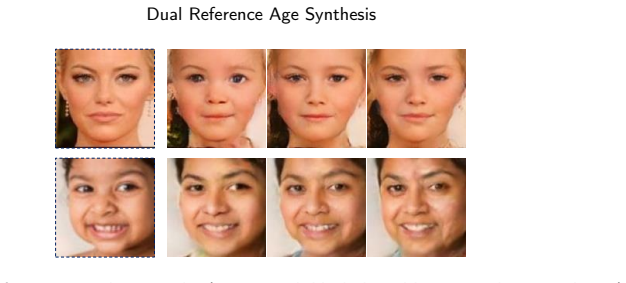
The paper's central claim is that facial age can be manipulated by an image reference instead of a scalar: the generator $G$ takes an identity feature $E_I(I^m_i)$ from the identity reference and an age feature $E_A(I^n_j)$ from the age reference and produces a face $\tilde{I}^n_i$ that satisfies both $E_I(\tilde{I}^n_i)\approx E_I(I^m_i)$ and $E_A(\tilde{I}^n_i)\approx E_A(I^n_j)$. The age agent is adapted from a pretrained apparent-age network by removing its last layer and adding two fully connected layers (1024 and 50 units), so the 50-dimensional output acts as a compact 'soft age' code. Training minimizes a hybrid loss of five terms: a pixel reconstruction loss, an adversarial loss on the image, an adversarial uniform-prior loss on identity features, an identity preservation loss, and the age preservation loss of Equation (1). Because the age reference is just another image sampled at random from the same dataset, the training needs no age annotations and no same-person cross-age pairs. The reported consequence is that DRAS synthesizes the identity at whatever apparent age the reference image displays, with higher age-preservation accuracy than a numeric-conditioned age model and better feature-space identity separation than a reconstruction-only model.
Load-bearing premise
The load-bearing premise is that the 50-dimensional age feature really captures apparent age and nothing else, so two faces whose features are close in Euclidean distance will look the same age even when their identities, poses, and expressions differ.
Editorial extensions
If this is right
- Age synthesis becomes feasible on datasets that have neither age labels nor pairs of the same person at different ages, since the age reference image supplies supervision through the age feature.
- Swapping the age reference image changes the apparent age of the output, so a user can specify 'looks like this person's age' rather than a number, including subtle within-group differences.
- The framework separates identity and age into different feature spaces during training, which is what lets it age the same identity consistently across ten age groups.
- On the reported benchmark comparisons, the model's age-preservation accuracy exceeds the numeric-conditioned baseline while its identity verification confidence stays above the acceptance threshold.
- Numeric age conditioning becomes a special case: choose an age reference image that looks the target age and the same generation mechanism applies.
Reading between the lines
- The 'no age labels' claim applies to DRAS training, not to the age feature itself, which is inherited from a network pretrained on labeled apparent-age data; a stricter test of the paradigm would start the age agent from an unsupervised face embedding.
- The dual-reference formulation should transfer to other attributes that resist numeric labels, such as expression intensity, fatigue, or apparent health, by replacing the age agent with a feature extractor for that attribute.
- A library-based interface is a natural extension: instead of a slider, a user selects an exemplar face, and the model interpolates or extrapolates between identity and age references.
- Because only a single 50-dimensional vector represents age, using distributional divergence between feature distributions (a direction the authors themselves flag) may improve robustness when several reference images define the target age.
Signed reviews
Editorial analysis
A structured set of objections, weighed in public.
Referee Report
Summary. The paper proposes dual-reference age synthesis (DRAS), a GAN-based framework that takes two facial images as input: one identity reference and one age reference. The age agent maps the age reference to a 50-dimensional feature, the identity agent maps the identity reference to a latent identity code, and the generator synthesizes an output that is meant to share identity with the first image and age with the second. The model is trained with reconstruction, adversarial, identity-preservation, and age-preservation losses, and is evaluated on UTKFace and CACD against CAAE and IPCGAN. The authors claim that DRAS provides a more flexible 'soft' age control than numeric conditioning and requires no paired data or age annotations.
Significance. If the central mechanism works, the paper introduces a genuinely useful task formulation: age synthesis conditioned on a reference image rather than a scalar age. This could simplify annotation requirements and better capture the perceived-age variability that a single number misses. The framework itself is clearly described, and the idea of using an externally pretrained age estimator (DEX) as the age feature extractor is reasonable. The paper also includes ablation studies and quantitative comparisons, and it reports machine-checkable experimental numbers. However, the central claim depends on an unvalidated assumption about the age feature space, and the experimental protocol omits the closest prior work and trivial baselines, so the significance of the empirical results is currently not established.
major comments (5)
- [§3.2, Eq. (1)] The age preservation loss minimizes the Euclidean distance between EA of the generated image and EA of the age reference. The entire age-transfer mechanism therefore rests on the assumption that the 50-dimensional EA space is a faithful, transferable representation of perceived age and is largely invariant to identity, pose, and expression. The paper provides no direct evidence for this. The two newly added fully-connected layers are trained from DEX initialization using L_age, L_rec, and the adversarial losses without any age labels or monotonicity constraint, so nothing prevents EA from collapsing or from encoding generator-specific artifacts. The paper's own age-preservation evaluation uses a separate AlexNet classifier fine-tuned on age labels, not the internal EA metric, so it does not validate that Euclidean distance in EA corresponds to perceived age. Please provide evidence for age-monotonicity or cross-identity age transfer in the EA space, for example by evaluating age retrieval accuracy using EA features, comparing fixed DEX features against the fine-tuned ones, or showing that matching EA produces the target age in a controlled experiment.
- [§4.2 and §4.3.3] The closest prior work, Dual Conditional GANs [41], is mentioned in Section 4.2 as a method that DRAS differs from, but it is never included in the experimental comparisons. Given that [41] also uses two conditional inputs for face aging, the statement that DRAS achieves the best performance among compared methods is incomplete without a comparison to this baseline. If [41] is excluded for a concrete reason, that reason should be stated explicitly; otherwise the comparison should be added.
- [§4.3.2, Tables 4, 9, 10] The age-preservation accuracies are reported without error bars, confidence intervals, or significance tests. Since the accuracies are often near saturation (e.g., 99.93% vs 99.80% for group 0#), the reported differences may not be statistically meaningful. Please report standard deviations over multiple training runs or apply a significance test, and state how many test images underlie each accuracy value.
- [§4.3.4, Tables 5-8] The identity-preservation comparison with IPCGAN is confounded. In Section 4.3.3 and Figure 12 the authors note that IPCGAN's synthesized images look almost the same as their identity reference images, with little visible aging effect. It is therefore expected that IPCGAN achieves the highest verification confidence, since it trivially preserves identity by failing at the age-transfer task. A meaningful identity-preservation comparison must control for the magnitude of the applied age change, for example by measuring identity preservation only on images where the age reference is correctly matched.
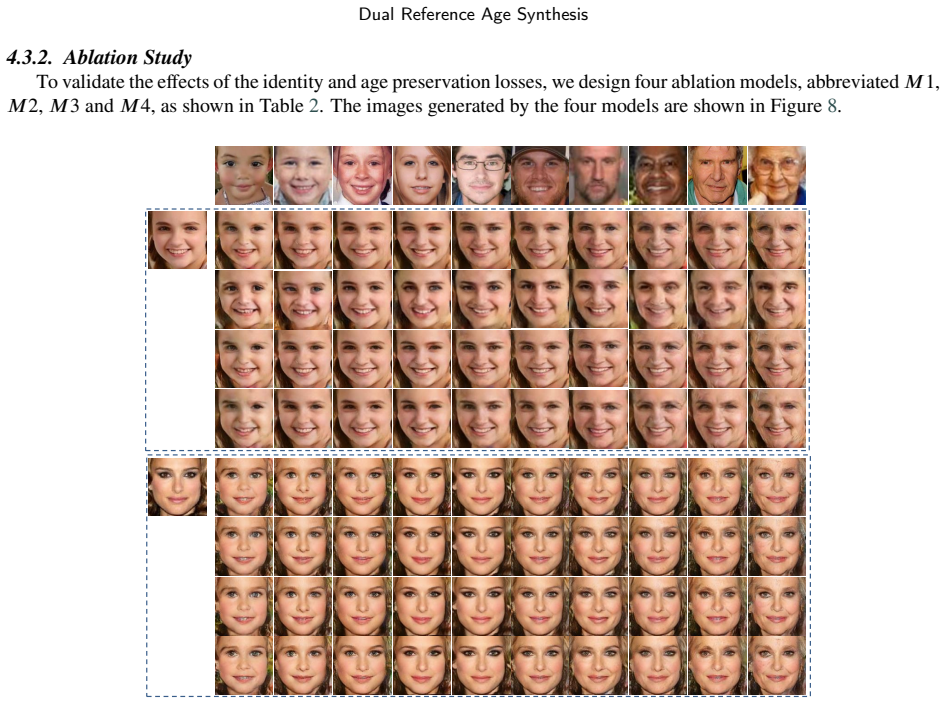
- [§4.2 and §4.3, Fig. 12] No trivial baseline is reported. A simple baseline that outputs the identity reference unchanged, or a version of DRAS trained without the age reference, would clarify whether the age reference contributes any measurable effect beyond the reconstruction objective. Reporting identity and age preservation for such a baseline would strengthen the claim that the dual-reference mechanism itself is responsible for the observed performance.
minor comments (6)
- [§3.1, Eq. (3)] In Eq. (3), the notation 'EI∼pdata (I)' is confusing; it should be 'I ∼ pdata(I)' in the data term. Also, the two discriminators DI and D are both used in the text with subscripts, but later the implementation section refers to them without consistent notation.
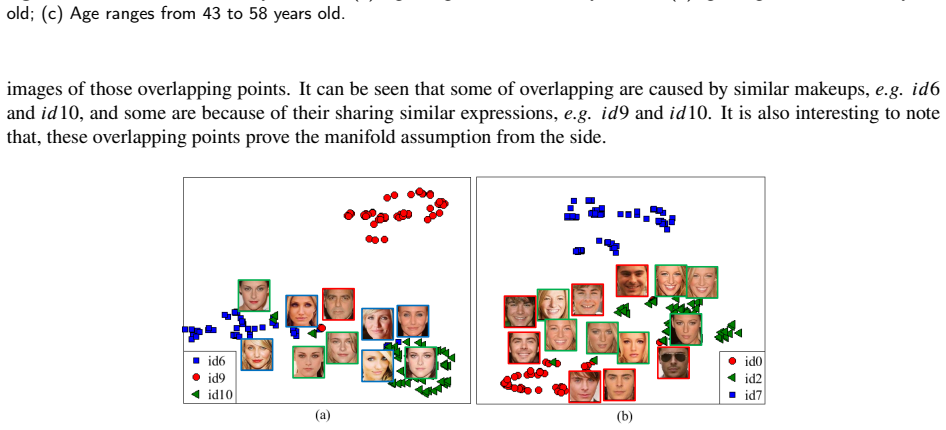
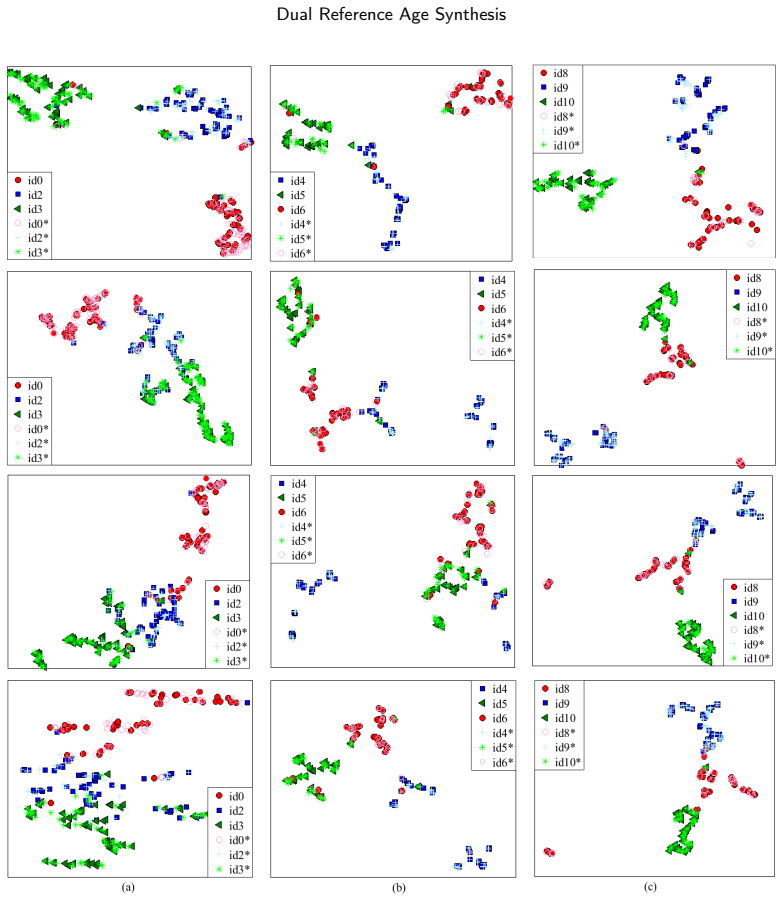
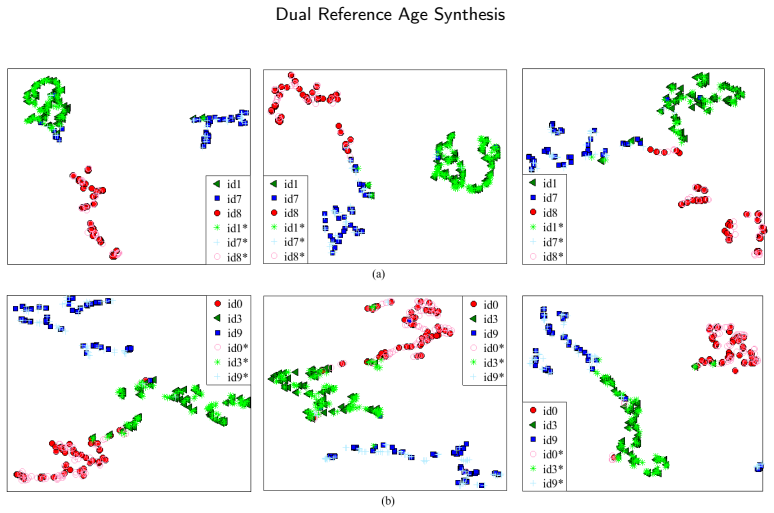
- [§4.3.1] The sentence 'T-Distributed Stochastic Neighbor Embedding(t-SNE) [42,43]depictsthesimilaritiesofidentityfeatures, which can be used to visualize the disentangled their disentangled representations' is grammatically broken and should be rewritten.
- [§4.1] The phrase 'images with rank higher than five are low quality' refers to CACD's rank annotation, but the notion of rank is not defined for a reader who is not already familiar with the CACD dataset. A brief definition or reference would help.
- [§4.3.2] The sentence 'which explain the reconstruction loss plays an important role in identity perservation' contains typos and should read 'which explains that the reconstruction loss plays an important role in identity preservation.'
- [Eq. (6)] In Eq. (6) the loss weights are displayed with placeholder glyphs in the submitted PDF; they should be typeset as ordinary Greek symbols (e.g., λ_adv, λ_id, λ_age) to be legible.
- [§3.2] The term 'soft age information' is used informally. Since it is a central conceptual contribution, consider giving a precise definition of what 'soft' means in terms of the feature-space representation.
Circularity Check
No significant circularity; the age representation is anchored to an external pretrained DEX model and age transfer is evaluated with an independent classifier.
full rationale
The paper's training objective defines age transfer as minimizing ||EA(I_n_j) - EA(G(EI(I_m_i), EA(I_n_j)))|| (Eq. 1), but EA is initialized from the externally pretrained DEX age estimator [37,38] and its last fully connected layers are only lightly adapted without age labels before being frozen for generator training (Sec. 4.2, Stage 1/2). The target age is therefore not defined solely by the model's own outputs; DEX provides an independent, label-trained anchoring. The age-preservation evaluation uses a separate AlexNet fine-tuned on UTKFace/CACD age labels rather than the trained EA, so the reported 'same age group' accuracies are not the same quantity as the training loss. Identity preservation is likewise evaluated with Face++ and t-SNE on EI. The framework borrows GAN/AAE architectures and a uniform identity prior from prior work [10] by citation, but those are standard external building blocks, not self-citations, and the central dual-reference formulation is not reduced to them. No fitted parameter is renamed as a prediction, and no uniqueness theorem or author-chain citation is used to force the design. The main limitation flagged by the skeptic, that DEX features may not be age-only or age-monotonic, is a correctness/robustness assumption, not a circularity, because the paper checks age transfer externally.
Assumptions & free parameters
free parameters (3)
- lambda_id (identity preservation weight) =
1e-3
- lambda_age (age preservation weight) =
1e-2
- age feature dimension =
50
assumptions (4)
- domain assumption A face image lies on two low-dimensional manifolds, identity and age, that change smoothly and are sufficiently disentangled to allow independent feature extraction.
- domain assumption DEX (pretrained for age estimation) provides a feature space where Euclidean distance reflects age similarity, and adapting only the last two FC layers preserves this property.
- domain assumption The identity feature is assumed to follow a uniform distribution, following CAAE [10], which regularizes the identity manifold.
- ad hoc to paper Training with a reconstruction loss using the same image as both references (Stage 1) is sufficient to learn meaningful identity and age features without paired data.
Cite this review
Pith. "Pith review of Dual-reference Age Synthesis." pith.science (2026). https://pith.science/paper/O36A2BXT
@misc{pith2026190802671,
  author       = {Pith},
  title        = {Pith review of: Dual-reference Age Synthesis},
  year         = {2026},
  howpublished = {\url{https://pith.science/paper/O36A2BXT}},
  note         = {Machine review of arXiv:1908.02671}
}
read the original abstract
Age synthesis methods typically take a single image as input and use a specific number to control the age of the generated image. In this paper, we propose a novel framework taking two images as inputs, named dual-reference age synthesis (DRAS), which approaches the task differently; instead of using "hard" age information, i.e. a fixed number, our model determines the target age in a "soft" way, by employing a second reference image. Specifically, the proposed framework consists of an identity agent, an age agent and a generative adversarial network. It takes two images as input - an identity reference and an age reference - and outputs a new image that shares corresponding features with each. Experimental results on two benchmark datasets (UTKFace and CACD) demonstrate the appealing performance and flexibility of the proposed framework.
Figures

Figures from the paper (13 more)



Reference graph
Works this paper leans on
-
[41]
J. Song, J. Zhang, L. Gao, X. Liu, H. T. Shen, Dual conditional gans for face aging and rejuvenation., in: IJCAI, 2018, pp. 899–905
work page 2018
-
[1]
I. Goodfellow, J. Pouget-Abadie, M. Mirza, B. Xu, D. Warde-Farley, S. Ozair, A. Courville, Y. Bengio, Generative adversarial nets, in: Advances in neural information processing systems, 2014, pp. 2672–2680
work page 2014
-
[2]
K. Ricanek Jr, E. Boone, E. Patterson, Craniofacial aging impacts on the eigenface face biometric, Computer Science 1 (2006) 3
work page 2006
-
[3]
Y.Fu,G.Guo,T.S.Huang,Agesynthesisandestimationviafaces: Asurvey,IEEEtransactionsonpatternanalysisandmachineintelligence 32 (11) (2010) 1955–1976
work page 2010
-
[4]
L. S. Mark, J. B. Pittenger, H. Hines, C. Carello, R. E. Shaw, J. T. Todd, Wrinkling and head shape as coordinated sources of age-level information, Perception & Psychophysics 27 (2) (1980) 117–124
work page 1980
-
[5]
A.J.O’toole,T.Vetter,H.Volz,E.M.Salter,Three-dimensionalcaricaturesofhumanheads: distinctivenessandtheperceptionoffacialage, Perception 26 (6) (1997) 719–732
work page 1997
-
[6]
A. J. O’Toole, T. Price, T. Vetter, J. C. Bartlett, V. Blanz, 3d shape and 2d surface textures of human faces: the role of â/uni0102/uni0132averagesâ/uni0102/uni0130 in attractiveness and age, Image and Vision Computing 18 (1) (1999) 9–19
work page 1999
-
[7]
J.Suo,S.-C.Zhu,S.Shan,X.Chen,Acompositionalanddynamicmodelforfaceaging,IEEETransactionsonPatternAnalysisandMachine Intelligence 32 (3) (2009) 385–401
work page 2009
Show all 44 references
-
[8]
Tazoe, H
Y. Tazoe, H. Gohara, A. Maejima, S. Morishima, Facial aging simulator considering geometry and patch-tiled texture, in: ACM SIGGRAPH 2012 Posters, 2012, pp. 1–1
2012
-
[9]
2378–2386
W.Wang,Z.Cui,Y.Yan,J.Feng,S.Yan,X.Shu,N.Sebe,Recurrentfaceaging,in: ProceedingsoftheIEEEConferenceonComputerVision and Pattern Recognition, 2016, pp. 2378–2386
2016
-
[10]
Zhang, Y
Z. Zhang, Y. Song, H. Qi, Age progression/regression by conditional adversarial autoencoder, in: The IEEE Conference on Computer Vision and Pattern Recognition (CVPR), Vol. 2, 2017
2017
-
[11]
Z. Wang, X. Tang, W. Luo, S. Gao, Face aging with identity-preserved conditional generative adversarial networks, in: Proceedings of the IEEE Conference on Computer Vision and Pattern Recognition, 2018, pp. 7939–7947
2018
-
[12]
Tiddeman, M
B. Tiddeman, M. Burt, D. Perrett, Prototyping and transforming facial textures for perception research, IEEE computer graphics and applica- tions 21 (5) (2001) 42–50
2001
-
[13]
P. J. Benson, D. I. Perrett, Extracting prototypical facial images from exemplars, Perception 22 (3) (1993) 257–262
1993
-
[14]
Kemelmacher-Shlizerman, S
I. Kemelmacher-Shlizerman, S. Suwajanakorn, S. M. Seitz, Illumination-aware age progression, in: Proceedings of the IEEE conference on computer vision and pattern recognition, 2014, pp. 3334–3341
2014
-
[15]
Z. Liu, Z. Zhang, Y. Shan, Image-based surface detail transfer, IEEE Computer Graphics and Applications 24 (3) (2004) 30–35
2004
-
[16]
H. Yang, D. Huang, Y. Wang, A. K. Jain, Learning face age progression: A pyramid architecture of gans, arXiv preprint arXiv:1711.10352 (2017)
2017 arXiv
-
[17]
Antipov, M
G. Antipov, M. Baccouche, J.-L. Dugelay, Face aging with conditional generative adversarial networks, arXiv preprint arXiv:1702.01983 (2017)
2017 arXiv
-
[18]
Lanitis, C
A. Lanitis, C. J. Taylor, T. F. Cootes, Toward automatic simulation of aging effects on face images, IEEE Transactions on pattern Analysis and machine Intelligence 24 (4) (2002) 442–455
2002
-
[19]
Mukaida, H
S. Mukaida, H. Ando, Extraction and manipulation of wrinkles and spots for facial image synthesis, in: Sixth IEEE International Conference on Automatic Face and Gesture Recognition, 2004. Proceedings., IEEE, 2004, pp. 749–754
2004
-
[20]
M. R. Gandhi, A method for automatic synthesis of aged human facial images, Ph.D. thesis, Citeseer (2004)
2004
-
[21]
Ramanathan, R
N. Ramanathan, R. Chellappa, Modeling age progression in young faces, in: 2006 IEEE Computer Society Conference on Computer Vision and Pattern Recognition (CVPR’06), Vol. 1, IEEE, 2006, pp. 387–394
2006
-
[22]
Y. Fu, N. Zheng, M-face: An appearance-based photorealistic model for multiple facial attributes rendering, IEEE Transactions on Circuits and Systems for Video technology 16 (7) (2006) 830–842
2006
-
[23]
J.Suo,X.Chen,S.Shan,W.Gao,Q.Dai,Aconcatenationalgraphevolutionagingmodel,IEEEtransactionsonpatternanalysisandmachine intelligence 34 (11) (2012) 2083–2096
2012
-
[24]
P. Kaur, H. Zhang, K. J. Dana, Photo-realistic facial texture transfer, arXiv preprint arXiv:1706.04306 (2017)
2017 arXiv
-
[25]
X. Shu, J. Tang, H. Lai, L. Liu, S. Yan, Personalized age progression with aging dictionary, in: Proceedings of the IEEE international conference on computer vision, 2015, pp. 3970–3978
2015
-
[26]
X. Shu, J. Tang, H. Lai, Z. Niu, S. Yan, Kinship-guided age progression, Pattern Recognition 59 (2016) 156–167
2016
-
[27]
A. M. Bukar, H. Ugail, Facial age synthesis using sparse partial least squares (the case of ben needham), Journal of forensic sciences 62 (5) (2017) 1205–1212. Yuan Zhou et al.:Preprint submitted to Elsevier Page 18 of 19 Dual Reference Age Synthesis
2017
-
[28]
A. M. Bukar, H. Ugail, N. Hussain, On facial age progression based on modified active appearance models with face texture, in: Advances in computational intelligence systems, Springer, 2017, pp. 465–479
2017
-
[29]
T. F. Cootes, G. J. Edwards, C. J. Taylor, Active appearance models, IEEE Transactions on pattern analysis and machine intelligence 23 (6) (2001) 681–685
2001
-
[30]
Mirza, S
M. Mirza, S. Osindero, Conditional generative adversarial nets, arXiv preprint arXiv:1411.1784 (2014)
2014 arXiv
-
[31]
Makhzani, J
A. Makhzani, J. Shlens, N. Jaitly, I. Goodfellow, B. Frey, Adversarial autoencoders, arXiv preprint arXiv:1511.05644 (2015)
2015 arXiv
-
[32]
5967–5976
G.Lample,N.Zeghidour,N.Usunier,A.Bordes,L.Denoyer,etal.,Fadernetworks: Manipulatingimagesbyslidingattributes,in: Advances in Neural Information Processing Systems, 2017, pp. 5967–5976
2017
-
[33]
S.Liu, Y.Sun, D.Zhu, R.Bao, W.Wang, X.Shu, S.Yan, Faceagingwithcontextualgenerativeadversarialnets, in: Proceedingsofthe2017 ACM on Multimedia Conference, ACM, 2017, pp. 82–90
2017
-
[34]
H. Ding, K. Sricharan, R. Chellappa, Exprgan: Facial expression editing with controllable expression intensity, arXiv preprint arXiv:1709.03842 (2017)
2017 arXiv
-
[35]
Y. Choi, M. Choi, M. Kim, J.-W. Ha, S. Kim, J. Choo, Stargan: Unified generative adversarial networks for multi-domain image-to-image translation, in: The IEEE Conference on Computer Vision and Pattern Recognition (CVPR), 2018
2018
-
[36]
J. Bao, D. Chen, F. Wen, H. Li, G. Hua, Towards open-set identity preserving face synthesis, in: Proceedings of the IEEE Conference on Computer Vision and Pattern Recognition, 2018, pp. 6713–6722
2018
-
[37]
R.Rothe,R.Timofte,L.V.Gool,Dex: Deepexpectationofapparentagefromasingleimage,in: IEEEInternationalConferenceonComputer Vision Workshops (ICCVW), 2015
2015
-
[38]
Rothe, R
R. Rothe, R. Timofte, L. V. Gool, Deep expectation of real and apparent age from a single image without facial landmarks, International Journal of Computer Vision (IJCV) (July 2016)
2016
-
[39]
J. Deng, W. Dong, R. Socher, L.-J. Li, K. Li, L. Fei-Fei, Imagenet: A large-scale hierarchical image database, in: 2009 IEEE conference on computer vision and pattern recognition, Ieee, 2009, pp. 248–255
2009
-
[40]
Chen, C.-S
B.-C. Chen, C.-S. Chen, W. H. Hsu, Cross-age reference coding for age-invariant face recognition and retrieval, in: European conference on computer vision, Springer, 2014, pp. 768–783
2014
-
[42]
L. v. d. Maaten, G. Hinton, Visualizing data using t-sne, Journal of machine learning research 9 (Nov) (2008) 2579–2605
2008
-
[43]
Van der Maaten, G
L. Van der Maaten, G. Hinton, Visualizing non-metric similarities in multiple maps, Machine learning 87 (1) (2012) 33–55
2012
-
[44]
Yuan Zhou et al.:Preprint submitted to Elsevier Page 19 of 19
Megvii, Face++ face comparing api, acessed December 2019 athttps://www.faceplusplus.com/face-comparing/. Yuan Zhou et al.:Preprint submitted to Elsevier Page 19 of 19
2019
Reviewed August 14, 2026 · model on record in the stance chip above.
Discussion (0). Continue with ORCID to comment.