REVIEW 4 major objections 4 minor 20 references
Hybrid Precoding for Multi-Group Multicasting in mmWave Systems
T0 review · 4 major / 4 minor · reviewed 2026-08-14 · deepseek-v4-flash
Pith's one-line read A joint SDR-based design for hybrid transmit precoders and receive combiners brings mmWave multi-group multicast to near-fully-digital performance with fewer RF chains, and two receive antennas raise successful reception by 60%.
desk verdict Plausible first joint hybrid multicast precoder/combiner design, but the headline gains may be counting slack-satisfied users as decoded, so those numbers need a fix before the claims stand. read the letter →
The pith
A machine-rendered reading of the paper's core claim, the machinery that carries it, and where it could break.
The reading
What carries the argument
The load-bearing mechanism is a three-block alternating optimizer. First, the analog precoder $F$ is optimized by rewriting $F m_i = J_i f$, forming the rank-one matrix $D = f f^H$, relaxing the rank and phase constraints to a semidefinite program whose diagonal entries are pinned to $\delta$, and then recovering a phase vector by Cholesky factorization $\hat{D} = \hat{Q}^T \hat{Q}^*$, least-squares fitting of a common vector $\hat{u}$ and per-entry phases so that $\hat{q}_n \approx [\hat{f}]_n \hat{u}$, and randomization over candidate $\hat{u}$. Second, the digital precoders $m_i$ are optimized by a further SDR over $M_i = m_i m_i^H$. Third, the receive combiners $w_k$ are optimized by a per-user SDR over $W_k = w_k w_k^H$. Slack variables $x_k$ penalized in the objective keep every subproblem feasible, so the alternation does not stall. The central identity is $D = Q^T Q^*$ with $q_n \approx [f]_n u$: it converts the hard constant-modulus finite-alphabet constraint on $F$ into a solvable least-squares problem.
What would settle it
Run the relaxed program for the analog precoder ($P^{\mathrm{hyb}}_{\mathrm{SDR},1}$) on a channel realization and compute the two largest eigenvalues of $\hat{D}$. If the second eigenvalue is comparable to the first, the least-squares recovery cannot produce $\hat{q}_n \approx [\hat{f}]_n \hat{u}$ for all $n$, and the decoded-packet count should fall below the fully-digital baseline; observing that drop on a realistic realization would settle the limit of the claim.
Extended reading notes
Core claim
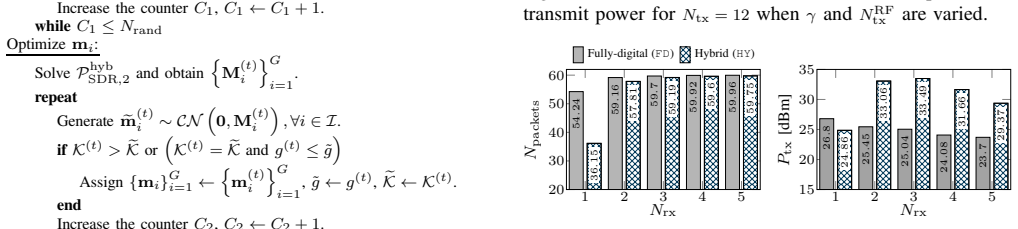
The central claim is that joint design of the hybrid transmit precoder and the per-user receive combiners, rather than treating them separately, is what unlocks near-digital performance in mmWave multi-group multicast. With receivers limited to one omnidirectional antenna, the scheme saturates; with two antennas, the algorithm makes each receiver reject interference, raising decoded packets by 60% and improving average transmit power per received message by 16.8% for the hybrid precoder. At the transmitter, the SDR-based alternating scheme with finite-resolution phase shifts reaches the same number of decoded packets as the fully digital precoder, which needs 12 RF chains, using only 8 RF chains, at the cost of a few dB more transmit power. The design is stated to be the first to handle an arbitrary number of finite-resolution phase shifts together with multi-antenna receivers in this setting.
Load-bearing premise
The algorithm's success hinges on the relaxed SDP solution being close to rank one: after the rank constraint is dropped, the Cholesky factors $\hat{q}_n$ must be approximable as $[\hat{f}]_n \hat{u}$ for one common vector $\hat{u}$ and valid phase values, and the paper concedes this cannot be guaranteed.
Editorial extensions
If this is right
- With 8 RF chains and 12 transmit antennas, the hybrid precoder matches the fully digital precoder's decoded-packet count over the simulated SINR targets of 4, 6, and 8 dB.
- Adding a second receive antenna improves decoded packets by 60% for the hybrid precoder and 9% for the fully digital precoder, so receive-side combining is a cheap performance multiplier.
- The transmit power per successfully received message falls by 16.8% for the hybrid precoder and 12.9% for the fully digital precoder when receivers use two antennas.
- The optimizer works with naive initialization and without any knowledge of the optimal fully digital precoder, so the design does not depend on an oracle solution.
- Because the framework allows an arbitrary number of phase levels, the same algorithm covers both coarse and finely quantized analog phase shifters.
Reading between the lines
- Beyond the paper, the same SDR-plus-Cholesky-plus-least-squares phase recovery is a generic recipe for any constant-modulus finite-alphabet constraint, so it could transfer to reconfigurable-intelligent-surface phase profiles or discrete-phase analog beamforming in other frequency bands.
- Beyond the paper, the reported 60% gain is measured in one correlated scenario (60 users, four groups, 30-degree angular spread) and is likely scenario-dependent, shrinking when inter-group channels are already well separated or when the number of receive antennas exceeds two.
- Beyond the paper, the algorithm's dependence on random candidate vectors suggests a testable engineering tradeoff: when the relaxed SDP solution is nearly rank one, far fewer random draws should be needed, potentially cutting complexity by an order of magnitude.
- Beyond the paper, since the fully digital baseline also fails to reach 100% decoded packets in the hardest scenarios, the practical bottleneck is multicast interference itself rather than the hybrid architecture.
Signed reviews
Editorial analysis
A structured set of objections, weighed in public.
Referee Report
Summary. The paper studies the joint design of hybrid transmit precoders (analog phase-shifter network plus digital precoder) and receive combiners for multi-group multicast in mmWave systems. It formulates an NP-hard QoS power-minimization problem, introduces slack variables to keep the alternating subproblems feasible, and solves the subproblems via semidefinite relaxation with randomization, alternating optimization, and a Cholesky-factorization-based phase-recovery step. Simulation results over 100 channel realizations claim that a hybrid precoder with NRF=8 performs close to its fully-digital counterpart and that two receive antennas yield roughly 60% improvement in decoded packets and 16.8% improvement in average transmit power per received message.
Significance. If the numerical claims are credible, the paper would be a useful extension of multicast beamforming to hybrid arrays with finite-resolution phase shifters and multi-antenna receivers, an area that prior work treated only with single-antenna receivers. The problem formulation is clearly structured, the algorithmic pipeline is described in detail, and the simulation study covers challenging co-located-user scenarios. However, the central performance claims are not yet sufficiently supported: the success metric can be inflated by slack variables, the rank-one recovery step has no guarantee, and no convergence proof or statistical dispersion measures are provided. These are load-bearing issues that can be fixed within the scope of the manuscript.
major comments (4)
- [Section IV-A, Algorithm 1, Section V] Algorithm 1 defines K(t) as the number of users satisfying (5b), but (5b) is the slack-augmented inequality in which x_k is allowed to be positive. A user with x_k>0 does not necessarily satisfy the original SINR constraint (3b); its true SINR is γ_i - x_k/(sum_{j≠i}|w_k^H H_k F m_j|^2 + σ^2||w_k||^2), which is below γ_i. The paper reports Npackets and the 60% and 16.8% gains without stating that the final counts are recomputed with x_k=0 or reporting the final slack values. If any counted user has x_k>0, the headline results are not established. Please re-evaluate all reported Npackets using the un-relaxed constraint (3b), or report the slack magnitudes and verify they are zero for all users counted as successfully received.
- [Section IV-A, Stage A2] The phase-recovery step assumes q_n ≈ [f]_n u after Cholesky factorization of the SDR solution. The paper itself states that a solution may not exist, and no diagnostic is provided for how close the SDR solution is to rank one in the simulated scenarios. Since the quality of the recovered analog precoder F depends directly on this approximation, the reader cannot assess whether the reported hybrid performance is robust or an artifact of favorable randomizations. Please add a quantitative measure of rank-one closeness of D (e.g., the eigenvalue ratio or normalized residual of the least-squares fit) and report its distribution over the 100 channel realizations, or provide a theoretical bound on the approximation error.
- [Section VI, convergence discussion] The paper admits there is no theoretical evidence supporting convergence of Algorithm 1. Because the simulation study uses Niter as low as 1, and the acceptance rule in Algorithm 1 is based on K(t) and g(t), the operating point reported could be a poor local solution in some realizations. A monotonicity or local-convergence statement, or at least a numerical convergence check showing the objective and K(t) versus iteration for individual representative realizations, would support the claim that the plotted results reflect the algorithm's typical behavior rather than its stagnation.
- [Section V, Figures 1-3] All numerical results are averages over 100 channel realizations, but no confidence intervals, standard deviations, or error bars are shown. The abstract reports precise percentage gains (16.8% and 60%) from these averages; without statistical dispersion, those numbers are not established with any stated uncertainty. Additionally, the metric 'average transmit power per received message' is not explicitly defined. Please specify its formula (e.g., Ptx/Npackets) and provide error bars or confidence intervals for the key comparisons, especially the Nrx=1 versus Nrx=2 contrast in Fig. 2.
minor comments (4)
- [Section IV] The text states that P^hyb_SDR,1, P^hyb_SDR,2, and P^hyb_SDR,3 'can be recast as linear programs'; these are semidefinite programs, not linear programs. The statement should be corrected to say they are convex SDPs solvable in polynomial time.
- [Algorithm 1] The randomization step for W_k uses w_k = W_k v_k with v_k uniformly distributed on the unit sphere, which is not the standard Gaussian randomization used in SDR. The text should justify why this spherical randomization is valid, or use the standard Gaussian approach.
- [Section V] The units for P_max_rx and σ^2 are given in dBm, but the equations use linear power quantities. Please make the conversion explicit to avoid ambiguity.
- [Section II, Eq. (2)] In the SINR expression, the denominator is written as ∑_{j≠i}|...|^2 + σ^2||w_k||^2_2; the subscript 2 on the norm appears only in the second term, which is correct but stylistically inconsistent. This is a minor notation issue.
Circularity Check
No significant circularity: the paper reports a self-contained simulation study of an SDR-based alternating optimization, with no fitted parameter renamed as a prediction.
full rationale
The paper's central claims are simulation outputs of an optimization procedure, not derivations from first principles or fits to data. The objective (4a) and QoS constraints (4b) define the problem, and the reported Npackets and Ptx are evaluations of the proposed algorithm, so no prediction reduces by construction to an input. The phase-recovery stage is explicitly acknowledged as heuristic: the authors state that a solution (f_hat, u_hat) for q_hat_n = [f_hat]_n u_hat 'may not exist,' and Section VI states 'There is no theoretical evidence supporting the convergence of Algorithm 1.' These are honest limitations, not hidden circularities. The only self-citation ([1], by author G. H. Sim) supports a background statement on multicast benefits and is not load-bearing. One correctness risk should be tracked separately: Algorithm 1 defines K(t) as the count of users satisfying the slack-augmented constraint (5b), and if Npackets were not recomputed with x_k = 0, the headline 60% reception gain could be inflated; however, the paper nowhere equates Npackets to K(t), so under the hard-evidence rule this is not a demonstrated circular step.
Assumptions & free parameters
free parameters (3)
- beta (regularization weight) =
G^3 * N_RF_tx * N_tx * N_rx
- Nrand (number of randomizations) =
500, or 400+300*(Ntx+Nrx-11) in Section V.C
- Niter (alternating iterations) =
3-5 in simulations
assumptions (4)
- domain assumption Narrowband flat-fading channel model
- domain assumption Geometric channel model with Mp=8 paths and specified angular spreads
- ad hoc to paper SDR relaxation tightness
- ad hoc to paper Convergence of alternating optimization
Cite this review
Pith. "Pith review of Hybrid Precoding for Multi-Group Multicasting in mmWave Systems." pith.science (2026). https://pith.science/paper/MZXUEXOW
@misc{pith2026190802678,
  author       = {Pith},
  title        = {Pith review of: Hybrid Precoding for Multi-Group Multicasting in mmWave Systems},
  year         = {2026},
  howpublished = {\url{https://pith.science/paper/MZXUEXOW}},
  note         = {Machine review of arXiv:1908.02678}
}
abstract
Multicast beamforming is known to improve spectral efficiency. However, its benefits and challenges for hybrid precoders design in millimeter-wave (mmWave) systems remain understudied. To this end, this paper investigates the first joint design of hybrid transmit precoders (with an arbitrary number of finite-resolution phase shifts) and receive combiners for mmWave multi-group multicasting. Our proposed design leverages semidefinite relaxation (SDR), alternating optimization and Cholesky matrix factorization to sequentially optimize the digital/analog precoders at the transmitter and the combiners at each receiver. By considering receivers with multiple-antenna architecture, our design remarkably improves the overall system performance. Specifically, with only two receive antennas the average transmit power per received message improves by $ 16.8\% $ while the successful information reception is boosted by $ 60\% $. We demonstrate by means of extensive simulations that our hybrid precoder design performs very close to its fully-digital counterpart even under challenging scenarios (i.e., when co-located users belong to distinct multicast groups).
Figures


Figures from the paper (2 more)


Reference graph
Works this paper leans on
-
[14]
Hybrid Precoding for Physical La yer Mul- ticasting,
M. Dai and B. Clerckx, “Hybrid Precoding for Physical La yer Mul- ticasting,” IEEE Communication Letters , vol. 20, no. 2, pp. 228–231, February 2016
work page 2016
-
[17]
O. T. Demir and T. E. Tuncer, “Antenna Selection and Hybr id Beam- forming for Simultaneous Wireless Information and Power Tr ansfer in Multi-Group Multicasting Systems,” IEEE Transactions on Wireless Communications, vol. 15, no. 10, pp. 6948–6962, October 2016
work page 2016
-
[15]
Hybrid Precod ing for Multi- Group Physical Layer Multicasting,
M. Sadeghi, L. Sanguinetti, and C. Y uen, “Hybrid Precod ing for Multi- Group Physical Layer Multicasting,” in EW, May 2018, pp. 1–6
work page 2018
-
[1]
Finite Horizon Opportunistic Mu lti- cast Beamforming,
G. H. Sim and J. Widmer, “Finite Horizon Opportunistic Mu lti- cast Beamforming,” IEEE Transactions on Wireless Communications , vol. 16, no. 3, March 2017
work page 2017
-
[2]
Scalable Multicast in High ly-Directional 60-GHz WLANs,
S. Naribole and E. Knightly, “Scalable Multicast in High ly-Directional 60-GHz WLANs,” IEEE/ACM Transactions on Networking , vol. 25, no. 5, pp. 2844–2857, October 2017
work page 2017
-
[3]
An Incremental Mul ticast Grouping Scheme for mmWave Networks with Directional Anten nas,
H. Park, S. Park, T. Song, and S. Pack, “An Incremental Mul ticast Grouping Scheme for mmWave Networks with Directional Anten nas,” IEEE Communications Letters, vol. 17, no. 3, pp. 616–619, March 2013
work page 2013
-
[4]
Transmit Beam- forming for Physical-Layer Multicasting,
N. D. Sidiropoulos, T. N. Davidson, and Z. Luo, “Transmit Beam- forming for Physical-Layer Multicasting,” IEEE Transactions on Signal Processing, vol. 54, no. 6, pp. 2239–2251, June 2006
work page 2006
-
[5]
M. X. Goemans and D. P . Williamson, “Improved Approximat ion Algorithms for Maximum Cut and Satisfiability Problem Using Semi- Definite Programming,” Journal of the Association for Computing Machinery, vol. 42, no. 6, pp. 1115–1145, November 1995
work page 1995
Show all 20 references
-
[6]
Quality of Service and Max-Min Fair Transmit Beamforming to Multiple Cochannel Mu lticast Groups,
E. Karipidis, N. D. Sidiropoulos, and Z. Luo, “Quality of Service and Max-Min Fair Transmit Beamforming to Multiple Cochannel Mu lticast Groups,” IEEE Transactions on Signal Processing , vol. 56, no. 3, pp. 1268–1279, March 2008
2008
-
[7]
Transmi t Beam- forming of Multiple Co-Channel Multicast Group,
E. Karipidis, N. D. Sidiropoulos, and Z. Q. Luo, “Transmi t Beam- forming of Multiple Co-Channel Multicast Group,” in IEEE CAMSAP , December 2005, pp. 109–112
2005
-
[8]
An Iterative Convex Appr oximation Approach for Transmit Beamforming in Multi-Group Multicas ting,
N. Bornhorst and M. Pesavento, “An Iterative Convex Appr oximation Approach for Transmit Beamforming in Multi-Group Multicas ting,” in IEEE SPAWC, June 2011, pp. 426–430
2011
-
[9]
A Conic Quadratic Pro gramming Approach to Physical Layer Multicasting for Large-Scale An tenna Arrays,
L. Tran, M. F. Hanif, and M. Juntti, “A Conic Quadratic Pro gramming Approach to Physical Layer Multicasting for Large-Scale An tenna Arrays,” IEEE Sig. Proc. Lett. , vol. 21, no. 1, pp. 114–117, January 2014
2014
-
[10]
Multi-Group Multicast Bea mforming for Simultaneous Wireless Information and Power Transfer,
O. T. Demir and T. E. Tuncer, “Multi-Group Multicast Bea mforming for Simultaneous Wireless Information and Power Transfer,” in EUSIPCO, August 2015, pp. 1356–1360
2015
-
[11]
Max-min Fair Transmit Beamf orming for Multi-Group Multicasting,
A. Schad and M. Pesavento, “Max-min Fair Transmit Beamf orming for Multi-Group Multicasting,” in WSA, March 2012, pp. 115–118
2012
-
[12]
W eighted Fair Mul- ticast Multigroup Beamforming Under Per-antenna Power Con straints,
D. Christopoulos, S. Chatzinotas, and B. Ottersten, “W eighted Fair Mul- ticast Multigroup Beamforming Under Per-antenna Power Con straints,” IEEE Transaction on Signal Processing , vol. 62, no. 19, pp. 5132–5142, October 2014
2014
-
[13]
Max-Min Fair Transmit Precoding for Multi-Group Multicas ting in Massive MIMO,
M. Sadeghi, E. Bj¨ ornson, E. G. Larsson, C. Y uen, and T. L . Marzetta, “Max-Min Fair Transmit Precoding for Multi-Group Multicas ting in Massive MIMO,” IEEE Transactions on Wireless Communications , vol. 17, no. 2, pp. 1358–1373, February 2018
2018
-
[16]
Low-Complexity Hybrid Analog/Digital Beamforming for Multicast Transmission in mmWave Systems,
J. Huang, Z. Cheng, E. Chen, and M. Tao, “Low-Complexity Hybrid Analog/Digital Beamforming for Multicast Transmission in mmWave Systems,” in IEEE ICC , May 2017, pp. 1–6
2017
-
[18]
Limited Feedbac k Hybrid Precoding for Multi-User Millimeter Wave Systems,
A. Alkhateeb, G. Leus, and R. W. Heath, “Limited Feedbac k Hybrid Precoding for Multi-User Millimeter Wave Systems,” IEEE Transaction on Wireless Communications , vol. 14, no. 11, pp. 6481–6494, Nov. 2015
2015
-
[19]
Hybrid pre coding design in millimeter wave mimo systems: An alternating mini mization approach,
X. Y u, J. C. Shen, J. Zhang, and K. B. Letaief, “Hybrid pre coding design in millimeter wave mimo systems: An alternating mini mization approach,” in IEEE GLOBECOM , December 2015, pp. 1–6
2015
-
[20]
Semidefinite Relaxati on Based Multiuser Detection for M-Ary PSK Multiuser Systems,
W. K. Ma, P . C. Ching, and Z. Ding, “Semidefinite Relaxati on Based Multiuser Detection for M-Ary PSK Multiuser Systems,” IEEE Trans- actions on Signal Processing, vol. 52, no. 10, pp. 2862–2872, Oct. 2004
2004
Reviewed August 14, 2026 · model on record in the stance chip above.
Discussion (0). Continue with ORCID to comment.