REVIEW 4 major objections 5 minor 36 references
Zero-Shot Deep Hashing and Neural Network Based Error Correction for Face Template Protection
T0 review · 4 major / 5 minor · reviewed 2026-08-14 · deepseek-v4-flash
Pith's one-line read The paper claims a face-template-protection architecture that enables zero-shot enrollment by pairing deep hashing with a neural-network error-correction decoder, reporting about 85% genuine accept rate at 0.01% false accept rate for…
desk verdict The zero-shot enrollment idea is real and worth taking seriously, but the paper does not yet prove the neural decoder is what makes it work, and the security analysis overstates the brute-force space. read the letter →
The pith
A machine-rendered reading of the paper's core claim, the machinery that carries it, and where it could break.
The reading
What carries the argument
The load-bearing mechanism is the joint system of a deep hashing layer and a neural network decoder (NND). The hashing layer outputs a sigmoid-activated binary vector that is treated as a noisy codeword of a BCH error-correcting code; the NND, seeded by a neural decoder for linear codes and fine-tuned on biometric data, is trained to force all intermediate codes from the same subject to decode to one common codeword. This error-correction step is what lets enrollment and probe images match after cryptographic hashing, and it is the component expected to generalize to subjects never seen in training. The final codeword is then hashed with SHA3-512 to produce the protected template.
What would settle it
Enroll a set of subjects excluded from training using one image each, then authenticate under increasingly distorted conditions while recording how many bits differ between enrollment and probe intermediate codes relative to the BCH code's correction radius; if genuine accepts collapse for subjects whose intermediate codes fall outside that radius, the zero-shot claim is conditional on exactly that generalization.
Extended reading notes
Core claim
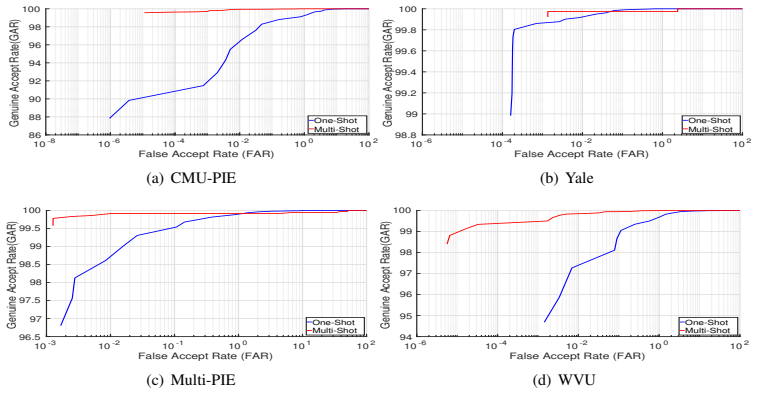
The central discovery is that by generating the binary codes from the hashing layer rather than assigning fixed label codes to subjects, and by fine-tuning a neural error-correction decoder on a disjoint set of subjects, the system can map enrollment and probe images of an unseen subject to the same final codeword. The final codeword is never stored directly; only its SHA3-512 hash is kept, which is what makes the template non-invertible and revocable. The paper reports stable performance across code sizes of $K=255$ and $K=1023$, with zero-shot genuine accept rates of roughly 81--88% at 0.01% false accept rate across datasets, and near-perfect one-shot and multi-shot performance. This is stated as an improvement over earlier face template protection schemes that required retraining with every newly enrolled subject.
Load-bearing premise
The trained neural decoder generalizes its error-correction mapping to faces never seen during training, so that a new person's enrollment and probe images both land on the same final codeword.
Editorial extensions
If this is right
- A new subject can be enrolled by a single forward pass through the trained hashing network and decoder, followed by SHA3-512 hashing, with no retraining of the network.
- One-shot and multi-shot enrollment reach near-perfect genuine accept rates at strict false accept rates, making the protected-template pipeline competitive with unprotected face matching in these experiments.
- Template security reduces to the one-wayness of SHA3-512 and the entropy of the final codes, so with code sizes of $K=255$ or $K=1023$, brute-force inversion of a stolen template is infeasible.
- Because the deep hashing plus neural decoder pipeline treats the input image generically, the same architecture is claimed to carry over to other biometric traits such as iris or fingerprint without changing the protection logic.
- The comparison against the system without a decoder and against a conventional BCH decoder indicates that the neural decoder, not the hashing alone, is responsible for the large reduction in equal error rate.
Reading between the lines
- The zero-shot guarantee is likely bounded by the correction radius of the chosen BCH code: a stress test that enrolls unseen subjects with one image and authenticates under progressively harder pose or illumination changes should reveal a sharp drop once intermediate codes fall outside the decoder's correction region.
- One way to isolate what makes zero-shot work is to compare the current VGG-19-initialized system against the same architecture with a randomly initialized backbone; a large performance gap would indicate that face-specific feature pretraining, rather than the error-correction coupling alone, is carrying the unseen-subject generalization.
- The reported gap between zero-shot (roughly 85%) and one-shot or multi-shot (near 100%) suggests a testable target: replacing the fixed BCH codes with stronger or learned codes could extend the correction region and close most of that gap, since the paper already shows the neural decoder outperforms a conventional BCH decoder.
Signed reviews
Editorial analysis
A structured set of objections, weighed in public.
Referee Report
Summary. The paper proposes a face template protection architecture that couples a deep hashing (DH) network with a neural network decoder (NND). Enrollment and probe images are mapped by the DH network to intermediate binary codes, the NND maps these codes to a final codeword, and a cryptographic hash (SHA3-512) of the final codeword is stored as the template. The authors claim that the architecture supports zero-shot enrollment, meaning that subjects not seen during training can be enrolled without retraining, and report GAR/EER results for zero-shot, one-shot, and multi-shot enrollment on CMU-PIE, Extended Yale B, Multi-PIE, and WVU multimodal databases. They also compare against prior template protection methods and include an ablation of the NND for the WVU dataset.
Significance. If the zero-shot claim were fully supported, this would be a meaningful step forward: prior deep-learning template protection methods require retraining when a new subject is enrolled, whereas the proposed design aims to avoid that by using a learned error-correcting decoder. The paper reports mean and standard deviation over five random splits, which is a positive feature of the evaluation, and the three-stage training procedure is clearly described. However, the evidence for the central mechanism is incomplete: the zero-shot generalization of the NND is asserted rather than demonstrated, and the reported comparison with prior work uses mismatched operating points. The significance of the contribution therefore depends on additional ablations and fair comparisons that are currently missing.
major comments (4)
- [4.3, Table 2] The comparison in Table 2 evaluates the proposed method at 0.01% FAR while the prior methods are evaluated at 1% or 0.1% FAR, and some entries are listed at 0% FAR. Since GAR is non-increasing as FAR becomes stricter, the claimed '4.5% improvement' over Deep CNN [10] does not follow from the reported numbers. Please provide a direct comparison at a common FAR operating point and with identical enrollment protocols, or clearly state that the comparison is indicative rather than a head-to-head performance claim.
- [3.3, 4.3, Table 3] The zero-shot enrollment claim rests on the NND generalizing its error-correction regions to subjects never seen during training, but Sec. 3.3 only asserts that the trained NND 'will generally compensate' for biometric distortion, and Sec. 3.2 concedes that intermediate codes can decode to a plurality of codewords. Table 3 compares DH-, DH+Decoder, and DH+NND only for one-shot and multi-shot enrollment on WVU; there is no zero-shot ablation. The paper should report zero-shot EER/GAR for all three variants on all datasets, and should report statistics such as the distance of unseen-subject DH outputs to the codewords used for NND training. Without this, the observed zero-shot GAR could be produced by the DH component's code stability rather than by the NND's error-correction behavior, leaving the headline mechanism unverified.
- [3.2, 3.3] In Stage 2, the ground-truth labels for the NND are generated by applying a conventional BCH decoder to the DH network's own outputs on a disjoint subject set. This is self-referential pseudo-labeling: the NND can at best reproduce the BCH decoder on the DH output distribution observed during training, and it cannot correct errors that the DH network systematically makes on subjects with a different output distribution. The paper should report the fraction of subjects whose intermediate codes decoded to multiple codewords, the accuracy of the most-common-codeword labels, and a comparison of distance-to-codeword statistics between the disjoint training subjects and the zero-shot test subjects. This is necessary to support the claim that the NND forces enrollment and probe codes of an unseen subject to a common final codeword.
- [3.1, Eq. (3) and Eq. (5)] The sign and wording for the quantization/entropy loss are inconsistent. Equation (3) defines E2 with a negative sign and the text says this constraint 'needs to be maximized,' but the overall objective (5) is minimized and contains +beta E2. Since minimizing E2 maximizes the squared distance from 0.5, the sentence appears to be incorrect and should be reworded to avoid confusion about the optimization direction.
minor comments (5)
- [4.1, WVU description] The text says 'a subset of 50 subjects of the unique 900 subjects from the 2012 dataset' are used for zero-shot testing, but the arithmetic in the same paragraph gives 1200-294=906 unique 2012 subjects; please correct the number.
- [4.3, results paragraph] In the sentence 'we achieve GARs up to roughly 88% on Multi-PIE,' the dataset should be WVU Multimodal rather than Multi-PIE, since the preceding numbers refer to the four databases and the Table 1 zero-shot WVU value is 88.7%.
- [Table 2] The column heading 'GAR@FAR' lists values at 1%, 0.1%, and 0% FAR among prior methods; please specify how the 0% FAR operating point was computed and whether the numbers are exact zero false accepts or a small positive value.
- [2.2] The paper refers to [18] for the NND architecture but does not specify the decoder's layer sizes, activation functions, or training schedule in the main text; a short description in an appendix would make the architecture reproducible without relying on the reader having the cited paper at hand.
- [Abstract and Table 1] The abstract reports 'approximately 85% GAR at 0.01% FAR' for zero-shot enrollment, which matches the average of the four zero-shot GAR values in Table 1; this convention is fine, but the paper should state explicitly that the abstract number is an average across databases.
Circularity Check
No significant circularity: the zero-shot claim is an empirical generalization tested on disjoint subjects, not a result forced by construction or by self-citation.
full rationale
The paper's central derivation is not circular. In Stage 2, the NND training labels are produced by a conventional BCH decoder applied to the DH network's own outputs, so the NND is trained to imitate a fixed teacher on a disjoint subject set. This pseudo-labeling is self-referential in a narrow sense, but it does not make the zero-shot enrollment result equivalent to the training inputs: the NND is then evaluated on subjects that were neither used to train the DH nor to train/fine-tune the NND (e.g., 6, 6, 20, and 50 held-out subjects on PIE, Yale, Multi-PIE, and WVU respectively). The claim that the trained NND 'will generally compensate' for biometric distortion in zero-shot enrollment is an empirical generalization, not a guarantee derived by construction. The absence of a zero-shot ablation isolating DH- alone or DH- plus a conventional decoder is a completeness/correctness limitation, not a circularity. The paper's self-citations (e.g., refs. 6, 21, 26-33) are not load-bearing for the architecture's derivation, and no uniqueness theorem is imported from the authors' prior work. Therefore no specific circular step can be exhibited with the required reduction, and the appropriate finding is no significant circularity.
Assumptions & free parameters
free parameters (3)
- Loss weights alpha, beta, gamma
- BCH code parameters =
BCH(255,187) and BCH(1023,933)
- Neural network decoder hyperparameters
assumptions (4)
- domain assumption Intermediate binary codes of a subject behave like noisy codewords of a BCH code, and a conventional BCH decoder gives reliable ground truth.
- domain assumption The NND generalizes its error-correction mapping to unseen subjects.
- domain assumption Face-CNN features transfer from its training subjects to held-out subjects in the same databases.
- standard math SHA3-512 is a one-way hash and the final binary codes have high entropy.
Cite this review
Pith. "Pith review of Zero-Shot Deep Hashing and Neural Network Based Error Correction for Face Template Protection." pith.science (2026). https://pith.science/paper/JXZSZGPA
@misc{pith2026190802706,
  author       = {Pith},
  title        = {Pith review of: Zero-Shot Deep Hashing and Neural Network Based Error Correction for Face Template Protection},
  year         = {2026},
  howpublished = {\url{https://pith.science/paper/JXZSZGPA}},
  note         = {Machine review of arXiv:1908.02706}
}
read the original abstract
In this paper, we present a novel architecture that integrates a deep hashing framework with a neural network decoder (NND) for application to face template protection. It improves upon existing face template protection techniques to provide better matching performance with one-shot and multi-shot enrollment. A key novelty of our proposed architecture is that the framework can also be used with zero-shot enrollment. This implies that our architecture does not need to be re-trained even if a new subject is to be enrolled into the system. The proposed architecture consists of two major components: a deep hashing (DH) component, which is used for robust mapping of face images to their corresponding intermediate binary codes, and a NND component, which corrects errors in the intermediate binary codes that are caused by differences in the enrollment and probe biometrics due to factors such as variation in pose, illumination, and other factors. The final binary code generated by the NND is then cryptographically hashed and stored as a secure face template in the database. The efficacy of our approach with zero-shot, one-shot, and multi-shot enrollments is shown for CMU-PIE, Extended Yale B, WVU multimodal and Multi-PIE face databases. With zero-shot enrollment, the system achieves approximately 85% genuine accept rates (GAR) at 0.01% false accept rate (FAR), and with one-shot and multi-shot enrollments, it achieves approximately 99.95% GAR at 0.01% FAR, while providing a high level of template security.
Figures


Figures from the paper (1 more)

Reference graph
Works this paper leans on
-
[10]
A. K. Jindal, S. Chalamala, and S. K. Jami. Face template protection using deep convolutional neural network. InProc. IEEE Conf. on Computer Vision and Pattern Recognition (CVPR) Workshops, pages 575–5758, June 2018
work page 2018
- [1]
-
[2]
Z. Cao, M. Long, J. Wang, and P. S. Yu. Hashnet: Deep learning to hash by continuation. In Proc. IEEE Interna- tional Conference on Computer Vision , pages 5609–5618, Oct. 2017
work page 2017
-
[3]
Z. Chen, X. Yuan, J. Lu, Q. Tian, and J. Zhou. Deep hash- ing via discrepancy minimization. Proc. IEEE Conference on Computer Vision and Pattern Recognition (CVPR), pages 6838–6847, 2018
work page 2018
-
[4]
Y . C. Feng and P. C. Yuen. Binary discriminant analysis for generating binary face template. IEEE Trans. on Inform. Forensics and Sec., 7(2):613–624, April 2012
work page 2012
-
[5]
Y . C. Feng, P. C. Yuen, and A. K. Jain. A hybrid approach for generating secure and discriminating face template.IEEE Trans. on Inform. Forensics and Sec., 5(1), March 2010
work page 2010
-
[6]
S. N. Ferdous, M. Mostofa, and N. M. Nasrabadi. Super resolution-assisted deep aerial vehicle detection. In Artificial Intelligence and Machine Learning for Multi-Domain Oper- ations Applications, 2019
work page 2019
-
[7]
A. S. Georghiades, P. N. Belhumeur, and D. J. Kriegman. Illumination cone models for face recognition under vari- able lighting and pose. IEEE Trans. on Pattern Analysis and Mach. Intelligence, 23(6):643–660, June 2001
work page 2001
Show all 36 references
-
[8]
Gross, I
R. Gross, I. Matthews, J. Cohn, T. Kanade, and S. Baker. Multi-PIE. In Proc. IEEE Int. Conf. on Automatic Face Ges- ture Recognition, Sep. 2008
2008
-
[9]
Gruber, S
T. Gruber, S. Cammerer, J. Hoydis, and S. ten Brink. On deep learning-based channel decoding. In Proc. IEEE Annual Conference on Information Sciences and Systems (CISS) , 2017
2017
-
[11]
Kazemi, S
H. Kazemi, S. Soleymani, F. Taherkhani, S. Iranmanesh, and N. Nasrabadi. Unsupervised image-to-image transla- tion using domain-specific variational information bound. In Advances in Neural Information Processing Systems , pages 10348–10358, 2018
2018
-
[12]
Kazemi, F
H. Kazemi, F. Taherkhani, and N. M. Nasrabadi. Unsuper- vised facial geometry learning for sketch to photo synthesis. In IEEE International Conference of the Biometrics Special Interest Group (BIOSIG), 2018
2018
-
[13]
D. E. King. Dlib-ml: A machine learning toolkit. J. Mach. Learn. Res., 10:1755–1758, Dec. 2009
2009
-
[14]
Krizhevsky, I
A. Krizhevsky, I. Sutskever, and G. E. Hinton. Imagenet classification with deep convolutional neural networks. In Proc. Advances in Neural Information Processing Systems , pages 1097–1105. Dec. 2012
2012
-
[15]
K. Lin, J. Lu, C. S. Chen, and J. Zhou. Learning compact binary descriptors with unsupervised deep neural networks. In Proc. IEEE Conference on Computer Vision and Pattern Recognition (CVPR), June 2016
2016
-
[16]
H. Liu, R. Wang, S. Shan, and X. Chen. Deep supervised hashing for fast image retrieval. In Proc. IEEE Conference on Computer Vision and Pattern Recognition (CVPR), pages 2064–2072, June 2016
2016
-
[17]
Lugosch and W
L. Lugosch and W. J. Gross. Neural offset min-sum decod- ing. Proc. IEEE Int. Symposium on Inform. Theory , pages 1361–1365, June 2017
2017
-
[18]
Nachmani, Y
E. Nachmani, Y . Be’ery, and D. Burshtein. Learning to de- code linear codes using deep learning. In Proc. 54th Annual Allerton Conf. on Communication, Control, and Computing (ALLERTON), pages 341–346, Sept. 2016
2016
-
[19]
Nachmani, E
E. Nachmani, E. Marciano, L. Lugosch, W. J. Gross, D. Bur- shtein, and Y . Be’ery. Deep learning methods for improved decoding of linear codes. IEEE Journal of Selected Topics in Signal Processing, 12(1):119–131, 2018
2018
-
[20]
Nagar, K
A. Nagar, K. Nandakumar, and A. K. Jain. Multibiometric cryptosystems based on feature-level fusion. IEEE Trans. on Inform. Forensics and Security, 7(1):255–268, Feb. 2012
2012
-
[21]
U. M. Osahor and N. M. Nasrabadi. Design of adversar- ial targets: fooling deep ATR systems. In Automatic Target Recognition XXIX, 2019
2019
-
[22]
R. K. Pandey and V . Govindaraju. Secure face template gen- eration via local region hashing. In Proc. Int. Conf. on Bio- metrics (ICB), pages 299–304, May 2015
2015
-
[23]
R. K. Pandey, Y . Zhou, B. U. Kota, and V . Govindaraju. Deep secure encoding for face template protection. In Proc. IEEE Conf. on Computer Vision and Pattern Recognition (CVPR) Workshops, pages 77–83, June 2016
2016
-
[24]
T. Sim, S. Baker, and M. Bsat. The CMU pose, illumination, and expression database. In Proc. IEEE Int. Conf. on Auto- matic Face Gesture Recognition, pages 53–58, May 2002
2002
-
[25]
Simonyan and A
K. Simonyan and A. Zisserman. Very deep convolu- tional networks for large-scale image recognition. CoRR, abs/1409.1556, Sept. 2014
2014 arXiv
-
[26]
Soleymani, A
S. Soleymani, A. Dabouei, J. Dawson, and N. M. Nasrabadi. Adversarial examples to fool iris recognition systems.CoRR, abs/1906.09300, 2019
1906 arXiv
-
[27]
Soleymani, A
S. Soleymani, A. Dabouei, S. M. Iranmanesh, H. Kazemi, J. Dawson, and N. M. Nasrabadi. Prosodic-enhanced siamese convolutional neural networks for cross-device text- independent speaker verification. In Proc. IEEE Interna- tional Conference on Biometrics Theory, Applications an...
2018
-
[28]
Taherkhani, N
F. Taherkhani, N. M. Nasrabadi, and J. Dawson. A deep face identification network enhanced by facial attributes predic- tion. In Proc. of the IEEE Conference on Computer Vision and Pattern Recognition (CVPR) Workshops , pages 553– 560, 2018
2018
-
[29]
Taherkhani, V
F. Taherkhani, V . Talreja, H. Kazemi, and N. Nasrabadi. Fa- cial attribute guided deep cross-modal hashing for face im- age retrieval. In International Conference of the Biometrics Special Interest Group (BIOSIG). IEEE, 2018
2018
-
[30]
Talreja, T
V . Talreja, T. Ferrett, M. C. Valenti, and A. Ross. Biometrics- as-a-service: A framework to promote innovative biometric recognition in the cloud. In Proc. IEEE International Con- ference on Consumer Electronics (ICCE), 2018
2018
-
[31]
Talreja, S
V . Talreja, S. Soleymani, M. C. Valenti, and N. M. Nasrabadi. Learning to authenticate with deep multibiometric hashing and neural network decoding. CoRR, abs/1902.04149, 2019
1902 arXiv
-
[32]
Talreja, F
V . Talreja, F. Taherkhani, M. C. Valenti, and N. M. Nasrabadi. Using deep cross modal hashing and error cor- recting codes for improving the efficiency of attribute guided facial image retrieval. In Proc. IEEE Global Conference on Signal and Information Processing (GlobalSIP),...
2018
-
[33]
Talreja, M
V . Talreja, M. C. Valenti, and N. M. Nasrabadi. Multibio- metric secure system based on deep learning. In Proc. IEEE Global Conference on Signal and Information Processing (GlobalSIP), pages 298–302, Nov. 2017
2017
-
[34]
D. Yi, Z. Lei, S. Liao, and S. Z. Li. Learning face represen- tation from scratch. CoRR, abs/1411.7923, Nov. 2014
2014 arXiv
-
[35]
X. Yuan, L. Ren, J. Lu, and J. Zhou. Relaxation-free deep hashing via policy gradient. In The European Conference on Computer Vision (ECCV), September 2018
2018
-
[36]
H. Zhu, M. Long, J. Wang, and Y . Cao. Deep hashing net- work for efficient similarity retrieval. In Proc. AAAI Confer- ence on Artificial Intelligence, pages 2415–2421, Feb. 2016
2016
Reviewed August 14, 2026 · model on record in the stance chip above.
Discussion (0). Continue with ORCID to comment.