REVIEW 3 major objections 4 minor 49 references
I Bet You Are Wrong: Gambling Adversarial Networks for Structured Semantic Segmentation
T0 review · 3 major / 4 minor · reviewed 2026-08-14 · deepseek-v4-flash
Pith's one-line read This paper argues that adversarial semantic segmentation should be reformulated as a correct/incorrect gambling game, where a budget-limited gambler network bets on likely wrong pixels and the segmenter tries to leave no profitable bets…
desk verdict A genuinely new twist on adversarial segmentation with a plausible uncertainty story, but the mechanism needs proof and the abstract oversells the pixel-wise gains. read the letter →
The pith
A machine-rendered reading of the paper's core claim, the machinery that carries it, and where it could break.
The reading
What carries the argument
The load-bearing object is the gambler network and its betting map. The gambler $g(x, \hat{y}; \theta_g)$ receives the input image and the segmenter's prediction map, never the ground truth, and outputs a pixel-wise betting map normalized as a smoothed probability distribution, $g_{ij} = (g_{\sigma,ij} + \beta) / \sum_{k,l}(g_{\sigma,kl} + \beta)$, with smoothing factor $\beta$ preventing all budget from concentrating on a single pixel. The segmenter's adversarial loss is the negative of the gambler's weighted cross-entropy: the gambler maximizes the expected weighted cross-entropy and the segmenter minimizes it. Because the gambler reads the whole prediction map, structural inconsistencies such as non-smoothness, disconnections, and shape anomalies become profitable bets; the gradient travelling through the gambler carries inter-pixel structural feedback, while the direct weighted cross-entropy term gives pixel-wise feedback.
What would settle it
Measure where the gambler's bets land relative to two pixel-level maps, softmax uncertainty and structural error, such as distance to the nearest boundary error; if the betting map correlates mainly with low confidence rather than with structural anomalies, gradient flow through the gambler is not delivering structural feedback and the uncertainty-preservation claim would not be a consequence of the correct/incorrect reformulation.
Extended reading notes
Core claim
The central claim is that value-based fake/real discrimination in adversarial semantic segmentation causes two failures: it forces segmenters toward one-hot encodings, suppressing uncertainty, and it gives the discriminator a permanent value gap because softmax probabilities can never reach exact zeros and ones. The paper's replacement turns the adversarial task from fake/real into correct/incorrect: a gambler network maps the RGB image and current prediction map to a smoothed betting map with a fixed budget; the gambler profits by betting on pixels that are contextually wrong, while the segmenter minimizes the same weighted loss and removes the clues the gambler exploits. The authors report that on Cityscapes and Camvid, with U-Net and PSPNet segmenters, gambling adversarial networks preserve uncertainty and achieve the best or competitive pixel-wise and structure-based scores, with the notable exception of pixel IoU on Camvid where standard adversarial training remains highest.
Load-bearing premise
The benefits rest on the gambler learning to bet chiefly on structural inconsistencies rather than on low prediction confidence; the paper itself notes that it sometimes bets on uncertain pixels, and if that value-based behavior were dominant the claimed uncertainty preservation would not follow from the objective.
Editorial extensions
If this is right
- Trained with a gambler instead of a fake/real discriminator, adversarial semantic segmentation no longer collapses softmax confidence toward one-hot: on Cityscapes with U-Net, the mean maximum class likelihood stays near the cross-entropy baseline (91.4% versus 98.4% for standard adversarial training).
- Structure-based evaluation improves in the same settings: on Cityscapes with U-Net, gambling nets raise the BF-score from 57.3 to 58.5 and lower the modified Hausdorff distance from 31.3 to 27.6 relative to the CE + adversarial baseline.
- Pixel-wise IoU improves over adversarial baselines on Cityscapes for both U-Net and PSPNet, with the largest gains on fine-structured classes such as traffic light, pole, rider, and person; on Camvid the method improves structure metrics while standard CE + adversarial keeps the highest mean IoU.
- Because the gambler reads the whole prediction map, the adversarial signal decomposes into a pixel-wise gradient and a structural gradient through the gambler, so the objective can supply structural feedback that focal loss, being pixel-wise, cannot.
- The method requires no separate pre-training of the critic and is reported to be less sensitive to hyperparameters than conventional adversarial training.
Reading between the lines
- If the structural-bias mechanism holds, the same correct/incorrect betting objective should transfer to other dense prediction tasks, such as depth estimation or instance boundary detection, where value-based fake/real discriminators also push outputs toward extremes; the paper only evaluates semantic segmentation.
- The gambler's betting map is a learned error-attention signal that could be reused at inference as a heuristic for where the segmenter is structurally unreliable, though the paper does not evaluate it as a calibrated uncertainty estimate.
- A natural test of the mechanism is to ablate the structural gradient (stop gradients through the gambler) and vary the smoothing factor $\beta$; the paper fixes $\beta = 0.02$ and does not report such an ablation, so the claim that structural feedback rather than mere reweighting drives the gains remains open.
- The paper notes that the gambler sometimes bets on uncertain pixels; if that value-based behavior grows during longer training, the uncertainty-preservation result could erode, so tracking the correlation between bets and softmax confidence over epochs would settle it.
Signed reviews
Editorial analysis
A structured set of objections, weighed in public.
Referee Report
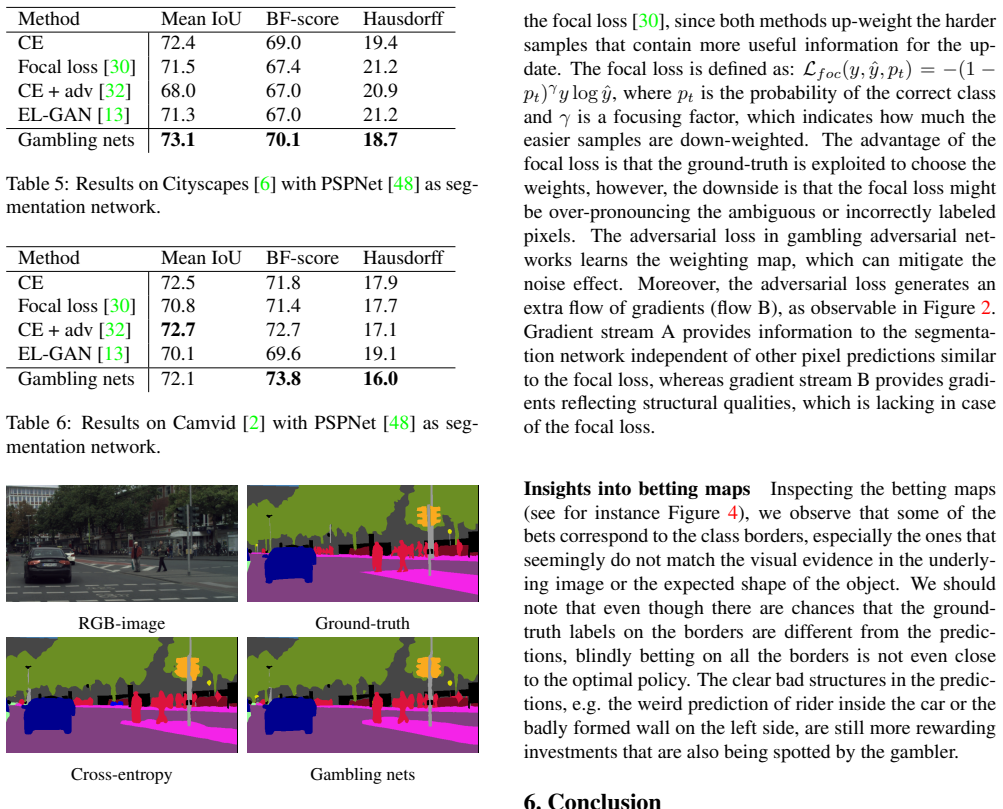
Summary. The paper proposes Gambling Adversarial Networks (GANs) for semantic segmentation, replacing the real/fake discriminator of standard adversarial segmentation with a 'gambler' network that produces a normalized betting map over pixels, aiming to concentrate a limited budget on locations where the segmenter's prediction is likely incorrect. The segmenter is trained with the standard cross-entropy plus a gambler-weighted cross-entropy term, so it is penalized more heavily at pixels the gambler chooses. The stated motivation is to avoid value-based discrimination of softmax values, which forces predictions toward one-hot encodings and suppresses uncertainty. Experiments on Cityscapes and Camvid with U-Net and PSPNet compare against CE, focal loss, CE+adversarial, and EL-GAN, reporting improved or competitive IoU, BF-score, and Hausdorff distance, and showing that the mean max softmax remains close to the CE baseline (91.4% vs 90.7%) instead of converging to about 98%.
Significance. If verified, the gambling objective is a conceptually novel training signal that may improve structural consistency without sacrificing calibrated uncertainty, with practical value for autonomous driving and medical imaging. The paper includes clear equations, two network backbones, two datasets, and multiple baselines, making the empirical comparison fairly complete. The authors should also be credited for explicitly discussing the value-based discrimination pitfall and for providing a direct comparison to focal loss as a hard-sample-mining baseline. However, the central mechanistic claim that the gambler learns structural cues rather than exploiting per-pixel confidence is not directly tested, and one experiment (Camvid IoU) does not support the unqualified abstract claim.
major comments (3)
- [Section 3.2, Eqs. (4)-(6)] The text states that the gambler 'maximizes the expected weighted pixel-wise cross-entropy,' but Eq. (4) defines Lg as minus that quantity. If Lg is the loss to be minimized, this is consistent with the intended behavior; if it is to be maximized, the gambler would bet on correct rather than incorrect pixels. Please clarify the sign convention so that the minimax game description matches the equations without ambiguity.
- [Section 5 and Figure 4] The paper concedes that the gambler sometimes uses prediction values to bet on pixels where the segmenter is uncertain. Because cross-entropy is high for uncertain predictions, this is an obvious strategy for maximizing the weighted CE. The preservation of uncertainty (Table 1) and the improved structural metrics are attributed to structural reasoning by the gambler, but no quantitative evidence shows that betting maps depend on contextual inconsistencies rather than per-pixel confidence. Provide an analysis such as the correlation of bets with softmax entropy, or an ablation using a gambler restricted to a local receptive field, to support the structural interpretation.
- [Abstract and Table 6] The claim that the method 'improves pixel-wise and structure-based metrics' is not supported on Camvid, where the gambling net IoU (72.1) is below CE+adv (72.7). Qualify the claim to reflect dataset-dependent pixel-wise results, or add a statistical analysis demonstrating that the differences are significant despite the lower raw IoU.
minor comments (4)
- [Section 4.2] The sentence beginning 'One can observe that for both the standard' appears to be incomplete; please finish it.
- [Table 1] Table 1 cites Cityscapes as [7], but the correct reference is [6].
- [Section 3.2] The notation g is used for both the gambler network and its betting-map output; distinguish them (e.g., use \hat{g} for the normalized map).
- [Equation 6] The smoothing factor \beta is only mentioned in the supplementary material; state its value (0.02) in the main text for reproducibility.
Circularity Check
No significant circularity: the gambler objective is an empirical training scheme evaluated on held-out benchmarks; uncertainty preservation is an observed outcome, not an input.
full rationale
The paper's derivation chain is not circular. The gambler network is trained with Eq. 4, a per-pixel weighted cross-entropy loss supervised by ground-truth labels, and the segmenter in Eq. 5 combines the standard cross-entropy with the negative gambler loss. The claimed re-enabling of uncertainty is measured by the mean maximum softmax value in Table 1 and Figure 3, which are outputs of the trained segmenter, not fitted inputs or targets of the gambler loss. The structural metric improvements (IoU, BF-score, Hausdorff distance) are computed against held-out ground truth on Cityscapes and Camvid, so they are external benchmark evaluations rather than quantities built into the objective. The Section 5 admission that the gambler sometimes utilizes prediction values by betting on uncertain pixels is a limitation on how the benefit is attributed, not a circular reduction: Eq. 4 does not define the reported final segmentation metrics, and no fitted parameter is renamed as a prediction. Self-citations to EL-GAN [13] and Student beats the teacher [14] are baselines or auxiliary background support and are not load-bearing: EL-GAN is used as a comparison method, and the noisy-labels argument is not the central claim. There is no uniqueness theorem or ansatz imported from the authors' prior work to force the proposed choice. Consequently, the central claims have independent empirical content and the paper receives a non-circularity score of 0.
Assumptions & free parameters
free parameters (2)
- beta (smoothing factor) =
0.02 (all experiments)
- lambda (adversarial coefficient) =
1.0 for U-Net/PSPNet on Cityscapes, 0.5 for PSPNet on Camvid
assumptions (3)
- ad hoc to paper The gambler learns to predominantly rely on structural inconsistencies rather than the softmax values of the prediction map.
- domain assumption Standard adversarial training dynamics (alternating updates, non-saturating objectives) apply without additional stabilization.
- domain assumption Ground-truth labels are available and reliable for training the gambler.
Cite this review
Pith. "Pith review of I Bet You Are Wrong: Gambling Adversarial Networks for Structured Semantic Segmentation." pith.science (2026). https://pith.science/paper/3NOV7M4C
@misc{pith2026190802711,
  author       = {Pith},
  title        = {Pith review of: I Bet You Are Wrong: Gambling Adversarial Networks for Structured Semantic Segmentation},
  year         = {2026},
  howpublished = {\url{https://pith.science/paper/3NOV7M4C}},
  note         = {Machine review of arXiv:1908.02711}
}
read the original abstract
Adversarial training has been recently employed for realizing structured semantic segmentation, in which the aim is to preserve higher-level scene structural consistencies in dense predictions. However, as we show, value-based discrimination between the predictions from the segmentation network and ground-truth annotations can hinder the training process from learning to improve structural qualities as well as disabling the network from properly expressing uncertainties. In this paper, we rethink adversarial training for semantic segmentation and propose to formulate the fake/real discrimination framework with a correct/incorrect training objective. More specifically, we replace the discriminator with a "gambler" network that learns to spot and distribute its budget in areas where the predictions are clearly wrong, while the segmenter network tries to leave no clear clues for the gambler where to bet. Empirical evaluation on two road-scene semantic segmentation tasks shows that not only does the proposed method re-enable expressing uncertainties, it also improves pixel-wise and structure-based metrics.
Figures


Figures from the paper (2 more)

Reference graph
Works this paper leans on
-
[1]
A. BenTaieb and G. Hamarneh. Topology aware fully con- volutional networks for histology gland segmentation. In In- ternational Conference on Medical Image Computing and Computer-Assisted Intervention , pages 460–468. Springer,
-
[2]
G. J. Brostow, J. Fauqueur, and R. Cipolla. Semantic object classes in video: A high-definition ground truth database. Pattern Recognition Letters, 30(2):88–97, 2009. 2, 5, 6, 8, 11
work page 2009
-
[3]
S. R. Bulo, G. Neuhold, and P. Kontschieder. Loss max- pooling for semantic image segmentation. In 2017 IEEE Conference on Computer Vision and Pattern Recognition (CVPR), pages 7082–7091. IEEE, 2017. 3
work page 2017
-
[4]
N. V . Chawla, K. W. Bowyer, L. O. Hall, and W. P. Kegelmeyer. Smote: synthetic minority over-sampling tech- nique. Journal of artificial intelligence research , 16:321– 357, 2002. 3
work page 2002
-
[5]
L.-C. Chen, G. Papandreou, I. Kokkinos, K. Murphy, and A. L. Yuille. Deeplab: Semantic image segmentation with deep convolutional nets, atrous convolution, and fully con- nected crfs. IEEE transactions on pattern analysis and ma- chine intelligence, 40(4):834–848, 2017. 2
work page 2017
-
[6]
M. Cordts, M. Omran, S. Ramos, T. Rehfeld, M. Enzweiler, R. Benenson, U. Franke, S. Roth, and B. Schiele. The cityscapes dataset for semantic urban scene understanding. In Proceedings of the IEEE conference on computer vision and pattern recognition, pages 3213–3223, 2016. 2, 5, 6, 7, 8, 11, 12, 13
work page 2016
- [7]
-
[8]
W. Dai, J. Doyle, X. Liang, H. Zhang, N. Dong, Y . Li, and E. P. Xing. Scan: Structure correcting adversarial net- work for chest x-rays organ segmentation. arXiv preprint arXiv:1703.08770, 1, 2017. 2
work page Pith review arXiv 2017
Show all 49 references
-
[9]
Dubuisson and A
M.-P. Dubuisson and A. K. Jain. A modified hausdorff dis- tance for object matching. In Proceedings of 12th interna- tional conference on pattern recognition , volume 1, pages 566–568. IEEE, 1994. 5
1994
-
[10]
Eigen and R
D. Eigen and R. Fergus. Predicting depth, surface normals and semantic labels with a common multi-scale convolu- tional architecture. In Proceedings of the IEEE international conference on computer vision, pages 2650–2658, 2015. 3
2015
-
[11]
Fedus, M
W. Fedus, M. Rosca, B. Lakshminarayanan, A. M. Dai, S. Mohamed, and I. Goodfellow. Many paths to equilib- rium: Gans do not need to decrease a divergence at every step. arXiv preprint arXiv:1710.08446, 2017. 4
2017 arXiv
-
[12]
Garcia-Garcia, S
A. Garcia-Garcia, S. Orts-Escolano, S. Oprea, V . Villena- Martinez, and J. Garcia-Rodriguez. A review on deep learn- ing techniques applied to semantic segmentation. arXiv preprint arXiv:1704.06857, 2017. 1
2017 arXiv
-
[13]
Ghafoorian, C
M. Ghafoorian, C. Nugteren, N. Baka, O. Booij, and M. Hof- mann. El-gan: embedding loss driven generative adversarial networks for lane detection. In Proceedings of the European Conference on Computer Vision (ECCV) , pages 0–0, 2018. 1, 2, 4, 6, 7, 8
2018
-
[14]
Ghafoorian, J
M. Ghafoorian, J. Teuwen, R. Manniesing, F.-E. de Leeuw, B. van Ginneken, N. Karssemeijer, and B. Platel. Student beats the teacher: deep neural networks for lateral ventricles segmentation in brain mr. In Medical Imaging 2018: Im- age Processing, volume 10574, page 105742U. I...
2018
-
[15]
Ghosh, N
S. Ghosh, N. Das, I. Das, and U. Maulik. Understanding deep learning techniques for image segmentation. arXiv preprint arXiv:1907.06119, 2019. 1
1907 arXiv
-
[16]
Goodfellow, J
I. Goodfellow, J. Pouget-Abadie, M. Mirza, B. Xu, D. Warde-Farley, S. Ozair, A. Courville, and Y . Bengio. Gen- erative adversarial nets. In Advances in neural information processing systems, pages 2672–2680, 2014. 1, 4
2014
-
[17]
K. He, X. Zhang, S. Ren, and J. Sun. Deep residual learn- ing for image recognition. In Proceedings of the IEEE con- ference on computer vision and pattern recognition , pages 770–778, 2016. 5
2016
-
[18]
Hung, Y .-H
W.-C. Hung, Y .-H. Tsai, Y .-T. Liou, Y .-Y . Lin, and M.-H. Yang. Adversarial learning for semi-supervised semantic segmentation. arXiv preprint arXiv:1802.07934, 2018. 2
2018 arXiv
-
[19]
Y . Huo, Z. Xu, S. Bao, C. Bermudez, A. J. Plassard, J. Liu, Y . Yao, A. Assad, R. G. Abramson, and B. A. Land- man. Splenomegaly Segmentation using Global Convolu- tional Kernels and Conditional Generative Adversarial Net- works. Proceedings of SPIE , 10574:10574 – 10574 – 7,
-
[20]
Hwang, T.-W
J.-J. Hwang, T.-W. Ke, J. Shi, and S. X. Yu. Adversar- ial structure matching loss for image segmentation. arXiv preprint arXiv:1805.07457, 2018. 2
2018 arXiv
-
[21]
Isola, J.-Y
P. Isola, J.-Y . Zhu, T. Zhou, and A. A. Efros. Image-to- image translation with conditional adversarial networks. In Proceedings of the IEEE conference on computer vision and pattern recognition, pages 1125–1134, 2017. 1, 2, 3, 5, 6, 7, 11, 12
2017
-
[22]
Jaderberg, K
M. Jaderberg, K. Simonyan, A. Vedaldi, and A. Zisserman. Deep structured output learning for unconstrained text recog- nition. arXiv preprint arXiv:1412.5903, 2014. 2
2014 arXiv
-
[23]
T. Joy, A. Desmaison, T. Ajanthan, R. Bunel, M. Salzmann, P. Kohli, P. H. Torr, and M. P. Kumar. Efficient relaxations for dense crfs with sparse higher-order potentials.SIAM Journal on Imaging Sciences, 12(1):287–318, 2019. 2
2019
-
[24]
D. P. Kingma and J. Ba. Adam: A method for stochastic optimization. arXiv preprint arXiv:1412.6980, 2014. 5, 11
2014 arXiv
-
[25]
S. Kohl, D. Bonekamp, H.-P. Schlemmer, K. Yaqubi, M. Ho- henfellner, B. Hadaschik, J.-P. Radtke, and K. Maier- Hein. Adversarial Networks for the Detection of Aggressive Prostate Cancer. arXiv preprint arXiv:1702.08014, 2017. 2
2017 arXiv
-
[26]
Kr ¨ahenb¨uhl and V
P. Kr ¨ahenb¨uhl and V . Koltun. Efficient inference in fully connected crfs with gaussian edge potentials. In Advances in neural information processing systems , pages 109–117,
-
[27]
Larsson, A
M. Larsson, A. Arnab, F. Kahl, S. Zheng, and P. Torr. Learn- ing arbitrary pairwise potentials in crfs for semantic segmen- tation. terrain, 4:4. 2
-
[28]
Larsson, A
M. Larsson, A. Arnab, S. Zheng, P. Torr, and F. Kahl. Re- visiting deep structured models for pixel-level labeling with gradient-based inference. SIAM Journal on Imaging Sci- ences, 11(4):2610–2628, 2018. 2
2018
-
[29]
Z. Li, Y . Wang, and J. Yu. Brain Tumor Segmentation Using an Adversarial Network. In International MICCAI Brainle- sion Workshop, pages 123–132. Springer, 2017. 2
2017
-
[30]
T.-Y . Lin, P. Goyal, R. Girshick, K. He, and P. Doll´ar. Focal loss for dense object detection. In Proceedings of the IEEE international conference on computer vision , pages 2980– 2988, 2017. 3, 6, 7, 8
2017
-
[31]
J. Long, E. Shelhamer, and T. Darrell. Fully convolutional networks for semantic segmentation. In Proceedings of the IEEE conference on computer vision and pattern recogni- tion, pages 3431–3440, 2015. 1
2015
-
[32]
P. Luc, C. Couprie, S. Chintala, and J. Verbeek. Seman- tic segmentation using adversarial networks. arXiv preprint arXiv:1611.08408, 2016. 1, 2, 3, 6, 7, 8
2016 arXiv
-
[33]
Mirikharaji and G
Z. Mirikharaji and G. Hamarneh. Star shape prior in fully convolutional networks for skin lesion segmentation. In In- ternational Conference on Medical Image Computing and Computer-Assisted Intervention , pages 737–745. Springer,
-
[34]
Moeskops, M
P. Moeskops, M. Veta, M. W. Lafarge, K. A. Eppenhof, and J. P. Pluim. Adversarial Training and Dilated Convolutions for Brain MRI Segmentation. In Deep Learning in Medical Image Analysis and Multimodal Learning for Clinical Deci- sion Support, pages 56–64. Springer, 2017. 2
2017
-
[35]
S. T. Namin, M. Najafi, M. Salzmann, and L. Petersson. A multi-modal graphical model for scene analysis. In 2015 IEEE Winter Conference on Applications of Computer Vi- sion, pages 1006–1013. IEEE, 2015. 2
2015
-
[36]
Natarajan, I
N. Natarajan, I. S. Dhillon, P. K. Ravikumar, and A. Tewari. Learning with noisy labels. In Advances in neural informa- tion processing systems, pages 1196–1204, 2013. 3
2013
-
[37]
Nguyen, T
V . Nguyen, T. F. Y . Vicente, M. Zhao, M. Hoai, and D. Sama- ras. Shadow detection with conditional generative adversar- ial networks. In ICCV: IEEE International Conference on Computer Vision, pages 4520–4528. IEEE, 2017. 2
2017
-
[38]
Oktay, E
O. Oktay, E. Ferrante, K. Kamnitsas, M. Heinrich, W. Bai, J. Caballero, S. A. Cook, A. De Marvao, T. Dawes, D. P. ORegan, et al. Anatomically constrained neural networks (acnns): application to cardiac image enhancement and segmentation. IEEE transactions on medical imaging , ...
2017
-
[39]
Ronneberger, P
O. Ronneberger, P. Fischer, and T. Brox. U-net: Convo- lutional networks for biomedical image segmentation. In International Conference on Medical image computing and computer-assisted intervention , pages 234–241. Springer,
-
[40]
S. K. Sadanandan, J. Karlsson, and C. Whlby. Spheroid seg- mentation using multiscale deep adversarial networks. InIC- CVW: IEEE International Conference on Computer Vision Workshops, pages 36–41, Oct 2017. 2
2017
-
[41]
A. G. Schwing and R. Urtasun. Fully connected deep struc- tured networks. arXiv preprint arXiv:1503.02351, 2015. 2
2015 arXiv
-
[42]
Tsogkas, I
S. Tsogkas, I. Kokkinos, G. Papandreou, and A. Vedaldi. Deep learning for semantic part segmentation with high-level guidance. arXiv preprint arXiv:1505.02438, 2015. 1, 2
2015 arXiv
-
[43]
C. Wang, C. Xu, C. Wang, and D. Tao. Perceptual adversarial networks for image-to-image transformation. IEEE Transac- tions on Image Processing, 27(8):4066–4079, 2018. 2, 4
2018
-
[44]
Wang, M.-Y
T.-C. Wang, M.-Y . Liu, J.-Y . Zhu, A. Tao, J. Kautz, and B. Catanzaro. High-resolution image synthesis and seman- tic manipulation with conditional gans. In Proceedings of the IEEE conference on computer vision and pattern recog- nition, pages 8798–8807, 2018. 2
2018
-
[45]
Y . Xue, T. Xu, H. Zhang, L. R. Long, and X. Huang. Segan: Adversarial network with multi-scale l 1 loss for medical image segmentation. Neuroinformatics, 16(3-4):383–392,
-
[46]
D. Yang, D. Xu, S. K. Zhou, B. Georgescu, M. Chen, S. Gr- bic, D. Metaxas, and D. Comaniciu. Automatic liver seg- mentation using an adversarial image-to-image network. In International Conference on Medical Image Computing and Computer-Assisted Intervention , pages 507–515. Springer,
-
[47]
F. G. Zanjani, D. A. Moin, B. Verheij, F. Claessen, T. Cherici, T. Tan, et al. Deep learning approach to semantic segmen- tation in 3d point cloud intra-oral scans of teeth. In Interna- tional Conference on Medical Imaging with Deep Learning, pages 557–571, 2019. 2
2019
-
[48]
H. Zhao, J. Shi, X. Qi, X. Wang, and J. Jia. Pyramid scene parsing network. In Proceedings of the IEEE conference on computer vision and pattern recognition, pages 2881–2890,
-
[49]
Zheng, S
S. Zheng, S. Jayasumana, B. Romera-Paredes, V . Vineet, Z. Su, D. Du, C. Huang, and P. H. Torr. Conditional ran- dom fields as recurrent neural networks. In Proceedings of the IEEE international conference on computer vision, pages 1529–1537, 2015. 1, 2 Supplementary Material I...
2015
Reviewed August 14, 2026 · model on record in the stance chip above.
Discussion (0). Continue with ORCID to comment.