REVIEW 4 major objections 6 minor 65 references
WFIRST and EUCLID: enabling the microlensing parallax measurement from space
T0 review · 4 major / 6 minor · reviewed 2026-08-14 · deepseek-v4-flash
Pith's one-line read Simultaneous observations by two L2 spacecraft can give masses for free-floating planets that WFIRST alone cannot.
desk verdict First quantitative case that Euclid can measure parallaxes for WFIRST free-floating planets, but the headline yield rests on an untested finite-source assumption and unpublished simulations. read the letter →
The pith
A machine-rendered reading of the paper's core claim, the machinery that carries it, and where it could break.
The reading
What carries the argument
The load-bearing object is the Fisher information matrix for the two-spacecraft light curve, specifically the minimum-error expression for the parallax vector $\pi_E$ (Eq. 4), which tracks how well the parallel and perpendicular components of the satellite parallax can be separated. The physical mechanism is satellite parallax: because Euclid and WFIRST view the event from slightly different positions, the same microlensing magnification is measured at slightly different times, and that timing offset pins down the parallax. The authors combine this with an assumed event geometry (8 kpc source, 4 kpc lens, $V = 200$ km/s) and the relation $M_l = \theta_E / (\kappa \pi_E)$, plus $\pi_E = 4.3 (1\,{\rm day}/t_{\rm E})$, so a measured parallax converts directly into a lens mass for events where $\theta_E$ is known.
What would settle it
Take the missions' actual planned windows and simulate realistic 30-minute-cadence Euclid light curves for the simulated WFIRST free-floating planet events, including pointing gaps, dither patterns, blending from unresolved stars, and downlink losses; if the fraction of events whose parallax is recovered at 5-sigma falls clearly below the predicted 17% for Jupiter-mass and 38% for Earth-mass planets, the central claim fails.
Extended reading notes
Core claim
The central claim is that simultaneous high-cadence observations by Euclid and WFIRST, separated by roughly 100,000 km in their L2 orbits, can measure microlensing parallax for the short-timescale events caused by free-floating planets. WFIRST alone cannot do this: annual parallax from L2's orbital acceleration is undetectable for events with $t_{\rm E} \le 4$ days, and free-floating planet events typically last about a day. With Euclid observing at 30-minute cadence, the authors estimate one measurable free-floating-planet parallax per six days of simultaneous observing, and about 20 over 120 days of coordinated observations split between Euclid's main and extended missions. When combined with an angular Einstein radius measured from finite-source effects, each parallax yields the planet's mass, information otherwise unavailable for isolated, dark planets.
Load-bearing premise
The load-bearing premise is that Euclid can actually be scheduled to point at WFIRST's microlensing fields for 20-day continuous windows at 30-minute cadence, and that the resulting data volume fits Euclid's downlink; if real pointing, thermal, or telemetry limits allow far fewer simultaneous days, the projected 20 free-floating planet parallaxes shrink even though the per-day Fisher-matrix feasibility could still hold.
Editorial extensions
If this is right
- Roughly one free-floating planet parallax is measurable per six days of 30-minute-cadence Euclid observations that overlap WFIRST's survey.
- A total of 120 such days, divided between Euclid's main and extended missions, would yield about 20 free-floating planet parallaxes, plus about 60 bound-planet parallaxes.
- For free-floating planets, these Euclid-based parallaxes are the only planned route to masses, since WFIRST alone cannot measure parallax for events shorter than about four days.
- A projected separation between the two spacecraft greater than about 100,000 km is sufficient, so precise orbital-phase control is not required.
- Deep, low-cadence Euclid observations in schedule gaps are not useful for free-floating planet parallaxes; high-cadence sampling that resolves the short events is necessary.
Reading between the lines
- Editorial inference: because the required projected separation is only about 100,000 km, the method is not specific to Euclid and WFIRST; any two wide-field imagers sharing an L2 halo orbit could in principle run the same satellite-parallax campaign.
- Editorial inference: the per-day yield of 0.17 free-floating planet parallaxes implies that even partial overlap windows, days rather than full 20-day blocks, would return useful measurements, so mission planners could trade continuous blocks for more, shorter overlaps without losing all science.
- Editorial inference: a direct empirical validation could come before Euclid and WFIRST by comparing parallax-derived and lens-light-derived masses for the bound planets WFIRST will detect; agreement would verify the Fisher-matrix scalings, while disagreement would warn that the free-floating planet mass estimates carry the same systematic bias.
Signed reviews
Editorial analysis
A structured set of objections, weighed in public.
Referee Report
Summary. This paper proposes that simultaneous high-cadence microlensing observations by Euclid and WFIRST, separated by ~100,000 km in their L2 orbits, can measure microlensing parallax for free-floating planets, which WFIRST alone cannot do for events with t_E <= 4 days. Using a Fisher matrix formalism to estimate parallax uncertainties, the authors derive detection contours as functions of event timescale, impact parameter, and source magnitude, and apply them to simulated WFIRST free-floating planet detections. They conclude that one free-floating planet parallax measurement can be expected per ~6 days of simultaneous Euclid observations, and ~20 measurements over 120 days of observing divided between Euclid's prime and extended missions. The paper also discusses deep low-cadence Euclid observations, finding them less useful for short-timescale events, and recommends high-cadence observations in schedule gaps.
Significance. If correct, this result would provide the only practical route to mass measurements for dozens of free-floating planets discovered by WFIRST, a key missing piece for interpreting the free-floating planet population. The Fisher matrix approach is standard and the paper is transparent about its geometric and photometric assumptions. The paper explicitly acknowledges the unknown free-floating planet occurrence rate and states the dependence on two in-preparation simulations. However, the headline yield numbers rest on several load-bearing assumptions that are not quantitatively justified in the manuscript, most notably the neglect of finite-source effects and an optimistic scheduling scenario.
major comments (4)
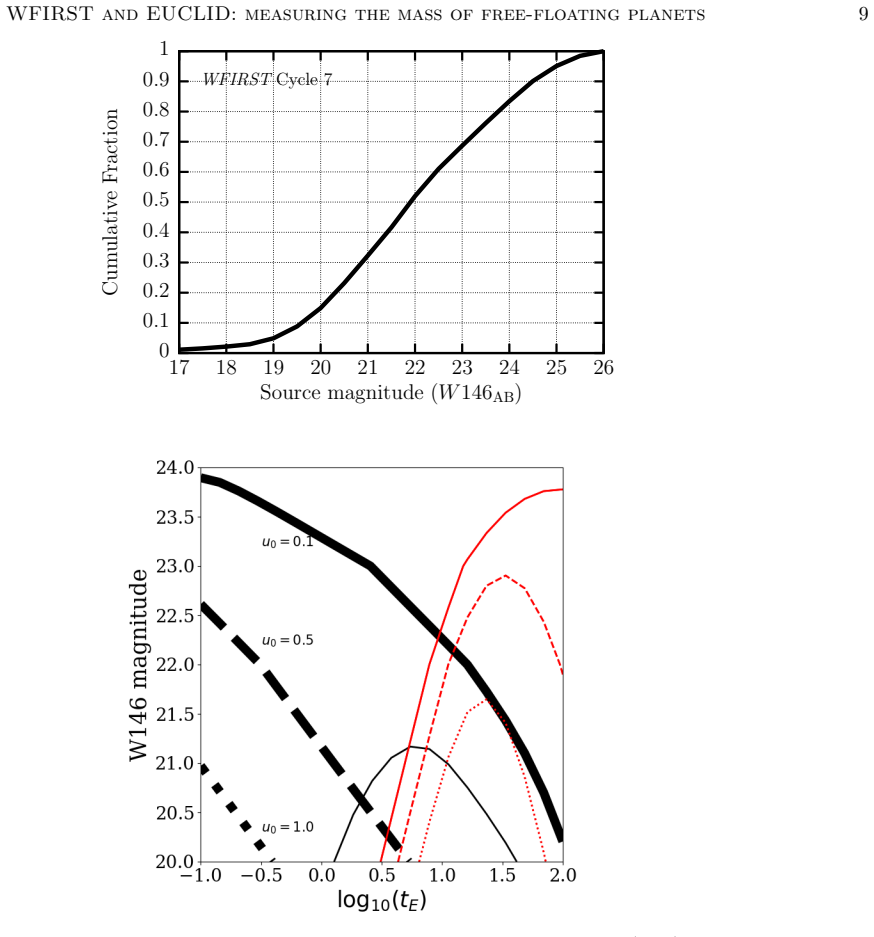
- [§2 footnote 1 and §4] The Fisher matrix calculation explicitly assumes no finite-source effects, but the events that dominate the headline yield are 3-Earth-mass free-floating planets with t_E ~ 0.1 d. For a typical bulge source (angular radius ~0.6 μas) and the adopted 4 kpc lens distance, the source size relative to the Einstein radius is rho ~ 0.2, so finite-source effects are non-negligible. The footnote's assertion that such cases are 'generally favorable' to parallax measurement is not demonstrated, and finite-source smoothing of the magnification profile could instead reduce the differential signal between the two spacecraft. A quantitative finite-source Fisher matrix calculation for representative events is needed to support the claimed 38% detectability fraction for 3-Earth-mass planets and the resulting 0.17 events per day rate.
- [§2, §5, and abstract] The total yield of ~20 free-floating planet parallaxes depends on the assumption that Euclid can observe the WFIRST microlensing fields continuously for 20-day windows, with 60 days during the prime mission and 60 days during an extended mission. This scenario is stated to follow from Gómez-Alvarez et al. (2018), but no detailed scheduling or pointing-constraint model is presented. If the actual simultaneous observing time is shorter, the yield scales linearly and could be substantially smaller than 20. The authors should present the yield as an explicit function of simultaneous observing time, or provide a more detailed justification for the assumed 120 days.
- [§4, Eq. (8)] The expected yield of 0.17 free-floating planet parallax measurements per day depends on the adopted free-floating planet mass function, specifically the Cassan et al. (2012) broken power law extrapolated to masses below 5 Earth masses with a flat normalization of 2 per star. The paper acknowledges that the occurrence rate is unknown, but it does not quantify how the yield changes under alternative mass functions, such as different normalizations or slopes motivated by other studies. A sensitivity analysis over plausible mass functions is needed to avoid overstating the expected yield as a definite prediction.
- [§3 and §4] The central quantitative estimates rely on two in-preparation simulations: Johnson et al. for the WFIRST free-floating planet event distribution, and Huston & Penny for the Galactic crowding model used to compute photometric precision. These inputs are load-bearing for the 17% and 38% detectability fractions and for the signal-to-noise curves in Figure 1, but the manuscript provides no means for readers to verify or reproduce the calculation. The authors should include the relevant distributions as an appendix or make the in-preparation material available to referees, so that the headline numbers are checkable rather than dependent on private inputs.
minor comments (6)
- [Abstract] The phrase 'with a potential to increase' should be 'with the potential to increase' or 'potentially increasing'.
- [§5] The sentence 'We found that deep, dithered, low-cadence observations by Euclid, to be taken in holes in Euclid’s regular observing schedule could provide parallaxes for a modest number of microlensing events with timescales' appears to be missing a specification after 'with timescales'; as written the sentence is incomplete.
- [§3] The sentence 'with Euclid’s expected adjacent field slew times of ∼350 s (Gómez-Alvarez et al. 2018) this cadence allows four fields to be observed' is missing a comma or conjunction for clarity.
- [§4] The statement that deep 1-day cadence observations provide parallax constraints for 'fewer than the brightest 30% of events with u0 < 0.1 (i.e., of the order of a few percent of events)' is confusing; clarify whether 30% is a fraction of all events or of bright events.
- [Keywords] The manuscript keywords ('editorials, notices — miscellaneous — catalogs — surveys') appear to be template placeholders and should be replaced with relevant descriptors such as free-floating planets, microlensing parallax, WFIRST, and Euclid.
- [§2] The sentence 'Bachelet et al. (2018) also shown than the Fisher matrix formalism can be optimistic' contains a typo; it should read 'showed that'.
Circularity Check
No significant circularity: the yield estimate is a forward model from external inputs and previously published survey simulations.
full rationale
The paper's derivation chain is self-contained and not circular. The Fisher-matrix parallax uncertainty formalism (Eq. 4) is taken from prior literature (Gould 2013; Mogavero & Beaulieu 2016; Bachelet et al. 2018) and applied with stated assumptions: fixed lens distance, source distance, transverse velocity, and orbital parameters (Section 2). Equations (5) and (6) are simple kinematic relations derived from those assumptions, not fits to the target yield. The noise model (Section 3) uses instrument parameters and extinction/background models that are independent of the conclusion. The headline rates in Sections 4 and 5 are forward-modeled by combining these Fisher contours with external event distributions: Penny et al. (2019) for WFIRST source magnitudes and survey parameters, Johnson et al. (in prep.) for simulated free-floating planet detections, and Cassan et al. (2012) for the adopted mass function. None of these inputs assumes the Euclid-parallax result, so the prediction that Euclid can measure roughly 0.17 free-floating planet parallaxes per day does not reduce by construction to its inputs. The self-citations (Bachelet et al. 2018 for the Fisher formalism, Penny et al. 2019/2013 for survey simulations) are normal uses of prior work that provide independent support rather than circular justification. The footnote asserting that finite-source effects are 'generally favorable to measuring parallax' is an unquantified modeling assumption and a correctness risk, but it is not a circular step because it is not derived from, nor does it define, the claimed yield. No fitted parameter is renamed as a prediction, no uniqueness theorem is imported, and no known result is merely relabeled. The derivation chain is therefore not circular.
Assumptions & free parameters
free parameters (10)
- Baseline photometric precision sigma =
0.01 mag at W146=20
- Euclid high-cadence precision relative to WFIRST =
1.33x worse
- Euclid deep precision relative to WFIRST =
0.5x better
- Lens distance Dl =
4 kpc
- Source distance Ds =
8 kpc
- Relative lens-source transverse velocity V =
200 km/s
- Orbital phase separation phi =
pi (ideal case)
- Euclid continuous observing window =
20 days per season
- Cadences and exposures =
WFIRST 15 min, Euclid high-cadence 30 min, exp 47s/100s; deep 4x250s dithers at 1, 3, or 7 day cadence
- FFP mass function normalization =
Cassan et al. 2012 dN/dM piecewise
assumptions (7)
- domain assumption Fisher matrix uncertainties from Gaussian photometric noise are a valid proxy for achievable parallax precision.
- domain assumption Microlensing events can be modeled as single point lenses with no finite-source effects.
- domain assumption No blending from isolated stars; only smooth unresolved background light enters the photometric noise.
- domain assumption Euclid can observe the WFIRST fields continuously for 20 days per season under its solar aspect angle and thermal constraints.
- domain assumption The free-floating planet mass function follows the Cassan et al. 2012 bound-planet mass function.
- domain assumption WFIRST will detect the stated numbers of free-floating planets, about 100 per mass decade between 2 Earth masses and 2 Jupiter masses plus 50 below 2 Earth masses.
- domain assumption Spacecraft orbits around L2 are circular with radius 300,000 km and period 180 days, and annual parallax contributes negligibly for tE up to 4 days.
Cite this review
Pith. "Pith review of WFIRST and EUCLID: enabling the microlensing parallax measurement from space." pith.science (2026). https://pith.science/paper/NBHI3PB7
@misc{pith2026190802720,
  author       = {Pith},
  title        = {Pith review of: WFIRST and EUCLID: enabling the microlensing parallax measurement from space},
  year         = {2026},
  howpublished = {\url{https://pith.science/paper/NBHI3PB7}},
  note         = {Machine review of arXiv:1908.02720}
}
read the original abstract
The Wide Field Infrared Survey Telescope (WFIRST) is expected to detect hundreds of free-floating planets, but it will not be able to measure their masses. However, simultaneous microlensing observations by both Euclid and WFIRST spacecraft, separated by ~ 100, 000 km in orbits around the Sun-Earth L2 Lagrange point, will enable measurements of microlensing parallax for low-mass lenses such as free-floating planets. Using simple Fisher matrix estimates of the parallax measurement uncertainties, we show that high-cadence observations by Euclid could be used to measure ~ 1 free-floating planet microlens parallax per 6 days of simultaneous Euclid observations. Accounting for Euclid's pointing constraints, it could therefore potentially measure ~ 20 free-floating planet parallaxes with 120 days of observations split equally between Euclid's main mission and an extended mission, with a potential to increase this number if spacecraft pointing constraints can be relaxed after the end of the main mission. These Euclid observations would also provide additional mass measurements or cross-checks for larger numbers of WFIRST's bound planets, among other benefits to several science cases.
Figures


Figures from the paper (1 more)

Reference graph
Works this paper leans on
-
[1]
, " * write output.state after.block = add.period write newline
ENTRY address archivePrefix author booktitle chapter doi edition editor eprint howpublished institution journal key month note number organization pages publisher school series title misctitle type volume year version url label extra.label sort.label short.list INTEGERS output.state before.all mid.sentence after.sentence after.block FUNCTION init.state.co...
-
[2]
write newline
" write newline "" before.all 'output.state := FUNCTION format.doi doi empty "" "doi:" doi * if FUNCTION format.url url empty "" new.block "" url * "" * if FUNCTION format.eprint eprint empty "" archivePrefix empty "" archivePrefix ":" * if eprint field.or.null * if FUNCTION format.pid eprint empty format.doi format.eprint if FUNCTION n.dashify 't := "" t...
-
[3]
# MU YI A
thebibliography [1] 20pt to REFERENCES 6pt =0pt 10pt plus 3pt =0pt =0pt =1pt plus 1pt =0pt =0pt -12pt =13pt plus 1pt =20pt =13pt plus 1pt \@M =10000 =-1.0em =0pt =0pt 0pt =0pt =1.0em @enumiv\@empty 10000 10000 `\.\@m \@noitemerr \@latex@warning Empty `thebibliography' environment \@ifnextchar \@reference \@latexerr Missing key on reference command Each re...
2017
-
[4]
Abell, P. A., Allison, J., Anderson, S. F., et al. 2009, arXiv:0912.0201
arXiv 2009
-
[5]
Alcock , C., Akerlof , C. W., Allsman , R. A., et al. 1993, , 365, 621
work page 1993
-
[6]
Aubourg , E., Bareyre , P., Br \'e hin , S., et al. 1993, , 365, 623
work page 1993
- [7]
- [8]
Show all 65 references
-
[9]
V., Raymond , S
Barclay , T., Quintana , E. V., Raymond , S. N., & Penny , M. T. 2017, , 841, 86
2017
-
[10]
P., Bennett , D
Beaulieu , J. P., Bennett , D. P., Fouqu \'e , P., et al. 2006, , 439, 437
2006
-
[11]
P., Anderson , J., & Gaudi , B
Bennett , D. P., Anderson , J., & Gaudi , B. S. 2007, , 660, 781
2007
-
[12]
P., Batista , V., Bond , I
Bennett , D. P., Batista , V., Bond , I. A., et al. 2014, , 785, 155
2014
-
[13]
P., Bennett , D
Bhattacharya , A., Beaulieu , J. P., Bennett , D. P., et al. 2018, , 156, 289
2018
-
[14]
A., Udalski , A., Jaroszy \'n ski , M., et al
Bond , I. A., Udalski , A., Jaroszy \'n ski , M., et al. 2004, , 606, L155
2004
-
[15]
Burgess , A. S. M., Moraux , E., Bouvier , J., et al. 2009, , 508, 823
2009
-
[16]
2015, , 804, 20
Calchi Novati , S., Gould , A., Udalski , A., et al. 2015, , 804, 20
2015
-
[17]
A., Clayton , G
Cardelli , J. A., Clayton , G. C., & Mathis , J. S. 1989, , 345, 245
1989
-
[18]
P., et al
Cassan , A., Kubas , D., Beaulieu , J. P., et al. 2012, , 481, 167
2012
-
[19]
2016, , 823, 102
Choi , J., Dotter , A., Conroy , C., et al. 2016, , 823, 102
2016
-
[20]
2018, in Society of Photo-Optical Instrumentation Engineers (SPIE) Conference Series, Vol
Cropper , M., Pottinger , S., Azzollini , R., et al. 2018, in Society of Photo-Optical Instrumentation Engineers (SPIE) Conference Series, Vol. 10698, 1069828
2018
-
[21]
2016, , 222, 8
Dotter , A. 2016, , 222, 8
2016
-
[22]
Gaudi , B. S. 1998, , 506, 533
1998
-
[23]
2012, Annual Review of Astronomy and Astrophysics, 50, 411
---. 2012, Annual Review of Astronomy and Astrophysics, 50, 411
2012
-
[24]
2018, in Society of Photo-Optical Instrumentation Engineers (SPIE) Conference Series, Vol
G \'o mez-Alvarez , P., Dupac , X., Buenadicha , G., et al. 2018, in Society of Photo-Optical Instrumentation Engineers (SPIE) Conference Series, Vol. 10707, Software and Cyberinfrastructure for Astronomy V, 1070712
2018
-
[25]
A., Rejkuba , M., Zoccali , M., et al
Gonzalez , O. A., Rejkuba , M., Zoccali , M., et al. 2012, , 543, A13
2012
-
[26]
1994, , 421, L75
Gould , A. 1994, , 421, L75
1994
-
[27]
2000, , 542, 785
---. 2000, , 542, 785
2000
-
[28]
2013, , 763, L35
---. 2013, , 763, L35
2013
-
[29]
2016, Journal of Korean Astronomical Society, 49, 9
Gould , A., Huber , D., & Stello , D. 2016, Journal of Korean Astronomical Society, 49, 9
2016
-
[30]
2008, , 684, 684
Han , C. 2008, , 684, 684
2008
-
[31]
K., Shvartzvald , Y., et al
Han , C., Jung , Y. K., Shvartzvald , Y., et al. 2018, , 865, 14
2018
-
[32]
B., & Shvartzvald , Y
Henderson , C. B., & Shvartzvald , Y. 2016, , 152, 96
2016
-
[33]
B., Poleski , R., Penny , M., et al
Henderson , C. B., Poleski , R., Penny , M., et al. 2016, Publications of the Astronomical Society of the Pacific, 128, 124401
2016
-
[34]
H., Udalski , A., Bond , I
Hwang , K. H., Udalski , A., Bond , I. A., et al. 2018, , 155, 259
2018
-
[35]
2019, arXiv e-prints, arXiv:1905.05794
Koshimoto , N., & Bennett , D. 2019, arXiv e-prints, arXiv:1905.05794
2019 arXiv
-
[36]
2011, arXiv e-prints, arXiv:1110.3193
Laureijs , R., Amiaux , J., Arduini , S., et al. 2011, arXiv e-prints, arXiv:1110.3193
2011 arXiv
-
[37]
2010, , 520, A68
Liebig , C., & Wambsganss , J. 2010, , 520, A68
2010
-
[38]
L., Adame , L., D'Alessio , P., et al
Luhman , K. L., Adame , L., D'Alessio , P., et al. 2005, , 635, L93
2005
-
[39]
Ma , S., Mao , S., Ida , S., Zhu , W., & Lin , D. N. C. 2016, , 461, L107
2016
-
[40]
2016, in Society of Photo-Optical Instrumentation Engineers (SPIE) Conference Series, Vol
Maciaszek , T., Ealet , A., Jahnke , K., et al. 2016, in Society of Photo-Optical Instrumentation Engineers (SPIE) Conference Series, Vol. 9904, Space Telescopes and Instrumentation 2016: Optical, Infrared, and Millimeter Wave, 99040T
2016
-
[41]
A., Plavchan , P., Kirkpatrick , J
Marsh , K. A., Plavchan , P., Kirkpatrick , J. D., et al. 2010, , 719, 550
2010
-
[42]
2014, , 445, 4137
McDonald , I., Kerins , E., Penny , M., et al. 2014, , 445, 4137
2014
-
[43]
Mogavero , F., & Beaulieu , J. P. 2016, , 585, A62
2016
-
[44]
T., Yee , J
Montet , B. T., Yee , J. C., & Penny , M. T. 2017, Publications of the Astronomical Society of the Pacific, 129, 044401
2017
-
[45]
2017, , 548, 183
Mr \'o z , P., Udalski , A., Skowron , J., et al. 2017, , 548, 183
2017
-
[46]
1999, , 526, 336
Oasa , Y., Tamura , M., & Sugitani , K. 1999, , 526, 336
1999
-
[47]
2019, , 622, A201
OGLE Collaboration , Mr \'o z , P., Udalski , A., et al. 2019, , 622, A201
2019
-
[48]
1986, , 304, 1
Paczy\'nski , B. 1986, , 304, 1
1986
-
[49]
2011, , 192, 3
Paxton , B., Bildsten , L., Dotter , A., et al. 2011, , 192, 3
2011
-
[50]
T., Gaudi , B
Penny , M. T., Gaudi , B. S., Kerins , E., et al. 2019, The Astrophysical Journal Supplement Series, 241, 3
2019
-
[51]
T., Kerins , E., Rattenbury , N., et al
Penny , M. T., Kerins , E., Rattenbury , N., et al. 2013, , 434, 2
2013
-
[52]
P., et al
Poindexter , S., Afonso , C., Bennett , D. P., et al. 2005, , 633, 914
2005
-
[53]
1966, , 134, 315
Refsdal , S. 1966, , 134, 315
1966
-
[54]
2015, , 814, 111
Shvartzvald , Y., Udalski , A., Gould , A., et al. 2015, , 814, 111
2015
-
[55]
2015, arXiv e-prints, arXiv:1503.03757
Spergel , D., Gehrels , N., Baltay , C., et al. 2015, arXiv e-prints, arXiv:1503.03757
2015 arXiv
-
[56]
A., Lund , M
Street , R. A., Lund , M. B., Donachie , M., et al. 2018, arXiv e-prints, arXiv:1812.04445
2018 arXiv
-
[57]
P., et al
Sumi , T., Kamiya , K., Bennett , D. P., et al. 2011, , 473, 349
2011
-
[58]
2003, , 590, 284
Udalski , A. 2003, , 590, 284
2003
-
[59]
1993, , 43, 289
Udalski , A., Szymanski , M., Kaluzny , J., et al. 1993, , 43, 289
1993
-
[60]
Veras , D., & Raymond , S. N. 2012, , 421, L117
2012
-
[61]
J., & Mao , S
Witt , H. J., & Mao , S. 1994, , 430, 505
1994
-
[62]
2016, , 458, 3012
Wyrzykowski , ., Kostrzewa-Rutkowska , Z., Skowron , J., et al. 2016, , 458, 3012
2016
-
[63]
R., B \'e jar , V
Zapatero Osorio , M. R., B \'e jar , V. J. S., Mart \' n , E. L., et al. 2000, Science, 290, 103
2000
-
[64]
2016, Journal of Korean Astronomical Society, 49, 93
Zhu , W., & Gould , A. 2016, Journal of Korean Astronomical Society, 49, 93
2016
-
[65]
X., et al
Zhu , W., Udalski , A., Huang , C. X., et al. 2017, , 849, L31
2017
Reviewed August 14, 2026 · model on record in the stance chip above.
Discussion (0). Continue with ORCID to comment.