REVIEW 2 major objections 4 minor 115 references
How planets grow by pebble accretion II: Analytical calculations on the evolution of polluted envelopes
T0 review · 2 major / 4 minor · reviewed 2026-08-14 · deepseek-v4-flash
Pith's one-line read Critical metal mass, not core mass, triggers runaway gas accretion
desk verdict A clean analytical framework for polluted-envelope runaway that is internally contradicted by its own energy calculation at the regime it targets. read the letter →
The pith
A machine-rendered reading of the paper's core claim, the machinery that carries it, and where it could break.
The reading
What carries the argument
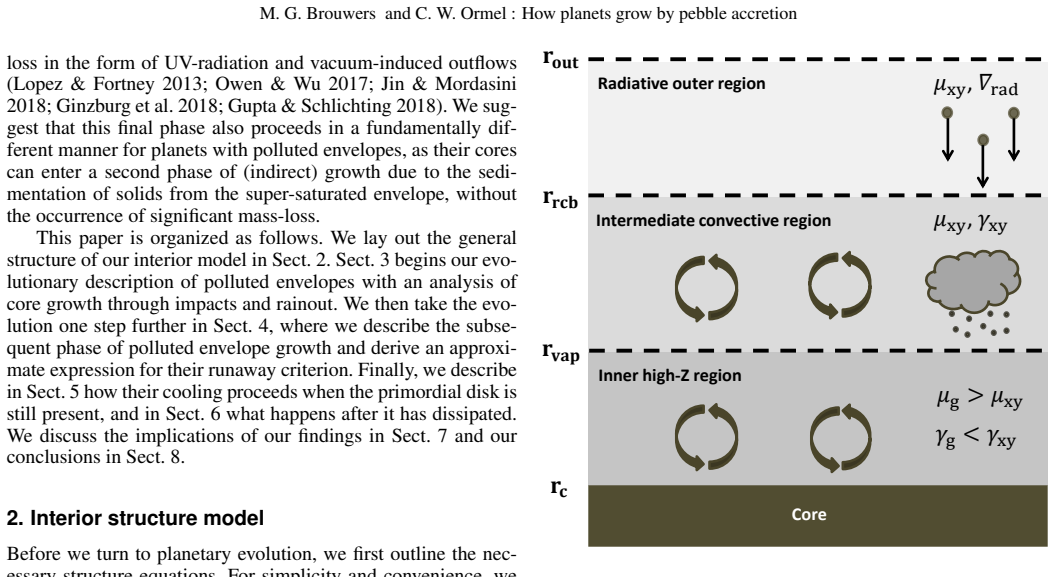
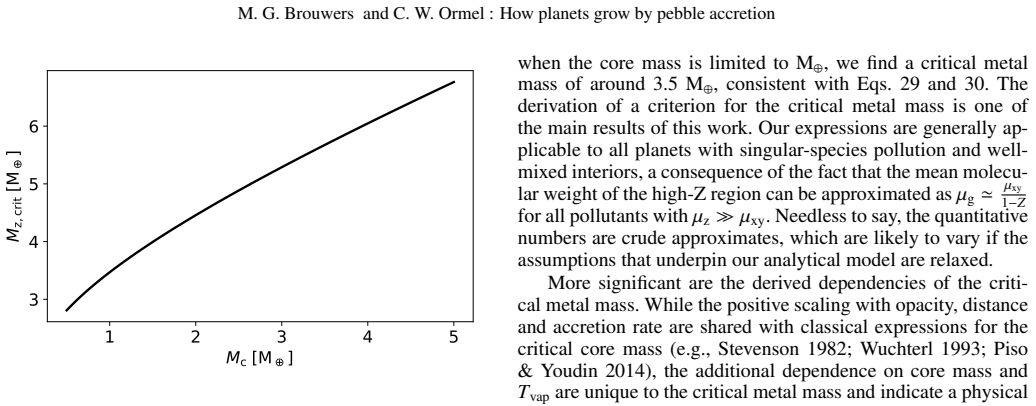
The load-bearing object is the three-zone analytical envelope: an outer isothermal radiative region, an intermediate metal-free convective region with adiabatic index $\gamma_{xy} > 4/3$, and an inner high-Z vapor layer that is assumed perfectly mixed, with mean molecular weight $\mu_g \simeq \mu_{xy}/(1-Z)$ and adiabatic index $\gamma_g < 4/3$. Because $\gamma_g$ lies below $4/3$, most of the vapor mass sits near the core, so the envelope mass is controlled by this inner layer, and runaway is approximated by the crossover $M_z = M_{xy}$; combining these pieces produces the critical metal mass formula (Eqs. 29-30). The same machinery generates the dilution-limited gas accretion scaling for embedded cooling (Eq. 43) and the rainout timescale estimate after disk dispersal (Eq. 51).
What would settle it
Compute the deep interior with a realistic equation of state for hydrogen-helium plus silicate vapor at the temperatures and pressures of a forming super-Earth and check whether the effective adiabatic index stays below 4/3 while the composition remains uniform; a mixed envelope that is dynamically unstable, or that develops a compositional gradient instead of mixing, would break the critical metal mass and dilution-limited cooling.
Extended reading notes
Core claim
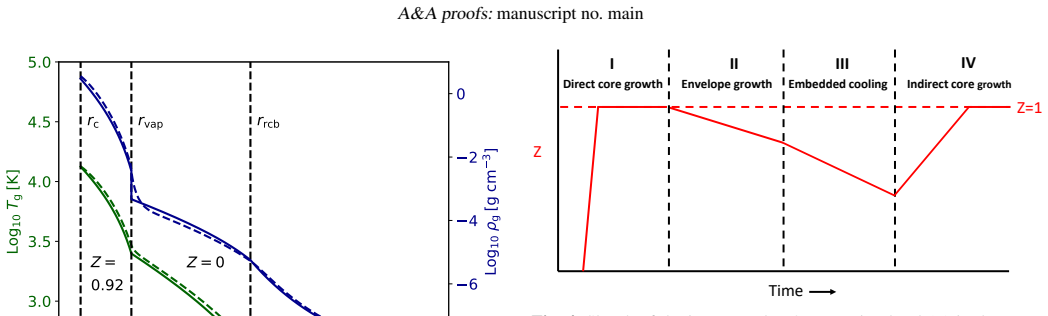
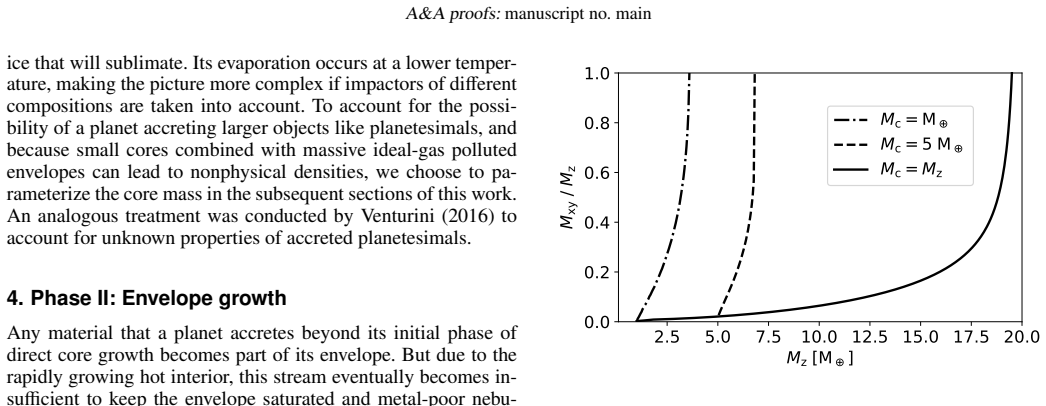
The paper's central claim is that the classical critical core mass should be replaced, for planets with polluted envelopes, by a critical metal mass $M_{z,\mathrm{crit}}$: runaway gas accretion begins when $M_z = M_c + M_{\mathrm{vapor}}$ exceeds this threshold. For the nominal silicate case the model gives $M_{z,\mathrm{crit}} \approx 4.0\,M_\oplus\,(\kappa_{\mathrm{rcb}}/0.01\,\mathrm{g\,cm^{-2}})^{1/6}(d/\mathrm{AU})^{7/108}(T_{\mathrm{vap}}/2500\,\mathrm{K})^{8/27}(\dot{M}_z/10^{-5}\,M_\oplus\,\mathrm{yr^{-1}})^{1/6}(M_c/M_\oplus)^{1/2}$. Pollution lowers the solid mass at which runaway sets in relative to a metal-free envelope, because the heavy vapor raises the mean molecular weight and lowers the adiabatic index, pulling in nebular gas; the threshold nevertheless rises for larger cores, which dilute the pollution, and for less volatile pollutants, which produce a smaller vapor region. The same framework yields a four-phase evolutionary sequence, with direct core growth, vapor-dominated envelope growth, dilution-limited embedded cooling, and post-disk rainout as the final stage.
Load-bearing premise
The whole argument assumes that vaporized rock mixes evenly through the hot inner atmosphere and that this atmosphere remains dynamically stable during formation; if mixing is weak or the atmosphere can collapse, the critical metal mass and dilution mechanisms fail.
Editorial extensions
If this is right
- Runaway gas accretion is set by the total metal mass, so planets that vaporize their accreted solids can become gas giants at lower solid mass than the classical critical core mass predicts.
- Planets inside the ice line, accreting silicates with high evaporation temperature, need more solids to reach runaway, biasing the inner disk toward super-Earths and sub-Neptunes and the outer disk toward gas giants.
- If solids accretion stops while the disk is still present, the inflow of hydrogen-helium dilutes the heavy-element vapor and slows further contraction, giving sub-Neptune-mass planets a longer runway before runaway.
- After disk dissipation, the contracting envelope eventually condenses its vapor, adding mass to the core over several Gyr, and the energy released comes too late to power significant outflow.
- Planets that keep their primordial envelopes can retain part of their heavy elements outside the core after billions of years, so a diffuse heavy-element region in a giant planet need not imply core erosion.
Reading between the lines
- If the critical metal mass holds, the observed close-in pile-up of sub-Neptunes may partly reflect a formation barrier, the extra solids needed to trigger runaway inside the ice line, rather than only later photo-evaporation sculpting the distribution.
- A natural next test is a realistic equation-of-state calculation for mixed hydrogen-helium and silicate vapor in the deep interior, to check whether the effective adiabatic index really stays below $4/3$ and whether such layers are dynamically stable; the paper itself flags this as its largest uncertainty.
- The model suggests a correlation between a sub-Neptune's envelope heavy-element abundance and its formation location, with more volatile-rich interiors tracing formation farther out, a prediction that could be checked against atmospheric abundances and orbital architectures.
- Because the competing non-mixed picture gives the opposite gas-accretion trend, measuring how efficiently hot planetary interiors mix, through rainout outcomes or through the observable dilution of envelope metals, would decide which scenario shapes super-Earth evolution.
Signed reviews
Editorial analysis
A structured set of objections, weighed in public.
Referee Report
Summary. The paper presents an analytical three-zone model for the interior structure of proto-planets whose envelopes are polluted by vaporized solids. The model assumes an ideal-gas equation of state, a uniformly mixed inner high-Z vapor region with constant adiabatic index γg < 4/3, a step-function compositional transition, and neglect of Ledoux stabilization. Using this model, the authors describe four evolutionary phases: direct core growth, polluted envelope growth, embedded cooling, and post-disk indirect core growth. The central result is a critical metal mass, Eq. (30), that marks the onset of runaway gas accretion when the total metal mass (core plus vapor) exceeds ~4 M⊕ for nominal parameters; this is claimed to supersede the traditional critical core mass. A second major result is that compositional dilution during embedded cooling slows gas accretion, and a third is that post-disk vapor sedimentation produces only slow indirect core growth without significant mass-loss. The derivation is internally consistent in a formal sense and is cross-checked against a numerical integration of the structure equations (Fig. 3) and against phase-I core masses from BVO18 (Fig. 5).
Significance. If the central claims hold, this would be the first analytical framework for the evolution of polluted planetary envelopes, with testable scalings for the critical metal mass as a function of orbital distance, opacity, accretion rate, volatility, and core mass. The model usefully identifies dilution as a self-limiting mechanism in embedded cooling and makes a falsifiable prediction that volatile-poor inner-disk planets require more solids to reach runaway than volatile-rich outer-disk planets. The paper is transparent about many of its simplifications, and the comparison with a numerical structure integrator in Fig. 3 is a genuine check. However, the main result is conditional on the perfect-mixing assumption, which the paper itself notes is in direct opposition to the no-mixing numerical models of Bodenheimer et al. (2018). More seriously, the paper's own energy calculation in §5.2.1 implies that the quasi-static well-mixed envelope is unbound at the very crossover that defines the critical metal mass, a contradiction that is not reconciled in the text. The manuscript deserves publication only after this load-bearing issue is addressed.
major comments (2)
- [§4.2 (Eqs. 25–30) and §5.2.1 (Eq. 42b)] The runaway criterion Mz,crit is derived for the crossover Mz = Mxy, where the envelope mass is Menv = (1+fz)Mz and the core mass is Mc = (1−fz)Mz. For any fz ≥ 0, Menv/Mc = (1+fz)/(1−fz) ≥ 1. Equation (42b), with the default γg = 1.25, gives Eenv > 0 for Menv/Mc ≳ 0.43, and the authors state in §5.2.1 that this positive-energy configuration is “clearly non-physical” and in §7 that dynamical instability “would fundamentally change their evolution and likely invalidate our results.” The paper does not connect this statement to the validity of the runaway criterion. In the heavily polluted regime (small cores, large fz), where the inner high-Z region dominates the envelope mass, the quasi-static, well-mixed envelope assumed in the derivation of Eq. (30) is unbound at the crossover. The central claim therefore needs either a demonstration that the envelope reaches Mz,crit before becoming dynamically unstable, or a re-derivation of the criterion from the bound-energy limit. As written, the criterion is internally contradicted in exactly the regime where it differs most from the classical critical core mass.
- [§2.3.2 and §7] The conclusion that pollution accelerates gas accretion and lowers the mass at runaway rests entirely on the assumption that the convective high-Z region is perfectly mixed with uniform composition. The paper itself notes that Bodenheimer et al. (2018), who assume no compositional mixing, find the opposite trend: in their model a saturated inner region slows gas accretion. Since the mixing efficiency in planetary envelopes is poorly constrained, the sign of the effect is not established by this model. I am not asking for a full parameter study, but the abstract's statement that the critical metal mass “supersedes the traditional critical core mass” should be qualified to make clear that this is a consequence of the perfect-mixing assumption. A concrete step would be to state the regime of validity explicitly and to identify what would falsify the prediction — for example, a numerical simulation with finite compositional diffusion that brackets the mixed and unmixed limits.
minor comments (4)
- [Eq. (30)] The normalization of κrcb is written as “0.01 g cm−2”; opacity κ has units of cm2 g−1 in Eq. (6), so the label should read “0.01 cm2 g−1”.
- [Fig. 5 caption] The superscript “1” before “Impacts and rainout” appears to be a misplaced footnote marker; the sentence reads awkwardly and should be reformatted.
- [§6.1, Eq. (46)] The text says the sedimentation condition is Tcg = Tvap, but Eq. (46) is written in terms of Trcb and rrcb/rc; please clarify how the condition T(rc) = Tvap translates to the stated expression.
- [§5.2.1] The phrase “a negative scaling with MenvMc” is ambiguous; it should be “a negative scaling with Menv Mc” (the product of the envelope and core masses).
Circularity Check
No significant circularity: the critical metal mass is obtained by integrating the assumed hydrostatic structure rather than by fitting runaway data; the Tvap calibration and the positive-energy caveat are self-acknowledged limitations, not input-output equivalences.
full rationale
Walking the derivation chain: Equation 30 follows from Equations 25 and 29, which are obtained by substituting the high-Z region mass integral (Eq. 22b), the pollution-fraction parameterization (Eq. 23), and the mean-molecular-weight relation (Eq. 24) into the condition that the envelope mass equals the metal mass. The crossover condition Mz = Mxy is explicitly introduced as an approximation ('we simply approximate runaway accretion to initiate around the crossover mass when Mz = Mxy'), and the paper then computes the value of Mz at that crossover from the structure equations; this is a calculation of the reported mass, not a restatement of it. The only fitted quantity connected to prior work by the same authors is Tvap, used in Section 3.2 to match BVO18 phase-I core masses; the critical-metal-mass expression uses the default silicate estimate Tvap = 2500 K, and the derived scaling with Tvap is not identical to the calibration target. This is therefore a minor self-citation and calibration step, not a load-bearing circular reduction. The paper itself flags the serious caveat that its energy expression, Eq. 42b, turns positive for Menv greater than about 0.43 Mc, and states in Section 7 that dynamical instability 'would fundamentally change their evolution and likely invalidate our results.' At the Eq. 30 crossover, Menv/Mc = (1+fz)/(1-fz) >= 1, so the assumed bound, uniformly mixed envelope is internally contradicted in exactly the regime of interest. That is an internal-consistency and correctness limitation, not a circular reduction, so under the hard rules it does not raise the circularity score. The central derivation is self-contained against the stated structural assumptions and is benchmarked against BVO18 numerics, so the appropriate circularity finding is low: score 2.
Assumptions & free parameters
free parameters (4)
- Tvap (vapor boundary temperature) =
2500 K default; fitted to BVO18 in Sect. 3.2
- gamma_g (adiabatic index of high-Z region) =
1.2 (pure silicate), 1.25 (mixed)
- kappa_rcb (opacity at radiative-convective boundary) =
0.01 g cm^-2 in Eq. 29
- gamma_xy (adiabatic index of intermediate nebular region) =
1.45
assumptions (6)
- domain assumption Hydrostatic, spherically symmetric envelope with ideal gas equation of state; hydrodynamic term neglected.
- domain assumption Outer radiative region is isothermal; opacity at the radiative-convective boundary follows a grain-free molecular power law.
- ad hoc to paper Compositional transition to the high-Z region is a step function at rvap with continuous temperature; Ledoux stabilization from the compositional gradient is ignored.
- ad hoc to paper Convective regions are perfectly mixed, with uniform composition in each zone.
- ad hoc to paper The high-Z region has constant adiabatic index gamma_g < 4/3 and remains dynamically stable.
- domain assumption Planet remains embedded in a Minimum Mass Solar Nebula until disk dissipation; outer boundary at the smaller of Bondi and Hill radii.
Cite this review
Pith. "Pith review of How planets grow by pebble accretion II: Analytical calculations on the evolution of polluted envelopes." pith.science (2026). https://pith.science/paper/YJNSJJPL
@misc{pith2026190802742,
  author       = {Pith},
  title        = {Pith review of: How planets grow by pebble accretion II: Analytical calculations on the evolution of polluted envelopes},
  year         = {2026},
  howpublished = {\url{https://pith.science/paper/YJNSJJPL}},
  note         = {Machine review of arXiv:1908.02742}
}
read the original abstract
Proto-planets embedded in their natal disks acquire hot envelopes as they grow and accrete solids. This ensures that the material they accrete - pebbles, as well as (small) planetesimals - will vaporize to enrich their atmospheres. Enrichment modifies an envelope's structure and significantly alters its further evolution. Our aim is to describe the formation of planets with polluted envelopes from the moment that impactors begin to sublimate to beyond the disk's eventual dissipation. We constructed an analytical interior structure model, characterized by a hot and uniformly mixed high-Z vapor layer surrounding the core, located below the usual unpolluted radiative-convective regions. The evolution of planets with uniformly mixed polluted envelopes follows four potential phases. Initially, the central core grows directly through impacts and rainout until the envelope becomes hot enough to vaporize and absorb all incoming solids. We find that a planet reaches runaway accretion when the sum of its core and vapor mass exceeds a value that we refer to as the critical metal mass - a criterion that supersedes the traditional critical core mass. It scales positively with both the pollutant's evaporation temperature and with the planet's core mass. Hence, planets at shorter orbital separations require the accretion of more solids to reach runaway as they accrete less volatile materials. If the solids accretion rate dries up, we identify the decline of the mean molecular weight - dilution - as a mechanism to limit gas accretion during a polluted planet's embedded cooling phase. When the disk ultimately dissipates, the envelope's inner temperature declines and its vapor eventually rains out, augmenting the mass of the core. The energy release that accompanies this does not result in significant mass-loss, as it only occurs after the planet has substantially contracted.
Figures

Figures from the paper (6 more)



Reference graph
Works this paper leans on
-
[1]
, " * write output.state after.block = add.period write newline
ENTRY address archiveprefix author booktitle chapter edition editor howpublished institution eprint journal key month note number organization pages publisher school series title type volume year label extra.label sort.label short.list INTEGERS output.state before.all mid.sentence after.sentence after.block FUNCTION init.state.consts #0 'before.all := #1 ...
-
[2]
write newline
" write newline "" before.all 'output.state := FUNCTION n.dashify 't := "" t empty not t #1 #1 substring "-" = t #1 #2 substring "--" = not "--" * t #2 global.max substring 't := t #1 #1 substring "-" = "-" * t #2 global.max substring 't := while if t #1 #1 substring * t #2 global.max substring 't := if while FUNCTION word.in bbl.in " " * FUNCTION format....
-
[3]
E., & Cridland , A
Alessi , M., Pudritz , R. E., & Cridland , A. J. 2017, , 464, 428
2017
-
[4]
2017, , 606, A69
Alibert , Y. 2017, , 606, A69
2017
-
[5]
Armitage , P. J. 2007, arXiv e-prints, astro
2007
-
[6]
2004, , 419, L13
Baraffe , I., Selsis , F., Chabrier , G., et al. 2004, , 419, L13
2004
-
[7]
Bell , K. R. & Lin , D. N. C. 1994, , 427, 987
1994
-
[8]
2013, Stellar Structure and Evolution (Springer), 47--63
Benacquista , M. 2013, Stellar Structure and Evolution (Springer), 47--63
2013
Show all 115 references
-
[9]
Benvenuto , O. G. & Brunini , A. 2005, , 356, 1383
2005
-
[10]
& Asphaug , E
Benz , W. & Asphaug , E. 1999, , 142, 5
1999
-
[11]
K., Irwin , J., Charbonneau , D., et al
Berta-Thompson , Z. K., Irwin , J., Charbonneau , D., et al. 2015, , 527, 204
2015
-
[12]
N., & Izidoro , A
Bitsch , B., Raymond , S. N., & Izidoro , A. 2019, , 624, A109
2019
-
[13]
J., Lissauer , J
Bodenheimer , P., Stevenson , D. J., Lissauer , J. J., & D'Angelo , G. 2018, , 868, 138
2018
-
[14]
J., Koch , D
Borucki , W. J., Koch , D. G., Basri , G., et al. 2011, , 736, 19
2011
-
[15]
G., Vazan , A., & Ormel , C
Brouwers , M. G., Vazan , A., & Ormel , C. W. 2018, , 611, A65
2018
-
[16]
& Laughlin , G
Chiang , E. & Laughlin , G. 2013, , 431, 3444
2013
-
[17]
F., Thomas , P
Chyba , C. F., Thomas , P. J., & Zahnle , K. J. 1993, , 361, 40
1993
-
[18]
P., Kuiper , R., & Ormel , C
Cimerman , N. P., Kuiper , R., & Ormel , C. W. 2017, , 471, 4662
2017
-
[19]
Coleman , G. A. L., Papaloizou , J. C. B., & Nelson , R. P. 2017, , 470, 3206
2017
-
[20]
Cranmer , S. R. 2004, American Journal of Physics, 72, 1397
2004
-
[21]
& Bodenheimer , P
D'Angelo , G. & Bodenheimer , P. 2013, , 778, 77
2013
-
[22]
& Podolak , M
D'Angelo , G. & Podolak , M. 2015, , 806, 203
2015
-
[23]
I., Chiang , E., & Lee , E
Dawson , R. I., Chiang , E., & Lee , E. J. 2015, , 453, 1471
2015
-
[24]
D., Charbonneau , D., & Newton , E
Dressing , C. D., Charbonneau , D., & Newton , E. R. 2015, in AAS/Division for Extreme Solar Systems Abstracts, Vol. 47, 501.03
2015
-
[25]
2018, Computer Physics Communications, 227, 117
Faik , S., Tauschwitz , A., & Iosilevskiy , I. 2018, Computer Physics Communications, 227, 117
2018
-
[26]
2013, , 766, 81
Fressin , F., Torres , G., Charbonneau , D., et al. 2013, , 766, 81
2013
-
[27]
Fulton , B. J. & Petigura , E. A. 2018, , 156, 264
2018
-
[28]
J., Petigura , E
Fulton , B. J., Petigura , E. A., Howard , A. W., et al. 2017, , 154, 109
2017
-
[29]
2015, , 811, 101
Fung , J., Artymowicz , P., & Wu , Y. 2015, , 811, 101
2015
-
[30]
E., & Sari , R
Ginzburg , S., Schlichting , H. E., & Sari , R. 2016, , 825, 29
2016
-
[31]
E., & Sari , R
Ginzburg , S., Schlichting , H. E., & Sari , R. 2018, , 476, 759
2018
-
[32]
2010, , 520, A27
Guillot , T. 2010, , 520, A27
2010
-
[33]
& Schlichting , H
Gupta , A. & Schlichting , H. E. 2018, arXiv e-prints, arXiv:1811.03202
2018 arXiv
-
[34]
1981, Progress of Theoretical Physics Supplement, 70, 35
Hayashi , C. 1981, Progress of Theoretical Physics Supplement, 70, 35
1981
-
[35]
& Guillot , T
Helled , R. & Guillot , T. 2018, Internal Structure of Giant and Icy Planets: Importance of Heavy Elements and Mixing (Springer), 44
2018
-
[36]
& Stevenson , D
Helled , R. & Stevenson , D. 2017, , 840, L4
2017
-
[37]
& Ikoma , M
Hori , Y. & Ikoma , M. 2011, , 416, 1419
2011
-
[38]
Howard , A. W. 2013, Science, 340, 572
2013
-
[39]
B., Hattori , M
Hubbard , W. B., Hattori , M. F., Burrows , A., & Hubeny , I. 2007, , 658, L59
2007
-
[40]
Hubickyj , O., Bodenheimer , P., & Lissauer , J. J. 2005, , 179, 415
2005
-
[41]
& Podolak , M
Iaroslavitz , E. & Podolak , M. 2007, , 187, 600
2007
-
[42]
& Hori , Y
Ikoma , M. & Hori , Y. 2012, , 753, 66
2012
-
[43]
Inamdar , N. K. & Schlichting , H. E. 2015, , 448, 1751
2015
-
[44]
& Mordasini , C
Jin , S. & Mordasini , C. 2018, , 853, 163
2018
-
[45]
S., Mac Low , M.-M., et al
Johansen , A., Oishi , J. S., Mac Low , M.-M., et al. 2007, , 448, 1022
2007
-
[46]
2009, , 704, L75
Johansen , A., Youdin , A., & Mac Low , M.-M. 2009, , 704, L75
2009
-
[47]
& Weigert , A
Kippenhahn , R. & Weigert , A. 1989, Stellar Structure and Evolution (Springer-Verlag), 64--66
1989
-
[48]
G., Stewart , S
Kraus , R. G., Stewart , S. T., Swift , D. C., et al. 2012, Journal of Geophysical Research (Planets), 117, E09009
2012
-
[49]
& Johansen , A
Lambrechts , M. & Johansen , A. 2012, , 544, A32
2012
-
[50]
2014, , 572, A35
Lambrechts , M., Johansen , A., & Morbidelli , A. 2014, , 572, A35
2014
-
[51]
A., et al
Lambrechts , M., Morbidelli , A., Jacobson , S. A., et al. 2019, , 627, A83
2019
-
[52]
Lee , E. J. 2019, , 878, 36
2019
-
[53]
Lee , E. J. & Chiang , E. 2015, , 811, 41
2015
-
[54]
Lee, E. J. & Chiang, E. 2016, The Astrophysical Journal, 817, 90
2016
-
[55]
J., Chiang , E., & Ormel , C
Lee , E. J., Chiang , E., & Ormel , C. W. 2014, , 797, 95
2014
-
[56]
2019, arXiv e-prints, arXiv:1906.09261
Li , R., Youdin , A., & Simon , J. 2019, arXiv e-prints, arXiv:1906.09261
2019 arXiv
-
[57]
J., Hubickyj , O., D'Angelo , G., & Bodenheimer , P
Lissauer , J. J., Hubickyj , O., D'Angelo , G., & Bodenheimer , P. 2009, , 199, 338
2009
-
[58]
Lissauer , J. J. & Stevenson , D. J. 2007, in Protostars and Planets V, ed. B. Reipurth , D. Jewitt , & K. Keil , 591
2007
-
[59]
W., & Johansen , A
Liu , B., Ormel , C. W., & Johansen , A. 2019, arXiv e-prints, arXiv:1902.10062
2019 arXiv
-
[60]
Lopez , E. D. & Fortney , J. J. 2013, , 776, 2
2013
-
[61]
Lopez , E. D. & Fortney , J. J. 2014, , 792, 1
2014
-
[62]
D., Fortney , J
Lopez , E. D., Fortney , J. J., & Miller , N. 2012, , 761, 59
2012
-
[63]
2018, , 866, 49
Lozovsky , M., Helled , R., Dorn , C., & Venturini , J. 2018, , 866, 49
2018
-
[64]
D., & Bodenheimer , P
Lozovsky , M., Helled , R., Rosenberg , E. D., & Bodenheimer , P. 2017, , 836, 227
2017
-
[65]
W., Isaacson , H., Howard , A
Marcy , G. W., Isaacson , H., Howard , A. W., et al. 2014, , 210, 20
2014
-
[66]
McAuliffe , J. P. & Christou , A. A. 2006, , 180, 8
2006
-
[67]
Melosh , H. J. 2007, Meteoritics and Planetary Science, 42, 2079
2007
-
[68]
Melosh , H. J. & Goldin , T. J. 2008, in Lunar and Planetary Science Conference, Vol. 39, Lunar and Planetary Science Conference, 2457
2008
-
[69]
1980, Progress of Theoretical Physics, 64, 544
Mizuno , H. 1980, Progress of Theoretical Physics, 64, 544
1980
-
[70]
2015, , 258, 418
Morbidelli , A., Lambrechts , M., Jacobson , S., & Bitsch , B. 2015, , 258, 418
2015
-
[71]
& Nesvorny , D
Morbidelli , A. & Nesvorny , D. 2012, , 546, A18
2012
-
[72]
2014, , 572, A118
Mordasini , C. 2014, , 572, A118
2014
-
[73]
2015, International Journal of Astrobiology, 14, 201
Mordasini , C., Molli \`e re , P., Dittkrist , K.-M., Jin , S., & Alibert , Y. 2015, International Journal of Astrobiology, 14, 201
2015
-
[74]
D., Mordasini , C., Pascucci , I., et al
Mulders , G. D., Mordasini , C., Pascucci , I., et al. 2019, arXiv e-prints, arXiv:1905.08804
2019 arXiv
-
[75]
A., Chiang , E
Murray-Clay , R. A., Chiang , E. I., & Murray , N. 2009, , 693, 23
2009
-
[76]
Ormel , C. W. 2014, , 789, L18
2014
-
[77]
Ormel , C. W. & Klahr , H. H. 2010, , 520, A43
2010
-
[78]
Ormel , C. W. & Kobayashi , H. 2012, , 747, 115
2012
-
[79]
W., Shi , J.-M., & Kuiper , R
Ormel , C. W., Shi , J.-M., & Kuiper , R. 2015, , 447, 3512
2015
-
[80]
Owen , J. E. & Wu , Y. 2016, , 817, 107
2016
-
[81]
Owen , J. E. & Wu , Y. 2017, , 847, 29
2017
-
[82]
Papaloizou , J. C. B. & Nelson , R. P. 2005, , 433, 247
2005
-
[83]
Parker, E. N. 1958, The Astrophysical Journal, 128, 664
1958
-
[84]
& Chiang , E
Perez-Becker , D. & Chiang , E. 2013, , 433, 2294
2013
-
[85]
2002, in COSPAR Meeting, Vol
Petrovic , J. 2002, in COSPAR Meeting, Vol. 34, 34th COSPAR Scientific Assembly
2002
-
[86]
2016, , 463, 4516
Pinhas , A., Madhusudhan , N., & Clarke , C. 2016, , 463, 4516
2016
-
[87]
Piso , A.-M. A. & Youdin , A. N. 2014, , 786, 21
2014
-
[88]
A., Youdin , A
Piso , A.-M. A., Youdin , A. N., & Murray-Clay , R. A. 2015, , 800, 82
2015
-
[89]
B., & Reynolds , R
Podolak , M., Pollack , J. B., & Reynolds , R. T. 1988, , 73, 163
1988
-
[90]
B., Hubickyj , O., Bodenheimer , P., et al
Pollack , J. B., Hubickyj , O., Bodenheimer , P., et al. 1996, , 124, 62
1996
-
[91]
K., et al
Popova , O., Borovi c ka , J., Hartmann , W. K., et al. 2011, Meteoritics and Planetary Science, 46, 1525
2011
-
[92]
N., Boulet , T., Izidoro , A., Esteves , L., & Bitsch , B
Raymond , S. N., Boulet , T., Izidoro , A., Esteves , L., & Bitsch , B. 2018, , 479, L81
2018
-
[93]
Rogers , L. A. 2015, , 801, 41
2015
-
[94]
Rogers , L. A. & Seager , S. 2010, , 716, 1208
2010
-
[95]
Saumon , D., Chabrier , G., & van Horn , H. M. 1995, The Astrophysical Journal Supplement Series, 99, 713
1995
-
[96]
Schlichting , H. E. 2014, , 795, L15
2014
-
[97]
2015, , 799, 180
Silburt , A., Gaidos , E., & Wu , Y. 2015, , 799, 180
2015
-
[98]
B., Armitage , P
Simon , J. B., Armitage , P. J., Youdin , A. N., & Li , R. 2017, , 847, L12
2017
-
[99]
Stevenson , D. J. 1982, Planetary and Space Science, 30, 755
1982
-
[100]
Stewart , S. T. & Leinhardt , Z. M. 2011, in EPSC-DPS Joint Meeting 2011, 1447
2011
-
[101]
Stull, D. R. 1947, Industrial & Engineering Chemistry, 39, 517
1947
-
[102]
V., Nemtchinov , I
Svetsov , V. V., Nemtchinov , I. V., & Teterev , A. V. 1995, , 116, 131
1995
-
[103]
2010, , 516, A20
Valencia , D., Ikoma , M., Guillot , T., & Nettelmann , N. 2010, , 516, A20
2010
- [104]
-
[105]
2016, , 829, 118
Vazan , A., Helled , R., Podolak , M., & Kovetz , A. 2016, , 829, 118
2016
-
[106]
W., Noack , L., & Dominik , C
Vazan , A., Ormel , C. W., Noack , L., & Dominik , C. 2018, , 869, 163
2018
-
[107]
2016, , 596, A90
Venturini , J., Alibert , Y., & Benz , W. 2016, , 596, A90
2016
-
[108]
2015, , 576, A114
Venturini , J., Alibert , Y., Benz , W., & Ikoma , M. 2015, , 576, A114
2015
-
[109]
& Helled , R
Venturini , J. & Helled , R. 2017, , 848, 95
2017
-
[110]
M., Hubbard , W
Wahl , S. M., Hubbard , W. B., Militzer , B., et al. 2017, , 44, 4649
2017
-
[111]
Weidenschilling , S. J. 1977, , 51, 153
1977
-
[112]
Whipple , F. L. 1972, in From Plasma to Planet, ed. A. Elvius , 211
1972
-
[113]
Winn , J. N. & Fabrycky , D. C. 2015, , 53, 409
2015
-
[114]
1990, , 238, 83
Wuchterl , G. 1990, , 238, 83
1990
-
[115]
1993, , 106, 323
Wuchterl , G. 1993, , 106, 323
1993
Reviewed August 14, 2026 · model on record in the stance chip above.
Discussion (0). Continue with ORCID to comment.