REVIEW 2 major objections 6 minor 3 cited by
Dark Matter, Dark Radiation and Gravitational Waves from Mirror Higgs Parity
T0 review · 2 major / 6 minor · reviewed 2026-08-14 · deepseek-v4-flash
Pith's one-line read Mirror electrons can be the dark matter, and the theory predicts the mirror Higgs scale and neutrino mass window that make the mechanism work.
desk verdict Serious, carefully worked extension of the Higgs Parity program whose central v'–m_ν consistency is real but rests on an unquantified mirror-hadron annihilation assumption. read the letter →
The pith
A machine-rendered reading of the paper's core claim, the machinery that carries it, and where it could break.
The reading
What carries the argument
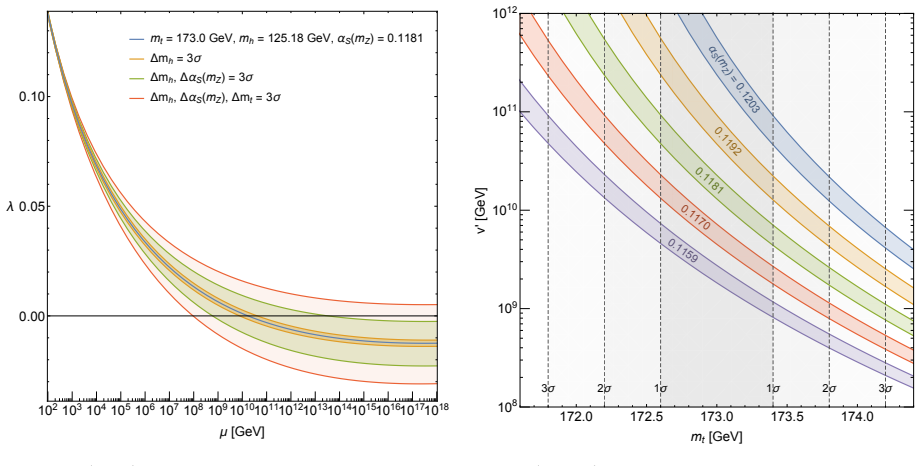
The engine is Higgs Parity: an exact Z2 symmetry that maps every SM field to a mirror field and is spontaneously broken by the mirror Higgs vacuum expectation value v' much larger than the SM Higgs vev. Because the two Higgs doublets form an approximate SU(4) multiplet, the SM Higgs is a pseudo-Nambu-Goldstone boson whose quartic coupling vanishes at v'; this pins v' to measured top, Higgs, and QCD inputs. On the cosmological side, the machinery is the freeze-out-then-dilution sequence: e' and u' freeze out in the mirror bath, then long-lived mirror neutrinos decay to l H and inject entropy into the SM bath, diluting the relic abundance. The dilution factor ties the SM neutrino mass to v' and to the neutrino portal mass M_D, closing the allowed window.
What would settle it
A lattice QCD computation of the mirror-hadron annihilation cross section at the mirror confinement temperature that yields a value well below pi/(m_q' alpha_s')^2 would break the freeze-out/dilution mechanism; alternatively, a future measurement of mt, alpha_s(mZ), and mh that fixes v' outside ($10^{8}$-$10^{10}$) GeV, or a neutrino mass determination outside 0.01-0.1 eV, would exclude the high-reheat e' window.
Extended reading notes
Core claim
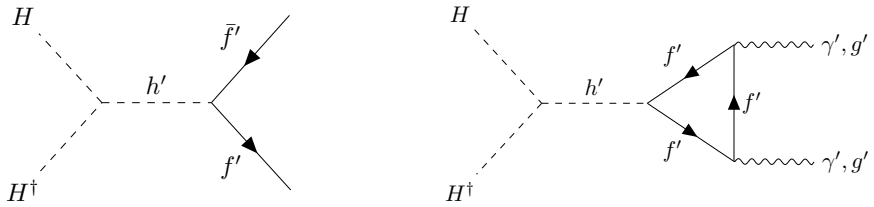
The paper argues that a full mirror copy of the Standard Model, connected by Higgs parity and by kinetic, Higgs, and neutrino portals, can account for dark matter as mirror electrons. With a high reheat temperature, the e' relic density is set by standard freeze-out and then diluted by the late decays of mirror neutrinos. Imposing the observed DM abundance forces the mirror electroweak scale v' into ($10^{8}$-$10^{10}$) GeV, exactly the range in which the SM Higgs quartic vanishes, and forces the partner SM neutrino mass into the 0.01-0.1 eV range matching neutrino observations. The same sector yields dark radiation with $\Delta$ Neff ~0.03-0.4 and gravitational waves from the first-order mirror QCD phase transition. With low reheating, freeze-in through the Higgs or kinetic mixing portals can instead produce e' dark matter.
Load-bearing premise
The mechanism assumes that, after the mirror QCD phase transition, mirror hadrons containing u' and d' annihilate with a cross section near pi/(m_q' alpha_s')^2; if that annihilation is weaker, stable mirror baryons survive and would either overclose the universe or decay into e'.
Editorial extensions
If this is right
- The mirror electron e' is a thermal relic, and its final abundance is diluted by mirror neutrino decay, so the observed dark matter density forces the SM neutrino mass near 0.01-0.1 eV.
- The same v' that makes the SM Higgs quartic vanish also sets the mirror fermion masses, so refined measurements of mt, alpha_s(mZ), and mh determine whether the e' freeze-out/dilution window is viable.
- Mirror glueballs from the mirror QCD transition decay to mirror photons, producing dark radiation with Delta Neff ~0.03-0.4 that next-generation CMB surveys can probe.
- The first-order mirror QCD phase transition emits gravitational waves whose spectrum is fully determined once the DM abundance is fixed; for mt and alpha_s offset by 2-3 sigma from current values, the signal could reach future space-based interferometers.
- If the gauge groups unify, kinetic mixing is induced by higher-dimensional operators, correlating the e' direct detection rate with the proton decay rate; a combination of next-generation proton decay and direct detection experiments can probe much of the parameter space.
Reading between the lines
- The paper leaves implicit that the freeze-out/dilution window could be checked by a first-principles lattice computation of the mirror-hadron annihilation cross section near T_c'; this is the quantity on which the whole e' abundance estimate rests.
- One consequence the paper does not pursue is a direct cross-correlation test: if a stochastic gravitational-wave background from the mirror QCD transition is found, its peak frequency and amplitude should correlate with Delta Neff and with mt, so observing one without the other would point to a different cosmology.
- A testable extension is the mirror-QCD-axion variant discussed at the end: the mirror axion mass is tied to v', so the same top-mass measurement that fixes v' would also fix the axion dark-matter mass.
- If future neutrino experiments push the lightest neutrino mass below about 0.01 eV, the universal-coupling freeze-out/dilution story is excluded; low-reheat freeze-in through kinetic mixing provides an alternative that does not require this mass range.
Signed reviews
Editorial analysis
A structured set of objections, weighed in public.
Referee Report
Summary. This paper studies a mirror Standard Model with an exact Higgs parity Z2 symmetry that maps the full SM gauge group and matter content to a mirror sector. The mirror Higgs vacuum expectation value v' is identified with the scale at which the SM Higgs quartic coupling vanishes, giving v' in the range of roughly 10^8 to 10^12 GeV depending on measured parameters. The paper considers mirror electrons e' as dark matter candidates, with production by freeze-out followed by dilution from late mirror-neutrino decays in the high-reheat scenario, or by freeze-in through the Higgs and kinetic-mixing portals in the low-reheat scenario. It also computes dark radiation from mirror glueball decays and gravitational waves from the mirror QCD phase transition, and derives a correlation between direct detection rates and proton decay in unified embeddings. The central quantitative claim is that the freeze-out plus dilution mechanism selects v' ~ (10^8 to 10^10) GeV and SM neutrino masses of 0.01 to 0.1 eV, consistent with the Higgs-mass determination and with oscillation data.
Significance. If the central claims hold, the paper provides a striking connection between the scale where the SM Higgs quartic vanishes, the dark matter relic abundance, and the observed neutrino mass scale. The manuscript is unusually explicit in providing the Boltzmann equations for the freeze-out and freeze-in dynamics in Appendix A, and it uses measured SM parameters plus the observed DM abundance rather than ad hoc model building. The predictions for Delta_Neff and for the gravitational-wave spectrum are falsifiable targets for CMB-S4 and LISA/DECIGO/BBO, respectively, and the direct-detection/proton-decay correlation in Sec. IV is a concrete, testable consequence of the unified embedding. These strengths make the paper a serious candidate for publication, provided that the non-perturbative assumptions underlying the central e' DM mechanism are properly quantified.
major comments (2)
- [Sec. VI A, item 4 and Appendix A; Figs. 9 and 10] The central allowed region in the (v', m_nu) plane is conditional on the assumption that mirror hadrons containing u' and d' annihilate efficiently after the mirror QCD confinement transition, with a cross-section near pi/(m_q' alpha_s')^2. The freeze-out Boltzmann equations in Appendix A stop at the quark/lepton level, and the confinement step is implemented as an instantaneous efficiency statement rather than being derived or solved. Figure 9 brackets only the two extremes (efficient annihilation vs. complete cessation), but the paper does not quantify how a moderately less efficient annihilation cross-section changes the e' yield from s' and d' beta decays, which in turn shifts the required dilution D and the lower edge of the allowed m_nu window in Fig. 10. Because the abstract's central claim about v' and m_nu rests directly on this non-perturbative step, the authors should either provide a sensitivity scan over the annihilation efficiency or demonstrate that the allowed region is robust within a physically plausible range of cross-sections.
- [Sec. VII, Eqs. (36)-(39) and Fig. 14] The gravitational-wave spectra are presented as targets for LISA, DECIGO, and BBO, but the amplitude scales as (beta/H)^-2 and also depends on rho_kin/rho_lat, which the authors acknowledge are not well determined. The paper shows only beta/H = 10 and beta/H = 100 and does not quantify how the reach changes over the plausible range of these parameters. A quantitative statement of the assumed range of beta/H and rho_kin/rho_lat, with resulting variations in the spectra, would make the 'may be detected' claim more precise and would allow readers to judge how robust the gravitational-wave signature is.
minor comments (6)
- [Abstract and Sec. VIII] The wording 'Remarkably, this requires' could be read as an independent prediction; since the neutrino portal mass scale M_D is fitted to the observed DM abundance and m_nu is scanned over a range, the consistency of the resulting v' and m_nu with measured values is a nontrivial consistency test rather than a parameter-free prediction. Consider rewording to avoid overstatement.
- [Sec. V, Fig. 7 caption] The caption states 'For clarity, we take A = 1', but the purple Delta_Neff contours in Figs. 10 and 11 depend on the glueball energy-density factor A. Please clarify whether those later contours use the A computed in Appendix B or the A = 1 simplification.
- [Sec. IV B] The word 'analgous' should be 'analogous' in the text associated with Fig. 5.
- [Sec. VII] The word 'satisifed' should be 'satisfied' in the sentence about the phase transition occurring before the neutrino matter-dominated era.
- [Sec. VI A 2] There is a duplicated definite article in 'the the measurements' in the discussion of future neutrino mass measurements; this should be corrected.
- [Fig. 13 caption] The caption refers to 'dotted counters'; this should be 'dotted contours'.
Circularity Check
No significant circularity: the DM constraint fixes the free neutrino-portal parameter MD, and the (v', m_nu) window is an externally constrained allowed region rather than a quantity built from its own inputs.
full rationale
The derivation chain is self-contained against external data rather than circular. The scale v' is obtained by running the measured SM parameters (mt, mh, alpha_s) and using the one-loop threshold correction (Eq. 9); the crossing of the SM quartic at v' is identified with the mirror Higgs VEV by the Higgs Parity construction. Although the framework is cited from the authors' prior work, the paper displays the potential and threshold formulas, and the inputs are external measurements. The e' dark-matter abundance is not claimed to be a prediction: Eq. (29) gives the relic density as a function of the free neutrino-portal mass MD, and the text states, 'For a given (v', m'_nu), the parameter MD is determined to yield the correct e' DM abundance.' The resulting (v', m_nu) window in Fig. 10 is therefore an allowed region obtained by imposing BBN, beta-decay, and neutrino-mass bounds after fixing MD to the observed DM abundance. This is a conditional parameter-space statement, not an input renamed as an output. The same holds for Delta N_eff and the gravitational-wave spectra: D is chosen to match DM, and the signals are then computed in the surviving region. The non-perturbative uncertainties (mirror-hadron annihilation in Sec. VI A; beta/H and rho_kin/rho_lat in Sec. VII) affect robustness but are acknowledged and are not circular reductions. No equation in the paper equates a claimed prediction to an input by construction, and no load-bearing argument reduces to an unverified self-citation.
Assumptions & free parameters
free parameters (7)
- MD (neutrino portal mass scale) =
10^18 to 10^23 GeV
- Kinetic mixing epsilon =
below about 1e-10 (constrained); about 4e-11 for freeze-in DM
- Reheat temperature TRH =
scanned: high (TRH > Tdec) or low (TRH < Tdec)
- Unification scale vG and coefficients c6, c8 =
vG about 10^13 to 10^16 GeV in examples
- beta/H (phase transition inverse duration) =
10 and 100
- Glueball energy-density factor A =
A about 1 in figures, computed in App. B
- Neutrino portal flavor matrices xi, eta =
set to 1
assumptions (9)
- domain assumption SM Higgs quartic RGE above MZ is not modified by new physics until the scale v', where the mirror-sector threshold correction applies.
- domain assumption The Z2 Higgs Parity is exact and maps the entire SM gauge group SU(3)xSU(2)xU(1) to its mirror, so all mirror couplings equal SM couplings at scale v'.
- domain assumption Mirror electromagnetism remains unbroken after Higgs Parity breaking, and the mirror electron is the lightest mirror-charged fermion, hence stable.
- domain assumption The universe reheated above the two-sector decoupling temperature Tdec (Eq. 19) in the high-TRH scenario, establishing thermal equilibrium between SM and mirror sectors.
- domain assumption The mirror QCD phase transition is first order and proceeds via near-lightspeed bubble walls, with parameters beta/H = 10 to 100.
- domain assumption Mirror hadrons containing u' and d' annihilate efficiently after mirror confinement, with cross section around pi/(m_q' alpha_s')^2.
- domain assumption Dimension-5 neutrino operators with scales MM and MD generate the observed neutrino masses and the nu' to l H decay that dilutes DM.
- domain assumption Standard cosmological evolution with radiation domination, entropy conservation, and standard freeze-out or freeze-in Boltzmann dynamics, plus a matter-dominated era when nu' is long-lived.
- domain assumption The maximum temperature after inflation remains below the mirror electroweak scale v', avoiding domain walls from spontaneous parity breaking.
invented entities (3)
-
Mirror electron (e')
independent evidence
-
Mirror neutrinos (nu')
independent evidence
-
Mirror glueballs (S')
independent evidence
Cite this review
Pith. "Pith review of Dark Matter, Dark Radiation and Gravitational Waves from Mirror Higgs Parity." pith.science (2026). https://pith.science/paper/24N62WCE
@misc{pith2026190802756,
  author       = {Pith},
  title        = {Pith review of: Dark Matter, Dark Radiation and Gravitational Waves from Mirror Higgs Parity},
  year         = {2026},
  howpublished = {\url{https://pith.science/paper/24N62WCE}},
  note         = {Machine review of arXiv:1908.02756}
}
abstract
An exact parity replicates the Standard Model giving a Mirror Standard Model, SM $\leftrightarrow$ SM$'$. This "Higgs Parity" and the mirror electroweak symmetry are spontaneously broken by the mirror Higgs, $\left\langle H'\right\rangle = v' \gg \left\langle H\right\rangle$, yielding the Standard Model Higgs as a Pseudo-Nambu-Goldstone Boson of an approximate $SU(4)$ symmetry, with a quartic coupling $\lambda_{SM}(v') \sim 10^{-3}$. Mirror electromagnetism is unbroken and dark matter is composed of $e'$ and $\bar{e}'$. Direct detection may be possible via the kinetic mixing portal, and in unified theories this rate is correlated with the proton decay rate. With a high reheat temperature after inflation, the $e'$ dark matter abundance is determined by freeze-out followed by dilution from decays of mirror neutrinos, $\nu' \rightarrow \ell H$. Remarkably, this requires $v' \sim (10^8 - 10^{10})$ GeV, consistent with the Higgs mass, and a Standard Model neutrino mass of $(10^{-2} - 10^{-1})$ eV, consistent with observed neutrino masses. The mirror QCD sector exhibits a first order phase transition producing gravitational waves that may be detected by future observations. Mirror glueballs decay to mirror photons giving dark radiation with $\Delta N_{\rm eff} \sim 0.03 - 0.4$. With a low reheat temperature after inflation, the $e'$ dark matter abundance is determined by freeze-in from the SM sector by either the Higgs or kinetic mixing portal.
Figures


Figures from the paper (14 more)




Forward citations
Cited by 3 Pith papers
-
Universal Seesaw Leptogenesis
Leptogenesis can proceed from single-generation gauge-singlet mediator decays in a Universal Seesaw model if parity is broken in the neutrino sector; the lightest right-handed neutrino is a sub-eV dark-radiation relic.
-
Prospecting bipartite Dark Matter through Gravitational Waves
A two-component dark matter model with an inert triplet scalar and a singlet fermion can explain the relic abundance while producing a strong electroweak phase transition and gravitational wave signals detectable by L...
-
Freeze-Twin Dark Matter
Twin electrons and positrons, frozen in via a massive twin photon, can be the dark matter in mirror twin Higgs models with asymmetric reheating, with the required kinetic mixing matching loop-level expectations.
Reference graph
Works this paper leans on
-
[1]
One generation of long-lived ν′ 19
-
[2]
Freeze-In from Higgs Portal and Kinetic Mixing 24 VII
Universal coupling strength of neutrino portal 22 B. Freeze-In from Higgs Portal and Kinetic Mixing 24 VII. Gravitational Waves from Mirror QCD phase transition 26 VIII. Conclusions and Discussions 29 Acknowledgement 31 A. Boltzmann equations for the e′ and u′ abundance 31
-
[3]
Freeze-In 33 B. Energy densities of the mirror QCD bath 35 References 37 2 I. INTRODUCTION At high energy colliders, precision measurements of the electroweak symmetry breaking sector of the Standard Model (SM) have been pursued for decades, but so far there has been no discovery of any physics that would lead to a natural explanation of the weak scale. I...
-
[4]
During these annihilations, b′ and c′ decay producing c′, µ′ and s′
c′, µ′ and s′ freeze-out. During these annihilations, b′ and c′ decay producing c′, µ′ and s′. The annihilations also produce e′, u′ and d′, but they thermalize quickly
-
[5]
During these annihilations, s′ andµ′ partially decay producing e′, u′ and d′
d′,u′ ande′ freeze-out. During these annihilations, s′ andµ′ partially decay producing e′, u′ and d′
-
[6]
Mirror hadrons composed of s′, u′ and d′ quickly annihilate
QCD’ phase transition occurs. Mirror hadrons composed of s′, u′ and d′ quickly annihilate. Mirror hadrons composed of s′ and d′ decay into u′u′u′. We note that τ′ is short-lived and does not affect the above processes. A set of Boltzmann equations describing the freeze-out dynamics is shown in Appendix A. 17 We elaborate on the fourth process. After the mi...
-
[7]
One generation of long-lived ν′ For our first example, we assume that two flavors ofν′ decay rapidly and studye′ dilution from decays of the single long-lived flavor. The long-lived ν′ decays to 𝓁H via the neutrino portal operator of (5) 5 with a decay rate Γν′→lh = mν′ 8π v′2 M 2 D . (26) 5 We takeξ =η = 1. 19 The mass of the mirror neutrino is given by Eq....
-
[8]
Universal coupling strength of neutrino portal As a second illustration of e′ freeze-out and dilution from ν′ decays, we take the strength of the neutrino portal coupling to be independent of generation. Thus, in a neutrino mass basis, we take ν′→lH decays to be given by (26) for all three generations of ν′. To avoid overproducing e′, all three ν′ must be...
Show all 82 references
-
[9]
27 Gravitational waves are also produced by the turbulent motion of fluids induced by the bubbles [52]
The ratio ρSM/ρg′ is estimated in Appendix B. 27 Gravitational waves are also produced by the turbulent motion of fluids induced by the bubbles [52]. The abundance of such gravitational waves Ω GW,tubh2 is d ΩGW,tubh2 d lnf ≃ 4× 10⁻⁹ 9(f/fp)3 (f/fp + 0.02H/β)(f/fp + 0.8)11/3 ( ...
-
[10]
F reeze-Out ForTRH >T dec, the relic abundances of e and u are set by freeze-out. b′ freeze-out During the freeze-out ofb, the decay ofb is negligible and we solve the following equation, ˙nb + 3Hnb =−⟨σbvrel⟩ (n2 b−nb,eq), (A1) ⟨σbv⟩ is the thermal average of the annihilation...
-
[11]
F reeze-In ForTRH <T dec, the relic abundances ofe andu are set by freeze-in. During the reheating era, the Boltzmann equations are given by ˙nf + 3Hnf = ⟨ σHH †→f ¯fvrel ⟩ (n2 H−n2 f) +⟨σthermvrel⟩ (n2 g−n2 f)Θ(T′−mf) + (A14) ⟨σthermvrel⟩ (n2 γ−n2 f)Θ(T′−mf) +⟨σfvrel⟩ (n2 γ,e...
- [12]
-
[13]
L. J. Hall and Y. Nomura, JHEP 02, 129 (2014), arXiv:1312.6695 [hep-ph]
2014 arXiv
-
[14]
M. Ibe, S. Matsumoto, and T. T. Yanagida, Phys. Lett. B732, 214 (2014), arXiv:1312.7108 [hep-ph]
2014 arXiv
-
[15]
L. J. Hall, Y. Nomura, and S. Shirai, JHEP 06, 137 (2014), arXiv:1403.8138 [hep-ph]
2014 arXiv
-
[16]
P. J. Fox, G. D. Kribs, and A. Martin, Phys. Rev. D90, 075006 (2014), arXiv:1405.3692 [hep-ph]
2014 arXiv
-
[17]
L. J. Hall and K. Harigaya, JHEP 10, 130 (2018), arXiv:1803.08119 [hep-ph]
2018 arXiv
-
[18]
M. A. B. Beg and H. S. Tsao, Phys. Rev. Lett. 41, 278 (1978)
1978
-
[19]
R. N. Mohapatra and G. Senjanovic, Phys. Lett. 79B, 283 (1978)
1978
-
[20]
K. S. Babu and R. N. Mohapatra, Phys. Rev. Lett. 62, 1079 (1989)
1989
-
[21]
K. S. Babu and R. N. Mohapatra, Phys. Rev. D41, 1286 (1990). 37
1990
-
[22]
L. J. Hall and K. Harigaya, (2019), arXiv:1905.12722 [hep-ph]
2019 arXiv
-
[23]
Dunsky, L
D. Dunsky, L. J. Hall, and K. Harigaya, JHEP 07, 016 (2019), arXiv:1902.07726 [hep-ph]
2019 arXiv
-
[24]
S. M. Barr, D. Chang, and G. Senjanovic, Phys. Rev. Lett. 67, 2765 (1991)
1991
-
[25]
T. D. Lee and C.-N. Yang, Phys. Rev. 104, 254 (1956)
1956
-
[26]
I. Yu. Kobzarev, L. B. Okun, and I. Ya. Pomeranchuk, Sov. J. Nucl. Phys. 3, 837 (1966), [Yad. Fiz.3,1154(1966)]
1966
- [27]
-
[28]
R. Foot, H. Lew, and R. R. Volkas, Phys. Lett. B272, 67 (1991)
1991
-
[29]
Agrawal, S
V. Agrawal, S. M. Barr, J. F. Donoghue, and D. Seckel, Phys. Rev. D57, 5480 (1998), arXiv:hep-ph/9707380 [hep-ph]
1998 arXiv
-
[30]
L. J. Hall, D. Pinner, and J. T. Ruderman, JHEP 12, 134 (2014), arXiv:1409.0551 [hep-ph]
2014 arXiv
-
[31]
Borsanyi, G
S. Borsanyi, G. Endrodi, Z. Fodor, S. D. Katz, and K. K. Szabo, JHEP 07, 056 (2012), arXiv:1204.6184 [hep-lat]
2012 arXiv
-
[32]
Chen et al
Y. Chen et al. , Phys. Rev. D73, 014516 (2006), arXiv:hep-lat/0510074 [hep-lat]
2006 arXiv
-
[33]
Buttazzo, G
D. Buttazzo, G. Degrassi, P. P. Giardino, G. F. Giudice, F. Sala, A. Salvio, and A. Strumia, JHEP 12, 089 (2013), arXiv:1307.3536 [hep-ph]
2013 arXiv
-
[34]
Dunsky, L
D. Dunsky, L. J. Hall, and K. Harigaya, JCAP 1907, 015 (2019), arXiv:1812.11116 [astro- ph.HE]
2019 arXiv
-
[35]
R. H. Helm, Phys. Rev. 104, 1466 (1956)
1956
-
[36]
J. D. Lewin and P. F. Smith, Astropart. Phys. 6, 87 (1996)
1996
-
[37]
Aprile et al
E. Aprile et al. (XENON), Phys. Rev. Lett. 121, 111302 (2018), arXiv:1805.12562 [astro- ph.CO]
2018 arXiv
-
[38]
Y. Aoki, E. Shintani, and A. Soni, Phys. Rev. D89, 014505 (2014), arXiv:1304.7424 [hep-lat]
2014 arXiv
-
[39]
J. E. Juknevich, D. Melnikov, and M. J. Strassler, JHEP 07, 055 (2009), arXiv:0903.0883 [hep-ph]
2009 arXiv
-
[40]
H. B. Meyer, JHEP 01, 071 (2009), arXiv:0808.3151 [hep-lat]
2009 arXiv
-
[41]
Kawasaki, K
M. Kawasaki, K. Kohri, and T. Moroi, Phys. Rev. D71, 083502 (2005), arXiv:astro- ph/0408426 [astro-ph]
2005
- [42]
- [43]
-
[44]
Harigaya, M
K. Harigaya, M. Ibe, K. Kaneta, W. Nakano, and M. Suzuki, JHEP 08, 151 (2016), 38 arXiv:1606.00159 [hep-ph]
2016 arXiv
-
[45]
J. Kang, M. A. Luty, and S. Nasri, JHEP 09, 086 (2008), arXiv:hep-ph/0611322 [hep-ph]
2008 arXiv
-
[46]
De Luca, A
V. De Luca, A. Mitridate, M. Redi, J. Smirnov, and A. Strumia, Phys. Rev. D97, 115024 (2018), arXiv:1801.01135 [hep-ph]
2018 arXiv
-
[47]
Harigaya and M
K. Harigaya and M. Kawasaki, Phys. Lett. B782, 1 (2018), arXiv:1802.00579 [hep-ph]
2018 arXiv
-
[48]
Kawasaki, K
M. Kawasaki, K. Kohri, and N. Sugiyama, Phys. Rev. Lett. 82, 4168 (1999), arXiv:astro- ph/9811437 [astro-ph]
1999
-
[49]
Kawasaki, K
M. Kawasaki, K. Kohri, and N. Sugiyama, Phys. Rev. D62, 023506 (2000), arXiv:astro- ph/0002127 [astro-ph]
2000
-
[50]
P. F. de Salas, M. Lattanzi, G. Mangano, G. Miele, S. Pastor, and O. Pisanti, Phys. Rev. D92, 123534 (2015), arXiv:1511.00672 [astro-ph.CO]
2015 arXiv
- [51]
-
[52]
K. N. Abazajian et al. (CMB-S4), (2016), arXiv:1610.02743 [astro-ph.CO]
2016 arXiv
-
[53]
Font-Ribera, P
A. Font-Ribera, P. McDonald, N. Mostek, B. A. Reid, H.-J. Seo, and A. Slosar, JCAP 1405, 023 (2014), arXiv:1308.4164 [astro-ph.CO]
2014 arXiv
-
[54]
Allison, P
R. Allison, P. Caucal, E. Calabrese, J. Dunkley, and T. Louis, Phys. Rev. D92, 123535 (2015), arXiv:1509.07471 [astro-ph.CO]
2015 arXiv
-
[55]
Archidiacono, T
M. Archidiacono, T. Brinckmann, J. Lesgourgues, and V. Poulin, JCAP 1702, 052 (2017), arXiv:1610.09852 [astro-ph.CO]
2017 arXiv
-
[56]
Choi, J.-O
K.-Y. Choi, J.-O. Gong, and C. S. Shin, Phys. Rev. Lett. 115, 211302 (2015), arXiv:1507.03871 [astro-ph.CO]
2015 arXiv
-
[57]
Harigaya, M
K. Harigaya, M. Kawasaki, K. Mukaida, and M. Yamada, Phys. Rev. D89, 083532 (2014), arXiv:1402.2846 [hep-ph]
2014 arXiv
-
[58]
Harigaya, K
K. Harigaya, K. Mukaida, and M. Yamada, JHEP 07, 059 (2019), arXiv:1901.11027 [hep-ph]
2019 arXiv
-
[59]
L. G. Yaffe and B. Svetitsky, Phys. Rev. D26, 963 (1982)
1982
-
[60]
Svetitsky and L
B. Svetitsky and L. G. Yaffe, Nucl. Phys. B210, 423 (1982)
1982
-
[61]
Witten, Phys
E. Witten, Phys. Rev. D30, 272 (1984)
1984
-
[62]
S. J. Huber and T. Konstandin, JCAP 0809, 022 (2008), arXiv:0806.1828 [hep-ph]
2008 arXiv
-
[63]
Kamionkowski, A
M. Kamionkowski, A. Kosowsky, and M. S. Turner, Phys. Rev. D49, 2837 (1994), arXiv:astro- ph/9310044 [astro-ph]
1994
-
[64]
Caprini, R
C. Caprini, R. Durrer, and G. Servant, JCAP 0912, 024 (2009), arXiv:0909.0622 [astro- 39 ph.CO]
2009 arXiv
-
[65]
Caprini, R
C. Caprini, R. Durrer, and X. Siemens, Phys. Rev. D82, 063511 (2010), arXiv:1007.1218 [astro-ph.CO]
2010 arXiv
-
[66]
C. J. Hogan, Phys. Lett. 133B, 172 (1983)
1983
-
[67]
C. J. Moore, R. H. Cole, and C. P. L. Berry, Class. Quant. Grav. 32, 015014 (2015), arXiv:1408.0740 [gr-qc]
2015 arXiv
-
[68]
R. D. Peccei and H. R. Quinn, Phys. Rev. Lett. 38, 1440 (1977)
1977
-
[69]
R. D. Peccei and H. R. Quinn, Phys. Rev. D16, 1791 (1977)
1977
-
[70]
Weinberg, Phys
S. Weinberg, Phys. Rev. Lett. 40, 223 (1978)
1978
-
[71]
Wilczek, Phys
F. Wilczek, Phys. Rev. Lett. 40, 279 (1978)
1978
-
[72]
S. Durr, Z. Fodor, C. Hoelbling, and T. Kurth, JHEP 04, 055 (2007), arXiv:hep-lat/0612021 [hep-lat]
2007 arXiv
-
[73]
V. A. Rubakov, JETP Lett. 65, 621 (1997), arXiv:hep-ph/9703409 [hep-ph]
1997 arXiv
-
[74]
Berezhiani, L
Z. Berezhiani, L. Gianfagna, and M. Giannotti, Phys. Lett. B500, 286 (2001), arXiv:hep- ph/0009290 [hep-ph]
2001
- [75]
-
[76]
Fukuda, K
H. Fukuda, K. Harigaya, M. Ibe, and T. T. Yanagida, Phys. Rev. D92, 015021 (2015), arXiv:1504.06084 [hep-ph]
2015 arXiv
-
[77]
Sommerfeld, Annalen der Physik 403, 257 (1931)
A. Sommerfeld, Annalen der Physik 403, 257 (1931)
1931
-
[78]
Ellis, M
J. Ellis, M. K. Gaillard, and D. Nanopoulos, Nuclear Physics B 106, 292 (1976)
1976
-
[79]
Resnick, M
L. Resnick, M. K. Sundaresan, and P. J. S. Watson, Phys. Rev. D 8, 172 (1973)
1973
-
[80]
E. D. Carlson, M. E. Machacek, and L. J. Hall, Astrophys. J. 398, 43 (1992)
1992
-
[81]
Hochberg, E
Y. Hochberg, E. Kuflik, T. Volansky, and J. G. Wacker, Phys. Rev. Lett. 113, 171301 (2014), arXiv:1402.5143 [hep-ph]
2014 arXiv
-
[82]
Forestell, D
L. Forestell, D. E. Morrissey, and K. Sigurdson, Phys. Rev. D95, 015032 (2017), arXiv:1605.08048 [hep-ph]. 40
2017 arXiv
Reviewed August 14, 2026 · model on record in the stance chip above.
Discussion (0). Continue with ORCID to comment.