REVIEW 4 major objections 5 minor 1 cited by
Sulfate Aerosol Hazes and SO2 Gas as Constraints on Rocky Exoplanets' Surface Liquid Water
T0 review · 4 major / 5 minor · reviewed 2026-08-14 · deepseek-v4-flash
Pith's one-line read The sustained coexistence of H2SO4-H2O haze and SO2 gas on a rocky exoplanet indicates the absence of significant surface liquid water.
desk verdict A well-built, genuinely new sulfur-cycle argument that observable sulfate haze or SO2 implies no large surface ocean, but it rests on irreversible S(IV) decay and pH>6, and the recycling loop is handwaved. read the letter →
The pith
A machine-rendered reading of the paper's core claim, the machinery that carries it, and where it could break.
The reading
What carries the argument
The central object is the critical aqueous S(IV) decay timescale $\tau^*_{S(IV)}$: the ocean lifetime that would be required for observing SO2 or haze, computed from detection thresholds via Henry's law, ocean pH and mass, and outgassing flux. The comparison of $\tau^*_{S(IV)}$ to the ~0.1-year empirical S(IV) instability carries the argument. The model also rests on a transmission-spectrum calibration setting the observable haze optical depth at $\delta^* \approx 0.1$ and on a stratospheric steady-state relation linking H2SO4 aerosol mass to SO2 via photochemical conversion and sedimentation timescales.
What would settle it
A laboratory experiment showing that sulfite/bisulfite remains stable in seawater-like solutions at pH>6 for thousands of years, or the discovery of a rocky habitable-zone exoplanet with an independently constrained ocean above $10^{-3}$ Earth masses that nonetheless sustains both a detectable H2SO4-H2O haze and ≥1 ppm SO2, would falsify the paper's central claim.
Extended reading notes
Core claim
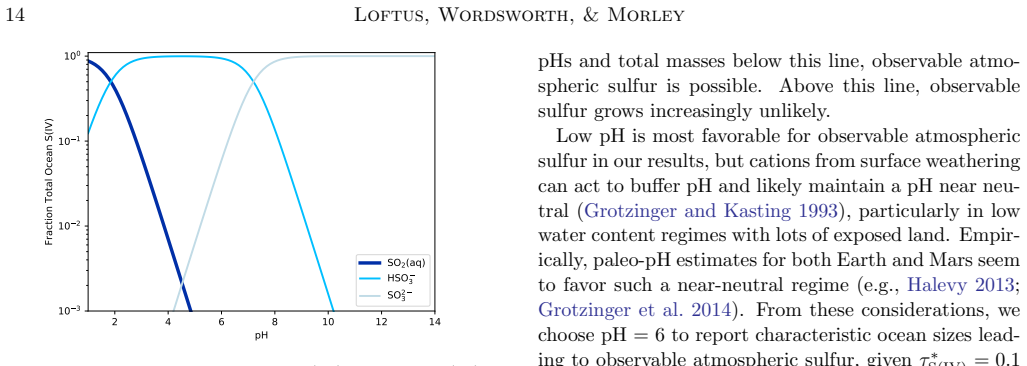
On a wet, oxidized rocky planet, the ocean acts as an enormous sulfur reservoir that poisons the atmosphere's ability to hold observable sulfur. Henry's law partitions SO2 between air and water, and at typical ocean pH the dissolved forms (SO2(aq), HSO3^-, $SO3^{2}$-) vastly outnumber the gas; at Earth's pH and ocean mass the atmosphere holds only ~$10^{-9}$ of the system's S(IV). Because aqueous S(IV) is thermodynamically unstable and decays on timescales of seconds to months to S(VI) or S(0), each rainfall and ocean mixing event permanently removes sulfur from the atmosphere-ocean exchangeable pool, so only recent volcanic outgassing can supply new SO2. Comparing the sulfur needed to reach detection thresholds (1 ppm SO2, or haze optical depth ~0.1) with a conservatively high outgassing estimate, the authors show that for pH > 6 an ocean larger than $10^{-3}$ Earth oceans demands S(IV) lifetimes of at least $10^{4}$ years—orders of magnitude beyond laboratory and Earth-ocean constraints. They conclude that a sustained, simultaneously observable H2SO4-H2O haze and SO2 gas is a remote diagnostic for the near-absence of surface liquid water.
Load-bearing premise
The claim collapses if dissolved S(IV) (sulfite, bisulfite, and dissolved SO2) does not decay rapidly and irreversibly, but instead persists or is recycled back to atmospheric SO2 on geologic timescales.
Editorial extensions
If this is right
- Observing both H2SO4-H2O haze and SO2 gas in an oxidized terrestrial exoplanet atmosphere becomes evidence against a significant surface ocean, complementing water-vapor detections.
- For M-dwarf planets, where photochemistry favors oxidized atmospheres, these two signatures may be among the first practical surface-water diagnostics available to future telescopes.
- The quantitative framework yields an upper limit on surface water compatible with sulfur observability for any target whose outgassing and pH can be constrained.
- The contrast between Venus (thick haze, no ocean) and Earth (no sustained haze, ocean) gains a mechanistic explanation.
- The method extends naturally to reflected-light spectroscopy, since the critical sulfur columns can be recalculated for any detection technique.
Reading between the lines
- The paper does not prove that sulfur-free atmospheres have oceans; I would expect the inverse diagnostic to be weak, as the authors note. A more promising extension would be to model the reduced sulfur cycle (H2S and S8 hazes) where aqueous chemistry may be less irreversible.
- If microbial sulfur disproportionation or recycling operates on exoplanets, it could partially close the S(IV) decay loop; the authors argue this is at most a fractional effect, but a coupled ecosystem-sulfur model would settle it.
- One testable corollary of the model is that any planet with both an ocean larger than ~10^-3 Earth oceans and observable SO2/haze must be outgassing sulfur at rates far above the Kite et al. upper bound, which would likely reveal itself in other volcanic gas products such as CO2 or H2O variability.
Signed reviews
Editorial analysis
A structured set of objections, weighed in public.
Referee Report
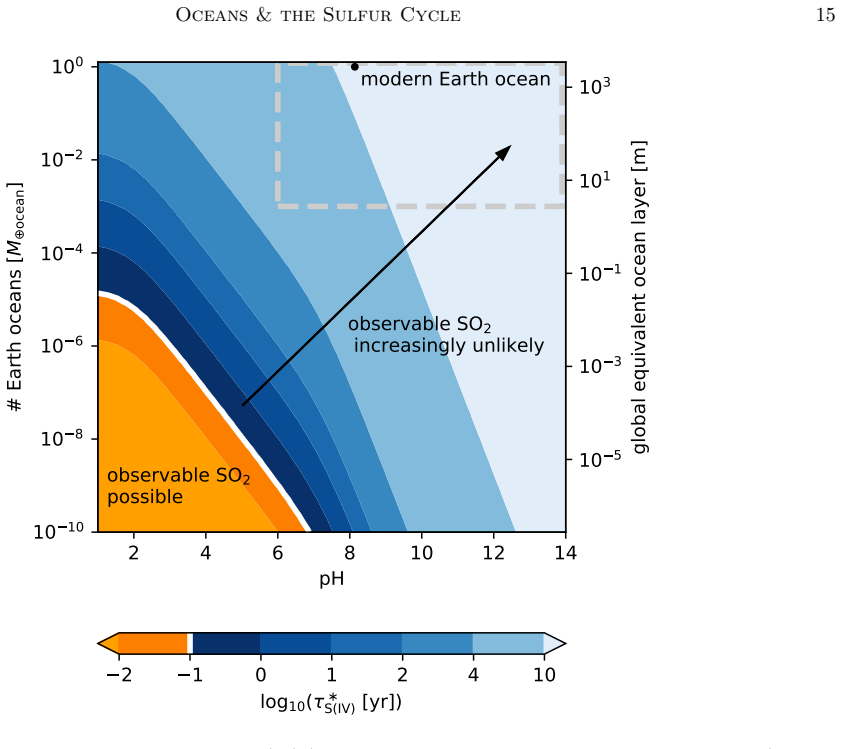
Summary. The paper proposes that sustained, observable H2SO4-H2O aerosol hazes and elevated SO2 gas on rocky exoplanets are remotely diagnostic of the near-absence of significant surface liquid water. The authors construct a three-reservoir sulfur cycle model (stratosphere, troposphere, ocean) with Henry's law partitioning, aerosol microphysics, photochemical conversion of SO2 to H2SO4, and a steady-state balance between volcanic outgassing and aqueous S(IV) decay. They compute the critical sulfur inventory needed for observable SO2 or haze, compare it with the expected inventory N_S = Ndot_S * tau_S(IV), and plot contours of the required S(IV) decay timescale as a function of ocean pH and mass. Under their 'best guess' and 'limiting' parameter sets, they find that for pH > 6 and ocean masses above 10^-3 Earth oceans, the required tau_S(IV) exceeds 10^4 years, much longer than laboratory-based S(IV) decay estimates of about 0.1 years, implying that such oceans are incompatible with sustained observable sulfur features.
Significance. If the central claim holds, the paper provides a genuinely new and observationally actionable route to constraining the presence of surface liquid water on rocky exoplanets, complementing radiative-based ocean-detection methods. The modeling is transparent: the parameter choices are tabulated, the sensitivity to planetary parameters is explored (Figure 4), the code is publicly available, and the authors consistently choose limiting cases that favor sulfur buildup. The forward-derived, falsifiable prediction that a sustained H2SO4-H2O haze and SO2 should be anti-correlated with large oceans is a valuable contribution to the discussion of habitability diagnostics. The main weakness is that the conclusion rests on the irreversibility of aqueous S(IV) loss and on assumptions about ocean pH and maximum outgassing, each of which the authors acknowledge but do not quantitatively bound.
major comments (4)
- [§3.8 and Eq. (31); §5.4] The central diagnostic requires that aqueous S(IV) loss be effectively irreversible for at least ~10^4 years: at pH > 6 and ocean masses above 10^-3 M⊕, Figures 7 and 8 require tau*_S(IV) > 10^4 yr, while Eq. (31) equates the expected sulfur inventory with Ndot_S * tau_S(IV). The cited laboratory studies constrain the forward oxidation/disproportionation of HSO3- and SO3^2- to seconds-to-weeks timescales, but they do not bound the reverse loop: microbial or hydrothermal reduction of S(VI) to H2S, H2S escape and re-oxidation to SO2, or oxidation of accumulated S(0). Section 5.4 dismisses biological recycling as 'a fraction of outgassing' and '< order of magnitude' without a mass-balanced calculation. Because the required effective lifetimes exceed the measured forward decay timescale by orders of magnitude, even a modest return flux from S(VI)/S(0) reservoirs could lengthen the effective S(IV) residence time and undermine the exclusion. The authors should either provide a quantitative bound on recycling or explicitly state that the conclusion is conditional on the absence of such recycling.
- [§4.4, Figures 7-8; §5.1] The pH > 6 assumption is load-bearing. From Eq. (21), lowering ocean pH from 6 to 4-5 reduces the dissolved S(IV) concentration by roughly 10^2-10^3, shrinking the required tau*_S(IV) by the same factor. At pH ~4, the required tau* for a 10^-3 M⊕ ocean falls from ~10^4 yr to ~10^2 yr for SO2 and to ~10 yr for haze, values that are much closer to the upper end of reported S(IV) decay timescales. The arguments that weathering buffers pH near neutral are plausible for Earth-like silicate weathering but are not established for exoplanets, and Section 5.1 itself lists 'lower bounds of ocean pHs' as a needed constraint. The headline claim should be presented as conditional on pH >= 6, with the pH range where the diagnostic weakens stated explicitly.
- [§3.8, Eq. (33)] The limiting outgassing rate in Eq. (33) rests on an unvalidated multiplicative factor: Kite et al. (2009) provide a 20x upper bound, and the authors add an additional factor of 10 based on qualitative reasoning about sulfur content in melts. The resulting 200x-Earth value drives the limiting-case contours in Figures 9-10. For the haze diagnostic at pH = 6, the limiting-case contour lies at 1.3-1.5 x 10^-3 M⊕, so a factor of a few uncertainty in Ndot_S can determine whether a 10^-3 M⊕ ocean is excluded. The paper honestly flags this as a region for future study, but as written the absolute 'incompatibility' claim inherits this uncertainty. The authors should show how the limiting-case contours shift if Ndot_S is increased by another order of magnitude, or soften the corresponding claim.
- [§3.8 and abstract] The term 'sustained observable' is not defined with a timescale. The model excludes transient volcanic events by design, yet a single transmission-spectroscopy observation of SO2 or haze could in principle catch a post-eruption state on an ocean-bearing planet (as on Earth after Pinatubo). For the proposed diagnostic to be unambiguous, 'sustained' should be quantified relative to the expected recurrence interval of large eruptions, and the observational strategy should address how a single snapshot can be distinguished from a transient event.
minor comments (5)
- [Table 1] The table's 'limiting value - Sun-like (M dwarf)' formatting is confusing; consider making the stellar dependence explicit for r_avg and tau_SO2-to-H2SO4.
- [§3.4, Eq. (14)] The UV-flux lower-limit calculation for tau_SO2-to-H2SO4 sets quantum yield q = 1 at all wavelengths and integrates from lambda = 0 nm; this is a legitimate conservative bound, but the text should state more clearly that the result is a strict lower limit rather than a realistic photochemical lifetime.
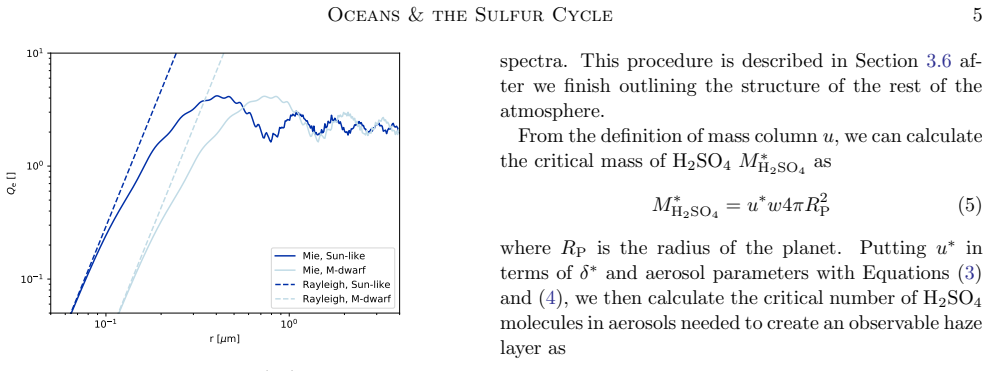
- [§3.6 and Figure 3] The critical optical depth delta* = 0.1 is inferred from simulated spectra for an Earth-like atmosphere; the paper notes that other atmospheres may differ, but it would be helpful to state the expected range of delta* explicitly.
- [§3.8] The transition from Eq. (31) to Eq. (35) neglects the direct atmospheric contribution to N*_S when solving for tau*_S(IV); the text explains this is conservative, but the approximation should be stated in the main derivation rather than only in the accompanying sentence.
- [§5.4] The discussion of life's impact is brief and relies on an unquantified 'fraction of outgassing' assertion; even if a full biosphere model is out of scope, a simple order-of-magnitude estimate with cited fluxes would make the dismissal more convincing.
Circularity Check
No significant circularity: the SO2/haze anti-ocean diagnostic is derived forward from external detection thresholds, outgassing bounds, and laboratory S(IV) kinetics.
full rationale
The paper's derivation is self-contained in the relevant sense: critical atmospheric sulfur burdens are computed from externally motivated detection thresholds (Kaltenegger & Sasselov 2010 for SO2 mixing ratios; simulated transmission spectra for haze optical depth), outgassing upper bounds are taken from Kite et al. (2009), ocean speciation follows Henry's law and tabulated dissociation constants, and the critical S(IV) decay time is obtained by inverting the comparison condition, tau*_S(IV) = N*_S / Ndot_S (Eq. 35), rather than by fitting to the desired no-ocean conclusion. Ocean mass and pH are treated as independent variables, and the central claim is a threshold comparison of the derived tau* contours against an externally measured S(IV) lifetime of about 0.1 yr. Self-citations appear, but they are not load-bearing in a circular way: Wordsworth et al. (2018) supplies an M-dwarf redox-evolution argument, Macdonald & Wordsworth (2017) supplies an Earth-like SO2-to-H2SO4 timescale, and Morley et al. (2015, 2017) provides the radiative-transfer code for transmission spectra; none of these is used to define the diagnostic itself. The paper explicitly acknowledges the main vulnerabilities in Section 5.1 (S(IV) decay pathways and kinetics, outgassing bounds, ocean pH) and Section 5.4 (microbial recycling), but these are limitations and conditional assumptions, not circular reductions. The derivation does not rename a known result or import a uniqueness theorem, and no fitted parameter is relabeled as a prediction.
Assumptions & free parameters
free parameters (9)
- SO2 detection threshold (f*_SO2) =
1 ppm (best), 0.01 ppm (limiting)
- Critical aerosol optical depth (delta*) =
0.1
- H2SO4 mass fraction in aerosol (w) =
0.75 kg/kg
- Aerosol mean radius (r) =
1 micron (best), 0.1 micron Sun-like / 0.2 micron M-dwarf (limiting)
- SO2-to-H2SO4 conversion timescale (tau_SO2->H2SO4) =
30 d (best), 3.4 d Sun-like / 2.5 d M-dwarf (limiting)
- Stratosphere-troposphere mixing timescale (tau_mix) =
1 yr
- Tropopause-to-surface SO2 mixing ratio factor (alpha) =
0.1 (best), 1 (limiting)
- Sulfur outgassing rate (Ndot_S) =
1x Earth (best), 200x Earth (limiting)
- Aqueous S(IV) decay timescale (tau_S(IV)) =
0.1 yr
assumptions (6)
- domain assumption Atmosphere and ocean surface are in Henry's law equilibrium for SO2, with rapid mixing in the ocean and lower atmosphere.
- domain assumption Aqueous S(IV) species are thermodynamically unstable and convert to S(VI) or S(0), with no abiotic pathway returning those products to S(IV).
- domain assumption Ocean pH is buffered to values near or above 6 on water-rich rocky planets via silicate weathering.
- domain assumption Volcanic outgassing is bounded by 20x Earth's peak total outgassing rate, with sulfur yield per melt within 10x Earth's.
- ad hoc to paper Stratospheric SO2 photochemical loss is neglected as a conservative simplification.
- standard math Atmospheric thermal structure follows a dry or moist adiabat to an isothermal stratosphere.
Cite this review
Pith. "Pith review of Sulfate Aerosol Hazes and SO2 Gas as Constraints on Rocky Exoplanets' Surface Liquid Water." pith.science (2026). https://pith.science/paper/DGBCRUSI
@misc{pith2026190802769,
  author       = {Pith},
  title        = {Pith review of: Sulfate Aerosol Hazes and SO2 Gas as Constraints on Rocky Exoplanets' Surface Liquid Water},
  year         = {2026},
  howpublished = {\url{https://pith.science/paper/DGBCRUSI}},
  note         = {Machine review of arXiv:1908.02769}
}
read the original abstract
Despite surface liquid water's importance to habitability, observationally diagnosing its presence or absence on exoplanets is still an open problem. Inspired within the Solar System by the differing sulfur cycles on Venus and Earth, we investigate thick sulfate (H2SO4-H2O) aerosol haze and high trace mixing ratios of SO2 gas as observable atmospheric features whose sustained existence is linked to the near absence of surface liquid water. We examine the fundamentals of the sulfur cycle on a rocky planet with an ocean and an atmosphere in which the dominant forms of sulfur are SO2 gas and H2SO4-H2O aerosols (as on Earth and Venus). We build a simple but robust model of the wet, oxidized sulfur cycle to determine the critical amounts of sulfur in the atmosphere-ocean system required for detectable levels of SO2 and a detectable haze layer. We demonstrate that for physically realistic ocean pH values (pH > 6) and conservative assumptions on volcanic outgassing, chemistry, and aerosol microphysics, surface liquid water reservoirs with greater than 1e-3 Earth oceans are incompatible with a sustained observable H2SO4-H2O haze layer and sustained observable levels of SO2. Thus, we propose the observational detection of a H2SO4-H2O haze layer and of SO2 gas as two new remote indicators that a planet does not host significant surface liquid water.
Figures


Figures from the paper (7 more)




Forward citations
Cited by 1 Pith paper
-
SCoRE: the Surface Composition of Rocky Exoplanets
In over 150,000 equilibrium crust-atmosphere models, the thermal stability of 23 minerals is tied to atmospheric type, independent of the six tested refractory-element abundance sets.
Reference graph
Works this paper leans on
-
[1]
thebibliography [1] 20pt to REFERENCES 6pt =0pt 10pt plus 3pt =0pt =0pt =1pt plus 1pt =0pt =0pt -12pt =13pt plus 1pt =20pt =13pt plus 1pt \@M =10000 =-1.0em =0pt =0pt 0pt =0pt =1.0em @enumiv\@empty 10000 10000 `\.\@m \@noitemerr \@latex@warning Empty `thebibliography' environment \@ifnextchar \@reference \@latexerr Missing key on reference command Each re...
arXiv 1979
-
[2]
Ackerman, A. S. and Marley, M. S. (2001). Precipitating condensation clouds in substellar atmospheres. The Astrophysical Journal , 556(2):872
2001
-
[3]
Anderson, A. (1974). Chlorine, sulfur, and water in magmas and oceans. Geological Society of America Bulletin , 85(9):1485--1492
1974
-
[4]
and Golding, R
Avrahami, M. and Golding, R. (1968). The oxidation of the sulphide ion at very low concentrations in aqueous solutions. Journal of the Chemical Society A: Inorganic, Physical, Theoretical , pages 647--651
1968
-
[5]
Bar-Nun, A., Kleinfeld, I., and Ganor, E. (1988). Shape and optical properties of aerosols formed by photolysis of acetylene, ethylene, and hydrogen cyanide. Journal of Geophysical Research: Atmospheres , 93(D7):8383--8387
1988
-
[6]
Bohren, C. F. and Huffman, D. R. (2008). Absorption and scattering of light by small particles . John Wiley & Sons
2008
-
[7]
Boulegue, J. (1978). Solubility of elemental sulfur in water at 298 k. Phosphorus and Sulfur and the related Elements , 5(1):127--128
1978
-
[8]
and Lein, A
Brimblecombe, P. and Lein, A. Y. (1989). Evolution of the global biogeochemical sulphur cycle . New York, NY; John Wiley and Sons Inc
1989
Show all 126 references
-
[9]
Brion, C., Tan, K., Van der Wiel, M., and Van der Leeuw, P. E. (1979). Dipole oscillator strengths for the photoabsorption, photoionization and fragmentation of molecular oxygen. Journal of Electron Spectroscopy and Related Phenomena , 17(2):101--119
1979
-
[10]
Burkholder, J., Sander, S., Abbatt, J., Barker, J., Huie, R., Kolb, C., Kurylo, M., Orkin, V., Wilmouth, D., and Wine, P. (2015). Chemical kinetics and photochemical data for use in atmospheric studies: evaluation number 18. Technical report, Pasadena, CA: Jet Propulsion Labor...
2015
-
[11]
Caldeira, K., Bala, G., and Cao, L. (2013). The science of geoengineering. Annual Review of Earth and Planetary Sciences , 41(1):231--256
2013
-
[12]
C., Zahnle, K
Catling, D. C., Zahnle, K. J., and McKay, C. P. (2001). Biogenic methane, hydrogen escape, and the irreversible oxidation of early earth. Science , 293(5531):839--843
2001
-
[13]
Chan, W., Cooper, G., and Brion, C. (1993). The electronic spectrum of water in the discrete and continuum regions. absolute optical oscillator strengths for photoabsorption (6--200 ev). Chemical physics , 178(1-3):387--400
1993
-
[14]
B., Abbot, D
Cowan, N. B., Abbot, D. S., and Voigt, A. (2012). A false positive for ocean glint on exoplanets: The latitude-albedo effect. The Astrophysical Journal Letters , 752(1):L3
2012
-
[15]
B., Agol, E., Meadows, V
Cowan, N. B., Agol, E., Meadows, V. S., Robinson, T., Livengood, T. A., Deming, D., Lisse, C. M., A'Hearn, M. F., Wellnitz, D. D., Seager, S., et al. (2009). Alien maps of an ocean-bearing world. The Astrophysical Journal , 700(2):915
2009
-
[16]
Cronin, T. W. (2014). On the choice of average solar zenith angle. Journal of the Atmospheric Sciences , 71(8):2994--3003
2014
-
[17]
Darwent, B
deB. Darwent, B. (1970). Bond dissociation energies in simple molecules. NSRDS-NBS 31
1970
-
[18]
J., Agol, E., Dobbs-Dixon, I., Madhusudhan, N., Crouzet, N., Desert, J.-M., et al
Deming, D., Wilkins, A., McCullough, P., Burrows, A., Fortney, J. J., Agol, E., Dobbs-Dixon, I., Madhusudhan, N., Crouzet, N., Desert, J.-M., et al. (2013). Infrared transmission spectroscopy of the exoplanets hd 209458b and xo-1b using the wide field camera-3 on the hubble sp...
2013
-
[19]
L., Trainer, M
DeWitt, H. L., Trainer, M. G., Pavlov, A. A., Hasenkopf, C. A., Aiken, A. C., Jimenez, J. L., McKay, C. P., Toon, O. B., and Tolbert, M. A. (2009). Reduction in haze formation rate on prebiotic earth in the presence of hydrogen. Astrobiology , 9(5):447--453
2009
-
[20]
D., Segura, A., Claire, M
Domagal-Goldman, S. D., Segura, A., Claire, M. W., Robinson, T. D., and Meadows, V. S. (2014). Abiotic ozone and oxygen in atmospheres similar to prebiotic earth. The Astrophysical Journal , 792(2):90
2014
-
[21]
and Sharman, G
Eakins, B. and Sharman, G. (2010). Volumes of the world’s oceans from etopo1. NOAA National Geophysical Data Center, Boulder, CO , 7
2010
-
[22]
and Mather, T
Edmonds, M. and Mather, T. A. (2017). Volcanic sulfides and outgassing. Elements , 13(2):105--110
2017
-
[23]
noncatalytic
Ermakov, A. N. and Purmal, A. P. (2001). Catalytic mechanism of the “noncatalytic” autooxidation of sulfite. Kinetics and catalysis , 42(4):479--489
2001
-
[24]
Fortney, J. J. (2005). The effect of condensates on the characterization of transiting planet atmospheres with transmission spectroscopy. Monthly Notices of the Royal Astronomical Society , 364(2):649--653
2005
-
[25]
Fraine, J., Deming, D., Benneke, B., Knutson, H., Jord \'a n, A., Espinoza, N., Madhusudhan, N., Wilkins, A., and Todorov, K. (2014). Water vapour absorption in the clear atmosphere of a neptune-sized exoplanet. Nature , 513(7519):526
2014
-
[26]
S., Lustig-Yaeger, J., Fortney, J
Freedman, R. S., Lustig-Yaeger, J., Fortney, J. J., Lupu, R. E., Marley, M. S., and Lodders, K. (2014). Gaseous mean opacities for giant planet and ultracool dwarf atmospheres over a range of metallicities and temperatures. The Astrophysical Journal Supplement Series , 214(2):25
2014
-
[27]
S., Marley, M
Freedman, R. S., Marley, M. S., and Lodders, K. (2008). Line and mean opacities for ultracool dwarfs and extrasolar planets. The Astrophysical Journal Supplement Series , 174(2):504
2008
-
[28]
Georgii, H.-W. (1978). Large scale spatial and temporal distribution of sulfur compounds. In Sulfur in the Atmosphere , pages 681--690. Elsevier
1978
-
[29]
M., Westrich, H
Gerlach, T. M., Westrich, H. R., and Symonds, R. B. (1996). Preeruption vapor in magma of the climactic mount pinatubo eruption: Source of the giant stratospheric sulfur dioxide cloud. Fire and mud: eruptions and lahars of Mount Pinatubo, Philippines , 415:33
1996
-
[30]
and Chameides, W
Giorgi, F. and Chameides, W. (1985). The rainout parameterization in a photochemical model. Journal of Geophysical Research: Atmospheres , 90(D5):7872--7880
1985
-
[31]
Goldhaber, M. (2003). Sulfur-rich sediments. Treatise on Geochemistry , 7:407
2003
-
[32]
Grotzinger, J. P. and Kasting, J. F. (1993). New constraints on precambrian ocean composition. The Journal of Geology , 101(2):235--243
1993
-
[33]
P., Sumner, D
Grotzinger, J. P., Sumner, D. Y., Kah, L., Stack, K., Gupta, S., Edgar, L., Rubin, D., Lewis, K., Schieber, J., Mangold, N., et al. (2014). A habitable fluvio-lacustrine environment at yellowknife bay, gale crater, mars. Science , 343(6169):1242777
2014
-
[34]
Guekezian, M., Coichev, N., Su \'a rez-Iha, M. E. V., and Neves, E. d. A. (1997). Stability of sulfur (iv) solutions in the presence of amines and the tendency of sulfite ions to disproportionate in stock solutions. Analytical letters , 30(7):1423--1436
1997
-
[35]
Halevy, I. (2013). Production, preservation, and biological processing of mass-independent sulfur isotope fractionation in the archean surface environment. Proceedings of the National Academy of Sciences , 110(44):17644--17649
2013
-
[36]
and Bachan, A
Halevy, I. and Bachan, A. (2017). The geologic history of seawater ph. Science , 355(6329):1069--1071
2017
-
[37]
T., and Schrag , D
Halevy , I., Zuber , M. T., and Schrag , D. P. (2007). A Sulfur Dioxide Climate Feedback on Early Mars . Science , 318:1903
2007
-
[38]
M., Schmincke, H.-U., and Graf, H.-F
Halmer, M. M., Schmincke, H.-U., and Graf, H.-F. (2002). The annual volcanic gas input into the atmosphere, in particular into the stratosphere: a global data set for the past 100 years. Journal of Volcanology and Geothermal Research , 115(3-4):511--528
2002
-
[39]
Hamdy, H., He, Z., and Samson, J. (1991). Precision photoabsorption cross section measurements of so2 from 147 to 1017 a. Journal of Physics B: Atomic, Molecular and Optical Physics , 24(22):4803
1991
-
[40]
Hansen, J. E. and Hovenier, J. (1974). Interpretation of the polarization of venus. Journal of the Atmospheric Sciences , 31(4):1137--1160
1974
-
[41]
D., Segura, A., Tian, F., and Kasting, J
Harman, C., Felton, R., Hu, R., Domagal-Goldman, S. D., Segura, A., Tian, F., and Kasting, J. (2018a). Abiotic o2 levels on planets around f, g, k, and m stars: effects of lightning-produced catalysts in eliminating oxygen false positives. The Astrophysical Journal , 866(1):56
2018
-
[42]
Harman, C., Pavlov, A., Babikov, D., and Kasting, J. (2018b). Chain formation as a mechanism for mass-independent fractionation of sulfur isotopes in the archean atmosphere. Earth and Planetary Science Letters , 496:238--247
2018
-
[43]
Hayon, E., Treinin, A., and Wilf, J. (1972). Electronic spectra, photochemistry, and autoxidation mechanism of the sulfite-bisulfite-pyrosulfite systems. so2-, so3-, so4-, and so5-radicals. Journal of the American Chemical Society , 94(1):47--57
1972
-
[44]
M., He, C., Lewis, N
H \"o rst, S. M., He, C., Lewis, N. K., Kempton, E. M.-R., Marley, M. S., Morley, C. V., Moses, J. I., Valenti, J. A., and Vuitton, V. (2018). Haze production rates in super-earth and mini-neptune atmosphere experiments. Nature Astronomy , 2(4):303
2018
-
[45]
Hu , R., Seager , S., and Bains , W. (2012). Photochemistry in Terrestrial Exoplanet Atmospheres. I. Photochemistry Model and Benchmark Cases . , 761:166
2012
-
[46]
Hu , R., Seager , S., and Bains , W. (2013). Photochemistry in Terrestrial Exoplanet Atmospheres. II. H _ 2 S and SO _ 2 Photochemistry in Anoxic Atmospheres . , 769:6
2013
-
[47]
Huestis, D. L. and Berkowitz, J. (2010). Critical evaluation of the photoabsorption cross section of co2 from 0.125 to 201.6 nm at room temperature. In Bulletin of the American Astronomical Society , volume 42, page 972
2010
-
[48]
M., Sing, D
Huitson, C. M., Sing, D. K., Pont, F., Fortney, J., Burrows, A., Wilson, P. A., Ballester, G., Nikolov, N., Gibson, N., Deming, D., et al. (2013). An hst optical-to-near-ir transmission spectrum of the hot jupiter wasp-19b: detection of atmospheric water and likely absence of ...
2013
-
[49]
Jacob, D. (1999). Introduction to atmospheric chemistry . Princeton University Press
1999
-
[50]
J., Rodhe, H., and Orians, G
Jacobson, M., Charlson, R. J., Rodhe, H., and Orians, G. H. (2000). Earth System Science: from biogeochemical cycles to global changes , volume 72. Academic Press
2000
-
[51]
Johnston , D. T. (2011). Multiple sulfur isotopes and the evolution of Earth's surface sulfur cycle . Earth Science Reviews , 106:161--183
2011
-
[52]
Jugo, P. J. (2009). Sulfur content at sulfide saturation in oxidized magmas. Geology , 37(5):415--418
2009
-
[53]
J., Luth, R
Jugo, P. J., Luth, R. W., and Richards, J. P. (2005). An experimental study of the sulfur content in basaltic melts saturated with immiscible sulfide or sulfate liquids at 1300° c and 1 0 gpa. Journal of Petrology , 46(4):783--798
2005
-
[54]
G., and Sasselov , D
Kaltenegger , L., Henning , W. G., and Sasselov , D. D. (2010). Detecting Volcanism on Extrasolar Planets . , 140:1370--1380
2010
-
[55]
and Sasselov, D
Kaltenegger, L. and Sasselov, D. (2010). Detecting planetary geochemical cycles on exoplanets: atmospheric signatures and the case of so2. The Astrophysical Journal , 708(2):1162–1167
2010
-
[56]
H., editor (1970)
Karchmer, J. H., editor (1970). Analytical chemistry of sulfur and its compounds . Wiley-Interscience
1970
-
[57]
Kasting, J. (2012). How to find a habitable planet . Princeton University Press
2012
-
[58]
F., Whitmire, D
Kasting, J. F., Whitmire, D. P., and Reynolds, R. T. (1993). Habitable zones around main sequence stars. Icarus , 101(1):108--128
1993
-
[59]
F., Zahnle , K
Kasting , J. F., Zahnle , K. J., Pinto , J. P., and Young , A. T. (1989). Sulfur, ultraviolet radiation, and the early evolution of life . Origins of Life and Evolution of the Biosphere , 19:95--108
1989
-
[60]
and Degens, E
Kempe, S. and Degens, E. T. (1985). An early soda ocean? Chemical Geology , 53(1-2):95--108
1985
-
[61]
Kharecha, P., Kasting, J., and Siefert, J. (2005). A coupled atmosphere--ecosystem model of the early archean earth. Geobiology , 3(2):53--76
2005
-
[62]
S., Manga, M., and Gaidos, E
Kite, E. S., Manga, M., and Gaidos, E. (2009). Geodynamics and rate of volcanism on massive earth-like planets. The Astrophysical Journal , 700(2):1732
2009
-
[63]
and Hunten, D
Knollenberg, R. and Hunten, D. (1980). The microphysics of the clouds of venus: Results of the pioneer venus particle size spectrometer experiment. Journal of Geophysical Research: Space Physics , 85(A13):8039--8058
1980
-
[64]
Kockarts, G. (1976). Absorption and photodissociation in the schumann-runge bands of molecular oxygen in the terrestrial atmosphere. Planetary and Space Science , 24(6):589--604
1976
-
[65]
K., Ramirez, R., Kasting, J
Kopparapu, R. K., Ramirez, R., Kasting, J. F., Eymet, V., Robinson, T. D., Mahadevan, S., Terrien, R. C., Domagal-Goldman, S., Meadows, V., and Deshpande, R. (2013). Habitable zones around main-sequence stars: new estimates. The Astrophysical Journal , 765(2):131
2013
-
[66]
L., D \'e sert , J.-M., Benneke , B., Deming , D., Stevenson , K
Kreidberg , L., Bean , J. L., D \'e sert , J.-M., Benneke , B., Deming , D., Stevenson , K. B., Seager , S., Berta-Thompson , Z., Seifahrt , A., and Homeier , D. (2014). Clouds in the atmosphere of the super-Earth exoplanet GJ1214b . , 505:69--72
2014
-
[67]
and Laaksonen , A
Kulmala , M. and Laaksonen , A. (1990). Binary nucleation of water-sulfuric acid system: Comparison of classical theories with different H _ 2 SO _ 4 saturation vapor pressures . , 93:696--701
1990
-
[68]
P., Meadows, V
Lincowski, A. P., Meadows, V. S., Crisp, D., Robinson, T. D., Luger, R., Lustig-Yaeger, J., and Arney, G. N. (2018). Evolved climates and observational discriminants for the trappist-1 planetary system. The Astrophysical Journal , 867(1):76
2018
-
[69]
Lu, H.-C., Chen, H.-K., Chen, H.-F., Cheng, B.-M., and Ogilvie, J. (2010). Absorption cross section of molecular oxygen in the transition e 3 u-v= 0--x 3 g-v= 0 at 38 k. Astronomy & Astrophysics , 520:A19
2010
-
[70]
and Barnes, R
Luger, R. and Barnes, R. (2015). Extreme water loss and abiotic o2 buildup on planets throughout the habitable zones of m dwarfs. Astrobiology , 15(2):119--143
2015
-
[71]
a \"a tt \
M \"a \"a tt \"a nen, A., Merikanto, J., Henschel, H., Duplissy, J., Makkonen, R., Ortega, I. K., and Vehkam \"a ki, H. (2018). New parameterizations for neutral and ion-induced sulfuric acid-water particle formation in nucleation and kinetic regimes. Journal of Geophysical Re...
2018
-
[72]
Macdonald , F. A. and Wordsworth , R. (2017). Initiation of Snowball Earth with volcanic sulfur aerosol emissions . Geophysical Research Letters , 44:1938--1946
2017
-
[73]
J., and Russell, M
Macleod, G., McKeown, C., Hall, A. J., and Russell, M. J. (1994). Hydrothermal and oceanic ph conditions of possible relevance to the origin of life. Origins of Life and Evolution of the Biosphere , 24(1):19--41
1994
-
[74]
Manatt, S. L. and Lane, A. L. (1993). A compilation of the absorption cross-sections of so2 from 106 to 403 nm. Journal of Quantitative Spectroscopy and Radiative Transfer , 50(3):267--276
1993
-
[75]
Mathez, E. (1976). Sulfur solubility and magmatic sulfides in submarine basalt glass. Journal of Geophysical Research , 81(23):4269--4276
1976
-
[76]
P., Thomason, L
McCormick, M. P., Thomason, L. W., and Trepte, C. R. (1995). Atmospheric effects of the mt pinatubo eruption. Nature , 373(6513):399
1995
-
[77]
Meixner, F. (1984). The vertical sulfur dioxide distribution at the tropopause level. Journal of atmospheric chemistry , 2(2):175--189
1984
-
[78]
C., and Sholes, S
Misra, A., Krissansen-Totton, J., Koehler, M. C., and Sholes, S. (2015). Transient sulfate aerosols as a signature of exoplanet volcanism. Astrobiology , 15(6):462--477
2015
-
[79]
V., Fortney, J
Morley, C. V., Fortney, J. J., Marley, M. S., Zahnle, K., Line, M., Kempton, E., Lewis, N., and Cahoy, K. (2015). Thermal emission and reflected light spectra of super earths with flat transmission spectra. The Astrophysical Journal , 815(2):110
2015
-
[80]
V., Kreidberg , L., Rustamkulov , Z., Robinson , T., and Fortney , J
Morley , C. V., Kreidberg , L., Rustamkulov , Z., Robinson , T., and Fortney , J. J. (2017). Observing the Atmospheres of Known Temperate Earth-sized Planets with JWST . , 850:121
2017
-
[81]
Mota , R., Parafita , R., Giuliani , A., Hubin-Franskin , M.-J., Louren c o , J. M. C., Garcia , G., Hoffmann , S. V., Mason , N. J., Ribeiro , P. A., Raposo , M., and Lim \ a o-Vieira , P. (2005). Water VUV electronic state spectroscopy by synchrotron radiation . Chemical Phy...
2005
-
[82]
and Huie, R
Neta, P. and Huie, R. E. (1985). Free-radical chemistry of sulfite. Environmental Health Perspectives , 64:209--217
1985
-
[83]
and Lenardic, A
O'Neill, C. and Lenardic, A. (2007). Geological consequences of super-sized earths. Geophysical Research Letters , 34(19)
2007
-
[84]
Oppenheimer, C., Scaillet, B., and Martin, R. S. (2011). Sulfur degassing from volcanoes: source conditions, surveillance, plume chemistry and earth system impacts. Reviews in Mineralogy and Geochemistry , 73(1):363--421
2011
-
[85]
Palmer, K. F. and Williams, D. (1975). Optical constants of sulfuric acid; application to the clouds of venus? Applied Optics , 14(1):208--219
1975
-
[86]
Pavlov, A. A. and Kasting, J. (2002). Mass-independent fractionation of sulfur isotopes in archean sediments: strong evidence for an anoxic archean atmosphere. Astrobiology , 2(1):27--41
2002
-
[87]
Pierrehumbert, R. T. (2010). Principles of planetary climate . Cambridge University Press
2010
-
[88]
L., Kyuberis , A
Polyansky , O. L., Kyuberis , A. A., Zobov , N. F., Tennyson , J., Yurchenko , S. N., and Lodi , L. (2018). ExoMol molecular line lists XXX: a complete high-accuracy line list for water . , 480(2):2597--2608
2018
-
[89]
W., Tomasko, M
Ragent, B., Esposito, L. W., Tomasko, M. G., Marov, M. Y., Shari, V. P., and Lebedev, V. (1985). Particulate matter in the venus atmosphere. Advances in space research , 5(11):85--115
1985
-
[90]
R., Sutherland, J
Ranjan, S., Todd, Z. R., Sutherland, J. D., and Sasselov, D. D. (2018). Sulfidic anion concentrations on early earth for surficial origins-of-life chemistry. Astrobiology
2018
-
[91]
Righter, K., Pando, K., and Danielson, L. (2009). Experimental evidence for sulfur-rich martian magmas: Implications for volcanism and surficial sulfur sources. Earth and Planetary Science Letters , 288(1-2):235--243
2009
-
[92]
Robinson, T. D. (2017). A theory of exoplanet transits with light scattering. The Astrophysical Journal , 836(2):236
2017
-
[93]
D., Meadows, V
Robinson, T. D., Meadows, V. S., and Crisp, D. (2010). Detecting oceans on extrasolar planets using the glint effect. The Astrophysical Journal Letters , 721(1):L67
2010
-
[94]
Russell, P., Livingston, J., Pueschel, R., Bauman, J., Pollack, J., Brooks, S., Hamill, P., Thomason, L., Stowe, L., Deshler, T., et al. (1996). Global to microscale evolution of the pinatubo volcanic aerosol derived from diverse measurements and analyses. Journal of Geophysic...
1996
-
[95]
and Oshman, V
Ryabinina, A. and Oshman, V. (1972). Thermal decomposition of aqueous sulfur dioxide solutions. Tr Ural Lesotekh Inst , 28:182--189
1972
-
[96]
N., Grenfell, J
Scalo, J., Kaltenegger, L., Segura, A., Fridlund, M., Ribas, I., Kulikov, Y. N., Grenfell, J. L., Rauer, H., Odert, P., Leitzinger, M., et al. (2007). M stars as targets for terrestrial exoplanet searches and biosignature detection. Astrobiology , 7(1):85--166
2007
-
[97]
D., Berta-Thompson, Z., and Sasselov, D
Schaefer, L., Wordsworth, R. D., Berta-Thompson, Z., and Sasselov, D. (2016). Predictions of the atmospheric composition of gj 1132b. The Astrophysical Journal , 829(2):63
2016
-
[98]
Schlesinger, W. H. and Bernhardt, E. S. (2013). Biogeochemistry: an analysis of global change . Academic press
2013
-
[99]
Seinfeld, J. H. and Pandis, S. N. (2012). Atmospheric chemistry and physics: from air pollution to climate change . John Wiley & Sons
2012
-
[100]
Sekiya, T., Sudo, K., and Nagai, T. (2016). Evolution of stratospheric sulfate aerosol from the 1991 pinatubo eruption: Roles of aerosol microphysical processes. Journal of Geophysical Research: Atmospheres , 121(6):2911--2938
2016
-
[101]
Shinohara, H. (2008). Excess degassing from volcanoes and its role on eruptive and intrusive activity. Reviews of Geophysics , 46(4)
2008
-
[102]
Shkolnik , E. L. and Barman , T. S. (2014). HAZMAT. I. The Evolution of Far-UV and Near-UV Emission from Early M Stars . , 148:64
2014
-
[103]
P., Cho, J
Showman, A. P., Cho, J. Y., and Menou, K. (2010). Atmospheric circulation of exoplanets. Exoplanets , pages 471--516
2010
-
[104]
Showman, A. P. and Polvani, L. M. (2011). Equatorial superrotation on tidally locked exoplanets. The Astrophysical Journal , 738(1):71
2011
-
[105]
K., Fortney, J
Sing, D. K., Fortney, J. J., Nikolov, N., Wakeford, H. R., Kataria, T., Evans, T. M., Aigrain, S., Ballester, G. E., Burrows, A. S., Deming, D., et al. (2016). A continuum from clear to cloudy hot-jupiter exoplanets without primordial water depletion. Nature , 529(7584):59
2016
-
[106]
Sleep, N. H. and Zahnle, K. (2001). Carbon dioxide cycling and implications for climate on ancient earth. Journal of Geophysical Research: Planets , 106(E1):1373--1399
2001
-
[107]
Stamenkovi \'c , V., Noack, L., Breuer, D., and Spohn, T. (2012). The influence of pressure-dependent viscosity on the thermal evolution of super-earths. The Astrophysical Journal , 748(1):41
2012
-
[108]
Stockwell, W. R. and Calvert, J. G. (1983). The mechanism of the ho-so2 reaction. Atmospheric Environment (1967) , 17(11):2231--2235
1983
-
[109]
Suzuki, I. (1999). Oxidation of inorganic sulfur compounds: chemical and enzymatic reactions. Canadian Journal of Microbiology , 45(2):97--105
1999
-
[110]
N., Cebula , R., Hilsenrath , E., Hers \'e , M., and Labs , D
Thuillier , G., Floyd , L., Woods , T. N., Cebula , R., Hilsenrath , E., Hers \'e , M., and Labs , D. (2004). Solar Irradiance Reference Spectra . In Pap , J. M., Fox , P., Frohlich , C., Hudson , H. S., Kuhn , J., McCormack , J., North , G., Sprigg , W., and Wu , S. T., edito...
2004
-
[111]
L., Mauas, P
Tian, F., France, K., Linsky, J. L., Mauas, P. J., and Vieytes, M. C. (2014). High stellar fuv/nuv ratio and oxygen contents in the atmospheres of potentially habitable planets. Earth and Planetary Science Letters , 385:22--27
2014
-
[112]
and Ida, S
Tian, F. and Ida, S. (2015). Water contents of earth-mass planets around m dwarfs. Nature Geoscience , 8(3):177
2015
-
[113]
Turco, R., Hamill, P., Toon, O., Whitten, R., and Kiang, C. (1979). The nasa-ames research center stratospheric aerosol model. 1. physical processes and computational analogs
1979
-
[114]
P., Hamill , P., Toon , O
Turco , R. P., Hamill , P., Toon , O. B., Whitten , R. C., and Kiang , C. S. (1979). A One-Dimensional Model Describing Aerosol Formation and Evolution in the Stratosphere: I. Physical Processes and Mathematical Analogs. Journal of Atmospheric Sciences , 36:699--717
1979
-
[115]
J., and Sasselov, D
Valencia, D., O’connell, R. J., and Sasselov, D. D. (2007). Inevitability of plate tectonics on super-earths. The Astrophysical Journal Letters , 670(1):L45
2007
-
[116]
Wallace, P. J. and Gerlach, T. M. (1994). Magmatic vapor source for sulfur dioxide released during volcanic eruptions: evidence from mount pinatubo. Science , 265(5171):497--499
1994
-
[117]
Warneck, P. (1999). Chemistry of the natural atmosphere , volume 71. Elsevier
1999
-
[118]
and Toon, O
Wolf, E. and Toon, O. (2010). Fractal organic hazes provided an ultraviolet shield for early earth. Science , 328(5983):1266--1268
2010
-
[119]
and Pierrehumbert, R
Wordsworth, R. and Pierrehumbert, R. (2014). Abiotic oxygen-dominated atmospheres on terrestrial habitable zone planets. The Astrophysical Journal Letters , 785(2):L20
2014
-
[120]
Wordsworth , R. D. and Pierrehumbert , R. T. (2013). Water Loss from Terrestrial Planets with CO _ 2 -rich Atmospheres . , 778:154
2013
-
[121]
D., Schaefer , L
Wordsworth , R. D., Schaefer , L. K., and Fischer , R. A. (2018). Redox Evolution via Gravitational Differentiation on Low-mass Planets: Implications for Abiotic Oxygen, Water Loss, and Habitability . , 155:195
2018
-
[122]
Yoshino, K., Cheung, A.-C., Esmond, J., Parkinson, W., Freeman, D., Guberman, S., Jenouvrier, A., Coquart, B., and Merienne, M. (1988). Improved absorption cross-sections of oxygen in the wavelength region 205--240 nm of the herzberg continuum. Planetary and space science , 36...
1988
-
[123]
Yung, Y. L. and DeMore, W. B. (1998). Photochemistry of planetary atmospheres . Oxford University Press
1998
-
[124]
A., Piccoli, P
Zajacz, Z., Candela, P. A., Piccoli, P. M., and Sanchez-Valle, C. (2012). The partitioning of sulfur and chlorine between andesite melts and magmatic volatiles and the exchange coefficients of major cations. Geochimica et Cosmochimica Acta , 89:81--101
2012
-
[125]
Zopfi, J., Ferdelman, T., and Fossing, H. (2004). Distribution and fate of sulfur intermediates—sulfite, tetrathionate, thiosulfate, and elemental sulfur—in marine sediments. Sulfur Biogeochemistry: Past and Present , 379:97--116
2004
-
[126]
E., Kasting, J
Zugger, M. E., Kasting, J. F., Williams, D. M., Kane, T. J., and Philbrick, C. R. (2010). Light scattering from exoplanet oceans and atmospheres. The Astrophysical Journal , 723(2):1168
2010
Reviewed August 14, 2026 · model on record in the stance chip above.
Discussion (0). Continue with ORCID to comment.