REVIEW 4 major objections 5 minor 4 references
Characterizing the Distribution of Parameters of Planets Found by Radial Velocity is Essential for Understanding Planet Formation and Evolution
T0 review · 4 major / 5 minor · reviewed 2026-08-14 · deepseek-v4-flash
Pith's one-line read This paper claims that the log-period distribution of giant planets around metal-rich, sunlike, single stars is bimodal, with a deep zero-object gap separating two peaks, and that this structure is real rather than a statistical artifact.
desk verdict A white paper that honestly advocates for more RV data but leaves the evidence for its central claim in a companion paper. read the letter →
The pith
A machine-rendered reading of the paper's core claim, the machinery that carries it, and where it could break.
The reading
What carries the argument
The load-bearing object is the log-period histogram of rSLSS objects, with the rSLSS criterion defined as a sunlike star (log g > 4 and 4500 < Teff < 6500 K) that is single and more metal-rich than the Sun. The specific feature that carries the argument is the deep gap: a bin in log period that contains zero objects between two peaks of the histogram. The paper uses the presence of this empty bin, together with the comparison to single-peaked control subsamples, as evidence that the distribution is bimodal rather than a smooth pileup.
What would settle it
Use injection-recovery simulations to model the RV surveys' detection completeness for the 113 rSLSS planets, then resample the expected period distribution; if the gap fills in under the completeness-corrected expectation at a rate consistent with the peaks, the bimodal claim is falsified. A simpler version: a larger unbiased RV survey of metal-rich sunlike single stars that finds planets inside the empty log-period bin at the density of the adjacent peaks would settle it.
Extended reading notes
Core claim
Among 434 radial-velocity planet-star objects with periods from 100 to 5000 days found before 2016, the paper defines a subsample of 113 objects around metal-rich, sunlike, single stars (rSLSS). The paper claims, following T19, that this subsample is sufficient to establish a bimodal log-period distribution: one peak at shorter periods, a gap containing zero objects, and a second peak in the longer-period pileup. It also reports that the remaining populations (metal-poor sunlike stars, and stars with stellar companions) show a single peak, and that eccentricity appears to correlate with planet-count density, metallicity, stellar multiplicity, and planet number in ways that change with period. The paper's stated conclusion is that these patterns imply surprisingly uniform planet formation and evolution across many systems, and that the main obstacle to testing them is the small number of planets—only seven additional sunlike objects in the 100–5000 day range appeared between the 2016 and 2019 datasets.
Load-bearing premise
The observed zero-object gap in the log-period distribution of the 113 rSLSS planets is a real property of the underlying planet population rather than a product of small-number statistics or the radial-velocity surveys' detection biases.
Editorial extensions
If this is right
- If the bimodal peak-gap-peak is real, giant-planet formation around metal-rich sunlike single stars is spatially or dynamically structured, and smooth-migration pileup models alone are incomplete.
- The same 113-object sample is enough to motivate but not to establish dependence on stellar mass or planet multiplicity, so the paper's call for more RV planets in the 100–5000 day range follows directly.
- Because the gap appears only for rSLSS objects and not for the other subsamples, any successful formation theory must explain why metallicity or binarity removes the bimodality.
- Eccentricity correlations with period and metallicity become tied to planet-count density, meaning the period distribution itself becomes a testable predictor of eccentricity behavior.
Reading between the lines
- If the gap survives completeness corrections, it may point to a preferred formation radius or a migration barrier; the paper does not propose a mechanism, but the feature invites dynamical modeling.
- The gap's reality could be checked independently with transit or direct-imaging planet samples, which have different selection functions; agreement across methods would make a detection-bias explanation much less likely.
- The hint that the two peaks are wider around higher-mass stars suggests a testable prediction: an unbiased RV survey should find the short-period peak starting at shorter periods and the long-period peak extending further for higher-mass primaries.
Signed reviews
Editorial analysis
A structured set of objections, weighed in public.
Referee Report
Summary. This Astro2020 white paper argues that continued radial-velocity (RV) searches are essential for characterizing the distribution of exoplanet parameters, because the distribution contains features that constrain planet formation and evolution. The paper focuses on the 'main pileup' of RV-detected planets with periods from 100 to 5000 days, and reports a double-peak-gap ('peak-gap-peak') structure in the log-period distribution of 113 planets around metal-rich, sunlike, single stars (rSLSS objects). It also discusses eccentricity correlations with metallicity, planetary multiplicity, and stellar mass, and notes that current sample sizes are too small to reliably study the dependence of these features on other parameters. The central claim is that the companion paper T19 demonstrates the statistical reality of the double-peak-gap feature; the present manuscript itself concedes that 'the major features are not easily proven.' The paper concludes with recommendations to support long-period RV surveys and to study exoplanet parameter distributions more generally.
Significance. If the double-peak-gap feature in the rSLSS log-period distribution is real, it would be an important and unexpected constraint on giant planet formation, indicating a structured rather than smooth pileup around metal-rich, sunlike, single stars. The paper's broader advocacy for continued RV observations in the few-hundred-to-few-thousand-day period range is well motivated and timely. However, the manuscript as submitted is not self-contained: the key statistical evidence for the double-peak-gap feature is delegated to a companion paper (T19) and to a ResearchGate project, and the text explicitly acknowledges that the features are not easily proven. No significance tests, completeness corrections, or null-model comparisons appear in this preprint. The paper's strength lies in its clear articulation of the scientific questions and its recommendation for more data, not in the independent demonstration of the claimed feature.
major comments (4)
- [Features in the main pileup; Fig. 1] The load-bearing claim that "T19 shows these 113 are enough to establish the presence of the two peaks and gap among the log period distribution of rSLSS objects" is not supported by any analysis presented in this manuscript. No significance test, error bar, completeness correction, or comparison against a single-peak null model is given. The paper itself concedes, in the later section 'Attributes of Features Needing Better Statistics,' that 'the major features are not easily proven.' To make the central claim self-contained, the authors must either include the significance analysis (e.g., bootstrap or false-discovery-rate calibration under a smooth baseline) or explicitly phrase the feature as a tentative pattern that is established in a companion paper.
- [Attributes of Features Needing Better Statistics] The 'zero-object gap' in Fig. 1 is presented as a line with no statistical context. With 113 objects spread over roughly 1.7 dex in log period (100 to 5000 d), the expected count per bin can be small, and a single empty bin is not by itself evidence for a genuine gap. The manuscript should provide a quantitative assessment of the probability of observing such a gap under a smooth unimodal distribution, and should discuss whether RV detection biases (e.g., reduced sensitivity at long periods or around survey baselines) could preferentially deplete this period range. Without this, the deep-gap feature is not established in this preprint.
- [Linked Reference Material] The claim that the double-peak-gap features are "extremely difficult (on the order of many 10^4) to result from random distributions of observations" is relegated to a ResearchGate project and a draft paper rather than to the peer-reviewed manuscript. The reader cannot verify this claim, and it is not part of the archival record. Either the analysis should be included in the manuscript or the assertion should be removed in favor of a more measured statement about the current evidence.
- [Attributes of Features Needing Better Statistics] The rSLSS/pSLSS split is central to the claimed feature, but the manuscript does not specify the metallicity threshold used to divide the 154 SLSS objects into 113 rSLSS and 41 pSLSS objects, nor the source and uncertainty of the stellar metallicities. Without this information, the robustness of the double-peak-gap feature to the chosen threshold cannot be assessed, and the analysis is not reproducible from the text.
minor comments (5)
- [Throughout] There are several typographical and grammatical errors: 'but it we degrade our statistics' should read 'but if we degrade our statistics'; 'eccentricity is correlated with metallicity in shorter periods that described above' should read 'as described above'; 'T19 has also being listed' should read 'has also been listed'; and 'Astronomiche Nachrichten' should be 'Astronomische Nachrichten.'
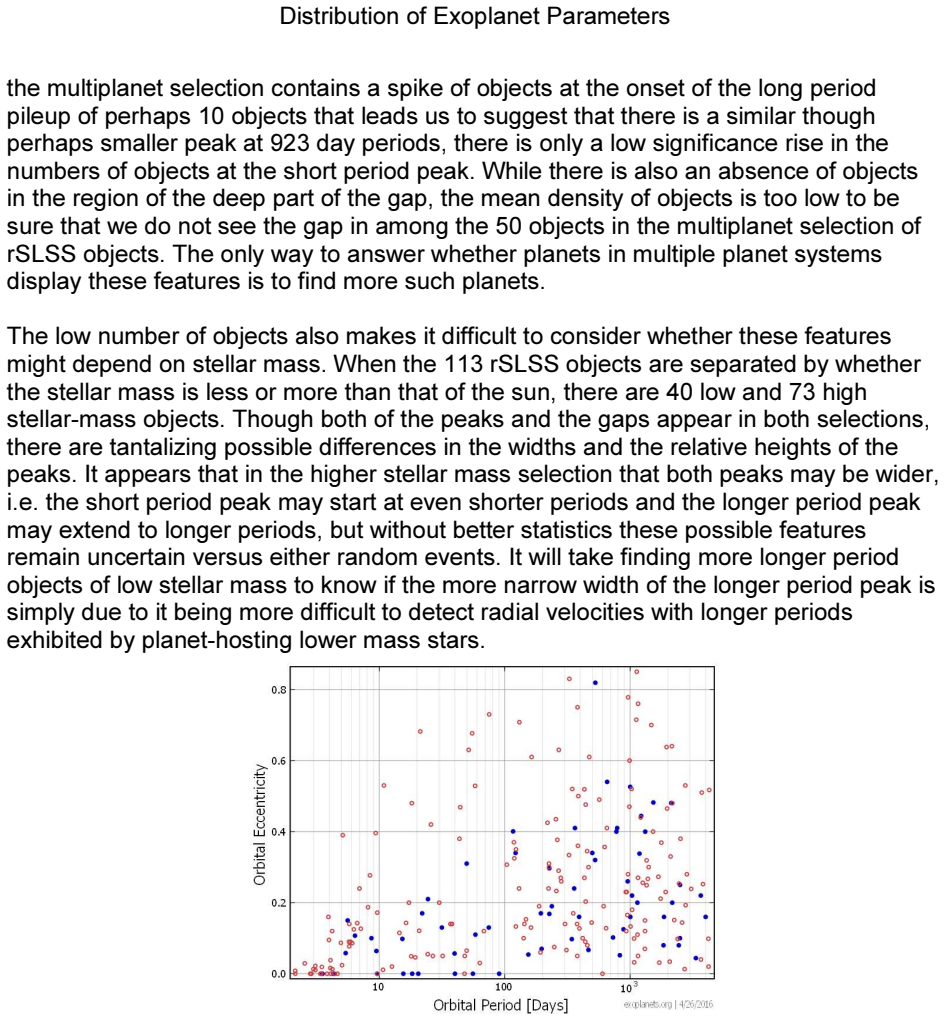
- [Fig. 1 caption] The caption states 'The width of the deep gap (with zero objects) in log period space is shown as a line,' but it does not specify the period interval covered by the gap or the bin width. Adding error bars or shaded confidence regions would help the reader judge the significance of the empty bin.
- [Introduction and motivation] The manuscript states 'contains 313 of the 434 objects found by RV before 2016 that we study' and later says 'There are only 434 objects with periods from 100 d to 5000d found by RV before 2016.' These statements are inconsistent about whether 434 is the total sample or the ROI subsample; clarify the sample definition.
- [References] The reference list includes 'X16: Xie et al. 2016' without a full bibliographic entry, and the T19 reference is only given as a ResearchGate project URL with a note that an arXiv identifier 'may be changed.' Provide complete, stable citations for both.
- [Fig. 2] The figure uses filled blue circles and open red circles to distinguish iron-poor and iron-rich objects. If the paper is printed in grayscale, the distinction may be lost; consider using different symbol shapes in addition to color.
Circularity Check
The central peak-gap-peak claim for rSLSS planets rests on a citation to the author's own companion paper T19, whose significance analysis is not reproduced in this white paper.
-
self citation load bearing
[Section 'Features in the main pileup' and Section 'Attributes of Features Needing Better Statistics' (Fig. 1 discussion)]
"T19 shows these 113 are enough to establish the presence of the two peaks and gap among the log period distribution of rSLSS objects, Fig. 1. The white paper T18 presented the features of this peak-gap-peak feature of the rSLSS population. ... Indeed, the major features are not easily proven."
The paper's central empirical claim—that the rSLSS log-period distribution has two peaks and a deep zero-object gap—is not established by any analysis contained in this manuscript. The sole support offered for its statistical reality is 'T19 shows', where T19 is the same author's companion paper, accepted but not reproduced here. The text even concedes that 'the major features are not easily proven' and points to a ResearchGate project for the significance calculation. Thus the load-bearing evidence for the headline structure is a self-citation rather than a self-contained derivation, null-model test, or independent benchmark in this white paper.
full rationale
This is not a mathematical derivation that reduces to its inputs by construction: no parameter is fitted and then renamed as a prediction, and no uniqueness theorem is imported. However, the paper's motivating scientific result—the peak-gap-peak structure in the rSLSS period distribution—is asserted primarily through 'T19 shows' and 'T18 presented', both authored by the same Stuart F. Taylor. The significance of the gap, the completeness corrections, and the comparison against smooth single-peak null models all live in the companion work, not in this document; the white paper itself admits the major features are 'not easily proven'. Because the central claim is load-bearing for the paper's recommendation to continue RV surveys, the reliance on self-citation is significant. The score of 6 reflects that the central pattern is effectively imported from the author's own companion analysis rather than demonstrated here, while stopping short of 8 because the white paper does not force the result by definition and a companion paper with possible external evidence is referenced.
Assumptions & free parameters
free parameters (4)
- Period range lower bound (ROI) =
100 d
- Period range upper bound (ROI) =
5000 d
- Metallicity split for rSLSS vs pSLSS =
[Fe/H] = 0 (solar)
- Stellar classification thresholds (sunlike) =
log g > 4, 4500 < Teff < 6500 K
assumptions (4)
- domain assumption The Exoplanet Data Explorer catalog at exoplanets.org accurately represents the population of radial-velocity planets in the period range studied.
- domain assumption The companion paper T19's statistical analysis correctly establishes that the double-peak-gap is highly unlikely to arise from random distributions and is difficult to explain by observational effects.
- domain assumption Radial-velocity detection biases do not fully create the observed gap and peaks.
- domain assumption Prior literature (e.g., DM13, LT15, U07) correctly established the eccentricity correlations cited.
Cite this review
Pith. "Pith review of Characterizing the Distribution of Parameters of Planets Found by Radial Velocity is Essential for Understanding Planet Formation and Evolution." pith.science (2026). https://pith.science/paper/5VVWJKHX
@misc{pith2026190802771,
  author       = {Pith},
  title        = {Pith review of: Characterizing the Distribution of Parameters of Planets Found by Radial Velocity is Essential for Understanding Planet Formation and Evolution},
  year         = {2026},
  howpublished = {\url{https://pith.science/paper/5VVWJKHX}},
  note         = {Machine review of arXiv:1908.02771}
}
read the original abstract
Features in the distribution of exoplanet parameters by period demonstrate that the distribution of planet parameters is rich with information that can provide essential guidance to understanding planet histories. Structure has been found in the counts of planet-star "objects" by period, and within these structures, there are different correlations of eccentricity with planet number, stellar metallicity, planet count density per log period, stellar multiplicity, and planet mass. These appear to change with each other, and with stellar mass, but there are too few planets to easily and reliably study these important relationships. These relationships are the bulk observables against which the theory of planet formation and evolution must be tested. The opportunity to determine the nature of the relationships of the exoplanet parameters on each other demonstrate the value of finding more planets across period ranging from days to thousands of days and beyond. We recommend support for continuing to find more planets, even giant planets, with periods up to periods of a few thousand days. We also recommend support for the study of the distribution of the many exoplanet parameters.
Figures

Reference graph
Works this paper leans on
-
[4]
A “How-To’’ guide to quickly plot the double-peak-gap feature on exoplanets.org
to result from random distributions of observations, and would be very difficult to result from observational effects. A “How-To’’ guide to quickly plot the double-peak-gap feature on exoplanets.org. References: A13: Adibekyan, V.Z., Figueira, P., Santos, N.C., Mortier, A., et al., 2013, Orbital and physical properties of planets and their hosts…, A&A, 56...
work page 2013
-
[117]
LT15: Limbach & Turner, 2015, PNAS, 112, 20L. T12a: Taylor, S.F. 2012a, Does the innermost occurrence distribution measure tidal dissipation, reveal a flow of giant planets, or both?, arXiv:astro-ph/1206.1343. T12b: Taylor, S.F., 2012b, Flow of Planets Raises Short Period Fall Off, in “Formation, Detection, and Characterization …,” N. Haghighipour, Ed., P...
work page Pith review arXiv 2015
-
[827]
HP12: Hasegawa, Y., & Pudritz, R. E. 2012, ApJ, 760,
work page 2012
-
[1084]
Rings and Gaps Everywhere?: Features in the distribution of planets
X16: Xie et al. 2016 Acknowledgements: Data for this work taken from the Exoplanet Data Explorer at exoplanets.org. Distribution of Exoplanet Parameters S.F. Taylor 7 Appended 2019 August 7: Published as Taylor, Stuart F., Astro2020: Decadal Survey on Astronomy and Astrophysics, science white papers, no. 179; Bulletin of the American Astronomical Society,...
Reviewed August 14, 2026 · model on record in the stance chip above.
Discussion (0). Continue with ORCID to comment.