REVIEW 3 major objections 6 minor 43 references
Attend To Count: Crowd Counting with Adaptive Capacity Multi-scale CNNs
T0 review · 3 major / 6 minor · reviewed 2026-08-14 · deepseek-v4-flash
Pith's one-line read ACM-CNN assigns different network capacity to dense and sparse crowd regions, cutting count error on five benchmarks.
desk verdict Incrementally novel attention-based crowd counter with a plausible design, but the headline results rest on test-set tuning and an unvalidated assumption that coarse peaks mark dense regions. read the letter →
The pith
A machine-rendered reading of the paper's core claim, the machinery that carries it, and where it could break.
The reading
What carries the argument
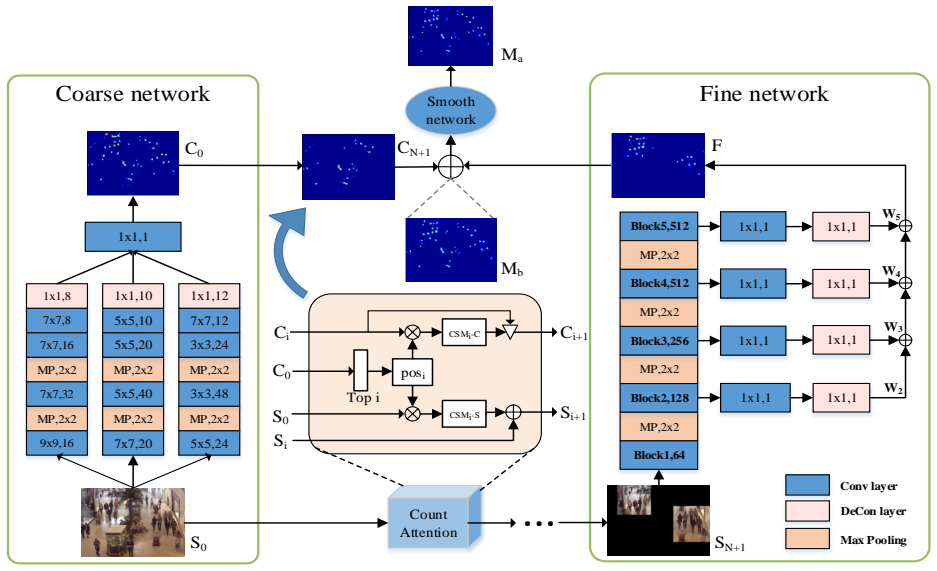
The load-bearing object is the count attention mechanism. It traverses the coarse density map $C_0$, selects the $N$ positions with the highest pixel values as centers $\text{pos}_i$, crops the corresponding spatial patches $\text{CSM}_i$ from the input, and accumulates them into the high-density map $S_{N+1} = S_1 + \sum_i \text{CSM}_i \otimes S_0$, while the complement $C_{N+1} = C_1 - \sum_i \text{CSM}_i \otimes C_0$ keeps the low-density regions. This pair of operations is what lets one network spend deep capacity exactly where the coarse estimate says people are dense. The secondary machinery is the smooth network, a small stack of convolution-ReLU layers that fuses the fine feature map with the low-density coarse map so the final density map does not show seams at the attention patch boundaries.
What would settle it
On a held-out set of crowd images, compare the top-$N$ patch centers picked by the count attention mechanism against the actual positions of the highest-density head clusters in the ground-truth density map. If the selected centers miss a substantial fraction of true dense clusters while the final MAE stays low, the attention mechanism is not the cause of the accuracy; conversely, if errors concentrate in missed clusters, the premise is confirmed.
Extended reading notes
Core claim
The central claim is that adaptive capacity allocation beats a single fixed-capacity structure for crowd counting: a shallow multi-column network is good at finding where crowds are, a deep network is good at resolving dense regions, and combining them through an attention-guided split yields accurate density maps. The count attention mechanism reads the coarse density map, takes the highest-valued pixel positions as attention centers, crops patches around them, and iteratively builds a high-density input $S_{N+1}$ for the fine network while stripping those same regions from the coarse feature map to form the low-density map $C_{N+1}$. The fine and coarse features are added, then passed through a small smoothing network to remove the rigid boundary between attended and unattended regions. The authors report MAE reductions to 72.2 on ShanghaiTech Part A, 1.01 on UCSD, and 291.6 on UCF CC 50, and ablation results attributing the gain to the attention mechanism and the smoothing fusion.
Load-bearing premise
The mechanism assumes the highest-valued pixels in the coarse density map are the true dense crowd centers, so if the coarse network peaks in the wrong places, the fine network refines irrelevant patches and the claimed benefit of adaptive capacity does not follow.
Editorial extensions
If this is right
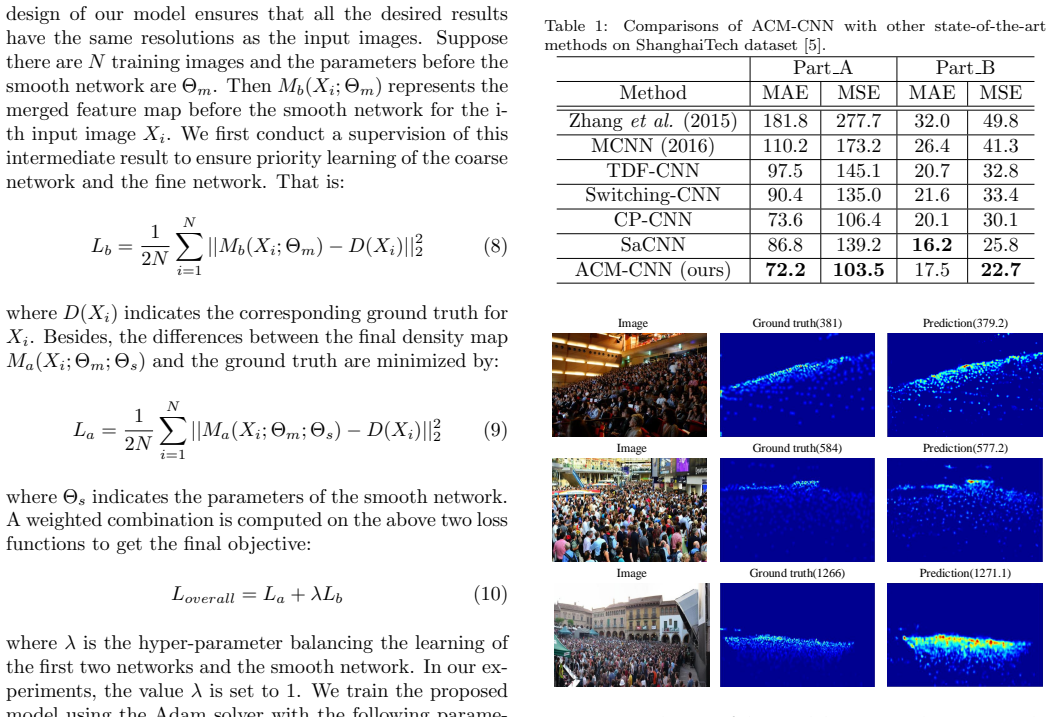
- On dense-scene benchmarks, the full three-network model lowers MAE from 74.5 to 72.2 on ShanghaiTech Part A when the smooth network is added, so the smoothing stage contributes accuracy, not just visual smoothness.
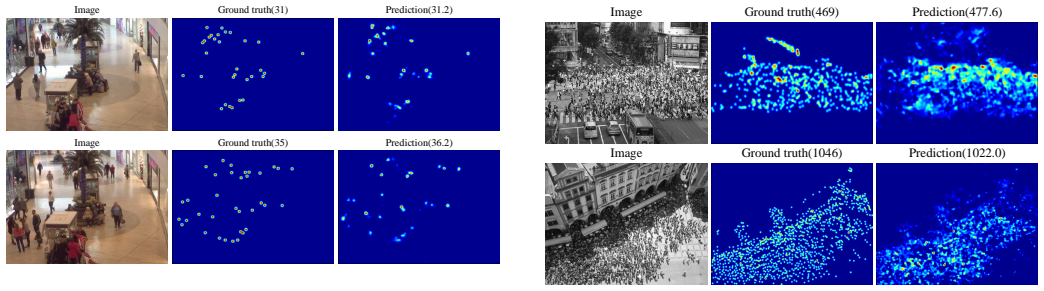
- On sparse-scene benchmarks, the same architecture reaches MAE 1.01 on UCSD and 2.3 on Mall, showing the adaptive split does not hurt when crowds occupy only a small part of the frame.
- The count attention mechanism is not tied to the specific coarse and fine networks: swapping in the deep and shallow networks from CrowdNet still improves UCSD MAE from 1.5 with simple concatenation to 1.2 with count attention, indicating it is a general fusion strategy.
- Because the method is fully convolutional and trained end-to-end with an $L_2$ loss plus an intermediate supervision term, it can be inserted into existing counting pipelines without changing the training paradigm.
Reading between the lines
- A natural extension is to make the attention selection differentiable or soft instead of a hard top-$N$ crop; this could let the model learn how many patches and what sizes are needed per image and remove the dataset-dependent threshold parameter.
- If the coarse network's peaks are unreliable, the error propagates: a missed dense cluster never reaches the fine network. A testable prediction of the paper's mechanism is that counting error concentrates in clusters the coarse map ranks below the top $N$.
- The same attend-then-refine loop could transfer to other dense-object counting tasks, such as cell counting in microscopy or vehicle counting in aerial imagery, where a cheap density estimate can gate a deeper refinement network.
Signed reviews
Editorial analysis
A structured set of objections, weighed in public.
Referee Report
Summary. This paper proposes ACM-CNN, a crowd counting architecture with three modules: a shallow multi-column coarse network, a VGG-16 based fine network, and a smooth fusion network. A 'count attention' mechanism selects the N highest-valued pixels in the coarse density map C0, extracts the corresponding patches from the input for the fine network, and strips those patches from C0 before the two feature maps are summed and passed to the smooth network. The authors report state-of-the-art or near-state-of-the-art MAE/MSE on ShanghaiTech Part A/B, WorldExpo'10, UCSD, Mall, and UCF CC 50, and provide ablations showing each module contributes, plus a generality experiment using CrowdNet sub-networks.
Significance. The adaptive-capacity idea is reasonable and the three-module decomposition is clearly described. The paper includes useful ablations (Table 8) and a generality experiment (Table 9). If the reported numbers are reproducible, the method would be competitive. However, the significance is currently limited by evaluation concerns: hyperparameters N and S appear to be selected on test sets, no error bars are reported, and no code is released, so the state-of-the-art claim rests on weaker evidence than the tables suggest.
major comments (3)
- [Section 3.1-3.2, Eqs. (5)-(6), (8)] The count attention mechanism assumes that the highest-valued pixels in the coarse map C0 identify dense crowd regions, but this property is never supervised or validated. The intermediate loss Lb in Eq. (8) supervises the merged map Mb = CN+1 + F, and Eq. (5) strips the selected C0 regions out before this sum; the hard top-N selection is non-differentiable, so no gradient encourages C0 to place its peaks in truly dense areas. The manuscript provides no visualization or quantitative check that the selected patches coincide with dense regions (e.g., an IoU measure against the ground-truth density or a comparison of the selected patches with the true head locations). Without such evidence, the improvement of C+F over C or F in Table 8 cannot be attributed to correct localization rather than simply to the added capacity of a second network.
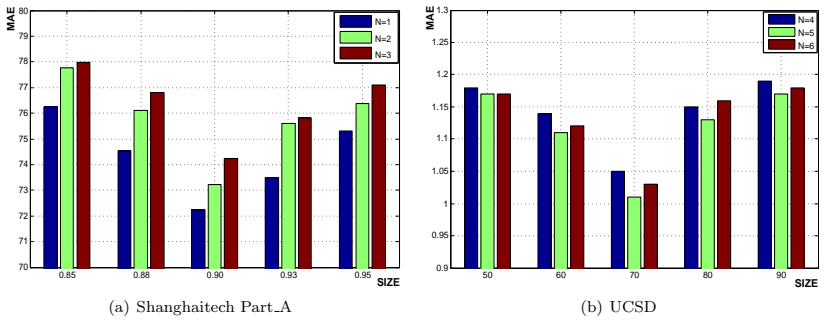
- [Section 5.1, Tables 1-5] The hyperparameters N and S appear to be selected on the test sets. The dataset splits described in Sections 4.2 and 4.4 contain no validation portion, and Figure 9 plots MAE against N and S for Shanghaitech Part A and UCSD without distinguishing train, validation, or test. Choosing N=1, S=[0.9*height,0.9*width] for dense sets and N=5, S=[70,70] for sparse sets from these curves and then reporting the resulting test numbers as state-of-the-art risks test-set overfitting. The authors should tune on a held-out validation split (or fix N and S before evaluation) and report the mean and standard deviation over multiple runs, especially for the 5-fold cross-validation on UCF CC 50 in Table 5.
- [Section 5.1, Table 7] For all dense datasets, the chosen configuration is N=1 with a patch covering 0.9*height by 0.9*width, i.e., 81% of the image area. Under this configuration, the fine network processes nearly the entire image and the coarse network contributes only the remaining border regions; this weakens the paper's central claim of assigning 'different capacities to different portions' adaptively. The authors should either justify this configuration as a limiting case of adaptive capacity or provide results for smaller patches to demonstrate that spatial selection is what drives the gain.
minor comments (6)
- [Section 2.2] There is a typo: 'convolutional nerual network' should be 'convolutional neural network'.
- [Section 3.3] There is a typo: 'the mooth network' should be 'the smooth network'.
- [Table 9] The label 'CrowdNet contact' should be 'CrowdNet concatenation'.
- [Section 4.1, Eqs. (11)-(12)] The notation in the MAE and MSE equations uses a norm symbol where an absolute value is intended; please replace with |ci - ci_hat| for clarity.
- [Table 2] The method 'LBP + RR' is cited as reference [5], but [5] is MCNN; please correct the citation.
- [Figure 2] The architecture diagram is very dense; the count attention submodule, in particular, would benefit from a separate, more detailed illustration.
Circularity Check
No derivation-chain circularity: the final density map is supervised end-to-end and the count-attention routing is not a restatement of the coarse map; test-set hyperparameter selection is an evaluation concern, not a circular reduction.
full rationale
ACM-CNN is an empirical architecture paper, not a derivation. The final density map Ma is obtained by merging the fine-network output F with the residual low-density map CN+1 and passing through a smooth network (Eqs. 5-7, 9-10), and all components are trained against the same ground-truth density map D via Lb and La. The count-attention selection (Eqs. 3-4) uses the coarse prediction C0 to choose crop locations, but the final output is not defined to equal C0: the selected regions are re-processed by the fine network and the coarse contribution is explicitly removed (Eq. 5), so there is no equation-level identity that makes the prediction a restatement of its inputs. The 'highest values indicate dense areas' statement is a property of the constructed ground truth (Eq. 2) and is applied to the predicted C0 as an empirical localization assumption; this is an unsupported premise and a correctness risk, not a circular definition. The paper does not rely on any load-bearing self-citation: prior-work citations (MCNN, VGG, CrowdNet, etc.) are external baselines or architecture choices, and no uniqueness theorem or fitted parameter is invoked to force the result. The only notable concern is that N and S are tuned using the test results in Section 5.1 and Table 7, but this is benchmark leakage under soundness, not a circularity of the model's input-output relation. Therefore no circular step is exhibited.
Assumptions & free parameters
free parameters (4)
- N (number of attention regions) =
N=1 for ShanghaiTech, WorldExpo'10, UCF CC 50; N=5 for UCSD, Mall
- S (attention patch size) =
[0.9*height, 0.9*width] for dense datasets; [0.4*height, 0.3*width] for sparse datasets
- T (dense/sparse threshold) =
40 average count
- beta and k in density map generation =
beta=0.3, k=3
assumptions (4)
- domain assumption Geometry-adaptive Gaussian kernels produce a valid regression target for crowd counting.
- domain assumption The highest pixel values in the coarse density map indicate the most densely populated image regions.
- domain assumption Deep networks perform better on dense regions and shallow networks on sparse regions.
- standard math L2 loss between predicted and ground truth density maps is an appropriate training objective.
Cite this review
Pith. "Pith review of Attend To Count: Crowd Counting with Adaptive Capacity Multi-scale CNNs." pith.science (2026). https://pith.science/paper/QNTJFF4I
@misc{pith2026190802797,
  author       = {Pith},
  title        = {Pith review of: Attend To Count: Crowd Counting with Adaptive Capacity Multi-scale CNNs},
  year         = {2026},
  howpublished = {\url{https://pith.science/paper/QNTJFF4I}},
  note         = {Machine review of arXiv:1908.02797}
}
read the original abstract
Crowd counting is a challenging task due to the large variations in crowd distributions. Previous methods tend to tackle the whole image with a single fixed structure, which is unable to handle diverse complicated scenes with different crowd densities. Hence, we propose the Adaptive Capacity Multi-scale convolutional neural networks (ACM-CNN), a novel crowd counting approach which can assign different capacities to different portions of the input. The intuition is that the model should focus on important regions of the input image and optimize its capacity allocation conditioning on the crowd intensive degree. ACM-CNN consists of three types of modules: a coarse network, a fine network, and a smooth network. The coarse network is used to explore the areas that need to be focused via count attention mechanism, and generate a rough feature map. Then the fine network processes the areas of interest into a fine feature map. To alleviate the sense of division caused by fusion, the smooth network is designed to combine two feature maps organically to produce high-quality density maps. Extensive experiments are conducted on five mainstream datasets. The results demonstrate the effectiveness of the proposed model for both density estimation and crowd counting tasks.
Figures


Figures from the paper (6 more)



Reference graph
Works this paper leans on
- [1]
-
[2]
Y. P. Kocak, S. Sevgen, Detecting and counting people using real-time directional algorithms implemented by compute uni- fied device architecture, Neurocomputing 248 (2017) 105 – 111, neural Networks : Learning Algorithms and Classification Sys- tems
work page 2017
-
[3]
A. B. Chan, N. Vasconcelos, Bayesian poisson regression for crowd counting, in: Computer Vision, 2009 IEEE 12th Interna- tional Conference on, IEEE, 2009, pp. 545–551
work page 2009
-
[4]
K. Chen, C. C. Loy, S. Gong, T. Xiang, Feature mining for localised crowd counting., in: BMVC, Vol. 1, 2012, p. 3
work page 2012
- [5]
-
[6]
Crowd counting via scale-adaptive convolutional neural network
L. Zhang, M. Shi, Q. Chen, Crowd counting via scale-adaptive convolutional neural network, CoRR abs/1711.04433
-
[7]
D. B. Sam, S. Surya, R. V. Babu, Switching convolutional neural network for crowd counting, in: Proceedings of the IEEE Conference on Computer Vision and Pattern Recognition, Vol. 1, 2017, p. 6
work page 2017
-
[8]
K. Simonyan, A. Zisserman, Very deep convolutional networks for large-scale image recognition, CoRR abs/1409.1556
Show all 43 references
-
[9]
Q. Wang, J. Gao, W. Lin, Y. Yuan, Learning from synthetic data for crowd counting in the wild, CoRR abs/1903.03303
1903 arXiv
-
[10]
Q. Wang, M. Chen, F. Nie, X. Li, Detecting coherent groups in crowd scenes by multiview clustering, IEEE Transactions on Pattern Analysis and Machine Intelligence (2018) 1–1 doi:10. 1109/TPAMI.2018.2875002
2018
-
[11]
Q. Wang, J. Wan, Y. Yuan, Deep metric learning for crowd- edness regression, IEEE Transactions on Circuits and Sys- tems for Video Technology 28 (10) (2018) 2633–2643. doi: 10.1109/TCSVT.2017.2703920. 9
2018
-
[12]
Zhang, C
Y. Zhang, C. Zhou, F. Chang, A. C. Kot, Multi-resolution at- tention convolutional neural network for crowd counting, Neu- rocomputing 329 (2019) 144 – 152. doi:https://doi.org/10. 1016/j.neucom.2018.10.058
2019
-
[13]
V. A. Sindagi, V. M. Patel, A survey of recent advances in cnn- based single image crowd counting and density estimation, Pat- tern Recognition Letters 107 (2018) 3 – 16, video Surveillance- oriented Biometrics. doi:https://doi.org/10.1016/j.patrec. 2017.07.007
2018 doi
-
[14]
Jiang, Z
X. Jiang, Z. Xiao, B. Zhang, X. Zhen, X. Cao, D. S. Doer- mann, L. Shao, Crowd counting and density estimation by trel- lis encoder-decoder network, CoRR abs/1903.00853
1903 arXiv
-
[15]
N. Liu, Y. Long, C. Zou, Q. Niu, L. Pan, H. Wu, Adcrowd- net: An attention-injective deformable convolutional network for crowd understanding, CoRR abs/1811.11968
-
[16]
Y. Liu, M. Shi, Q. Zhao, X. Wang, Point in, box out: Beyond counting persons in crowds, CoRR abs/1904.01333
1904 arXiv
-
[17]
V. A. Sindagi, V. M. Patel, Generating high-quality crowd den- sity maps using contextual pyramid cnns, in: The IEEE Inter- national Conference on Computer Vision (ICCV), 2017
2017
-
[18]
Babu Sam, N
D. Babu Sam, N. N. Sajjan, R. Venkatesh Babu, M. Srinivasan, Divide and grow: Capturing huge diversity in crowd images with incrementally growing cnn, in: The IEEE Conference on Computer Vision and Pattern Recognition (CVPR), 2018
2018
-
[19]
X. Cao, Z. Wang, Y. Zhao, F. Su, Scale aggregation network for accurate and efficient crowd counting, in: The European Conference on Computer Vision (ECCV), 2018
2018
-
[20]
Y. Li, X. Zhang, D. Chen, Csrnet: Dilated convolutional neural networks for understanding the highly congested scenes, in: The IEEE Conference on Computer Vision and Pattern Recognition (CVPR), 2018
2018
-
[21]
J. Liu, C. Gao, D. Meng, A. G. Hauptmann, Decidenet: Count- ing varying density crowds through attention guided detection and density estimation, in: The IEEE Conference on Computer Vision and Pattern Recognition (CVPR), 2018
2018
-
[22]
Ranjan, H
V. Ranjan, H. Le, M. Hoai, Iterative crowd counting, in: The European Conference on Computer Vision (ECCV), 2018
2018
-
[23]
W. Liu, M. Salzmann, P. Fua, Context-aware crowd counting, CoRR abs/1811.10452
-
[24]
L.-C. Chen, G. Papandreou, I. Kokkinos, K. Murphy, A. L. Yuille, Deeplab: Semantic image segmentation with deep con- volutional nets, atrous convolution, and fully connected crfs, arXiv preprint arXiv:1606.00915
-
[25]
S. S. Kruthiventi, K. Ayush, R. V. Babu, Deepfix: A fully con- volutional neural network for predicting human eye fixations, IEEE Transactions on Image Processing
-
[26]
Y. Ji, H. Zhang, Q. J. Wu, Salient object detection via multi- scale attention cnn, Neurocomputing 322 (2018) 130 – 140
2018
-
[27]
A. R. Gepperth, M. G. Ortiz, E. Sattarov, B. Heisele, Dynamic attention priors: a new and efficient concept for improving ob- ject detection, Neurocomputing 197 (2016) 14 – 28
2016
-
[28]
K. G. Y. Y. S. C. Shuangjie Xu, Yu Cheng, P. Zhou, Jointly attentive spatial-temporal pooling networks for video-based per- son re-identification, in: ICCV, 2017
2017
-
[29]
V. Mnih, N. Heess, A. Graves, K. Kavukcuoglu, Recurrent mod- els of visual attention, CoRR abs/1406.6247. URL http://arxiv.org/abs/1406.6247
-
[30]
Z. Gan, Y. Cheng, A. E. Kholy, L. Li, J. Liu, J. Gao, Multi- step reasoning via recurrent dual attention for visual dialog, in: Proceedings of the 57th Conference of the Association for Computational Linguistics, ACL 2019, Florence, Italy, July 28- August 2, 2019, Volume 1: Lo...
2019
-
[31]
J. Ba, V. Mnih, K. Kavukcuoglu, Multiple object recognition with visual attention, CoRR abs/1412.7755. URL http://arxiv.org/abs/1412.7755
-
[32]
Almahairi, N
A. Almahairi, N. Ballas, T. Cooijmans, Y. Zheng, H. Larochelle, A. C. Courville, Dynamic capacity networks, CoRR abs/1511.07838
-
[33]
Hossain, M
M. Hossain, M. Hosseinzadeh, O. Chanda, Y. Wang, Crowd counting using scale-aware attention networks, in: 2019 IEEE Winter Conference on Applications of Computer Vision (WACV), 2019, pp. 1280–1288. doi:10.1109/WACV.2019.00141
2019
-
[34]
L. Zhu, Z. Zhao, C. Lu, Y. Lin, Y. Peng, T. Yao, Dual path multi-scale fusion networks with attention for crowd counting, CoRR abs/1902.01115
1902 arXiv
-
[35]
Zhang, H
C. Zhang, H. Li, X. Wang, X. Yang, Cross-scene crowd counting via deep convolutional neural networks, in: Proceedings of the IEEE Conference on Computer Vision and Pattern Recognition, 2015, pp. 833–841
2015
-
[36]
D. B. Sam, R. V. Babu, Top-down feedback for crowd counting convolutional neural network, CoRR abs/1807.08881
-
[37]
A. B. Chan, Z.-S. J. Liang, N. Vasconcelos, Privacy preserving crowd monitoring: Counting people without people models or tracking, in: Computer Vision and Pattern Recognition, 2008. CVPR 2008. IEEE Conference on, IEEE, 2008, pp. 1–7
2008
-
[38]
Kumagai, K
S. Kumagai, K. Hotta, T. Kurita, Mixture of counting cnns: Adaptive integration of cnns specialized to specific appearance for crowd counting, CoRR abs/1703.09393
-
[39]
V. Q. Pham, T. Kozakaya, O. Yamaguchi, R. Okada, Count for- est: Co-voting uncertain number of targets using random forest for crowd density estimation, in: IEEE International Conference on Computer Vision, 2015, pp. 3253–3261
2015
-
[40]
Idrees, I
H. Idrees, I. Saleemi, C. Seibert, M. Shah, Multi-source multi- scale counting in extremely dense crowd images, in: The IEEE Conference on Computer Vision and Pattern Recognition (CVPR), 2013
2013
-
[41]
Boominathan, S
L. Boominathan, S. S. S. Kruthiventi, R. V. Babu, Crowdnet: A deep convolutional network for dense crowd counting, in: Pro- ceedings of the 2016 ACM on Multimedia Conference, MM ’16, ACM, New York, NY, USA, 2016, pp. 640–644
2016
-
[42]
Cheng, Q
Y. Cheng, Q. Fan, S. Pankanti, A. Choudhary, Temporal se- quence modeling for video event detection, in: Proceedings of the 2014 IEEE Conference on Computer Vision and Pattern Recognition, CVPR ’14, 2014, pp. 2235–2242
2014
-
[43]
J. Wang, Y. Cheng, R. Schmidt Feris, Walk and learn: Fa- cial attribute representation learning from egocentric video and contextual data, in: The IEEE Conference on Computer Vision and Pattern Recognition (CVPR), 2016. 10
2016
Reviewed August 14, 2026 · model on record in the stance chip above.
Discussion (0). Continue with ORCID to comment.