REVIEW 5 major objections 4 minor 105 references
Fundamental and higher-order excited modes of radial oscillation of neutron stars for various types of cold nucleonic and hyperonic matter
T0 review · 5 major / 4 minor · reviewed 2026-08-14 · deepseek-v4-flash
Pith's one-line read This paper computes the fundamental and first two excited radial-mode frequencies of neutron stars for six realistic dense-matter equations of state and shows that the fundamental-mode spectrum follows the density-dependent adiabatic index.
desk verdict A useful parameter scan undone by impossible f-mode frequencies at the maximum-mass rows; the tables need a thorough re-check before anyone cites them. read the letter →
The pith
A machine-rendered reading of the paper's core claim, the machinery that carries it, and where it could break.
The reading
What carries the argument
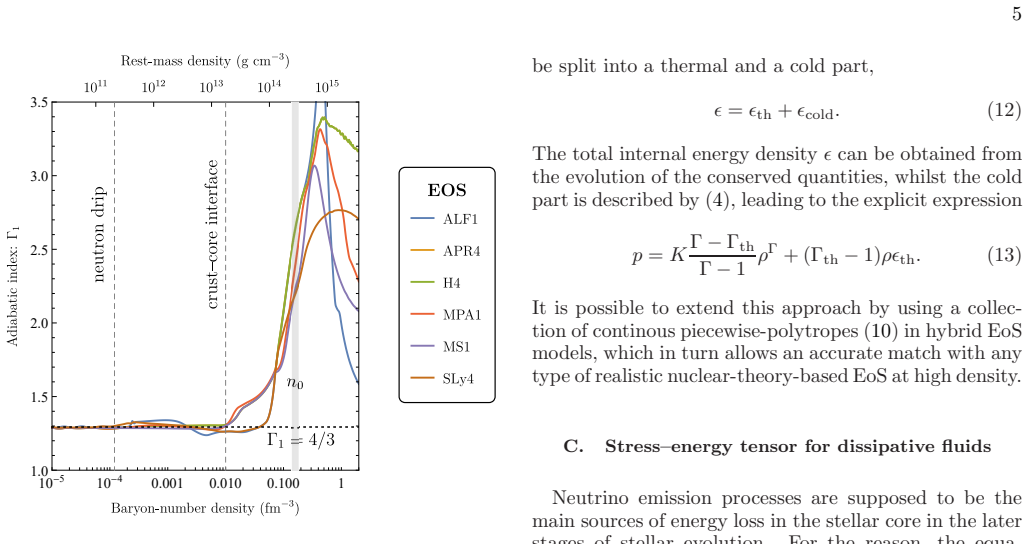
The engine is a Sturm–Liouville eigenvalue problem for the radial displacement amplitude $X(r)$, coming from the general-relativistic pulsation equation (52). The center satisfies $X(0)=0$ and the surface requires the Lagrangian pressure perturbation to vanish; the problem is discretized with second-order central finite differences on a uniform radial grid, turning it into a tridiagonal matrix eigenvalue problem. The physical quantity that controls the frequencies is the adiabatic index $\Gamma_1 = (\epsilon+p)/p\, dp/d\epsilon$, reconstructed by spline interpolation from the tabulated equations of state. The approximate relation $\omega_0^2 \simeq G\bar{\rho}\,(4-3\Gamma)$ then links the fundamental mode to the mean density and the stiffness of the stellar model.
What would settle it
Recompute $\nu_0$, $\nu_1$, and $\nu_2$ for one or two of the tabulated equations of state using a different interpolation scheme and an independent shooting solver on the same stellar models; if the frequencies shift by more than the claimed $10^{-4}$ Hz at a fixed central density, the interpolation assumption is the limiting uncertainty. The comparison would be most telling at high redshift ($z \gtrsim 0.1$), where earlier published eigenfrequencies are known to diverge.
Extended reading notes
Core claim
The central result is the eigenfrequency tables themselves: for each stellar model, the fundamental mode $\nu_0$ and the first two excited modes $\nu_1,\nu_2$ are reported as functions of central energy density, for six of the seven listed equations of state (APR4, MPA1, MS1, SLy4, H4, SQM1; ALF1 is listed but does not appear in the tables). At the maximal-mass configuration for a given equation of state, $\nu_0$ drops to, or near, zero, marking the dynamical-stability limit, and beyond it the f-mode becomes unstable. Across the full sequence, all three frequencies decrease as the central density approaches the minimum value that still yields a stable model. The paper reads these patterns as confirming that the fundamental-mode spectrum correlates with the density-dependent adiabatic index $\Gamma_1$, so the tables give an indirect handle on the stiffness of dense matter.
Load-bearing premise
The whole calculation is only as good as the smooth curves fit through the sparse tabulated equation-of-state points, because the oscillation frequencies are controlled by the derivative of pressure with respect to density, and slightly different smooth curves would shift the numbers.
Editorial extensions
If this is right
- The zero-frequency fundamental mode at the maximal-mass configuration marks the dynamical-stability limit for each equation of state, so the tables locate the onset of f-mode instability.
- For the same central density, softer equations of state give higher fundamental-mode frequencies because they are more centrally condensed; a measured $\nu_0$ would therefore distinguish stiff from soft dense matter.
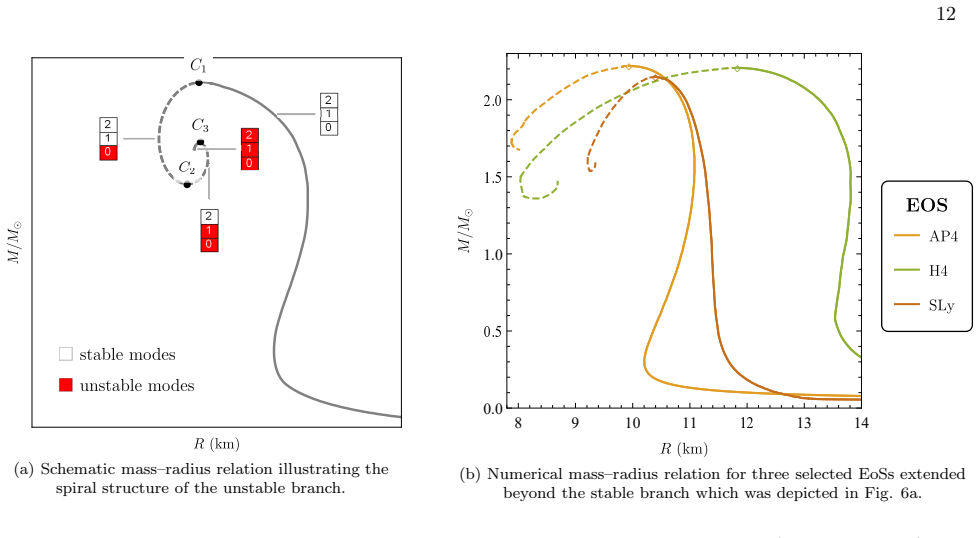
- The reported periods fall in the roughly 0.2–0.9 ms range expected for neutron-star radial modes, within reach of compact-object asteroseismology.
- Providing $\nu_1$ and $\nu_2$ alongside $\nu_0$ means a detected overtone would give an independent consistency check on the equation of state.
Reading between the lines
- The tables could be repackaged as a calibration between $\nu_0$ and the pressure-weighted adiabatic index; the paper establishes the raw numbers but does not fit such a relation.
- The stated interpolation sensitivity could be quantified by rebuilding the stellar models with different spline choices and quoting the spread in $\nu_0,\nu_1,\nu_2$ as error bars.
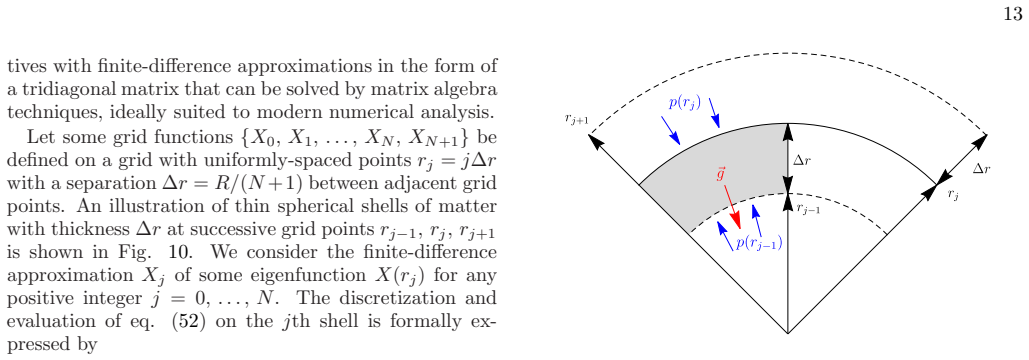
- Extending the same finite-difference eigenvalue approach to non-radial modes would connect these radial tables to gravitational-wave asteroseismology, which the paper explicitly leaves aside.
Signed reviews
Editorial analysis
A structured set of objections, weighed in public.
Referee Report
Summary. The manuscript computes the fundamental and first two excited radial-oscillation modes of non-rotating neutron stars for a set of seven tabulated equations of state, using a second-order finite-difference discretization of the Chandrasekhar pulsation equation. Results are presented as frequency-versus-central-density tables and figures for six equations of state (APR4, H4, MPA1, MS1, SLy4, SQM1), together with a claimed correlation between the fundamental-mode frequency and the density variation of the adiabatic index. The paper also contains a discussion of dissipative extensions, Newtonian stability criteria, and an error estimate for the finite-difference scheme.
Significance. If the numerical tables were correct, they would provide a useful reference for neutron-star asteroseismology and for constraining dense-matter equations of state, complementing earlier work by Vath & Chanmugam and Kokkotas & Ruoff. The finite-difference method is standard, the truncation-error estimate for the discretization is plausible, and the paper explicitly engages with the relevant literature. However, the central deliverable—the eigenfrequency tables—contains internal inconsistencies severe enough to make the reported quantitative results, and the conclusions drawn from them, unsupported in the present version. In particular, the fundamental-mode frequencies at the maximal-mass configurations contradict the turning-point theorem that the paper itself states, and the SQM1 table appears to duplicate the MS1 results.
major comments (5)
- [Table III, panels (d) and (f)] At the asterisked maximal-mass rows, the manuscript reports ν0 = 3.270 kHz for MS1 at εc = 0.863 GeV fm^-3 and ν0 = 3.165 kHz for SQM1 at εc = 0.823 GeV fm^-3. This contradicts the turning-point theorem stated in Sec. VI (and in Refs. [22,23]): the fundamental radial frequency must vanish at a maximum of the M(εc) curve. These rows correspond to the claimed maximal-mass configurations (M = 2.782 M_sun for MS1, matching Table I), so either the eigenvalue labeled ν0 is not the fundamental mode of those models, or the rows do not represent the claimed configurations. Either way, the frequency tables, which are the paper's central result, are internally inconsistent, and the correlation with the adiabatic index built on these frequencies is not supported.
- [Table III, panel (f), and Table I] The panel labeled SQM1 reports gravitational masses up to 2.782 M_sun and radii around 13.4 km, whereas Table I lists SQM1 with Mmax = 1.56 M_sun and R = 8.54 km. The SQM1 frequencies and stellar parameters closely track the MS1 panel, strongly suggesting that the SQM1 results are erroneous, possibly duplicated from MS1. This is a load-bearing error because SQM1 is one of the six equations of state for which results are presented.
- [Sec. IIA, Table I, Table III, Fig. 11] The abstract and Sec. IIA state that seven realistic equations of state are considered, but Table III and Fig. 11 contain only six: ALF1 is listed in Table I but no ALF1 panel appears anywhere in the numerical results. The paper thus does not deliver what its title and abstract promise, and the missing equation of state is not discussed in the results section.
- [Sec. VI B and Table III] The text states that for MS1 and APR4 the f-mode frequency at the maximal-mass configuration has 'dropped to less than 5% of that of the first excited mode'. From Table III, APR4 gives ν0/ν1 = 0.398/6.012 ≈ 6.6%, while MS1 gives ν0/ν1 = 3.270/7.873 ≈ 41.5%. Neither value satisfies the stated '<5%' claim. This quantitative disagreement between the prose and the tables further undermines confidence in the mode identification and configuration labeling.
- [Sec. II A and Sec. VI A/VI B] The manuscript acknowledges that spline interpolation of the tabulated equations of state affects the eigenfrequencies and that deviations from the literature are expected, but it does not quantify this uncertainty. The claimed truncation-error bound of order 10^-4 Hz applies only to the finite-difference discretization on a fixed background model; it does not cover the interpolation error in Γ1, which enters directly into the coefficients of Eq. (52). Without a convergence study over interpolation schemes or a comparison against an independent numerical method, the accuracy claim for the final frequency tables is incomplete.
minor comments (4)
- [Sec. I] The introduction says the paper computes 'the four lowest-frequency radial-oscillation modes', but the abstract and the results present only three modes (fundamental and first two excited). This should be corrected.
- [Sec. V A and Appendix B] There is a sign-convention inconsistency: Sec. V A states that the star is dynamically stable for ω0^2 > 0, while Appendix B defines ω^2 = Gρ̄(4 − 3Γ) and states that the star is stable for ω^2 < 0. The same symbol ω^2 is used with opposite stability meanings in the two places; this will confuse readers and should be clarified.
- [Throughout] The manuscript contains numerous typographical errors and inconsistent spellings, including 'themoindynamics', 'Bresmmstrahlung', 'assimptotic', 'Sly4' instead of 'SLy4', 'inhereted', 'polytripic', and 'SL-EPV'. A careful proofreading pass is needed.
- [Table III caption] The caption says the asterisk indicates ν0 corresponds to the maximal-mass stable configuration, while Sec. VI B says the asterisk marks a configuration 'just beyond the limit of dynamical stability'. These descriptions are not equivalent and should be reconciled with the actual numerical rows.
Circularity Check
No significant circularity; the eigenfrequency computation is self-contained and uses external EoS inputs.
full rationale
The paper's central deliverable is the numerical solution of the standard radial pulsation eigenvalue problem for a set of external tabulated equations of state. The pulsation equation (52) is the well-known Chandrasekhar/Glass-Lindblom equation, and the finite-difference implementation in Sec. VI solves the homogeneous Sturm-Liouville problem (the text states: 'The homogeneous SL-EVP (52) is associated with harmonic oscillations and can be converted to a self-adjoint form which poses a boundary-value problem'); the dissipative terms from the author's prior paper [24] appear only in the inhomogeneous extension and do not enter the computed spectra. The claimed correlation between the fundamental-mode frequency and the adiabatic index is supported by the independent Newtonian approximation ω² ≃ Gρ̄(4 − 3Γ) in eq. (B10) and by comparison with earlier external studies [22,23], not by fitting or by a self-citation chain. The acknowledged interpolation sensitivity of the tabulated EoS affects numerical accuracy, but it does not make the derivation circular. The only notable anomaly is an internal-consistency issue in Table III, where asterisked maximal-mass rows list nonzero ν0 values despite the text's assertion that zero-frequency modes occur at mass extrema; this is a correctness concern, not a circularity. The self-citation to [24] is not load-bearing for the paper's numerical results, so the circularity score is zero.
Assumptions & free parameters
assumptions (5)
- standard math The Tolman-Oppenheimer-Volkoff equations describe the hydrostatic equilibrium of spherically symmetric stars in general relativity.
- standard math Chandrasekhar's linearized pulsation equation (52) governs adiabatic radial oscillations.
- domain assumption The fluid perturbations are adiabatic, so the perturbed adiabatic index equals the equilibrium Gamma1.
- domain assumption Zero-temperature, barotropic equations of state p=p(rho) accurately describe neutron-star matter at T approximately 0.
- ad hoc to paper The tabulated EoS can be smoothly interpolated without altering the adiabatic index in a way that materially changes the eigenfrequencies.
Cite this review
Pith. "Pith review of Fundamental and higher-order excited modes of radial oscillation of neutron stars for various types of cold nucleonic and hyperonic matter." pith.science (2026). https://pith.science/paper/25YEA6A2
@misc{pith2026190802808,
  author       = {Pith},
  title        = {Pith review of: Fundamental and higher-order excited modes of radial oscillation of neutron stars for various types of cold nucleonic and hyperonic matter},
  year         = {2026},
  howpublished = {\url{https://pith.science/paper/25YEA6A2}},
  note         = {Machine review of arXiv:1908.02808}
}
read the original abstract
This research paper complements our earlier qualitative study of the effect of viscosity and thermal conductivity on the radial oscillation and relaxation of non-rotating neutron stars. The fundamental and first two lowest-frequency excited modes of radial oscillation have been computed in the high nuclear density regime for a set of seven realistic equations of state (EoS) as functions of central energy density. Various types of zero-temperature EoS of cold nucleonic and hybrid nucleon-hyperon-quark matter models are used in the inner core to determine the internal structure in and around the hydrostatic equilibrium states and investigate the influence of each EoS on the dynamical behaviour of non-rotating neutron stars. We confirm the principal results of earlier, related studies that suggest an underlying correlation between the frequency spectrum of the fundamental oscillation mode and the variation of the adiabatic index over the high nuclear-density regime. We provide valuable information to impose further constraints on the plausible set of realistic EoS models, in addition to the practical applications for the rapidly evolving field of asteroseismology of compact objects.
Figures

Figures from the paper (7 more)



Reference graph
Works this paper leans on
-
[1]
The thermodynamic stability requires the EoS be monotonic ( dp/dρ ≥ 0 and dp/dǫ ≥ 0), and there- fore Γ 1 must be positive
-
[2]
(6) The constraint of eqs
The causality requires the speed of sound cs be less than the speed of light which is expressed by c2 s = dp dǫ ⏐ ⏐ ⏐ ⏐ s ≤ 1. (6) The constraint of eqs. ( 5–6) on the pressure-averaged adiabatic index, defined by ¯Γ 1 = ∫ R 0 Γ 1p(4πr2)dr ∫ R 0 p(4πr2)dr , (7) demand that ¯Γ 1 = ǫ + p p c2 s ≥ 4 3 (8) within a dynamically stable star of radius R. [49] Ex-...
-
[3]
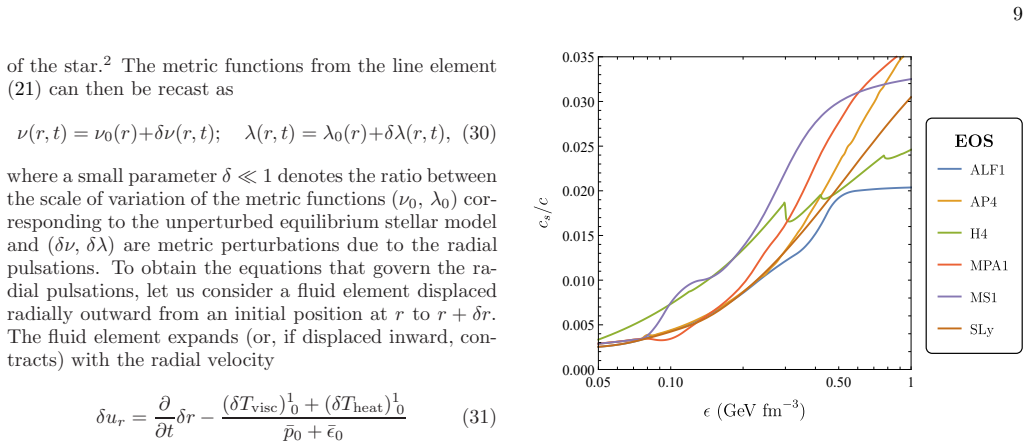
at a given density. [47, p. 190] For instance, a non-relativistic degenerate Fermi gas is reasonably well described by a polytropic EoS that scales as p ∝ ρ5/ 3, and for highly relativistic degenerate Fermi gases, p ∝ ρ4/ 3. Generally, Γ 1 and the speed of sound cs depend on the dynamical regime determined by ρ (or ǫ) as presented in Fig. 2 for the repres...
-
[4]
J. S. Read, B. D. Lackey, B. J. Owen, and J. L. Friedman, Constraints on a phenomenolog- ically parametrized neutron-star equation of state, Phys. Rev. D 79, 124032 (2009)
work page 2009
-
[5]
is written in a param- eterized form as p(ρ) = KiρΓ i for ρi ≤ ρ < ρ i+1 (0 ≤ i ≤ n), (10) 5 10-5 10-4 0.001 0.010 0.100 1 1.0 1.5 2.0 2.5 3.0 3.5 FIG. 2. The effective adiabatic index Γ 1 as a function of baryon-number density (or rest-mass density) for the set of representative EoS models considered in Table I. The dotted horizontal line corresponds to Γ...
-
[6]
is a good approximation for a ‘cold’ star, there are extremely energetic processes, like the merger of stars or accretion from a disk, which can increase enormously the temperature and a simple poly- trope will not provide a physical description. A more realistic EoS in closed form can be obtained by a com- bination of the polytripic EoS to describe the c...
-
[7]
M. C. Miller and F. K. Lamb, Observational constraints on neutron star masses and radii, Eur. Phys. J. A52, 63 (2016)
work page 2016
-
[8]
In terms of a superposition of sinusoids, the ω0 is the lowest-frequency sinusoidal in the sum (see dynamical stability in Sec. V A). Owing to the fact that the general solution to eq. ( 52) is always a superposition of both growing and damped oscillation modes, the def- initions (
Show all 105 references
-
[9]
A. L. Watts et al. , Colloquium: Measuring the neutron star equation of state using X-ray timing, Rev. Mod. Phys. 88, 021001 (2016)
2016
-
[10]
in hybrid EoS models, which in turn allows an accurate match with any type of realistic nuclear-theory-based EoS at high density. C. Stress–energy tensor for dissipative fluids Neutrino emission processes are supposed to be the main sources of energy loss in the stellar core in...
-
[11]
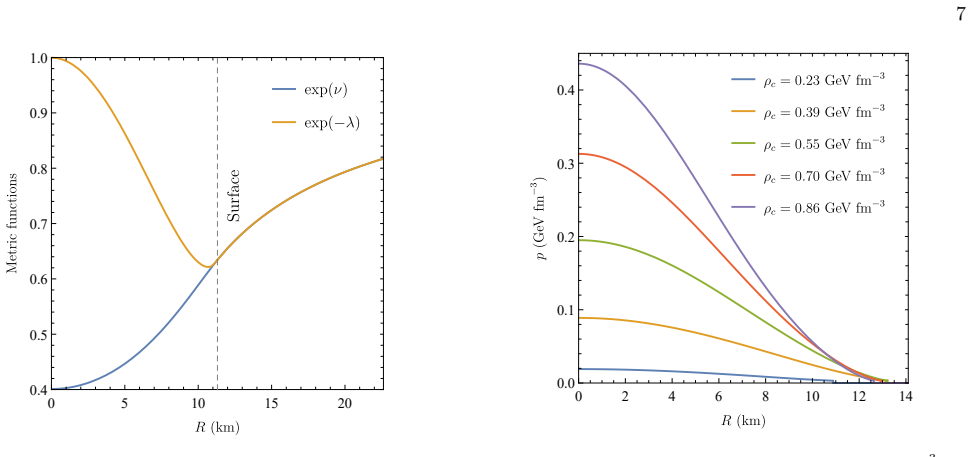
in such a way that does not violate the spherical symmetry 9 of the star. 2 The metric functions from the line element (21) can then be recast as ν(r, t) = ν0(r)+δν(r, t); λ(r, t) = λ0(r)+δλ(r, t), (30) where a small parameter δ ≪ 1 denotes the ratio between the scale of varia...
-
[12]
Lindblom, Determining the nuclear equa- tion of state from neutron-star masses and radii, Astrophys
L. Lindblom, Determining the nuclear equa- tion of state from neutron-star masses and radii, Astrophys. J. 398, 569 (1992)
1992
-
[13]
Ramaty and R
R. Ramaty and R. E. Lingenfelter, Interpreta- tions and implications of β-ray lines from so- lar flares, the galactic centre and β-ray transients, Phil. Trans. Roy. Soc. 301, 671 (1981)
1981
-
[14]
Sagun, G
V. Sagun, G. Panotopoulos, and I. Lopes, Asteroseismol- ogy: Radial oscillations of neutron stars with realistic equation of state, Phys. Rev. D 101, 063025 (2020)
2020
-
[15]
Detweiler and L
S. Detweiler and L. Lindblom, On the nonra- dial pulsations of general relativistic stellar models, Astrophys. J. 292, 12 (1985)
1985
-
[16]
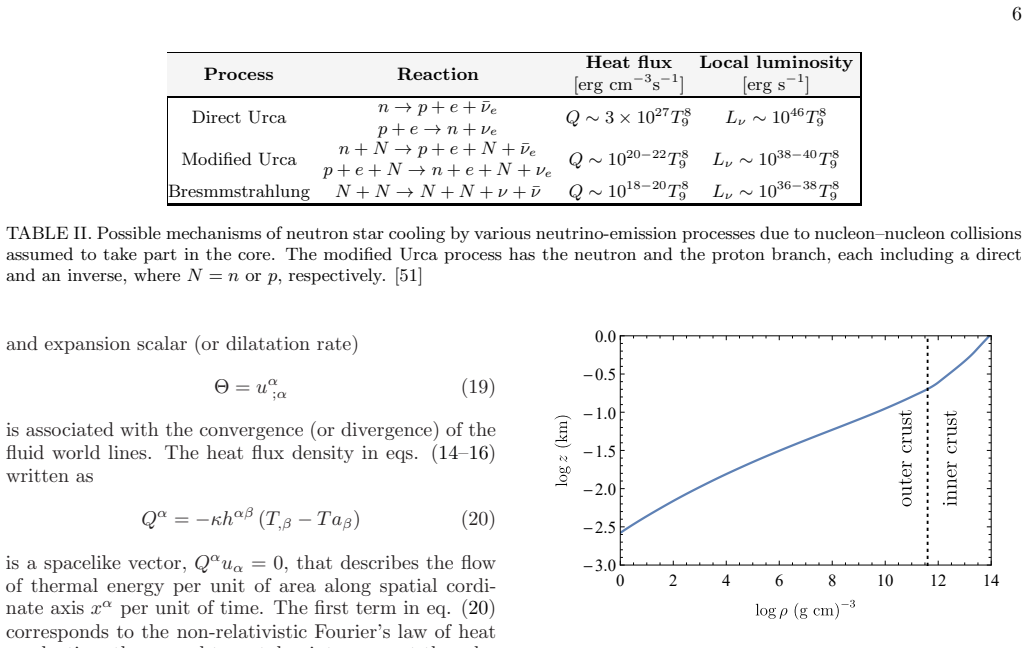
and ( 20), η, ζ , and κ are collectively called transport coefficients (or dissipation coefficients). The bulk viscosity coefficient ζ defines the resistance of the medium to gradual uniform compression or expan- sion; and κ is non-negative and accounts for the thermal conductivity, ...
2008
-
[17]
The fluid at the center of the star is assumed to remain at rest; thus, X = 0 at r = 0. (56)
-
[18]
(57) Let us keep in mind that even the homogeneous SL-EVP cannot be solved analytically in general
The perturbed pressure is required to vanish on the perturbed boundary of the star; thus the Lagrangian change in the pressure δp = eν0/ 2r−2Γ p0 d dr ( e−ν0/ 2r2X ) has to vanish at the surface; thus, δp = 0 at r = R. (57) Let us keep in mind that even the homogeneous SL-EVP ...
-
[19]
If ω2 0 > 0, then all the higher eigenfrequencies of the spectrum are real, which indicates that the equi- librium stellar model is dynamically stable with respect to small perturbations, and they form a lower-bounded infinite sequence ω1 ≤ ω2 ≤ ω3 . . .. In this case the small...
-
[20]
ex- hibit purely harmonic oscillations in the f-mode. [18]
-
[21]
◇ ◇ ◇ ◇◇ ◇ 8 9 10 11 1 13 14 0.0 0 1.0 2 (b) Numerical mass–radius relation for three selected EoSs extended beyond the stable branch which was depicted in Fig
If ω2 0 < 0, then ω0 becomes purely imaginary, which indicates that the equilibrium stellar model comes 12 (a) Schematic mass–radius relation illustrating the spiral structure of the unstable branch. ◇ ◇ ◇ ◇◇ ◇ 8 9 10 11 1 13 14 0.0 0 1.0 2 (b) Numerical mass–radius relation f...
-
[22]
and verified by the two different numerical schemes of Ref. [23]. In addition to having the earlier studies re-examined, Kokkotas & Ruoff also included further six zero-temperature EoSs in Ref. [23]. Our present paper, together with its accompanying pa- per [24], is devoted to st...
-
[23]
As discussed in detail by our preceding study [24], the highest in- stability increment, associated with the most rapid exponential growth or dampening, is provided by the f-mode
ex- ponentially grow or damp with time (depending on the value of the damping ratio ζd). As discussed in detail by our preceding study [24], the highest in- stability increment, associated with the most rapid exponential growth or dampening, is provided by the f-mode. Instabil...
-
[24]
The homogeneous SL-EVP ( 52) is associated with har- monic oscillations and can be converted to a self-adjoint form which poses a boundary-value problem
and shall not be repeated here. The homogeneous SL-EVP ( 52) is associated with har- monic oscillations and can be converted to a self-adjoint form which poses a boundary-value problem. [24] The eigenvalues and corresponding eigenfunctions of the given boundary-value problem a...
-
[25]
In this case ǫ0 = ǫcrit as marked in Fig
Finally, at ω0 = 0 the equilibrium stellar model is at neutral stability; neither stable nor unstable. In this case ǫ0 = ǫcrit as marked in Fig. 6b by the symbols ⋄ for states at neutral stability. The dynamical stability is also inherently related to the shape of the M (R) cu...
-
[26]
We consider the finite-difference approximation Xj of some eigenfunction X(rj) for any positive integer j = 0 , . . . , N . The discretization and evaluation of eq. ( 52) on the jth shell is formally ex- pressed by aj[D2 rX]j + bj[DrX]j + cj = ω2 j Xj (59) where ω2 j is the squa...
-
[27]
P. S. Shternin and D. G. Yakovlev, Shear viscosity in neutron star cores, Phys. Rev. D 78, 063006 (2008)
2008
-
[28]
We demonstrate that it does not exceed ca
will be esti- mated. We demonstrate that it does not exceed ca. 10 −4 Hz for setting up regular grid of size N ≃ 3000. A. An error estimate of the finite-difference approximation Two potential sources of numerical errors occur in com- puting our finite-difference approximation to ...
-
[29]
This hindrance is especially evident in the vicinity of the stellar surface, where the pressure is zero, but it gets im- mensely increased as one moves into the stellar interior
are not as smooth as those of polytropic ones. This hindrance is especially evident in the vicinity of the stellar surface, where the pressure is zero, but it gets im- mensely increased as one moves into the stellar interior. (See footnote 1 and Fig. 5.) The underlying reason ...
-
[30]
Tolos, C
L. Tolos, C. Manuel, S. Sarkar, and J. Tarrus, Transport coefficients in superfluid neutron stars, AIP Conference Proceedings 1701, 080001 (2016)
2016
-
[31]
Kopal, The effects of viscosity and radiative braking on stellar pulsations, Astrophys
Z. Kopal, The effects of viscosity and radiative braking on stellar pulsations, Astrophys. Nor. 9, 239 (1964)
1964
-
[32]
Here, we only repeat those quantities from our preceding paper [24] that appear in the present paper
and quan- tities involving them shall be explicitly evaluated below. Here, we only repeat those quantities from our preceding paper [24] that appear in the present paper. The non- vanishing components of the unperturbed and perturbed states are written in the notation we used ...
-
[33]
that determines the damped solution is ex- pressed by S1 = e−ν0/ 2 r ( ηδλ + Aδur − A (δTvisc + δTheat)1 0 ¯p0 + ¯ǫ0 ) − 1 2 (Tvisc + Theat)1 0(δλ + δν), S2 = e−(λ 0+2ν0)/ 2 d dr [ eλ 0+2ν0 r2 ( ∂ ¯N0 ∂ ¯p0 ) −1 × d dr ( r2e−(λ 0+2ν0)/ 2 ¯N0 (δTvisc + δTheat)1 0 ¯p0 + ¯ǫ0 )] ,...
-
[34]
Chirenti, G
C. Chirenti, G. H. de Souza, and W. Kastaun, Fundamen- tal oscillation modes of neutron stars: validity of univer- sal relations, Phys. Rev. D 91, 044034 (2015)
2015
-
[35]
The equation for X 2 0 = X0X ∗ 0 can be obtained from the Lagrangian L = G(ω, k)X 2 0 , (37) where G(ω, k) = 0 is the desired dispersion relation
become successively smaller in the small parameter δ ≪ 1 where ∂Xn/∂t = ∂Xn/∂r = 0. The equation for X 2 0 = X0X ∗ 0 can be obtained from the Lagrangian L = G(ω, k)X 2 0 , (37) where G(ω, k) = 0 is the desired dispersion relation. The Lagrangian for the pulsation equation ( 52...
-
[36]
With respect to (e−ν0/ 2∂t, e −λ 0/ 2∂r) the transformed quantities are ˜ω = e−ν0/ 2ω, ˜k = e−λ 0/ 2k
must be transformed to a local Lorentz frame. With respect to (e−ν0/ 2∂t, e −λ 0/ 2∂r) the transformed quantities are ˜ω = e−ν0/ 2ω, ˜k = e−λ 0/ 2k. (46) The transformed dispersion relation is ˜ω2 = c2 s˜k2 − µ2 (47) where µ2(r) = −8πp + 4˜ω2 1 + r2 ˜ω4 1 (48) and ˜ω2 1 = ( m ...
-
[37]
¨Ozel and P
F. ¨Ozel and P. Freire, Masses, radii, and the equation of state of neutron stars, Annu. Rev. Astron. Astrophys. 54, 401 (2016)
2016
-
[38]
J. M. Lattimer and M. Prakash, Neutron star structure and the equation of state, Astrophys. J. 550, 426 (2001)
2001
-
[39]
Fonseca et al
E. Fonseca et al. , The NANOGrav nine-year data set: mass and geometric measurements of binary millisecond pulsars, Astrophys. J. 832, 167 (2016)
2016
-
[40]
Antoniadis et al
J. Antoniadis et al. , A massive pulsar in a compact rela- tivistic binary, Science 340, 448 (2013)
2013
-
[41]
K. C. Gendreau, Z. Arzoumanian, and T. Okajima, The neutron star interior composition explorer (nicer): an ex- plorer mission of opportunity for soft X-ray timing spec- troscopy, Proc. SPIE 8443, 844313 (2012)
2012
-
[42]
provide the means to separate the real and 11 0.0 0.2 0.4 0.6 0.8 1.0 -4 -2 0 2 4 FIG. 8. Eigenfunctions functions of radial displace- ment for the first three lowest-frequency oscillation modes (X0, X 1, X 2) as a function of the fractional radius r/R obtained for SLy4 EoS at ...
-
[43]
B. P. Abbott et al. (The LIGO Scientific Collabora- tion and the Virgo Collaboration), GW170817: Mea- surements of neutron star radii and equation of state, Phys. Rev. Lett. 121, 161101 (2018)
2018
-
[44]
B. P. Abbott et al. (The LIGO Scientific Collabora- tion and the Virgo Collaboration), GW190425: Obser- vation of a compact binary coalescence with total mass ∼ 3.4M⊙, Astrophys. J. 892, L3 (2020)
2020
-
[45]
Ruoff, The numerical evolution of neutron star os- cillations, Ph.D
J. Ruoff, The numerical evolution of neutron star os- cillations, Ph.D. thesis, University of T¨ ubingen (2000), arXiv:gr-qc/0010041
2000 arXiv
-
[46]
R. F. Tooper, Stability of massive stars in general rela- tivity, Astrophys. J. 140, 811 (1964)
1964
-
[47]
C. Bona, C. Palenzuela-Luque, and C. Bona-Casas, Elements of numerical relativity and relativistic hydrody namics: From Einstein ’s equations to astrophysical simula tions, 2nd ed., Lecture Notes in Physics, Vol. 783 (Springer- Verlag, Berlin; Heidelberg, 2009) p. 214
2009
-
[48]
J. M. Ib´ a˜ nez, A. Marquina, S. Serna, and M. A. Aloy, Anomalous dynamics triggered by a non- convex equation of state in relativistic flows, Mon. Not. R. Astron. Soc. 476, 1100 (2018)
2018
-
[49]
Phelan, O
D. Phelan, O. Ryan, and A. Shearer, eds., High Time Resolution Astrophysics , Astrophysics and Space Science Library, Vol. 351 (Springer Publishing, Dordrecht, The Netherlands, 2008)
2008
-
[50]
Chandrasekhar, The dynamical instability of gaseous masses approaching the Schwarzschild limit in General Relativity, Astrophys
S. Chandrasekhar, The dynamical instability of gaseous masses approaching the Schwarzschild limit in General Relativity, Astrophys. J. 140, 417 (1964) , erratum: As- trophys. J. 140, 1342 (1964)
1964
-
[51]
B. K. Harrison, K. S. Thorne, M. Wakano, and J. A. Wheeler, Gravitation Theory and Gravitational Collapse, Chicago: U niversity of Chicago Press, 1965 , 1st ed., Vol. 1 (University of Chicago Press, Chicago, IL, 1965)
1965
-
[52]
Let some grid functions {X0, X 1,
into a system of algebraic equations by replacing the deriva- 13 tives with finite-difference approximations in the form of a tridiagonal matrix that can be solved by matrix algebra techniques, ideally suited to modern numerical analysis. Let some grid functions {X0, X 1, . . . ...
-
[53]
Ya. B. Zel’dovich and I. D. Novikov, Relativistic Astro- physics: Stars and Relativity , 1st ed., Vol. 1 (University of Chicago Press, 1971)
1971
-
[54]
Chanmugam, Radial oscillations of zero-temperature white dwarfs and neutron stars below nuclear densities, Astrophys
G. Chanmugam, Radial oscillations of zero-temperature white dwarfs and neutron stars below nuclear densities, Astrophys. J. 217, 799 (1977)
1977
-
[55]
in Ref [56].) As in Ref
and Figure 4.1. in Ref [56].) As in Ref. [24], the physical variables for energy den- sity ǫ and for isotropic pressure p are replaced by the corresponding effective variables ¯ǫ = ǫ + (Tvisc + Theat)0 0, ¯p = p − (Tvisc + Theat)1 1 (28) that incorporate time-dependent dissipat...
-
[56]
E. N. Glass and L. Lindblom, The radial oscillations of neutron stars, Astrophys. J. Sup. 53, 93 (1983)
1983
-
[57]
H. M. V¨ ath and G. Chanmugam, Radial oscillations of neutron stars and strange stars, Astron. Astrophys. 260, 250 (1992)
1992
-
[58]
relies ex- tremely sensitively on the particular equilibrium stellar model (and thus inherently on the choice of interpolants used to fill the gaps in the associated discontinuous EoS, the smoothness of Γ( ǫ), etc.), slight deviances between each numerical predictions of the sc...
-
[59]
by the following finite central differ- ences: [DrX]j = Xj+1 − Xj−1 2∆ r = X ′(rj ) + ǫt,D , (61a) [D2 r X]j = Xj+1 − 2Xj + Xj−1 (∆ r)2 = X ′′(rj) + ǫt,D 2 (61b) with the truncation error ǫt,D = ǫt,D 2 = O(∆ r2) is to be assessed in Sec. VI A. By re-expressing the finite differ- e...
-
[60]
K. D. Kokkotas and J. Ruoff, Radial oscillations of rela- tivistic stars, Astron. Astrophys. 366, 565 (2001)
2001
-
[61]
The later one, however, can be controlled by varying the spacing of the radial grid on which equilibrium stellar models and the eigenfunctions of radial displacement are determined
for derivatives of grid functions. The later one, however, can be controlled by varying the spacing of the radial grid on which equilibrium stellar models and the eigenfunctions of radial displacement are determined. [66] As stated in the previous section, the discrete deriva-...
-
[62]
Barta, Effect of viscosity and thermal conductivity on the radial oscillation and relaxation of relativistic star s, Class
D. Barta, Effect of viscosity and thermal conductivity on the radial oscillation and relaxation of relativistic star s, Class. Quant. Grav. 36, 215012 (2019) . 20
2019
-
[63]
Gondek, P
D. Gondek, P. Haensel, and J. L. Zdunik, Radial pulsa- tions and stability of protoneutron stars, Astron. Astro- phys. 325, 217 (1997)
1997
-
[64]
Gondek and J
D. Gondek and J. Zdunik, Avoided crossings in radial pulsations of neutron and strange stars, Astron. Astro- phys. 344, 117 (1999)
1999
-
[65]
P. S. Shternin, M. Baldo, and P. Haensel, Transport coefficients of nuclear matter in neutron star cores, Phys. Rev. C 88, 065803 (2013)
2013
-
[66]
P. S. Shternin, M. Baldo, and H. J. Schulze, Trans- port coefficients in neutron star cores in BHF ap- proach. comparison of different nucleon potentials, J. Phys. Conf. Ser. 932, 012042 (2017)
2017
-
[67]
Harrison et al
is referred to as the characteristic equation, considering that the roots of pΣ (ω2) = 0 are exactly the eigenvalues of Σ. Harrison et al. [18] have argued that a sufficiently accurate numeri- cal algorithm always yield a zero-frequency mode at that specific central density that ...
-
[68]
T. P. Higgins and Z. Kopal, Volume integrals of the products of spherical harmonics and their ap- plication to viscous dissipation phenomena in fluids, Astrophys. Space Sci. 2, 352 (1968)
1968
-
[69]
Mihalas, Comments on the dynamical effects of radia- tive viscosity, Astrophys
D. Mihalas, Comments on the dynamical effects of radia- tive viscosity, Astrophys. J. 266, 242 (1983)
1983
-
[70]
Herrera, G
L. Herrera, G. Le Denmat, and N. O. Santos, Dy- namical instability for non-adiabatic spherical collapse , Mon. Not. R. Astron. Soc. 237, 257 (1989)
1989
-
[71]
in the computation of eigenfre- quencies did not exceed ǫt ∼ 10−4 Hz. B. Numerical results and interpretation This subsection discusses the numerical results ob- tained by the implementation of the finite-difference method for the homogeneous SL-EVP ( 52). We present the first th...
-
[72]
R. Chan, L. Herrera, and N. O. Santos, Dynam- ical Instability for Radiating Anisotropic Collapse, Mon. Not. R. Astron. Soc. 265, 533 (1993)
1993
-
[73]
Herrera and N
L. Herrera and N. O. Santos, Thermal evolu- tion of compact objects and relaxation time, Mon. Not. R. Astron. Soc. 287, 161 (1997)
1997
-
[74]
B. D. Lackey, K. Kyutoku, M. Shibata, P. R. Brady, and J. L. Friedman, Extracting equation of state pa- rameters from black hole-neutron star mergers: Aligned- spin black holes and a preliminary waveform model, Phys. Rev. D 89, 043009 (2014)
2014
-
[75]
B. D. Lackey, M. Nayyar, and B. J. Owen, Ob- servational constraints on hyperons in neutron stars, Phys. Rev. D 73, 024021 (2006)
2006
-
[76]
Alford, M
M. Alford, M. Braby, M. Paris, and S. Reddy, Hybrid stars that masquerade as neutron stars, Astrophys. J. 629, 969 (2005)
2005
-
[77]
Akmal, V
A. Akmal, V. R. Pandharipande, and D. G. Ravenhall, Equation of state of nucleon matter and neutron star structure, Phys. Rev. C 58, 1804 (1998)
1998
-
[78]
M¨ uther, M
H. M¨ uther, M. Prakash, and T. Ainsworth, The nuclear symmetry energy in relativistic brueckner-hartree-fock calculations, Physics Letters B 199, 469 (1987)
1987
-
[79]
M¨ uller and B
H. M¨ uller and B. D. Serot, Relativistic mean-field the- ory and the high-density nuclear equation of state, Nucl. Phys. A606, 508 (1996)
1996
-
[80]
Douchin and P
F. Douchin and P. Haensel, A unified equation of state of dense matter and neutron star structure, Astron. Astrophys. 380, 151 (2001)
2001
-
[81]
Prakash, J
M. Prakash, J. R. Cooke, and J. M. Lattimer, Quark-hadron phase transition in protoneutron stars, Phys. Rev. D 52, 661 (1995)
1995
-
[82]
B. V. Ivanov, Analytical study of anisotropic compact star models, Eur. Phys. J. C 77, 738 (2017)
2017
-
[83]
Hotokezaka et al
K. Hotokezaka et al. , Mass ejection from the merger of binary neutron stars, Phys. Rev. D 87, 024001 (2013)
2013
-
[84]
Y. Lim, C. H. Hyun, and C. H. Lee, Nu- clear equation of state and neutron star cooling, Int. J. Mod. Phys. E26, 1750015 (2017)
2017
-
[85]
M. E. Gusakov, D. G. Yakovlev, and O. Y. Gnedin, Thermal evolution of a pulsating neutron star, Mon. Not. R. Astron. Soc. 361, 1415 (2005)
2005
-
[86]
Eckart, The thermodynamics of irreversible pro- cesses
C. Eckart, The thermodynamics of irreversible pro- cesses. iii. relativistic theory of the simple fluid, Phys. Rev. 58, 919 (1940)
1940
-
[87]
Rezzolla and O
L. Rezzolla and O. Zanotti, Relativistic hydrodynamics , 1st ed., Vol. 1 (Oxford University Press, 2013)
2013
-
[88]
Chamel and P
N. Chamel and P. Haensel, Physics of neutron star crusts, Living Rev. Relativ. 11, 10 (2008)
2008
-
[89]
Camenzind, Relativistic stellar structure, in Compact objects in Astrophysics: White dwarfs, neutron sta rs and black holes (Springer, Berlin, Heidelberg, Germany, 2007) pp
M. Camenzind, Relativistic stellar structure, in Compact objects in Astrophysics: White dwarfs, neutron sta rs and black holes (Springer, Berlin, Heidelberg, Germany, 2007) pp. 123– 135
2007
-
[90]
Y. Suwa, T. Yoshida, M. Shibata, H. Umeda, and K. Takahashi, On the minimum mass of neutron stars, MNRAS 481, 3305 (2018)
2018
-
[91]
Haensel, J
P. Haensel, J. L. Zdunik, M. Bejger, and J. M. Lattimer, Keplerian frequency of uniformly rotating neutron stars and strange stars, Astron. Astrophys. 502, 605 (2009)
2009
-
[92]
J. M. Lattimer, The nuclear equa- tion of state and neutron star masses, Annu. Rev. Nucl. Part. Sci. 62, 485 (2012)
2012
-
[93]
E. N. Glass and A. Harpaz, The stability of relativistic gas spheres, Mon. Not. R. Astron. Soc. 202, 159 (1983)
1983
-
[94]
G. B. Whitham, Linear Dispersive Waves , 1st ed., Vol. 1 (New York: John Wiley & Sons, 1974)
1974
-
[95]
Cutler and L
C. Cutler and L. Lindblom, The effect of viscosity on neutron star oscillations, Astrophys. J. 314, 234 (1987)
1987
-
[96]
Chandrasekhar, On stars, their evolution and their stability, Rev
S. Chandrasekhar, On stars, their evolution and their stability, Rev. Mod. Phys. 56, 137 (1984)
1984
-
[97]
Haensel, A
P. Haensel, A. Y. Potekhin, and D. G. Yakovlev, eds., Neutron Stars 1 , Astrophysics and Space Science Li- brary, Vol. 326 (Springer Publishing, New York, NY, 2007)
2007
-
[98]
Schertler, C
K. Schertler, C. Greiner, S.-B. J., and M. H. Thoma, Quark phases in neutron stars and a third family of compact stars as signature for phase transitions, Nucl. Phys. A 677, 463 (2000)
2000
-
[99]
LeVeque, Finite difference methods for ordinary and partial differentia l equations , Classics in Applied Mathematics (SIAM, Philadelphia, PA, US, 2007)
R. LeVeque, Finite difference methods for ordinary and partial differentia l equations , Classics in Applied Mathematics (SIAM, Philadelphia, PA, US, 2007)
2007
-
[100]
H. P. Langtangen and L. Svein, Finite difference computing with PDEs: A modern software appr oach, Texts in Computational Science and Engineering (Springer Nature, Cham, Germany, 2017)
2017
-
[101]
W. D. Arnett and R. L. Bowers, A microscopic interpre- 21 tation of neutron star structure, ApJS 33, 415 (1977)
1977
-
[102]
Alcock and A
C. Alcock and A. Olinto, Exotic phases of hadronic matter and their astrophysical application, Annu. Rev. Nucl. Part. Sci. 38, 161 (1988)
1988
-
[103]
Kippenhahn and A
R. Kippenhahn and A. Weigert, eds., Stellar structure and evolution , Astrophysics and Space Science Library, Vol. 16 (Springer-Verlag, Berlin, Heidelberg, New York, 1990)
1990
-
[104]
Maeder, ed., Physics, formation and evolution of rotating stars , Astrophysics and Space Science Library, Vol
A. Maeder, ed., Physics, formation and evolution of rotating stars , Astrophysics and Space Science Library, Vol. 1 (Springer- Verlag, Berlin, Heidelberg, 2009)
2009
-
[105]
A. C. Phillips, ed., The physics of stars (Wiley, Chich- ester, UK, 1994)
1994
Reviewed August 14, 2026 · model on record in the stance chip above.
Discussion (0). Continue with ORCID to comment.