REVIEW 3 major objections 4 minor 153 references
Structural, Electronic and Magnetic Properties of Bulk and Epitaxial LaCoO$_3$ through Diffusion Monte Carlo
T0 review · 3 major / 4 minor · reviewed 2026-08-14 · deepseek-v4-flash
Pith's one-line read Diffusion Monte Carlo calculations predict that bulk LaCoO3 is a G-type antiferromagnet, 0.40 eV per formula unit below the nonmagnetic state.
desk verdict First DMC treatment of LaCoO3 predicts a G-type HS-AFM bulk ground state; careful and credible, but the untested canted-spin configuration leaves the headline claim conditional. read the letter →
The pith
A machine-rendered reading of the paper's core claim, the machinery that carries it, and where it could break.
The reading
What carries the argument
The load-bearing tool is diffusion Monte Carlo with Slater–Jastrow trial wavefunctions, using LDA+U orbitals with the Hubbard U tuned as a variational parameter to improve the nodal surface; energies are compared at fixed experimental geometry and along fitted equation-of-state curves. The central objects are the five Co3+ spin configurations — high-spin (S=2), intermediate-spin (S=1), and low-spin (S=0) — with ferromagnetic, antiferromagnetic, and mixed orderings, and the central comparisons are the DMC energy differences between them. A secondary mechanism is orbital ordering in the minority-spin t2g orbitals of the high-spin ferromagnetic state, which the paper argues weakens antiferromagnetic superexchange and stabilizes ferromagnetism under strain.
What would settle it
Cool a high-purity bulk LaCoO3 crystal and measure neutron diffraction: if no G-type antiferromagnetic Bragg peaks appear at low temperature, the predicted long-range AFM ground state is wrong. Alternatively, recompute the DMC energies with the spin-canted magnetic structure and find it below the G-type high-spin state, which would overturn the ordering within the paper's own method.
Extended reading notes
Core claim
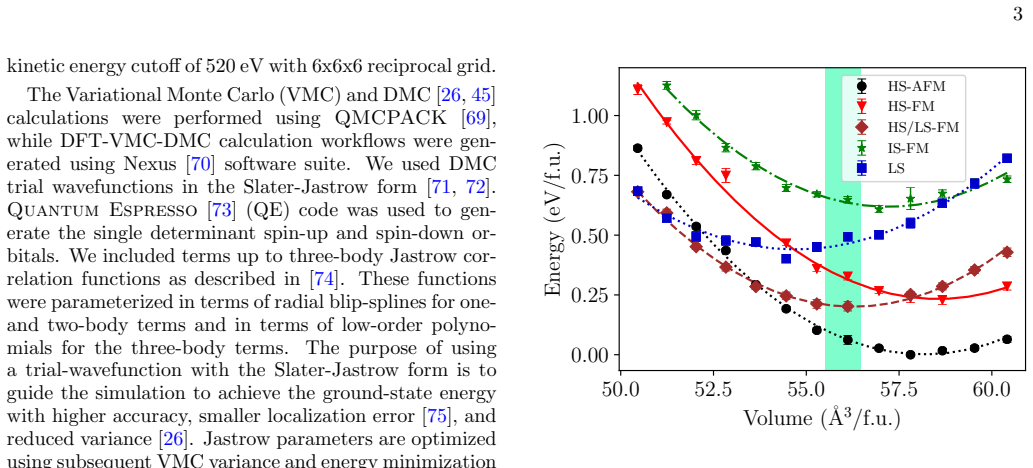
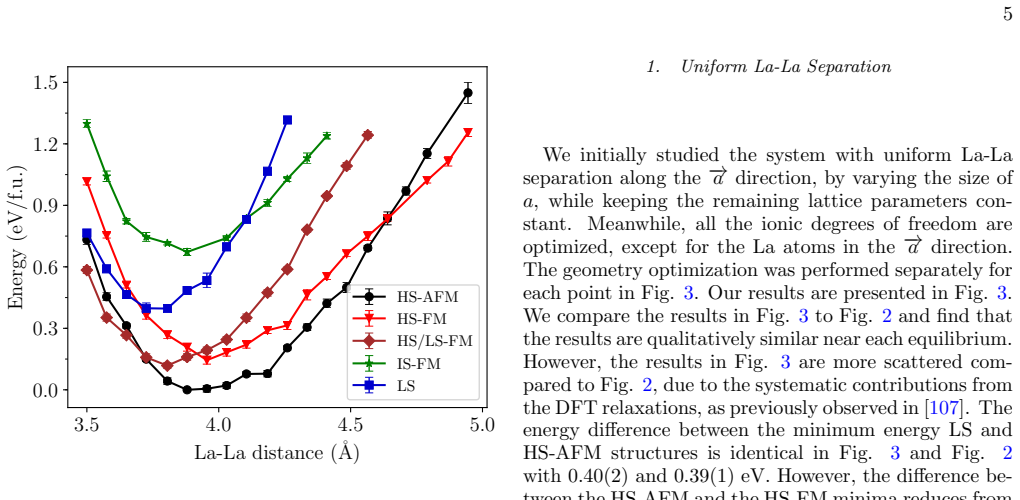
On the paper's own terms: using diffusion Monte Carlo on the experimental low-temperature structure, the authors compute total energies for five ordered spin states of Co3+ — high-spin antiferromagnetic (G-type, spins alternating along every direction), high-spin ferromagnetic, mixed high/low-spin ferromagnetic, intermediate-spin ferromagnetic, and low-spin nonmagnetic. The high-spin antiferromagnetic state is lowest by 0.40(2) eV per formula unit over the nonmagnetic state. Under uniaxial compression or expansion, ferromagnetic phases cross below it, and in the epitaxial superstructure a mixed high-spin-AFM/high-spin-FM pattern costs almost no energy, so ferromagnetism appears with small lattice modulation. The experimentally observed ~4.5 Å La–La stripe separation needs an extra ~0.3 eV per formula unit, which the authors attribute to defects. The same calculations put the optical and quasiparticle gap near 3.7 eV, matching photoluminescence rather than the sub-1 eV conductivity features.
Load-bearing premise
The predicted magnetic ground state is only the lowest of the five spin orders the paper tested; if a spin-canted or otherwise different magnetic order is actually lower in energy, the central conclusion collapses.
Editorial extensions
If this is right
- Bulk LaCoO3 should display short- or long-range G-type antiferromagnetic correlations at low temperature, and the nonmagnetic low-spin picture should be abandoned.
- Epitaxial ferromagnetism in LaCoO3 thin films can arise from strain-induced crossing of ferromagnetic and antiferromagnetic energy curves; a uniform or weakly modulated in-plane strain is sufficient, so oxygen vacancies are not required for the magnetism itself.
- The large lattice modulation observed in STEM images requires about 0.3 eV per formula unit beyond the magnetic energy landscape, pointing to defects as the driver of the superstructure.
- Optical and transport measurements below 1 eV in nominally clean LaCoO3 should be reinterpreted as internal d–d excitations or defect states, since the DMC fundamental gap is about 3.7 eV.
Reading between the lines
- If the antiferromagnetic ground state is confirmed, strain-engineering of LaCoO3 could select ferromagnetic order with far smaller lattice distortion than the observed stripes, changing the design rules for cobaltite films.
- The paper's own caveat about spin-canted structures suggests a direct DMC test with noncollinear spin arrangements; such a calculation would settle whether the predicted ground state survives outside the five orders tested.
- The predicted d–d transition near 0.7 eV could be tested directly by resonant inelastic x-ray scattering or optical spectroscopy under magnetic field, which would separate local spin excitations from charge excitations.
Signed reviews
Editorial analysis
A structured set of objections, weighed in public.
Referee Report
Summary. The manuscript reports diffusion Monte Carlo (DMC) calculations of the structural, electronic, and magnetic properties of bulk and epitaxial LaCoO3. For bulk LaCoO3, the authors find a G-type high-spin antiferromagnetic (HS-AFM) ground state, 0.40(2) eV per formula unit below the nonmagnetic low-spin state, in contrast to the long-held picture of bulk LaCoO3 as nonmagnetic. For epitaxial LaCoO3 on SrTiO3, they find that moderate uniaxial strain stabilizes ferromagnetic phases, that a lateral lattice modulation costs almost no energy for one mixed magnetic configuration, and that the experimentally observed large La-La modulation would require additional energy or defects. They also report DMC optical and quasiparticle gaps near 3.7 eV, larger than most experimental estimates, and argue that internal d-d transitions or defects may explain the discrepancy. The paper includes extensive DFT benchmarks, geometry relaxations with PBEsol+U, and DMC convergence tests for timestep and finite-size effects.
Significance. If the bulk ground-state prediction is correct, the paper overturns a textbook conclusion and reframes the epitaxial ferromagnetism debate, so the claim has high impact. The DMC methodology is handled carefully: the authors report timestep and finite-size convergence, a pseudopotential benchmark for the formation enthalpy (2.62(1) eV/f.u. versus the experimental 2.55(1) eV/f.u.), and a systematic check of the dependence of the phase ordering on the Hubbard U used to construct trial nodes (Fig. 9). The finding that the DMC phase ordering is stable for U from 2 to 10 eV is a genuine strength. The central weakness is that the ground state is identified only among five collinear spin configurations; the paper itself cites a claim that a spin-canted structure may be lower in energy, and that possibility is not tested in DMC. This limits the strength of the central claim until the competing magnetic order is assessed.
major comments (3)
- [Section III B, Fig. 3] The central claim that bulk LaCoO3 has a G-type HS-AFM ground state is established only within the set of five collinear spin configurations studied. The text explicitly states that a spin-canted magnetic structure has been claimed to be energetically more favorable (Section III A, citing Ref. [115]), yet no DMC calculation or controlled estimate for such a noncollinear state is provided. Because the ground-state identification is the paper's headline result, this is a load-bearing gap. Please add DMC calculations of the canted state, or alternatively provide a quantitative estimate of the energy lowering it could produce and demonstrate that it cannot overcome the 0.40(2) eV gap to the LS state.
- [Section II, Appendix] The epitaxial phase diagram is computed at geometries relaxed with PBEsol+U = 4 eV, and the manuscript itself notes that systematic contributions from DFT relaxations introduce scatter into the DMC energies. The PBEsol+U functional is benchmarked only for unstrained bulk volume and Co-O-Co bond angles, not for the strongly strained or modulated geometries used in Fig. 3 and Fig. 4. Because the strain-driven HS-AFM to HS-FM transition is central to the epitaxial conclusions, please provide a DMC-level check of representative relaxed geometries or an explicit sensitivity analysis using an alternative relaxation functional, especially near the crossing at a La-La distance of about 4.6 Å.
- [Appendix] The fixed-node approximation is the dominant systematic error in DMC energy differences among magnetic states. The manuscript optimizes the nodal surface by varying the Hubbard U in the trial wavefunction and shows that the phase ordering is stable, which is valuable, but it does not quantify the residual fixed-node bias for relative phase energies. A single-determinant nodal surface constructed from LDA+U orbitals could, in principle, favor collinear high-spin states relative to the true ground state. Please include a nodal-surface sensitivity test (for example, a multideterminant trial wavefunction for a smaller cell, or a comparison against a different nodal construction for a related cobalt oxide with known magnetic order) or state explicitly in the conclusions that the fixed-node bias is an unresolved uncertainty of this magnitude.
minor comments (4)
- [Abstract] The text reports the DMC equilibrium volume as "58.2(1) Å3 per formula unit (eV/f.u.)"; the parenthetical unit should read "Å3/f.u." rather than "eV/f.u.".
- [Section IV] The formation enthalpy is given as "2.62(1) eV eV/f.u." in Section III A; the duplicate "eV" should be removed.
- [Section III C] The sentence "This is in contrast to long-standing experiments; our experiments support this idea" appears in the conclusions, but the manuscript does not present new experiments. Please rephrase to refer to recent experimental work (e.g., Refs. [49-54]) or to collaborations explicitly if new experimental data are intended.
- [Section III C] In the discussion of band gaps, the manuscript says the DMC gaps are roughly 3.7(2) eV for both LS and HS-AFM states, while Table I lists 3.65 ± 0.06 and 3.77 ± 0.12 eV; please ensure the text and table are consistent and clarify which entries correspond to the optical versus quasiparticle gap at the stated wavevector.
Circularity Check
No circularity found: the DMC energy ordering is computed from the many-body wavefunction, the U parameter is variational and shown not to determine the phase ordering, and the central result is anchored by independent formation-enthalpy and volume benchmarks.
full rationale
The paper's central claim, that bulk LaCoO3 has a G-type HS-AFM ground state 0.40(2) eV/f.u. below the LS state (Fig. 2, Table II), is obtained by direct DMC total-energy comparisons for five spin configurations, not by fitting a parameter to that energy difference. The LDA+U value used to generate trial wavefunctions is explicitly a variational nodal-surface parameter: the paper states 'we show that DMC minima is largely insensitive to the choice of DFT functional, and the choice of U value does not affect the ordering between the magnetic phases of LCO' (Section II and Appendix, Fig. 9), and the plotted ordering is stable for U = 2-10 eV. Thus the 'fitted input called prediction' pattern does not apply. The method is independently anchored within the paper: DMC reproduces the experimental formation enthalpy of LaCoO3 (2.62(1) vs 2.55(1) eV/f.u.) and the equilibrium volume within about 4%, and the pseudopotentials and QMC settings are benchmarked. Self-citations to the authors' prior DMC work on CoO, La-containing compounds, and QMC pseudopotentials (Refs. 35, 42, 46-48, 84-85, 91) support methodological choices, but they are not load-bearing for the central claim because the present paper contains its own external benchmarks and convergence tests; a self-citation that is backed by independent in-paper evidence does not constitute circularity. The paper also honestly flags a completeness limitation rather than hiding it: 'it has been claimed that a spin-canted magnetic structure can also be energetically more favorable compared to the magnetic states we studied in this work [115]' (Section III A). This is a legitimate scientific risk about the restricted magnetic search space, not a circular derivation: the conclusion is explicitly stated as the lowest-energy 'among the structures considered' (Section IV). The band-gap predictions are also not circular: DFT is used only to identify band extrema, while DMC optical/quasiparticle gaps are computed from total-energy differences and finite-size extrapolation (Fig. 5), and the paper openly reports disagreement with some experiments and offers physical explanations. Overall, the derivation chain is self-contained: the predicted ground state is an energy competition computed from the Hamiltonian with controlled approximations, not a restatement of the inputs.
Assumptions & free parameters
free parameters (2)
- LDA+U Hubbard U for DMC trial wavefunction nodal surface =
6 eV
- PBEsol+U Hubbard U for epitaxial geometry relaxation =
4 eV
assumptions (5)
- domain assumption The five magnetic phases studied (HS-AFM, HS-FM, HS/LS-FM, IS-FM, LS) include the true magnetic ground state.
- domain assumption The fixed-node approximation with single-determinant Slater-Jastrow trial wavefunctions yields accurate relative energies among the close-lying magnetic phases.
- domain assumption The experimental 4 K neutron diffraction crystal structure, used unrelaxed for bulk DMC, is a valid geometry for the energy comparison.
- domain assumption PBEsol+U=4 eV optimized geometries are accurate enough for epitaxial DMC energy comparisons.
- standard math The RRKJ LDA pseudopotentials and the locality approximation for nonlocal pseudopotentials are sufficiently accurate for LCO.
Cite this review
Pith. "Pith review of Structural, Electronic and Magnetic Properties of Bulk and Epitaxial LaCoO$_3$ through Diffusion Monte Carlo." pith.science (2026). https://pith.science/paper/XF3SZDWC
@misc{pith2026190802811,
  author       = {Pith},
  title        = {Pith review of: Structural, Electronic and Magnetic Properties of Bulk and Epitaxial LaCoO$_3$ through Diffusion Monte Carlo},
  year         = {2026},
  howpublished = {\url{https://pith.science/paper/XF3SZDWC}},
  note         = {Machine review of arXiv:1908.02811}
}
abstract
Magnetism in lanthanum cobaltite (LCO, LaCoO$_3$) appears to be strongly dependent on strain, defects, and nanostructuring. LCO on strontium titanate (STO, SrTiO$_3$) is a ferromagnet with an interesting strain relaxation mechanism that yields a lattice modulation. However, the driving force of the ferromagnetism is still controversial. Experiments debate between a vacancy-driven or strain-driven mechanism for the ferromagnetism of epitaxial LCO. We found that a weak lateral modulation of the superstructure is sufficient to promote ferromagnetism. We find that ferromagnetism appears under uniaxial compression and expansion. Although earlier experiments suggest that bulk LCO is nonmagnetic, we find an antiferromagnetic ground state for bulk LCO. We discuss the recent experiments which indicate a more complicated picture for bulk magnetism and a closer agreement with our calculations. Role of defects are also discussed through excited state calculations.
Figures

Figures from the paper (5 more)





Reference graph
Works this paper leans on
- [115]
-
[1]
Meanwhile, all the ionic degrees of freedom are optimized, except for the La atoms in the − →a direction
Uniform La-La Separation We initially studied the system with uniform La-La separation along the − →a direction, by varying the size of a, while keeping the remaining lattice parameters con- stant. Meanwhile, all the ionic degrees of freedom are optimized, except for the La atoms in the − →a direction. The geometry optimization was performed separately fo...
-
[2]
4, we study the lattice modulation under the epitaxial conditions with two coexisting magnetic phases
Modulated La-La Separation In Fig. 4, we study the lattice modulation under the epitaxial conditions with two coexisting magnetic phases. The definitions for the lattice parameters and directions here are identical to Section III B. Here, the lattice pa- rameters are fixed as a = 3×aST O, b = 2×aST O, and c = 7.52 ˚A. However, the La-La distances along the ...
-
[3]
K. H. Ahn, T. Lookman, and A. R. Bishop, Nature 428, 401 (2004)
2004
-
[4]
Dagotto, Science (80-
E. Dagotto, Science (80-. ). 309, 257 (2005)
2005
-
[5]
Tokura and N
Y. Tokura and N. Nagaosa, Science (80-. ). 288, 462 (2000)
2000
-
[6]
Gazquez, W
J. Gazquez, W. Luo, M. P. Oxley, M. Prange, M. A. Torija, M. Sharma, C. Leighton, S. T. Pantelides, S. J. Pennycook, and M. Varela, Nano Lett. 11, 973 (2011)
2011
-
[7]
Biˇ skup, J
N. Biˇ skup, J. Salafranca, V. Mehta, M. P. Oxley, Y. Suzuki, S. J. Pennycook, S. T. Pantelides, and M. Varela, Phys. Rev. Lett. 112, 087202 (2014)
2014
Show all 153 references
-
[8]
V. V. Mehta, N. Biskup, C. Jenkins, E. Arenholz, M. Varela, and Y. Suzuki, Phys. Rev. B 91, 144418 (2015)
2015
-
[9]
L. Qiao, J. H. Jang, D. J. Singh, Z. Gai, H. Xiao, A. Mehta, R. K. Vasudevan, A. Tselev, Z. Feng, H. Zhou, S. Li, W. Prellier, X. Zu, Z. Liu, A. Bori- sevich, A. P. Baddorf, and M. D. Biegalski, Nano Lett. 15, 4677 (2015)
2015
-
[10]
J. H. Kwon, W. S. Choi, Y. K. Kwon, R. Jung, J. M. Zuo, H. N. Lee, and M. Kim, Chem. Mater. 26, 2496 (2014)
2014
-
[11]
W. S. Choi, J. H. Kwon, H. Jeen, J. E. Hamann-Borrero, A. Radi, S. MacKe, R. Sutarto, F. He, G. A. Sawatzky, V. Hinkov, M. Kim, and H. N. Lee, Nano Lett. 12, 4966 (2012)
2012
-
[12]
R. F. Klie, J. C. Zheng, Y. Zhu, M. Varela, J. Wu, and C. Leighton, Phys. Rev. Lett. 99, 047203 (2007)
2007
-
[13]
W. C. Koehler and E. O. Wollan, J. Phys. Chem. Solids 2, 100 (1957)
1957
-
[14]
Zobel, M
C. Zobel, M. Kriener, D. Bruns, J. Baier, M. Gruninger, T. Lorenz, P. Reutler, and A. Revcolevschi, Phys. Rev. B 66, 020402(R) (2002)
2002
-
[15]
Podlesnyak, S
A. Podlesnyak, S. Streule, J. Mesot, M. Medarde, E. Pomjakushina, K. Conder, A. Tanaka, M. W. Haverkort, and D. I. Khomskii, Phys. Rev. Lett. 97, 247208 (2006)
2006
-
[16]
P. G. Radaelli and S. W. Cheong, Phys Rev B 66, 094408 (2002)
2002
-
[17]
Se˜ nars-Rodrguez and J
M. Se˜ nars-Rodrguez and J. Goodenough, J. Solid State Chem. 116, 224 (1995)
1995
-
[18]
Phelan, D
D. Phelan, D. Louca, S. Rosenkranz, S.-H. Lee, Y. Qiu, P. J. Chupas, R. Osborn, H. Zheng, J. F. Mitchell, J. R. D. Copley, J. L. Sarrao, and Y. Moritomo, Phys. Rev. Lett. 96, 027201 (2006)
2006
-
[19]
Saitoh, T
T. Saitoh, T. Mizokawa, A. Fujimori, M. Abbate, Y. Takeda, and M. Takano, Phys. Rev. B 55, 4257 (1997)
1997
-
[20]
K. Asai, A. Yoneda, O. Yokokura, J. M. Tranquada, G. Shirane, and K. Kohn, J. Phys. Soc. Japan 67, 290 (1998)
1998
-
[21]
Fuchs, L
D. Fuchs, L. Dieterle, E. Arac, R. Eder, P. Adelmann, V. Eyert, T. Kopp, R. Schneider, D. Gerthsen, and H. v. L¨ ohneysen, Phys. Rev. B79, 024424 (2009)
2009
-
[22]
S. Zhou, L. Shi, J. Zhao, L. He, H. Yang, and S. Zhang, Phys. Rev. B 76, 172407 (2007)
2007
-
[23]
Fuchs, C
D. Fuchs, C. Pinta, T. Schwarz, P. Schweiss, P. Nagel, S. Schuppler, R. Schneider, M. Merz, G. Roth, and H. v. L¨ ohneysen, Phys. Rev. B75, 144402 (2007). 11 2 3 4 5 6 k-point set: NXNXN (N) 0.00 0.02 0.04 ∆Energy w.r.t N=6 (eV/per Co) VMC FIG. 7. One-body finite size error as ...
2007
-
[24]
F. Ma, S. Zhang, and H. Krakauer, New J. Phys. 15 (2013), arXiv:1211.4635
2013 arXiv
-
[25]
Kohn and L
W. Kohn and L. J. Sham, Phys. Rev. 140, A1133 (1965)
1965
-
[26]
Hohenberg and W
P. Hohenberg and W. Kohn, Phys. Rev. B 136, B864 (1964)
1964
-
[27]
Kolorenc, S
J. Kolorenc, S. Hu, and L. Mitas, Phys. Rev. B 82, 115108 (2010)
2010
-
[28]
D. M. Ceperley and B. J. Alder, Phys. Rev. Lett. 45, 566 (1980)
1980
-
[29]
Foulkes, L
W. Foulkes, L. Mitas, R. Needs, and G. Rajagopal, Rev. Mod. Phys. 73, 33 (2001)
2001
-
[30]
Mitra, J
C. Mitra, J. T. Krogel, J. A. Santana, and F. A. Re- boredo, J. Chem. Phys. 143, 164710 (2015)
2015
-
[31]
J. Yu, L. K. Wagner, and E. Ertekin, The J. Chem. Phys. 143, 224707 (2015). 2 4 6 8 10 U (eV) −902.275 −902.250 −902.225 −902.200 −902.175 Energy (Ha) HS-AFM HS-FM HS/LS IS-FM LS FIG. 9. DMC wavefunction optimization of 20-atom bulk LaCoO3 with 2x2x2 reciprocal grid. The wavef...
2015
-
[32]
R. J. Needs and M. D. Towler, Int. J. Mod. Phys. B 17, 5425 (2003)
2003
-
[33]
Saritas, T
K. Saritas, T. Mueller, L. Wagner, and J. C. Grossman, J. Chem. Theory Comput. 13, 1943 (2017)
2017
-
[34]
J. A. Schiller, L. K. Wagner, and E. Ertekin, Phys. Rev. B 92, 235209 (2015)
2015
-
[35]
Saritas, J
K. Saritas, J. T. Krogel, P. R. C. Kent, and F. A. Reboredo, Phys. Rev. Materials 2, 085801 (2018)
2018
-
[36]
Benali, L
A. Benali, L. Shulenburger, J. T. Krogel, X. Zhong, P. R. C. Kent, and O. Heinonen, Phys. Chem. Chem. Phys. 18, 1 (2016)
2016
-
[37]
Trail, B
J. Trail, B. Monserrat, P. L´ opez R´ ıos, R. Maezono, and R. J. Needs, Phys. Rev. B 95, 121108(R) (2017)
2017
-
[38]
Y. Luo, A. Benali, L. Shulenburger, J. T. Krogel, O. Heinonen, and P. R. C. Kent, New J. Phys. 18, 113049 (2016)
2016
-
[39]
J. Yu, L. K. Wagner, and E. Ertekin, Phys. Rev. B 95, 075209 (2017)
2017
-
[40]
Zheng and L
H. Zheng and L. K. Wagner, Phys. Rev. Lett. 114, 176401 (2015)
2015
-
[41]
Kyl¨ anp¨ a¨ a, J
I. Kyl¨ anp¨ a¨ a, J. Balachandran, P. Ganesh, O. Heinonen, P. R. C. Kent, and J. T. Krogel, Phys. Rev. Materials 1, 065408 (2017)
2017
-
[42]
H. Shin, A. Benali, Y. Luo, E. Crabb, A. Lopez- Bezanilla, L. E. Ratcliff, A. M. Jokisaari, and O. Heinonen, Phys. Rev. Materials 2, 075001 (2018)
2018
-
[43]
J. A. Santana, J. T. Krogel, J. Kim, P. R. C. Kent, and F. A. Reboredo, The J. Chem. Phys. 142, 164705 (2015)
2015
-
[44]
H. Shin, Y. Luo, P. Ganesh, J. Balachandran, J. T. Krogel, P. R. C. Kent, A. Benali, and O. Heinonen, Phys. Rev. Materials 1, 073603 (2017)
2017
-
[45]
R. J. Needs, M. D. Towler, N. D. Drummond, and 12 P. L´ opez R´ ıos, J. Phys.: Condensed Matter22, 023201 (2010)
2010
-
[46]
Saritas, W
K. Saritas, W. Ming, M.-H. Du, and F. A. Reboredo, J. Phys. Chem. Lett. 10, 67 (2019)
2019
-
[47]
Shulenburger and T
L. Shulenburger and T. R. Mattsson, Phys. Rev. B 88, 245117 (2013)
2013
-
[48]
J. A. Santana, J. T. Krogel, P. R. C. Kent, and F. A. Reboredo, J. Chem. Phys. 147, 034701 (2017)
2017
-
[49]
Saritas, J
K. Saritas, J. T. Krogel, and F. A. Reboredo, Phys. Rev. B 98, 155130 (2018)
2018
-
[50]
J. A. Santana, J. T. Krogel, P. R. C. Kent, and F. A. Reboredo, J. Chem. Phys. 144, 174707 (2016)
2016
-
[51]
A. M. Durand, T. J. Hamil, D. P. Belanger, S. Chi, F. Ye, J. A. Fernandez-Baca, Y. Abdollahian, and C. H. Booth, J. Phys. Condens. Matter 27, 126001 (2015)
2015
-
[52]
D. P. Belanger, T. Keiber, D. Bridges, A. M. Durand, A. Mehta, H. Zheng, J. F. Mitchell, and V. Borzenets, J. Phys. Condens. Matter 28, 025602 (2016)
2016
-
[53]
A. M. Durand, D. P. Belanger, T. J. Hamil, F. Ye, S. Chi, J. A. Fernandez-Baca, C. H. Booth, Y. Abdol- lahian, and M. Bhat, J. Phys. Condens. Matter 27, 176003 (2015)
2015
-
[54]
M. Itoh, M. Sugahara, K. Motoya, and I. Natori, J. Phys. Soc. Japan 64, 3967 (1995)
1995
-
[55]
G. M. Kaminsky, D. P. Belanger, F. Ye, J. A. Fernandez- Baca, J. Wang, M. Matsuda, and J. Q. Yan, Phys. Rev. B 97, 024418 (2018)
2018
-
[56]
A. M. Durand, D. P. Belanger, C. H. Booth, F. Ye, S. Chi, J. A. Fernandez-Baca, and M. Bhat, J. Phys. Condens. Matter 25, 382203 (2013)
2013
-
[57]
J. P. Perdew, A. Ruzsinszky, G. I. Csonka, O. A. Vy- drov, G. E. Scuseria, L. A. Constantin, X. Zhou, and K. Burke, Phys. Rev. Lett. 100, 136406 (2008)
2008
-
[58]
J. P. Perdew and A. Zunger, Phys. Rev. B 23, 5048 (1981)
1981
-
[59]
J. P. Perdew, K. Burke, and M. Ernzerhof, Phys. Rev. Lett. 77, 3865 (1996)
1996
-
[60]
J. Heyd, G. E. Scuseria, and M. Ernzerhof, J. Chem. Phys. 118, 8207 (2003)
2003
-
[61]
J. P. Perdew, W. Yang, K. Burke, Z. Yang, E. K. U. Gross, M. Scheffler, G. E. Scuseria, T. M. Henderson, I. Y. Zhang, A. Ruzsinszky, H. Peng, J. Sun, E. Trushin, and A. G¨ orling, PNAS114, 2801 (2017)
2017
-
[62]
A. D. Becke, J. Chem. Phys. 98, 5648 (1993)
1993
-
[63]
S. L. Dudarev, G. A. Botton, S. Y. Savrasov, C. J. Humphreys, and A. P. Sutton, Phys. Rev. B 57, 1505 (1998)
1998
-
[64]
Adamo and V
C. Adamo and V. Barone, J. Chem. Phys. 110, 6158 (1999)
1999
-
[65]
V. I. Anisimov, F. Aryasetiawan, and A. I. Lichtenstein, J. Phys.: Condens. Matter 9, 767 (1997)
1997
-
[66]
Thornton, B
G. Thornton, B. C. Tofield, and A. W. Hewat, J. Solid State Chem. 61, 301 (1986), 0112017
1986
-
[67]
Archibald, J
R. Archibald, J. T. Krogel, and P. R. Kent, J. Chem. Phys. 149, 164116 (2018)
2018
-
[68]
Sorella and L
S. Sorella and L. Capriotti, J. Chem. Phys. 133, 234111 (2010)
2010
-
[69]
Kim et al
J. Kim et al. , J. Phys.: Condens. Matter 30, 195901 (2018)
2018
-
[70]
Kresse and J
G. Kresse and J. Furthm¨ uller, Phys. Rev. B 54, 11169 (1996)
1996
-
[71]
Kresse and D
G. Kresse and D. Joubert, Phys. Rev. B59, 1758 (1999)
1999
-
[72]
Jastrow, Phys
R. Jastrow, Phys. Rev. 98, 1479 (1955)
1955
-
[73]
J. T. Krogel, Comput. Phys. Commun. 198, 154 (2016)
2016
-
[74]
J. C. Slater, Phys. Rev. 34, 1293 (1929)
1929
-
[75]
Mitas, E
L. Mitas, E. L. Shirley, and D. M. Ceperley, The J. Chem. Phys. 95, 3467 (1991)
1991
-
[76]
Giannozzi et al
P. Giannozzi et al. , J. Phys.: Condens. Matter 21, 395502 (2009)
2009
-
[77]
N. D. Drummond, M. D. Towler, and R. J. Needs, Phys. Rev. B 70, 235119 (2004)
2004
-
[78]
Y. Kwon, D. M. Ceperley, and R. M. Martin, Phys. Rev. B 48, 12037 (1993)
1993
-
[79]
C. J. Umrigar, J. Toulouse, C. Filippi, S. Sorella, and R. G. Hennig, Phys. Rev. Lett. 98, 110201 (2007)
2007
-
[80]
C. J. Umrigar and C. Filippi, Phys. Rev. Lett. 94, 150201 (2005)
2005
-
[81]
Bajdich, M
M. Bajdich, M. L. Tiago, R. Q. Hood, P. R. C. Kent, and F. A. Reboredo, Phys. Rev. Lett. 104, 193001 (2010)
2010
-
[82]
Y. Kwon, D. M. Ceperley, and R. M. Martin, Phys. Rev. B 58, 6800 (1998)
1998
-
[83]
L´ opez R´ ıos, A
P. L´ opez R´ ıos, A. Ma, N. D. Drummond, M. D. Towler, and R. J. Needs, Phys. Rev. E 74, 066701 (2006)
2006
-
[84]
A. L. Dzubak, J. T. Krogel, and F. A. Reboredo, The J. Chem. Phys. 147, 024102 (2017)
2017
-
[85]
See Supplementary Information at
-
[86]
Casula, S
M. Casula, S. Moroni, S. Sorella, and C. Filippi, J. Chem. Phys. 132, 154113 (2010)
2010
-
[87]
P. R. C. Kent, R. Q. Hood, A. J. Williamson, R. J. Needs, W. M. C. Foulkes, and G. Rajagopal, Phys. Rev. B 59, 1917 (1999)
1999
-
[88]
J. T. Krogel and P. R. C. Kent, The J. Chem. Phys. 146, 244101 (2017)
2017
-
[89]
A. J. Williamson, G. Rajagopal, R. J. Needs, L. M. Fraser, W. M. C. Foulkes, Y. Wang, and M.-Y. Chou, Phys. Rev. B 55, R4851 (1997)
1997
-
[90]
Opium pseudopotential generator,
“Opium pseudopotential generator,” http://opium. sourceforge.net
-
[91]
N. D. Drummond, R. J. Needs, A. Sorouri, and W. M. C. Foulkes, Phys. Rev. B 78, 125106 (2008)
2008
-
[92]
L. M. Fraser, W. M. C. Foulkes, G. Rajagopal, R. J. Needs, S. D. Kenny, and A. J. Williamson, Phys. Rev. B 53, 1814 (1996)
1996
- [93]
-
[94]
J. T. Krogel, J. A. Santana, and F. A. Reboredo, Phys. Rev. B 93, 075143 (2016)
2016
-
[95]
Y. Luo, K. P. Esler, P. R. C. Kent, and L. Shulenburger, J. Chem. Phys 149, 84107 (2018)
2018
-
[96]
Autret, J
C. Autret, J. Hejtm´ anek, K. Kn´ ıˇ zek, M. Maryˇ sko, Z. Jir´ ak, M. Dlouh´ a, and S. Vratislav, J. Phys. Con- dens. Matter 17, 1601 (2005)
2005
-
[97]
Hinuma, G
Y. Hinuma, G. Pizzi, Y. Kumagai, F. Oba, and I. Tanaka, Comput. Mater. Sci. 128, 140 (2017)
2017
-
[98]
J. H. Lloyd-Williams and B. Monserrat, Phys. Rev. B 92, 184301 (2015)
2015
-
[99]
R. R. Heikes, R. C. Miller, and R. Mazelsky, Physica 30, 1600 (1964)
1964
-
[100]
Oygarden, H
V. Oygarden, H. L. Lein, and T. Grande, J. Solid State Chem. 192, 246 (2012)
2012
-
[101]
E. O. Wollan and W. C. Koehler, Phys. Rev. 100, 545 (1955)
1955
-
[102]
J. B. Goodenough, Czechoslov. J. Phys. 17, 304 (1967)
1967
-
[103]
P. M. Raccah and J. B. Goodenough, Phys. Rev. 155, 932 (1967)
1967
-
[104]
J. B. Goodenough, J. Phys. Chem. Solids 6, 287 (1958)
1958
-
[105]
Buckeridge, F
J. Buckeridge, F. H. Taylor, and C. R. A. Catlow, Phys. Rev. B 93, 155123 (2016). 13
2016
-
[106]
Yan, J.-S
J.-Q. Yan, J.-S. Zhou, and J. B. Goodenough, Phys. Rev. B 70, 014402 (2004)
2004
-
[107]
Mukhopadhyay, M
S. Mukhopadhyay, M. W. Finnis, and N. M. Harrison, Phys. Rev. B 87, 125132 (2013)
2013
-
[108]
A. M. Ritzmann, M. Pavone, A. B. Mu˜ noz-Garc´ ıa, J. A. Keith, and E. A. Carter, J. Mater. Chem. A 2, 8060 (2014)
2014
-
[109]
M. A. Korotin, S. Y. Ezhov, I. V. Solovyev, V. I. Anisi- mov, D. I. Khomskii, and G. A. Sawatzky, Phys. Rev. B 54, 5309 (1996)
1996
-
[110]
J. M. Rondinelli and N. A. Spaldin, Phys. Rev. B 79, 054409 (2009)
2009
-
[111]
Abbate, J
M. Abbate, J. C. Fuggle, A. Fujimori, L. H. Tjeng, C. T. Chen, R. Potze, G. A. Sawatzky, H. Eisaki, and S. Uchida, Phys. Rev. B 47, 16124 (1993)
1993
-
[112]
F. D. Murnaghan, Proc. Natl. Acad. Sci. 30, 244 (1944)
1944
-
[113]
Chainani, M
A. Chainani, M. Mathew, and D. D. Sarma, Phys. Rev. B 46, 9976 (1992)
1992
-
[114]
Arima, Y
T. Arima, Y. Tokura, and J. B. Torrance, Phys. Rev. B 48, 17006 (1993)
1993
-
[116]
Tokura, Y
Y. Tokura, Y. Okimoto, S. Yamaguchi, H. Taniguchi, T. Kimura, and H. Takagi, Phys. Rev. B - Condens. Matter Mater. Phys. 58, R1699 (1998)
1998
-
[117]
Y. Li, S. J. Peng, D. J. Wang, K. M. Wu, and S. H. Wang, AIP Adv. , 056317 (2008)
2008
-
[118]
H. Seo, A. Posadas, and A. A. Demkov, Phys. Rev. B 86, 014430 (2012)
2012
-
[119]
R. D. Shannon, Acta Crystallogr. Sect. A 32, 751 (1976)
1976
-
[120]
K. I. Kugel’ and D. I. Khomskii, Acad. Sci. USSR Usp. Fiz. Nauk , Tech. Rep. (1982)
1982
-
[121]
Kanamori, J
J. Kanamori, J. Appl. Phys. (1960)
1960
-
[122]
P. W. Anderson, Phys. Rev. 79, 350 (1950)
1950
-
[123]
He and C
J. He and C. Franchini, Phys. Rev. B 86, 235117 (2012)
2012
-
[124]
between the PBE0 VASP-PAW and CRYSTAL- LCAO band gaps (2.4 eV vs. 3.2 eV). Our VASP-PAW DFT+U =4 eV and hybrid-DFT calculations are in very good agreement with the literature; therefore, we validate the VASP-PAW results from Gryaznov et. al. [124]. On the other hand, the bench...
-
[125]
H. Hsu, K. Umemoto, M. Cococcioni, and R. Wentz- covitch, Phys. Rev. B 79, 125124 (2009)
2009
-
[126]
Kniaek, P
K. Kniaek, P. Nov´ ak, and Z. Jir´ ak, Phys. Rev. B 71, 054420 (2005)
2005
-
[127]
Gryaznov, R
D. Gryaznov, R. A. Evarestov, and J. Maier, Phys. Rev. B 82, 224301 (2010)
2010
-
[128]
Jayapandi, D
S. Jayapandi, D. Lakshmi, S. Premkumar, P. Packi- yaraj, and K. Anitha, Mater. Lett. 218, 205 (2018)
2018
-
[129]
Jayapandi, V
S. Jayapandi, V. A. Prakasini, and K. Anitha, in AIP Conf. Proc., Vol. 1942 (2018) p. 140048
2018
-
[130]
S. K. M. G. K. D. Blaha, P. and L. J.,
-
[131]
Dovesi, A
R. Dovesi, A. Erba, R. Orlando, C. M. Zicovich-Wilson, B. Civalleri, L. Maschio, M. R´ erat, S. Casassa, J. Baima, S. Salustro, and B. Kirtman, Wiley Interdiscip. Rev. Comput. Mol. Sci. 8, e1360 (2018)
2018
-
[132]
A. I. Liechtenstein, V. I. Anisimov, and J. Zaanen, Phys. Rev. B 52, R5467 (1995)
1995
-
[133]
T. Dong, H. Suk, and H. Hosun, J. Korean Phys. Soc. 50, 632 (2007)
2007
-
[134]
Scemama, A
A. Scemama, A. Benali, D. Jacquemin, M. Caffarel, and P. F. Loos, J. Chem. Phys. 149, 034108 (2018)
2018
-
[135]
N. S. Blunt and E. Neuscamman, J. Chem. Theory Comput. 15, 178 (2019)
2019
-
[136]
N. S. Blunt and E. Neuscamman, J. Chem. Phys. 147, 194101 (2017)
2017
-
[137]
Zhao and E
L. Zhao and E. Neuscamman, Phys. Rev. Lett. 123, 036402 (2019)
2019
-
[138]
Pavarini, E
E. Pavarini, E. Koch, J. van den Brink, and G. Sawatzky, Quantum Materials: Experiments and Theory, Modeling and Simulation , Vol. 6 (2016)
2016
-
[139]
W. H. Baur, Acta Crystallogr. Sect. B Struct. Crystal- logr. Cryst. Chem. 30, 1195 (1974)
1974
-
[140]
Kˇ r´ apek, P
V. Kˇ r´ apek, P. Nov´ ak, J. Kuneˇ s, D. Novoselov, D. M. Korotin, and V. I. Anisimov, Phys. Rev. B 86, 195104 (2012)
2012
-
[141]
Izquierdo, M
M. Izquierdo, M. Karolak, C. Trabant, K. Holldack, A. F¨ ohlisch, K. Kummer, D. Prabhakaran, A. T. Boothroyd, M. Spiwek, A. Belozerov, A. Poteryaev, A. Lichtenstein, and S. L. Molodtsov, Phys. Rev. B - Condens. Matter Mater. Phys. 90, 235128 (2014)
2014
-
[142]
Y. Wang, Z. Wang, Z. Fang, and X. Dai, Phys. Rev. B 91, 125139 (2015)
2015
-
[143]
Siurakshina, B
L. Siurakshina, B. Paulus, V. Yushankhai, and E. Sivachenko, Eur. Phys. J. B 74, 53 (2010)
2010
-
[144]
Eder, Phys
R. Eder, Phys. Rev. B 81, 035101 (2010)
2010
-
[145]
Takahashi, F
H. Takahashi, F. Munakata, and M. Yamanaka, Phys. Rev. B - Condens. Matter Mater. Phys. 57, 15211 (1998)
1998
-
[146]
Kushima, S
A. Kushima, S. Yip, and B. Yildiz, Phys. Rev. B 82, 115435 (2010)
2010
-
[147]
J. W. Han and B. Yildiz, J. Mater. Chem. 21, 18983 (2011)
2011
-
[148]
V. I. Anisimov, J. Zaanen, and O. K. Andersen, Phys. Rev. B 44, 943 (1991)
1991
-
[149]
Peng and J
H. Peng and J. P. Perdew, Phys. Rev. B 96, 100101(R) (2017)
2017
-
[150]
D. A. Kitchaev, H. Peng, Y. Liu, J. Sun, J. P. Perdew, and G. Ceder, Phys. Rev. B 93, 045132 (2016)
2016
-
[151]
Sai Gautam and E
G. Sai Gautam and E. A. Carter, Phys. Rev. Mater. 2, 095401 (2018)
2018
-
[152]
L. Wang, T. Maxisch, and G. Ceder, Phys. Rev. B 73, 195107 (2006)
2006
-
[153]
A. Jain, G. Hautier, S. P. Ong, C. J. Moore, C. C. Fischer, K. A. Persson, and G. Ceder, Phys. Rev. B 84, 045115 (2011)
2011
Reviewed August 14, 2026 · model on record in the stance chip above.
Discussion (0). Continue with ORCID to comment.