REVIEW 4 major objections 6 minor 12 references
Superconductivity of Pure H3S Synthesis from Elemental Sulfur and Hydrogen
T0 review · 4 major / 6 minor · reviewed 2026-08-14 · deepseek-v4-flash
Pith's one-line read Pure H3S made from elemental sulfur and hydrogen shows a superconducting transition at 200 K, with a 186 K offset—the highest in the S–H system.
desk verdict First transport data on directly synthesized H3S, with the superconducting step landing right on the known Tc(P) curve; the claim is plausible but rests on a single two-probe resistance drop with no zero resistance or magnetic screening. read the letter →
The pith
A machine-rendered reading of the paper's core claim, the machinery that carries it, and where it could break.
The reading
What carries the argument
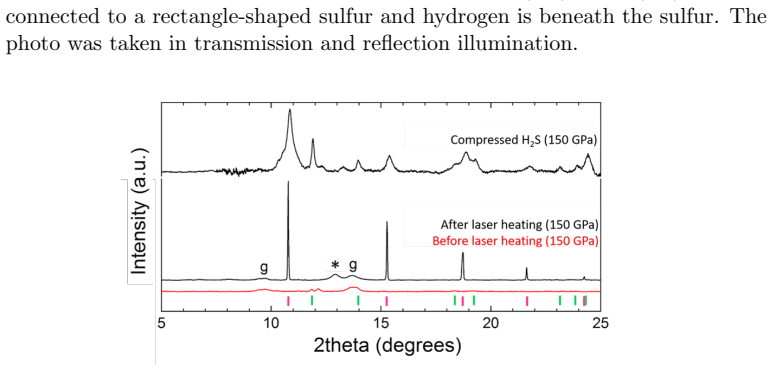
The central object is the phase-pure H3S sample with a body-centered-cubic sulfur sublattice (Im3m structure), prepared by laser heating of a sulfur-hydrogen mixture near 150 GPa under hydrogen-excess conditions. The argument rests on three pieces: direct synthesis yields no excess sulfur and much improved crystallinity, as shown by sharp PXRD peaks; the sharp resistance step near 200 K is anchored to superconductivity by its position on the established Tc(P) curve and by the absence of any known low-temperature structural transition; and the narrow transition width of about 14 K is read as a consequence of the sample's crystalline quality. The electrical measurement is AC two-probe resistance, pressure is determined from the diamond Raman edge, and the structural identification uses synchrotron PXRD with wavelength 0.41235 Å.
What would settle it
Cool the same directly synthesized H3S sample at 146 GPa from 200 K to below 186 K while measuring four-probe resistance and magnetic susceptibility; observing zero resistance and a diamagnetic Meissner signal would confirm the step is superconductivity, while their absence—or a low-temperature X-ray diffraction scan showing a structural transition across this range—would falsify the claim.
Extended reading notes
Core claim
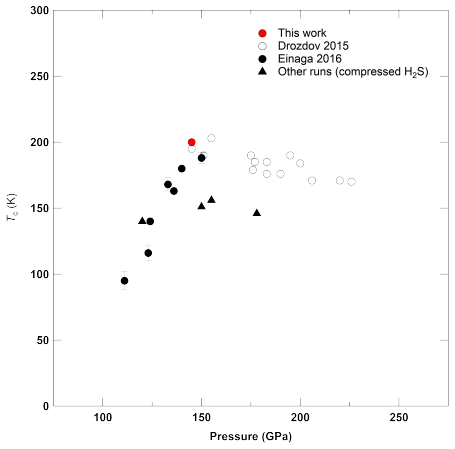
The central claim is that H3S synthesized directly from elemental sulfur and molecular hydrogen, via the reaction 3H2 + 2S -> 2H3S under hydrogen-excess conditions, is superconducting at high pressure. In a diamond anvil cell at 150 GPa, the authors laser-heated a sulfur-hydrogen mixture and observed a resistance drop to about 16 Ω; synchrotron powder X-ray diffraction then identified cubic Im3m H3S with a = 3.1027(5) Å and no residual sulfur. On cooling at 146 GPa, the resistance was metallic until a sharp step at about 200 K, reaching an offset near 186 K. The step is assigned to a superconducting transition because its pressure-temperature point closely matches the known Tc(P) curve of H3S derived from H2S, and because earlier diffraction work found no low-temperature structural phase transition in that region. Zero resistance was not observed because the measurement used a two-probe configuration, with residual resistance attributed to contacts and gold leads; the paper concludes that Toffset ~ 186 K is the highest offset temperature reported in the sulfur-hydrogen system.
Load-bearing premise
The sharp resistance drop at about 200 K is assumed to be an intrinsic superconducting transition of the H3S sample rather than a contact or probe artifact or a structural phase transition; if that assumption fails, the central claim does not follow.
Editorial extensions
If this is right
- If the transition is superconducting, the high Tc of the sulfur-hydrogen system does not require the H2S decomposition route; direct synthesis yields a cleaner material with the same high onset.
- The highest offset temperature of 186 K in the S-H system implies that better-crystallized samples can complete the resistive transition at higher temperature, suggesting disorder mostly broadens and lowers the transition's end point.
- The sharper diffraction peaks and narrower transition indicate that crystalline quality, not just stoichiometry, controls the spread of Tc seen in earlier H2S-derived samples.
- The demonstration opens a route for controlled variation of the synthesis—such as adjusting hydrogen excess or substituting deuterium—without sulfur contamination, enabling cleaner tests of superconductivity mechanisms.
Reading between the lines
- A natural next step is a four-probe or magnetic measurement on the same synthesis route; confirming zero resistance and a Meissner signal would make the direct-synthesis method the standard preparation for studying H3S superconductivity.
- The same direct-synthesis approach could be applied to deuterium substitution (D3S) under identical hydrogen-excess conditions to measure the isotope effect in a stoichiometrically clean sample, which the H2S route cannot provide as cleanly.
- The sharper transition in this cleaner material suggests that part of the Tc spread in H2S-derived samples comes from disorder; this could be tested by deliberately adding sulfur impurities to directly synthesized H3S and observing whether Toffset degrades.
Signed reviews
Editorial analysis
A structured set of objections, weighed in public.
Referee Report
Summary. The manuscript reports the first electrical resistance measurements on H3S synthesized directly from elemental sulfur and hydrogen in a diamond anvil cell. The authors load S and H2, compress to 150 GPa, laser-heat to synthesize Im-3m H3S, and confirm the structure by synchrotron powder X-ray diffraction. On cooling at 146 GPa they observe a sharp resistance drop with Tonset ~ 200 K and Toffset ~ 186 K, and they attribute this step to a superconducting transition based on its proximity to the known Tc(P) of H3S and on the absence of known structural transitions in this pressure range. The paper acknowledges that the two-probe method prevents observation of zero resistance and that the laser-heating resistance drop was likely a contact artifact.
Significance. If the identification is correct, the paper provides the first transport evidence for superconductivity in stoichiometric, impurity-free H3S made by direct synthesis, with a sharper transition width and the highest Toffset reported in the S-H system. The synthesis route and structural characterization are well documented, and the comparison to external Tc(P) data is appropriate and avoids circular reasoning. The main limitation is that the central claim rests on a single two-probe resistance trace, with no zero-resistance plateau, no Meissner measurement, no magnetic-field dependence, and no low-temperature structural data on this exact sample. The result is plausible and valuable but the evidence is not yet conclusive.
major comments (4)
- [Section 3 (conclusion paragraph)] The conclusion that the sharp resistance step corresponds to a superconducting transition is stronger than the evidence supports. The measurement is AC two-probe, zero resistance was not observed, no Meissner signal was measured, and no magnetic-field dependence is reported. The paper itself attributes the laser-heating resistance drop to a partial restoration of electrical contact between the sample and the Au probe, which shows that contact artifacts are a known issue in this geometry. The 200 K step could in principle also be a contact or probe artifact, or a structural/electronic transition. Please rephrase the conclusion to state that the step is 'consistent with a superconducting transition,' and add a detailed discussion of the possible artifacts and why they are considered unlikely.
- [Section 3 (paragraph on absence of phase transition)] The exclusion of a structural phase transition is based on prior low-temperature PXRD on compressed H2S [6] and on theoretical calculations, not on low-temperature X-ray diffraction of the present directly synthesized sample. Because the synthesis route and sample quality differ from those in Ref. [6], the absence of a structural transition in this specific sample is not established. The authors should either provide low-temperature XRD data for a directly synthesized sample or explicitly state that this check was not performed and treat this as a limitation.
- [Fig. 3 and accompanying text] The manuscript shows heating and cooling resistance curves but does not state whether the resistance step was reproduced in both directions or whether any hysteresis was observed. A superconducting transition should be reversible with no hysteresis, whereas a first-order structural transition might show hysteresis. Please report the heating and cooling traces quantitatively, including the measurement current/frequency and the noise floor, and indicate whether the step position and width are identical on heating and cooling.
- [Section 3 (resistivity estimate)] The resistivity estimate is obtained by subtracting a 'residual resistance' that is not independently measured, and the residual resistance itself may be temperature dependent. The procedure for determining the residual resistance and its uncertainty is not described, and no error bars are given for the resistance or the pressure. The agreement of the estimated resistivity with Drozdov's range does not constitute evidence for superconductivity. Please provide the raw resistance trace, a clear description of how the residual resistance was extracted, and estimates of the experimental uncertainties.
minor comments (6)
- [Abstract and Introduction] The word 'superconductive' is used in place of 'superconducting' throughout; please use consistent terminology. Also, 'no hydrogen deficiency is caused' should be rephrased to 'no hydrogen deficiency occurs' or 'no hydrogen deficiency is introduced.'
- [Section 2 (experimental methods)] The AC two-probe measurement is not fully described. Please specify the excitation frequency and amplitude and whether a lock-in amplifier was used.
- [References] Reference [2] is cited as Schilling et al., Nature 363 (1983); the correct year is 1993. Please correct this citation and check all other references for accuracy and consistency.
- [Fig. 3 caption] The figure caption is missing from the text. The caption should identify the red and blue lines as heating and cooling, state the pressure (146 GPa), and give the units of the axes.
- [Section 3 (XRD analysis)] The statement that the peak positions 'perfectly fit' Im-3m H3S is subjective. Please provide a quantitative measure of the fit, such as the observed and calculated peak positions or a residual plot.
- [Section 3 (Toffset claim)] The claim that Toffset = 186 K is the highest in the S-H system should be supported by listing the Toffset values from the cited previous work (e.g., Refs. [1] and [6]) so the reader can verify the comparison.
Circularity Check
No circularity: the superconducting-transition claim is an experimental measurement benchmarked against independent prior Tc(P) data, not a derivation from fitted inputs.
full rationale
This is an experimental paper reporting electrical resistance measurements of directly synthesized H3S. There is no derivation chain, no fitting of parameters to data, and no quantity that is defined in terms of the claimed result. The central claim is that a sharp resistance step near 200 K at 146 GPa corresponds to a superconducting transition. The paper supports this identification by comparing the observed pressure-temperature point with Tc(P) data from Drozdov et al. [1] and from the authors' own prior work [6], and by citing prior low-temperature PXRD and theoretical calculations to argue against a structural transition. The citation of the authors' own prior work [6] is normal experimental precedent: it supplies independent Tc(P) measurements and structural data obtained on separately prepared samples, not a definition of the present result. The paper also transparently discusses limitations: the measurement is AC two-probe, zero resistance was not observed, no Meissner measurement was made, and the resistance drop during laser heating is attributed partly to contact restoration. These are validity concerns about interpretation, not circularity. No equation reduces to an input, no fitted parameter is renamed a prediction, and no uniqueness claim is imported from a self-citation. Therefore the circularity score is 0.
Assumptions & free parameters
assumptions (4)
- domain assumption Diamond Raman pressure calibration is valid at ~150 GPa.
- domain assumption The observed resistance drop is intrinsic superconductivity rather than a contact artifact or structural phase transition.
- domain assumption Hydrogen-excess synthesis conditions yield stoichiometric H3S without hydrogen deficiency.
- domain assumption No structural phase transition occurs in the temperature range of the resistance anomaly.
Cite this review
Pith. "Pith review of Superconductivity of Pure H3S Synthesis from Elemental Sulfur and Hydrogen." pith.science (2026). https://pith.science/paper/LJA6MXZ5
@misc{pith2026190802826,
  author       = {Pith},
  title        = {Pith review of: Superconductivity of Pure H3S Synthesis from Elemental Sulfur and Hydrogen},
  year         = {2026},
  howpublished = {\url{https://pith.science/paper/LJA6MXZ5}},
  note         = {Machine review of arXiv:1908.02826}
}
read the original abstract
Superconductive H3S synthesized from H2S is very poorly crystallized, and has excess sulfur as impurity (3H2S -> 2H3S + S). The phase transition process undergoes in sulfur excess condition, which might cause hydrogen deficiency. The influence of hydrogen deficiency is not clear. Therefore investigation on the superconductivity in H3S with no hydrogen deficiency is demanded. Two groups performed synthesis of H3S from elemental sulfur and hydrogen (direct synthesis) and their results have shown that no hydrogen deficiency is caused when the direct synthesis is performed under hydrogen excessive condition. However, no measurements of superconductivity has been carried out because of the major technical difficulties in hydrogen experiments in diamond anvil cells (DACs). Here, we report the first electrical resistance measurements in superconductive H3S synthesized from elemental sulfur and hydrogen (3H2 + 2S -> 2H3S). Our powder X-ray diffraction (PXRD) using a synchrotron X-ray revealed that synthesized H3S has much improved crystalline quality and no sulfur as reported in previous works. We observed a superconducting transition with a sharp drop of the resistance at Tonset = 200 K and we obtained the highest Toffset of 186 K in S-H system.
Figures


Figures from the paper (1 more)
Reference graph
Works this paper leans on
- [6]
-
[1]
A. P. Drozdov, M. I. Eremets, I. A. Troyan, V. Ksenofontov, and S. I. Shylin, Nature 525, 73 (2015)
work page 2015
-
[2]
A. Schilling, M. Cantoni, J. D. Guo, and H. R. Ott, Nature 363, 56 (1983)
work page 1983
-
[3]
N. W. Ashcroft, Phys. Rev. Lett. 92, 187002 (2004)
2004
-
[4]
Y. Li, J. Hao, H. Liu, Y. Li, and Y. Ma, J. Chem. Phys. 140, 174712 (2014)
work page 2014
-
[5]
D. Duan, Y. Liu, F. Tian, D. Li, X. Huang, Z. Zhao, H. Yu, B. Liu, W. Tian, and T. Cui, Sci. Rep. 4, 6968 (2015)
work page 2015
-
[7]
H. Fujihisa, H. Yamawaki, M. Sakashita, A. Nakayama, T. Yamada, and K. Aoki, Phys. Rev. B 69, 214102 (2004)
work page 2004
-
[8]
A. F. Goncharov, S. S. Lobanov, I. Kruglov, X. M. Zhao, X. J. Chen, A. R. Oganov, Z. Konˆ opkov´ a, and V. B. Prakapenka, Phys. Rev. B93, 174105 (2016)
work page 2016
Show all 12 references
-
[9]
Guigue, A
B. Guigue, A. Marizy, and P. Loubeyre, Phys. Rev. B 95, 020104(R) (2017)
2017
-
[10]
A. F. Goncharov, S. S. Lobanov, V. B. Prakapenka, and E. Greenberg, 95, 140101(R) (2017)
2017
-
[11]
Akahama, H
Y. Akahama, H. Kawamura, J. Appl. Phys. 96, 3748 (2004)
2004
-
[12]
Kometani, M
S. Kometani, M. I. Eremets, K. Shimizu, M. Kobayashi, and K. Amaya, 66, 2564 (1997). 5 Fig. 1: A photo image of the sample after loading at 25 GPa (RT). Gold (Au) probes are connected to a rectangle-shaped sulfur and hydrogen is beneath the sulfur. The photo was taken in trans...
1997
Reviewed August 14, 2026 · model on record in the stance chip above.
Discussion (0). Continue with ORCID to comment.