REVIEW 4 major objections 5 minor 73 references
Location Field Descriptors: Single Image 3D Model Retrieval in the Wild
T0 review · 4 major / 5 minor · reviewed 2026-08-14 · deepseek-v4-flash
Pith's one-line read This paper establishes that location-field descriptors—per-pixel 3D coordinates predicted from a single RGB image and embedded into a learned pose-invariant space—match the correct 3D model up to 20 percentage points more often than…
desk verdict A solid empirical retrieval paper with a genuinely useful intermediate representation, but the 'in the wild' scope is narrower than advertised and the baseline set is thin. read the letter →
The pith
A machine-rendered reading of the paper's core claim, the machinery that carries it, and where it could break.
The reading
What carries the argument
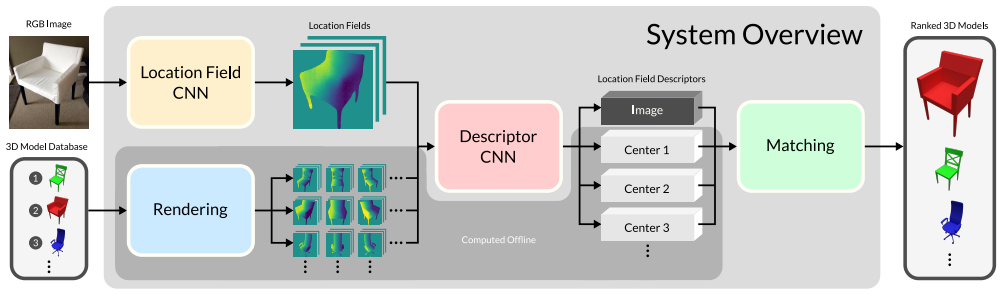
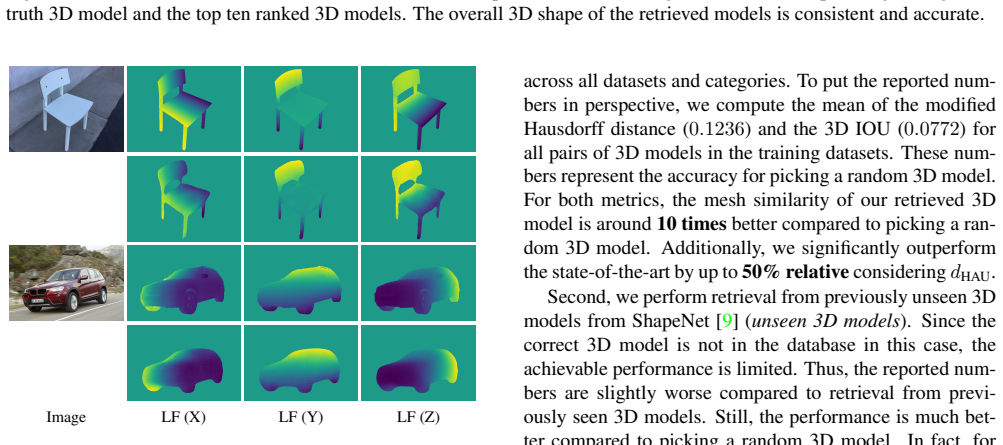
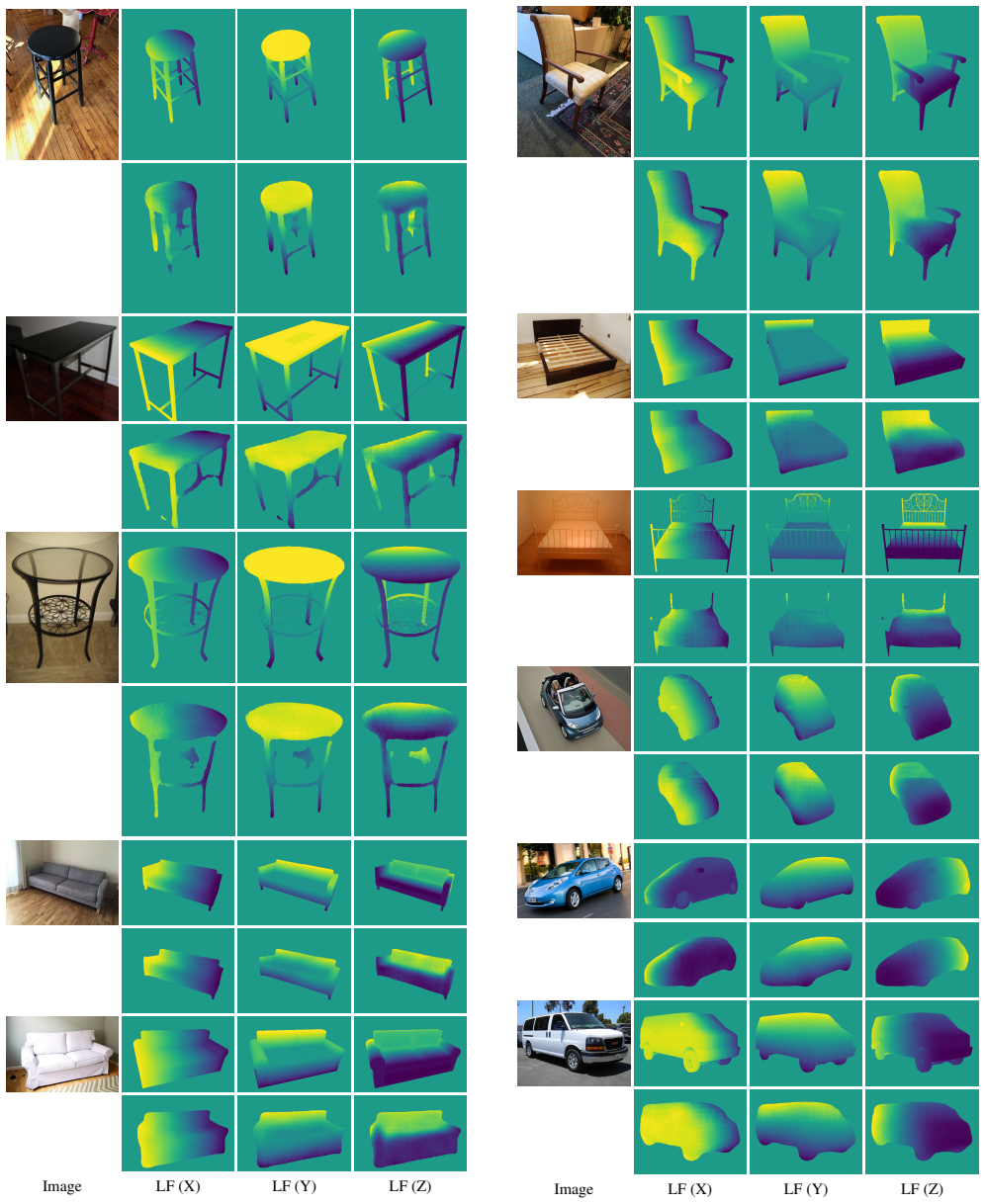
The load-bearing object is the location field: an image-like tensor whose three channels store the X/Y/Z coordinates, in the object's canonical frame, of the surface point visible at each pixel. It explicitly encodes both shape and pose while discarding texture, lighting, and material. Around it the method builds two mechanisms: a Location Field CNN branch that predicts a 56x56 location field per detected object, with the mask branch thresholding out background, and a Descriptor CNN with a combined softmax, Center, and Triplet-Center loss that learns one center descriptor per 3D model. Because each center descriptor is the average of embeddings over 100 rendered location fields, descriptors become pose-invariant, and new 3D databases can be added at test time by rendering and averaging, with no retraining.
What would settle it
Render two 3D models that differ only in a structure thinner than the 56x56 location-field grid (for example, two chairs identical except for leg thickness, or two cars identical except for mirror shape), compute their center descriptors from the rendered location fields, and measure the descriptor distance. If the distance is near zero while a human viewer can see the difference, the location-field bottleneck cannot support the fine-grained discriminations the method claims.
Extended reading notes
Core claim
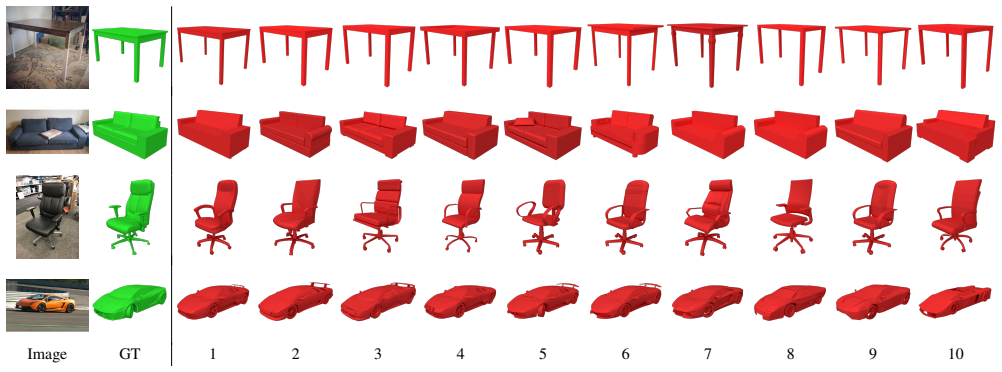
The central discovery is that location fields—image-like maps in which each object pixel carries the X/Y/Z coordinate of the corresponding point on the object's canonical surface—are a sufficient and advantageous common representation for retrieval. Rendered location fields are generated from 3D meshes by interpolating per-vertex coordinates; predicted location fields are produced from RGB images by a region-based CNN at 56x56 resolution and thresholded with predicted masks. A Descriptor CNN embeds each location field into a 270-dimensional pose-invariant descriptor, and each 3D model is represented by a learned center descriptor obtained by averaging the embeddings of 100 rendered views. Retrieval is nearest-neighbor matching in this space. The paper's experiments show that this pipeline beats direct-embedding baselines on three real-world furniture and car datasets, including on unseen 3D model collections, and that the same predicted location fields can be fed to a PnP solver to recover the object's 3D pose.
Load-bearing premise
The load-bearing premise is that a 56x56 location field predicted from a single photo keeps enough 3D shape detail to tell similar models apart, even though thin structures such as chair legs and car side mirrors are routinely missed.
Editorial extensions
If this is right
- The same predicted location field that drives retrieval can also feed a PnP solver, so 3D model retrieval and 3D pose estimation come out of a single representation.
- The descriptor network can be trained mostly on synthetic data: rendered location fields are cheap to generate, and the real-image supervision is concentrated in the location-field prediction branch.
- Adding a new 3D model database at test time requires no retraining—render each model about 100 times, average its embeddings, and match.
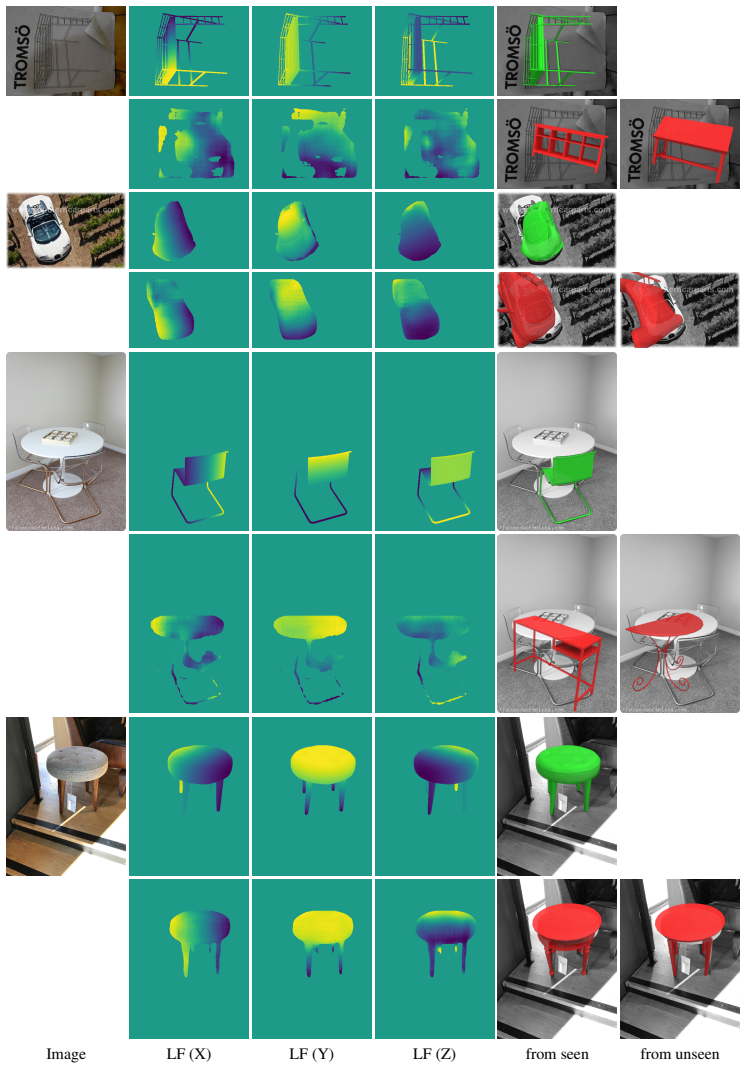
- When retrieval fails, the predicted location field shows whether the error was a bad per-pixel 3D estimate or a genuinely ambiguous shape, turning a black box into an inspectable pipeline.
- Since location fields eliminate appearance, retrieval accuracy should be insensitive to lighting, texture, and material changes, which the paper identifies as a core advantage over RGB-rendering baselines.
Reading between the lines
- Beyond the paper, the resolution of the location-field bottleneck is the most likely scaling lever: the ablation shows half-resolution fields hurt accuracy, so a higher-resolution or multi-scale location field could push retrieval further on thin structures like chair legs and mirrors.
- A natural transfer test is fine-grained category-level pose: because location fields encode dense 2D-3D correspondences, the same network could replace current keypoint-based pose pipelines for objects with few stable keypoints.
- Retrieval databases built from raw scanned point clouds, not watertight meshes, could be enrolled by training the Descriptor CNN on point-cloud-derived fields, which would widen the approach to non-CAD data.
- The paper leaves open whether the bottleneck also helps under occlusion; datasets are filtered to non-occluded, non-truncated objects, so testing on partially visible objects would show whether the mask-thresholded location field still preserves enough shape.
Signed reviews
Editorial analysis
A structured set of objections, weighed in public.
Referee Report
Summary. The paper proposes Location Field Descriptors for single-image 3D model retrieval. Images and 3D models are first mapped to a common low-level representation: location fields that encode, for each object pixel, the corresponding 3D surface coordinate in a canonical object coordinate system. A Descriptor CNN then maps these location fields to pose-invariant descriptors in an embedding space learned with a combination of softmax, Center, and Triplet-Center losses, with center descriptors for each 3D model computed offline. The Location Field CNN predicts location fields from RGB images, and the Descriptor CNN is trained jointly on predicted and rendered location fields, allowing large amounts of synthetic data to be exploited. The method is evaluated on Pix3D, Comp, and Stanford for retrieval from both seen and unseen 3D model databases, with an ablation study on Pix3D. The central claim is that the approach significantly outperforms the state of the art by up to 20% absolute in multiple retrieval metrics.
Significance. If the claims hold, this is a useful and interesting contribution. Using location fields as an intermediate representation is well motivated: the representation is interpretable, explicitly encodes 3D shape and pose, and enables training on abundant synthetic renderings while reducing the appearance domain gap. The evaluation is broader than in many prior works, covering three datasets, seen and unseen database splits, several retrieval metrics, and an ablation study. The paper also honestly identifies failure modes and limitations. However, the strength of the empirical claim is weakened by protocol choices and missing statistical support, and the training objective is stated inconsistently between equations.
major comments (4)
- [Sec. 6 (supplementary) and Table 1] The evaluation is restricted to non-occluded and non-truncated Pix3D samples, as stated in Sec. 6, yet the title, abstract, and Sec. 1 claim retrieval "in the wild," and Sec. 8 lists complex occlusion and extreme pose as failure modes. The headline improvements in Table 1 are therefore computed on exactly the cases the method handles best, and the paper does not explicitly state whether the baselines [3] and [14] were re-evaluated on the identical filtered split with identical detections. Please clarify the exact protocol and either report results on the full Pix3D set or qualify the "in the wild" claim.
- [Table 1 and Sec. 4.1] The claim that the method "significantly outperform[s] the state-of-the-art" is not supported by error bars, confidence intervals, or significance tests. In categories with very few database models (Pix3D bed: 19 models; Pix3D sofa: 20 models; see Table 3), an absolute improvement of roughly 20% in AccTop-1 may correspond to only a handful of test samples. Please report variance across train/test splits or at least bootstrap confidence intervals for the main comparisons.
- [Eq. (3) and Eq. (5)] Equation (3) defines the Descriptor loss as L_D = L_softmax + alpha L_C + beta L_TC, but Eq. (5) gives the system loss as L = L_D + L_softmax + alpha L_C + beta L_TC + gamma L_LF + delta L_FM, which double-counts the softmax, Center, and Triplet-Center terms. This ambiguity affects reproducibility of the training objective and should be resolved.
- [Sec. 8, Fig. 5, and Table 1] The method's ability to rank visually similar 3D models depends on the predicted location fields preserving fine shape details, but Sec. 8 and Fig. 5 acknowledge that thin structures and side mirrors are missed. The car categories, where fine details are most discriminative, show markedly lower AccTop-1 (20.5% on Comp, 29.5% on Stanford in Table 1), which is consistent with this limitation. Please provide an analysis of whether incorrect exact-model retrievals coincide with missing fine details in the predicted location fields, rather than relying only on aggregate dHAU/dIOU.
minor comments (5)
- [Sec. 3.1 vs. Sec. 7] Section 3.1 states that location fields are predicted at a resolution of 56x56x3, while Sec. 7 states 58x58x3. Please harmonize the reported resolution.
- [Sec. 6] The Pix3D train/test split is described as randomly choosing 50% of images per 3D model, but no random seed or exact split is given. Please release the exact split for reproducibility.
- [Sec. 4.1 and Table 1] The text says the method "correctly detect[s] 95% of all objects in the images on average," but Table 1 reports per-dataset AccD0.5 values of 94.6% (Pix3D mean), 99.9% (Comp), and 99.6% (Stanford). Please clarify which average is meant.
- [Sec. 4.1] The comparison set contains only two baselines, one of which ([14]) is the authors' own prior work. Adding an independently published third-party baseline would strengthen the empirical claim.
- [Eq. (4)] The symbol D is used both for the Euclidean distance between vertices in Eq. (4) and for the Huber distance between descriptors in Eqs. (1)-(2). Please use distinct notation for clarity.
Circularity Check
No circularity: the retrieval pipeline is a supervised embedding learned from rendered and predicted location fields and evaluated on held-out data.
full rationale
We walked the derivation chain: (i) location fields are rendered from 3D meshes and predicted from RGB images by a CNN trained with Huber loss against rendered location fields; (ii) a Descriptor CNN maps both rendered and predicted location fields into an embedding, trained with Center loss (Eq. 1), Triplet-Center loss (Eq. 2), softmax, and a system loss (Eq. 5); (iii) retrieval is nearest-neighbor matching against center descriptors, which are either learned weights or averages of rendered-location-field embeddings for unseen databases. None of these steps defines the output in terms of the claimed result: the ground-truth 3D model labels are used only as supervision, not as retrieval inputs, and the unseen-database protocol uses a database disjoint from training. The comparison to [14] (a prior paper by two of the authors) is a baseline comparison, not a load-bearing premise; Feature Mapping [44] is shown by the ablation (Table 2: 60.0% vs. 60.7% AccTop-1) to be non-essential. There is no fitted parameter renamed as a prediction, no uniqueness theorem imported from self-citation, and no ansatz smuggled in via citation. The only notable caveat is scope: Supplementary Sec. 6 explicitly restricts Pix3D training/evaluation to non-occluded and non-truncated samples, which limits the 'in the wild' generalization claim but does not make the derivation circular. Verdict: no circularity, score 0.
Assumptions & free parameters
free parameters (7)
- alpha (Center loss weight) =
0.01
- beta (Triplet-Center loss weight) =
0.1
- gamma (Location Field loss weight) =
10
- delta (Feature Mapping loss weight) =
0.01
- margin m (Triplet-Center) =
1
- Huber threshold =
1
- predicted:rendered location field training ratio =
1:3
assumptions (5)
- domain assumption Ground truth 3D models and image-to-model annotations in Pix3D, Comp, and Stanford are correct.
- domain assumption The evaluation metrics (modified Hausdorff distance, voxel IOU) reflect meaningful 3D shape similarity.
- domain assumption Location fields predicted from a single RGB image (at 56x56 resolution, masked) retain enough 3D shape detail for fine-grained discrimination.
- domain assumption Rendered location fields from the training set 3D models are representative enough to train a descriptor that generalizes to unseen ShapeNet models.
- ad hoc to paper Excluding occluded and truncated Pix3D samples is acceptable for benchmarking 'in the wild' retrieval.
Cite this review
Pith. "Pith review of Location Field Descriptors: Single Image 3D Model Retrieval in the Wild." pith.science (2026). https://pith.science/paper/HE7LVLA3
@misc{pith2026190802853,
  author       = {Pith},
  title        = {Pith review of: Location Field Descriptors: Single Image 3D Model Retrieval in the Wild},
  year         = {2026},
  howpublished = {\url{https://pith.science/paper/HE7LVLA3}},
  note         = {Machine review of arXiv:1908.02853}
}
read the original abstract
We present Location Field Descriptors, a novel approach for single image 3D model retrieval in the wild. In contrast to previous methods that directly map 3D models and RGB images to an embedding space, we establish a common low-level representation in the form of location fields from which we compute pose invariant 3D shape descriptors. Location fields encode correspondences between 2D pixels and 3D surface coordinates and, thus, explicitly capture 3D shape and 3D pose information without appearance variations which are irrelevant for the task. This early fusion of 3D models and RGB images results in three main advantages: First, the bottleneck location field prediction acts as a regularizer during training. Second, major parts of the system benefit from training on a virtually infinite amount of synthetic data. Finally, the predicted location fields are visually interpretable and unblackbox the system. We evaluate our proposed approach on three challenging real-world datasets (Pix3D, Comp, and Stanford) with different object categories and significantly outperform the state-of-the-art by up to 20% absolute in multiple 3D retrieval metrics.
Figures


Figures from the paper (8 more)




Reference graph
Works this paper leans on
-
[3]
M. Aubry and B. Russell. Understanding Deep Features with Computer-Generated Imagery. In Conference on Computer Vision and Pattern Recognition, pages 2875–2883, 2015
work page 2015
-
[14]
Grabner, P
A. Grabner, P. M. Roth, and V . Lepetit. 3D Pose Estimation and 3D Model Retrieval for Objects in the Wild. In Con- ference on Computer Vision and Pattern Recognition, pages 3022–3031, 2018
2018
- [1]
- [2]
-
[4]
S. Bai, X. Bai, W. Liu, and F. Roli. Neural Shape Codes for 3D Model Retrieval. Pattern Recognition Letters, 65(1):15– 21, 2015
work page 2015
-
[5]
S. Bai, X. Bai, Z. Zhou, Z. Zhang, and L. Jan Latecki. Gift: A Real-Time and Scalable 3D Shape Search Engine. InCon- ference on Computer Vision and Pattern Recognition, pages 5023–5032, 2016
work page 2016
-
[6]
P. Besl and N. McKay. Method for Registration of 3-D Shapes. In Sensor Fusion IV: Control Paradigms and Data Structures, pages 586–607. International Society for Optics and Photonics, 1992
work page 1992
-
[7]
Brachmann, A
E. Brachmann, A. Krull, F. Michel, S. Gumhold, J. Shotton, and C. Rother. Learning 6D Object Pose Estimation using 3D Object Coordinates. In European Conference on Com- puter Vision, pages 536–551, 2014
2014
Show all 73 references
-
[8]
Brachmann, F
E. Brachmann, F. Michel, A. Krull, M. Ying Yang, S. Gumhold, and C. Rother. Uncertainty-Driven 6D Pose Estimation of Objects and Scenes from a Single RGB Image. In Conference on Computer Vision and Pattern Recognition, pages 3364–3372, 2016
2016
-
[9]
Chang, T
A. Chang, T. Funkhouser, L. Guibas, P. Hanrahan, Q. Huang, Z. Li, S. Savarese, M. Savva, S. Song, H. Su, J. Xiao, L. Yi, and F. Yu. Shapenet: An Information-Rich 3D Model Repository. Technical report, Stanford University — Prince- ton University — Toyota Technological Institut...
2015
-
[10]
Chen, X.-P
D.-Y . Chen, X.-P. Tian, Y .-T. Shen, and M. Ouhyoung. On Visual Similarity Based 3D Model Retrieval. In Computer Graphics Forum, pages 223–232, 2003
2003
-
[11]
Esteves, C
C. Esteves, C. Allen-Blanchette, A. Makadia, and K. Dani- ilidis. Learning SO(3) Equivariant Representations with Spherical CNNs. In European Conference on Computer Vi- sion, pages 52–68, 2018
2018
-
[12]
H. Fan, H. Su, and L. Guibas. A Point Set Generation Net- work for 3D Object Reconstruction from a Single Image. In Conference on Computer Vision and Pattern Recognition, pages 605–613, 2017
2017
-
[13]
Girdhar, D
R. Girdhar, D. Fouhey, M. Rodriguez, and A. Gupta. Learn- ing a Predictable and Generative Vector Representation for Objects. In European Conference on Computer Vision, pages 484–499, 2016
2016
-
[15]
Grabner, P
A. Grabner, P. M. Roth, and V . Lepetit. GP 2C: Geometric Projection Parameter Consensus for Joint 3D Pose and Focal Length Estimation in the Wild. In International Conference on Computer Vision, 2019
2019
-
[16]
Hartley and A
R. Hartley and A. Zisserman. Multiple View Geometry in Computer Vision. Cambridge University Press, 2003
2003
-
[17]
K. He, G. Gkioxari, P. Doll ´ar, and R. Girshick. Mask R- CNN. In International Conference on Computer Vision , pages 2980–2988, 2017
2017
-
[18]
K. He, X. Zhang, S. Ren, and J. Sun. Deep Residual Learning for Image Recognition. In Conference on Computer Vision and Pattern Recognition, pages 770–778, 2016
2016
-
[19]
K. He, X. Zhang, S. Ren, and J. Sun. Identity Mappings in Deep Residual Networks. In European Conference on Com- puter Vision, pages 630–645, 2016
2016
-
[20]
X. He, Y . Zhou, Z. Zhou, S. Bai, and X. Bai. Triplet-Center Loss for Multi-View 3D Object Retrieval. In Conference on Computer Vision and Pattern Recognition , pages 1945– 1954, 2018
1945
-
[21]
Huang, Z
G. Huang, Z. Liu, L. van der Maaten, and K. Weinberger. Densely Connected Convolutional Networks. In Conference on Computer Vision and Pattern Recognition , pages 2261– 2269, 2017
2017
-
[22]
Huang, S
S. Huang, S. Qi, Y . Zhu, Y . Xiao, Y . Xu, and S.-C. Zhu. Holistic 3D Scene Parsing and Reconstruction from a Single RGB Image. In European Conference on Computer Vision, pages 187–203, 2018
2018
-
[23]
P. Huber. Robust Estimation of a Location Parameter. The Annals of Mathematical Statistics, 35(1):73–101, 1964
1964
-
[24]
Hueting, P
M. Hueting, P. Reddy, E. Yumer, V . Kim, N. Carr, and N. Mi- tra. SeeThrough: Finding Objects in Heavily Occluded In- door Scene Images. In International Conference on 3D Vi- sion, pages 267–276, 2018
2018
-
[25]
Izadinia, Q
H. Izadinia, Q. Shan, and S. Seitz. IM2CAD. In Conference on Computer Vision and Pattern Recognition, 2017
2017
-
[26]
O. H. Jafari, S. K. Mustikovela, K. Pertsch, E. Brachmann, and C. Rother. iPose: Instance-Aware 6D Pose Estimation of Partly Occluded Objects. In Asian Conference on Computer Vision, 2018
2018
-
[27]
Kanezaki, Y
A. Kanezaki, Y . Matsushita, and Y . Nishida. Rotation- Net: Joint Object Categorization and Pose Estimation using Multiviews from Unsupervised Viewpoints. In Conference on Computer Vision and Pattern Recognition , pages 5010– 5019, 2018
2018
-
[28]
Keller, Z
M. Keller, Z. Chen, F. Maffra, P. Schmuck, and M. Chli. Learning Deep Descriptors with Scale-Aware Triplet Net- works. In Conference on Computer Vision and Pattern Recognition, pages 2762–2770, 2018
2018
-
[29]
Klokov and V
R. Klokov and V . Lempitsky. Escape from Cells: Deep KD- Networks for the Recognition of 3D Point Cloud Models. In International Conference on Computer Vision , pages 863– 872, 2017
2017
-
[30]
B. Kulis. Metric Learning: A Survey. Foundations and Trends in Machine Learning, 5(4):287–364, 2013
2013
-
[31]
Lee, Y .-L
T. Lee, Y .-L. Lin, H. Y . Chiang, M.-W. Chiu, W. Hsu, and P. Huang. Cross-Domain Image-Based 3D Shape Retrieval by View Sequence Learning. In International Conference on 3D Vision, pages 258–266, 2018
2018
-
[32]
Y . Li, H. Su, C. R. Qi, N. Fish, D. Cohen-Or, and L. Guibas. Joint Embeddings of Shapes and Images via CNN Image Pu- 9 rification. ACM Transactions on Graphics, 34(6):234, 2015
2015
-
[33]
T.-Y . Lin, P. Doll ´ar, R. B. Girshick, K. He, B. Hariharan, and S. J. Belongie. Feature Pyramid Networks for Object Detection. In Conference on Computer Vision and Pattern Recognition, pages 2117–2125, 2017
2017
-
[34]
T.-Y . Lin, M. Maire, S. Belongie, J. Hays, P. Perona, D. Ra- manan, P. Doll´ar, and C. L. Zitnick. Microsoft COCO: Com- mon Objects in Context. In European Conference on Com- puter Vision, pages 740–755, 2014
2014
-
[35]
Mandikal, K
P. Mandikal, K. L. Navaneet, M. Agarwal, and R. V . Babu. 3D-LMNet: Latent Embedding Matching for Accurate and Diverse 3D Point Cloud Reconstruction from a Single Im- age. In British Machine Vision Conference , pages 55.1– 55.12, 2018
2018
-
[36]
Massa, B
F. Massa, B. Russell, and M. Aubry. Deep Exemplar 2D- 3D Detection by Adapting from Real to Rendered Views. In Conference on Computer Vision and Pattern Recognition, pages 6024–6033, 2016
2016
-
[37]
Mottaghi, Y
R. Mottaghi, Y . Xiang, and S. Savarese. A Coarse-To-Fine Model for 3D Pose Estimation and Sub-Category Recogni- tion. In Conference on Computer Vision and Pattern Recog- nition, pages 418–426, 2015
2015
-
[38]
K. L. Navaneet, P. Mandikal, M. Agarwal, and V . Babu. CAPNet: Continuous Approximation Projection for 3D Point Cloud Reconstruction using 2D Supervision. In AAAI Conference on Artificial Intelligence, 2019
2019
-
[39]
Nooruddin and G
F. Nooruddin and G. Turk. Simplification and Repair of Polygonal Models Using V olumetric Techniques. IEEE Transactions on Visualization and Computer Graphics , 9(2):191–205, 2003
2003
-
[40]
Oh Song, Y
H. Oh Song, Y . Xiang, S. Jegelka, and S. Savarese. Deep Metric Learning via Lifted Structured Feature Embedding. In Conference on Computer Vision and Pattern Recognition, pages 4004–4012, 2016
2016
-
[41]
C. Qi, H. Su, M. Nießner, A. Dai, M. Yan, and L. Guibas. V olumetric and Multi-View CNNs for Object Classification on 3D Data. In Conference on Computer Vision and Pattern Recognition, pages 5648–5656, 2016
2016
-
[42]
C. R. Qi, H. Su, K. Mo, and L. Guibas. Pointnet: Deep Learning on Point Sets for 3D Classification and Segmenta- tion. In Conference on Computer Vision and Pattern Recog- nition, pages 652–660, 2017
2017
-
[43]
C. R. Qi, L. Yi, H. Su, and L. Guibas. Pointnet++: Deep Hierarchical Feature Learning on Point Sets in a Metric Space. In Advances in Neural Information Processing Sys- tems, pages 5099–5108, 2017
2017
-
[44]
M. Rad, M. Oberweger, and V . Lepetit. Feature Mapping for Learning Fast and Accurate 3D Pose Inference from Syn- thetic Images. In Conference on Computer Vision and Pat- tern Recognition, pages 4663–4672, 2018
2018
-
[45]
S. Ren, K. He, R. Girshick, and J. Sun. Faster R-CNN: Towards Real-Time Object Detection with Region Proposal Networks. In Advances in Neural Information Processing Systems, pages 91–99, 2015
2015
-
[46]
Russakovsky, J
O. Russakovsky, J. Deng, H. Su, J. Krause, S. Satheesh, S. Ma, Z. Huang, A. Karpathy, A. Khosla, M. Bernstein, et al. Imagenet Large Scale Visual Recognition Challenge. International Journal of Computer Vision , 115(3):211–252, 2015
2015
-
[47]
Santa Cruz and J
C. Santa Cruz and J. Dorronsoro. A Nonlinear Discrimi- nant Algorithm for Feature Extraction and Data Classifica- tion. IEEE Transactions on Neural Networks , 9(6):1370– 1376, 1998
1998
-
[48]
Savva, F
M. Savva, F. Yu, H. Su, et al. SHREC’16 Track Large-Scale 3D Shape Retrieval from ShapeNet Core55. InEurographics Workshop on 3D Object Retrieval, 2016
2016
-
[49]
Savva, F
M. Savva, F. Yu, H. Su, et al. SHREC’17 Track Large-Scale 3D Shape Retrieval from ShapeNet Core55. InEurographics Workshop on 3D Object Retrieval, 2017
2017
-
[50]
Schroff, D
F. Schroff, D. Kalenichenko, and J. Philbin. FaceNet: A Unified Embedding for Face Recognition and Clustering. In Conference on Computer Vision and Pattern Recognition , pages 815–823, 2015
2015
-
[51]
Stockman and L
G. Stockman and L. Shapiro. Computer Vision. Prentice Hall PTR, 2001
2001
-
[52]
H. Su, S. Maji, E. Kalogerakis, and E. Learned-Miller. Multi- View Convolutional Neural Networks for 3D Shape Recog- nition. In Conference on Computer Vision and Pattern Recognition, pages 945–953, 2015
2015
-
[53]
X. Sun, J. Wu, X. Zhang, Z. Zhang, C. Zhang, T. Xue, J. Tenenbaum, and W. Freeman. Pix3D: Dataset and Meth- ods for Single-Image 3D Shape Modeling. In Conference on Computer Vision and Pattern Recognition , pages 2974– 2983, 2018
2018
-
[54]
Szeliski
R. Szeliski. Computer Vision: Algorithms and Applications. Springer Science & Business Media, 2010
2010
-
[55]
F. P. Tasse and N. Dodgson. Shape2Vec: Semantic-Based Descriptors for 3D Shapes, Sketches and Images. ACM Transactions on Graphics, 35(6):208, 2016
2016
-
[56]
Tatarchenko, S
M. Tatarchenko, S. Richter, R. Ranftl, Z. Li, V . Koltun, and T. Brox. What Do Single-View 3D Reconstruction Networks Learn? In Conference on Computer Vision and Pattern Recognition, 2019
2019
-
[57]
Taylor, J
J. Taylor, J. Shotton, T. Sharp, and A. Fitzgibbon. The Vit- ruvian Manifold: Inferring Dense Correspondences for One- Shot Human Pose Estimation. In Conference on Computer Vision and Pattern Recognition, pages 103–110, 2012
2012
-
[58]
Tulsiani, S
S. Tulsiani, S. Gupta, D. Fouhey, A. Efros, and J. Malik. Factoring Shape, Pose, and Layout from the 2D Image of a 3D Scene. In Conference on Computer Vision and Pattern Recognition, pages 302–310, 2018
2018
-
[59]
H. Wang, S. Sridhar, J. Huang, J. Valentin, S. Song, and L. Guibas. Normalized Object Coordinate Space for Category-Level 6D Object Pose and Size Estimation. In Conference on Computer Vision and Pattern Recognition , pages 2642–2651, 2019
2019
-
[60]
S. Wang, J. Wu, X. Sun, W. Yuan, W. Freeman, J. Tenen- baum, and E. Adelson. 3D Shape Perception from Monoc- ular Vision, Touch, and Shape Priors. In International Con- ference on Intelligent Robots and Systems, pages 1606–1613, 2018
2018
-
[61]
Y . Wang, X. Tan, Y . Yang, X. Liu, E. Ding, F. Zhou, and L. S. Davis. 3D Pose Estimation for Fine-Grained Object Categories. In European Conference on Computer Vision Workshops, 2018
2018
-
[62]
Weinberger and L
K. Weinberger and L. Saul. Distance Metric Learning for Large Margin Nearest Neighbor Classification. Journal of Machine Learning Research, 10:207–244, 2009. 10
2009
-
[63]
Y . Wen, K. Zhang, Z. Li, and Y . Qiao. A Discriminative Feature Learning Approach for Deep Face Recognition. In European Conference on Computer Vision, pages 499–515, 2016
2016
-
[64]
Wohlhart and V
P. Wohlhart and V . Lepetit. Learning Descriptors for Ob- ject Recognition and 3D Pose Estimation. In Conference on Computer Vision and Pattern Recognition , pages 3109– 3118, 2015
2015
-
[65]
J. Wu, C. Zhang, X. Zhang, Z. Zhang, W. Freeman, and J. Tenenbaum. 3D ShapeNets: A Deep Representation for V olumetric Shapes. In Conference on Computer Vision and Pattern Recognition, pages 1912–1920, 2015
1912
-
[66]
Z. Wu, S. Song, A. Khosla, F. Yu, L. Zhang, X. Tang, and J. Xiao. Learning Shape Priors for Single-View 3D Comple- tion and Reconstruction. In European Conference on Com- puter Vision, pages 646–662, 2018
2018
-
[67]
Xiang, W
Y . Xiang, W. Kim, W. Chen, J. Ji, C. Choy, H. Su, R. Mot- taghi, L. Guibas, and S. Savarese. ObjectNet3D: A Large Scale Database for 3D Object Recognition. In European Conference on Computer Vision, pages 160–176, 2016
2016
-
[68]
Xiang, R
Y . Xiang, R. Mottaghi, and S. Savarese. Beyond Pascal: A Benchmark for 3D Object Detection in the Wild. In IEEE Winter Conference on Applications of Computer Vi- sion, pages 75–82, 2014
2014
-
[69]
Zhang, Z
X. Zhang, Z. Zhang, C. Zhang, J. Tenenbaum, W. Freeman, and J. Wu. Learning to Reconstruct Shapes from Unseen Classes. In Advances in Neural Information Processing Sys- tems, pages 2257–2268, 2018. 11 Location Field Descriptors: Single Image 3D Model Retrieval in the Wild Supp...
2018
-
[70]
These datasets have only been released recently and, to the best of our knowledge, we are the first to report results for 3D model retrieval on all of them
Datasets and Evaluation Setup We evaluate our proposed approach for 3D model re- trieval in the wild on three challenging real-world datasets with different object categories: Pix3D [53] ( bed, chair, sofa, table), Comp [61] ( car), and Stanford [61] ( car). These datasets hav...
-
[71]
For our Descriptor CNN, we use a DenseNet-50 architec- ture [21] with 3 dense blocks and a growth rate of 24
Implementation and Training Details For our Location Field CNN, we use a Feature Pyramid Network [33] on top of a ResNet-101 backbone [18, 19]. For our Descriptor CNN, we use a DenseNet-50 architec- ture [21] with 3 dense blocks and a growth rate of 24. For our implementation,...
-
[72]
8 shows failure cases of our approach
Failure Cases Fig. 8 shows failure cases of our approach. Most failure cases relate to incorrect location field predictions. For ex- ample, if the 3D pose of the object in the image is far from the 3D poses seen during training, or if multiple objects are detected as a single o...
-
[73]
Additional Qualitative Results Finally, we present additional qualitative results which complement those presented in the main paper. Fig. 9 presents further qualitative examples of our pre- dicted location fields. We upscale and pad the predicted location fields to match the in...
Reviewed August 14, 2026 · model on record in the stance chip above.
Discussion (0). Continue with ORCID to comment.