REVIEW 3 major objections 4 minor 23 references
BEACHES: Beamspace Channel Estimation for Multi-Antenna mmWave Systems and Beyond
T0 review · 3 major / 4 minor · reviewed 2026-08-14 · deepseek-v4-flash
Pith's one-line read BEACHES shows that mmWave channel estimation can be reduced to soft-thresholding a DFT beamspace vector, with a SURE-based threshold that is provably MSE-optimal as the antenna count grows.
desk verdict A genuinely useful O(B log B) SURE-tuned beamspace denoiser with a real proof gap: the advertised large-antenna optimality is not established as written. read the letter →
The pith
A machine-rendered reading of the paper's core claim, the machinery that carries it, and where it could break.
The reading
What carries the argument
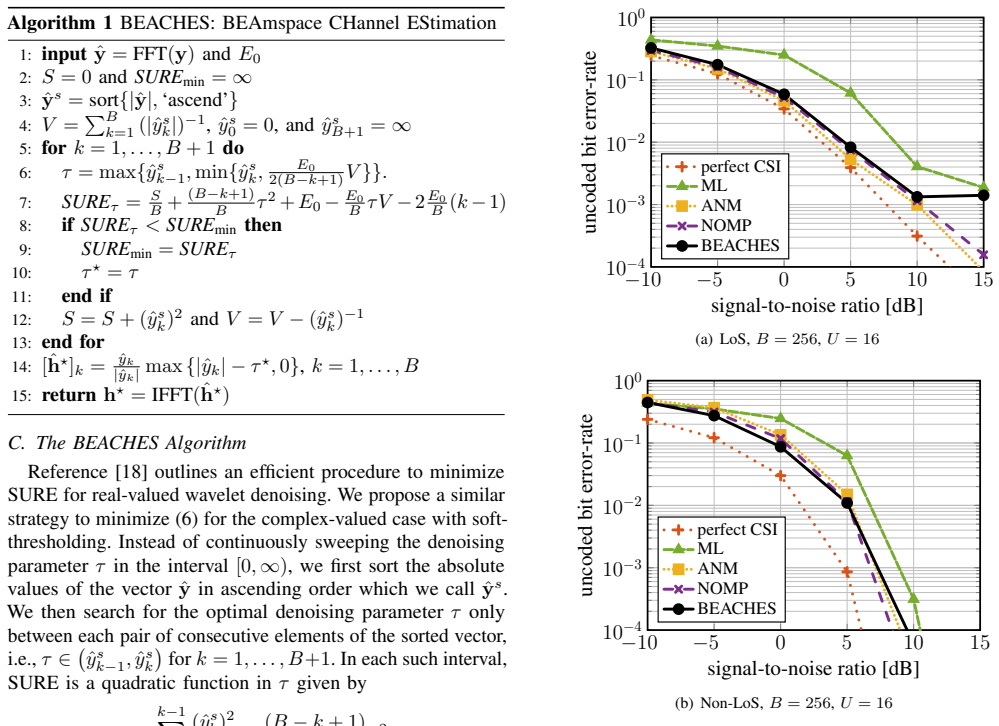
The load-bearing object is Stein's unbiased risk estimator for complex soft-thresholding, specialized to the beamspace channel model. For a weakly differentiable estimator $\mu(\hat{\mathbf y})$ of a vector observed in complex Gaussian noise, SURE (5) is an unbiased estimate of MSE; for $\mu=\eta(\cdot,\tau)$ it reduces to expression (6), a piecewise quadratic function of $\tau$ with jumps at the observed magnitudes $|\hat y_b|$. BEACHES sorts the $|\hat y_b|$ so the pieces are intervals between consecutive sorted magnitudes, evaluates the quadratic minimizer in each interval in constant time using running sums, and picks the $\tau$ with smallest SURE. This reduces the parameter-selection problem to an $O(B\log B)$ sweep, consisting of an FFT, a sort, and an inverse FFT, which is what makes the method cheap enough for practical hardware.
What would settle it
Generate beamspace channels from the model with a small number of paths at finite array sizes such as $B=64$ and $B=256$, add noise at SNRs from -10 to 15 dB, and compare the $\tau$ that minimizes SURE (6) with the $\tau$ that minimizes the true MSE; a systematic gap between the two minimizers, or a loss of BER parity with ANM and NOMP when the beamspace entries are strongly correlated, would show that the large-antenna optimality claim does not transfer to finite arrays.
Extended reading notes
Core claim
BEACHES estimates the uplink channel vector by taking the DFT of the noisy antenna-domain observation, applying the complex soft-thresholding operator $\eta(\hat{\mathbf y},\tau)$ entry by entry, and transforming back. The parameter $\tau$ is chosen by a sweep over the sorted magnitudes of the beamspace vector that minimizes the SURE expression (6), which depends only on the observations, the noise variance $E_0$, and $\tau$. Theorem 2 states that $\lim_{B\to\infty}\mathrm{SURE}_\tau = \mathrm{MSE}$, so in the large-antenna regime minimizing SURE provably minimizes the channel-estimation MSE. The paper's simulations show that this simple procedure delivers uncoded bit-error rates on par with the off-grid methods ANM and NOMP, and 2-3 dB better than maximum-likelihood estimation at a bit-error rate of $10^{-2}$, while the runtime is lower by factors of about 120-1500 versus NOMP and 29,000-58,000 versus ANM.
Load-bearing premise
The proof that SURE converges to the MSE treats the beamspace channel entries as independent and identically distributed draws from a fixed sparse distribution, even though the model represents them as a DFT of a few sinusoidal paths, which makes the entries correlated; the paper does not verify that the convergence theorem's conditions hold for this correlated model.
Editorial extensions
If this is right
- If the asymptotic SURE-MSE equivalence holds at operating array sizes, BEACHES removes the need for manual threshold tuning in beamspace denoising, since the data alone determine $\tau$.
- Off-the-grid methods such as ANM and NOMP are not needed for competitive bit-error rate in the simulated LoS and non-LoS 60 GHz scenarios, so mmWave channel estimation can be implemented with FFT, sorting, and scalar operations.
- The computational savings grow with scenario difficulty: the paper reports speedups up to 1,500x over NOMP and 58,000x over ANM in the non-LoS case.
- Because the SURE expression only needs the noise variance $E_0$ and the beamspace observation magnitudes, the method adapts automatically to changing propagation conditions and numbers of paths.
- The same SURE-based thresholding logic can apply to any approximately sparse beamspace vector, making the approach a candidate for terahertz and other high-dimensional array systems.
Reading between the lines
- The same SURE-sweep idea transfers to other element-wise denoisers, such as hard thresholding or nonnegative shrinkage, where closed-form SURE expressions exist; those variants would inherit the same $O(B\log B)$ tuning cost.
- One could test BEACHES as a front-end for hybrid or low-resolution-ADC architectures, where the paper's assumption of all-digital antennas and unquantized observations would need modification.
- Because the algorithm only uses sorted magnitudes of the beamspace coefficients, it may be robust to phase errors or to channels with many weak paths where sparsity is less pronounced, though the paper does not explore this.
Signed reviews
Editorial analysis
A structured set of objections, weighed in public.
Referee Report
Summary. The paper proposes BEACHES, a beamspace channel estimation method for massive MIMO mmWave/THz uplink systems. The channel vector is modeled as a superposition of L complex sinusoids in the antenna domain; after taking a DFT, the paper denoises the beamspace vector by complex soft-thresholding with threshold τ. To avoid manual tuning, BEACHES computes Stein's unbiased risk estimate (SURE) for the soft-thresholding estimator and selects τ by minimizing the SURE expression over intervals defined by the sorted magnitudes of the noisy beamspace observations. Theorem 1 proves the standard SURE identity in the complex domain, and Theorem 2 claims that SURE converges to MSE as B→∞, so the chosen threshold minimizes MSE in the large-antenna limit. Simulations with a QuaDRiGa 60 GHz model for LoS and non-LoS channels show BER comparable to ANM and NOMP at orders-of-magnitude lower runtime.
Significance. If Theorem 2 were rigorously established, the paper would provide a practical, low-complexity denoiser with automatic parameter selection for a relevant wireless setting; the runtime comparison in Table I and the BER results in Fig. 2 are concrete and favorable. The derivation of Theorem 1 in Appendix A is a correct application of Stein's identity, and the algorithmic idea of minimizing SURE over sorted intervals is clean and computationally attractive. The weakness is that the central asymptotic optimality claim rests on an unproved application of a CAMP state-evolution theorem to correlated beamspace entries, so the paper's headline theoretical guarantee is not currently supported as written.
major comments (3)
- [Appendix B, Eq. (14)] The proof of Theorem 2 applies [20, Thm. III.15 and III.16], a state-evolution result for complex approximate message passing, to the beamspace entries ```\hat h_b```. Those theorems require the entries of the observed vector to be independent (or to satisfy a specific exchangeability/state-evolution condition) and the empirical distribution of the true entries to converge to a fixed random variable H. Under the channel model (1), ```\hat h = F h``` is the DFT of a superposition of L complex sinusoids: the entries are correlated, and their magnitudes range from O(√B) down to O(1/√B) depending on whether a path is on the DFT grid. No limiting distribution H is defined for this model and none of the theorem's conditions are verified. Therefore Eq. (14) is not justified, and the convergence claim (7) is not established by the manuscript's argument.
- [Appendix B, Eq. (16)] The transition to Eq. (16) treats the sum of the derivative terms ```\partial[\eta_R]_b/\partial[\hat y_R]_b + \partial[\eta_I]_b/\partial[\hat y_I]_b``` as a pseudo-Lipschitz function and applies (14). These derivative terms are not pseudo-Lipschitz: they are discontinuous at |```\hat y_b| = \tau```, and SURE is undefined at those points, as the paper itself states after Eq. (6). The proof neither checks the pseudo-Lipschitz condition nor explains how the measure-zero discontinuity is handled in the limit interchange. This is a second unverified condition in the proof of Theorem 2.
- [Theorem 2 and Section III-C] Even if the pointwise limit ```\lim_{B→∞} SURE_\tau = MSE``` held for each fixed ```\tau```, the paper's advertised conclusion that BEACHES 'provably minimizes the MSE in the large-antenna limit' would not follow. The algorithm selects ```\tau^*``` by minimizing the empirical SURE function over the intervals defined by the sorted magnitudes ```|\hat y_b|``` (Section III-C and Algorithm 1). The paper does not prove uniform convergence of ```SURE_\tau``` to MSE or an argmin-consistency result, so convergence of the selected threshold to the MSE-minimizing threshold is not established. The central theoretical claim therefore needs an additional, nontrivial argument or a revised, weaker statement.
minor comments (4)
- [Algorithm 1, line 4] The update ```V = \sum_{k=1}^{B}(|\hat y^s_k|)^{-1}``` is undefined if any sorted magnitude is zero. For Gaussian noise this has probability zero, but the pseudocode should state the convention (e.g., omit zero entries or replace them by a small positive value).
- [Algorithm 1, lines 5–7 and footnote 2] The pseudocode evaluates SURE_```\tau``` at the interval boundaries ```\hat y^s_{k-1}``` and ```\hat y^s_k```, where the SURE expression is undefined, while the text says the values should be computed arbitrarily close to these boundaries. This inconsistency should be resolved either by defining the one-sided limits in Eq. (8) or by rewriting the loop to evaluate the limits explicitly.
- [Appendix B, Eq. (15)] The expression ```E_{\hat y}[ B^{-1}\|\eta(\hat y,\tau)-\hat y\|^2 ]``` uses the symbol ```\hat y``` for both the random vector and the fixed vector inside the norm; this is confusing and should be rewritten with a generic random vector such as ```\tilde y```.
- [Appendix B, after Eq. (14)] The phrase 'H is a random variable with the sparse distribution of the channel vector in the beamspace domain' is not a definition. The distribution of ```\hat h_b``` depends on B through the DFT of L sinusoids; without an explicit asymptotic model for L and the angles ```\Omega_\ell```, the statement is not precise.
Circularity Check
No significant circularity: BEACHES' SURE-based threshold selection is self-contained; the technical gap in Theorem 2 is a correctness concern, not a circular one.
full rationale
The derivation chain is not circular. The threshold τ is selected by minimizing the SURE expression (6), which is computed from the noisy beamspace observation ŷ and the known noise variance E0, not from the true channel vector h or from the MSE metric being reported. Theorem 1 establishes E[SURE] = MSE via a standard integration-by-parts argument (Appendix A), and Theorem 2 is an asymptotic claim about SURE converging to MSE for the soft-thresholding estimator. Even if the proof of Theorem 2 relies on CAMP convergence results [20, Thm. III.15 & III.16] whose i.i.d. and pseudo-Lipschitz conditions may not hold for correlated DFT beamspace entries, this is a mathematical validity issue, not circularity: the cited results are external, parameter-free statements and are not assumed to contain the paper's conclusion. The self-citations in the paper ([6], [9]) are contextual references to prior work on low-resolution ADCs and ANM-based mmWave channel estimation and are not load-bearing for the SURE derivation. No fitted input is renamed as a prediction, no uniqueness theorem is imported from the authors' own prior work, and no ansatz is smuggled in via self-citation. The paper's central algorithmic contribution—adaptive soft-thresholding with SURE-based parameter selection—is a self-contained application of standard SURE theory, so the circularity score is 0.
Assumptions & free parameters
assumptions (3)
- domain assumption The mmWave channel is a superposition of L complex sinusoids as in Eq. (1), giving sparse beamspace structure.
- domain assumption The channel estimation error e is complex Gaussian with known variance E0.
- ad hoc to paper The pseudo-Lipschitz convergence theorem [20, Thm. III.15 and III.16] applies to the beamspace entries h_hat_b under model (1).
Cite this review
Pith. "Pith review of BEACHES: Beamspace Channel Estimation for Multi-Antenna mmWave Systems and Beyond." pith.science (2026). https://pith.science/paper/P6A4EHQX
@misc{pith2026190802884,
  author       = {Pith},
  title        = {Pith review of: BEACHES: Beamspace Channel Estimation for Multi-Antenna mmWave Systems and Beyond},
  year         = {2026},
  howpublished = {\url{https://pith.science/paper/P6A4EHQX}},
  note         = {Machine review of arXiv:1908.02884}
}
read the original abstract
Massive multi-antenna millimeter wave (mmWave) and terahertz wireless systems promise high-bandwidth communication to multiple user equipments in the same time-frequency resource. The high path loss of wave propagation at such frequencies and the fine-grained nature of beamforming with massive antenna arrays necessitates accurate channel estimation to fully exploit the advantages of such systems. In this paper, we propose BEAmspace CHannel EStimation (BEACHES), a low-complexity channel estimation algorithm for multi-antenna mmWave systems and beyond. BEACHES leverages the fact that wave propagation at high frequencies is directional, which enables us to denoise the (approximately) sparse channel state information in the beamspace domain. To avoid tedious parameter selection, BEACHES includes a computationally-efficient tuning stage that provably minimizes the mean-square error of the channel estimate in the large-antenna limit. To demonstrate the efficacy of BEACHES, we provide simulation results for line-of-sight (LoS) and non-LoS mmWave channel models.
Figures

Reference graph
Works this paper leans on
-
[1]
Massive MIMO for next generation wireless systems,
E. G. Larsson, O. Edfors, F. Tufvesson, and T. L. Marzetta, “Massive MIMO for next generation wireless systems,” IEEE Communications Magazine, vol. 52, no. 2, pp. 186–195, Feb. 2014
work page 2014
-
[2]
Millimeter wave mobile communications for 5G cellular: It will work!
T. S. Rappaport, S. Sun, R. Mayzus, H. Zhao, Y . Azar, K. Wang, G. N. Wong, J. K. Schulz, M. Samimi, and F. Gutierrez, “Millimeter wave mobile communications for 5G cellular: It will work!” IEEE Access , vol. 1, pp. 335–349, May 2013
work page 2013
-
[3]
T. Rappaport, R. Heath, R. Daniels, and J. Murdock, Millimeter Wave Wireless Communications. Prentice Hall, 2015
work page 2015
-
[4]
T. S. Rappaport, G. R. MacCartney, M. K. Samimi, and S. Sun, “Wideband millimeter-wave propagation measurements and channel models for future wireless communication system design,” IEEE Transactions on Communications , vol. 63, no. 9, pp. 3029–3056, Sep. 2015
work page 2015
-
[5]
Z. Gao, C. Hu, L. Dai, and Z. Wang, “Channel estimation for millimeter- wave massive MIMO with hybrid precoding over frequency-selective fading channels,” IEEE Communications Letters , vol. 20, no. 6, pp. 1259–1262, Jun. 2016
work page 2016
-
[6]
Throughput analysis of massive MIMO uplink with low-resolution ADCs,
S. Jacobsson, G. Durisi, M. Coldrey, U. Gustavsson, and C. Studer, “Throughput analysis of massive MIMO uplink with low-resolution ADCs,” IEEE Transactions on Wireless Communications , vol. 16, no. 6, pp. 4038–4051, Jun. 2017
work page 2017
-
[7]
Channel estimation and hybrid precoding for millimeter wave cellular systems,
A. Alkhateeb, O. E. Ayach, G. Leus, and R. W. Heath, “Channel estimation and hybrid precoding for millimeter wave cellular systems,” IEEE Journal of Selected Topics in Signal Processing , vol. 8, no. 5, pp. 831–846, Oct. 2014
work page 2014
-
[8]
Channel estimation and precoder design for millimeter-wave communications: The sparse way,
P. Schniter and A. Sayeed, “Channel estimation and precoder design for millimeter-wave communications: The sparse way,” in Proceedings of the 48th Asilomar Conference on Signals, Systems and Computers , Nov. 2014, pp. 273–277
work page 2014
Show all 23 references
-
[9]
mmWave channel estimation via atomic norm minimization for multi-user hybrid precoding,
J. Deng, O. Tirkkonen, and C. Studer, “mmWave channel estimation via atomic norm minimization for multi-user hybrid precoding,” in Proceedings of the IEEE Wireless Communications and Networking Conference (WCNC), Apr. 2018, pp. 1–6
2018
-
[10]
Limited feedback hybrid precoding for multi-user millimeter wave systems,
A. Alkhateeb, G. Leus, and R. W. Heath, “Limited feedback hybrid precoding for multi-user millimeter wave systems,” IEEE Transactions on Wireless Communications , vol. 14, no. 11, pp. 6481–6494, Nov. 2015
2015
-
[11]
Channel estimation via orthogonal matching pursuit for hybrid MIMO systems in millimeter wave communications,
J. Lee, G. Gil, and Y . H. Lee, “Channel estimation via orthogonal matching pursuit for hybrid MIMO systems in millimeter wave communications,” IEEE Transactions on Communications , vol. 64, no. 6, pp. 2370–2386, Jun. 2016
2016
-
[12]
Beamspace MIMO for millimeter-wave communications: System architecture, modeling, analy- sis, and measurements,
J. Brady, N. Behdad, and A. M. Sayeed, “Beamspace MIMO for millimeter-wave communications: System architecture, modeling, analy- sis, and measurements,” IEEE Transactions on Antennas and Propaga- tion, vol. 61, no. 7, pp. 3814–3827, Jul. 2013
2013
-
[13]
Compressed sensing off the grid,
G. Tang, B. N. Bhaskar, P. Shah, and B. Recht, “Compressed sensing off the grid,” IEEE Transactions on Information Theory , vol. 59, no. 11, pp. 7465–7490, Nov. 2013
2013
-
[14]
Atomic norm denoising with applications to line spectral estimation,
B. N. Bhaskar, G. Tang, and B. Recht, “Atomic norm denoising with applications to line spectral estimation,” IEEE Transactions on Signal Processing, vol. 61, no. 23, pp. 5987–5999, Dec. 2013
2013
-
[15]
Newtonized orthog- onal matching pursuit: Frequency estimation over the continuum,
B. Mamandipoor, D. Ramasamy, and U. Madhow, “Newtonized orthog- onal matching pursuit: Frequency estimation over the continuum,” IEEE Transactions on Signal Processing , vol. 64, no. 19, pp. 5066–5081, Oct. 2016
2016
-
[16]
Millimeter wave channel modeling and cellular capacity evaluation,
M. R. Akdeniz, Y . Liu, M. K. Samimi, S. Sun, S. Rangan, T. S. Rappaport, and E. Erkip, “Millimeter wave channel modeling and cellular capacity evaluation,” IEEE Journal on Selected Areas in Communications, vol. 32, no. 6, pp. 1164–1179, Jun. 2014
2014
-
[17]
Tse and P
D. Tse and P. Viswanath, Fundamentals of Wireless Communication . New York, NY , USA: Cambridge University Press, 2005
2005
-
[18]
Adapting to unknown smoothness via wavelet shrinkage,
D. L. Donoho and I. M. Johnstone, “Adapting to unknown smoothness via wavelet shrinkage,” Journal of the American Statistical Association , vol. 90, no. 432, pp. 1200–1224, Dec. 1995
1995
-
[19]
Regression shrinkage and selection via the LASSO,
R. Tibshirani, “Regression shrinkage and selection via the LASSO,” Journal of the Royal Statistical Society. Series B (Methodological) , vol. 58, no. 1, pp. 267–288, 1996
1996
-
[20]
Asymptotic analysis of complex LASSO via complex approximate message passing (CAMP),
A. Maleki, L. Anitori, Z. Yang, and R. G. Baraniuk, “Asymptotic analysis of complex LASSO via complex approximate message passing (CAMP),” IEEE Transactions on Information Theory , vol. 59, no. 7, pp. 4290–4308, Jul. 2013
2013
-
[21]
Parameterless optimal approximate message passing,
A. Mousavi, A. Maleki, and R. G. Baraniuk, “Parameterless optimal approximate message passing,” Oct. 2013. [Online]. Available: http://arxiv.org/abs/1311.0035
2013 arXiv
-
[22]
QuaDRiGa - Quasi Deterministic Radio Channel Generator User Manual and Documentation,
S. Jaeckel, L. Raschkowski, K. Börner, L. Thiele, F. Burkhardt, and E. Eberlein, “QuaDRiGa - Quasi Deterministic Radio Channel Generator User Manual and Documentation,” Fraunhofer Heinrich Hertz Institute, Tech. Rep. v2.0.0, 2017
2017
-
[23]
Consistent parameter estimation for LASSO and approximate message passing,
A. Mousavi, A. Maleki, and R. G. Baraniuk, “Consistent parameter estimation for LASSO and approximate message passing,”arXiv preprint: 1511.01017 [math.ST] , Nov. 2015
2015 arXiv
Reviewed August 14, 2026 · model on record in the stance chip above.
Discussion (0). Continue with ORCID to comment.