REVIEW 3 major objections 5 minor 27 references
Wall-to-wall optimal transport in two dimensions
T0 review · 3 major / 5 minor · reviewed 2026-08-14 · deepseek-v4-flash
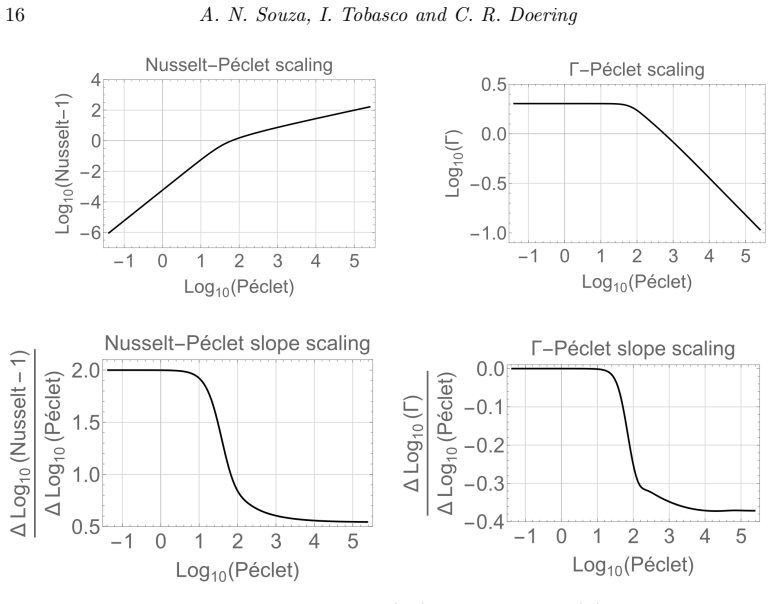
Pith's one-line read Two-dimensional wall-to-wall heat-transport optimizers switch from Nu - 1 ~ Pe^2 to Nu ~ Pe^0.54, with a separable-ansatz upper bound of Pe^{6/11}.
desk verdict The paper's headline bound is honestly conditional, and the numerics don't quite verify the separability assumption the bound uses—still a worthwhile contribution for the convection-bounds crowd. read the letter →
The pith
A machine-rendered reading of the paper's core claim, the machinery that carries it, and where it could break.
The reading
What carries the argument
The engine is the symmetrized variational functional $$S = \langle |\nabla\eta|^2 + 2\xi u\cdot(\hat z-\nabla\eta) - |\nabla\xi|^2 + \mu($Pe^{2}$-|\nabla u|^2)\rangle,$$ obtained from the Nusselt functional by writing the temperature deviation as $\theta=\xi+\eta$ and the adjoint variable as $\phi=\xi-\eta$; its saddle points are the wall-to-wall optimizers. Gradient ascent on $S$—ascent in $\xi$ and $u$, descent in $\eta$—produces the computed flows. For the analytic bound, the key object is the Howard-type functional $$M[\$\sigma$,v;Pe] = \frac{(\langle v_3\$\sigma$\rangle)^2}{$Pe^{{-2}}$\langle|\nabla\$\sigma$|^2\rangle\langle|\nabla v|^2\rangle + \langle(v_3\$\sigma$-\langle v_3\$\sigma$\rangle)^2\rangle},$$ which bounds $Nu-1$ from above. Under the separable ansatz, elementary inequalities—Cauchy-Schwarz, the interpolation bound $[(\varphi'')^2][\varphi^2]\ge1$, and Howard's lemma—give a denominator bounded below by $\delta + Pe^{-2}\delta^{-8/3}$, whose minimum is $\sim Pe^{-6/11}$. That minimization is what produces the conditional upper bound $Nu\lesssim Pe^{6/11}$.
What would settle it
Run gradient ascent from many random initial conditions at $Pe\approx10^5$ and compare the best Nusselt number with the value on the published $Nu$–$Pe$ curve; if any flow exceeds that curve by more than numerical discretization error, the claimed optimal scaling fails. Alternatively, project the computed optimizer onto the separable subspace at that $Pe$ and measure $(N_1-N_2)/N_1$: the paper reports this transport error is at most 1%, so an independent computation that finds a non-separable optimizer with $(N_1-N_2)/N_1$ substantially larger than 1% would show that the separability assumption is the active restriction.
Extended reading notes
Core claim
The central claim is that in two dimensions with no-slip boundaries, the local maximizers of the wall-to-wall transport problem—flows maximizing convective heat transfer at prescribed enstrophy—switch scaling at $Pe\sim10$, entering a regime where $Nu\sim Pe^{0.54}$ that persists to at least $Pe\approx2.5\times10^5$. Numerically, the optimizers are nearly separable in their singular-value decomposition, with the first mode carrying more than 99% of $Nu-1$, and the horizontal profile resembles Jacobi elliptic functions rather than sinusoids. Under the explicit separable ansatz $u_1=-\Psi'(z)\varphi(x)$, $u_3=\Psi(z)\varphi'(x)$, $\xi=\Xi(z)\varphi'(x)$, the Howard-type functional is bounded above by $Pe^{6/11}=Pe^{0.\overline{54}}$, so the computation and the conditional analysis agree. The paper also notes that this cannot be the global asymptotic scaling because existing lower bounds give $\max Nu > C\,Pe^{2/3}/(\log Pe)^{4/3}$ as $Pe\to\infty$; the $Pe^{0.54}$ behavior is therefore presented as the optimal scaling in the computed moderate-$Pe$ range.
Load-bearing premise
The load-bearing premise is that the optimizing fields are exactly, or negligibly close to, separable products of wall-normal and wall-parallel profiles, $u_1=-\Psi'(z)\varphi(x)$, $u_3=\Psi(z)\varphi'(x)$, $\xi=\Xi(z)\varphi'(x)$; the paper provides no proof that non-separable parts contribute negligibly to transport over the computed $Pe$ range.
Editorial extensions
If this is right
- For two-dimensional no-slip wall-to-wall flows, optimal transport follows $Nu\sim Pe^{0.54}$ over $Pe\in[10^3,10^5]$, which translates in Rayleigh-Bénard variables to the single-wavenumber upper-bound scaling $Nu\lesssim Ra^{3/8}$.
- The optimizing fields are nearly separable, with the leading singular mode accounting for at least 99% of $Nu-1$; their horizontal profiles are Jacobi-elliptic-like rather than single sinusoids.
- The conditional $Pe^{6/11}$ bound cannot describe the global maximum at arbitrarily large $Pe$, since rigorous lower bounds grow like $Pe^{2/3}/(\log Pe)^{4/3}$; the $Pe^{0.54}$ regime is a moderate-$Pe$ plateau that branching structures should eventually replace.
- The optimal aspect ratio shrinks with enstrophy budget, with $\Gamma\sim Pe^{-0.37}$ in the nonlinear regime, so optimal cells narrow as $Pe$ increases.
- The gradient-ascent framework transfers to other geometries and boundary conditions wherever Poisson and Stokes solvers are available.
Reading between the lines
- A natural testable extension is to prove an energy estimate on the second singular mode's contribution to $Nu-1$; if that contribution can be bounded uniformly small up to $Pe\sim10^5$, the conditional $Pe^{6/11}$ bound would become unconditional over that range.
- The near-separability of the optimizers suggests a practical control conclusion the paper does not draw: in two-dimensional settings, actuating a single large-scale roll (the dominant mode) should recover roughly 99% of the optimal heat transport, so low-order controllers may suffice.
- The oscillatory relaxation of the local scaling exponent hints at a sequence of modal transitions; one could search for additional 'branched' optimizers slightly beyond $Pe=10^5$ and predict the onset where the exponent moves from $0.54$ toward $2/3$.
- The same separable-ansatz machinery could be applied to three-dimensional wall-to-wall problems; a non-separable ansatz that produced a bound below $Pe^{6/11}$ in two dimensions would overturn the conclusion that the separable class captures the extremal scaling.
Signed reviews
Editorial analysis
A structured set of objections, weighed in public.
Referee Report
Summary. This paper addresses the wall-to-wall optimal transport problem in two dimensions with no-slip isothermal boundaries. The authors develop pseudo-spectral gradient-ascent schemes based on the variational formulation of the Nusselt number, and compute steady locally maximizing flows for Peclet numbers up to approximately 10^5, reporting a transition from Nu-1 ~ Pe^2 to Nu ~ Pe^{0.54} and an optimal aspect-ratio scaling Gamma ~ Pe^{-0.37}. They observe that the computed fields are nearly rank-one via singular value decomposition, which motivates a separable ansatz. Under that ansatz, they derive a conditional upper bound Nu <= C Pe^{6/11} and discuss connections to the background method, Howard-Busse-Malkus theory, and a conjectured duality gap. The paper is explicitly careful to label the analytic bound as conditional, and it notes that the computed finite-Pe scaling cannot persist for global optimizers as Pe tends to infinity in light of known lower bounds.
Significance. The paper is significant because it provides the most complete numerical map to date of locally optimal two-dimensional wall-to-wall transport in the no-slip case, identifies a clear finite-Pe scaling regime, and supplies a conditional analytic bound at the same exponent. The variational machinery connecting the wall-to-wall problem to the background method and Howard's functional is elegantly presented, and the polynomial example illustrating a possible duality gap is instructive. The authors are explicit that the analytic bound is conditional on the separable ansatz, and they correctly note that the computed Pe^{0.54} branch cannot represent global optimizers at asymptotically large Pe in light of the Tobasco-Doering lower bound. The main weaknesses are that the numerical evidence does not directly validate the common horizontal profile required by the ansatz, that the derivation of the bound contains an incorrect identity that must be repaired, and that the numerical scaling lacks rigorous error or resolution estimates.
major comments (3)
- [Section 4.1 and Section 5.1, Eqs. (4.6)-(4.9) and (5.3)-(5.5)] The diagnostic (N1-N2)/N1 <= 0.01 reported in Section 4.1 uses two different horizontal profiles phi1 and phi2 in the leading-rank approximation (4.6)-(4.7), so it measures the fraction of transport carried by the leading singular triad rather than the error incurred by imposing the common-profile ansatz phi1 = phi2 = phi that is used in the bound of Section 5.1. Consequently the computed Nu ~ Pe^{0.54} branch is not demonstrated to lie within the separable class analyzed, and the claimed accord between the numerics and the Pe^{6/11} bound is not established. I ask the authors to add a direct test of the common-phi ansatz, for example by computing the transport of the projection of the optimal fields onto a single horizontal profile, or to soften the connection between the two results.
- [Section 5.1, Eq. (5.11)] The identity <(u3 xi - <u3 xi>)^2> = integral (Psi Xi - 1)^2 dz is not correct when phi(x) is nonconstant: with the normalization <(phi')^2> = 1, horizontal averaging yields <(u3 xi - <u3 xi>)^2> = integral (Psi Xi)^2 <(phi')^4> dz - (integral Psi Xi dz)^2, which generally exceeds integral (Psi Xi - 1)^2 dz. The lower-bound argument still goes through if the equality is replaced by the inequality '>=' (justified by Jensen's inequality since <(phi')^4> >= <(phi')^2>^2 = 1), but the derivation as written is invalid and must be corrected.
- [Section 4, Figure 2] The central numerical scaling Nu ~ Pe^{0.54} is inferred from local logarithmic slopes at the largest computed Pe, yet the paper reports no error bars, resolution or convergence studies, or statement of data availability. Because the local slope oscillates (bottom-left panel of Figure 2), the single value 0.544 at the largest Pe is not by itself a robust estimate of the exponent over the claimed range, and the manuscript should provide a quantitative uncertainty estimate or additional resolution checks.
minor comments (5)
- [Abstract and Section 1] The abstract and several places describe the computed flows as 'maximizing' or 'optimal' without the qualifier 'locally'; since the optimization problem is non-convex and the method finds local maxima, please add 'locally' to these statements to avoid overstatement.
- [Keywords] There is a typo in the keywords: 'variational methds' should be 'variational methods'.
- [Introduction] In the first paragraph, 'complimentary role' should be 'complementary role'.
- [Section 5.1] The inequalities in the derivation of the conditional bound omit all constants; since the result is an upper bound with an unspecified prefactor, a sentence stating that all constants are finite and depend only on the boundary conditions would clarify the logical status of the '>' signs.
- [Section 2.6 and Section 5.1] The overline notation for horizontal averages is introduced in Section 2.6 but is reused in Section 5.1 in expressions such as phi^2 and (phi'')^2 without an explicit reminder of the convention; please make the notation self-contained in Section 5.
Circularity Check
No circularity: the numerical scaling is independently computed, and the separable-ansatz bound is explicitly conditional and not used to produce the numerics.
full rationale
The paper's central numerical result, Nu ~ Pe^0.54 for Pe > 10^3, comes from time-stepping gradient ascent solutions of the wall-to-wall Euler-Lagrange equations, not from the analytic bound. The Pe^{6/11} bound is derived only within an explicitly stated separable ansatz and is never claimed to be an unconditional proof. The authors say plainly: 'It should be emphasized that this is not a rigorous proof for the observed numerical scaling from the previous section since it must still be proven that all solutions in the range Pe ≲ 10^5 are indeed separable, or what is more likely the case, that their non-separable part contributes negligibly to transport.' They also state: 'What we lack is a proof that (5.3)-(5.5) are indeed valid assumptions over the given range of Pe.' The skeptical concern that the SVD evidence uses different horizontal profiles phi1 and phi2 while the ansatz uses a common phi is a genuine rigor gap, but it is an admitted limitation, not a circular reduction: the bound's conclusion is not assumed among its hypotheses. The variational identity (2.19) is attributed to prior same-group work but is rederived in Section 2.3 from the functional S, so the citation is not load-bearing. The lower bound cited from Tobasco & Doering (2017) and Doering & Tobasco (2019) is used only to argue that the computed Pe^0.54 scaling cannot persist as Pe -> infinity, which undermines rather than supports the paper's headline claim and is independent external support. No fitted parameter is renamed as a prediction, and no self-citation supplies the derivation of the main numerical result. The paper is self-contained in its numerical computations and explicitly transparent about the conditional status of the analytic part; there is no exhibited reduction of any claimed result to its own inputs.
Assumptions & free parameters
assumptions (4)
- domain assumption The variational formula Nu-1 = max_xi min_eta S (Eq. 2.19) is a valid exact characterization of the Nusselt number for fixed velocity fields.
- domain assumption Time-independent flows suffice; time-dependent flows do not enhance transport beyond steady flows.
- standard math Howard's lemma: integral of (Psi Xi - 1)^2 is bounded below by (integral (Psi'')^2 integral (Xi')^2)^{-1/4}.
- ad hoc to paper The separable ansatz (5.3)-(5.5) describes optimal fields to leading order in transport.
Cite this review
Pith. "Pith review of Wall-to-wall optimal transport in two dimensions." pith.science (2026). https://pith.science/paper/2DLPXHVA
@misc{pith2026190802896,
  author       = {Pith},
  title        = {Pith review of: Wall-to-wall optimal transport in two dimensions},
  year         = {2026},
  howpublished = {\url{https://pith.science/paper/2DLPXHVA}},
  note         = {Machine review of arXiv:1908.02896}
}
abstract
Gradient ascent methods are developed to compute incompressible flows that maximize heat transport between two isothermal no-slip parallel walls. Parameterizing the magnitude of velocity fields by a P\'eclet number $\text{Pe}$ proportional to their root-mean-square rate-of-strain, the schemes are applied to compute two-dimensional flows optimizing convective enhancement of diffusive heat transfer, i.e., the Nusselt number $\text{Nu}$ up to $\text{Pe} \approx 10^5$. The resulting transport exhibits a change of scaling from $\text{Nu}-1 \sim \text{Pe}^{2}$ for $\text{Pe} < 10$ in the linear regime to $\text{Nu} \sim \text{Pe}^{0.54}$ for $\text{Pe} > 10^3$. Optimal fields are observed to be approximately separable, i.e., products of functions of the wall-parallel and wall-normal coordinates. Analysis employing a separable ansatz yields a conditional upper bound $\lesssim \text{Pe}^{6/11} = \text{Pe}^{0.\overline{54}}$ as $\text{Pe} \rightarrow \infty$ similar to the computationally achieved scaling. Implications for heat transfer in buoyancy-driven Rayleigh-B\'enard convection are discussed.
Figures


Figures from the paper (2 more)


Reference graph
Works this paper leans on
-
[1]
, " * write output.state after.block = add.period write newline
ENTRY address author booktitle chapter edition editor howpublished institution journal key month note number organization pages publisher school series title type volume year eprint label extra.label sort.label short.list INTEGERS output.state before.all mid.sentence after.sentence after.block FUNCTION init.state.consts #0 'before.all := #1 'mid.sentence ...
-
[2]
write newline
" write newline "" before.all 'output.state := FUNCTION n.dashify 't := "" t empty not t #1 #1 substring "-" = t #1 #2 substring "--" = not "--" * t #2 global.max substring 't := t #1 #1 substring "-" = "-" * t #2 global.max substring 't := while if t #1 #1 substring * t #2 global.max substring 't := if while FUNCTION word.in bbl.in capitalize " " * FUNCT...
-
[3]
Alben, Silas 2017 Improved convection cooling in steady channel flows . Phys. Rev. Fluids 2 , 104501
work page 2017
-
[4]
2001 Chebyshev and Fourier Spectral Methods\/ , 2nd edn
Boyd, J.P. 2001 Chebyshev and Fourier Spectral Methods\/ , 2nd edn. Dover
work page 2001
-
[5]
1969 On H oward's bound for heat transport by turbulent convection
Busse, F.H. 1969 On H oward's bound for heat transport by turbulent convection . Journal of Fluid Mechanics 37 , 457--477
work page 1969
-
[6]
Ding, Zijing & Kerswell, Richard R. 2019 Exhausting the background approach for bounding the heat transport in rayleigh-b\'enard convection . preprint
work page 2019
-
[7]
Doering, C. R. & Constantin, P. 1996 Variational bounds on energy dissipation in incompressible flows. III . C onvection . Physical Review E 53 , 5957--5981
work page 1996
-
[8]
& Tobasco, Ian 2019 On the optimal design of wall-to-wall heat transport
Doering, Charles R. & Tobasco, Ian 2019 On the optimal design of wall-to-wall heat transport . to appear in Communications on Pure and Applied Mathematics d oi:10.1002/cpa.21832
Show all 27 references
-
[9]
& Hibbs, A
Feynman, Richard P. & Hibbs, A. R. 1965 Quantum Mechanics and Path Integrals\/ , 1st edn. McGraw-Hill Companies
1965
-
[10]
, Chini, G
Hassanzadeh, P. , Chini, G. P. & Doering, Charles R. 2014 Wall to wall optimal transport . Journal of Fluid Mechanics 751 , 627--662
2014
-
[11]
Howard, L. N. 1963 Heat transport by turbulent convection . Journal of Fluid Mechanics 17 , 405--432
1963
-
[12]
Kerswell, R. R. 1998 Unification of variational principles for turbulent shear flows: The background method of D oering- C onstantin and the mean-fluctuation formulation of H oward- B usse . Physica D 121 , 175--192
1998
-
[13]
& Schumann , U
Kleiser , L. & Schumann , U. 1980 Treatment of incompressibility and boundary conditions in 3-D numerical spectral simulations of plane channel flows . In 3rd Conference on Numerical Methods in Fluid Mechanics\/ (ed. E. H. Hirschel ) , pp. 165--173
1980
-
[14]
1954 Discrete transitions in turbulent convection
Malkus, W.V.R. 1954 Discrete transitions in turbulent convection . Proceedings of the Royal Society of London 225 , 185--195
1954
-
[15]
, Doering, C.R
Marcotte, F. , Doering, C.R. , Thiffeault, J.-L. & Young, W.R 2018 Optimal heat transfer and optimal exit times . SIAM Journal on Applied Mathematics 78 (1), 591--608
2018
-
[16]
Journal of Fluid Mechanics 851
Motoki, Shingo , Kawahara, Genta & Shimizu, Masaki 2018 a\/ Maximal heat transfer between two parallel plates . Journal of Fluid Mechanics 851
2018
-
[17]
Journal of Fluid Mechanics 835 , 1157–1198
Motoki, Shingo , Kawahara, Genta & Shimizu, Masaki 2018 b\/ Optimal heat transfer enhancement in plane couette flow . Journal of Fluid Mechanics 835 , 1157–1198
2018
-
[18]
Plasting, S. C. & Kerswell, R. R. 2003 Improved upper bound on the energy dissipation rate in plane couette flow: the full solution to busse's problem and the constantin–doering–hopf problem with one-dimensional background field . Journal of Fluid Mechanics 477 , 363–379
2003
-
[19]
Souza, A. N. 2016 An optimal control approach to bounding transport properties of thermal convection . University of Michigan Doctoral Thesis
2016
-
[20]
Souza, A. N. & Doering, C. R. 2015 a\/ Maximal transport in the L orenz equations . Physics Letters A 379 , 518--523
2015
-
[21]
& Doering, Charles R
Souza, Andre N. & Doering, Charles R. 2015 b\/ Transport bounds for a truncated model of rayleigh–-b\'enard convection . Physica D: Nonlinear Phenomena 308 , 26 -- 33
2015
-
[22]
2017 Optimal wall-to-wall transport by incompressible flows
Tobasco, Ian & Doering, Charles R. 2017 Optimal wall-to-wall transport by incompressible flows . Phys. Rev. Lett. 118 , 264502
2017
-
[23]
2017 Roughness as a route to the ultimate regime of thermal convection
Toppaladoddi, Srikanth , Succi, Sauro & Wettlaufer, John S. 2017 Roughness as a route to the ultimate regime of thermal convection . Phys. Rev. Lett. 118 , 074503
2017
-
[24]
Trefethen, L. N. 2001 Spectral Methods in MATLAB\/ , 1st edn. SIAM
2001
-
[25]
Journal of Computational and Applied Mathematics 290 , 159 -- 173
Viswanath, Divakar 2015 Spectral integration of linear boundary value problems . Journal of Computational and Applied Mathematics 290 , 159 -- 173
2015
-
[26]
Journal of Computational Physics 251 , 414 -- 431
Viswanath, Divakar & Tobasco, Ian 2013 Navier–-stokes solver using green’s functions i: Channel flow and plane couette flow . Journal of Computational Physics 251 , 414 -- 431
2013
-
[27]
, Chini, G
Wen, B. , Chini, G. P. , Kerswell, R. R. & Doering, C. R. 2015 Aspect-ratio-dependent upper bounds for two-dimensional R ayleigh-- B \' e nard convection between stress-free isothermal boundaries . Physical Review E 85
2015
Reviewed August 14, 2026 · model on record in the stance chip above.
Discussion (0). Continue with ORCID to comment.