REVIEW 3 major objections 4 minor 80 references
Causal concept for black hole shadows
T0 review · 3 major / 4 minor · reviewed 2026-08-14 · deepseek-v4-flash
Pith's one-line read Black hole shadows are produced by the accumulation of light rays around wandering null geodesics, not by stationary photon orbits.
desk verdict A genuinely new causal redefinition of photon-sphere concepts, but the central implication from wandering null geodesics to observable shadows is asserted rather than proven. read the letter →
The pith
A machine-rendered reading of the paper's core claim, the machinery that carries it, and where it could break.
The reading
What carries the argument
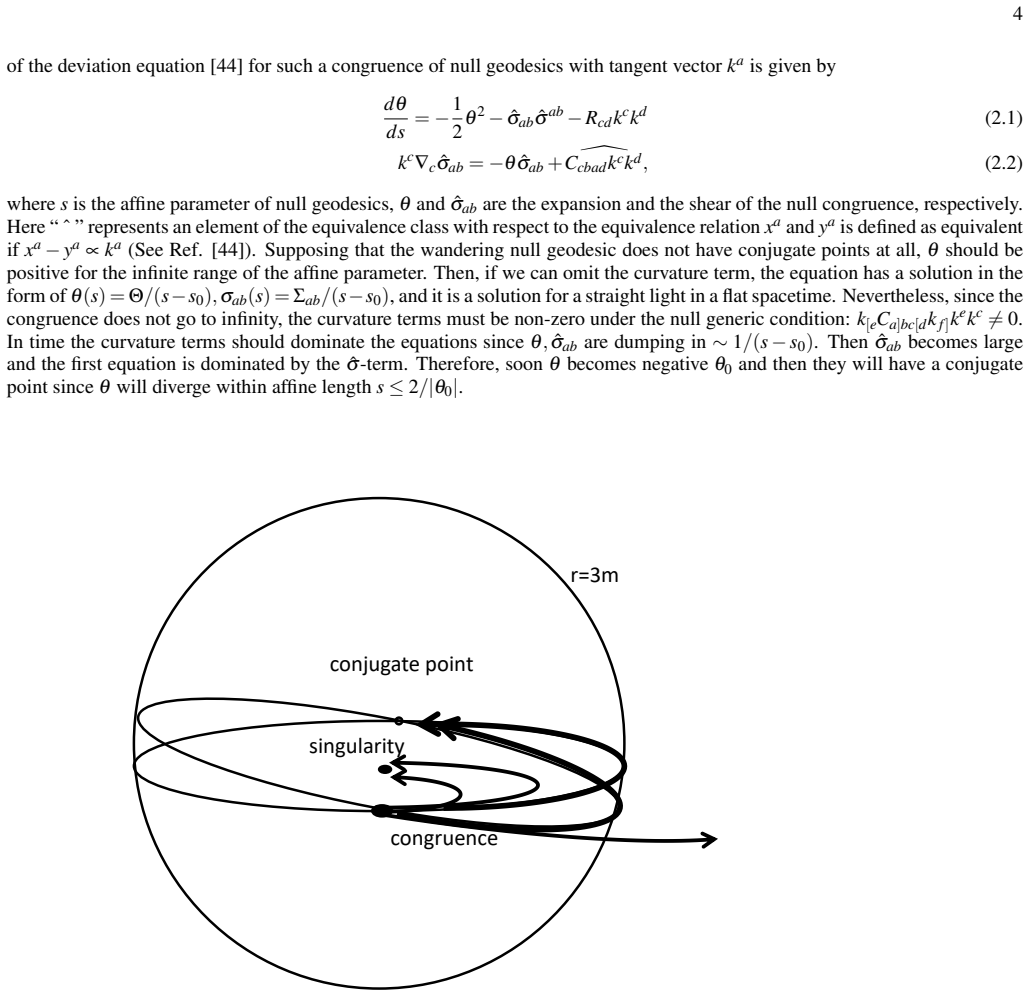
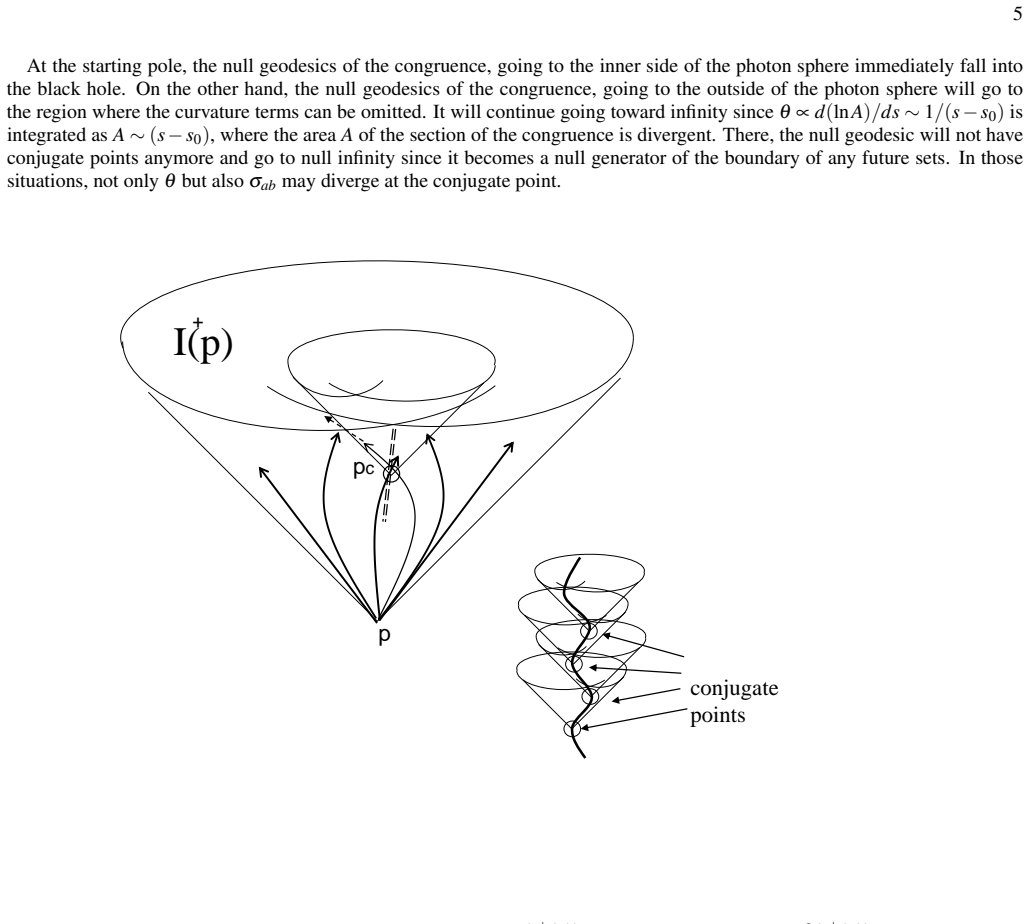
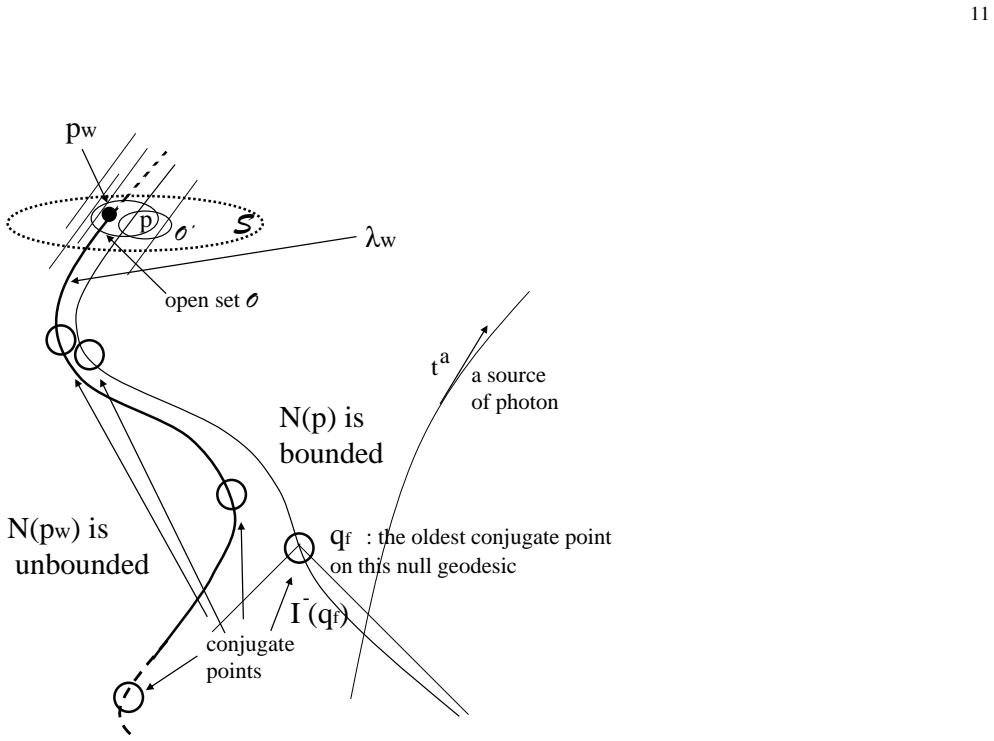
The load-bearing object is the wandering null geodesic, a complete null geodesic with an unlimited number of conjugate points; its totally wandering version, with repeated conjugate points toward both past and future, is what replaces the photon sphere in general spacetimes. Conjugate points are detected through the null geodesic deviation and Raychaudhuri equations, where the Weyl curvature acts as an effective focusing source; the paper isolates Weyl focusing by a conformal transformation and derives an affine-length scale, roughly $1/\sqrt{C_1}$ with $C_1$ a bound on Weyl curvature, below which no truncated wandering geodesic can form. The shadow-relevance argument is carried by a singular null congruence and a number function $N(p)$ counting conjugate points along each past-directed ray, with the oldest conjugate point $q_f$ defining the causal boundary $\partial I^-(q_f)$. The paper then uses the projection of this boundary along timelike source worldlines onto a spatial slice to conclude that complete past rays cross infinitely many light sources, producing the accumulation that appears as a shadow.
What would settle it
Take a past-directed light cone in Minkowski spacetime and compute the projection of $\partial I^-(q_f)$ onto a spatial slice: it is a sphere of finite radius, not the whole slice, so the open-and-closed premise already fails in the simplest globally hyperbolic spacetime; repeating this computation in a numerical collapse and finding a proper subset there would break the claim that asymptotic flatness forces an accumulation somewhere.
Extended reading notes
Core claim
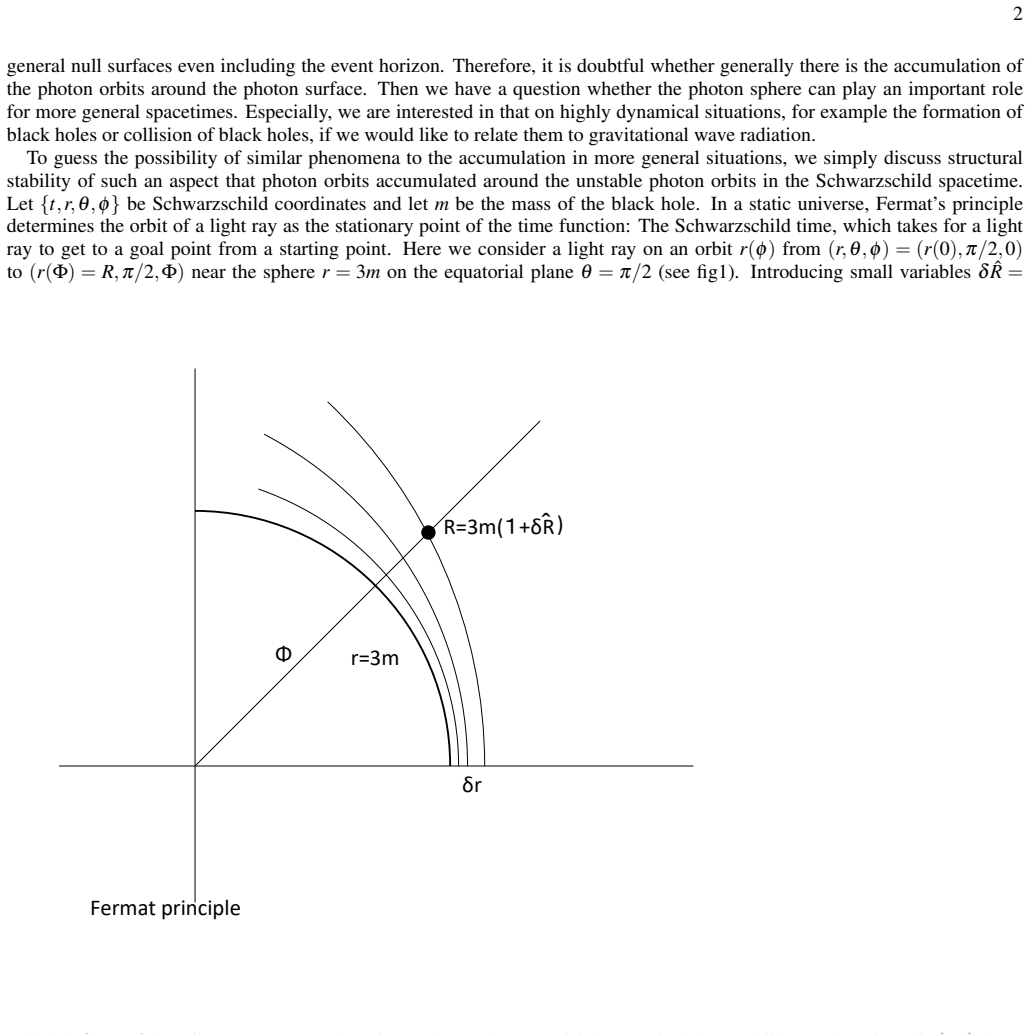
The paper's central claim is that the essence of a black hole shadow is not stationary cycling of photon orbits but the accumulation of null geodesics near a ray that repeatedly acquires conjugate points. It defines a wandering null geodesic as a complete, inextendible null geodesic with unlimited conjugate points, and a totally wandering null geodesic as one with unlimited conjugate points in both future and past directions; the set of these is the wandering set, the proposed general replacement for the photon sphere. Using the geodesic deviation equation and Weyl focusing, it argues that such wandering rays exist in general asymptotically flat black-hole spacetimes, and that a truncated version can be used to discuss when a shadow structure forms during collapse. The paper also contends that near a totally wandering ray the number of conjugate points on nearby rays becomes unbounded and rapidly varying, which is the causal mechanism for the brightness contrast seen as a shadow, and that this structure is invariant under conformal transformations.
Load-bearing premise
The argument leans on the premise that the boundary traced by the oldest conjugate points projects onto the whole spatial slice of spacetime rather than only part of it; if that projection is only partial, the conclusion that every past light ray crosses infinitely many light-source worldlines does not follow.
Editorial extensions
If this is right
- Shadow theory no longer needs stationarity, so dynamical, merging, and collapsing black holes can have a well-defined shadow locus defined by conjugate-point accumulation.
- In any asymptotically flat spacetime with enough light sources, the existence of at least one totally wandering null geodesic implies a brightness contrast—the shadow—will appear somewhere in the observer's sky.
- Because conjugate points are conformally invariant, the wandering set survives conformal rescalings that can change event-horizon topology, giving a causal way to optically distinguish such spacetimes.
- The absence of truncated wandering geodesics in globally conformally flat collapse means homogeneous spherical collapse suppresses shadow-structure formation until Weyl curvature grows.
- The arguments apply to sufficiently old black holes and not to young ones, so the predicted contrast depends on the black hole's age and curvature scale rather than on stationarity.
Reading between the lines
- Editorial inference: the conjugate-point count $N(p)$ along simulated past rays could be used as a numerical diagnostic for locating the wandering set in dynamical spacetimes without solving for photon spheres.
- Editorial inference: observed or simulated shadow brightness profiles might be compared with $N(p)$ to estimate how many windings light rays make, offering an observational probe of the wandering structure.
- Editorial inference: since the same accumulation underlies strong-deflection lensing, the wandering-set idea could connect shadow formation to deflection-angle divergences in time-dependent spacetimes.
- Editorial inference: the conformal-invariance result suggests that shadow observations probe conformal structure, which could separate spacetimes that share horizon topology but differ by a conformal factor.
Signed reviews
Editorial analysis
A structured set of objections, weighed in public.
Referee Report
Summary. The paper proposes a causal, coordinate-free replacement for the notion of a photon sphere in general black hole spacetimes. It defines a 'wandering null geodesic' as a complete null geodesic with infinitely many conjugate points, a 'totally wandering null geodesic' as one that is wandering in both temporal directions, and a 'wandering set' as the set of such geodesics. A 'truncated wandering null geodesic' is introduced to discuss the formation of the structure in dynamical collapses. The central claim is that the physical essence of a black hole shadow is not the stationary cycling of photon orbits but the accumulation of null geodesics near a wandering null geodesic, and that the existence of a wandering null geodesic implies such accumulation somewhere in an asymptotically flat spacetime. Section III gives a theorem on the absence of truncated wandering geodesics in globally conformally flat regions and a perturbative Weyl-focusing estimate of the scale below which they do not form. Section IV attempts to show, via a congruence argument, that a totally wandering null geodesic produces an accumulation of light rays and hence a shadow.
Significance. The conceptual framework is interesting and could be valuable for discussing black hole shadows in non-stationary spacetimes, where the standard photon sphere is undefined. The paper is careful to reproduce the Schwarzschild photon-sphere limit, and Theorem 1 is a clean, checkable statement. The perturbative Weyl-focusing estimate provides a concrete scale, and the paper is transparent about several limitations. However, the central implication from a wandering null geodesic to an observable accumulation is not established: the topological step in Section IV is unsupported, the existence of wandering geodesics is assumed rather than proved, and the link from conjugate-point counts to brightness is purely qualitative. As it stands, the paper is best described as a research proposal rather than a proof of the claimed general phenomenon.
major comments (3)
- [Section IV] The assertion that A = ψ[∂I^-(q_f)] is "a closed and open subset in the topology of C, so that A is C" is not derived from the hypotheses and is not a general topological fact. The image of a closed achronal C^1 submanifold under a timelike flow is homeomorphic to the submanifold, but homeomorphism does not make the image either open or closed in the Cauchy surface. In Minkowski spacetime with a vertical timelike flow the image happens to be all of C because the light cone is a graph over the Cauchy surface, but that is a special case, not a general theorem. The subsequent conclusion that every timelike source worldline intersects ∂I^-(q_f) precisely once, and hence that every complete past null geodesic crosses infinitely many source worldlines, rests on this unsupported clopen conclusion and therefore collapses.
- [Sections IV and V; Ref. [58]] The paper's central implication is conditional on the existence of a totally wandering null geodesic, but no existence theorem is proved. Section IV begins "We suppose a situation that there is at least one totally wandering null geodesic through pw," and Section V explicitly defers the existence theorem to Ref. [58], which is listed as "our forthcoming task" and is not available to the reader. The perturbative analysis in Section III.A only bounds a scale below which truncated wandering geodesics are absent; it does not show that any wandering geodesic appears. Moreover, the final paragraph of Section IV argues that "not all null geodesics... can be totally wandering" implies "there must be a totally wandering null geodesic λrw," which is a non-sequitur: non-emptiness of the wandering set cannot be inferred from the fact that a large congruence contains some non-wandering geodesics. Thus the claimed relevance to general black hole shadows is not established.
- [Section IV] The step from the number function N(p) to observable brightness is asserted rather than derived. The text says "the closer O' approaches pw, the wider the range of N(p) becomes and the brighter the light rays are," but no map from N(p) to surface brightness or angular density is supplied. Similarly, the claim that each null geodesic of the sub-congruence c[O'] "will cross an infinite (numerous) number of orbits for the luminous sources" is not justified by the topological condition that C\ψ[c[O']] is not dense; a complete null geodesic can intersect a non-dense set only in a limited portion of its affine parameter, for instance a single worldline. The paper's own caveat that these considerations "may be far from astrophysical generality" does not repair the logical gap between conjugate-point counts and image brightness.
minor comments (4)
- [References] Reference [58] is given as "our forthcoming task"; this is not a usable citation and should be replaced by a real reference or removed along with the passages that rely on it.
- [Section III.A] There is a typo in the text: "vanishing Wyle curvature" should read "vanishing Weyl curvature."
- [Section II] The statement that "the conjugate point is sufficient for a null geodesic to stay a chronal region" is imprecise; a conjugate point causes a geodesic to fail to be a maximum of Lorentzian length, and the relation to remaining in a chronal region should be stated more carefully.
- [Section IV] The regularity of the achronal boundary is referred to inconsistently as C^1 and C^1-; the notation should be unified, and the smoothness assumptions on the number function N(p) near the totally wandering geodesic should be stated explicitly.
Circularity Check
No load-bearing step reduces to its inputs by construction; the deferred existence theorem in Ref. [58] is a completeness gap, not a circular derivation.
full rationale
The paper's central claim is conditional: if a totally wandering null geodesic (a complete null geodesic with unbounded conjugate points) exists, then it implies accumulation and brightness contrast in an asymptotically flat spacetime. That conditional claim is not equivalent to the definitions by construction: the wandering geodesic is defined through conjugate points, while the shadow conclusion is argued via achronal boundaries and luminous-source crossings in Section IV, and the definitions are checked against the Schwarzschild photon sphere as an external benchmark. No parameter is fitted and no known result is merely renamed. The main self-referential element is Ref. [58], listed in the bibliography as 'our forthcoming task'; Section IV says 'the other theorem for the existence of wandering null geodesics will be introduced in our forthcoming research...' This is an explicit deferral of the general existence proof, so it is a completeness gap rather than a circular step: the paper does not cite the self-reference as if it were an established external theorem. The Section IV assertion that the image A of partial I^-(q_f) under a timelike flow is 'a closed and open subset in the topology of C, so that A is C' is asserted without proof and is a mathematical gap, but it is not a definitional reduction. Overall, no load-bearing step reduces to its own input, so the circularity score is low.
Assumptions & free parameters
free parameters (1)
- curvature bound C1 =
unspecified, assumed C1 < 1
assumptions (7)
- domain assumption The spacetime is globally hyperbolic.
- domain assumption The null generic condition k[e Ca]bc[dk f] ke kc != 0 holds along wandering geodesics.
- ad hoc to paper At least one totally wandering null geodesic exists in the spacetime under study.
- domain assumption Past null geodesic completeness of the spacetime.
- ad hoc to paper The image of partial I^-(q_f) under the timelike-flow homeomorphism is both closed and open in the Cauchy surface.
- ad hoc to paper Weyl curvature is small and bounded by C1, with Ricci terms negligible, near the formation region.
- standard math Conjugate points along null geodesics are invariant under global conformal transformations.
invented entities (3)
-
Wandering null geodesic and totally wandering variant
-
Wandering set W
-
Truncated wandering null geodesic
Cite this review
Pith. "Pith review of Causal concept for black hole shadows." pith.science (2026). https://pith.science/paper/W4D3ZJO6
@misc{pith2026190802921,
  author       = {Pith},
  title        = {Pith review of: Causal concept for black hole shadows},
  year         = {2026},
  howpublished = {\url{https://pith.science/paper/W4D3ZJO6}},
  note         = {Machine review of arXiv:1908.02921}
}
read the original abstract
Causal concept for the general black hole shadow is investigated, instead of the photon sphere. We define several `wandering null geodesics' as complete null geodesics accompanied by repetitive conjugate points, which would correspond to null geodesics on the photon sphere in Schwarzschild spacetime. We also define a `wandering set', that is, a set of totally wandering null geodesics as a counterpart of the photon sphere, and moreover, a truncated wandering null geodesic to symbolically discuss its formation. Then we examine the existence of a wandering null geodesic in general black hole spacetimes mainly in terms of Weyl focusing. We will see the essence of the black hole shadow is not the stationary cycling of the photon orbits which is the concept only available in a stationary spacetime, but their accumulation. A wandering null geodesic implies that this accumulation will be occur somewhere in an asymptotically flat spacetime.
Figures
Figures from the paper (1 more)
Reference graph
Works this paper leans on
- [58]
-
[1]
In such a case, we will eliminate the contribution of Ricci curvature from the deviation equation. Firstly, we want to distinguish the effect of Ricci curvature Rabkakb from the deviation equation given in the previous section (Eq. (2.1) and Eq. (2.2)) by an appropriate conformal transformation. Considering a conformal transformation ˜ gab = Ω2gab, 6 Glob...
-
[2]
B. P. Abbott et al. Observation of Gravitational Waves from a Binary Black Hole Merger. Phys. Rev. Lett., 116(6):061102, 2016
2016
-
[3]
First M87 Event Horizon Telescope Results
Kazunori Akiyama et al. First M87 Event Horizon Telescope Results. I. The Shadow of the Supermassive Black Hole. Astrophys. J., 875(1):L1, 2019
work page 2019
-
[4]
First M87 Event Horizon Telescope Results
Kazunori Akiyama et al. First M87 Event Horizon Telescope Results. II. Array and Instrumentation. Astrophys. J., 875(1):L2, 2019
work page 2019
-
[5]
First M87 Event Horizon Telescope Results
Kazunori Akiyama et al. First M87 Event Horizon Telescope Results. III. Data Processing and Calibration. Astrophys. J., 875(1):L3, 2019
work page 2019
-
[6]
First M87 Event Horizon Telescope Results
Kazunori Akiyama et al. First M87 Event Horizon Telescope Results. IV . Imaging the Central Supermassive Black Hole. Astrophys. J., 875(1):L4, 2019
work page 2019
-
[7]
First M87 Event Horizon Telescope Results
Kazunori Akiyama et al. First M87 Event Horizon Telescope Results. V . Physical Origin of the Asymmetric Ring. Astrophys. J., 875(1):L5, 2019
work page 2019
Show all 80 references
-
[8]
First M87 Event Horizon Telescope Results
Kazunori Akiyama et al. First M87 Event Horizon Telescope Results. VI. The Shadow and Mass of the Central Black Hole. Astrophys. J., 875(1):L6, 2019
2019
-
[9]
Topology of event horizon
Masaru Siino. Topology of event horizon. Phys. Rev., D58:104016, 1998
1998
-
[10]
Topological appearance of event horizon: What is the topology of the event horizon that we can see? Prog
Masaru Siino. Topological appearance of event horizon: What is the topology of the event horizon that we can see? Prog. Theor. Phys., 99:1–32, 1998
1998
-
[11]
The Asymmetric merger of black holes
Sascha Husa and Jeffrey Winicour. The Asymmetric merger of black holes. Phys. Rev., D60:084019, 1999
1999
-
[12]
Cohen, Jeffrey D
Michael I. Cohen, Jeffrey D. Kaplan, and Mark A. Scheel. On Toroidal Horizons in Binary Black Hole Inspirals.Phys. Rev., D85:024031, 2012
2012
-
[13]
Kidder, and Saul A
Andy Bohn, Lawrence E. Kidder, and Saul A. Teukolsky. Toroidal Horizons in Binary Black Hole Mergers. Phys. Rev., D94(6):064009, 2016
2016
-
[14]
Black hole fusion in the extreme mass ratio limit
Roberto Emparan, Marina Martinez, and Miguel Zilhao. Black hole fusion in the extreme mass ratio limit. Phys. Rev., D97(4):044004, 2018
2018
-
[15]
S. W. Hawking and G. F. R. Ellis.The Large Scale Structure of Space-Time. Cambridge Monographs on Mathematical Physics. Cambridge University Press, 2011
2011
-
[16]
Viewing the shadow of the black hole at the galactic center
Heino Falcke, Fulvio Melia, and Eric Agol. Viewing the shadow of the black hole at the galactic center. Astrophys. J., 528:L13, 2000
2000
-
[17]
Broderick, Abraham Loeb, and Ramesh Narayan
Avery E. Broderick, Abraham Loeb, and Ramesh Narayan. The Event Horizon of Sagittarius A*. Astrophys. J., 701:1357–1366, 2009
2009
-
[18]
Broderick, Vincent L
Avery E. Broderick, Vincent L. Fish, Sheperd S. Doeleman, and Abraham Loeb. Evidence for Low Black Hole Spin and Physically Motivated Accretion Models from Millimeter VLBI Observations of Sagittarius A*. Astrophys. J., 735:110, 2011
2011
-
[19]
Shape and position of the shadow in the δ = 2 Tomimatsu-Sato space-time
Cosimo Bambi and Naoki Yoshida. Shape and position of the shadow in the δ = 2 Tomimatsu-Sato space-time. Class. Quant. Grav., 27:205006, 2010
2010
-
[20]
Testing the rotational nature of the supermassive object m87 from the circularity and size of its first image
Cosimo Bambi, Katherine Freese, Sunny Vagnozzi, and Luca Visinelli. Testing the rotational nature of the supermassive object m87 from the circularity and size of its first image. Physical Review D, 100(4), aug 2019
2019
-
[21]
Shadows of colliding black holes
Daisuke Nitta, Takeshi Chiba, and Naoshi Sugiyama. Shadows of colliding black holes. Physical Review D, 84(6), sep 2011
2011
-
[22]
Shadows of Multi-Black Holes: Analytic Exploration
Akifumi Yumoto, Daisuke Nitta, Takeshi Chiba, and Naoshi Sugiyama. Shadows of Multi-Black Holes: Analytic Exploration. Phys. Rev., D86:103001, 2012
2012
-
[23]
Shadow of Kerr-Taub-NUT black hole
Ahmadjon Abdujabbarov, Farruh Atamurotov, Yusuf Kucukakca, Bobomurat Ahmedov, and Ugur Camci. Shadow of Kerr-Taub-NUT black hole. Astrophys. Space Sci., 344:429–435, 2013
2013
-
[24]
Photon Regions and Shadows of Kerr-Newman-NUT Black Holes with a Cosmological Constant
Arne Grenzebach, V olker Perlick, and Claus L ¨ammerzahl. Photon Regions and Shadows of Kerr-Newman-NUT Black Holes with a Cosmological Constant. Phys. Rev., D89(12):124004, 2014
2014
-
[25]
Eiroa, and Gaston Giribet
Leonardo Amarilla, Ernesto F. Eiroa, and Gaston Giribet. Null geodesics and shadow of a rotating black hole in extended Chern-Simons modified gravity. Phys. Rev., D81:124045, 2010
2010
-
[26]
Leonardo Amarilla and Ernesto F. Eiroa. Shadow of a rotating braneworld black hole. Phys. Rev., D85:064019, 2012
2012
-
[27]
Shadow of a Charged Rotating Black Hole in f (R) Gravity
Sara Dastan, Reza Saffari, and Saheb Soroushfar. Shadow of a Charged Rotating Black Hole in f (R) Gravity. 2016
2016
-
[28]
Pedro V . P. Cunha, Carlos A. R. Herdeiro, Burkhard Kleihaus, Jutta Kunz, and Eugen Radu. Shadows of Einstein-dilaton-Gauss-Bonnet black holes. Phys. Lett., B768:373–379, 2017. 14
2017
-
[29]
Hunting for extra dimensions in the shadow of m87
Sunny Vagnozzi and Luca Visinelli. Hunting for extra dimensions in the shadow of m87. Physical Review D, 100(2), jul 2019
2019
-
[30]
V . Perlick. Gravitational lensing from a spacetime perspective. Living Rev.Rel. 7,9, 2004
2004
-
[31]
Upper bound on the radii of black-hole photonspheres
Shahar Hod. Upper bound on the radii of black-hole photonspheres. Physics Letters B, 727(1-3):345–348, nov 2013
2013
-
[32]
On the number of light rings in curved spacetimes of ultra-compact objects
Shahar Hod. On the number of light rings in curved spacetimes of ultra-compact objects. Physics Letters B, 776:1–4, jan 2018
2018
-
[33]
Absorption and emission spectra of a schwarzschild black hole
Norma Sanchez. Absorption and emission spectra of a schwarzschild black hole. Physical Review D, 18(4):1030–1036, aug 1978
1978
-
[34]
Unstable circular null geodesics of static spherically symmetric black holes, regge poles, and quasinormal frequencies
Yves D ´ecanini, Antoine Folacci, and Bernard Raffaelli. Unstable circular null geodesics of static spherically symmetric black holes, regge poles, and quasinormal frequencies. Physical Review D, 81(10), may 2010
2010
-
[35]
K. S. Virbhadra and George F. R. Ellis. Schwarzschild black hole lensing. Physical Review D, 62(8), sep 2000
2000
-
[36]
Spherical photon orbits around a kerr black hole
Edward Teo. Spherical photon orbits around a kerr black hole. General Relativity and Gravitation, 35(11):1909–1926, 2003
1909
-
[37]
Clarissa-Marie Claudel, K. S. Virbhadra, and G. F. R. Ellis. The Geometry of photon surfaces. J. Math. Phys., 42:818–838, 2001
2001
-
[38]
Catastrophe theory and its applications
Tim Poston and Ian Stewart. Catastrophe theory and its applications. Courier Corporation, 2014
2014
-
[39]
The shadow of a collapsing dark star
Stefanie Schneider and V olker Perlick. The shadow of a collapsing dark star. General Relativity and Gravitation, 50(6), may 2018
2018
-
[40]
Quasi-local photon surfaces in general spherically symmetric spacetimes
Li-Ming Cao and Yong Song. Quasi-local photon surfaces in general spherically symmetric spacetimes. 2019
2019
-
[41]
Understanding photon sphere and black hole shadow in dynamically evolving spacetimes
Akash K Mishra, Sumanta Chakraborty, and Sudipta Sarkar. Understanding photon sphere and black hole shadow in dynamically evolving spacetimes. Physical Review D, 99(10), may 2019
2019
-
[42]
Bisnovatyi-Kogan and Oleg Yu
Gennady S. Bisnovatyi-Kogan and Oleg Yu. Tsupko. Shadow of a black hole at cosmological distances. Physical Review D, 98(8), oct 2018
2018
-
[43]
Transversely trapping surfaces: Dynamical version
Hirotaka Yoshino, Keisuke Izumi, Tetsuya Shiromizu, and Yoshimune Tomikawa. Transversely trapping surfaces: Dynamical version. Progress of Theoretical and Experimental Physics, 2020(2), feb 2020
2020
-
[44]
The fingerprints of black holes—shadows and their degeneracies
Marc Mars, Claudio F Paganini, and Marius A Oancea. The fingerprints of black holes—shadows and their degeneracies. Classical and Quantum Gravity, 35(2):025005, dec 2017
2017
-
[45]
Robert M. Wald. General Relativity. University of Chicago Pr., 1984
1984
-
[46]
Spherical steady accretion flows: Dependence on the cosmological constant, exact isothermal solutions, and applications to cosmology
Patryk Mach, Edward Malec, and Janusz Karkowski. Spherical steady accretion flows: Dependence on the cosmological constant, exact isothermal solutions, and applications to cosmology. Physical Review D, 88(8), oct 2013
2013
-
[47]
Radial accretion flows on static spherically symmetric black holes.Classical and Quantum Gravity, 32(15):155006, jul 2015
Eliana Chaverra and Olivier Sarbach. Radial accretion flows on static spherically symmetric black holes.Classical and Quantum Gravity, 32(15):155006, jul 2015
2015
-
[48]
Cveti ˇc, G
M. Cveti ˇc, G. W. Gibbons, and C. N. Pope. Photon spheres and sonic horizons in black holes from supergravity and other theories. Physical Review D, 94(10), nov 2016
2016
-
[49]
Correspondence between sonic points of ideal photon gas accretion and photon spheres
Yasutaka Koga and Tomohiro Harada. Correspondence between sonic points of ideal photon gas accretion and photon spheres. Physical Review D, 94(4), aug 2016
2016
-
[50]
Rotating accretion flows in d dimensions: Sonic points, critical points, and photon spheres
Yasutaka Koga and Tomohiro Harada. Rotating accretion flows in d dimensions: Sonic points, critical points, and photon spheres. Physical Review D, 98(2), jul 2018
2018
-
[51]
Photon surfaces in spherically, planar, and hyperbolically symmetric spacetimes in d dimensions: Sonic point/photon sphere correspondence
Yasutaka Koga. Photon surfaces in spherically, planar, and hyperbolically symmetric spacetimes in d dimensions: Sonic point/photon sphere correspondence. Physical Review D, 99(6), mar 2019
2019
-
[52]
Gibbons and C.M
G.W. Gibbons and C.M. Warnick. Aspherical photon and anti-photon surfaces. Physics Letters B, 763:169–173, dec 2016
2016
-
[53]
Pedro V . P. Cunha, Carlos A. R. Herdeiro, and Eugen Radu. Fundamental photon orbits: Black hole shadows and spacetime instabilities. Physical Review D, 96(2), jul 2017
2017
-
[54]
D. V . Gal’tsov and K. V . Kobialko. Completing characterization of photon orbits in kerr and kerr-newman metrics. Physical Review D, 99(8), apr 2019
2019
-
[55]
D. V . Gal’tsov and K. V . Kobialko. Photon trapping in static axially symmetric spacetime.Physical Review D, 100(10), nov 2019
2019
-
[56]
Stability of null orbits on photon spheres and photon surfaces
Yasutaka Koga and Tomohiro Harada. Stability of null orbits on photon spheres and photon surfaces. Physical Review D, 100(6), sep 2019
2019
-
[57]
Spinors and space-time, vol
Roger Penrose and Wolfgang Rindler. Spinors and space-time, vol. ii. Cambridge Monographs on Mathematical Physics (Cambridge University Press, 1984, 1986), 1986
1984
-
[59]
our forthcoming task
-
[60]
C. C. Dyer and R. C. Roeder. On the transition from weyl to ricci focusing. General Relativity and Gravitation, 13(12):1157–1160, dec 1981
1981
-
[61]
J. R. Oppenheimer and H. Snyder. On Continued gravitational contraction. Phys. Rev., 56:455–459, 1939
1939
-
[62]
Slowly decaying waves on spherically symmetric spacetimes and ultracompact neutron stars
Joe Keir. Slowly decaying waves on spherically symmetric spacetimes and ultracompact neutron stars. Classical and Quantum Gravity, 33(13):135009, jun 2016
2016
-
[63]
Vitor Cardoso, Lu´ıs C. B. Crispino, Caio F. B. Macedo, Hirotada Okawa, and Paolo Pani. Light rings as observational evidence for event horizons: Long-lived modes, ergoregions and nonlinear instabilities of ultracompact objects. Physical Review D, 90(4), aug 2014
2014
-
[64]
Pedro V . P. Cunha, Emanuele Berti, and Carlos A. R. Herdeiro. Light-ring stability for ultracompact objects. Physical Review Letters, 119(25), dec 2017
2017
-
[65]
M. H. Stone. Applications of the theory of boolean rings to general topology. Transactions of the American Mathematical Society , 41(3):375–375, mar 1937
1937
-
[66]
V . Bozza. Gravitational lensing in the strong field limit. Physical Review D, 66(10), nov 2002
2002
-
[67]
Light curves of light rays passing through a wormhole
Naoki Tsukamoto and Tomohiro Harada. Light curves of light rays passing through a wormhole. Physical Review D, 95(2), jan 2017
2017
-
[68]
V . Bozza. Quasiequatorial gravitational lensing by spinning black holes in the strong field limit. Physical Review D, 67(10), may 2003
2003
-
[69]
Eiroa, Gustavo E
Ernesto F. Eiroa, Gustavo E. Romero, and Diego F. Torres. Reissner-nordstr¨om black hole lensing. Physical Review D, 66(2), jul 2002
2002
-
[70]
A. O. Petters. On relativistic corrections to microlensing effects: applications to the galactic black hole. Monthly Notices of the Royal Astronomical Society, 338(2):457–464, jan 2003
2003
-
[71]
S. V . Iyer and A. O. Petters. Light’s bending angle due to black holes: from the photon sphere to infinity. General Relativity and 15 Gravitation, 39(10):1563–1582, jul 2007
2007
-
[72]
Analytical approach to strong gravitational lensing from ultra- compact objects
Rajibul Shaikh, Pritam Banerjee, Suvankar Paul, and Tapobrata Sarkar. Analytical approach to strong gravitational lensing from ultra- compact objects. Physical Review D, 99(10), may 2019
2019
-
[73]
Stefanov, Stoytcho S
Ivan Zh. Stefanov, Stoytcho S. Yazadjiev, and Galin G. Gyulchev. Connection between black-hole quasinormal modes and lensing in the strong deflection limit. Physical Review Letters, 104(25), jun 2010
2010
-
[74]
Thorne W.L
K.S. Thorne W.L. Ames. Astrophys.J. 151,659, 1968
1968
-
[75]
J. L. Synge. The escape of photons from gravitationally intense stars. Monthly Notices of the Royal Astronomical Society, 131(3):463– 466, feb 1966
1966
-
[76]
How does a collapsing star look? Physical Review D, 100(8), oct 2019
Hirotaka Yoshino, Kazuma Takahashi, and Ken ichi Nakao. How does a collapsing star look? Physical Review D, 100(8), oct 2019
2019
-
[77]
TOPOLOGICAL CLASSIFICATION OF BLACK HOLES: GENERIC MAXWELL SET AND CREASE SET OF a HORIZON
MASARU SIINO and TATSUHIKO KOIKE. TOPOLOGICAL CLASSIFICATION OF BLACK HOLES: GENERIC MAXWELL SET AND CREASE SET OF a HORIZON. International Journal of Modern Physics D, 20(06):1095–1122, jun 2011
2011
-
[78]
Topology of event horizon in axially symmetric spacetime: Classification of maxwell set with symmetry
Masaru Siino. Topology of event horizon in axially symmetric spacetime: Classification of maxwell set with symmetry. arXiv:gr- qc/0505004, 2005
2005
-
[79]
Larry Smarr and James W. York. Kinematical conditions in the construction of spacetime. Physical Review D, 17(10):2529–2551, may 1978
1978
-
[80]
Siino and D
M. Siino and D. Ida. Half-period theorem of binary black holes. Progress of Theoretical Physics, 122(4):1015–1025, oct 2009
2009
Reviewed August 14, 2026 · model on record in the stance chip above.
Discussion (0). Continue with ORCID to comment.