REVIEW 2 major objections 6 minor 46 references
Local and global patterns in quasiparticle interference: a reduced response function approach
T0 review · 2 major / 6 minor · reviewed 2026-08-14 · deepseek-v4-flash
Pith's one-line read For a Dirac point of topological charge $n$, an $x$-scattering and $x$-probe quasiparticle interference image shows exactly $2|n|$ disconnected bright arcs, making arc counts topological-number indicators.
desk verdict Clever framework and a concrete arc-counting rule, but the paper's own graphene section admits false GJDOS hot spots at exactly the momenta where the rule is read, so the central justification for using J is not established. read the letter →
The pith
A machine-rendered reading of the paper's core claim, the machinery that carries it, and where it could break.
The reading
What carries the argument
The load-bearing object is the reduced response function $R_{\alpha\beta}(\mathbf p,\omega)=S_{\alpha\beta}(\mathbf p,\omega)+iJ_{\alpha\beta}(\mathbf p,\omega)$, assembled from an autocorrelation of spectral functions $A_s(\mathbf k,\omega)=\delta(\omega-E^s_{\mathbf k})$ and their Hilbert partners $B_s(\mathbf k,\omega)$. Its imaginary part $J_{\alpha\beta}$, the generalized joint density of states, is the practical imaging tool: it integrates the spin coherent factor $F^{ss'}_{\alpha\beta}(\mathbf k+\mathbf p,\mathbf k)$ over pairs of momenta on constant-energy contours that are separated by $\mathbf p$. The singularity condition $v^{s'}_{\mathbf k_0+\mathbf p}\times v^s_{\mathbf k_0}=0$ reduces QPI pattern formation to contour geometry, and the channel-dependent structure of the coherent factor encodes how each scattering and probing channel suppresses or restores those singularities: for $\alpha=\beta=x$ the factor reflects spins across the $x$-axis, which selects the directions that form $2|n|$ arcs. Because the real part is the Hilbert transform of the imaginary part, the two have the same singular behavior, which is what licenses reading FT-LDOS from the simpler $J$ once its recognizable artifacts are discarded.
What would settle it
Take the model $H_n(\mathbf k)=k^n(\cos n\theta\,\sigma_x+\sin n\theta\,\sigma_y)$ with a small warping term added to flatten a segment of a constant-energy contour, and compute both the real part $S_{xx}$ and the imaginary part $J_{xx}$ at finite lifetime; if any bright feature of $J_{xx}$ that has no counterpart in $S_{xx}$ lies at the same momentum as one of the expected arcs, the count is ambiguous. Experimentally, a spin-resolved FT-STS measurement of ABC-stacked trilayer graphene counting the bright arcs in the intravalley and intervalley regions would settle whether the predicted $2N$ arc counts appear exactly as stated.
Extended reading notes
Core claim
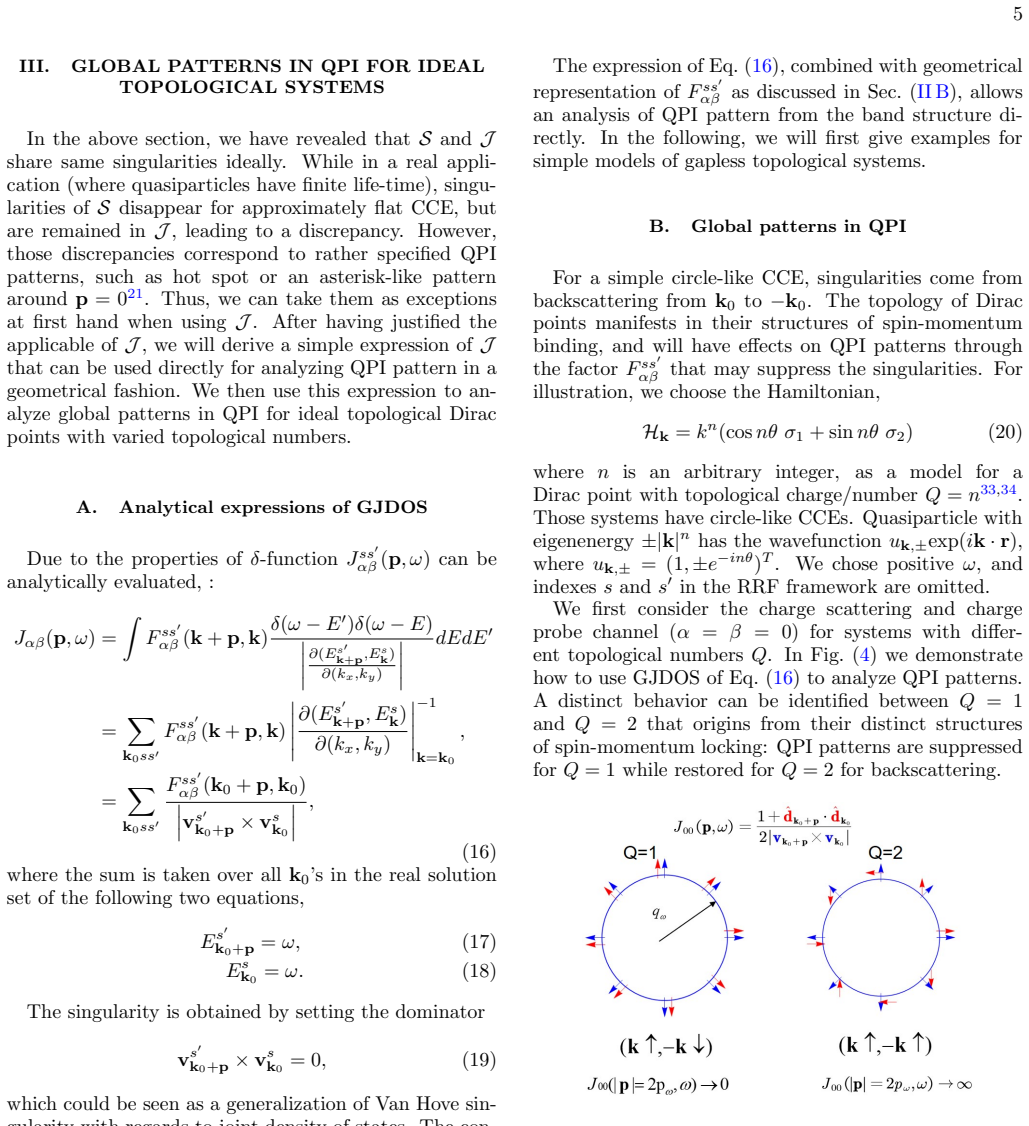
The paper's central claim is that for a two-band Hamiltonian $H(\mathbf k)=E_0(\mathbf k)+\mathbf d(\mathbf k)\cdot\boldsymbol\sigma$, the reduced response function $R_{\alpha\beta}(\mathbf p,\omega)=S_{\alpha\beta}(\mathbf p,\omega)+iJ_{\alpha\beta}(\mathbf p,\omega)$ carries the full singular information of quasiparticle interference: its real part $S$ and imaginary part $J$ share the same singularities, and $J$ is the generalized joint density of states, an autocorrelation of spectral functions along constant-energy contours weighted by a spin coherent factor $F^{ss'}_{\alpha\beta}$. The singularities occur when a pair of points on two contours linked by $\mathbf p$ have group velocities satisfying $v^{s'}_{\mathbf k_0+\mathbf p}\times v^s_{\mathbf k_0}=0$, i.e. parallel or antiparallel velocities, with an inverse-square-root divergence that becomes stronger where the joint curvature vanishes. For an ideal Dirac point $H_n(\mathbf k)=k^n(\cos n\theta\,\sigma_x+\sin n\theta\,\sigma_y)$ of topological charge $n$, the paper proves that the channel $\alpha=\beta=x$ produces exactly $2|n|$ disconnected hot arcs, while the charge channel $\alpha=\beta=0$ suppresses backscattering for odd $n$; the number of arcs is therefore a global topological-number indicator. Numerical evaluation for Bi$_2$Te$_3$, BiTeI, and ABC-stacked $N$-layer graphene shows that the indicator remains legible when constant-energy contours are nonconvex and when local features such as cusp-scattering hot spots and false joint-density peaks distort the images.
Load-bearing premise
The arc-counting indicator rests on the assumption, stated rather than proved, that with finite quasiparticle lifetime the only differences between the easily computed imaginary part and the real QPI signal are recognizable artifacts such as a $\mathbf p=0$ hot spot or an asterisk-like pattern, and that these never appear at the momenta where the $2|n|$ arcs are being counted.
Editorial extensions
If this is right
- A spin-resolved FT-STS experiment with an $x$-polarized impurity and $x$-sensitive probe can read the topological charge of a Dirac point by counting bright arcs: $2|n|$ arcs means charge $n$.
- For the graphene family, two valleys with opposite charges $\pm N$ produce $2N$ disconnected hot arcs in intervalley QPI, and the charge channel distinguishes whether the charge difference is odd or even.
- The generalized joint density of states is a legitimate stand-in for full FT-LDOS in QPI analysis, provided its known artifacts, the $\mathbf p=0$ hot spot and asterisk-like features from flat or near-nesting contours, are recognized and discarded.
- Zero joint curvature at cusp-to-cusp scattering produces higher-order singularities whose hotter spots should dominate experimental QPI images of Bi$_2$Te$_3$ when the constant-energy contour becomes nonconvex; the paper reproduces the measured FT-STS patterns.
- The topological arc indicators survive nonconvex contours and complicated local geometry, so they need not wait for idealized band structures to be useful in real materials.
Reading between the lines
- Inference: because the mechanism uses only contour geometry and a channel-dependent coherent factor, the same $2|n|$ arc-counting should extend to multi-band crossings, nodal lines, or non-Hermitian band touchings as long as generalized constant-energy contours and an effective spin/pseudospin factor exist; the paper's two-band restriction is a convenience, not a prerequisite.
- Inference: the 'artifacts are excludable at first hand' rule could be turned into a quantitative protocol by comparing $S_{\alpha\beta}$ and $J_{\alpha\beta}$ over a range of finite lifetimes; any feature of $J$ that disappears from $S$ as a contour flattens is spurious, so the topological indicator could be automated rather than judged by eye.
- Inference: the sign of the topological charge is read from the direction the arcs rotate when the $x$-channel is rotated slightly, which predicts that reversing the chirality of a sample reverses the rotation direction in a spin-resolved FT-STS experiment; this is a direct consequence the paper does not itself test.
Signed reviews
Editorial analysis
A structured set of objections, weighed in public.
Referee Report
Summary. The paper develops a reduced response function (RRF) framework for quasiparticle interference, decomposing the Fourier-transformed LDOS into real and imaginary parts S and J (the generalized joint density of states, GJDOS). It claims that S and J share the same singularities in ideal zero-lifetime systems and that, under finite quasiparticle lifetime, discrepancies between them are limited to recognizable false features that can be 'excluded at first hand,' thereby justifying the use of GJDOS for QPI analysis. From an analytical expression for GJDOS, the paper derives topological-number indicators: for the scattering/probe channel alpha = beta = x, a Dirac point of topological charge n produces 2|n| hot arcs, while the alpha = beta = 0 channel gives an odd-even distinction. The indicators are demonstrated numerically on Bi2Te3, BiTeI, and ABC-stacked N-layer graphene.
Significance. The paper offers a clean decomposition of the FT-LDOS response into real and imaginary parts, a transparent spin-coherent-factor algebra (Sec. II B), and a closed-form GJDOS expression (Eq. (16)) that enables a geometric reading of QPI patterns. The proposed topological-number indicators for the ideal Hamiltonian Eq. (20) are elegant and produce falsifiable predictions: 2|n| hot arcs for the x-x channel and an odd-even selection for the 0-0 channel. The numerical simulations for Bi2Te3, BiTeI, and ABC-stacked graphene are internally consistent and show that global patterns survive complicated constant-energy contours. If the derivation behind Eq. (14) is supplied and the status of J relative to S is clarified, the framework would be a useful contribution to the QPI literature. The current manuscript, however, does not establish the central claim that GJDOS is a generally justified substitute for FT-LDOS.
major comments (2)
- [Sec. III (intro) and Sec. IV C] The central justification for using J (GJDOS) in place of the full FT-LDOS rests on the assertion in the Sec. III introduction that finite-lifetime discrepancies between S and J are limited to recognizable patterns (a p=0 hot spot or an asterisk-like feature) that can be excluded 'at first hand' when using J. No proof of this classification is provided. The assertion is directly contradicted by the paper's own closing statement of Sec. IV C, which admits that the joint density of states gives false hot spots at p=0, plus or minus 2K, plus or minus 2K prime, and plus or minus 2(K - K prime). These momenta are precisely the regions where the intervalley topological indicator is read: the 2N hot arcs in Fig. 9 arise from intervalley scattering at those same wave vectors. Thus the admitted false features overlap the readout region of the central indicator. Since the numerical demonstrations of the indicators in Sec. IV are all performed with S (the real part) rather than J, the paper does not actually demonstrate that J can be used directly for topological-number inference in finite-lifetime systems. This is a load-bearing gap: without a proof of the exclusion or a restriction of the indicator claim to S, the central claim that GJDOS is a justified tool for QPI analysis is not established.
- [Sec. II C, Eq. (14)] The asymptotic formula Eq. (14) is introduced with the phrase 'after a tedious derivation we can show,' but no derivation is supplied in the main text or in an appendix. This formula is the mathematical foundation for the statement that the real and imaginary parts of the reduced response function share the same singularities and for the subsequent joint-curvature analysis used throughout the paper, including the classification of higher-order singularities in Fig. 2 and the stability discussion in Sec. II D. Without a presented derivation or a reference to a complete proof, the central analytic result of the paper is not independently verifiable from the manuscript. The authors should include the derivation in an appendix or provide a detailed outline of the stationary-phase or contour-integral argument that leads to Eq. (14).
minor comments (6)
- [Abstract] The sentence 'It is justified that the generalized joint density of states, which is the imaginary part of RRF, for studying QPI' lacks a main verb; it should be rewritten, for example, as 'the generalized joint density of states, which is the imaginary part of the RRF, is justified for studying QPI.'
- [Sec. II D] The text states that S is 'an autocorrelation of A(k,omega) and A(k,omega)'; from Eq. (10), S is a cross-correlation of A and B (A B + B A), not an autocorrelation of A with itself. The subsequent discussion of the sign change of B confirms that this is a typographical error that should be corrected.
- [Sec. IV C] The sentence 'distinct 2N pieces of disconnected hot arcs appear for intravalley scattering' should read 'intervalley scattering,' consistent with the figure caption and the surrounding discussion that places the hot arcs at wave vectors such as plus or minus 2K and plus or minus 2(K - K prime).
- [Sec. IV C] The list of false hot spots 'p=0, plus or minus 2K, plus or minus 2K, and plus or minus 2(K - K prime)' appears to contain a duplicated 'plus or minus 2K'; presumably the second one should be 'plus or minus 2K prime.'
- [Fig. 1 caption] The caption 'Behavior of dot-E_{k_omega(t0)}+p' is unclear notation; it likely refers to the energy at k_omega(t0)+p and should be typeset accordingly for readability.
- [Sec. III B] The 'Positive-negative indicator' is defined by rotating the scattering and probe channels 'a little,' but the required rotation angle (presumably pi/(2n)) is not specified, which makes the prescription ambiguous.
Circularity Check
No circularity in the core derivation: the topological indicators are analytic consequences of the model Hamiltonian, and the noted GJDOS false features are a validity caveat rather than a circular step.
full rationale
The central derivation is not circular. Eq. (8) writes FT-LDOS as a sum of S-type and J-type autocorrelations, and the RRF is defined in Eqs. (9)-(10) by retaining the AA term as J; the claim that S and J share singularities is then derived analytically in Sec. II C via Eq. (14), not assumed. The topological-number indicators in Sec. III B start from H_k = k^n(cos nθ σ1 + sin nθ σ2), with n an independent winding-number parameter, and derive F_xx ~ (1 + cos n(2θ+π)); the resulting 2|n| hot arcs are a prediction from the model, not a quantity fitted to the target. The materials sections use band parameters from prior literature and compare computed S_αα patterns with known topological numbers and experiments, which is an external consistency check rather than a circular fit. Self-citations are present but not load-bearing: Ref. [33] labels the topological charge of H_n, a fact already encoded in the Hamiltonian's winding, and Ref. [12] is only a supporting entry in a list of QPI studies. The genuine limitation is Sec. IV C's admission that "joint density of states give false hot spots at p = 0, ±2K, ±2K, and ±2(K−K′)", which overlaps the intervalley indicator readout; however, the graphene QPI panels are evaluated with S_00 and S_zz, so this is a robustness caveat, not a reduction of the prediction to its inputs. Score 2 reflects only minor non-load-bearing self-citation.
Assumptions & free parameters
assumptions (6)
- domain assumption Born approximation and single-impurity T-matrix: T(k',k) = V_{k',k} σβ
- domain assumption Centrosymmetry of the response: Λαβ(p,ω)=Λαβ(−p,ω)
- domain assumption Scattering potential has a momentum-independent phase: V_{k+p,k}=e^{iφ}|V_{k+p,k}|
- domain assumption Two-band Hamiltonian description with H(k)=E0(k)+d(k)·σ
- ad hoc to paper GJDOS exceptions are limited to recognizable patterns
- domain assumption Topological charge of a gapless point equals the winding of the d-vector, and the low-energy Hamiltonian spin texture faithfully represents the material's topology
Cite this review
Pith. "Pith review of Local and global patterns in quasiparticle interference: a reduced response function approach." pith.science (2026). https://pith.science/paper/IIQHUOCP
@misc{pith2026190802955,
  author       = {Pith},
  title        = {Pith review of: Local and global patterns in quasiparticle interference: a reduced response function approach},
  year         = {2026},
  howpublished = {\url{https://pith.science/paper/IIQHUOCP}},
  note         = {Machine review of arXiv:1908.02955}
}
read the original abstract
A physical system exposes to us in a real space, while its description often refers to its reciprocal momentum space. A connection between them can be established by exploring patterns of quasiparticles interference (QPI), which is experimentally accessible by Fourier transformation of the scanning tunneling spectroscopy (FT-STS). We here investigate how local and global features of QPI patterns are related to the geometry and topology of electronic structure in the considered physical system. A reduced response function (RRF) approach is developed that can analyze QPI patterns with clear physical pictures. It is justified that the generalized joint density of states, which is the imaginary part of RRF, for studying QPI. Moreover, we reveal that global patterns of QPI may be indicators of topological numbers for gapless systems, and demonstrate that robustness of such indicators against distractive local features of QPI for topological materials with complicated band structures.
Figures


Figures from the paper (5 more)


Reference graph
Works this paper leans on
-
[1]
author author M. F. \ Crommie , author C. P. \ Lutz , \ and\ author D. M. \ Eigler ,\ 10.1038/363524a0 journal journal Nature \ volume 363 ,\ pages 524 ( year 1993 ) NoStop
doi:10.1038/363524a0 1993
-
[2]
author author Y. Hasegawa \ and\ author P. Avouris ,\ 10.1103/PhysRevLett.71.1071 journal journal Phys. Rev. Lett. \ volume 71 ,\ pages 1071 ( year 1993 ) NoStop
-
[3]
author author P. T. \ Sprunger , author L. Petersen , author E. W. \ Plummer , author E. Lægsgaard , \ and\ author F. Besenbacher ,\ 10.1126/science.275.5307.1764 journal journal Science \ volume 275 ,\ pages 1764 ( year 1997 ) NoStop
-
[4]
author author L. Capriotti , author D. J. \ Scalapino , \ and\ author R. D. \ Sedgewick ,\ 10.1103/PhysRevB.68.014508 journal journal Phys. Rev. B \ volume 68 ,\ pages 014508 ( year 2003 ) NoStop
-
[5]
author author Q.-H. \ Wang \ and\ author D.-H. \ Lee ,\ 10.1103/PhysRevB.67.020511 journal journal Phys. Rev. B \ volume 67 ,\ pages 020511 ( year 2003 ) NoStop
-
[6]
author author T. Hanaguri , author Y. Kohsaka , author M. Ono , author M. Maltseva , author P. Coleman , author I. Yamada , author M. Azuma , author M. Takano , author K. Ohishi , \ and\ author H. Takagi ,\ 10.1126/science.1166138 journal journal Science \ volume 323 ,\ pages 923 ( year 2009 ) NoStop
-
[7]
author author H. M. \ Guo \ and\ author M. Franz ,\ 10.1103/PhysRevB.81.041102 journal journal Phys. Rev. B \ volume 81 ,\ pages 041102 ( year 2010 ) NoStop
-
[8]
author author N. Avraham , author J. Reiner , author A. Kumar-Nayak , author N. Morali , author R. Batabyal , author B. Yan , \ and\ author H. Beidenkopf ,\ doi:10.1002/adma.201707628 journal journal Adv. Mater. \ volume 30 ,\ pages 1707628 ( year 2018 ) NoStop
Show all 46 references
-
[9]
author author J. E. \ Hoffman , author K. McElroy , author D.-H. \ Lee , author K. M. \ Lang , author H. Eisaki , author S. Uchida , \ and\ author J. C. \ Davis ,\ 10.1126/science.1072640 journal journal Science \ volume 297 ,\ pages 1148 ( year 2002 ) NoStop
-
[10]
Pereg-Barnea \ and\ author M
author author T. Pereg-Barnea \ and\ author M. Franz ,\ 10.1103/PhysRevB.68.180506 journal journal Phys. Rev. B \ volume 68 ,\ pages 180506 ( year 2003 ) NoStop
2003 doi
-
[11]
Lee , author K
author author J. Lee , author K. Fujita , author A. R. \ Schmidt , author C. K. \ Kim , author H. Eisaki , author S. Uchida , \ and\ author J. C. \ Davis ,\ 10.1126/science.1176369 journal journal Science \ volume 325 ,\ pages 1099 ( year 2009 a ) NoStop
-
[12]
\ Zhang , author Q
author author D.-B. \ Zhang , author Q. Han , \ and\ author Z.-D. \ Wang ,\ 10.1088/0256-307x/30/5/057401 journal journal Chinese. Phys. Lett. \ volume 30 ,\ pages 057401 ( year 2013 ) NoStop
2013 doi
-
[13]
author author G. M. \ Rutter , author J. N. \ Crain , author N. P. \ Guisinger , author T. Li , author P. N. \ First , \ and\ author J. A. \ Stroscio ,\ 10.1126/science.1142882 journal journal Science \ volume 317 ,\ pages 219 ( year 2007 ) NoStop
-
[14]
Pereg-Barnea \ and\ author A
author author T. Pereg-Barnea \ and\ author A. H. \ MacDonald ,\ 10.1103/PhysRevB.78.014201 journal journal Phys. Rev. B \ volume 78 ,\ pages 014201 ( year 2008 ) NoStop
2008 doi
-
[15]
Brihuega , author P
author author I. Brihuega , author P. Mallet , author C. Bena , author S. Bose , author C. Michaelis , author L. Vitali , author F. Varchon , author L. Magaud , author K. Kern , \ and\ author J. Y. \ Veuillen ,\ 10.1103/PhysRevLett.101.206802 journal journal Phys. Rev. Lett. \...
-
[16]
Dombrowski , author W
author author D. Dombrowski , author W. Jolie , author M. Petrović , author S. Runte , author F. Craes , author J. Klinkhammer , author M. Kralj , author P. Lazić , author E. Sela , \ and\ author C. Busse ,\ 10.1103/PhysRevLett.118.116401 journal journal Phys. Rev. Lett. \ vol...
-
[17]
Jolie , author J
author author W. Jolie , author J. Lux , author M. Pörtner , author D. Dombrowski , author C. Herbig , author T. Knispel , author S. Simon , author T. Michely , author A. Rosch , \ and\ author C. Busse ,\ 10.1103/PhysRevLett.120.106801 journal journal Phys. Rev. Lett. \ volume...
-
[18]
Zhou , author C
author author X. Zhou , author C. Fang , author W.-F. \ Tsai , \ and\ author J. Hu ,\ 10.1103/PhysRevB.80.245317 journal journal Phys. Rev. B \ volume 80 ,\ pages 245317 ( year 2009 ) NoStop
2009 doi
-
[19]
\ Lee , author C
author author W.-C. \ Lee , author C. Wu , author D. P. \ Arovas , \ and\ author S.-C. \ Zhang ,\ @noop journal journal Phys. Rev. B \ volume 80 ,\ pages 245439 ( year 2009 b ) NoStop
2009
-
[20]
Beidenkopf , author P
author author H. Beidenkopf , author P. Roushan , author J. Seo , author L. Gorman , author I. Drozdov , author Y. S. \ Hor , author R. J. \ Cava , \ and\ author A. Yazdani ,\ 10.1038/nphys2108 https://www.nature.com/articles/nphys2108#supplementary-information journal journal...
-
[21]
Kohsaka , author M
author author Y. Kohsaka , author M. Kanou , author H. Takagi , author T. Hanaguri , \ and\ author T. Sasagawa ,\ 10.1103/PhysRevB.91.245312 journal journal Phys. Rev. B \ volume 91 ,\ pages 245312 ( year 2015 ) NoStop
2015 doi
-
[22]
Kohsaka , author T
author author Y. Kohsaka , author T. Machida , author K. Iwaya , author M. Kanou , author T. Hanaguri , \ and\ author T. Sasagawa ,\ 10.1103/PhysRevB.95.115307 journal journal Phys. Rev. B \ volume 95 ,\ pages 115307 ( year 2017 ) NoStop
-
[23]
Batabyal , author N
author author R. Batabyal , author N. Morali , author N. Avraham , author Y. Sun , author M. Schmidt , author C. Felser , author A. Stern , author B. Yan , \ and\ author H. Beidenkopf ,\ 10.1126/sciadv.1600709 journal journal Science Advances \ volume 2 ,\ pages e1600709 ( yea...
-
[24]
Inoue , author A
author author H. Inoue , author A. Gyenis , author Z. Wang , author J. Li , author S. W. \ Oh , author S. Jiang , author N. Ni , author B. A. \ Bernevig , \ and\ author A. Yazdani ,\ 10.1126/science.aad8766 journal journal Science \ volume 351 ,\ pages 1184 ( year 2016 ) NoStop
-
[25]
author author A. K. \ Mitchell \ and\ author L. Fritz ,\ 10.1103/PhysRevB.93.035137 journal journal Phys. Rev. B \ volume 93 ,\ pages 035137 ( year 2016 ) NoStop
2016 doi
-
[26]
Zheng \ and\ author M
author author H. Zheng \ and\ author M. Zahid Hasan ,\ 10.1080/23746149.2018.1466661 journal journal Advances in Physics: X \ volume 3 ,\ pages 1466661 ( year 2018 ) NoStop
2018
-
[27]
Topp , author R
author author A. Topp , author R. Queiroz , author A. Grüneis , author L. Müchler , author A. W. \ Rost , author A. Varykhalov , author D. Marchenko , author M. Krivenkov , author F. Rodolakis , author J. L. \ McChesney , author B. V. \ Lotsch , author L. M. \ Schoop , \ and\ ...
-
[28]
Queiroz \ and\ author A
author author R. Queiroz \ and\ author A. Stern ,\ 10.1103/PhysRevLett.121.176401 journal journal Phys. Rev. Lett. \ volume 121 ,\ pages 176401 ( year 2018 ) NoStop
2018 doi
-
[29]
Zhu , author T.-R
author author Z. Zhu , author T.-R. \ Chang , author C.-Y. \ Huang , author H. Pan , author X.-A. \ Nie , author X.-Z. \ Wang , author Z.-T. \ Jin , author S.-Y. \ Xu , author S.-M. \ Huang , author D.-D. \ Guan , author S. Wang , author Y.-Y. \ Li , author C. Liu , author D. ...
-
[30]
McElroy , author R
author author K. McElroy , author R. W. \ Simmonds , author J. E. \ Hoffman , author D. H. \ Lee , author J. Orenstein , author H. Eisaki , author S. Uchida , \ and\ author J. C. \ Davis ,\ 10.1038/nature01496 journal journal Nature \ volume 422 ,\ pages 592 ( year 2003 ) NoStop
-
[31]
author author P. G. \ Derry , author A. K. \ Mitchell , \ and\ author D. E. \ Logan ,\ 10.1103/PhysRevB.92.035126 journal journal Phys. Rev. B \ volume 92 ,\ pages 035126 ( year 2015 ) NoStop
2015 doi
-
[32]
Liu , author X.-L
author author Q. Liu , author X.-L. \ Qi , \ and\ author S.-C. \ Zhang ,\ 10.1103/PhysRevB.85.125314 journal journal Phys. Rev. B \ volume 85 ,\ pages 125314 ( year 2012 ) NoStop
2012 doi
-
[33]
author author Y. X. \ Zhao \ and\ author Z. D. \ Wang ,\ 10.1103/PhysRevLett.110.240404 journal journal Phys. Rev. Lett. \ volume 110 ,\ pages 240404 ( year 2013 ) NoStop
2013 doi
-
[34]
Min \ and\ author A
author author H. Min \ and\ author A. H. \ MacDonald ,\ 10.1103/PhysRevB.77.155416 journal journal Phys. Rev. B \ volume 77 ,\ pages 155416 ( year 2008 ) NoStop
2008 doi
-
[35]
Mallet , author I
author author P. Mallet , author I. Brihuega , author S. Bose , author M. M. \ Ugeda , author J. M. \ Gómez-Rodríguez , author K. Kern , \ and\ author J. Y. \ Veuillen ,\ 10.1103/PhysRevB.86.045444 journal journal Phys. Rev. B \ volume 86 ,\ pages 045444 ( year 2012 ) NoStop
-
[36]
author author M. Z. \ Hasan \ and\ author C. L. \ Kane ,\ 10.1103/RevModPhys.82.3045 journal journal Rev. Mod. Phys. \ volume 82 ,\ pages 3045 ( year 2010 ) NoStop
2010 doi
-
[37]
\ Qi \ and\ author S.-C
author author X.-L. \ Qi \ and\ author S.-C. \ Zhang ,\ 10.1103/RevModPhys.83.1057 journal journal Rev. Mod. Phys. \ volume 83 ,\ pages 1057 ( year 2011 ) NoStop
2011 doi
-
[38]
Fu ,\ 10.1103/PhysRevLett.103.266801 journal journal Phys
author author L. Fu ,\ 10.1103/PhysRevLett.103.266801 journal journal Phys. Rev. Lett. \ volume 103 ,\ pages 266801 ( year 2009 ) NoStop
2009 doi
-
[39]
Zhang , author P
author author T. Zhang , author P. Cheng , author X. Chen , author J.-F. \ Jia , author X. Ma , author K. He , author L. Wang , author H. Zhang , author X. Dai , author Z. Fang , author X. Xie , \ and\ author Q.-K. \ Xue ,\ 10.1103/PhysRevLett.103.266803 journal journal Phys. ...
-
[40]
Crepaldi , author L
author author A. Crepaldi , author L. Moreschini , author G. Autès , author C. Tournier-Colletta , author S. Moser , author N. Virk , author H. Berger , author P. Bugnon , author Y. J. \ Chang , author K. Kern , author A. Bostwick , author E. Rotenberg , author O. V. \ Yazyev ...
-
[41]
author author A. K. \ GEIM \ and\ author K. S. \ NOVOSELOV ,\ title The rise of graphene , \ in\ 10.1142/9789814287005_0002 booktitle Nanoscience and Technology ,\ pp.\ pages 11--19 NoStop
-
[42]
Roushan , author J
author author P. Roushan , author J. Seo , author C. V. \ Parker , author Y. S. \ Hor , author D. Hsieh , author D. Qian , author A. Richardella , author M. Z. \ Hasan , author R. J. \ Cava , \ and\ author A. Yazdani ,\ 10.1038/nature08308 https://www.nature.com/articles/natur...
-
[43]
Wiesendanger ,\ 10.1103/RevModPhys.81.1495 journal journal Rev
author author R. Wiesendanger ,\ 10.1103/RevModPhys.81.1495 journal journal Rev. Mod. Phys. \ volume 81 ,\ pages 1495 ( year 2009 ) NoStop
2009 doi
-
[44]
Jeon , author Y
author author S. Jeon , author Y. Xie , author J. Li , author Z. Wang , author B. A. \ Bernevig , \ and\ author A. Yazdani ,\ 10.1126/science.aan3670 journal journal Science \ volume 358 ,\ pages 772 ( year 2017 ) NoStop
2017 doi
-
[45]
Cornils , author A
author author L. Cornils , author A. Kamlapure , author L. Zhou , author S. Pradhan , author A. A. \ Khajetoorians , author J. Fransson , author J. Wiebe , \ and\ author R. Wiesendanger ,\ 10.1103/PhysRevLett.119.197002 journal journal Phys. Rev. Lett. \ volume 119 ,\ pages 19...
-
[46]
Ishizaka , author M
author author K. Ishizaka , author M. S. \ Bahramy , author H. Murakawa , author M. Sakano , author T. Shimojima , author T. Sonobe , author K. Koizumi , author S. Shin , author H. Miyahara , author A. Kimura , author K. Miyamoto , author T. Okuda , author H. Namatame , author...
Reviewed August 14, 2026 · model on record in the stance chip above.
Discussion (0). Continue with ORCID to comment.