REVIEW 3 major objections 5 minor 24 references
Obvious Manipulations in Cake-Cutting
T0 review · 3 major / 5 minor · reviewed 2026-08-14 · deepseek-v4-flash
Pith's one-line read The paper proves that the leftmost leaves cake-cutting mechanism gives every agent a fair share and leaves no obvious way to gain by lying.
desk verdict Genuinely new result with a fixable formal gap in the query specification; deserves peer review. read the letter →
The pith
A machine-rendered reading of the paper's core claim, the machinery that carries it, and where it could break.
The reading
What carries the argument
The key object is the leftmost leaves mechanism, a discrete variant of the moving-knife procedure in which all remaining agents cut simultaneously and the smallest cut leaves with the interval to its left. Its defining feature is the relative cut query: at period $t$ each agent is asked for the point $x$ such that $u_i([x_{t-1},x])=u_i([x_{t-1},1])/(n-t+1)$, the point that gives the agent a fair share of the cake that remains. This query does the work: Lemma 1 pins the truthful worst-case utility to exactly that fair share, Lemma 2 pins the truthful best-case utility to the whole remaining cake, and comparing these two extremes rules out every obvious manipulation. The relative form is essential, as Remark 1 demonstrates.
What would settle it
A counterexample would be a non-atomic valuation profile and a misreport for which, under the relative-cut leftmost leaves protocol, a truthful agent's worst-case utility is strictly below what the manipulation guarantees, or the manipulation's best-case utility exceeds the value of the remaining cake; an exhaustive search over piecewise-constant valuations would find such a profile if the theorem is false.
Extended reading notes
Core claim
The central claim is Theorem 2: the leftmost leaves mechanism is proportional and not-obviously-manipulable. In each round, every remaining agent marks the point from the current left boundary where the value equals the value of the remaining cake divided by the number of remaining agents, and the smallest such cut wins that interval and leaves. The proof shows that a truthful agent's worst-case utility is exactly an equal share of the remaining cake, and that in the best case the truth-teller can get arbitrarily close to the whole remaining cake, so no misreport can improve either extreme. The authors also prove that cut-and-choose, cut-middle, the last-diminisher procedure, and the original moving-knife mechanism are all obviously manipulable, and that replacing the relative cut query with an absolute $1/n$ cut makes leftmost leaves itself obviously manipulable.
Load-bearing premise
The proof depends on the mechanism asking each agent to cut at a point computed from the agent's own private value of the remaining cake, not at a pre-specified fraction; if this relative cut query cannot be implemented with the standard cut and eval queries, the exact scope of the theorem is undefined.
Editorial extensions
If this is right
- If Theorem 2 is correct, there is a deterministic, connected, procedurally fair cake-cutting mechanism that guarantees a truthful agent at least $1/n$ of the cake and admits no manipulation that improves the agent's worst-case or best-case utility.
- The classical proportional mechanisms listed in Theorem 1 are all obviously manipulable, so NOM separates leftmost leaves from these allocation-equivalent procedures.
- The choice of query matters: replacing the relative cut query with the absolute cut query $cut(i; x_{t-1}, 1/n)$ produces a variant that is obviously manipulable.
- In direct-revelation mechanisms, proportionality alone guarantees the worst-case NOM condition and Pareto-optimality alone guarantees the best-case condition, so the Nash-optimal mechanism is NOM, envy-free, and Pareto-optimal, though it may return disconnected pieces.
Reading between the lines
- The relative cut query is likely the general recipe: to make a sequential allocation protocol NOM, each agent's action should reference his own residual value of the remaining cake rather than a fixed fraction of the original cake.
- NOM only constrains the two extreme scenarios, so a mechanism satisfying it can still be manipulated when agents hold intermediate beliefs; a testable prediction is that leftmost leaves will be manipulated more when agents have informative priors that make a misreport attractive.
- The same simultaneous-relative-cut idea might transfer to other fair-division settings, such as allocating indivisible goods with cardinal utilities or rent division, as long as agents can report indifference points relative to their own residual value.
Signed reviews
Editorial analysis
A structured set of objections, weighed in public.
Referee Report
Summary. The paper extends the notion of not-obvious manipulability (NOM) from direct-revelation mechanisms to indirect cake-cutting mechanisms. It introduces the leftmost leaves mechanism, a simultaneous variant of the Dubins-Spanier moving knife, and claims in Theorem 2 that this mechanism is proportional and NOM. It further claims in Theorem 1 that several classical mechanisms, including cut-and-choose, cut-middle, last diminisher, and the original moving knife, are obviously manipulable. Finally, Section 6 argues that a Nash-optimal direct-revelation mechanism is NOM, envy-free, and Pareto-optimal, and Section 7 cites experimental evidence connecting NOM to observed manipulation rates.
Significance. If the main theorem is correct, the paper makes a meaningful contribution by showing that a weak incentive property, NOM, is compatible with the strong fairness guarantee of proportionality in cake-cutting, using a simple connected mechanism. The paper also offers a plausible explanation for observed differences in manipulation rates across cake-cutting procedures. The direct-revelation result in Section 6 is a nice application of the framework. However, the formal specification of the main mechanism is not valid within the Robertson-Webb model as defined, and the treatment of the moving knife in Theorem 1 appears to be incorrect; these issues must be resolved before the paper's claims can be relied upon.
major comments (3)
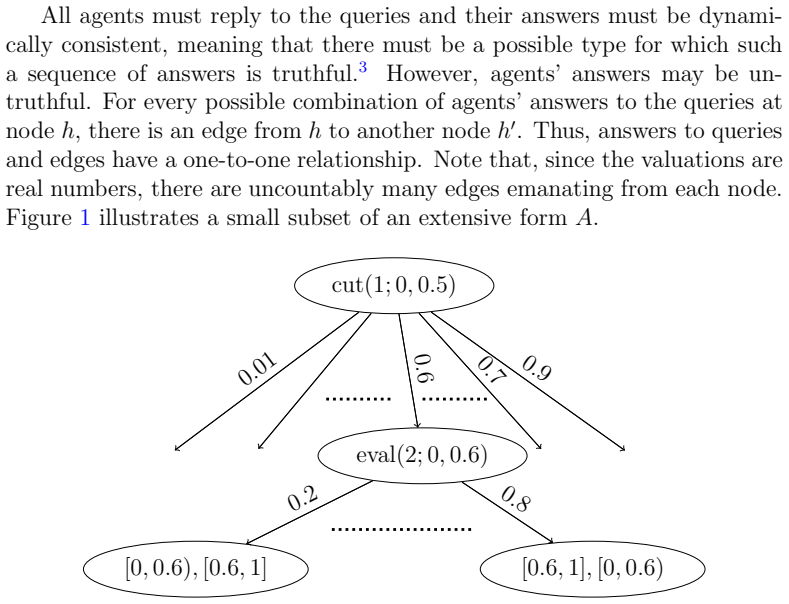
- [Section 4] The leftmost leaves mechanism is not well-defined in the Robertson-Webb model. The protocol asks cut(i; x_{t-1}, u_i([x_{t-1},1];θ_i)/(n-t+1)), but Section 3.2 defines a cut query cut(i; x, α) with α ∈ [0,1] a number known to the mechanism, not a quantity that depends on agent i's private type. Since θ_i has not been elicited at that point, the mechanism cannot compute the query parameter. The proofs of Lemmas 1 and 2 and the manipulation argument for Theorem 2 all rely on this relative-cut form, and Remark 1 shows that the choice of query is substantive. The protocol should be re-specified, for instance by asking eval(i; x_{t-1}, 1) before each cut and using the reported value in the cut parameter, and the NOM proof must then be re-checked to account for manipulations of the eval reports as well as the cut reports.
- [Section 5, Lemma 1] Lemma 1 is not stated precisely enough to be a valid equality. The right-hand side, u_i([x_{t-1},1];θ_i)/(n-t+1), depends on θ_{-i} through x_{t-1}, while the left-hand side is an infimum over θ_{-i}. As written, the lemma asserts that an infimum equals a quantity that varies with the variable being integrated out. The statement should be conditional on the realized history (or on the realized previous cut points), with the infimum taken over continuations from period t onward. The same issue affects Lemma 2. The proof of Theorem 2 needs this clarification to be formally coherent.
- [Theorem 1, Dubins-Spanier moving knife] The proof that the Dubins-Spanier moving knife is obviously manipulable is internally inconsistent. The text says that in the best case the other agent cuts at ε, giving the truthful agent almost 1, and then says that a truthful agent gets 0.5 with certainty; these two statements cannot both hold, since if the other agent cuts at ε, the truthful agent does not stop the knife at his fair-share point. Moreover, the proposed manipulation of stopping at 1−ε does not improve the best case, which is already arbitrarily close to 1, and it does not improve the worst case: other agents can stop just before 1−ε and leave the manipulator with only a small remaining piece. For n=2, the truthful cutoff at 1/2 is exactly the maximin strategy, so inequality (1) is not violated. Consequently, the claim that the moving knife is obviously manipulable is not established and appears to be false. This claim should be corrected or removed, and the abstract and related-literature statements that depend on it should be adjusted.
minor comments (5)
- [Abstract and Acknowledgments] The name 'Morrill' is misspelled as 'Morril' in the abstract and in the acknowledgments; the correct spelling appears elsewhere in the text.
- [Section 3.2] The phrase 'E(θ) is an edge cover' is nonstandard: an edge cover usually means a set of edges that touches every vertex, whereas here the intended meaning is a selection of one outgoing edge at every node. Please use different terminology to avoid confusion.
- [Section 5, Lemma 1 proof] The proof of Lemma 1 compresses an induction over periods into a single sentence. Expanding the induction explicitly, especially the 'otherwise' case and the recursive step, would improve readability and make the argument easier to verify.
- [Section 1 and Theorem 1] Theorem 1 relies on Figures 2 and 3, but these figures are not included in the arXiv text. The piecewise-uniform constructions used in the proof are therefore difficult to verify; please ensure that the figures are available or add a textual description of the valuations.
- [Section 6] The text says that a Nash-optimal allocation is 'hence also proportional' after noting it is Pareto-optimal and envy-free; since envy-freeness implies proportionality for additive utilities, this is correct, but the one-line justification would be helpful for readers.
Circularity Check
No significant circularity: Theorem 2 is derived directly from the defined leftmost-leaves protocol, and the self-citations used elsewhere are non-load-bearing inputs.
full rationale
The central derivation chain is self-contained. The leftmost-leaves mechanism is defined in Section 4 by explicit Robertson-Webb queries, and Theorem 2's proof in Section 5 establishes Lemmas 1 and 2 directly from the query definitions and the divisibility of utilities, with no fitted parameters and no appeal to the authors' own prior results. Proportionality follows by setting t=1 in Lemma 1, and both NOM inequalities are verified by worst-case and best-case arguments over the other agents' types. The paper's self-citations do not carry the central claim: the citation to Segal-Halevi and Sziklai (2019) in Theorem 3 supplies a known Pareto-optimal and envy-free property of the Nash-optimal allocation, which is an input to a separate existence result rather than a consequence of Theorem 2, and the Kyropoulou et al. (2019) experiment is presented as illustrative evidence rather than as a premise of any proof. The concern about the cut(i; x_{t-1}, u_i([x_{t-1},1];θ_i)/(n-t+1)) query using a private value as a parameter is a modeling/correctness question about whether the protocol is expressible in the stated Robertson-Webb model; it is not a circularity, because the proof does not assume the conclusion or rename a fitted quantity as a prediction. No step in the paper reduces by construction to its own inputs.
Assumptions & free parameters
assumptions (7)
- domain assumption Utility functions are non-atomic, additive measures normalized to 1 (divisibility).
- domain assumption Agents' answers must be dynamically consistent, so every answer path corresponds to some possible type.
- domain assumption In the best and worst-case comparisons, all other agents answer truthfully according to their types.
- ad hoc to paper The leftmost-leaves protocol may ask a cut query whose target value is the agent's own value for the remaining cake divided by the number of remaining agents.
- domain assumption Nash-optimal allocations are Pareto-optimal and envy-free.
- domain assumption Brânzei and Miltersen (2015) dictatorship theorem for strategy-proof cake cutting.
- domain assumption The experimental results of Kyropoulou, Ortega and Segal-Halevi (2019) correctly report manipulation rates.
Cite this review
Pith. "Pith review of Obvious Manipulations in Cake-Cutting." pith.science (2026). https://pith.science/paper/H7JJK64X
@misc{pith2026190802988,
  author       = {Pith},
  title        = {Pith review of: Obvious Manipulations in Cake-Cutting},
  year         = {2026},
  howpublished = {\url{https://pith.science/paper/H7JJK64X}},
  note         = {Machine review of arXiv:1908.02988}
}
read the original abstract
In cake-cutting, strategy-proofness is a very costly requirement in terms of fairness: for n=2 it implies a dictatorial allocation, whereas for n > 2 it requires that one agent receives no cake. We show that a weaker version of this property recently suggested by Troyan and Morril, called non-obvious manipulability, is compatible with the strong fairness property of proportionality, which guarantees that each agent receives 1/n of the cake. Both properties are satisfied by the leftmost leaves mechanism, an adaptation of the Dubins - Spanier moving knife procedure. Most other classical proportional mechanisms in literature are obviously manipulable, including the original moving knife mechanism. Non-obvious manipulability explains why leftmost leaves is manipulated less often in practice than other proportional mechanisms.
Figures


Reference graph
Works this paper leans on
-
[1]
Aziz, H. and C. Ye (2014): Cake cutting algorithms for piecewise constant and piecewise uniform valuations, in International Conference on Web and Internet Economics, Springer, 1--14
work page 2014
-
[2]
Brams, S., M. Jones, and C. Klamler (2006): Better ways to cut a cake, Notices of the AMS, 53, 1314--1321
work page 2006
-
[3]
Brams, S. and A. Taylor (1996): Fair division: From cake-cutting to dispute resolution, Cambridge University Press
work page 1996
-
[4]
Brams, S. J., M. A. Jones, and C. Klamler (2008): Proportional pie-cutting, International Journal of Game Theory, 36, 353--367
work page 2008
-
[5]
Br \^a nzei, S. and P. B. Miltersen (2015): A dictatorship theorem for cake cutting, in Twenty-Fourth International Joint Conference on Artificial Intelligence
work page 2015
-
[6]
Chen, Y., J. Lai, D. Parkes, and A. Procaccia (2013): Truth, justice, and cake cutting, Games and Economic Behavior, 77, 284--297
work page 2013
-
[7]
Crawford, V. P. (1977): A game of fair division, Review of Economic Studies, 44, 235--247
work page 1977
-
[8]
Dubins, L. and E. Spanier (1961): How to cut a cake fairly, American Mathematical Monthly, 68, 1--17
work page 1961
Show all 24 references
-
[9]
Even, S. and A. Paz (1984): A note on cake cutting, Discrete Applied Mathematics, 7, 285 -- 296
1984
-
[10]
Kurokawa, D., J. K. Lai, and A. D. Procaccia (2013): How to cut a cake before the party ends, in Twenty-Seventh AAAI Conference on Artificial Intelligence
2013
-
[11]
Ortega, and E
Kyropoulou, M., J. Ortega, and E. Segal-Halevi (2019): Fair cake-cutting in practice, in Proceedings of the 2019 ACM Conference on Economics and Computation, ACM, 547--548
2019
-
[12]
(2017): Obviously strategy-proof mechanisms, American Economic Review, 107, 3257--87
Li, S. (2017): Obviously strategy-proof mechanisms, American Economic Review, 107, 3257--87
2017
-
[13]
Menon, V. and K. Larson (2017): Deterministic, strategyproof, and fair cake cutting, in Proceedings of the 26th International Joint Conference on Artificial Intelligence, AAAI Press, 352--358
2017
-
[14]
Moore, J. and R. Repullo (1988): Subgame perfect implementation, Econometrica, 1191--1220
1988
-
[15]
Mossel, E. and O. Tamuz (2010): Truthful fair division, in Algorithmic Game Theory, ed. by S. Kontogiannis, E. Koutsoupias, and P. Spirakis, Springer, 288--299
2010
-
[16]
(2004): Fair division and collective welfare, MIT press
Moulin, H. (2004): Fair division and collective welfare, MIT press
2004
-
[17]
Nicol\`o, A. and Y. Yu (2008): Strategic divide and choose, Games and Economic Behavior, 64, 268 -- 289
2008
-
[18]
(2016): Cake cutting algorithms, in Handbook of Computational Social Choice, ed
Procaccia, A. (2016): Cake cutting algorithms, in Handbook of Computational Social Choice, ed. by F. Brandt, V. Conitzer, U. Endriss, J. Lang, and A. Procaccia, Cambridge University Press, 311--330
2016
-
[19]
Robertson, J. and W. Webb (1998): Cake-cutting algorithms: Be fair if you can, AK Peters/CRC Press
1998
-
[20]
Nitzan, A
Segal-Halevi, E., S. Nitzan, A. Hassidim, and Y. Aumann (2017): Fair and square: Cake-cutting in two dimensions, Journal of Mathematical Economics, 70, 1--28
2017
-
[21]
Segal-Halevi, E. and B. R. Sziklai (2018): Resource-monotonicity and population-monotonicity in connected cake-cutting, Mathematical Social Sciences, 95, 19--30
2018
-
[22]
--- -.1pt --- -.1pt --- (2019): Monotonicity and competitive equilibrium in cake-cutting, Economic Theory, 68, 363--401
2019
-
[23]
(1948): The problem of fair division, Econometrica, 16, 101--104
Steinhaus, H. (1948): The problem of fair division, Econometrica, 16, 101--104
1948
-
[24]
Troyan, P. and T. Morrill (2019): Obvious manipulations, in Proceedings of the 2019 ACM Conference on Economics and Computation, ACM, 865
2019
Reviewed August 14, 2026 · model on record in the stance chip above.
Discussion (0). Continue with ORCID to comment.