REVIEW 6 minor 45 references
Microscopic and phenomenological models of driven systems in structured reservoirs
T0 review · 0 major / 6 minor · reviewed 2026-08-14 · deepseek-v4-flash
Pith's one-line read In the secular limit, a driven qubit in a structured reservoir reaches steady states fixed by the spectral density at $\omega_L\pm\nu$, so the fixed-dissipator model and the microscopic master equation disagree.
desk verdict A careful, honest paper that shows the fixed-dissipator shortcut systematically mispredicts steady states for driven qubits in structured reservoirs; the central claim holds up and the paper deserves a serious referee. read the letter →
The pith
A machine-rendered reading of the paper's core claim, the machinery that carries it, and where it could break.
The reading
What carries the argument
The load-bearing object is the secular dissipator of Eq. (9), built from the Lindblad operators $\tilde\sigma_\pm$ and $\tilde\sigma_z$ in the dressed basis, with rates $\gamma^\theta_-$, $\gamma^\theta_+$, and $\gamma^\theta_z$ given in Eq. (10). These rates are combinations of the spectral density $J(\omega)$ evaluated at the carrier frequency $\omega_L$ and at the two sidebands $\omega_L\pm\nu$, each weighted by the dressed-state amplitudes $C^4$ and $S^4$. The argument then turns on Eq. (17): the secular steady state is the population ratio $\gamma^\theta_-/(\gamma^\theta_++\gamma^\theta_-)$ in the dressed basis. Because the ratio depends on how $J(\omega)$ is shaped across the sidebands, a structured spectrum changes the reachable steady-state surface, while a flat spectrum collapses the rates to a common $\gamma_{fd}$ and recovers the fixed-dissipator ellipsoid.
What would settle it
Compute the steady state of the full non-secular microscopic master equation, Eq. (8) with $D_{\rm nsec}$, for a Lorentzian spectral density with $\lambda\sim\Delta$ at the parameters of Fig. 2(b), and compare it with Eq. (17); if the non-secular steady state stays close to the FDME ellipsoid (or turns unphysical before the deviation appears), the reported widening of target states is an artifact of the secular approximation.
Extended reading notes
Core claim
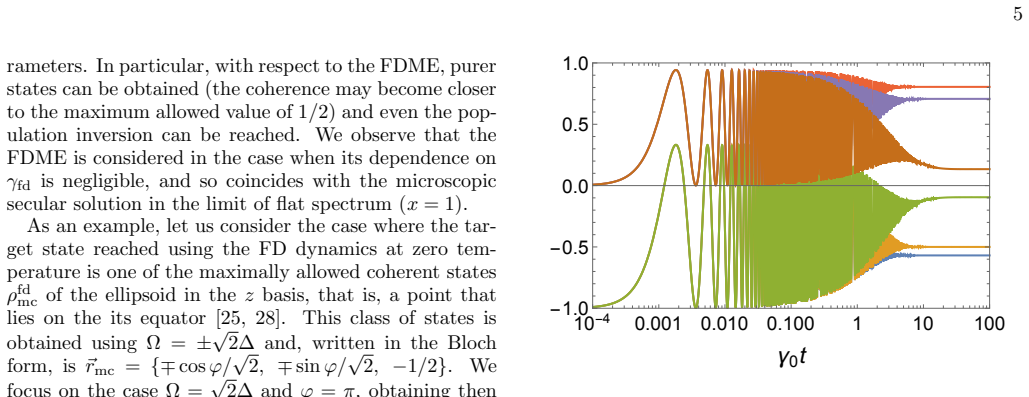
The paper's central claim is that, for a driven qubit coupled to a structured bosonic reservoir, the asymptotic state predicted by a microscopic master equation can differ from the fixed-dissipator prediction even in the secular limit. Concretely, the secular steady state is diagonal in the dressed basis $|\phi_\pm\rangle$ with populations $\gamma^\theta_-/(\gamma^\theta_++\gamma^\theta_-)$ and $\gamma^\theta_+/(\gamma^\theta_++\gamma^\theta_-)$, where $\gamma^\theta_\pm$ sample $J(\omega_L\pm\nu)$ and $\gamma^\theta_z$ samples $J(\omega_L)$. The fixed-dissipator model, by contrast, depends only on $J(\omega_0)$. When the spectral density varies on the scale of the dressed frequency $\nu$, the zero-temperature ratio $x=\gamma_-/\gamma_+=J(\omega_L-\nu)/J(\omega_L+\nu)$ deforms the ellipsoid of reachable steady states, producing states with larger coherence or population inversion; for a flat spectrum $x=1$ and the microscopic and fixed-dissipator models coincide.
Load-bearing premise
The comparison rests on the Born-Markov and secular approximations: if the oscillating non-secular dissipator terms are not negligible at the parameters plotted, Eq. (17) is not the true steady state and the claimed widening of the target-state family would need to be re-evaluated.
Editorial extensions
If this is right
- In a structured reservoir, a control protocol designed with the FDME will miss the true asymptotic state; the error grows with $\Omega/\Delta$ and with the asymmetry $x=\gamma_-/\gamma_+$, with fidelity between FDME and MME steady states falling below $3/4$ for $\Omega/\Delta\gtrsim1$.
- By choosing a spectral density with $J(\omega_L+\nu)\neq J(\omega_L-\nu)$, one can reach steady states outside the FDME ellipsoid, including states with higher coherence and population inversion at fixed control parameters.
- For a flat spectrum, the MME and FDME coincide, so the fixed-dissipator model is safe there; the discrepancies are a structured-environment effect.
- At finite temperature, an asymmetric structured environment can be compensated by thermal excitation: for $0\le x\le1$ there is a value $n_{fd}(x)$ such that the MME steady state equals the zero-temperature flat-spectrum FDME state.
- Since the steady-state manifold deforms continuously with $x$, slowly sweeping control parameters should trace a continuous family of target states, preserving the structured-environment difference from FDME.
Reading between the lines
- If the central claim holds, the same sideband mechanism should appear in driven multilevel systems: each dressed transition samples its own pair of frequencies $\omega_L\pm\nu_{ij}$, so a shaped spectral density could steer a ladder of states, not just a qubit.
- One experimental signature would be to hold the drive fixed, vary the spectral-density asymmetry, and observe the steady-state Bloch vector move along a curve that tracks $J(\omega_L+\nu)-J(\omega_L-\nu)$; this would distinguish the microscopic prediction from the FDME ellipsoid directly.
- The thermal-compensation result points to a practical inverse protocol: by measuring which temperature $n_{fd}$ restores a desired zero-temperature target, one could infer the sideband ratio $x$ of an unknown structured reservoir; the restriction $0\le x\le1$ means this thermometer works only on one slope of the spectral feature.
Signed reviews
Editorial analysis
A structured set of objections, weighed in public.
Referee Report
Summary. The paper compares two ways of modeling a driven qubit coupled to a structured bosonic reservoir: a microscopic Born-Markov master equation derived in the dressed-state basis, and a phenomenological fixed-dissipator (FD) master equation in which the dissipator is the undriven one. The authors derive explicit secular rates in Eq. (10), depending on the spectral density at $ {} {} {}omega_L$, $ {} {} {}omega_L\pm\nu$, and obtain the secular steady state in Eq. (17). For a flat spectrum they recover the FD steady state to the expected accuracy; for a structured spectrum the steady states differ from the FD ellipsoid, which opens the possibility of reservoir engineering of the asymptotic state. The paper illustrates this with fixed sideband ratios, a Lorentzian spectral density, time-dependent trajectories, a fidelity map, and a finite-temperature compensation formula.
Significance. If the result is correct, it is a useful caution for quantum control: the fixed-dissipator assumption mispredicts asymptotic target states in structured environments, and the family of microscopic steady states can be broadened by shaping the spectral density. The derivation is transparent and self-contained in the Appendix, the flat-spectrum limit is checked, and the secular approximation is numerically benchmarked against non-secular terms with explicit parameter ranges. The predictions are falsifiable through the rates in Eq. (10) and the steady-state formula Eq. (17).
minor comments (6)
- [Sec. V B, Eq. (18)] The approximation $n_+\approx n_-\approx n_0\approx n_{\rm fd}$ is used without stating its range of validity for a structured reservoir; at low temperature the thermal factors at the sidebands can differ substantially from $n(\omega_0)$. Please add a validity condition or give the exact expression before specializing.
- [Eq. (11)] There is a stray closing bracket in the displayed formula for $\gamma^\theta_z$: it reads $\gamma^\theta_z = S^2C^2\gamma_0(1+2n_0)]$, which should be corrected.
- [Eq. (16)] The expression for $\rho^{\rm fd}_{eg}$ is ambiguous as typeset; the numerator should be written with parentheses, e.g. $-\Omega\left(2\Delta/(1+2n_{\rm fd})+i\gamma_{\rm fd}\right)$, so that the separation of the real and imaginary parts is clear.
- [Sec. V A] The numerical comparison with non-secular terms is reported for $\gamma_{\rm fd}/\Delta=0.001$, but the caption of Fig. 2(b) does not state the value of $\gamma_{\rm fd}/\Delta$ used for the plotted curve; please state it explicitly.
- [Sec. V B] There is a typo in the sentence "they coincide the with the steady states"; it should read "they coincide with the steady states".
- [Abstract] The phrase "remarkably practically coincide" is redundant; consider simplifying to "practically coincide" or "coincide to a very good approximation".
Circularity Check
No significant circularity: the secular steady state follows from the microscopically derived rates of Eq. (10), with no fitted parameters and no load-bearing self-citations.
full rationale
The paper's central claim is that, for a structured reservoir, the secular microscopic master equation (MME) yields steady states different from those of the fixed-dissipator (FD) model. This is a derived consequence, not an input. The MME rates in Eq. (10) are obtained by applying Born, Markov, and secular approximations to the dressed-qubit interaction Hamiltonian, with the spectral density evaluated at the laser and sideband frequencies ω_L, ω_L ± ν. The steady state in Eq. (17) is then obtained by solving D_sec(ρ)=0 and [ρ, H_S+H_LS]=0, giving populations proportional to γ_θ_- and γ_θ_+. No experimental data are fitted, and the parameters Ω, Δ, λ, T are model inputs or scanning parameters. The flat-spectrum limit is shown to reduce the MME steady states to the FDME results, which is a consistency check rather than a circular step. The self-citations in the paper—e.g., Refs. [17,18,23,35]—are used for background context and examples of reservoir engineering or open-system thermodynamics, not as the logical basis for the steady-state comparison. The only substantive caveats concern the validity of the secular and Markov approximations, and the paper explicitly discusses these limits in Sec. V A, citing independent literature. Thus the central derivation is self-contained and no reduction of a prediction to an input or to a self-citation chain is present.
Assumptions & free parameters
assumptions (7)
- domain assumption Born-Markov approximation: weak system-bath coupling and negligible bath memory.
- domain assumption Secular approximation: oscillating terms at frequencies nu and 2 nu are dropped.
- domain assumption Rotating-wave approximation with omega_L much larger than Delta and Omega.
- domain assumption Control-field independence of the system-bath interaction.
- domain assumption Factorized initial system-bath state.
- domain assumption Thermal equilibrium bath state.
- domain assumption Approximation n+ close to n- close to n0 close to nfd in the finite-temperature secular formulas.
Cite this review
Pith. "Pith review of Microscopic and phenomenological models of driven systems in structured reservoirs." pith.science (2026). https://pith.science/paper/C5EKMTSS
@misc{pith2026190803002,
  author       = {Pith},
  title        = {Pith review of: Microscopic and phenomenological models of driven systems in structured reservoirs},
  year         = {2026},
  howpublished = {\url{https://pith.science/paper/C5EKMTSS}},
  note         = {Machine review of arXiv:1908.03002}
}
read the original abstract
We study the paradigmatic model of a qubit interacting with a structured environment and driven by an external field by means of a microscopic and a phenomenological model. The validity of the so-called fixed-dissipator (FD) assumption, where the dissipation is taken as the one of the undriven qubit is discussed. In the limit of a flat spectrum, the FD model and the microscopic one remarkably practically coincide. For a structured reservoir, we show in the secular limit that steady states can be different from those determined from the FD model, opening the possibility for exploiting reservoir engineering. We explore it as a function of the control field parameters, of the characteristics of the spectral density and of the environment temperature. The observed widening of the family of target states by reservoir engineering suggests new possibilities in quantum control protocols.
Figures


Figures from the paper (1 more)

Reference graph
Works this paper leans on
-
[41]
Weiss, Quantum Dissipative systems , 4th ed
U. Weiss, Quantum Dissipative systems , 4th ed. (World Scientific, Singapore, 2012)
work page 2012
-
[1]
Breuer and F
H.-P. Breuer and F. Petruccione, The Theory of Open Quantum Systems (Oxford University Press, New York, 2007)
2007
-
[2]
In Fig. 4, an important discrepancy may be observed for Ω/∆ & 1. In particular, for a given value of Ω/∆, smaller values of fidelity are obtained when x moves away from 1. The behavior for Ω /∆ < 1 is in- stead reminiscent of the fact that for small angles θ the microscopic dissipator tends to the FD one, as shown before Eq. (15). One may raise doubts abou...
work page 2020
-
[3]
C. W. Gardiner, and P. Zoller,Quantum Noise (Springer- Verlag, Berlin, 2000)
work page 2000
-
[4]
D’Alessandro, Introduction to Quantum Control and Dynamics (Chapman & Hall/CRC, 2007)
D. D’Alessandro, Introduction to Quantum Control and Dynamics (Chapman & Hall/CRC, 2007)
work page 2007
-
[5]
Carlini, A
A. Carlini, A. Hosoya, T. Koike, and Y. Okudaira, Phys. Rev. Lett. 96, 060503 (2006)
2006
-
[6]
Sugny, C
D. Sugny, C. Kontz, and H. R. Jauslin, Phys. Rev. A 76, 023419 (2007)
2007
- [7]
Show all 45 references
-
[8]
Shapiro and P
M. Shapiro and P. Brumer, Quantum Control of Molec- ular Processes, 2nd ed. (Wiley Interscience, 2012)
2012
-
[9]
S. J. Glaser et al., Eur. Phys. J. D 69, 279 (2015)
2015
-
[10]
C. P. Koch, J. Phys.: Condens. Matter 28, 213001 (2016)
2016
-
[11]
C. H. Bennett, D. P. DiVincenzo, P. W. Shor, J. A. Smolin, B. M. Terhal, and W. K. Wootters, Phys. Rev. Lett. 87, 077902 (2001)
2001
-
[12]
N. A. Peters, J. T. Barreiro, M. E. Goggin, T.-C. Wei, and P. G. Kwiat, Phys. Rev. Lett. 94, 150502 (2005)
2005
-
[13]
Viola and S
L. Viola and S. Lloyd, Phys. Rev. A 58, 2733 (1998)
1998
-
[14]
Viola, E
L. Viola, E. Knill, and S. Lloyd, Phys. Rev. Lett. 82, 2417 (1999)
1999
-
[15]
Addis, F
C. Addis, F. Ciccarello, M. Cascio, G. M. Palma, and S. Maniscalco, New J. Phys. 17, 123004 (2015)
2015
-
[16]
Hartmann, W
L. Hartmann, W. D¨ ur, and H.-J. Briegel, Phys. Rev. A 74, 052304 (2006)
2006
-
[17]
Krauter, C
H. Krauter, C. A. Muschik, K. Jensen, W. Wasilewski, J. M. Petersen, J. I. Cirac, and E. S. Polzik, Phys. Rev. Lett. 107, 080503 (2011)
2011
-
[18]
Bellomo, R
B. Bellomo, R. Messina, D. Felbacq, and M. Antezza, Phys. Rev. A 87, 012101 (2013)
2013
-
[19]
Bellomo and M
B. Bellomo and M. Antezza, Phys. Rev. A 91, 042124 (2015)
2015
-
[20]
Lindblad, Commun
G. Lindblad, Commun. Math. Phys. 48, 119 (1976)
1976
-
[21]
Gorini, A
V. Gorini, A. Kossakowski, and E. C. G: Sudarshan, J. Math. Phys. 17, 821 (1976)
1976
-
[22]
J. O. Gonz´ alez, L. A. Correa, G. Nocerino, J. P. Palao, D. Alonso, and G. Adesso, Open Syst. Inf. Dyn. 24, 1740010 (2017)
2017
-
[23]
M. T. Naseem, A. Xuereb, and ¨O. E. M¨ ustecaplıo˘ glu, Phys. Rev. A 98, 052123 (2018)
2018
-
[24]
Cattaneo, G
M. Cattaneo, G. L. Giorgi, S. Maniscalco, and R. Zam- brini, arXiv:1906.08893
1906 arXiv
-
[25]
Lacour, S
X. Lacour, S. Gu´ erin, and H. R. Jauslin, Phys. Rev. A 78, 033417 (2008)
2008
-
[26]
Sauer, C
S. Sauer, C. Gneiting, and A. Buchleitner, Phys. Rev. Lett. 111, 030405 (2013)
2013
-
[27]
Lapert, E
M. Lapert, E. Ass´ emat, S. J. Glaser, and D. Sugny, Phys. Rev. A 88, 033407 (2013)
2013
-
[28]
Mukherjee, A
V. Mukherjee, A. Carlini, A. Mari, T. Caneva, S. Mon- tangero, T. Calarco, R. Fazio, and V. Giovannetti, Phys. Rev. A 88, 062326 (2013)
2013
-
[29]
Sauer, C
S. Sauer, C. Gneiting, and A. Buchleitner, Phys. Rev. A 89, 022327 (2014)
2014
-
[30]
Scala, B
M. Scala, B. Militello, A. Messina, J. Piilo, and S. Man- iscalco, Phys. Rev. A 75, 013811 (2007)
2007
-
[31]
Rivas, A
´A. Rivas, A. Douglas, K. Plato, S. F. Huelga, and M. B. Plenio, New J. Phys. 12, 113032 (2010)
2010
-
[32]
Beaudoin, J
F. Beaudoin, J. M. Gambetta, and A. Blais, Phys. Rev. A 84, 043832 (2011)
2011
-
[33]
Werlang, M
T. Werlang, M. A. Marchiori, M. F. Cornelio, and D. Valente, Phys. Rev. E 89, 062109 (2014)
2014
-
[34]
Ko lody´ nski, J
J. Ko lody´ nski, J. B. Brask, M. Perarnau-Llobet, and B. Bylicka, Phys. Rev. A 97, 062124 (2018)
2018
-
[35]
Levy and R
A. Levy and R. Kosloff, Europhys. Lett. 107, 20004 (2014)
2014
-
[36]
De Chiara, G
G. De Chiara, G. Landi, A. Hewgill, A. Ferraro, A. J. Roncaglia, and M. Antezza, New J. Phys. 20, 113024 (2018)
2018
-
[37]
Addis, E.-M
C. Addis, E.-M. Laine, C. Gneiting, and S. Maniscalco, Phys. Rev. A 94, 052117 (2016)
2016
- [38]
-
[39]
Kowalewska-Kudlaszyk and R
A. Kowalewska-Kudlaszyk and R. Tana´ s, J. Mod. Opt. 48, 347 (2001)
2001
-
[40]
Haikka and S
P. Haikka and S. Maniscalco, Phys. Rev. A 81, 052103 (2010)
2010
-
[42]
H. Z. Shen, M. Qin, Xiao-Ming Xiu, and X. X. Yi, Phys. Rev. A 89, 062113 (2014)
2014
-
[43]
Recht, Y
B. Recht, Y. Maguire, S. Lloyd, I. L. Chuang, and N. A. Gershenfeld, arXiv:quant-ph/0210078
-
[44]
M. H. Levitt, Spin Dynamics: Basics of Nuclear Mag- netic Resonance (Wiley, New York, 2008)
2008
-
[45]
R. R. Ernst, G. Bodenhausen, and A. Wokaun,Principles of Nuclear Magnetic Resonance in one and two dimen- sions, Vol. 14 (Clarendon Press, Oxford, 1987)
1987
Reviewed August 14, 2026 · model on record in the stance chip above.
Discussion (0). Continue with ORCID to comment.