REVIEW 4 major objections 5 minor 33 references
Tetrahedron maps and symmetries of three dimensional integrable discrete equations
T0 review · 4 major / 5 minor · reviewed 2026-08-14 · deepseek-v4-flash
Pith's one-line read Tetrahedron maps arise from symmetry invariants of 4D-consistent lattice equations.
desk verdict A promising extension of the symmetry method to 3D, full of explicit maps, but the load-bearing implication from 4D consistency to the tetrahedron equation is asserted rather than proved. read the letter →
The pith
A machine-rendered reading of the paper's core claim, the machinery that carries it, and where it could break.
The reading
What carries the argument
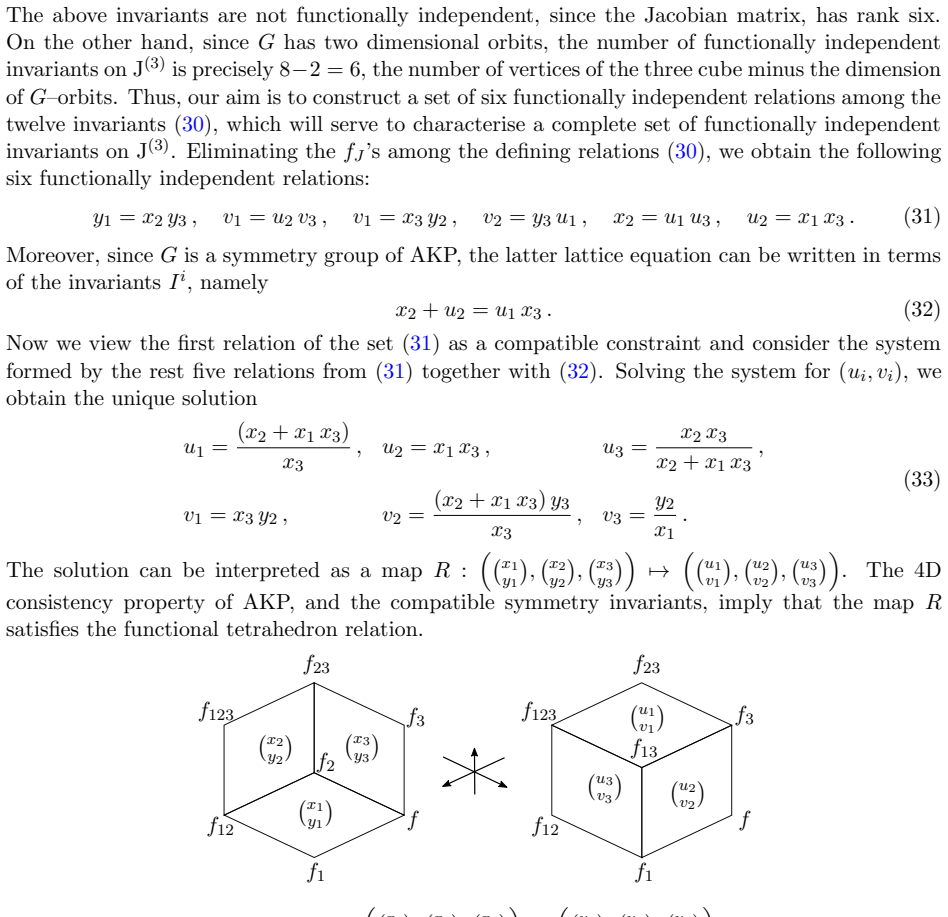
The load-bearing object is the collection of joint invariants of the symmetry group of a lattice equation, restricted to the six faces of a cube. For a two-dimensional symmetry group acting regularly on a face, Frobenius' theorem in its dual differential-form formulation supplies exactly two functionally independent invariants per face, giving twelve invariants for the cube. The lattice equation, rewritten in these invariants, together with the functionally independent relations among the invariants, is solved for the invariants on the outgoing half of the cube; that solution is the map R. The functional tetrahedron relation is the equality of two compositions of such maps, $R_{(123)}R_{(145)}R_{(246)}R_{(356)} = R_{(356)}R_{(246)}R_{(145)}R_{(123)}$, associated with the two ways of moving a plane across the other three in a tetrahedron configuration.
What would settle it
Take the BKP map (37) and evaluate the difference between the two sides of the functional tetrahedron relation at random complex values that do not satisfy the constraint y1 = x2 y3; a nonzero difference would show the tetrahedron property holds only modulo the symmetry constraint, qualifying the paper's claim. The same computation for the non-invertible AKP map (33) would show whether invertibility is required for the transfer from consistency to the tetrahedron equation.
Extended reading notes
Core claim
The paper's central claim appears in Section 3.1 in the AKP case: "The 4D consistency property of AKP, and the compatible symmetry invariants, imply that the map R satisfies the functional tetrahedron relation." More generally, the paper asserts that every octahedron-type equation of the recent classification, together with the invariants of its Lie-point symmetry group, yields a tetrahedron map by eliminating the lattice fields from the functional relations among the invariants and the invariant form of the equation. In several cases the resulting map is triangular, meaning its first component is a known scalar tetrahedron map and the remaining components form a vector extension that is itself a tetrahedron map. The paper also derives a non-commutative tetrahedron map by applying the same construction to non-commutative discrete potential KP, and shows that a solution of the functional tetrahedron equation can be used to recover an integrable lattice system, reversing the direction of the correspondence.
Load-bearing premise
The paper assumes, without proving, that whenever a lattice equation is consistent on a four-dimensional grid and its symmetry invariants are compatible, the map obtained by solving the invariant relations automatically satisfies the tetrahedron equation.
Editorial extensions
If this is right
- For AKP the derived map (33) is a vector extension of a known tetrahedron map, with an x-component that decouples and is reversible; the full map satisfies the tetrahedron equation but is not invertible.
- From discrete potential KP with the abelian symmetry subgroup, the construction yields the totally positive tetrahedron map (58), which is invertible and reversible and which the paper identifies as new relative to the existing classification.
- Two lattice equations, chi4 and chi5, produce maps that satisfy an entwining tetrahedron relation instead of the plain relation, indicating that the method also produces entwining solutions.
- Imposing discrete potential KP on Z^4, rather than Z^3, and using joint invariants of the full symmetry group yields the tetrahedron map (25) of the existing classification, showing that the dimension of the ambient lattice changes the resulting map.
- Applying the same construction in the opposite direction connects non-commutative tetrahedron maps to non-commutative lattice KP equations, and the discrete-mKP example suggests hidden-potential couplings to new 3D lattice systems.
Reading between the lines
- I infer that the transfer principle from 4D consistency to the tetrahedron equation likely holds only under a regularity condition on the symmetry action or the map; the BKP map (37) already needs the constraint y1 = x2 y3 to satisfy the relation, and map (33) is non-invertible, so a general proof would need to spell out when constraints propagate.
- The method suggests a concrete testable recipe: any 4D-consistent equation with a sufficiently large symmetry group should yield a tetrahedron map, and equations whose symmetry group has several non-equivalent two-dimensional subgroups should yield several inequivalent maps, as happens for discrete potential KP.
- I infer that the new totally positive map (58) is a candidate prototype for a wider family of positive tetrahedron maps obtained by conjugating known maps by positive transformations, in the same way that the electric-network map is conjugated by a sign involution.
- The hidden-potential coupling at the end of the paper suggests a strategy for constructing integrable coupled systems: take a tetrahedron map and read off the lattice equations for a new field from the missing invariant relation.
Signed reviews
Editorial analysis
A structured set of objections, weighed in public.
Referee Report
Summary. The paper proposes a method for constructing solutions of the functional tetrahedron equation from joint invariants of Lie point symmetry groups of 3D integrable lattice equations, in analogy with the known Yang-Baxter map construction from 2D lattice equations. The authors apply this method to the octahedron-type equations of the Adler-Bobenko-Suris classification as well as to BKP, deriving explicit maps for AKP, BKP, Schwarzian KP, discrete potential KP, discrete modified KP, and a degeneration. They also discuss multidimensional and non-commutative generalizations, and they claim several new tetrahedron maps, including a totally positive reversible map not contained in Sergeev's classification and a coupled map obtained from discrete potential KP under the affine symmetry group. The paper closes with a coupled lattice system associated with modified KP. The central assertion is that 4D consistency of the lattice equation together with compatibility of the symmetry invariants implies the tetrahedron property for the derived maps.
Significance. If the central transfer principle is valid, the paper establishes a useful and systematic bridge between the classification of 3D integrable discrete equations and the functional tetrahedron equation. The explicit maps, the comparison with Sergeev's classification, and the new totally positive reversible map are concrete contributions, and the non-commutative and multidimensional extensions broaden the potential impact. The paper is honest about several maps being non-invertible or satisfying the tetrahedron property only modulo symmetry constraints, but the main implication from 4D consistency to the tetrahedron equation is asserted rather than proved. Because this implication is load-bearing for every map obtained in Sections 3 and 4, the significance of the paper depends on closing that gap with a proof or direct verification.
major comments (4)
- [Section 3.1, after Eq. (33)] The sentence following Eq. (33), 'The 4D consistency property of AKP, and the compatible symmetry invariants, imply that the map R satisfies the functional tetrahedron relation,' is the only justification offered for the central claim, and it is asserted rather than proved. One-cube solvability of the invariant relations plus 4D consistency of the lattice equation does not by itself imply the six-factor identity (2); an equivariance statement for the invariant map over the full 4D consistency complex, or a direct symbolic verification of (2), is needed. This matters here because R in (33) is explicitly non-invertible; if the transfer principle relies on invertibility, it cannot be applied to this map without modification.
- [Section 3.1, Eq. (37)] The paper states that the BKP map (37) is a tetrahedron map 'modulo the symmetry constraint' y1 = x2 y3. Since the tetrahedron equation is an equality of maps on X^6, this claim needs a precise formulation: one must show that the constraint is preserved by all four factors R(123), R(145), R(246), and R(356) on both sides of (2), or present the identity on the constrained locus. Without this, the unqualified term 'tetrahedron map' is not justified for (37).
- [Sections 4.1 and 4.2] In Section 4.2 the noncommutative map obtained from equations (82)-(83) is claimed to satisfy the tetrahedron property 'from the four dimensional consistency property ... proved in Section 4.' Section 4.1 proves consistency of dpKP on Z4 by explicit formulas, but it does not prove a transfer theorem from 4D consistency to the tetrahedron equation. The same missing lemma is invoked here. Please provide a direct verification for the matrix map or prove the transfer principle in sufficient generality.
- [Section 3.4, Eq. (67)] The entwining relation (67) is presented as a new structural result, but no proof or computational check is supplied. Since the ordinary tetrahedron property was not verified directly for the constituent maps either, the entwining relation needs an explicit derivation or at least a reproducible symbolic verification.
minor comments (5)
- [Page 10] There is a typo: 'Moreovet' should be 'Moreover'.
- [Page 14] The text 'Mob 12 transformation' is a broken fragment; it should read 'Mobius transformation'.
- [Page 5] The phrase 'the equations are not affected by the transformation' is grammatically awkward; 'the equation is invariant under the transformation' would be clearer.
- [Eq. (76)] The notation Aijk := fij-fjk / fi-fk is ambiguous because the fraction bar is not typeset with braces; use Aijk := (fij-fjk)/(fi-fk).
- [Section 3.3] When the authors write 'conjugating x maps to 1+x', they mean a change of variables, not conjugation of the map by a Möbius transformation; the wording should be made explicit.
Circularity Check
No significant circularity: the maps are obtained by explicit algebraic solution from the lattice equations' invariants, and the unproved 4D-consistency-to-tetrahedron implication is a correctness risk, not a circular reduction.
full rationale
The paper's construction is self-contained as a direct calculation: for each lattice equation the authors fix joint invariants of the symmetry group, derive functional relations among them (e.g. (31), (46), (53)), rewrite the lattice equation in invariant form, and solve the resulting algebraic system uniquely for the output invariants (see (33), (37), (48), (55), (57), (64), (66), (79)). The tetrahedron maps are not fitted to the tetrahedron equation; they are the unique solutions of the displayed systems, and the new map (58) is explicitly checked against Sergeev's classification rather than claimed by self-citation. The main weakness is that the transfer principle that 4D consistency plus compatible invariants implies the functional tetrahedron relation is asserted immediately after Eq. (33) and reused throughout, but this is an unproved implication, not a circular equivalence: the tetrahedron equation (2) is not identified with the input consistency property, and the maps are not defined in terms of the tetrahedron equation. Likewise, the self-citations, notably [27], are used as methodological antecedents for the Yang-Baxter analogue and are not load-bearing replacements for the explicit computations; [29] is used to classify known maps, and map (58) is claimed new on the basis of the construction. Thus no load-bearing step reduces to its own inputs, and any deficiency lies in the asserted transfer principle rather than in circularity.
Assumptions & free parameters
assumptions (4)
- domain assumption The octahedron-type lattice equations χ1 to χ5 and their non-commutative analogues are 4D-consistent.
- ad hoc to paper For a 4D-consistent lattice equation, a map defined by joint invariants of its symmetry group satisfies the tetrahedron equation.
- standard math Frobenius theorem in dual form gives a complete set of functionally independent invariants under the symmetry group.
- domain assumption The computed infinitesimal Lie point symmetry groups are the full symmetry groups of the lattice equations.
Cite this review
Pith. "Pith review of Tetrahedron maps and symmetries of three dimensional integrable discrete equations." pith.science (2026). https://pith.science/paper/GDUXTCLR
@misc{pith2026190803019,
  author       = {Pith},
  title        = {Pith review of: Tetrahedron maps and symmetries of three dimensional integrable discrete equations},
  year         = {2026},
  howpublished = {\url{https://pith.science/paper/GDUXTCLR}},
  note         = {Machine review of arXiv:1908.03019}
}
abstract
A relationship between the tetrahedron equation for maps and the consistency property of integrable discrete equations on $\mathbb{Z}^3$ is investigated. Our approach is a generalization of a method developed in the context of Yang-Baxter maps, based on the invariants of symmetry groups of the lattice equations. The method is demonstrated by a case-by-case analysis of the octahedron type lattice equations classified recently, leading to some new examples of tetrahedron maps and integrable coupled lattice equations.
Figures


Reference graph
Works this paper leans on
-
[1]
V.E. Adler, A.I. Bobenko, and Yu.B. Suris. Classification of Integrable Equations on Quad–Graphs. The Consistency Approach. Comm. Math. Phys. , 233(3):513–543, 2003
work page 2003
-
[2]
V.E. Adler, A.I. Bobenko, and Yu.B. Suris. Classification of integrable discrete equations of octahedron type. Int. Math. Res. Notices , 2012(8):1822–1889, 2012
work page 2012
-
[3]
A. Doliwa and J. Kosiorek. Quadrangular sets in projective line and in Moebius space, and geometric interpretation of the non–commutative discrete Schwarzian Kadomtsev–Petviashvili equation. arXiv e-prints, page arXiv:1903.11952, Mar 2019
work page Pith review arXiv 1903
- [4]
-
[5]
P. Etingof, T. Schedler, and A. Soloviev. Set–theoretical solutions to the quantum Yang–Baxter equa- tion. Duke Math. J. , 100:169–209, 1999
work page 1999
-
[6]
G.G. Grahovski, S. Konstantinou-Rizos, and A.V. Mikhailov. Grassmann extensions of Yang–Baxter maps. J. Phys. A: Math. Theor. , 49(14):145202, 2016
work page 2016
-
[7]
M.M. Kapranov and V.A. Voevodsky. 2-categories and Zamolodchikov tetrahedra equations, volume 56 of Proc. Sympos. Pure Math., page 177–259. Amer. Math. Soc., Providence, RI, 1994
work page 1994
-
[8]
R.M. Kashaev. On discrete three–dimensional equations associated with the local Yang–Baxter relation. Lett. Math. Phys. , 38(4):389–397, 1996
work page 1996
Show all 33 references
-
[9]
Kashaev, I.G
R.M. Kashaev, I.G. Korepanov, and Sergeev S.M. Functional tetrahedron equation. Theor. Math. Phys., 117(3):1402–1413, 1998. translated from [Teoret. Mat. Fiz. Vol. 117, No. 3, pp. 370384, (1998)]
1998
-
[10]
Kassotakis
P. Kassotakis. Invariants in separated variables: Yang–Baxter, entwining and transfer maps. SIGMA, 15(048):36pp, 2019
2019
-
[11]
Kassotakis and M
P. Kassotakis and M. Nieszporski. Families of integrable equations. SIGMA, 7:100, 2011
2011
-
[12]
Kassotakis and M
P. Kassotakis and M. Nieszporski. On non–multiaffine consistent–around–the–cube lattice equations. Phys. Lett. A , 376(45):3135–3140, 2012
2012
-
[13]
Kassotakis and M
P. Kassotakis and M. Nieszporski. Difference systems in bond and face variables and non–potential versions of discrete integrable systems. J. Phys. A: Math. Theor. , 51(38):385203, 2018
2018
-
[14]
Kassotakis and M
P. Kassotakis and M. Nieszporski. Systems of difference equations on a vector valued function that admit 3D space of scalar potentials. arXiv e-prints, page arXiv:1908.01706, Aug 2019
1908 arXiv
-
[15]
Kassotakis, M
P. Kassotakis, M. Nieszporski, V. Papageorgiou, and A. Tongas. Integrable multi–component difference systems of equations. arXiv e-prints, page arXiv:1908.02413, Aug 2019
1908 arXiv
-
[16]
Konstantinou-Rizos and Mikhailov A.V
S. Konstantinou-Rizos and Mikhailov A.V. Darboux transformations, finite reduction groups and related Yang–Baxter maps. J. Phys. A: Math. Theor. , 46(42):425201, 2013
2013
-
[17]
Kouloukas and V.G
T.E. Kouloukas and V.G. Papageorgiou. 3D compatible ternary systems and Yang–Baxter maps. J. Phys. A: Math. Theor. , 45(34):345204, 2012
2012
-
[18]
S. Lie. Theorie der Transformationsgruppen Abschn. 3 . Teubner, Leipzig, 1893. Avalaible at http: //eudml.org/doc/202686
-
[19]
Maillet and F
J.M. Maillet and F. Nijhoff. Integrability for multidimensional lattice models. Phys. Lett. B, 224(4):389 – 396, 1989
1989
-
[20]
Maillet and F
J.M. Maillet and F. Nijhoff. The tetrahedron equation and the four–simplex equation. Phys. Lett. A , 134(4):221 – 228, 1989
1989
-
[21]
Nijhoff and H.W
F.W. Nijhoff and H.W. Capel. The direct linearisation approach to hierarchies of integrable pdes in 2 + 1 dimensions: I. lattice equations and the differential–difference hierarchies. Inverse Problems , 6:567–590, 1990
1990
-
[22]
J.C. Nimmo. On a non–Abelian Hirota–Miwa equation. J. Phys. A: Math. Gen. , 39(18):5053, 2006. 21
2006
-
[23]
P.J. Olver. Equivalence, Invariants and Symmetry . Cambridge University Press, Cambridge, 1995
1995
-
[24]
P.J. Olver. Classical Invariant Theory. Cambridge University Press, Cambridge, 1999
1999
-
[25]
Papageorgiou, Yu.B
V.G. Papageorgiou, Yu.B. Suris, A.G. Tongas, and A.P. Veselov. On quadrirational Yang–Baxter maps. SIGMA, 6(033), 2010
2010
-
[26]
Papageorgiou and A.G
V.G. Papageorgiou and A.G. Tongas. Yang–Baxter maps and multi–field integrable lattice equations. J. Phys A: Math. Theor. , 40(42):12677–12690, 2007
2007
-
[27]
Papageorgiou, A.G
V.G. Papageorgiou, A.G. Tongas, and A.P. Veselov. Yang–Baxter maps and symmetries of integrable equations on quad–graphs. J. Math. Phys. , 47(083502), 2006
2006
-
[28]
W.K. Schief. Isothermic Surfaces in Spaces of Arbitrary Dimension: Integrability, Discretization, and B¨ acklund Transformations – A Discrete Calapso Equation.Stud. Appl. Math. , 106(1):85–137, 2001
2001
-
[29]
S.M. Sergeev. Solutions of the Functional Tetrahedron Equation Connected with the Local Yang–Baxter Equation for the Ferro–Electric Condition. Lett. Math. Phys. , 45:113–119, 1998
1998
-
[30]
Sklyanin
E.K. Sklyanin. Classical limits of SU(2)–invariant solutions of the Yang–Baxter equation. J. Soviet Math., 40:93–107, 1988
1988
-
[31]
A.P. Veselov. Yang–Baxter maps and integrable dynamics. Phys. Lett. A , 314(3):214 – 221, 2003
2003
-
[32]
Zamolodchikov
A.B. Zamolodchikov. Tetrahedra equations and integrable systems in three–dimensional space. Sov. Phys. JETP, 52:325–336, 1980. A.B. Zamolodchikov, [Zh. Eksp. Teor. Fiz. 79, 641664 (1980)]
1980
-
[33]
Zamolodchikov
A.B. Zamolodchikov. Tetrahedron equations and the relativistic S–matrix of straight–strings in 2+1– Dimensions. Comm. Math. Phys. , 79(4):489–505, 1981. P. Kassotakis, Department of Mathematics and Statistics, University of Cyprus, P.O Box: 20537, 1678 Nicosia, Cyprus E-mail a...
1981
Reviewed August 14, 2026 · model on record in the stance chip above.
Discussion (0). Continue with ORCID to comment.