REVIEW 3 major objections 5 minor 33 references
Sim-to-Real Learning for Casualty Detection from Ground Projected Point Cloud Data
T0 review · 3 major / 5 minor · reviewed 2026-08-14 · deepseek-v4-flash
Pith's one-line read Point-cloud segment removal during training lifts real-sensor casualty detection to 91%
desk verdict A useful empirical study of point-cloud augmentation for sim-to-real casualty detection; the broad transfer benefit is credible, but the headline claim that segment removal beats other augmentations is not statistically supported. read the letter →
The pith
A machine-rendered reading of the paper's core claim, the machinery that carries it, and where it could break.
The reading
What carries the argument
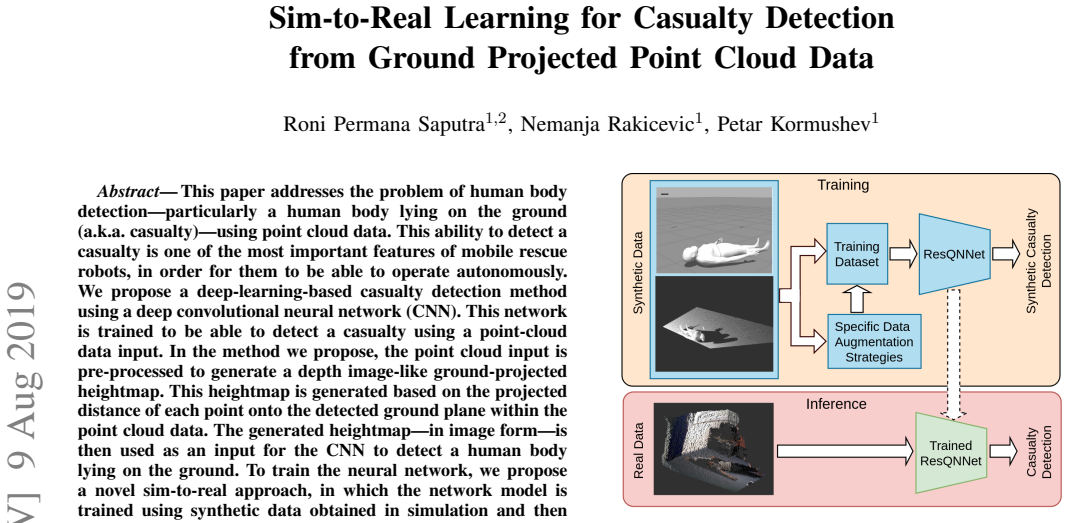
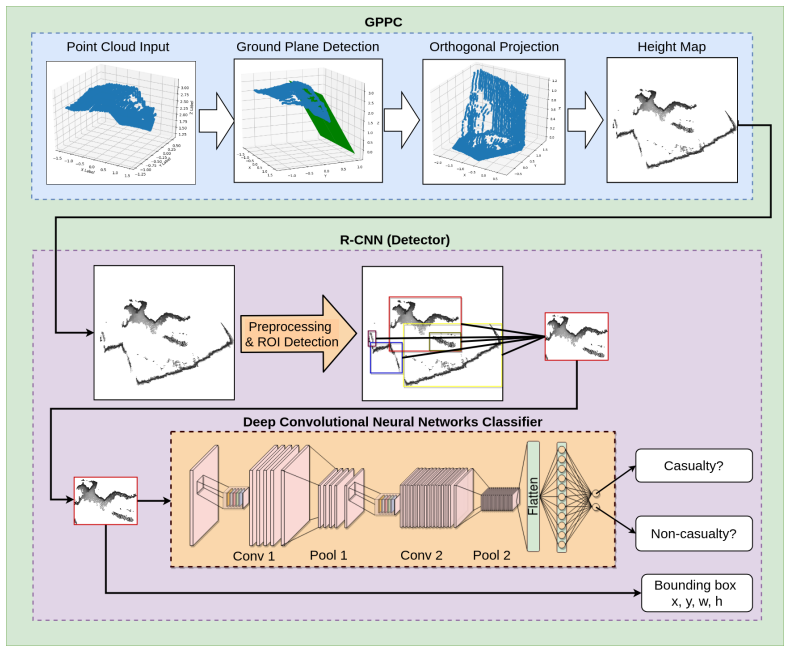
The load-bearing mechanism is the ground-projected point cloud (GPPC) heightmap together with point-cloud-specific data augmentation. The heightmap is a 2D greyscale grid on the detected ground plane, where each cell encodes the maximum normalized distance between point pairs projected into that cell; this converts an unstructured 3D cloud into an image-like representation that a CNN can process. Candidate regions are extracted from the heightmap by contour detection, and a LeNet-style binary CNN classifies each region as casualty or non-casualty. The argument for transfer is carried by the augmentation pipeline on the raw cloud: adding zero-mean Gaussian noise with $\sigma = 0.1$, $0.2$, and $0.25$, decimating points by scales $1:50$, $1:20$, and $1:10$, and deleting rectangular segments of sizes 50, 100, and 150 before projecting the cloud into the heightmap.
What would settle it
Collect point clouds from the real sensor with a calibration object under varied lighting and surface materials, map where readings drop to missing values, and retrain with that measured dropout mask; if accuracy on real test data does not improve over the rectangular-mask baseline, the claimed mechanism is wrong.
Extended reading notes
Core claim
On the paper's own terms, the discovery is that the bottleneck in sim-to-real transfer for this task is not the visual appearance of the heightmap but the dropout structure of real point clouds. Augmentation applied directly to raw point clouds—Gaussian sensor noise, down-sampling, and especially random rectangular segment removal—consistently outperforms augmentation of the GPPC heightmap images. Segment removal alone improved the synthetic-trained classifier from 83.16% to 91.11% accuracy on real sensor test data, with $F_1$ rising from 79.85 to 90.65; Bayesian optimization of a mix of the three point-cloud augmentations produced 93% on validation and 95% on unseen real test data, with balanced false-positive and false-negative errors.
Load-bearing premise
The augmentation parameters are assumed to approximate the real camera's artifacts: Gaussian noise with $\sigma$ values of 0.1–0.25 is taken from a cited indoor-mapping study rather than measured on the actual RGB-D sensor, and dropouts are modelled as rectangular removed segments regardless of the true pattern.
Editorial extensions
If this is right
- A rescue robot can be trained to spot a prone human using only simulated point clouds, with no manually labelled real casualty point-cloud data.
- When transferring RGB-D-trained models to new sensors, dropout artifacts deserve at least as much modelling effort as noise and resolution.
- The augmentation mix selected by Bayesian optimization is dominated by segment-removal samples (6000 of 10000), marking missing regions as the primary real-world corruption.
- The released synthetic and real point-cloud dataset enables direct reproduction of the sim-to-real benchmarks and comparison of new augmentation schemes.
Reading between the lines
- The same segment-removal augmentation probably transfers to other point-cloud tasks where occlusion or reflective dropout dominates, such as detecting objects under debris or behind vegetation; whether it helps depends on the real sensor's dropout shape.
- If one first measured the actual missing-data pattern of the real camera instead of assuming rectangular removal, the augmented training distribution could be matched to the observed artifact and likely push accuracy higher than 95%.
- The authors' protocol of ranking augmentation strategies by real-sensor accuracy could be reused with LIDAR point clouds, where the dominant corruption is likely beam-spacing and range noise rather than rectangular missing patches.
Signed reviews
Editorial analysis
A structured set of objections, weighed in public.
Referee Report
Summary. This paper proposes ResQNNet for detecting a human body lying on the ground from 3D point clouds. The pipeline projects point clouds onto an estimated ground plane to form a ground-projected point cloud (GPPC) heightmap, extracts candidate ROIs via contour detection, and classifies each ROI with a LeNet-style CNN. The CNN is trained exclusively on simulated Gazebo point clouds, with additional augmentation strategies applied either to the heightmap images or to the raw point clouds. Experiments compare no augmentation, image-noise augmentations, and three raw-point-cloud augmentations (sensor noise, down-sampling, and segment removal) on a held-out real dataset collected with the ResQbot robot; a Bayesian-optimization search over combinations of raw-point-cloud augmentations reportedly reaches 95% accuracy on a separate 200-sample test set. The paper claims that partially removing point-cloud segments is the most effective augmentation for sim-to-real transfer.
Significance. The problem is practical and timely, and the authors make a useful contribution by releasing a synthetic-plus-real dataset for a task for which no public dataset exists. The idea of augmenting raw point clouds with sensor noise, down-sampling, and segment removal is simple and can be evaluated by others. If the effect were established, the work would be a useful recipe for sim-to-real training in rescue robotics. The empirical design has good hygiene in one important respect: real data are held out from training, and the Bayesian optimization is performed on a separate validation set rather than the final test set. However, the central comparative result is currently not statistically supported, and the evaluation protocol for the full detection pipeline is not described precisely enough to know what was measured. These issues are fixable and should be addressed before publication.
major comments (3)
- [Table III and Section VI ('Performance on the real sensor test data')] Table III reports a single accuracy value per augmentation strategy. On the described 200-sample real test set (100 casualty, 100 non-casualty), an accuracy must be a multiple of 0.5 percentage points; values such as 91.11%, 87.88%, and 83.16% are impossible for one evaluation, so either the table reports an average over the ten augmentation-size conditions or the test set is larger or different than described. In either case, the paper gives no variance, confidence interval, or number of independent training runs. Treating the values as independent proportions on n=200, the 3.23-point gap between 'Removing points' and 'Down-sampling points' has z approximately 1.0 and is not significant; the central claim in Section VII that segment removal is superior 'compared to other strategies' is not supported by the reported numbers. The paper should report per-condition dispersion, a paired test across repeated training runs, and a corrected table description.
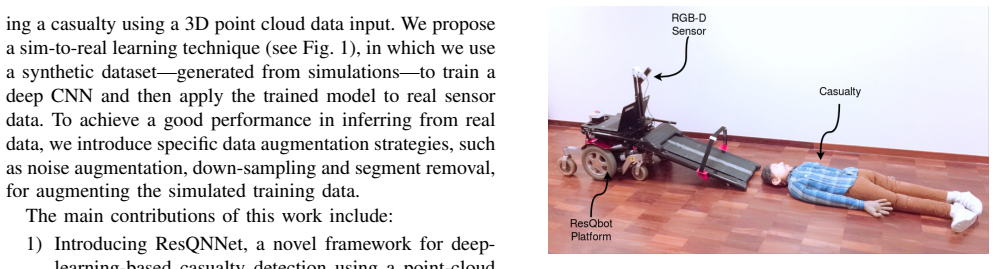
- [Section VI and Section IV.B] The experimental section states that 'the classification part of ResQNNet' was trained on cropped synthetic images, but it never specifies how the real test heightmaps were turned into candidate ROIs for evaluation. If the real 200-point-cloud test was evaluated by applying the full pipeline including contour-based ROI detection, the accuracy would reflect both ROI detection and classification, but no per-stage results are given; if instead the test crops were obtained manually or from ground-truth boxes, the reported accuracy overstates the end-to-end detector. The manuscript must describe the real-data evaluation protocol, including automatic ROI generation, thresholds, and whether every test cloud produced exactly one candidate, and it should report ROI recall separately.
- [Section VI, 'Simulated sensor noise', and Table II] The Gaussian sensor-noise standard deviations (0.1, 0.2, 0.25) are taken from [32], a distance-sensor study, rather than measured on the ResQbot RGB-D camera used for the real test data; the segment-removal augmentation similarly assumes that real artifacts appear as rectangular point-cloud dropouts. The paper's explanation of why segment removal transfers well depends on this assumed match. A concrete check would be to compare statistics of the real point clouds against the augmented training data (for example, local point density, connected dropout regions, or depth residuals), or at minimum to report that the real sensor exhibits such dropouts. Without this, the causal story in Section VII is a hypothesis, not a demonstrated mechanism.
minor comments (5)
- [Section IV.B.1] The sentence 'If there are no point pairs occupying the cell, we assign the maximum greyscale value' makes empty cells indistinguishable from occupied cells at maximum height; please clarify how contour detection and ROI extraction handle this.
- [Table III] The table header says 'Training & Augmentation', but the rows are conditions such as 'Synth-to-real'; use consistent naming and distinguish 'sensor reading noise' from 'Gaussian noise' applied to GPPC images.
- [Section VI and Fig. 8] The text says 'up to 91% accuracy' while Table III says 91.11%; specify whether the table values are the best or the average across the ten augmentation sample counts, and relabel the Fig. 8 panels consistently with the text.
- [Section VI, 'Injected Gaussian noise'] The text 'Gaussian noise with mean 0.2 and variance 10-50' is inconsistent with Table II, which lists 'mu: 0.2' and 'sigma: 10, 25, 50'; use consistent notation for mean and standard deviation.
- [Section VI, 'Performance on the synthetic test data'] The 'leave-one-out synthetic test set' is not described; given roughly 20,000 synthetic samples, specify how many held-out samples were used and how the split was constructed.
Circularity Check
No significant circularity: the sim-to-real claim is an empirical comparison on held-out real data, not a derivation from its inputs.
full rationale
The paper's central claim is an empirical observation: that training with point-cloud segment removal improves classification accuracy on a real sensor test set (Table III, 91.11% vs 83.16% baseline). The real sensor data is explicitly withheld from all training; the Bayesian optimization is performed on a separate validation set, and the final evaluation uses a distinct test set (Section VI). No fitted parameter is renamed as a prediction, and no equation or construction equates the output with the input. The GPPC preprocessing is based on the authors' prior work [27], [28], but this is a modular component adopted from earlier research, not a self-citation that forces the current conclusion. The choice of Gaussian noise parameters is justified by citation [32] (one shared author), but this is a parameter-setting choice, not a load-bearing derivation, and the experimental comparison does not reduce to that choice. The comparison of augmentation strategies is a direct empirical result, and the paper does not claim to derive it from first principles. Any concern about statistical significance or single-run training is a correctness/robustness issue, not circularity. Therefore, no circular step is identified.
Assumptions & free parameters
free parameters (4)
- Gaussian sensor noise sigma =
0.1, 0.2, 0.25
- Downsampling scales =
1/50, 1/20, 1/10
- Segment removal sizes =
50, 100, 150
- Augmentation sample proportions =
2000 noise, 2000 downsampling, 6000 segment removal
assumptions (3)
- domain assumption Gazebo-simulated point clouds, after augmentation, adequately represent the distribution of real point clouds from the ResQbot RGB-D sensor.
- domain assumption The UMTRI parametric human body models cover the range of body shapes and poses needed for casualty detection.
- domain assumption OpenCV contour detection on the GPPC heightmap reliably proposes regions containing casualties.
Cite this review
Pith. "Pith review of Sim-to-Real Learning for Casualty Detection from Ground Projected Point Cloud Data." pith.science (2026). https://pith.science/paper/D2VJ322Q
@misc{pith2026190803057,
  author       = {Pith},
  title        = {Pith review of: Sim-to-Real Learning for Casualty Detection from Ground Projected Point Cloud Data},
  year         = {2026},
  howpublished = {\url{https://pith.science/paper/D2VJ322Q}},
  note         = {Machine review of arXiv:1908.03057}
}
read the original abstract
This paper addresses the problem of human body detection---particularly a human body lying on the ground (a.k.a. casualty)---using point cloud data. This ability to detect a casualty is one of the most important features of mobile rescue robots, in order for them to be able to operate autonomously. We propose a deep-learning-based casualty detection method using a deep convolutional neural network (CNN). This network is trained to be able to detect a casualty using a point-cloud data input. In the method we propose, the point cloud input is pre-processed to generate a depth image-like ground-projected heightmap. This heightmap is generated based on the projected distance of each point onto the detected ground plane within the point cloud data. The generated heightmap -- in image form -- is then used as an input for the CNN to detect a human body lying on the ground. To train the neural network, we propose a novel sim-to-real approach, in which the network model is trained using synthetic data obtained in simulation and then tested on real sensor data. To make the model transferable to real data implementations, during the training we adopt specific data augmentation strategies with the synthetic training data. The experimental results show that data augmentation introduced during the training process is essential for improving the performance of the trained model on real data. More specifically, the results demonstrate that the data augmentations on raw point-cloud data have contributed to a considerable improvement of the trained model performance.
Figures
Figures from the paper (5 more)




Reference graph
Works this paper leans on
-
[32]
Experimental review of distance sensors for indoor mapping,
M. Mirdanies and R. P. Saputra, “Experimental review of distance sensors for indoor mapping,” Journal of Mechatronics, Electrical Power, and Vehicular Technology, vol. 8, no. 2, pp. 85–94, 2017
work page 2017
-
[1]
Multisensor low-cost system for real time human detection and remote respiration monitoring,
A. Ivanovs, A. Nikitenko, M. Di Castro, T. Torims, A. Masi, and M. Ferre, “Multisensor low-cost system for real time human detection and remote respiration monitoring,” in 2019 Third IEEE International Conference on Robotic Computing (IRC) , 2019, pp. 254–257
work page 2019
-
[2]
Vision based victim detection from unmanned aerial vehicles,
M. Andriluka, P. Schnitzspan, J. Meyer, S. Kohlbrecher, K. Petersen, O. V . Stryk, S. Roth, and B. Schiele, “Vision based victim detection from unmanned aerial vehicles,” in 2010 IEEE/RSJ International Conference on Intelligent Robots and Systems (IROS), 2010, pp. 1740– 1747. Fig. 10: Heatmaps showing the accuracy achieved for different combinations of da...
work page 2010
-
[3]
Pedestrian detection: An evaluation of the state of the art,
P. Dollar, C. Wojek, B. Schiele, and P. Perona, “Pedestrian detection: An evaluation of the state of the art,” IEEE Transactions on Pattern Analysis and Machine Intelligence , vol. 34, no. 4, pp. 743–761, 2012
work page 2012
-
[4]
A survey on visual surveillance of object motion and behaviors,
W. Hu, T. Tan, L. Wang, and S. Maybank, “A survey on visual surveillance of object motion and behaviors,” IEEE Transactions on Systems, Man, and Cybernetics, Part C (Applications and Reviews) , vol. 34, no. 3, pp. 334–352, 2004
work page 2004
-
[5]
Face alignment by explicit shape regression,
X. Cao, Y . Wei, F. Wen, and J. Sun, “Face alignment by explicit shape regression,” in2012 IEEE Conference on Computer Vision and Pattern Recognition (CVPR), 2012, pp. 2887–2894
work page 2012
-
[6]
Going deeper with convolutions,
C. Szegedy, W. Liu, Y . Jia, P. Sermanet, S. Reed, D. Anguelov, D. Erhan, V . Vanhoucke, and A. Rabinovich, “Going deeper with convolutions,” in 2015 IEEE Conference on Conference on Computer Vision and Pattern Recognition (CVPR) , 2015, pp. 1–9
work page 2015
-
[7]
Rich feature hierarchies for accurate object detection and semantic segmentation,
R. Girshick, J. Donahue, T. Darrell, and J. Malik, “Rich feature hierarchies for accurate object detection and semantic segmentation,” in 2014 IEEE Conference on Conference on Computer Vision and Pattern Recognition (CVPR), 2014, pp. 580–587
work page 2014
Show all 33 references
-
[8]
Fast r-cnn,
R. Girshick, “Fast r-cnn,” in 2015 IEEE International Conference on Computer Vision (ICCV) , 2015, pp. 1440–1448
2015
-
[9]
Faster r-cnn: towards real-time object detection with region proposal networks,
S. Ren, K. He, R. Girshick, and J. Sun, “Faster r-cnn: towards real-time object detection with region proposal networks,” IEEE Transactions on Pattern Analysis & Machine Intelligence , no. 6, pp. 1137–1149, 2017
2017
-
[10]
Focal loss for dense object detection,
T.-Y . Lin, P. Goyal, R. Girshick, K. He, and P. Doll ´ar, “Focal loss for dense object detection,” IEEE Transactions on Pattern Analysis and Machine Intelligence, 2018
2018
-
[11]
Mask r-cnn,
K. He, G. Gkioxari, P. Doll ´ar, and R. Girshick, “Mask r-cnn,” in 2017 IEEE International Conference on Computer Vision (ICCV), 2017, pp. 2961–2969
2017
-
[12]
Megdet: A large mini-batch object detector,
C. Peng, T. Xiao, Z. Li, Y . Jiang, X. Zhang, K. Jia, G. Yu, and J. Sun, “Megdet: A large mini-batch object detector,” in 2018 IEEE Con- ference on Conference on Computer Vision and Pattern Recognition (CVPR), 2018, pp. 6181–6189
2018
-
[13]
Learning appearance in virtual scenarios for pedestrian detection,
J. Marin, D. V ´azquez, D. Ger ´onimo, and A. M. L ´opez, “Learning appearance in virtual scenarios for pedestrian detection,” in 2010 IEEE Conference on Computer Vision and Pattern Recognition (CVPR) , 2010, pp. 137–144
2010
-
[14]
Semantic pose using deep networks trained on synthetic rgb-d,
J. Papon and M. Schoeler, “Semantic pose using deep networks trained on synthetic rgb-d,” in 2015 IEEE International Conference on Computer Vision (ICCV) , 2015, pp. 774–782
2015
-
[15]
Learning from synthetic humans,
G. Varol, J. Romero, X. Martin, N. Mahmood, M. J. Black, I. Laptev, and C. Schmid, “Learning from synthetic humans,” in2017 IEEE com- puter society conference on computer vision and pattern recognition (CVPR), 2017, pp. 109–117
2017
-
[16]
Articulated people detection and pose estimation: Reshaping the future,
L. Pishchulin, A. Jain, M. Andriluka, T. Thorm ¨ahlen, and B. Schiele, “Articulated people detection and pose estimation: Reshaping the future,” in 2012 IEEE Conference on Computer Vision and Pattern Recognition (CVPR), 2012, pp. 3178–3185
2012
-
[17]
Synthesizing training images for boosting human 3d pose estimation,
W. Chen, H. Wang, Y . Li, H. Su, Z. Wang, C. Tu, D. Lischinski, D. Cohen-Or, and B. Chen, “Synthesizing training images for boosting human 3d pose estimation,” in 2016 Fourth International Conference on 3D Vision (3DV) , 2016, pp. 479–488
2016
-
[18]
Learning a non-linear knowledge transfer model for cross-view action recognition,
H. Rahmani and A. Mian, “Learning a non-linear knowledge transfer model for cross-view action recognition,” in 2015 IEEE Conference on Computer Vision and Pattern Recognition (CVPR) , 2015, pp. 2458– 2466
2015
-
[19]
3d action recognition from novel view- points,
H. Rahmani and A. Mian, “3d action recognition from novel view- points,” in 2016 IEEE Conference on Computer Vision and Pattern Recognition (CVPR, 2016, pp. 1506–1515
2016
-
[20]
Learning people detection models from few training samples,
L. Pishchulin, A. Jain, C. Wojek, M. Andriluka, T. Thorm ¨ahlen, and B. Schiele, “Learning people detection models from few training samples,” in 2011 IEEE Conference on Computer Vision and Pattern Recognition (CVPR), 2011, pp. 1473–1480
2011
-
[21]
Unsupervised pixel-level domain adaptation with generative adver- sarial networks,
K. Bousmalis, N. Silberman, D. Dohan, D. Erhan, and D. Krishnan, “Unsupervised pixel-level domain adaptation with generative adver- sarial networks,” in 2017 IEEE Conference on Computer Vision and Pattern Recognition (CVPR), 2017, pp. 95–104
2017
-
[22]
Domain randomization for transferring deep neural networks from simulation to the real world,
J. Tobin, R. Fong, A. Ray, J. Schneider, W. Zaremba, and P. Abbeel, “Domain randomization for transferring deep neural networks from simulation to the real world,” in 2017 IEEE/RSJ International Con- ference on Intelligent Robots and Systems (IROS) , 2017, pp. 23–30
2017
-
[23]
On rendering synthetic images for training an object detector,
A. Rozantsev, V . Lepetit, and P. Fua, “On rendering synthetic images for training an object detector,” Computer Vision and Image Under- standing, vol. 137, pp. 24–37, 2015
2015
-
[24]
Depthsynth: Real- time realistic synthetic data generation from cad models for 2.5 d recognition,
B. Planche, Z. Wu, K. Ma, S. Sun, S. Kluckner, O. Lehmann, T. Chen, A. Hutter, S. Zakharov, H. Kosch, et al., “Depthsynth: Real- time realistic synthetic data generation from cad models for 2.5 d recognition,” in 2017 International Conference on 3D Vision (3DV) , 2017, pp. 1–10
2017
-
[25]
ResQbot: A mobile rescue robot for casualty extraction,
R. P. Saputra and P. Kormushev, “ResQbot: A mobile rescue robot for casualty extraction,” in 2018 ACM/IEEE International Conference on Human-Robot Interaction (HRI) , 2018, pp. 239–240
2018
-
[26]
ResQbot: A mobile rescue robot with immersive teleperception for casualty extraction,
R. P. Saputra and P. Kormushev, “ResQbot: A mobile rescue robot with immersive teleperception for casualty extraction,” in Annual Conference of Towards Autonomous Robotic Systems (TAROS) , 2018, pp. 209–220
2018
-
[27]
Casualty detection for mobile rescue robots via ground-projected point clouds,
R. P. Saputra and P. Kormushev, “Casualty detection for mobile rescue robots via ground-projected point clouds,” in Annual Conference of Towards Autonomous Robotic Systems (TAROS) , 2018, pp. 473–475
2018
-
[28]
Casualty detection from 3d point cloud data for autonomous ground mobile rescue robots,
R. P. Saputra and P. Kormushev, “Casualty detection from 3d point cloud data for autonomous ground mobile rescue robots,” in 2018 IEEE International Symposium on Safety, Security, and Rescue Robotics (SSRR), 2018, pp. 1–7
2018
-
[29]
Gradient-based learning applied to document recognition,
Y . LeCun, L. Bottou, Y . Bengio, P. Haffner, et al. , “Gradient-based learning applied to document recognition,” Proceedings of the IEEE , vol. 86, no. 11, pp. 2278–2324, 1998
1998
-
[30]
De- veloping and implementing parametric human body shape models in ergonomics software,
M. P. Reed, U. Raschke, R. Tirumali, and M. B. Parkinson, “De- veloping and implementing parametric human body shape models in ergonomics software,” in Proceedings of the 3rd international digital human modeling conference , 2014
2014
-
[31]
Human shapes - realistic human body shape modeler based on real data,
“Human shapes - realistic human body shape modeler based on real data,” http://humanshape.org/, accessed: 2018-07-30
2018
-
[33]
Bayesian optimization,
Fernando, “Bayesian optimization,” https://github.com/fmfn/ BayesianOptimization, 2018
2018
Reviewed August 14, 2026 · model on record in the stance chip above.
Discussion (0). Continue with ORCID to comment.