REVIEW 3 major objections 5 minor 63 references
A first step in the nuclear inverse Kohn-Sham problem: from densities to potentials
T0 review · 3 major / 5 minor · reviewed 2026-08-14 · deepseek-v4-flash
Pith's one-line read This paper reports that the nuclear inverse Kohn-Sham problem, extracting potentials from measured densities, works in the interior and surface of 40Ca and 208Pb, with a tail artifact from Gaussian fits.
desk verdict First nuclear inverse-KS paper: honest and well benchmarked, but the 'reliable interior' claim is missing the one sensitivity test that would nail it. read the letter →
The pith
A machine-rendered reading of the paper's core claim, the machinery that carries it, and where it could break.
The reading
What carries the argument
The central object is the one-dimensional radial Kohn-Sham equation for a local potential $U(r)$, with the density built from the occupied single-particle orbitals, $\rho(r)=\frac{1}{4\pi r^2}\sum_i n_i u_i^2(r)$. The vLB method iterates the potential through $U^{(k+1)}(r)=U^{(k)}(r)+\gamma\left(\rho^{(k)}(r)-\tilde{\rho}(r)\right)/\tilde{\rho}(r)$, adjusting the potential wherever the computed density misses the target. The constrained-variational method minimizes the kinetic energy of orthonormal orbitals under the equality constraint $\rho=\tilde{\rho}$, and the Lagrange multiplier for that constraint is the Kohn-Sham potential. The experimental input is handled with the sum-of-Gaussians parameterization of the densities, and the paper identifies the Gaussian tail of that parameterization as the source of the spurious divergent potential at large $r$.
What would settle it
A decisive experiment would be to invert the proton density of 40Ca obtained from a many-body calculation that includes spin-orbit and non-local terms, and compare the interior potential with the one extracted from the experimental sum-of-Gaussians density; a difference of more than a few MeV would show that the local-density assumption is the weak point, while a persisting large-radius divergence would show the tail artifact is algorithmic rather than a property of Gaussian fits.
Extended reading notes
Core claim
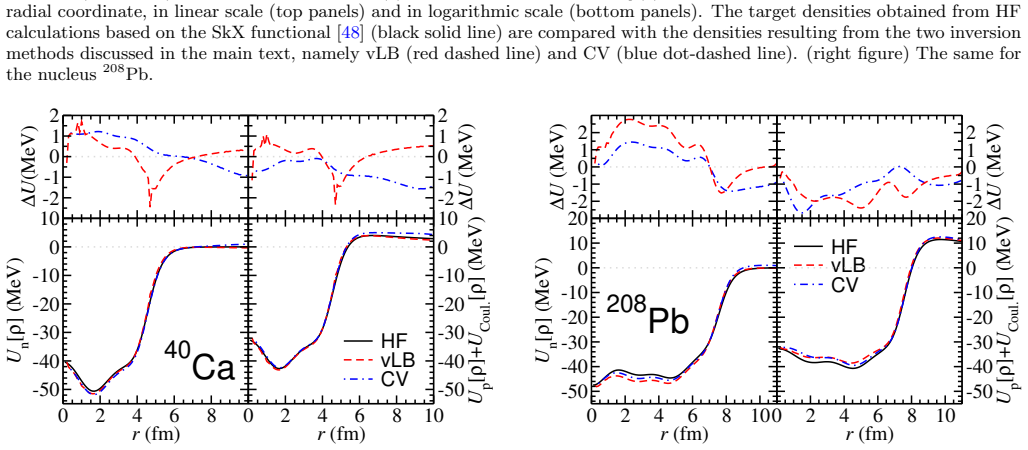
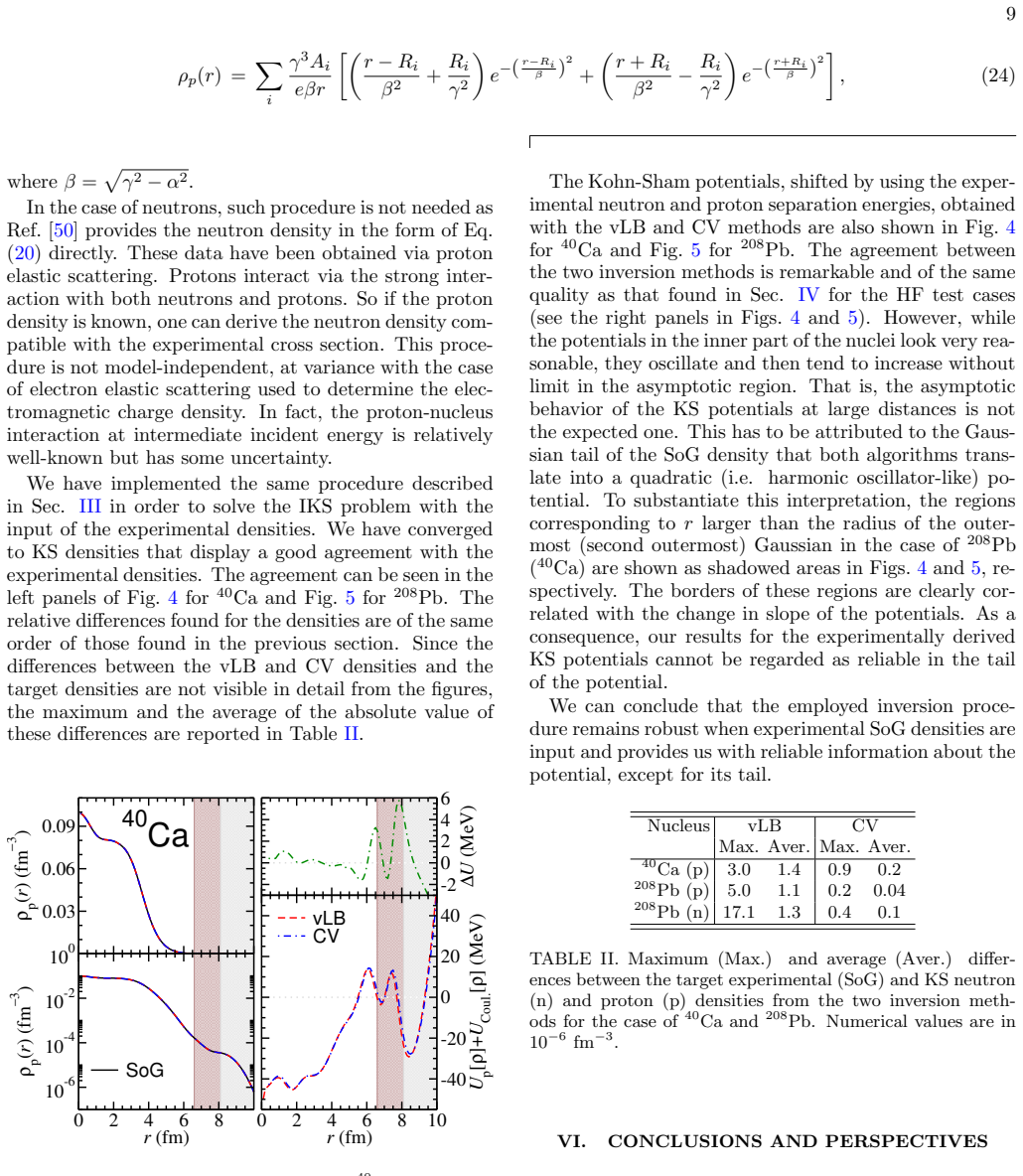
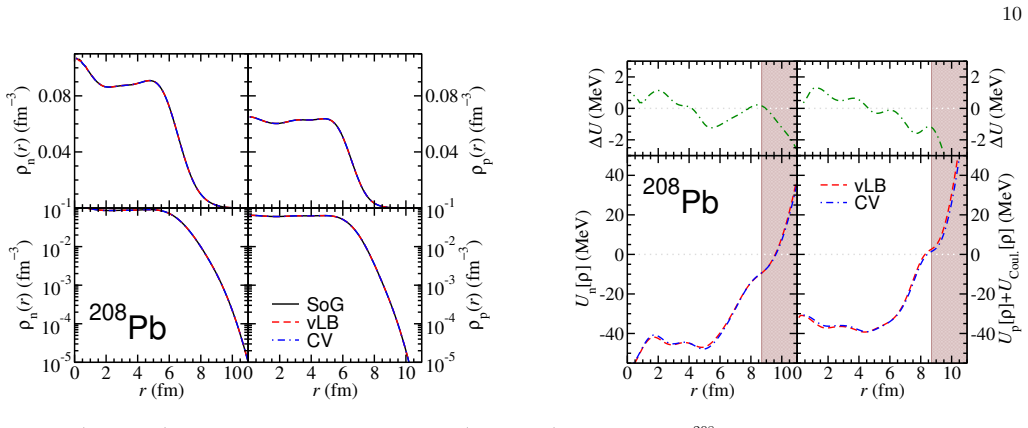
On the paper's own terms, the central discovery is that the inverse Kohn-Sham problem, previously applied to electronic systems, can be taken up for atomic nuclei. For 40Ca and 208Pb, the two inversion methods converge to the same potential, and for SkX Hartree-Fock input densities they reproduce the reference potential to within about 2.5 MeV in the interior. For experimental sum-of-Gaussians densities, both methods again agree with each other and give physically reasonable potentials up to the nuclear surface, but beyond the outermost Gaussian the algorithms convert the Gaussian density tail into a quadratic, harmonic-oscillator-like potential that grows without bound. The conclusion is that the inversion is stable and provides reliable information about the potential inside and at the surface of the nucleus, while the tail of the extracted potential is an artifact of the density parameterization and should not be interpreted.
Load-bearing premise
The load-bearing premise is that a purely local, central Kohn-Sham potential depending only on the local neutron and proton densities can faithfully describe nuclei once spin-orbit, non-local, and gradient terms are neglected; if those terms change the orbitals and densities appreciably, the extracted potential is not the potential of an exact Kohn-Sham system.
Editorial extensions
If this is right
- For spherical closed-shell nuclei, measured proton and neutron densities can be used to benchmark local phenomenological potentials in the interior and at the surface.
- The absolute scale of the extracted potential is fixed by the experimental separation energy of the last occupied orbital, so the inversion yields energies, not just shapes, once that anchor is used.
- Potentials extracted from sum-of-Gaussians densities should not be trusted in the tail; the divergence there is an artifact of the parameterization, not a physical signal.
- The next planned step is to apply the inversion to densities from ab initio calculations, which the paper expects to make it possible to extract gradient and spin terms of the energy functional.
- Knowing the potential along a continuous path of densities could, in principle, reconstruct the energy density functional itself, and the paper identifies neutron drops as a candidate system for such a path.
Reading between the lines
- The tail artifact is a general warning: the asymptotic form of the density parameterization, not the data alone, controls the extracted potential at large radius; one immediate extension would be to redo the inversion with an exponentially decaying tail and check whether the divergence disappears.
- If the local-density assumption is dropped, the correspondence between density and potential is no longer guaranteed; a direct test would be to include a gradient term in the inversion and see whether the interior potential moves by more than the paper's reported few MeV.
- The same machinery transfers to other doubly magic nuclei with measured charge densities, so the equal-quality interior potentials obtained for 40Ca and 208Pb could be checked against other phenomenological parameterizations without new formalism.
Signed reviews
Editorial analysis
A structured set of objections, weighed in public.
Referee Report
Summary. The paper presents a first application of the inverse Kohn-Sham (IKS) problem to nuclear systems. Starting from target neutron and proton densities for the spherical doubly-magic nuclei 40Ca and 208Pb, the authors extract a local, central Kohn-Sham potential using two algorithms: the van Leeuwen-Baerends iterative method (vLB) and a constrained variational method (CV). The algorithms are first benchmarked against Hartree-Fock densities from the Skyrme interaction SkX, reproducing target densities to better than 10^-5 fm^-3 and potentials within about 2.5 MeV. The same procedures are then applied to experimental sum-of-Gaussians (SoG) densities for protons in 40Ca and for neutrons and protons in 208Pb. The two methods agree closely with each other and produce potentials that look physical in the nuclear interior, but the potentials diverge in the asymptotic tail because the SoG parameterization has Gaussian tails. The authors conclude that the inversion is robust for experimental SoG densities and gives reliable information about the potential except for its tail, and they discuss perspectives for extending the approach.
Significance. If the central claim is established, this is a useful first step: it introduces a concrete numerical pipeline through which experimental or ab initio densities could constrain nuclear Kohn-Sham potentials and, eventually, energy density functionals. The paper's strengths include the use of two methodologically distinct inversion algorithms, a quantitative benchmark against independent Hartree-Fock densities, the explicit fixing of the potential scale through experimental separation energies, and the transparent acknowledgement of the SoG tail problem and of the limitations of the local-density ansatz. The numerical reproduction of target densities is carefully quantified in Tables I and II. However, the experimental conclusion that the extracted potential is reliable in the interior and at the surface is not yet fully supported, because the tail artifact could in principle feed back into the interior and because the two algorithms do not provide independent validation for the experimental input.
major comments (3)
- [Sec. V (concluding paragraph)] The claim that the experimental SoG input yields reliable potentials 'except for its tail' is not demonstrated. The agreement between vLB and CV is a consistency check, not an independent validation, because both methods use the same target density and the same local-potential ansatz. The benchmark in Sec. IV uses Hartree-Fock densities with physical exponential tails, so it does not exercise the Gaussian-tail regime that the paper identifies as the source of the divergent potential. Since the Kohn-Sham equation is a global boundary-value problem, a divergent tail potential can in principle alter the occupied orbitals and hence the potential in the interior. The paper should quantify this effect, for example by replacing the SoG tail beyond the outermost Gaussian with an exponential tail, or by truncating the target density at various radii, and checking whether the interior potential remains unchanged within the claimed accuracy.
- [Sec. III (first paragraph) and Sec. VI] The central ansatz that spin-orbit and non-local effects can be neglected because they are 'not expected to markedly change the KS orbitals' is asserted rather than tested for the experimental cases. The SkX benchmark has an effective mass close to the bare mass (m*/m between 0.92 and 1.08 for 208Pb), so it does not validate the ansatz for functionals with stronger non-locality or spin-orbit coupling. The paper itself acknowledges in Sec. VI that 'there is no guarantee that a purely local effective potential is the correct choice.' This is a load-bearing limitation: if the exact nuclear Kohn-Sham potential is nonlocal, the local potential that reproduces the density is not the Kohn-Sham potential of the exact system. The abstract, Sec. V, and the concluding remarks should therefore consistently qualify the extracted potential as reliable only within the local, central-potential ansatz; the current wording overstates the physical meaning of the result.
- [Eq. (10) and Sec. V] The vLB update in Eq. (10) divides by the target density, so small SoG parameterization artifacts in the low-density tail are strongly amplified. The authors note the resulting tail divergence, but they do not propagate the experimental density uncertainties from Refs. [49] and [50] into the extracted potential, nor do they test the sensitivity of the interior potential to the SoG parameters. Without such an uncertainty or sensitivity estimate, the statement that the interior and surface potentials are 'reliable' is not quantitative. A simple test would be to vary the SoG coefficients or the number of Gaussians within the experimental errors and report the spread of the extracted potential in the interior.
minor comments (5)
- [Eq. (8)] The symbol 'Ul' for the centrifugal potential is easily confused with the Kohn-Sham potential U(r); it should be typeset as U_l or defined more prominently.
- [Figs. 1, 2, 4, 5] The captions refer to 'left figure' and 'right figure'; these should be 'left panel' and 'right panel' for clarity.
- [Sec. IV (after Fig. 2)] The statement that spin-orbit energy splittings 'have been checked to have no special influence' is not backed by any displayed result; either show the check or cite a reference for this expectation.
- [Sec. II] The phrase 'We miss a formal proof' should be 'We lack a formal proof' or 'A formal proof is missing'.
- [Sec. V (concluding paragraph)] The word 'robust' is vague here; the authors should specify the sense in which the procedure is robust, given that the tail behavior is not physical and the interior reliability is the point to be established.
Circularity Check
No significant circularity: the inversion is a direct map from target density to potential, with an independent HF benchmark and no fitted parameter renamed as a prediction.
full rationale
The paper's central object is the Kohn-Sham potential U[rho] reconstructed from a target density rhotilde, which is the definition of the inverse Kohn-Sham problem rather than a hidden equivalence. Equations (8)-(10) map the target density to a potential, and the benchmark in Sec. IV tests this map against an independent SkX-HF potential, finding |Delta U| below 2.5 MeV. In the experimental case (Sec. V), the paper compares two distinct algorithms, vLB and CV, explicitly identifies the Gaussian-tail artifact, and hedges the interior/surface claim with 'appear to be reliable'; vLB/CV agreement is a consistency check, which may limit the strength of the robustness claim but is not circular. The experimental separation energy fixes the constant shift of the potential and is an input, not a quantity presented as predicted. The only self-citations (Refs. 14 and 43) support background statements about EDF construction and the local treatment of the Coulomb interaction; they are not load-bearing for the inversion derivation. No equation reduces to its own inputs by construction, and no fitted parameter is renamed as a prediction. The derivation is therefore self-contained with respect to circularity, with any remaining concerns belonging to correctness risk or validation strength rather than circular reasoning.
Assumptions & free parameters
free parameters (3)
- gamma (vLB update step) =
1 MeV
- alpha (vLB convergence threshold) =
20 keV
- IPOPT tolerances (epsilon, delta) =
not specified numerically
assumptions (5)
- domain assumption Existence and uniqueness of a local Kohn-Sham potential reproducing a given density, including for the intrinsic density of a self-bound nucleus.
- ad hoc to paper Spin-orbit and non-local terms do not markedly change KS orbitals and densities, so a purely local central potential suffices.
- domain assumption The last occupied KS eigenvalue equals the experimental neutron or proton separation energy, fixing the absolute shift of the potential.
- domain assumption Doubly-magic spherical nuclei can be treated with spherical symmetry and integer occupancies of 2j+1.
- domain assumption Experimental charge and neutron densities are faithfully represented by the sum-of-Gaussians parameterizations of Refs. [49,50].
Cite this review
Pith. "Pith review of A first step in the nuclear inverse Kohn-Sham problem: from densities to potentials." pith.science (2026). https://pith.science/paper/GXXPRFFO
@misc{pith2026190803068,
  author       = {Pith},
  title        = {Pith review of: A first step in the nuclear inverse Kohn-Sham problem: from densities to potentials},
  year         = {2026},
  howpublished = {\url{https://pith.science/paper/GXXPRFFO}},
  note         = {Machine review of arXiv:1908.03068}
}
read the original abstract
Nuclear Density Functional Theory (DFT) plays a prominent role in the understanding of nuclear structure, being the approach with the widest range of applications. Hohenberg and Kohn theorems warrant the existence of a nuclear Energy Density Functional (EDF), yet its form is unknown. Current efforts to build a nuclear EDF are hindered by the lack of a strategy for systematic improvement. In this context, alternative approaches should be pursued and, so far, an unexplored avenue is that related to the inverse DFT problem. DFT is based on the one-to-one correspondence between Kohn-Sham (KS) potentials and densities. The exact EDF produces the exact density, so that from the knowledge of experimental or {\it ab initio} densities one may deduce useful information through reverse engineering. The idea has already been proven to be useful in the case of electronic systems. The general problem should be dealt with in steps, and the objective of the present work is to focus on testing algorithms to extract the Kohn-Sham potential within the simplest ansatz from the knowledge of the experimental neutron and proton densities. We conclude that while robust algorithms exist, the experimental densities present some critical aspects. Finally, we provide some perspectives for future works.
Figures


Figures from the paper (2 more)
Reference graph
Works this paper leans on
-
[49]
labeled as SoG – sum of Gaussians – (black solid lines) are compared with those obtained with the inversion methods vLB (red dashed lines) and CV (blue dot-dashed lines). (right figure) The Kohn-Sham potentials calculated for neutrons and protons with the inversion methods vLB (red dashed lines) and CV (blue dot-dashed lines) are shown. In the top panels, ...
work page 2020
-
[50]
C. Titin-Schnaider and P. Quentin, Physics Letters B 49, 397 (1974)
work page 1974
-
[1]
the single particle orbitals φi(⃗ r) must be orthonor- mal
-
[2]
Let us start from the same assumptions as in the pre- vious subsection
the density of the system ρ(⃗ r) must be equal to the target density ˜ρ(⃗ r), for each value of ⃗ r. Let us start from the same assumptions as in the pre- vious subsection. We assume that we have Norb single particle states and that each of them has occupancy ni. We prefer here to write the equation without going im- mediately to the spherically symmetric...
-
[3]
Burke, The Journal of Chemical Physics 136, 150901 (2012)
K. Burke, The Journal of Chemical Physics 136, 150901 (2012)
work page 2012
-
[4]
the relative tolerance on the violation of the con- straints. This means that, at each step during the optimization, there is a test of the condition max i |gi−ci gi |<ϵ, (18) where the constraints are denoted by ci, and the quantities subject to the constraints are denoted bygi
-
[5]
the tolerance on the value of the objective function f. The algorithm stops if the change in value of the objective function between two successive iter- ationsk andk− 1 is smaller than a given tolerance δ, namely |f (k)−f (k−1)| < δ, (19) Notice that while the CV method checks the conver- gence of the objective functionf [Eq. (19)], that is, of the re-sc...
-
[6]
F. Raimondi, B. G. Carlsson, and J. Dobaczewski, Phys. Rev. C 83, 054311 (2011)
work page 2011
Show all 63 references
-
[7]
Becker, D
P. Becker, D. Davesne, J. Meyer, J. Navarro, and A. Pa- store, Phys. Rev. C 96, 044330 (2017)
2017
-
[8]
Bender, P.-H
M. Bender, P.-H. Heenen, and P.-G. Reinhard, Rev. Mod. Phys. 75, 121 (2003)
2003
-
[9]
Schunck, ed., Energy Density Functional Methods for Atomic Nuclei , 2053-2563 (IOP Publishing, 2019)
N. Schunck, ed., Energy Density Functional Methods for Atomic Nuclei , 2053-2563 (IOP Publishing, 2019)
2019
-
[10]
Perli´ nska, S
E. Perli´ nska, S. G. Rohozi´ nski, J. Dobaczewski, and W. Nazarewicz, Phys. Rev. C 69, 014316 (2004)
2004
-
[11]
A. D. Becke, The Journal of Chemical Physics 140, 18A301 (2014)
2014
-
[12]
Hohenberg and W
P. Hohenberg and W. Kohn, Phys. Rev. 136, B864 (1964)
1964
-
[13]
Baldo, P
M. Baldo, P. Schuck, and X. Vi˜ nas, Physics Letters B 663, 390 (2008)
2008
-
[14]
Gambacurta, L
D. Gambacurta, L. Li, G. Col` o, U. Lombardo, N. Van Giai, and W. Zuo, Phys. Rev. C 84, 024301 (2011)
2011
-
[15]
Engel, D
Y. Engel, D. Brink, K. Goeke, S. Krieger, and D. Vau- therin, Nuclear Physics A 249, 215 (1975)
1975
-
[16]
Dobaczewski and J
J. Dobaczewski and J. Dudek, Acta Physica Polonica B 27, 45 (1996)
1996
-
[17]
Navarro P´ erez, N
R. Navarro P´ erez, N. Schunck, A. Dyhdalo, R. J. Furn- stahl, and S. K. Bogner, Phys. Rev. C 97, 054304 (2018)
2018
-
[18]
J. Drut, R. Furnstahl, and L. Platter, Progress in Par- ticle and Nuclear Physics 64, 120 (2010)
2010
-
[19]
The two approaches that we discuss below have been origi- nally introduced in Refs
for a recent review and [22] for early references). The two approaches that we discuss below have been origi- nally introduced in Refs. [23] and [19]. The IKS prob- lem has been solved in the case of the He atom, where an exact analytic solution for wave functions and densi- t...
-
[20]
L. G. Cao, U. Lombardo, C. W. Shen, and N. V. Giai, Phys. Rev. C 73, 014313 (2006)
2006
-
[21]
We now focus on the convergence of the procedures
for r→∞ . We now focus on the convergence of the procedures. The two algorithms behave in a quite different way. As explained in Sec. III A, the vLB method iterates the potential according to Eq. (10) and stops when the condition (11) is satisfied: in the present case, we set α ...
-
[22]
Stoitsov, M
M. Stoitsov, M. Kortelainen, S. K. Bogner, T. Duguet, R. J. Furnstahl, B. Gebremariam, and N. Schunck, Phys. Rev. C 82, 054307 (2010)
2010
-
[23]
S. K. Bogner, R. J. Furnstahl, H. Hergert, M. Korte- lainen, P. Maris, M. Stoitsov, and J. P. Vary, Phys. Rev. C 84, 044306 (2011)
2011
-
[24]
E. A. Hylleraas, Zeitschrift f¨ ur Physik54, 347 (1929)
1929
-
[25]
Kohn and L
W. Kohn and L. J. Sham, Phys. Rev. 140, A1133 (1965)
1965
-
[26]
D. S. Jensen and A. Wasserman, International Journal of Quantum Chemistry 118, e25425 (2018)
2018
-
[27]
J. P. Perdew, R. G. Parr, M. Levy, and J. L. Balduz, Phys. Rev. Lett. 49, 1691 (1982)
1982
-
[28]
J. P. Perdew and M. Levy, Phys. Rev. B56, 16021 (1997)
1997
-
[29]
Wang and R
Y. Wang and R. G. Parr, Phys. Rev. A 47, R1591 (1993)
1993
-
[30]
van Leeuwen and E
R. van Leeuwen and E. J. Baerends, Phys. Rev. A 49, 2421 (1994)
1994
-
[31]
A. S. Umar and V. E. Oberacker, Phys. Rev. C 74, 021601 (2006)
2006
-
[32]
J. Li, N. D. Drummond, P. Schuck, and V. Olevano, SciPost Phys. 6, 40 (2019)
2019
-
[33]
S. E. B. Nielsen, M. Ruggenthaler, and R. van Leeuwen, EPL (Europhysics Letters) 101, 33001 (2013)
2013
-
[34]
S. E. B. Nielsen, M. Ruggenthaler, and R. van Leeuwen, The European Physical Journal B 91, 235 (2018)
2018
-
[35]
Kumar, R
A. Kumar, R. Singh, and M. K. Harbola, Journal of Physics B: Atomic, Molecular and Optical Physics 52, 075007 (2019)
2019
-
[36]
Kanungo, P
B. Kanungo, P. M. Zimmerman, and V. Gavini, Nature Communications 10, 4497 (2019)
2019
-
[37]
Naito, D
T. Naito, D. Ohashi, and H. Liang, Journal of Physics B: Atomic, Molecular and Optical Physics 52, 245003 (2019)
2019
-
[38]
Valiev and G
M. Valiev and G. W. Fernando, eprint arXiv:cond- mat/9702247 (1997), cond-mat/9702247
1997
-
[39]
Hadamard, Princeton Univ
J. Hadamard, Princeton Univ. Bull. 13, 49 (1902)
1902
-
[40]
J. T. Chayes, L. Chayes, and M. B. Ruskai, Journal of Statistical Physics 38, 497 (1985)
1985
-
[41]
R. M. Dreizler and E. K. U. Gross, Density functional theory: an approach to the quantum many-body problem (Springer, Berlin, 1990)
1990
-
[42]
A. P. Gaiduk, S. K. Chulkov, and V. N. Staroverov, Jour- nal of Chemical Theory and Computation 5, 699 (2009)
2009
-
[43]
van Leeuwen and E
R. van Leeuwen and E. J. Baerends, Phys. Rev. A 51, 170 (1995)
1995
-
[44]
Engel, Phys
J. Engel, Phys. Rev. C 75, 014306 (2007)
2007
-
[45]
Parr and W
R. Parr and W. Yang, Density-Functional Theory of Atoms and Molecules , International Series of Mono- graphs on Chemistry (Oxford University Press, USA, 1994)
1994
-
[46]
G. W. Fernando, in Metallic Multilayers and their Ap- plications, Handbook of Metal Physics, Vol. 4, edited by G. W. Fernando (Elsevier, 2008) pp. 131 – 156
2008
-
[47]
Barnea, Phys
N. Barnea, Phys. Rev. C 76, 067302 (2007)
2007
-
[48]
Messud, M
J. Messud, M. Bender, and E. Suraud, Phys. Rev. C 80, 054314 (2009)
2009
-
[51]
Roca-Maza, L.-G
X. Roca-Maza, L.-G. Cao, G. Col` o, and H. Sagawa, Phys. Rev. C 94, 044313 (2016)
2016
-
[52]
Wu and W
Q. Wu and W. Yang, The Journal of Chemical Physics 118, 2498 (2003)
2003
-
[53]
W¨ achter and L
A. W¨ achter and L. T. Biegler, Mathematical Program- ming 106, 25 (2006). 12
2006
-
[54]
Short tutorial: Getting started with ipopt in 90 minutes,
A. W¨ achter, “Short tutorial: Getting started with ipopt in 90 minutes,” In H. D. Simon U. Naumann, O. Schenk, editors, Combinatorial Scientific Computing. 2009
2009
-
[55]
Alex Brown, Phys
B. Alex Brown, Phys. Rev. C 58, 220 (1998)
1998
-
[56]
H. D. Vries, C. D. Jager, and C. D. Vries, Atomic Data and Nuclear Data Tables 36, 495 (1987)
1987
-
[57]
Zenihiro, H
J. Zenihiro, H. Sakaguchi, T. Murakami, M. Yosoi, Y. Ya- suda, S. Terashima, Y. Iwao, H. Takeda, M. Itoh, H. P. Yoshida, and M. Uchida, Phys. Rev. C 82, 044611 (2010)
2010
-
[58]
Sick, Nuclear Physics A 218, 509 (1974)
I. Sick, Nuclear Physics A 218, 509 (1974)
1974
-
[59]
Ray, Phys
L. Ray, Phys. Rev. C 19, 1855 (1979)
1979
-
[60]
B. G. Carlsson and J. Dobaczewski, Phys. Rev. Lett.105, 122501 (2010)
2010
-
[61]
P. W. Zhao and S. Gandolfi, Phys. Rev. C 94, 041302 (2016), arXiv:1604.01490
2016 arXiv
-
[62]
S. Shen, H. Liang, J. Meng, P. Ring, and S. Zhang, Phys. Rev. C 97, 054312 (2018)
2018
-
[63]
Dobaczewski, Journal of Physics G: Nuclear and Par- ticle Physics 43, 04LT01 (2016)
J. Dobaczewski, Journal of Physics G: Nuclear and Par- ticle Physics 43, 04LT01 (2016)
2016
Reviewed August 14, 2026 · model on record in the stance chip above.
Discussion (0). Continue with ORCID to comment.