REVIEW 3 major objections 5 minor 27 references
Creep failure of honeycombs made by rapid prototyping
T0 review · 3 major / 5 minor · reviewed 2026-08-14 · deepseek-v4-flash
Pith's one-line read A honeycomb near its glass temperature fails diffusely: strut fractures scatter across the lattice before a transverse crack forms, and this diffuse mode, driven by strut-to-strut ductility scatter, tolerates missing walls and inclusions.
desk verdict Solid experimental study of creep failure in PMMA honeycombs; the diffuse-damage story holds up qualitatively, but the FE validation of the ductility-scatter magnitude runs a calibration loop. read the letter →
The pith
A machine-rendered reading of the paper's core claim, the machinery that carries it, and where it could break.
The reading
What carries the argument
The chain of explanation runs through two dimensionless knobs. The transition flaw size, $a_T \approx (1/\pi)(K_{IC}/\sigma^\infty_f)^2$, is the crack semi-length below which a lattice fails by strength rather than by fracture toughness; it is about one cell length for the brittle hexagonal lattice and about 250 cell lengths for a ductile lattice whose struts fail by stretching at a true failure strain of 1.3. The second knob is the dispersion in strut ductility, $\varepsilon_{fs,sd}/\varepsilon_{fs}$, taken as 0.4. Plotted against each other, the two knobs organise a four-case map — brittle/deterministic (A), ductile/deterministic (B), ductile/dispersed (C), brittle/dispersed (D) — that predicts whether failure will be correlated or diffuse. The load-carrying device inside the finite-element model is a Johnson-Cook-type damage law: damage nucleates at a local true plastic strain of 1.3 and softens linearly over a fracture energy $\Gamma_f = 2.5$ kJ/m$^2$, regularised by a characteristic element length so the prediction is mesh-independent; this converts the measured constitutive response of PMMA into strut fracture near the joints, at the locations where the dispersion in ductility first seeds it.
What would settle it
Make a large number of individual laser-cut PMMA struts and tensile-test each one in isolation at 100 °C, measuring the coefficient of variation of the true failure strains: if the intrinsic material scatter is well below 0.4, the central mechanism is unsupported because the simulation input was extracted from in-lattice measurements that mix geometry with material scatter. A complementary test: manufacture lattices with deliberately homogenised struts (annealed or printed with uniform thickness and identical heat history) and check whether first-failure strains and damage patterns remain diffuse; the paper's claim predicts they should become correlated.
Extended reading notes
Core claim
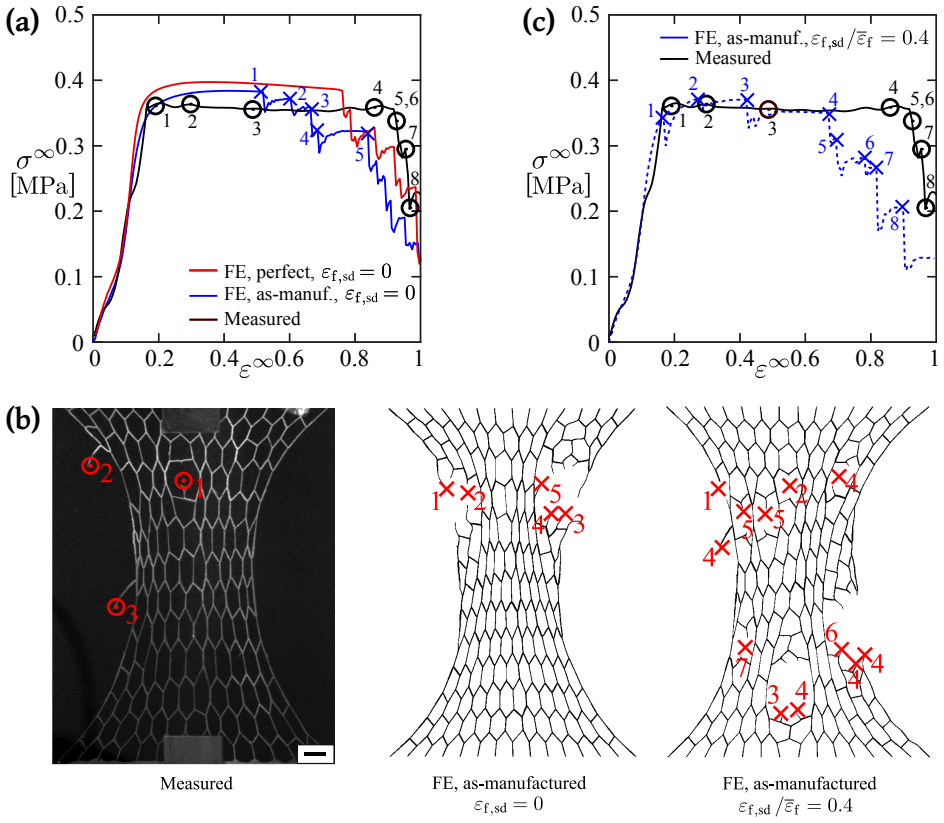
The central claim is that the failure mode of a hexagonal lattice switches from correlated to diffuse when the cell-wall solid moves from elastic-brittle to visco-plastic, and that the diffuse mode is what confers damage tolerance. In the creep regime at $T = 100\,^\circ\mathrm{C} \approx 0.97\,T_g$, first strut failure occurs at a macroscopic strain near 0.18 at a site that need not be the most highly stressed edge; subsequent failures land at random locations, with roughly half of the failed struts inclined at $\pm 60^\circ$ to the loading axis, until a critical cluster of failed struts reaches about half the specimen width and a transverse crack runs across. The same lattice at room temperature fails in a correlated, brittle manner with a crack advancing from one edge. FE simulations on the CT-scanned geometry show that as-manufactured geometric defects alone — dispersion in strut thickness $t_{sd}/t \approx 0.19$ and in Plateau-border radius — shift first failure from 0.76 to 0.42 macroscopic strain but still give a correlated crack-like mode; the observed early (0.18) and diffuse failure appears only when a dispersion in strut ductility $\varepsilon_{fs,sd}/\varepsilon_{fs} = 0.4$ is assigned strut by strut. The paper concludes that a dispersion in strut ductility is essential for the early strut failure and diffuse damage observed, and that together with the large transition flaw size of a ductile lattice ($a_T \approx 250\ell$) it makes the creep-regime lattice tolerant to missing cell walls and solid inclusions.
Load-bearing premise
The load-bearing premise is that the scatter in strut ductility used in the simulations, $\varepsilon_{fs,sd}/\varepsilon_{fs} = 0.4$, really is a material-level scatter: the paper takes this value from the measured spread of effective failure strains of struts inside the lattice, which mixes genuine material variability with geometric and structural effects, and then treats the agreement of the simulated and measured failure-strain distributions as confirmation of that same input; if the intrinsic material scatter were substantially smaller, the simulated failure would become correlated and the diffuse-damage mechanism would collapse.
Editorial extensions
If this is right
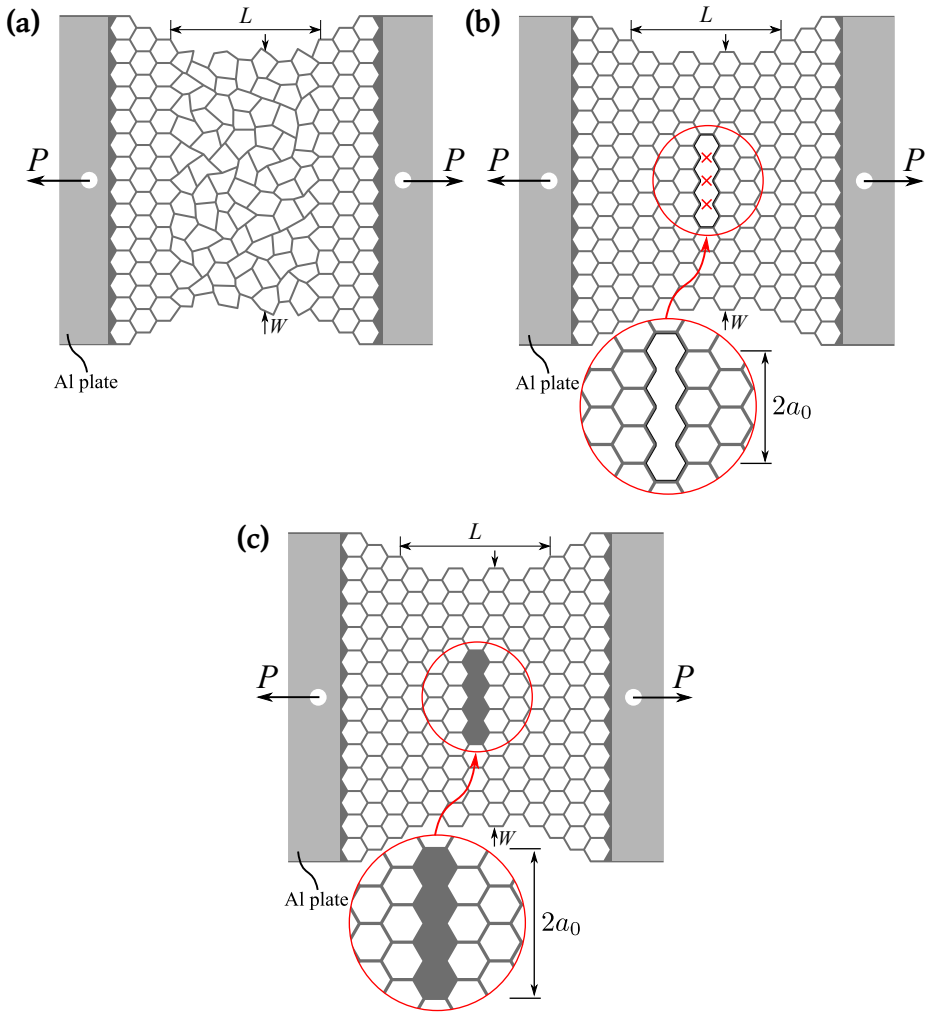
- Creep-regime lattices keep essentially their full tensile strength with up to about four missing cell walls and with solid inclusions present, so holes and inclusions introduced by manufacturing or in-service damage do not need to be treated as critical flaws.
- The same missing-row defect that is strength-limiting in the brittle lattice is almost harmless in the creep regime, because a large transition flaw size moves the lattice from toughness-controlled to strength-controlled failure.
- Randomly misplaced joints are the most potent defect, cutting first-failure strength by a factor of about two at $R/\ell = 0.5$; joint positioning accuracy, not cell-wall integrity, should be the manufacturing priority.
- The $a_T/\ell$ versus $\varepsilon_{fs,sd}/\varepsilon_{fs}$ map divides lattices into four classes with predictable failure modes, giving a design rule: diffuse damage and tolerance need both a large transition flaw size and a dispersion in strut ductility.
- Dispersion in strut ductility is not merely a nuisance: it is the enabling condition for the diffuse damage that produces the near-flat load plateau and a long, observable sequence of strut failures before fast fracture.
Reading between the lines
- Deliberately widening strut-to-strut ductility scatter — by process control, local heat treatment, or designed weak struts — should push other creep-ductile lattices (metallic or ceramic, not just PMMA) into the diffuse-damage class, provided their struts are ductile enough to keep the transition flaw size large.
- The near-flat load plateau while several struts fail means a creep lattice gives a long, observable warning before fast fracture; counting failed struts by imaging or acoustic emission could serve as a remaining-life indicator, an application the paper does not discuss.
- The paper leaves the net-section strength elevation at small crack sizes unexplained; a high-resolution DIC study of strut rotation at the tip of a two-to-three-cell pre-crack could test whether crack-tip blunting is the mechanism, and whether deliberately compliant blunting cells could enlarge the effect.
- The four-case map is built at one relative density (0.11); since the transition flaw size involves the density scaling of both toughness and strength, the diffuse/correlated boundary may shift with density — a testable direction using the $\rho = 0.07$ and 0.19 data already reported.
Signed reviews
Editorial analysis
A structured set of objections, weighed in public.
Referee Report
Summary. The paper reports an experimental and finite element study of uniaxial tensile failure of 2D PMMA honeycomb lattices tested at 100°C, i.e., slightly below the glass transition temperature, where PMMA is visco-plastic. The authors observe that, unlike the room-temperature brittle response of the same lattices, the high-temperature failure is diffuse: struts fail at uncorrelated locations before a single macroscopic crack forms. They quantify the dispersion of strut-level failure strain, and they use FE simulations that incorporate measured geometric imperfections and a scatter in material ductility to argue that strut-to-strut ductility dispersion is essential for reproducing the early strut failures and the diffuse damage mode. The paper also experimentally characterizes the sensitivity of the macroscopic strength to three designed defects—randomly perturbed joints, missing cell walls, and solid inclusions—and concludes that the visco-plastic lattice is highly damage tolerant to missing cell walls and inclusions because of its large transition flaw size.
Significance. The experimental observation that hexagonal PMMA lattices fail diffusely in the creep regime, in contrast to their correlated room-temperature failure, is a valuable and well-documented contribution. The measurements of defect sensitivity (missing cell walls, inclusions, joint perturbations) provide clear evidence of high damage tolerance in the visco-plastic regime, and the comparison with the companion brittle-lattice study is instructive. The FE study is a useful step toward mechanistic understanding, and the demonstration that a ductility dispersion is needed to reproduce the diffuse mode—while geometric imperfections alone produce a narrow failure-strain distribution and correlated failure—is qualitatively convincing. However, the quantitative identification of the ductility dispersion magnitude from the very lattice-level failure-strain distribution that is later used for validation introduces a circularity that weakens the force of the central mechanistic claim. If the authors can resolve this calibration issue, the paper would be a strong contribution to the mechanics of lattice materials.
major comments (3)
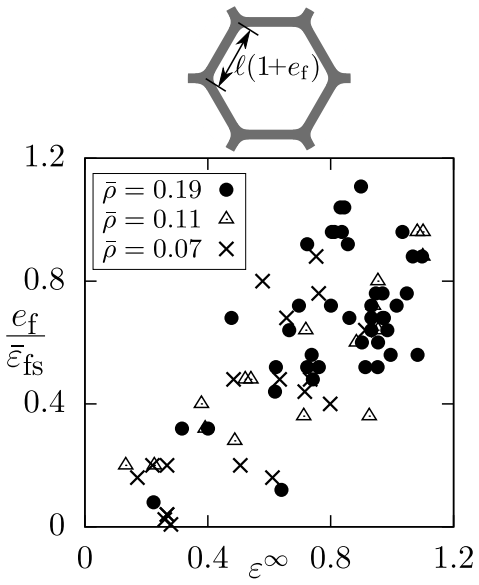
- [§6.2.1, Fig. 8] The FE input for material ductility scatter, εfs,sd/εfs = 0.4, is explicitly taken to equal the measured coefficient of variation of effective strut failure strains (ef,sd/ef = 0.4) obtained from within the lattice. The predicted p(ef) distribution is then compared with this same measured distribution and declared to be in 'excellent agreement,' implying the assumed scatter is of the correct level. This is a calibration-and-validation loop: the agreement does not independently test the hypothesis that material-level scatter has a coefficient of variation of 0.4, because the measured ey distribution includes geometric and structural contributions (thickness variation, Plateau borders, stress concentrations) that are not separated from material scatter. The comparison with the εfs,sd=0 case does show that some material-level dispersion is needed, but the specific magnitude of 0.4 and the relative roles of material versus geometric scatter remain unquantified. I recommend either direct measurement of the single-strut failure-strain distribution (rather than only its mean) or validation against an independent observable, such as the spatial statistics of failure locations in a specimen not used for calibration.
- [§6.2.1, Fig. 8] The statement 'a dispersion in strut ductility is essential to lead to early strut failure and diffuse damage' is based on FE simulations where the dispersion parameter is calibrated from the lattice-level failure-strain distribution that the model is then used to reproduce. Because the input and the validation target are the same measured quantity, the claim cannot be considered quantitatively established. The qualitative conclusion that some material-level scatter is required is supported by the contrast between the εfs,sd=0 and εfs,sd/εfs=0.4 cases, but the magnitude of the scatter and its dominance over geometric effects are not independently verified. I suggest adding a sensitivity study with intermediate values of εfs,sd/εfs (e.g., 0.1 and 0.2) and comparing not only p(ef) but also the spatial correlation of failure events with the experimental observations.
- [§5, Fig. 4] The experimental evidence for the diffuse failure mode is based on a small number of specimens (three per relative density, with one representative failure sequence shown in Fig. 4). The claim of 'uncorrelated locations' would be strengthened by quantitative spatial statistics, such as a nearest-neighbor distance distribution of failed struts compared with a random Poisson process, and by reporting the number of specimens that exhibited the diffuse mode. Without such analysis, the visual impression of randomness is suggestive but not definitive, especially since the specimen width is only 11 cells and boundary effects could artificially decorrelate failures.
minor comments (5)
- [§6.1.1, Eq. (6)] The notation for the ductility dispersion is inconsistent: the text uses both εfs,sd/εf and εfs,sd/εfs. Please define the notation once and use it consistently throughout, including in the figure captions and the map of Fig. 9(a).
- [Fig. 8] The ordinate of Fig. 8 is labeled as a probability distribution function p(ef) but the axis is not normalized; please clarify whether the plotted quantity is a probability density or a histogram count, and provide the corresponding units.
- [§7.2, Fig. 11(a)] The observed elevation in net section strength at finite crack lengths is mentioned as 'unclear' and left for future work. A slightly fuller discussion of the possible mechanisms (citing the crack-tip blunting analysis of Tankasala et al. and the Voronoi honeycomb study of Mangipudi and Onck) would help the reader place this counterintuitive result.
- [Abstract and §5] The abstract states that 'the dispersion in macroscopic strength is measured,' but the main reported quantity is the strength at first strut failure (and the associated ductility). Please harmonize the abstract and the main text so that the terminology is consistent.
- [§6.1.1] The sentence 'The value of Δε follows from the specified work of fracture in the softening regime, Γf, and the characteristic length associated with the finite element, 𝓁c' is clear, but it would be helpful to state explicitly that the influence of element size on the mesh-dependence is removed by this scaling, as is implied by the reference to Oliver (1989).
Circularity Check
Material ductility dispersion is calibrated from the same lattice-level failure-strain distribution used for validation, so the quantitative diffuse-damage claim is partially circular.
-
fitted input called prediction
[Section 6.2.1, Fig. 8]
"The assumed value of εfs,sd/εf is taken to equal the measured value ef,sd/ef of strut ductility from Fig. 8. ... It is in excellent agreement with the observed distribution, implying that the assumed scatter in material failure strain εfs,sd/εfs = 0.4 is of the correct level."
The FE parameter εfs,sd/εfs, which controls material-level ductility scatter, is set equal to the coefficient of variation ef,sd/ef of the effective strut failure-strain distribution measured inside the lattice (Fig. 8). The same measured distribution is then used as the validation target for the FE-predicted p(ef). Because the input is taken from the target statistic, the 'excellent agreement' is a consistency check of the FE transfer function, not an independent confirmation of the 0.4 value. The paper reports only the mean single-strut true failure strain (εfs = 1.3, from Fig. 3); no independent measurement of single-strut failure-strain dispersion is given.
full rationale
The central experimental observation of diffuse strut failure in the creep regime is independent and clearly documented. The FE contrast between deterministic strut ductility (εfs,sd = 0), which gives a correlated, crack-like failure mode and a narrow p(ef), and dispersed ductility, which gives a diffuse mode, provides independent support for the qualitative claim that some material-level dispersion is required. However, the quantitative dispersion parameter is not measured on isolated struts; it is taken to equal the lattice-level effective strut ductility distribution's coefficient of variation (ef,sd/ef = 0.4) in Fig. 8. The predicted p(ef) is then compared to that same measured distribution and the agreement is used to conclude that the assumed scatter is 'of the correct level.' This is a calibration-and-validation loop for that parameter. The paper's other uses of prior work by the same group, such as the transition-flaw-size estimate aT ≈ 250𝓁 from Tankasala et al., are interpretive and not the basis of the diffuse-damage mechanism; they are also supported by the present experiments showing high damage tolerance to missing cell walls. Thus the circularity is partial: the qualitative mechanism has independent content, but the specific material-dispersion input underpinning the quantitative validation is fitted from the data it is used to explain.
Assumptions & free parameters
free parameters (6)
- Reference stress sigma_0 in visco-plastic law =
1 MPa
- Reference strain rate epsilon_dot_0 =
4.4e-6 s^-1
- Hardening law coefficients in f(epsilon_P) =
exp(0.9*epsilon_P), 0.835*exp(1.2*epsilon_P), 0.48*exp(1.8*epsilon_P) over three strain ranges
- Mean solid ductility epsilon_fs =
1.3 (true strain)
- Strut ductility dispersion epsilon_fs,sd/epsilon_fs =
0.4
- Fracture energy Gamma_f =
2.5 kJ/m2
assumptions (6)
- domain assumption Hexagonal lattice stiffness and strength scale as E ~ rho^3 E_s and sigma_f ~ rho^2 sigma_fs (Eq. 2).
- domain assumption Cell wall solid obeys the sinh^-1 visco-plastic law with the fitted hardening function (Eqs. 5-6).
- domain assumption Johnson-Cook type damage initiation at local true strain epsilon_fs = 1.3 and linear softening from a prescribed fracture energy (Eq. 7).
- domain assumption The transition flaw size a_T about 250*l for ductile hexagonal lattices from Tankasala et al. [24] applies to the present visco-plastic PMMA lattices.
- ad hoc to paper The measured effective strut failure strain distribution (mean 1.63, CV 0.4) equals the material ductility distribution of the cell wall solid.
- domain assumption Plane strain conditions apply to the 5 mm thick PMMA sheet lattice (CPE6M elements).
Cite this review
Pith. "Pith review of Creep failure of honeycombs made by rapid prototyping." pith.science (2026). https://pith.science/paper/7GJDF55V
@misc{pith2026190803078,
  author       = {Pith},
  title        = {Pith review of: Creep failure of honeycombs made by rapid prototyping},
  year         = {2026},
  howpublished = {\url{https://pith.science/paper/7GJDF55V}},
  note         = {Machine review of arXiv:1908.03078}
}
read the original abstract
Additive manufacture and rapid prototyping are versatile methods for the generation of lattice materials for applications in the creep regime. However, these techniques introduce defects that can degrade the macro-scopic creep strength. In the present study, the uniaxial tensile response of two-dimensional PMMA lattices is measured in the visco-plastic regime: tests are performed at 100C which is slightly below the glass transition temperature T g of PMMA. Both as-manufactured defects (Plateau borders and strut thickness variation) and as-designed defects (missing cell walls, solid inclusions, and randomly perturbed joints) are introduced. The dispersion in macroscopic strength is measured for relative densities in the range of 0.07 to 0.19. It is observed that initial failure of the lattice is diffuse in nature: struts fail at a number of uncorrelated locations, followed by the development of a single macroscopic crack transverse to the loading direction. In contrast, the same PMMA lattice fails in a correlated, brittle manner at room temperature. An FE study is performed to gain insight into the diffuse failure mode and the role played by as-manufactured defects, including the dispersion in tensile strength of individual struts of the lattice. A high damage tolerance to as-designed defects is observed experimentally: there is negligible knock-down in strength due to the removal of cell walls or to the presence of solid inclusions. These findings aid the design and manufacture of damage tolerant lattices in the creep regime.
Figures


Figures from the paper (9 more)





Reference graph
Works this paper leans on
-
[1]
L. J. Gibson, M. F. Ashby, Cellular solids: structure and properties, Cambridge University Press, 1999
work page 1999
-
[2]
E. W. Andrews, L. J. Gibson, M. F. Ashby, The creep of cellular solids, Acta Materialia 47 (1999) 2853–2863
work page 1999
-
[3]
S. M. Oppenheimer, D. C. Dunand, Finite element modeling of creep deformation in cellular metals, Acta Materialia 55 (2007) 3825– 3834
work page 2007
-
[4]
N. J. Mills, A. Gilcrist, Creep and recovery of polyolefin foams-deformation mechanisms, Journal of Cellular Plastics 33 (1997) 264–292
work page 1997
-
[5]
S. Deschanel, L. Vanel, N. Godin, E. Maire, G. Vigier, S. Ciliberto, Mechanical response and fracture dynamics of polymeric foams, Journal of Physics D: Applied Physics 42 (2009) 214001
work page 2009
-
[6]
H. X. Zhu, N. J. Mills, Modelling the creep of open-cell polymer foams, Journal of the Mechanics and Physics of Solids 47 (1999) 1437–1457
work page 1999
-
[7]
Z. G. Fan, C. Q. Chen, T. J. Lu, Multiaxial creep of low density open-cell foams, Materials Science and Engineering: A 540 (2012) 83–88
work page 2012
-
[8]
K. A. Khan, R. K. A. Al-Rub, Time dependent response of architectured Neovius foams, International Journal of Mechanical Sciences 126 (2017) 106–119
work page 2017
Show all 27 references
-
[9]
J. S. Huang, L. J. Gibson, Creep of polymer foams, Journal of Materials Science 26 (1991) 637–647
1991
-
[10]
J. S. Huang, L. J. Gibson, Creep of open-cell Voronoi foams, Materials Science and Engineering: A 339 (2003) 220–226
2003
-
[11]
K. C. Goretta, R. Brezny, C. Q. Dam, D. J. Green, A. R. D. Arellano-Lopez, A. Dominguez-Rodriguez, High temperature mechanical behavior of porous open-cell Al2O3, Materials Science and Engineering: A 124 (1990) 151–158
1990
-
[12]
Chen, J.-S
T.-J. Chen, J.-S. Huang, Creep-rupturing of cellular materials: Regular hexagonal honeycombs with dual imperfections, Composites Science and Technology 68 (2008) 1562–1569. 19
2008
-
[13]
P. E. Seiler, H. C. Tankasala, N. A. Fleck, The role of defects in brittle honeycombs made via rapid prototyping, Acta Materialia 171 (2019) 190–200
2019
-
[14]
D. N. Boccaccini, H. L. Frandsen, B. R. Sudireddy, P. Blennow, ˚A. H. Persson, K. Kwok, P. V . Hendriksen, Creep behaviour of porous metal supports for solid oxide fuel cells, International Journal of Hydrogen Energy 39 (2014) 21569–21580
2014
-
[15]
B. Su, Z. Zhou, Z. Wang, Z. Li, X. Shu, Effect of defects on creep behavior of cellular materials, Materials Letters 136 (2014) 37–40
2014
-
[16]
Han, R.-P
B. Han, R.-P. Yu, Q.-C. Zhang, H.-J. Gao, Q. Zhang, T. J. Lu, B.-H. Lu, Creep of closed-cell aluminum foams: Effects of imperfections and predictive modeling, Materials & Design 156 (2018) 229–241
2018
-
[17]
Lin, J.-S
J.-Y. Lin, J.-S. Huang, Creep of hexagonal honeycombs with Plateau borders, Composite Structures 67 (2005) 477–484
2005
-
[18]
Van Loock, N
F. Van Loock, N. A. Fleck, Deformation and failure maps for PMMA in uniaxial tension, Polymer 148 (2018) 259–268
2018
-
[19]
G. R. Johnson, W. H. Cook, Fracture characteristics of three metals subjected to various strains, strain rates, temperatures and pres- sures, Engineering Fracture Mechanics 21 (1985) 31–48
1985
-
[20]
S. R. Choi, J. A. Salem, Fracture toughness of PMMA as measured with indentation cracks, Journal of Materials Research 8 (1993) 3210–3217
1993
-
[21]
Oliver, A consistent characteristic length for smeared cracking models, International Journal for Numerical Methods in Engineering 28 (1989) 461–474
J. Oliver, A consistent characteristic length for smeared cracking models, International Journal for Numerical Methods in Engineering 28 (1989) 461–474
1989
-
[22]
N. A. Fleck, X. Qiu, The damage tolerance of elastic–brittle, two-dimensional isotropic lattices, Journal of the Mechanics and Physics of Solids 55 (2007) 562–588
2007
-
[23]
Quintana-Alonso, S
I. Quintana-Alonso, S. P. Mai, N. A. Fleck, D. C. H. Oakes, M. V . Twigg, The fracture toughness of a cordierite square lattice, Acta Materialia 58 (2010) 201–207
2010
-
[24]
H. C. Tankasala, V . S. Deshpande, N. A. Fleck, Tensile response of elastoplastic lattices at finite strain, Journal of the Mechanics and Physics of Solids 109 (2017) 307 – 330
2017
-
[25]
N. E. R. Romijn, N. A. Fleck, The fracture toughness of planar lattices: Imperfection sensitivity, Journal of the Mechanics and Physics of Solids 55 (2007) 2538–2564
2007
-
[26]
H. C. Tankasala, V . S. Deshpande, N. A. Fleck, 2013 Koiter Medal Paper: Crack-Tip Fields and Toughness of Two-Dimensional Elasto- plastic Lattices, Journal of Applied Mechanics 82 (2015) 091004
2015
-
[27]
K. R. Mangipudi, P. R. Onck, Notch sensitivity of ductile metallic foams: A computational study, Acta Materialia 59 (2011) 7356–7367. 20 Figures (a) P P Ls (b) W L P P Figure 1: (a) Single strut specimen, and (b) lattice specimen ofρ= 0.11. The sheet thickness of all samples i...
2011
Reviewed August 14, 2026 · model on record in the stance chip above.
Discussion (0). Continue with ORCID to comment.